6
Dec
5
Dec
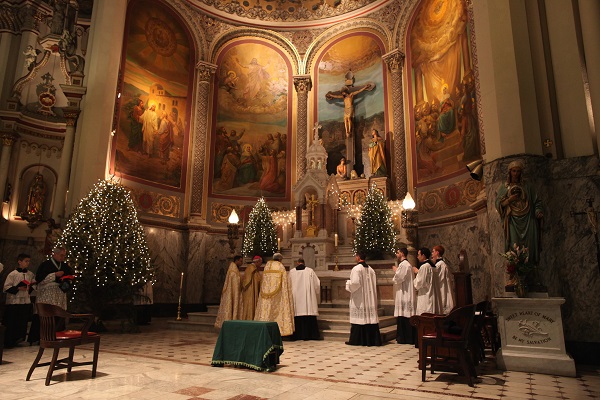
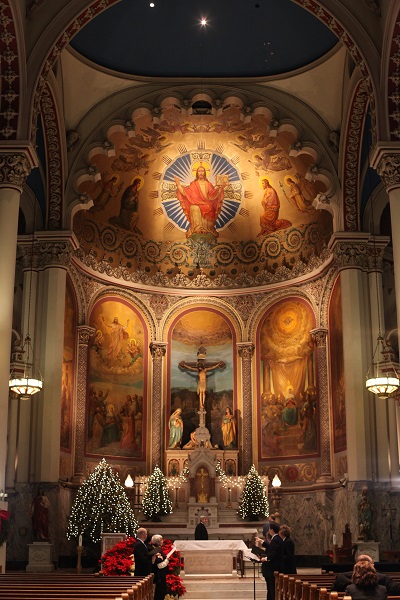
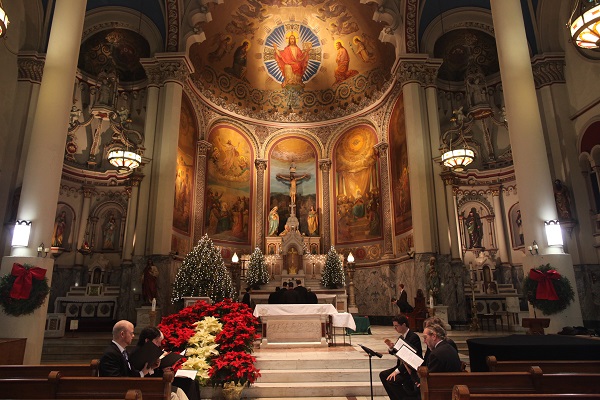
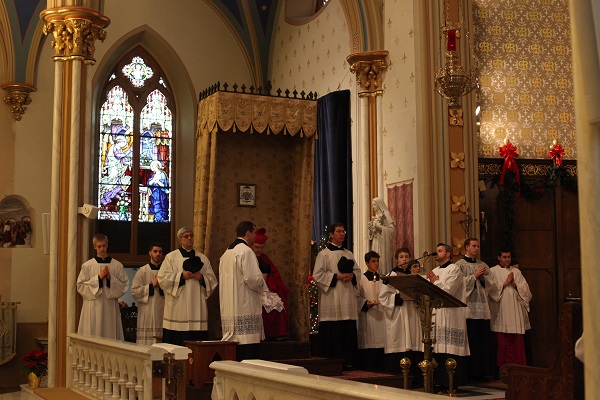
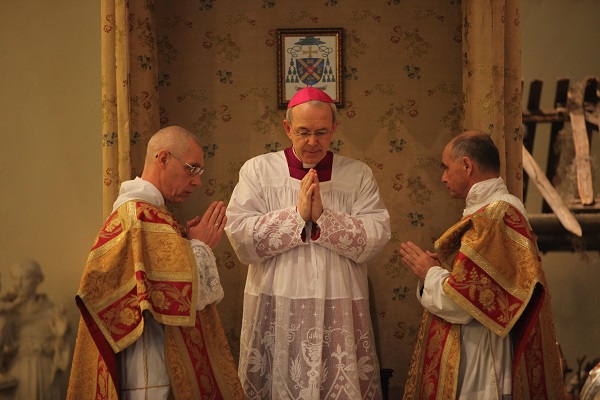
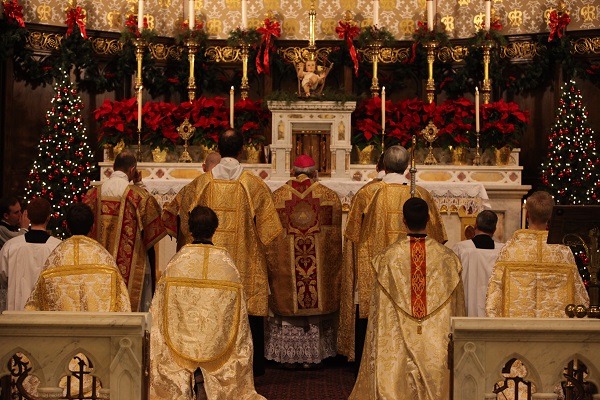
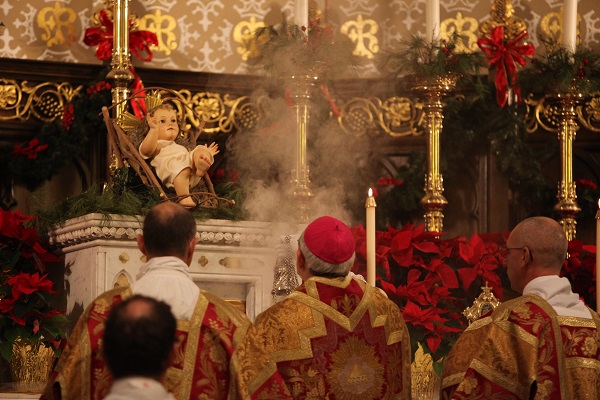
We regret to announce that the vespers for St. Lucy day this year at Our Saviour’s Church must be cancelled. Part of the Society’s administrative staff ( 1 of 2) has been called away for most of this week and next leaving us with insufficient resources. Next year though…
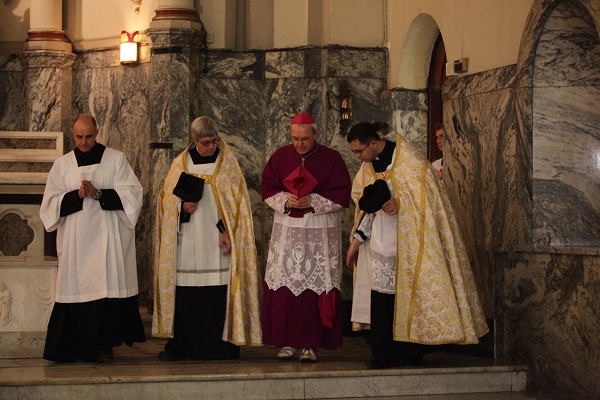
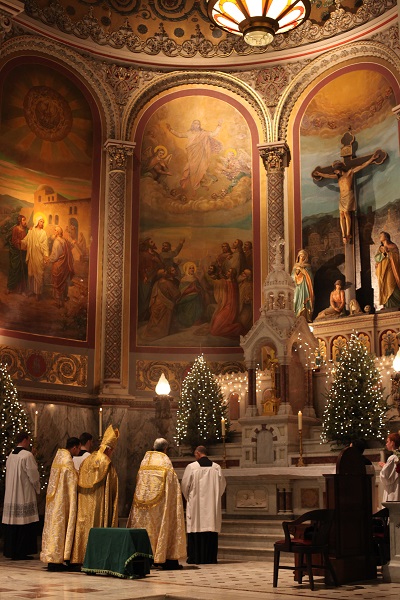
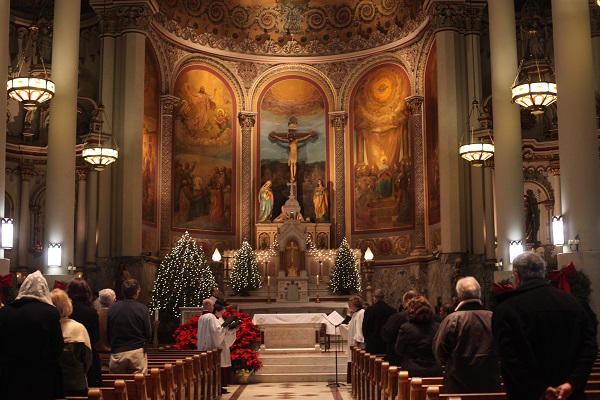
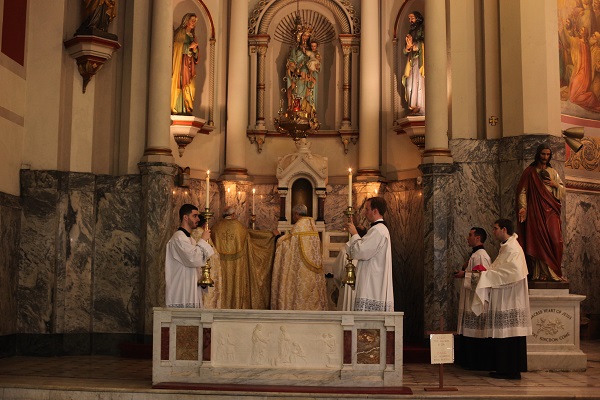
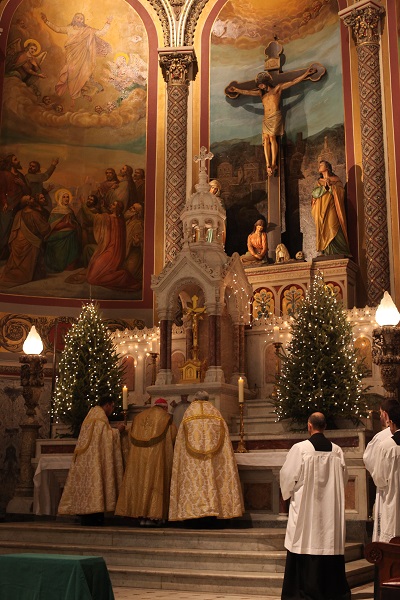
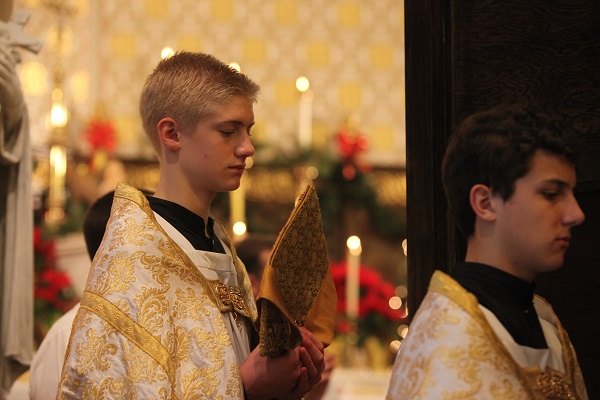
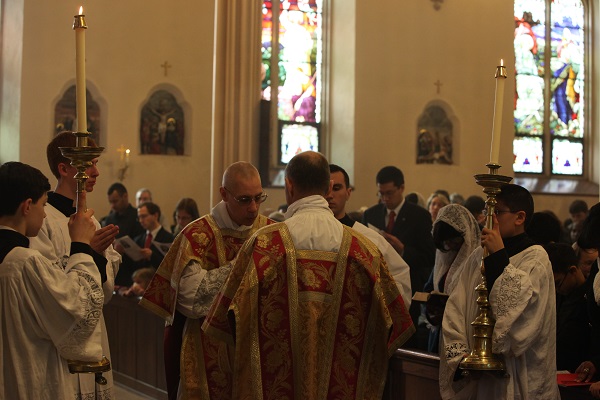
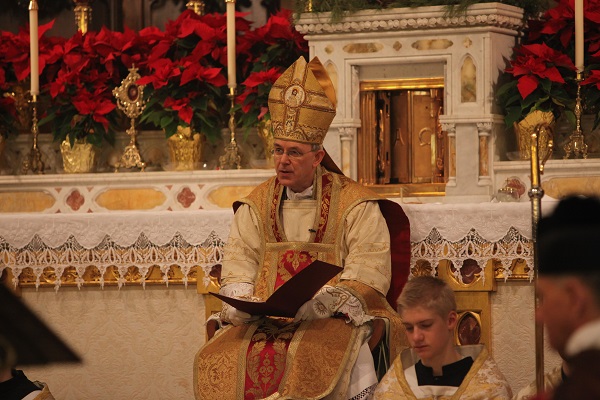
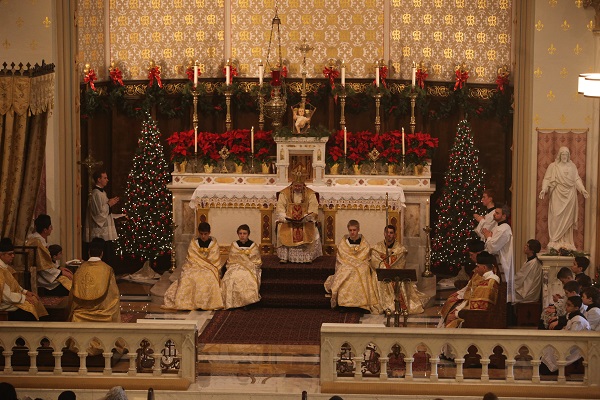
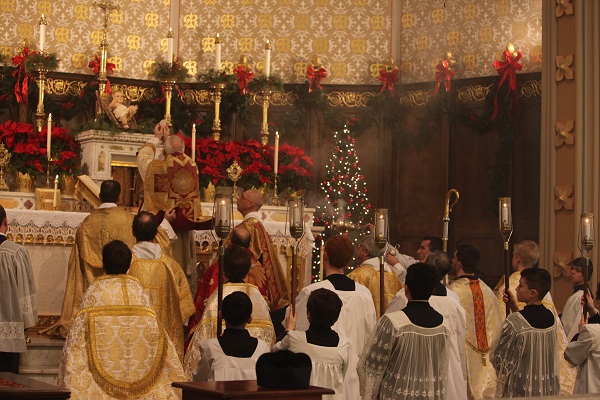
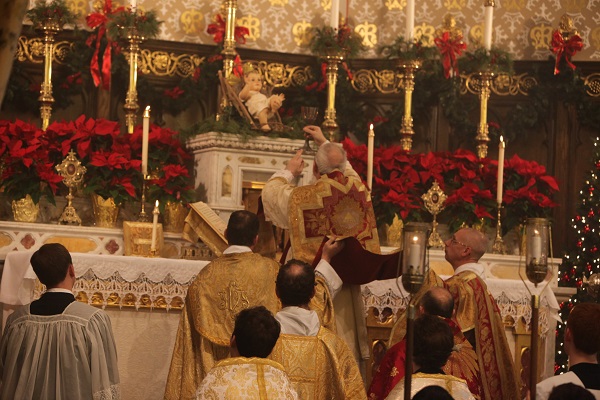
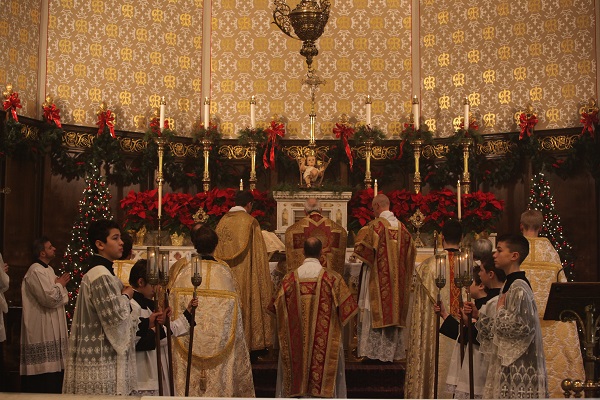
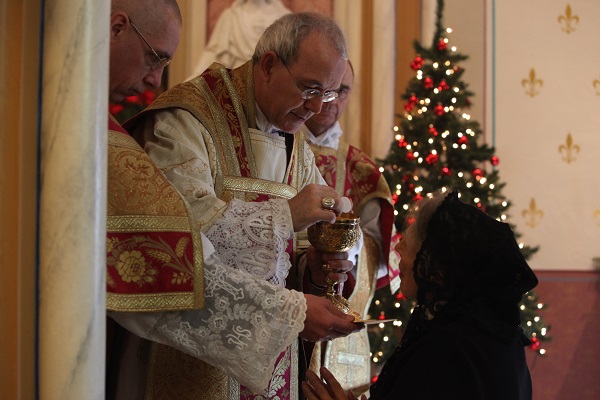
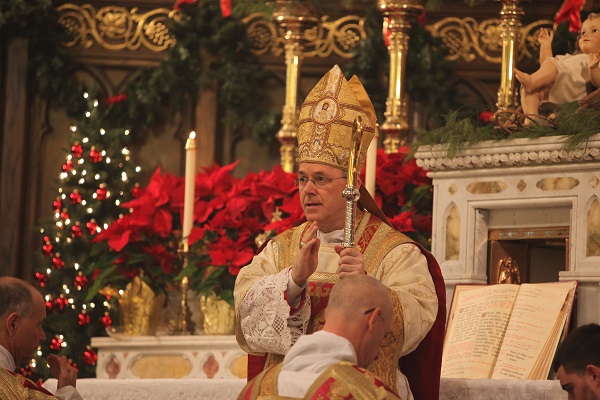
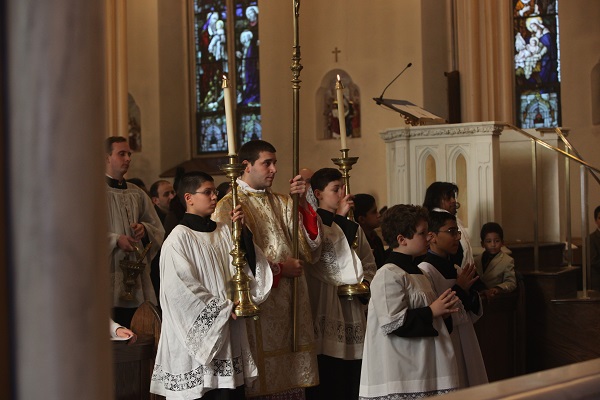
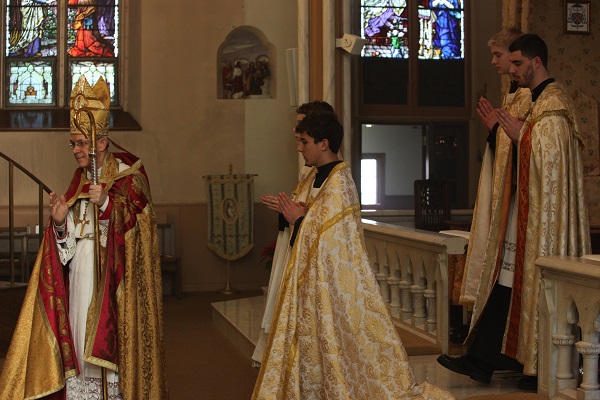
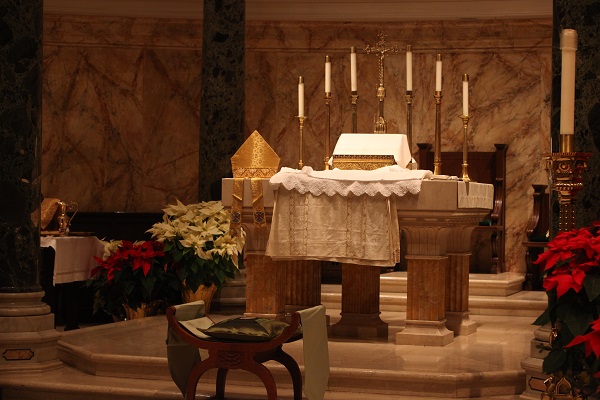
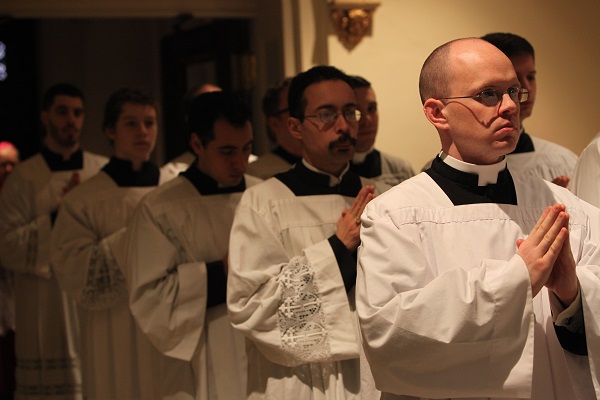
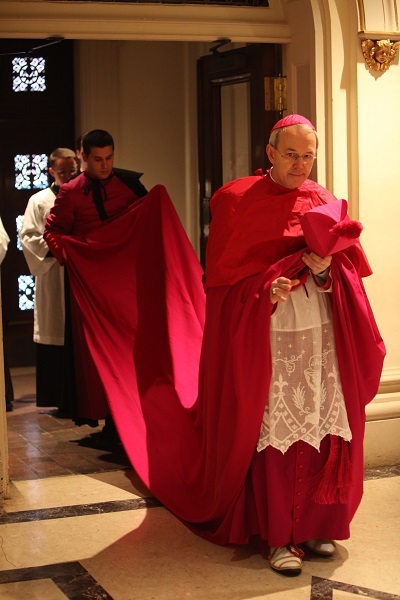
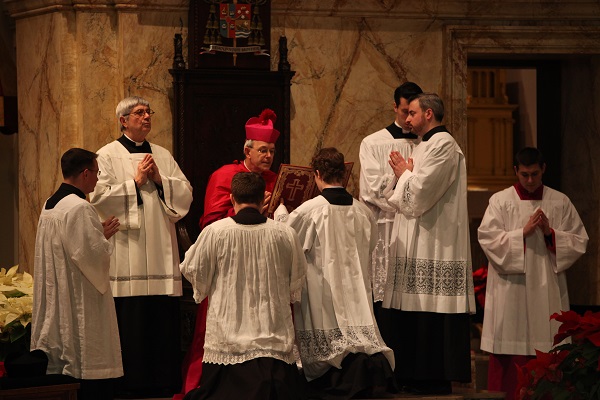
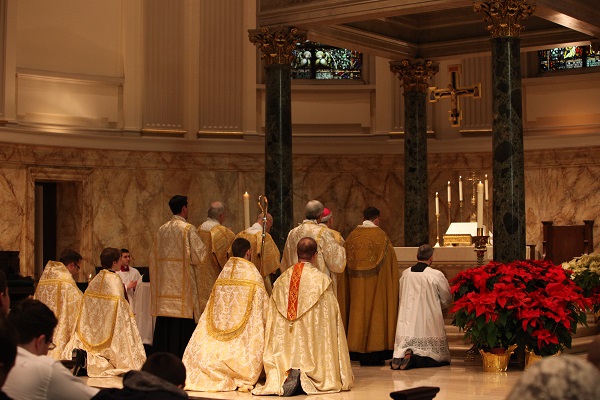
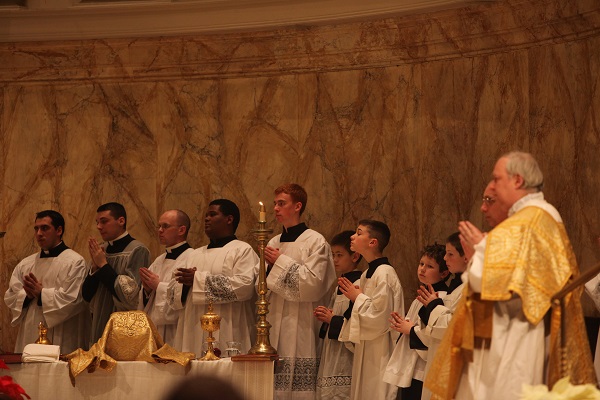
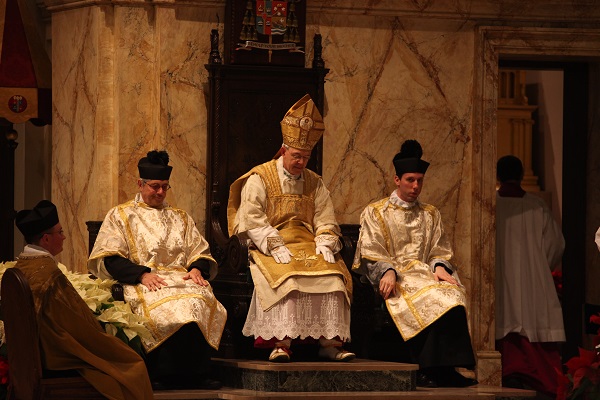
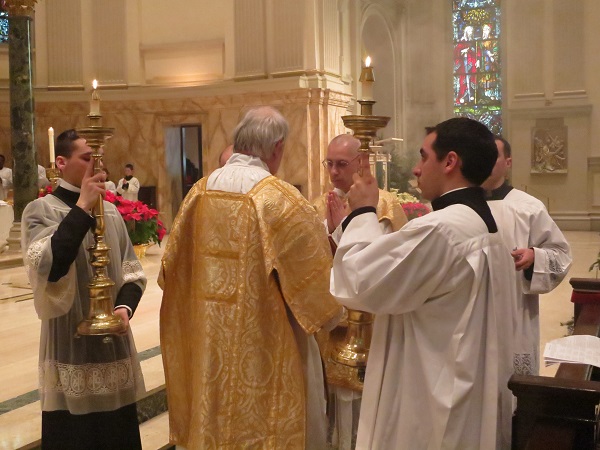
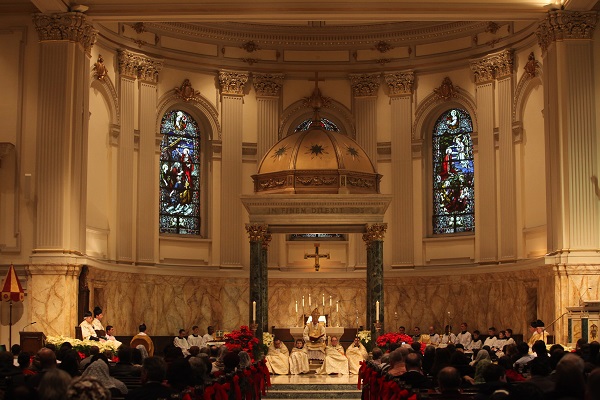
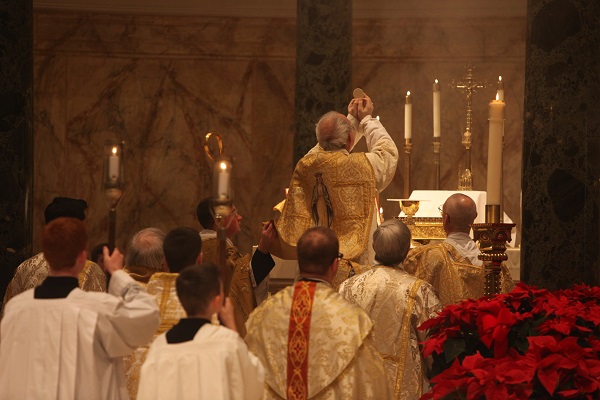
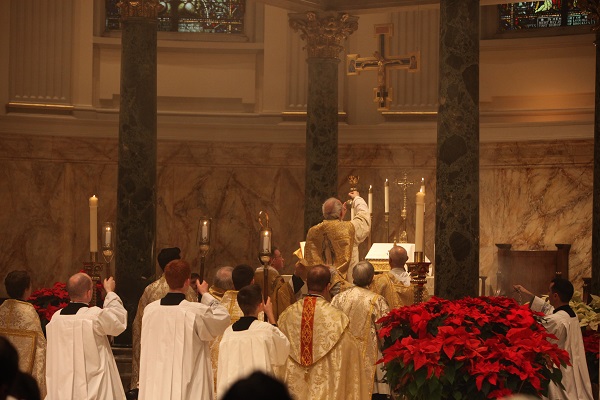
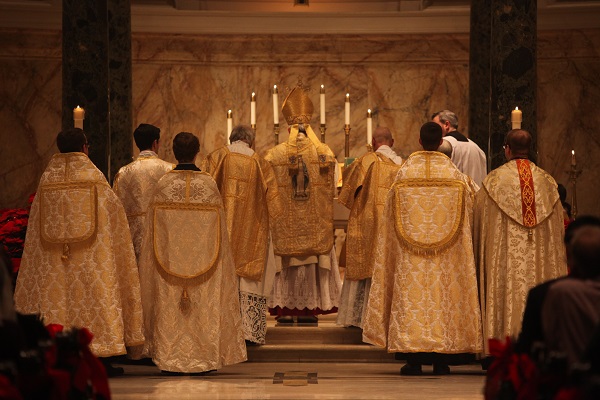
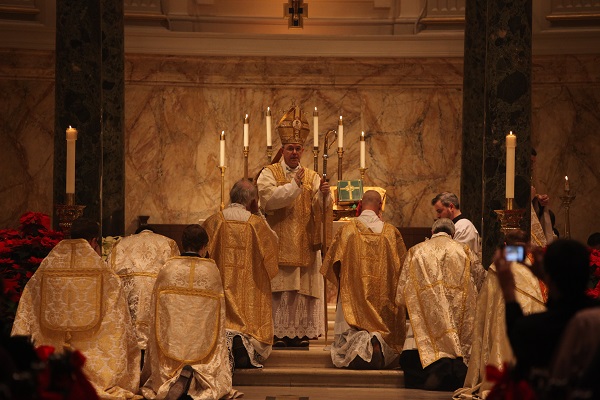
Solemn High Mass in the Extraordinary Form of the Roman Rite
for the
Feast of Saint Nicholas
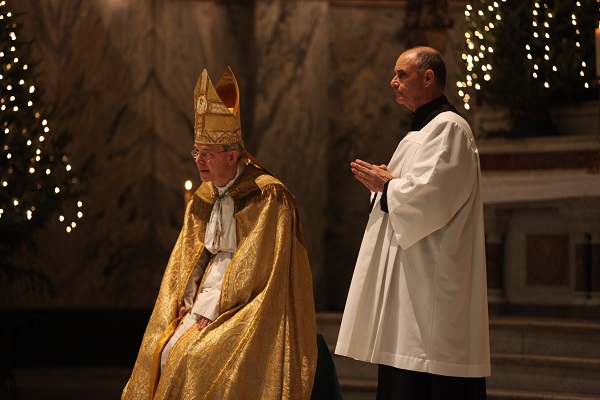
Thursday, December 6th at 7:30 PM
Saint Gabriel Church
914 Newfield Avenue
Stamford, Connecticut
Refreshments with special treats and crafts
for children to follow in the Parish Meeting Room
5
Dec
4
Dec

St Barbara in Vierzehnheiligen (“Fourteen Holy Helpers”)
In the late 1960s many little girls playfully imagined that they were the purple suited, fiery wig wearing acrobatic adventurer Batgirl! Of course the tiny titans were also interestingly intrigued by her civilian identity as Police Commissioner Gordon’s daughter who held the imposingly important job of Head Librarian of the Gotham City Library and whose name was Barbara.
Okay, I know that’s not the most serious segue but what do you expect from this Joker?
Switching Sixties screen symbolizations let us quoth from Around the Year with the Trapp Family by Maria Augusta Trapp regarding the Barbarazweig or Barbara Branch: “On the fourth of December, unmarried members of the household are supposed to go out into the orchard and cut twigs from the cherry trees and put them into water. There is an old belief that whoever’s cherry twig blossoms on Christmas Day can expect to get married in the following year. As most of us are always on tour at this time of the year, someone at home will be commissioned to “cut the cherry twigs.” These will be put in a vase in a dark corner, each one with a name tag, and on Christmas Day they will be eagerly examined; and even if they are good for nothing else, they provide a nice table decoration for the Christmas dinner.”
One of the medieval super-team known as the Fourteen Holy Helpers, St. Barbara is the patroness of artillerymen, military engineers, miners and others who work with explosives, fireworks manufacturers, firemen, stone masons and also of mathematicians; she is also invoked against sudden death, against fires, and against storms (especially lightning storms). Her feast is celebrated by the British (Royal Artillery, RAF Armourers), Australian (Royal Regiment of Australian Artillery, RAAF Armourers), Canadian (Explosive Ordnance Disposal Technicians (EOD), Canadian Air Force Armourers, Royal Canadian Artillery, Canadian Military Field Engineers, Royal Canadian Navy Weapons Engineering Technicians), New Zealand (RNZAF Armourers, RNZA, RNZN Gunners Branch) armed forces. Additionally, it’s celebrated by Irish Defence Forces Artillery Regiments, Norwegian Armed Forces Artillery Battalion, United States Army and Marine Corps Field and Air Defense Artillery, many Marine Corps Explosive Ordnance Disposal Technicians, and other Artillery formations. In art she is usually depicted as standing by a tower with three windows, carrying a palm branch and a chalice, sometimes with cannons by her side.
Biff! Bam! Kapow!
Mr. Screwtape
3
Dec
St.Paul’s
113 East 117th Street
(Old) St Patrick’s Cathedral was for many years the only Catholic church north of Canal Street in New York. At that time Harlem, far to the North, was a separate village in the midst of predominantly rural surroundings. It was under Bishop Du Bois in 1834 that St. Paul’s parish was founded to serve this vast region. Fr. Michael Curran from Pennsylvania, recommended by the saintly Fr. Prince Dmitri Gallitzin, was appointed the first pastor. What kind of priest was he? According to John Gilmary Shea:
“During the cholera of 1832 he was called to attend a man and his wife who were at the point of death on one of the highest peaks of the Alleghenies…(W)hen he could urge (his horse) no farther , he climbed on his hands and feet to the miserable shanty on the summit. Here he found the woman lying dead with an infant suckling at her breast; the man he had barely time to hear and absolve. Taking up the helpless baby, he wrapped it in his cloak, and carried it a considerable distance to the next habitation. He committed it to the charity of those good people by whom both the parent ere interred. He maintained a watchful care over his orphan for years, and when he died she was a full grown woman in Pittsburgh, a credit to her early benefactor” 1)
The contrast with present clerical lifestyles is all too glaring. We may also note that the curious fact that Fr. Curran’s “knowledge of the Irish tongue” was of special value to his ministry. 2) Construction of the first church of St. Paul commenced in 1835 and it was finished shortly thereafter.
Little is recorded regarding the life of this parish other than the usual 19th century narrative of population growth and the unfolding of educational and charitable activities. For the first century of its existence St Paul’s was predominantly Irish – some Germans and Italians arrived after 1900. The original St. Paul’s church had to be enlarged in 1871. But even this structure became inadequate – by 1900 it was considered one of the quaintest churches in New York. Fr. John McQuirk, pastor of St. Paul’s from the 1883 until 1924, launched after 1904 a massive building campaign, including a new school and rectory. Finally, the present huge church was erected in 1907-08.
St Paul’s still makes an imposing impression on East 117th Street. The gray stone, twin–towered facade is clear, simple and strong: Romanesque seen through classical eyes. Through a narthex one enters the grandiose interior – St. Paul’s is one of the largest parish churches in the city! It is one massive, simple space. Amid all the Byzantine domes, Baroque recreations and masterpieces of the French and English Gothic that made up Catholic Church architecture around 1910 there remained at least among certain of the Irish an atavistic yearning for the simple preaching halls of the first New York Catholic churches. St Paul’s evokes those early churches that replicate the architecture of the surrounding Protestant houses of worship – St. Mary, St. Teresa, St. James – only on an immensely greater scale.
The sanctuary, all in white like the surrounding walls, does not succeed in setting itself apart in this immense space. Old photographs show that it once was far more elaborately decorated. There were further renovations to the sanctuary under Fr. McQuirk’s successor, Fr. Kane, between 1924 and 1940. The fine communion rail and pulpit in the style of the Cosmati date from this period. Some other elements of the décor installed at that time – such as a wooden reredos – have disappeared, perhaps in the wake of the Council. 3)
More impressive than the sanctuary is the wooden, hammer beam ceiling. The well preserved windows provide a much needed element of color. Although bold in design and startling in hue, the quality of the execution regrettably falls far below the standard of that era (individual windows of the same studio or artist can be found elsewhere in the city (such as in Old St. Patrick).
In the narthex is the baptistry – now the shrine of Our Lady of Lujan. Like the communion rails, it was erected between 1924 and 1940 – its decoration and windows are of a much higher quality than those of the rest of the church. A word should be said about the pews – elaborate benches do seem to be a specialty of Harlem churches. St. Paul’s features individual folding wooden seats resembling those of a movie theater. I wonder though if those seats aren’t a bit noisy…

The splendid Baptistry -now a Shrine to Our Lady of Lujan (Argentina – and according to a notice in this church “Tachikistan”)
Even by 1940 the Spanish–speaking population of the neighborhood was growing. For many years now St. Paul’s has been an almost exclusively Spanish-speaking parish. It has become in effect a grand repository of Latin American devotions. A circuit around the “nave” is a like a tour through the Hispanic world: Madonnas from Puerto Rico, Argentina, Mexico and the Dominican republic, a wonder-working crucifix and an image of the Christ Child. This exuberant devotional life keeps St. Paul’s open for prayer – this not one of those parishes, all too common in New York, that remain padlocked outside of scheduled mass times. St. Paul’s is thus unmistakably a Catholic church, a house of God and a house of prayer.
the Lord of the Miracles of Daule (Ecuador)

Our Lady of Altagracia (Dominican Republic)

The Divne Child Jesus (originally Colombia)

Our Lady of Divine Providence (Puerto Rico)
So St. Paul’s and its school continue to serve the community of Spanish Harlem. In 1998 the care of the parish was handed over by the Archdiocese to a religious order – the Institute of the Divine Word – not necessarily a good sign! Yet we are hopeful that St Paul’s, a treasury of Latin American devotion and more faithful than most of its sister parishes to the true function of a Catholic church, will survive. 4 )
1. Shea, John Gilmary, The Catholic Churches of New York City (Lawrence G. Goulding & Co, New York 1878) at 565.
2. Ibid. at 566.
3. http://www.stpaulchurchive.org/index.htm (the parish website, informative and featuring many sources – if difficult to read)
4. Ibid.
29
Nov
Tonight the Catholic Artists Society and the New York Purgatorial Society sponsored a Solemn Requiem Mass at St Agnes Church in New York. Fr. Justin Wylie was the celebrant ansd homilist. Deacon was Fr. Michael Barone and Mr Stephen Pack was subdeacon. Samuel J. Howard was the master of ceremonies. The Requiem by Faure was sung under the direction of James D. Wetzel.

An outstanding sermon by Father Wylie on man created in the image and likeness of God. “Homo faber” – the artist – preeminently shares in the creative activity of God. The Sermon can be heard HERE.
29
Nov
St. Stephen/Our Lady of the Scapular
151 East 28th Street
It is hard to say enough about St. Stephen – next to St. Patrick, the grandest “Irish” church of the High Victorian era (1850 – 1890). Like St Patrick and Grace Church, St Stephen was designed by James Renwick, New York’s leading ecclesiastical architect of the age. The parish was founded in 1848 near East 28th Street as part of the first wave of the steady northward expansion of the Archdiocese under Archbishop Hughes – Fr. Jeremiah Cummings (described as an “American”) was the first pastor. Due to railroad construction the first church soon had to be abandoned. A new church was built 1853-54 on the present location. But that building quickly grew too small for the rapidly expanding parish. In 1865-66, the church was further expanded all the way through to 29th street. 1)
In the second half of the 19th century St Stephen’s played a central role in the life of the Catholic church of New York. From its creation it was viewed as one of the most magnificent churches of New York. The quality of the musical services matched the splendor of the surroundings. “St Stephen’s, because of its great beauty and the great merit of is choir became one of the attractions of New York City and was frequented, especially on Sunday at vespers, by so many strangers as to cause annoyance to the devout.” But the merits of this parish bore more lasting fruit. Orestes Brownson and his family were members of the congregation for many years. And then there was “the baptism on July 7 1861 of a young Persian, Alabab Shirazazazals (sic!) who renounced the Koran and received at the font the name of Andrew.” 2) By 1878 the population of the parish numbered twenty five thousand – and St Stephen’s unfolded the usual broad palette of activity typical of a Catholic parish in the 19th century. St. Stephens clergy also at first had to look after the Catholic population of nearby Bellevue hospital. 3)
The representative figure of this era was Father Edward McGlynn, who succeeded Fr. Cummings as pastor in 1866 and acquired national and even international prominence. We cannot describe in detail here all of Fr. McGlynn’s accomplishments. He was responsible for the completion of the expansion of St Stephen’s and for commissioning most of the decoration – the Brumidi paintings, the windows, the altars. He became a passionate advocate of social justice in the age of the most extreme capitalism. Unfortunately, he adopted perhaps a little too readily the economic theories of Henry George – a kind of home grown American socialist. That brought him into conflict with Archbishop Corrigan and led to his removal from St Stephen’s in 1887 and even to his excommunication. With help of the Vatican, peace was eventually made. Fr. McGlynn eventually received another pastorate in Newburgh, New York. When he died in 1900, 30,000 people filed by his coffin in his old parish of St. Stephen’s. 4) His succesor, Fr. Charls Colton, pastor until 1903, paid off his predecessor’s debts (St Stpehen’s was finally consecrated in 1894) and built the magnificent school building next to the church. This is still in operation as a Catholic school but is affiliated with Epiphany, not St. Stephen’s, parish.
The Architecture. St Stephens presents an unprepossessing appearance to the visitor both on East 28th and 29th streets. The unique façade on 28th street, short and squat, is composed of superimposed Romanesque arches and is covered in a kind of brownstone plaster. The façade on 29th street is more drab. But this was not always so. Old images show that in Victorian times the main façade was elaborately ornamented and probably gaily painted. The present rather depressing appearance apparently dates from an unimaginative restoration in the late 1940’s. The idea, however, that the outer appearance of St Stephen’s was inadequate in comparison to the interior must have circulated at a much earlier date. A project for a magnificent neobaroque “beaux-arts” façade was published in The American Architect magazine in 1903. It was never built.

The original appearance of the facade of St. Stephen’s in Shea,”The Catholic Churches of New York City” (1878) (above) and in an early photograph (below).

The unrealized project for a new facade on East 28th Street from “The American Architect” (April 1903)
The surprise on entering the church through a narrow vestibule is all the greater. The visitor stands overwhelmed by the scale of this church – one of the largest Catholic houses of worship in the city. The nave broadens out into a generously proportioned transept and terminates in a large sanctuary – if one largely windowless. The complex, rhythmic vaulting of the ceiling – blue, studded with stars – is fascinating. With St Stephen, Renwick certainly created an interior of harmonious, spacious grandeur.
The Paintings. What is of course unique to St Stephen is the elaborate, colorful painted decoration by Constantino Brumidi, executed in the 1860’s and 1870’s.. He had started his association with St. Stephen’s with the original painting for the high altar of the pre-civil war church. In the expansion in the 1860s this image of St Stephen was moved aside and the towering crucifixion painted in the apse. There are very few windows in the sanctuary – surprisingly, a topic of theological discussion at the time – that gave Brumidi a vast space to work with. But he by no means confined his efforts to the high altar. There are frescos in the choir lofts, in the rear of the church. Naturally he could not have executed all of this himself – the parish provides a helpful guide which estimates the participation of assistants for each work. 5) Brumidi’s style is as unique as the painted cycle itself – a combination of baroque, neoclassical and renaissance.

This view of the sanctuary gives an idea of the sheer volume of the painted decoration in St. Stephen’s.

Above and below: St. Cecilia in the rear of the Church (below the organ loft).
The Windows. Next to the paintings it is the stained glass that dominates the interior. St. Stephen must have the largest area of stained glass of any Catholic church in the city other than St Patrick’s cathedral. Largely by Mayer of Munich, the windows impart to the otherwise solemn interior a colorful, festive glow – as already noted by Shea in the 1870’s. 6) Almost every imaginable saint and devotion has received its commemoration in glass. The windows are by a wide variety of hands and seem to have been installed over considerable span of years. Some are sophisticated, others downright crude. Yet others seem never to have been executed – or to have been destroyed in the course of years. There is, for example, the ghost of a rose window sporting an Irish harp in one of the transepts.
The Sculpture and Altars. Statues and altars play a subordinate role in the nave and transepts of this church. As in most High Victorian era churches we have the usual heterogeneous assortment of statuary in plaster and stone assembled over many years. Some are charming, others crude or pedestrian. All seem lost in this vast space. Devotion also seems slack – few candles are burning here. And squatting in the center of the nave is an outrageous Conciliar horror of an altar. Just as in St John the Divine, the fact of declining congregations has been addressed by erecting a jerry-built altar in the middle of the church. But this travesty has produced an unanticipated benefit. For in the unused sanctuary we are delighted to encounter Victorian altars, communion rails, pulpit and statues – all in white marble, all in pristine condition. As Shea says, “the three marble altars are the finest ever seen in a Catholic church in this country.” 7) It is one of the most magnificent and best preserved sanctuaries of a Catholic church in New York! You should contemplate this superb, resplendent sanctuary before subscribing to the carping criticism so often brought today against the alleged retrograde “Irish” taste in church décor.
After the glory days of the 19th century, St Stephen’s parish seems to have fallen into a slow but steady decline as the paucity of post-1914 artifacts in this church so eloquently witnesses. It seems unclear to me why this should be so: the surrounding area, although growing more commercial, remained to a great extent rather middle-class residential. Murray Hill to the immediate north was, until the not-too-distant past, home to a fairly traditional Catholic minority. Certainly the founding of Our Saviour parish in the 1950’s did not help. And of course there is the usual Archdiocesan indifference to the artistic legacy of the past. The fabric of the church fell into deep neglect – as remains evident today.
In the 1980’s the nearby Carmelite parish of Our Lady of the Scapular was closed and St Stephen’s now became the combined parish of Our Lady of the Scapular/St Stephen’s, entrusted to Carmelite direction. Recently, for undisclosed reasons, the Carmelites were removed from the parish which thus returned to the care of the Archdiocesan clergy. In 2007, the nearby parish of the Sacred Hearts of Jesus and Mary was closed and folded into St Stephen’s as well(Sacred Hearts survives as a chapel). Several years ago the parish worked out a grand multimillion dollar renovation scheme – which would have finally succeeded in renovating – or should I say wrecking – the sanctuary which had survived intact for so many decades. Fortunately, this was halted at the direction of the Archdiocese – ominously, but only because of the pending “reconfiguration” of the Archdiocesan parishes. For, whether real or imaginary, the fear of closure has hung over St. Stephen’s for many years now.
But this risk may have a silver lining. It is curious, given the steadily increasing Traditionalist activity in the New York metropolitan area, that no Traditional order has received an invitation to Manhattan. Traditional orders flourish in the “boondocks” – Pequannock or West Orange – but not in New York itself. Now of all the old parishes of New York, St Stephen’s, with its pristine sanctuary, would be among the best suited for a establishing a Traditional parish. Who knows – if maintaining such an incomparable landmark as St. Stephens is beyond the resources of the Archdiocese, maybe the FSSP, the Canons of St John Cantius, the Institute of Christ the King or even the Oratory can lend a hand?
One afternoon, I met a young woman who had wandered into this church (any church?) for the first time and stood admiring the many works of art. She told me that had lived in the neighborhood for many years yet had no idea that all these beautiful things existed here. I have heard the same sentiment expressed several times since by visitors to St. Stephen’s. So, just as it did in the 1860’s, St. Stephen continues to impress those fortunate “strangers” who find their way inside. It is high time that the Catholics of New York also realize what a precious inheritance they possess in their old churches – and, if opened to the revival of Tradition in the liturgy, what an effective tool for evangelization they could become.
1. Shea, John Gilmary, The Catholic Churches of New York City (Lawrence G. Goulding & Co, New York 1878) at 659-660, 663-664
2. Shea, op. cit. at 662.
3. Shea op. cit, at 666, 672.
4. http://en.wikipedia.org/wiki/Edward_McGlynn (with many citations)
5. http://churchofststephen.com/chu_AB.htm
6. Shea, Op. cit. at 664.
7. Shea, Op. cit. at 664.
26
Nov
The Tallis Scholars, the renown vocal ensemble specializing in early music, will be performing at St. Paul’s Episcopal Church, 60 East Avenue, Norwalk, CT on Friday, November 30 at 7:30 pm. They will also perform at St. Mary the Virgin Church, 145 W. 46th Street, Mahhattan on Saturday, December 1 at 8 pm.
The program for both nights will include music for double choir:
VIVANCO: Magnificat Octavi Toni (a 8)
LASSUS, ORLANDE DE: Osculetur me
LASSUS, ORLANDE DE: Missa Osculetur me
Interval
PÄRT, ARVO: I am the true vine
PÄRT, ARVO: Tribute to Caesar
TALLIS, THOMAS: Sancte Deus
PRAETORIUS, HIERONYMUS: Magnificat quinti toni (longer version interspersed with Joseph lieber Joseph Mein & In dulci jubilo)
For tickets in Norwalk call the church office: 203-847-2806
For tickets in New York: http://www.millertheatre.com/Events/EventDetails.aspx?nid=1533
24
Nov
Der Ultramontane – alle Wege führen nach Rom
(The Ultramontane – all Roads Lead to Rome)
By Martin Mosebach
Sankt Ulrich Verlag
Augsburg, 2012
It’s safe to say that no other work advocating the Traditional liturgy has had the worldwide impact of Martin Mosebach’s Die Häresie der Formlosigkeit of 2002. Now, after ten years, Martin Mosebach has published a second collection of his non-fiction dealing explicitly with matters Catholic. I say “explicitly” because a deep Catholic sensibility underlies all of Martin Mosebach’s work. In Die Häresie the essays all revolved around the question of the liturgy; in Der Ultramontane (“The Ultramontane”) Mosebach deals with a broader spectrum of issues agitating the Church today.
The very title is a confrontation with the Catholic Church of Germany. In no other country is the anti-Roman and anti-papal rage so widespread as in Pope Benedict’s own homeland. In the country where any other expression of patriotic feeling is taboo it is only in relation to the Roman Catholic Church that nationalistic sentiment flourishes. The list of demands by Catholic theologians, clergy and laity aired almost daily in the media will be familiar: recognition of divorce, abolition of clerical celibacy, women priests, homosexual marriage, greater ‘democracy” in the Church etc. The German hierarchy either avoids confronting the attacks or not so subtly cooperates in enabling the protests. Against this attitude Mosebach professes Ultramontanism: the notion that every Catholic by his loyalty to a specific man – the pope – is a member of two jurisdictions or communities. He cannot give absolute loyalty to the German state and its current ideology. Mosebach thus cleverly links the current battles with persecution of the Church by Bismarck’s Prussia in the 19th century – the Kulturkampf – a struggle waged against the despised Ultramontane supporters of the pope. He points out once more that the papacy has prevented the creation of closed, totalitarian states in Europe – an observation made as early as the 18th century regarding the caesaropapism of Holy Roman Emperor Joseph II.
In several of these essays Mosebach enters the lists in favor of Papacy and Pope Benedict. He defends the Pope on the recognition of the FSSPX, on the absence of “democracy” in the church and the sexual abuse scandals. It is clear, however, that by Ultramontanism Mosebach does not mean a return to the pre-Conciliar regime centered on the Papacy. In He is after all just the Pope, Mosebach speaks of the salutary limits of papal authority – that infallibility is nothing but the submission of the Pope to Tradition. Now that is a concept with which even the Orthodox can get comfortable.
As in Die Häresie, Der Ultramontane shows the versatility of Mosebach’s style. There is straightforward polemic such as By Their (Piddling) Fruits you will know them: Six Theses on the Reform of the Liturgy. In 2004, like a kind of Ultramontane Martin Luther, Mosebach spoke out alone for the Traditional liturgy at the Katholikentag (Catholic congress) – Germanchurch’s progressive love fest. Or the “discussion paper” On the Value of Forbidding dealing with blasphemy – an ever increasing phenomenon in Europe, mostly directed against the Christianity – often by “artists”. Here Mosebach considers that it may well be advisable for the state to legally restrict blasphemy – and that it may not be so bad that outraged Muslims have given blasphemous artists a good scare.
Mosebach also employs a more poetic discourse, such as in the essays on Rome and Lourdes. The reader can here get an idea of Mosebach’s skill as a travel writer. In a short but marvelous evocation of the eternal city, the author focuses on the omnipresent ruins of the past. This is the true Rome – the spolia of past ages surviving into the present: not set apart in museums but aimlessly scattered about or even reused for utilitarian purposes. Mosebach even advances the thesis that the construction of St. Peter’s in the 16th century was, in a certain sense, a sin against the true spirit of Rome – as embodied in the age-old Constantinian basilica it replaced.
The friend of the Traditional Liturgy will also find much that will interest him. In addition to the Six Theses there is The Old Roman Missal between Loss and Rediscovery – a profound reflection on the liturgical history of the last 40+ years. In On Prayer, Mosebach argues powerfully for the significance of repetition in prayer – especially in the rosary! – and of maintaining correct posture.
I particularly liked Mosebach’s essay on the Lourdes Madonna. Mosebach starts from the time when, as a young boy in pre-Conciliar times, he began to encounter the Madonna of Lourdes: first, on a dresser in the house of a friend of his family, later, nearly everywhere. Mosebach then develops an entire theology of the image out of the contemplation of a mass – produced statuette often despised – especially by the artistic pundits of the Church in Western Europe. The author links the Lourdes Madonna with certain icons of the East the originals of which were considered as “not made by human hands.” As an attempt to reproduce a vision, the Lourdes Madonna falls into the same category. It is a true icon of the West.
In sum, Der Ultramontane offers a treasure trove of insights on liturgy, theology, art, Church government and contemporary spiritual issues. All is short and sweet, reflecting the concise style of a true master of prose. Der Ultramontane does not repeat platitudes or reinforce received opinions – it will make you think. Mosebach often returns, as a Leitmotiv of this work , to the “dual loyalty” of the Catholic: to the country/regime in which he lives and to the Church as represented by Rome. What outraged liberals of the Bismarck era or contemporary German Catholics is nevertheless central to our identity as Catholics. And is this not a quintessentially Catholic theme dating back to the time of Augustine?
We of course would wish that Der Ultramontane be translated into English as soon as possible. That should not be that hard – some of the ground work has already been done. One of the essays has already been translated on this website; several others on Roger McCaffrey’s The Traditionalist. Martin Mosebach himself presented, in English, The Old Roman Missal between Loss and Rediscovery first in 2010 in Colombo, then in 2011 in New York – it can be found on the NLM. And one essay, on the election of Pope Benedict, appeared first in English in the New York Times/ International Herald Tribune!