Fourth Sunday in Lent – Laetare 3PM (Missa Cantata)
Followed by special Convivium
Fourth Sunday in Lent – Laetare 3PM (Missa Cantata)
Followed by special Convivium
Today, Saturday, March 17th, 2012 (Feast of St. Patrick), there will be a Solemn Mass at the Church of the Holy Innocents at 1pm. The Celebrant of the Mass will be Canon Jean-Marie Moreau.
The Musical setting for the Ordinary will be: Missa VIII, De Angelis. The motet at communion time will be: O Panis Dulcissime. At the end of the Mass, the Ave Regina caelorum will be sung.
Processional: “Hail, Glorious Saint Patrick”
Recessional: “Saint Patrick, Thee Calling”
Organ: “Jig” Fugue BWV 577 JS Bach
15
Mar
15
Mar

A High Mass (Missa Cantata) for the Feast of Saint Joseph will be celebrated at the Church of Our Lady of Mount Carmel, 259 Oliver Street, Newark, NJ, Monday, March 19 at 7:00 p.m.
The celebrant will be Rev.Msgr. Joseph F. Ambrosio, V.F, pastor.
N.B. Our Lady of Mt. Carmel has a daily Traditional Mass Monday through Friday at 7:30 am.
11
Mar
Ten Popes who Shook the World
By Eamon Duffy
(Yale University Press, New Haven, 2011)
Prof Eamon Duffy is by a now well known figure even on this side of the Atlantic. His work falls into two categories. The first is a series of scholarly works which have revealed to us the liturgical, popular piety and social life of 16th century English Catholic Church before and during its near destruction – certainly as a national faith – by the Reformation:The Stripping of the Altars; Fires of Faith; the Voices of Morebath; Marking the Hours: English People and Their Prayers. The second consists of more popular works for the “public enlightenment” on history, theology and politics covering the entire course of Church history: Saints and Sinners; Faith of Our Fathers – and the present slim volume. In these latter works, Prof. Duffy appears as a dedicated advocate of the positions you would associate with The Tablet, America, Commonweal and The National Catholic Reporter. Naturally, this has endeared him to the BBC, for which he has functioned as an approved spokesman on all things Catholic. Ten Popes who shook the World is in fact largely a transcript of broadcasts on the history of the papacy given by Prof. Duffy in 2007.
The very title raises apprehension – does it not presage an entirely secular analysis of the papacy in line with the author’s liberal views? Moreover, the choice of popes in this volume appears debatable if secular significance is the requirement for membership: no Julius II, Sixtus V or Urban II? But Prof. Duffy quickly tells that he in fact not using “impact on the secular history” as an exclusive criterion. Rather, he has selected ten popes who took actions which had a decisive effect on the history of the Church – especially on the role of the papacy within the Church – or of the world.
Readers expecting a full if miniature biography of each pope will be disappointed. Prof. Duffy outlines briefly the age in which each described Pope lived and then generally focuses on a single aspect or act of each covered pontiff. Paul III is one exception and I think it not at all surprising that the description of this Pope of Prof. Duffy’s beloved 16th century is by far the most complete and nuanced presentation in the book. The descriptions and judgments of Ten Popes who shook the World follow closely those of Prof Duffy’s earlier, more comprehensive work on the papacy, Saints and Sinners, and I find myself repeating much of what I wrote years ago in a review of the first edition of that work.
The first “pope” covered (Prof Duffy allows that his status as such to be controversial) is St Peter. Now Prof. Duffy believes that there was in fact no “pope” or “bishop of Rome” in that city until well into the 2nd century. He also cites approvingly the view that the papacy as we find it today is not an “organic” development from an original apostolic seed but the by-product of successive, random historical events and forces – especially the French Revolution. Given this belief, I would have expected the author, in the interest of candor, to have spelled out more clearly that the historical and theological foundations of the authority claimed by the popes (and the bishops for that matter) are factually bogus. And would not this conclusion be of decisive importance for the entire discussion that follows?
From St. Peter, Prof. Duffy takes the reader on a vast sweep through history from the end of the Roman Empire through to the Renaissance, covering Leo the Great, Gregory the Great, Gregory VII, Innocent III and Paul III. What is said here is often succinct and insightful. But the narrative does suffer at times from the author’s attempts to show the “relevance” of the actions of these pontiffs to the contemporary secular world of the 21st century Western Europe: the Tome of Leo the Great helped to establish the ‘”freedom of human beings” (p. 47) and in Gregory VII’s struggles over lay investiture “human freedom took one small, uncertain step forward.” (p. 69). Crusading under Innocent III is of course questionable. And Cardinal Pole figures as a member of an alleged “soft left” (p. 87) around Cardinal Contarini that is contrasted with a Cardinal Caraffa dedicated to the inquisition and only “converting or killing” the heretics. To some extent this contrast existed – but of course under Queen Mary Cardinal Pole was himself not averse to employing force (Prof Duffy recently published a book dealing with this subject).
But a more strictly ideological narrative commences with the beginning of “modern times.” With the coming of the French revolution in 1789 “the fundamental values of Western democracy received their decisive expression”. “In theory Catholic Christianity had no quarrel with these noble ideals; indeed, many of them evolved out of Christian affirmations about the dignity and equality of human beings before God” (p. 94) ( It would thus seem that the French Revolution had at least as strong a claim to a divine origin as the papacy itself). What the Church needed was “a dialogue with the modern world.” (p. 100) But Pius IX, a man of limited intelligence surrounded by advisors urging him to extremes, issued only blanket condemnations. Cardinal Newman appears here through selective quotation exclusively as an opponent of the developments in papal and ecclesiastical authority between 1846 and 1878. From Pio Nono we move to Pius XII who is considered exclusively in relation to the accusation of “silence” in the face of crimes against the Jews in World War II. Duffy’s conclusion: guilty as charged!
Fortunately with John XXIII a new era dawned. Here Duffy strikes a new, hagiographic tone: Pope John was holy, he was humble, he worked to save the Jews. And most decisively, he called the Second Vatican Council “whose priority was pastoral care for a needy world, not the maintenance of the barricades which the Vatican had been throwing up ever since the French Revolution.” (p.121) For “Catholicism before Papa Roncalli had many strengths but it was overwhelmingly clerical, seeming both afraid and dismissive of the world around it, and though many of its people were warmly human, as an institution it existed in the deep freeze.” (p. 125) Moreover, Pope John also opened up relations with the communist world and “reversed Pius XII’s Cold War policy.” (p. 122) It was all a great gift to the Church and humanity, although Duffy does concede that John XXIII would have been horrified by some of the “fruits” of the council (including the loss of Latin).
The final pope considered is John Paul II. This biography, like that of Paul III, differs from the rest in its “multi-factor” approach. The hagiographic tone carries over here. John Paul II was “the most remarkable man of his time,” “the greatest man to occupy the chair of Peter for centuries” “the most intelligent holder of the office for centuries” etc. Yet a closer examination yields a more nuanced approach. On the plus side for Duffy, Pope Wojtyla apologized for “the sins of the Catholic Church against human dignity” “Catholic atrocities” and ‘Christian anti-Semitism.” (p. 133). “Ignoring worried advice from Cardinal Ratzinger” ( p.133) he inaugurated the Assisi gatherings. But Pope John Paul II also undertook to establish an assertive papacy at the heart of Catholicism to remedy the growing problems in the Church. He would seek to establish direct pastoral contact with Catholics everywhere. He allegedly appointed to the episcopacy and the Vatican “repressive” prelates and “defenders of strict and sometimes blinkered orthodoxy” (pp. 130, 132) We don’t know about that – but we can only agree with Duffy’s characterization of “the Pope’s evident lack of interest in management or institutional reform.” (p. 132) Perhaps John Paul II’s most significant legacy was his role in the fall of communism in Poland. But Duffy rightly points out that he did not cause the fall, rather he acted as a catalyst. Then there is the factor of John Paul II’s personal celebrity: “an equivocal legacy for the Church.” (p. 136) Given these qualifications, the reader might wonder at the effusive praise for John Paul II in this account – until one understands that Prof. Duffy elsewhere has contrasted Pope Wojtyla favorably with the “altogether smaller figure” of his successor.
Now Prof Duffy is aware of and records facts that might call into question key points of the narrative above. The French Revolution soon launched into a bloody anti Christian persecution. The anti-Catholicism of the 19th century Italian opponents of the papacy was evident. The reign of Pius IX witnessed such an expansion of the Church and of the religious orders that he could be considered “the most successful Pope ever.” (p. 96) In contrast, the results of Vatican II were decidedly mixed: “the reforms did not deliver the success many had hoped for. In the upheavals of the 1960’s Catholics shared the general collapse of confidence in venerable institutions and ideas. Thousands of priests, monks and nuns left to marry, recruitment halted….” (p. 128). Yet these facts do not shake Duffy’s story or even prompt him to explain them away.
What is the significance of all this? Why is this book published in 2011? Why would you purchase this volume, when for roughly the same money you can acquire Saints and Sinners by the same author, with much the same views but much additional valuable information besides? Perhaps the answer is the small BBC logo on the back cover. For this book testifies that not only does the revolutionary vision of the 1960’s remain clear and intact, but that the Catholic liberals dispose of the strongest possible secular allies in the media, government and education. “Don’t tread on me!” is this book’s unmistakable message to Pope Benedict and anyone else considering a reform, however tentative, of the Church.
But apart from its role in immediate Church politics, this book reveals a more fundamental issue with the liberal world view, which posits the regime of contemporary Western European “modernity” as an absolute value to which the Church must adapt itself. Indeed, to some extent modern democracy is claimed to have its origin in revelation itself. Now these views are by no means limited to progressives or Prof. Duffy – indeed, even the present pontiff on occasion has made statements in this direction. The question, is, however, how this revolutionary historical philosophy is compatible with a religion in which revelation was closed 2,000 years ago? A religion whose governing institutions also date back to that time (or, as Prof. Duffy would probably say, the 2nd -5th centuries AD)? Prof Duffy, in words echoing Macaulay, describes the epic of the papacy – surviving empires, dynasties and states over the ages to come down to us in the present time. (p.9) But how is this institution reconcilable with a modernity claiming to be the “end of history” and demanding absolute conformity? It is this unresolved contradiction that is at the heart of Catholic liberalism – and of the last Council itself.
There will be a Solemn Mass followed by an evening of recollection at the Church of the Holy Innocents in Manhattan tonight, March 7, starting at 6 pm. Two Meditiations will be giving by Fr. Christopher Salvatori. The evening will include exposition of the Blessed Sacrament, Rosary, opportunity for Confession and Benediction.
3
Mar
The Church of the Blessed Sacrament
152 West 71st Street
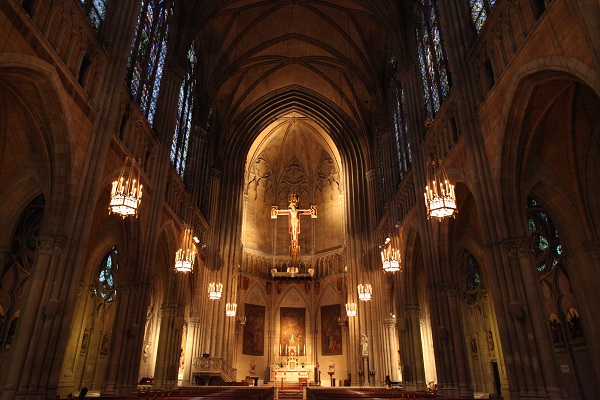
The era of 1890-1920 was the Golden Age of Catholic Church architecture in New York. New buildings of unprecedented magnificence arose, and churches of the earlier neoclassical and High Victorian periods often received magnificent new decoration in painting, sculpture and stained glass. The parish church of the Blessed Sacrament is one of the most representative structures of this era – and alongside the earlier church of St Stephen perhaps the most magnificent church in Manhattan not a cathedral or church of a religious order. The parish was organized in 1887 in what at the time was a semi-rural but rapidly developing outlier of the city. By the time the first parish church was finished in 1900 the Upper West Side was well on its way to becoming one of the most splendid residential areas of the city. The Dakota, the Ansonia and other grand apartment buildings arose in the neighborhood over the years, Broadway here became a wide splendid boulevard and the West Side IRT soon ran nearby. And by 1917-20, when the present church was constructed, Blessed Sacrament was perhaps the wealthiest Catholic parish in the city.1) That wealth helps explain the spectacular cathedral-like structure we find today.
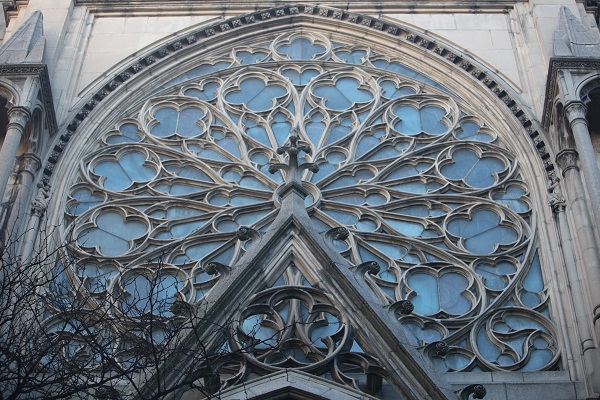
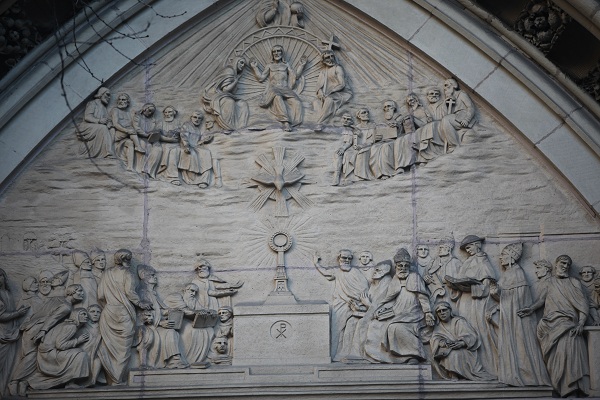
The church occupies a difficult site between West 71st and 70th Streets. Except for the West 71st Street façade, Blessed Sacrament church is entirely surrounded and obscured by other buildings. The architect of the church was a 37-year old Columbia graduate, Gustav Steinbach, who had a long career extending to the 1950’s specializing in commissions of all kinds from the Catholic Church. Blessed Sacrament must be his masterpiece. 2) Steinbach – nomen est omen, as the Germans say – did the architect in planning this edifice reflect on Erwin von Steinbach, the medieval architect of the magnificent façade of Strassburg (Strasbourg) cathedral, also a work inspired by French cathedral architecture? The façade of Blessed Sacrament is also in its own way a masterpiece, with its intricate rose window, elaborate entrance with sculptured tympanum and flanking statues. The AIA Guide to New York City praises: “the vigorous interplay of volume, void and silhouette.” 3) Close inspection reveals some anachronisms – the tympanum reproduces Raphael’s Disputa and except for St. Francis the statues on either side of the main entrance are of post-medieval saints.
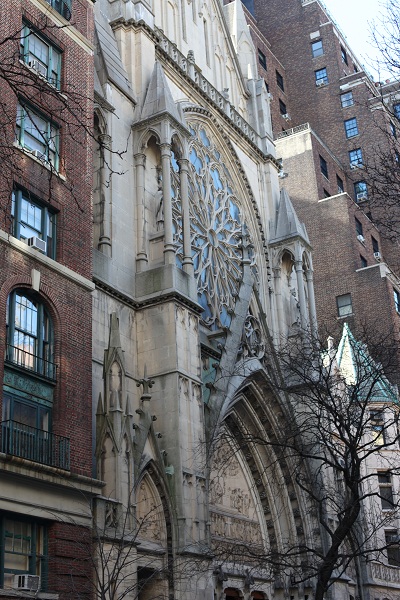
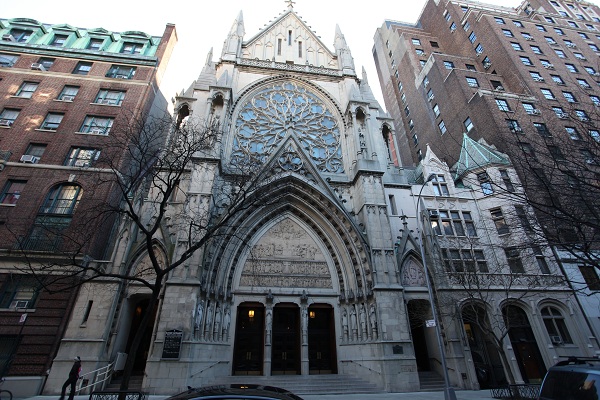
Note the rectory on the right.
The view of the apse from 70th Street is blocked by the parochial school contemporary with the church. The still functioning school uniquely bears an elaborate carved admonition in Latin to parents on the duty of attending Catholic schools. Could the parishioners understand it? Indeed, we should commend the rectory and school. For these buildings were all erected at the same time as the church as a unified architectural ensemble.
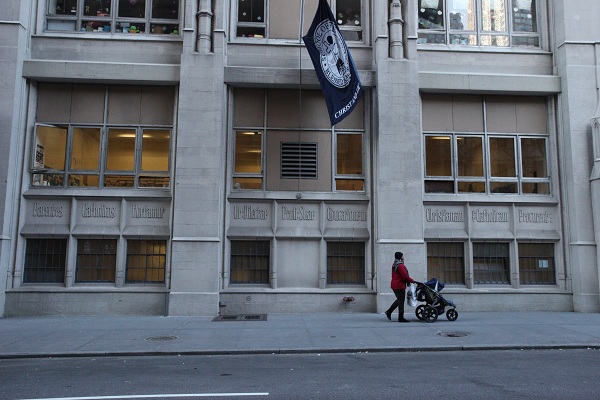
“Parentes Catholicos Hortamur ut Dilectae Proli Suae Educationem Christianam et Catholicam Procurent.”
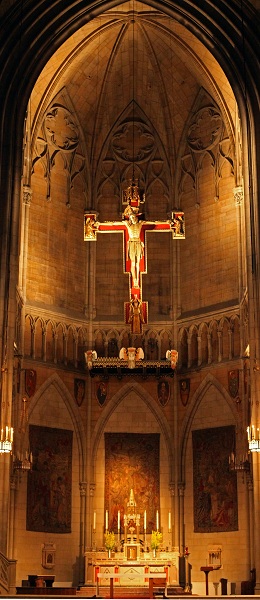
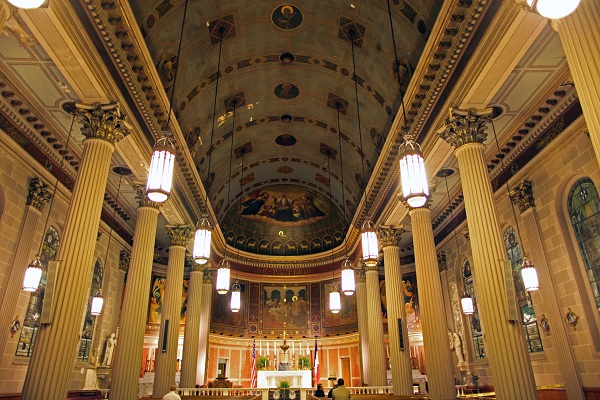
The façade is a magnificent gateway to the nave of church through a narrow vestibule or narthex. The interior is of great height and length. The effect of height is accentuated by the grand arch over the sanctuary glimmering in the distance – the interior of this church normally is shrouded in a mystic semi-darkness. The lighting picks out highlights of the decoration – particularly the great Rood over the altar. As was often the case in the Golden Age, the decoration was conceived and executed as part of the architectural plan.
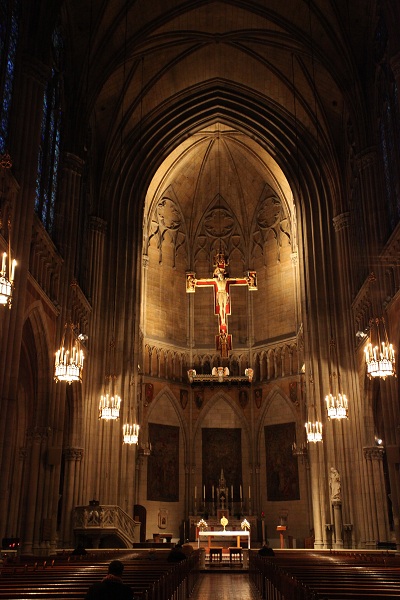
Actually, the layout of Blessed Sacrament is not all that different from a more conventional parish church like St Monica’s, erected at about the same time: a basilica with an apse – here windowless – containing the main altar flanked by side apses with altars to the Sacred Heart and Our Lady. It may seem strange the apse is windowless – undoubtedly the architect took into account the building of the parochial school rising immediately behind it. Uniquely, instead of windows or paintings, the arches of the apse are filled with fine tapestries.

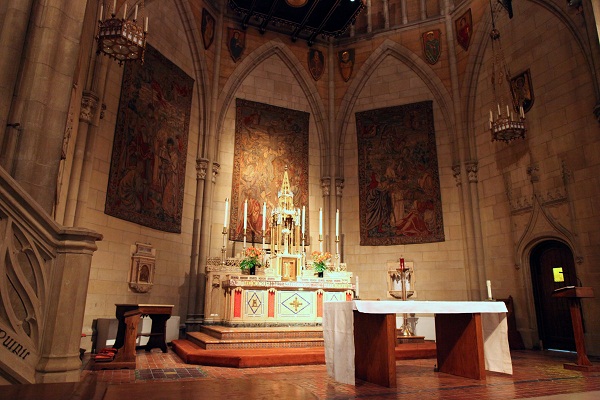
The high altar is intact – it would be a simple matter to move aside the “people’s altar” to allow for celebration of the Traditional Mass.
But the execution in stone of this architecture is of a wholly different and higher order than that found in most sister parish churches of this time. The same holds true of the altars and sculpture such as the enigmatic, moody bust of the virgin on a side wall.
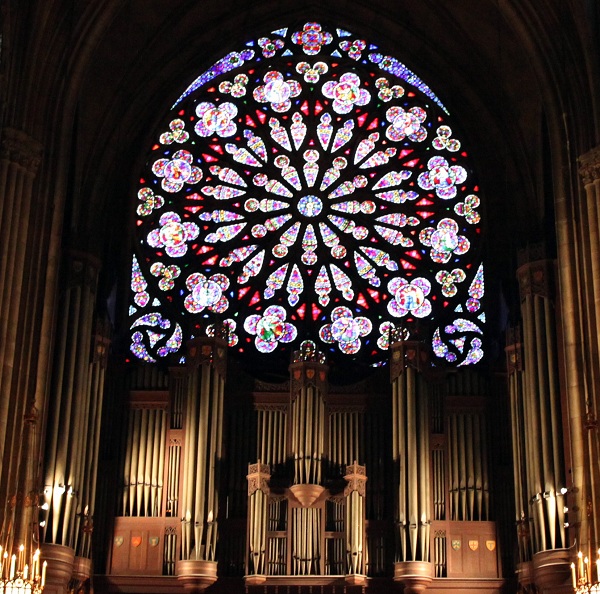
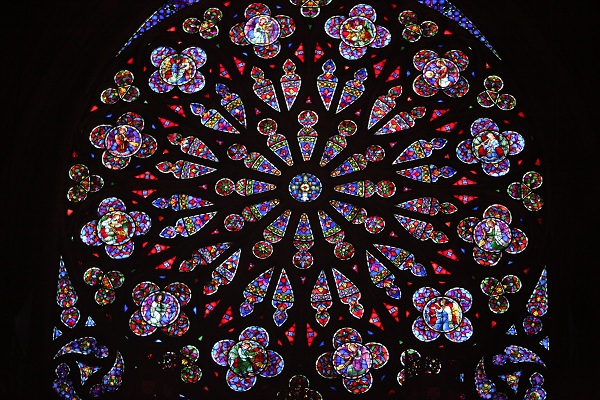
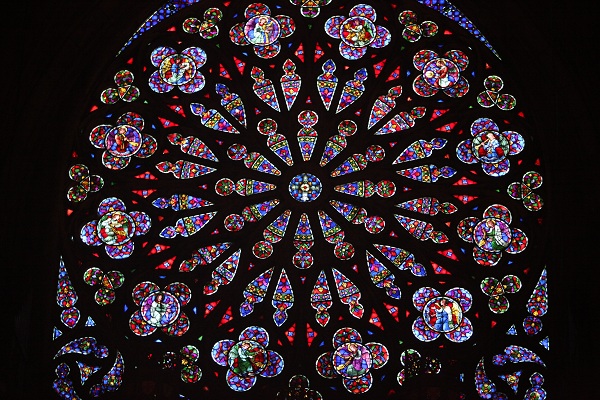
And especially of the wonderful windows by the noted, originally English glassmaker Clement Heaton. It is a program of stained glass that culminates in the glorious, largely non-figurative rose window.4)
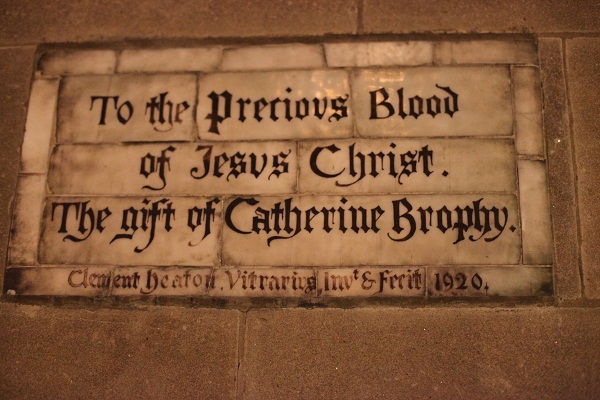
The artistic excellence extends further to the splendid tiled floors:
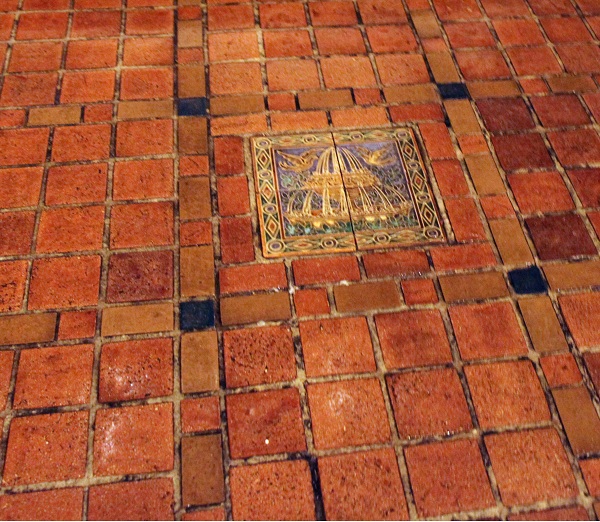
The eyes of the visitor, sitting in the darkness, are drawn upwards by the dramatic upward sweep of the architecture into the mysterious obscurity of the ceiling and then rest on the illuminated highlights – the Rood, the rose window, and the altars. It is no exaggeration to say that in this church Steinbach, on a more modest scale, has equaled or exceeded Cram’s Gothic contributions to the Cathedral of St. John the Divine. It is one of the few spots in New York where quiet and darkness lead the soul to prayer – contrast the visual and acoustic chaos of the current situation in St. Patrick’s. Furthermore, this church is always open – a blessing for the several individuals always to be found here at prayer as well as for the bums getting some much-needed rest.
What is there indeed to criticize about this nearly perfect church? Perhaps only this: it all too carefully planned, a Gesamtkunstwerk with perhaps too much artistic skill and aesthetic economy of means. For, as Catholics, are we not more attracted to other, less planned, less refined churches – like Most Holy Redeemer, St Stephen or even St Patrick’s cathedral: exuberantly overflowing with accumulated altars, paintings, statues and windows of all kinds of styles and quality?
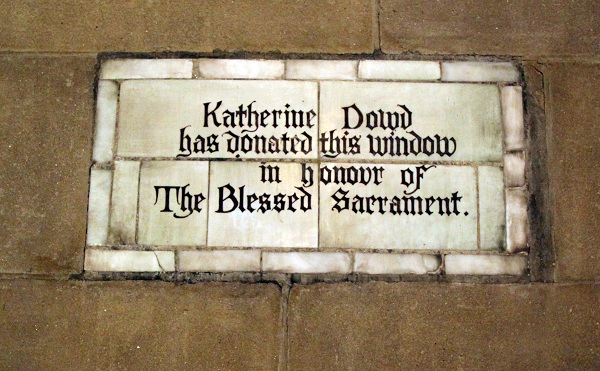
“Honour” -A bit too “Anglican”?
Blessed Sacrament always remained the parish of a residential neighborhood. Perhaps the most famous event associated with this parish happened even before the completion of its first church – the funeral mass of General Sherman in 1891 (did you know he was Catholic?).5) The parish history records other, subsequent funerals for less august personalities. After the 1920’s the Upper West Side surrendered its social eminence to the East side. The immediate vicinity off this parish, while never a disaster, had become by the 1960’s – 1970’s distinctly seedy – think Rosemary’s Baby. And “Plato’s Retreat” obscenely squatted in the nearby, formerly elegant Ansonia. Now, of course, the wheel of fortune has turned again. The Upper West Side through the 70’s has become one of the most expensive and exclusive parts of New York. We hope that this parish with its magnificent architecture can continue and expand its rightful role as a magnet of spirituality and culture in the money-hungry boomtown in which it now resides.
1) The Catholic Church in the United States of America Vol. 3 at 318 (the Catholic Editing Company, New York 1914)
2) R. O’Connell, Church of the Blessed Sacrament (Guide)
3) E. Willensky and M. White, AIA Guide to New York City at 306 (3rd Ed., Harcourt Brace Jovanovich, New York 1988)
4) O’Connell, Church of the Blessed Sacrament (guide)
5) O’Connell, Church of the Blessed Sacrament (guide)
When the wall of water came there was little warning, but no surprise, for it had been raining for so, so long now. But we had hoped that being this high up, the water would not reach us. But now it came in a wall and threw everything before it. There was no place to go, no place to hide, and it took me with its force and filled me with itself. I fought it by holding my breath and reaching upwards, trying to swim to the surface against the pull of the raging water. With a final push I broke the surface, the surface littered with bodies and debris. And although I had broken the surface and could now breathe, I despaired, for I had no strength left to do anything at all and drowning seemed like a relief. Ready to give into my despair and let the water take me, I looked up to see an arm outstretched to me, outstretched from a boat. I saw nothing but the arm, an arm which even in my terrible state impressed me as having immense strength, and I knew that if I could just swim the few strokes to the arm and the boat, that arm would grasp me and save me. And I did manage to swim those few strokes and I was seized by the strength of that arm and hauled aboard, choking, gasping, near death. I do not remember very much about my stay on that boat, for I was very will and delirious, but I do remember the animals, so many animals, I remember their smell and the sounds that each one made, I remember being tended to by the man with the strong arm. And I remember lying there gradually getting my strength back listening to the water lapping at the boat, and then one day seeing a rainbow which seemed to envelope the whole boat, and stillness, no sound of water, just stillness.
I was tired of the normal vacations. I had had it with the island, the South Pacific, helicopter skiing, safaris. I was sick of absorbing European culture, so I decided to take a vacation alone in the desert. They warned me that this was dangerous and a crazy thing to do, but I packed carefully and prudently and went off into the desert for two weeks. I got a lot of reading done the first week, and I was fascinated by the starkness of the place for a while, but then I got bored, and after eight days I decided to give it up and go back home. I got into my tent that night determined to leave first thing in the morning. I was awakened from my sleep by the sound of war: the sounds of thousands of planes roaring overhead, the shriek of falling bombs, the deafening explosions of detonating bombs. I was terrified and sat up and saw that it was already past dawn. Here I was in a tent in the middle of the desert, and there was a war raging out there. The noise was terrifying but I got up and looked out. And I saw nothing, no planes, no bombs. Then noise of the war continued unabated, but there was nothing to see out there except a man standing there with his arms lifted up. He stood there in the desert morning not moving, his arms lifted up amidst the din of the war that I could not see. And then some stones that lay just in front him started to glow and as they glowed gave off the wonderful aroma of baking bread. That aroma was so strong and so wonderful that even I, in the state I was, felt intensely hungry. And these stone rolls now began to dance around, to dance like on some Pillsbury TV commercial, and they began to dance around the man and aim themselves at his mouth. But he stood there with his arms upraised until the rolls fell back to the ground and turned back into stones.
The noise of the war increased in its fury, as the cactus growing in front of the man assumed huge proportions and turned into pure gold. My eyes nearly popped out of my head as I looked at this thing of intense beauty and I calculated that it would be worth trillions of dollars on the gold market and wondered if I could break off a small piece for myself. But the man stood there with his arms uplifted and the cactus returned to its normal state. The fury of the war sound track increased as now there was nothing in the desert except this man with his hands uplifted—nothing except a huge black scorpion a few feet from the man’s feet, slowly crawling towards the man. That is all there was in this stark, barren place, now: the man and the deadly scorpion advancing toward him. The man saw the scorpion but did not move. I wanted to shout out to him: “Move out of the way, you will die!” The scorpion was now at his feet, but then paused, almost as if to say: “Not now, not yet” and then went on his way. At that point the sound of war ceased, and out the stillness came a helicopter, and sure enough, when I looked up at the sky, there was a helicopter flying in with camouflage markings on it. It hovered above the man and then let down two rings on ropes which the man grasped. The man was lifted off the ground holding on to the two rings and passed right over my tent, so that he was very close to me. And with a shock I recognized the arms. I recognized the arm that was outstretched to me from that boat when I was drowning. The strength in those arms I could never forget. And I watched as the helicopter bore him hanging on those two rings, as they flew slowly towards a city in the distance, to hill just outside of that city, and there he was let down.
I was walking to Dunkin Donuts that day when the wall of water came. This is what everybody had feared after 40 straight days of rain. I could see the water coming down West Avenue in the distance. I looked across the street and there was a big stone church there with a big cross in front of it. It looked safe, and so I ran across the street and into the church. And there I saw a lot of people sitting there and a man with funny clothes was throwing smoke against some sort of stone table, and then it hit me, the water hit me and carried me up and with a violent force pushed me out the door and I thought I was drowning and I broke the surface trying to find something to hold onto. And in the torrent I saw that cross and I grabbed onto that cross and it floated and held me above the water, but I soon realized that I could stay afloat only if I lay right on the cross with my arms exactly on the two cross pieces and my head on the upper part and my legs crossed on the lower beam. I was lucky that the cross fit my body exactly. But there I was, lying on that cross, the raging flood beneath me, and I knew that if I moved an inch off that cross, I would die.
3
Mar
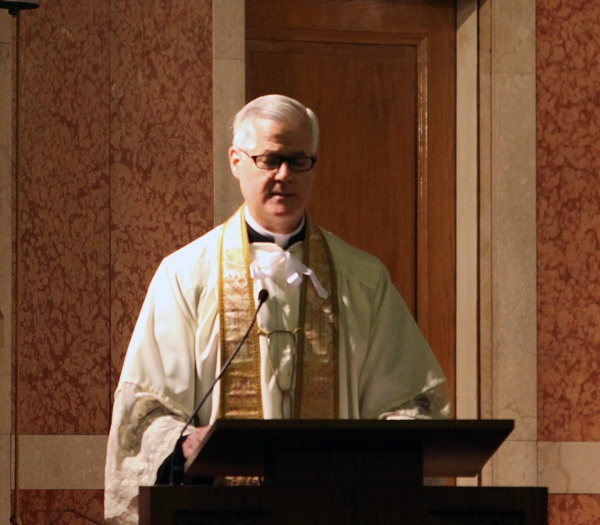
Last Thursday the Catholic Artists Society sponsored an evening of recollection at St Vincent de Paul Church, West 23rd Street. Fr. Gerald Murray, the pastor of St Vincent de Paul, delivered a an inspiring meditation on the role of the artist, referencing the writing of Romano Guardini and Pope Benedict. A reception followed in the Church hall. The Society is gaining traction. Attendance was good – I encountered one well-known (non-Catholic) painter. It was announced that the Society had obtained its tax exemption and Cardinal Burke had agreed to become its patron!
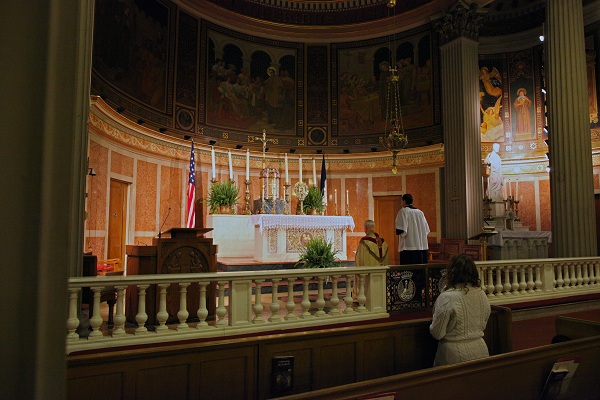
I regret to say Fr. Murray’s insightful comments concerning the need of the artist to orient himself to the beautiful contrasted greatly with the scandalous neglect of this splendid church by the New York Archdiocese. The condition of the interior is much worse than even two years ago: both side aisles have been cordoned off for water damage, the six large candles behind the altar are all awry and the lower sections of the glorious stained glass windows have been partially knocked out. We would hope that the government of France – if nobody else- could be induced to provide support for the restoration of this glorious monument to the French presence in New York.
The splendid tabernacle and monstrance – but note the candlesticks on what once was the main altar.
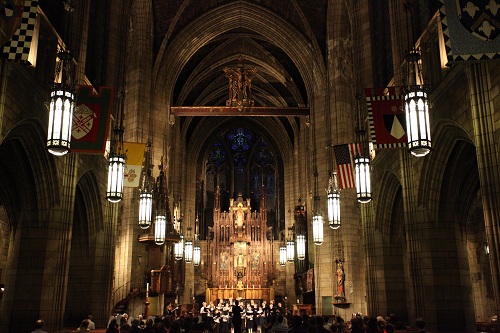
A 2011 Concert at St. Vincent Ferrer.
There will be a Missa Cantata in the Traditional Dominican Rite on Wednesday, March 7, 2012, at 6:30 p.m. at the Church of St. Vincent Ferrer
869 Lexington Avenue (between 65th and 66th Streets)
New York, NY
For more details see this post on the NLM.