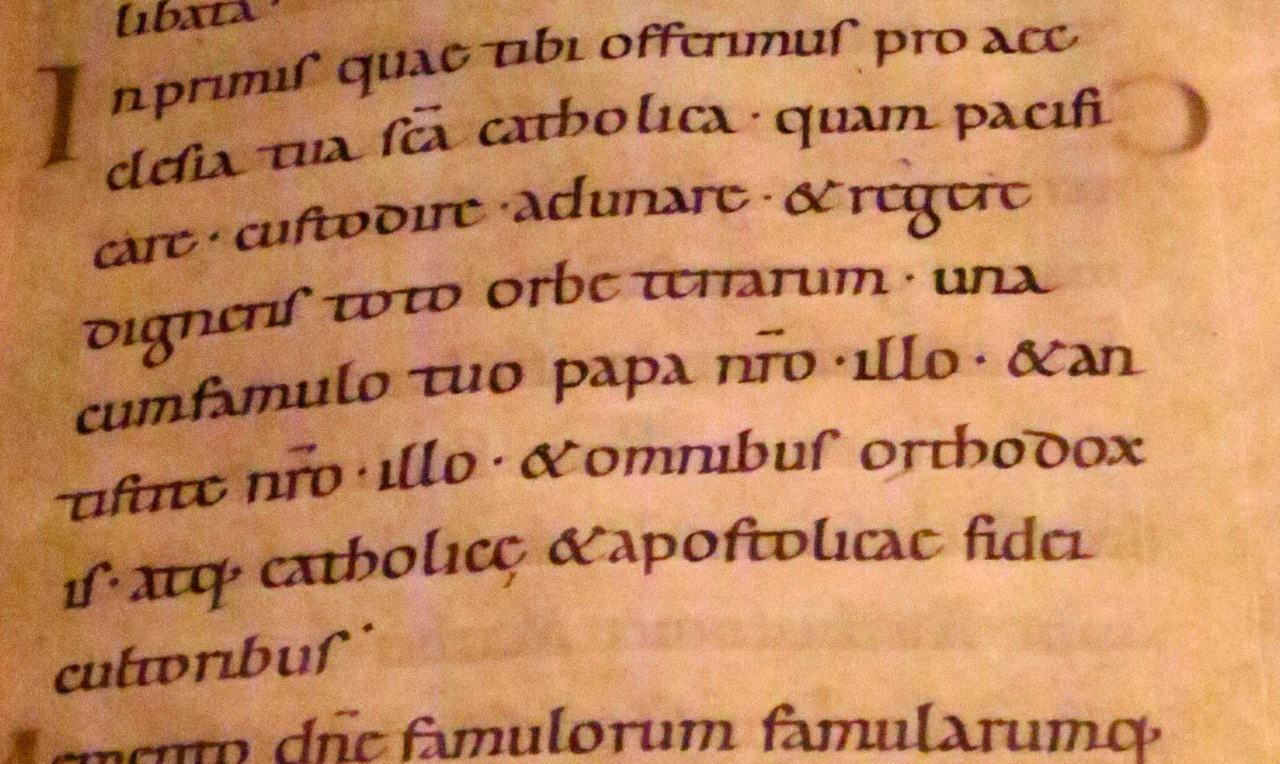
There will be a sung requiem with absolution at the catafalque on Memorial Day (Monday, May 30th) at 1 pm at the Church of the Holy Innocents in Manhattan.
27
May
There will be a sung requiem with absolution at the catafalque on Memorial Day (Monday, May 30th) at 1 pm at the Church of the Holy Innocents in Manhattan.
25
May
Fr. Rutler has written an insightful reflection on the “Mass for Artists” celebrated recently at his own church of Our Saviour’s. The final passage of his essay takes up a memorable example Fr. Rutler gave in his sermon on that day.
“Last Sunday, our church was overflowing for a Solemn High Mass to inaugurate a Society of Catholic Artists, founded at the initiative of Catholic painters, musicians, actors and writers. Whatever will be realized from this, it certainly is a hopeful sign in an age whose potential has often been thwarted by a misuse of art to diminish the human spirit. May it someday be said of these good people what was inscribed on the wall of a church in Leicester, England, during the iconoclastic period of the Protectorate: “In the year 1654 when all things were, throughout this nation, either demolished or profaned, Sir Robert Shirley, Baronet, founded and built this church. He it is whose singular praise it is to have done the best things in the worst times, and to have hoped them in the most calamitous.”
For the full text:
http://www.catholiceducation.org/articles/philosophy/ph0049.htm
25
May
There will be a Missa Cantata for the Feast of St. Phillip Neri tomorrow, Thursday, May 26th at 7 pm at the Church of St. Phillip Neri in the Bronx, Father Steven Markantonis, Celebrant.
(To travel by subway to the church — which is located at 3025 Grand Concourse, Bronx, New York 10468 — take the 4 Train to “Bedford Park Boulevard/Lehman College.” The Church is a five-minute walk east from this subway stop. For more information, please call the church office at (718) 733-3200.)
25
May
Fr. Greg Markey, pastor of St. Mary Church, Norwalk, has published a book, Discovering the Camino de Santiago, about his experiences walking the medieval pilgrimage route to Santiago de Compostela in Spain in summer of 2009. The book is based on the inspiring weekly installments that Fr. Markey wrote to his parishioners while on his pilgrimage about his encounters. Some of our readers may remember the excerpt we published on this blog link. Fr. Markey has become a sought-after speaker on the topic of his pilgrimage. Now you can read his account of the entire journey in his new book, costing $9.95, available from Roman Catholic Books http://www.booksforcatholics.com/pdf/rcb_catalog.pdf and at the bookstore of St. Mary Church in Norwalk.
N.B. Fr. Markey will have a book signing at the St. Mary church hall onFriday evening June 10th immediately after Benediction at 7:00 pm. He will then give a presentation on the Camino de Santiago at 7:30 pm.
24
May
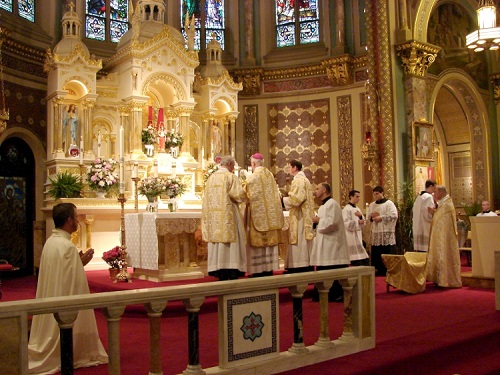
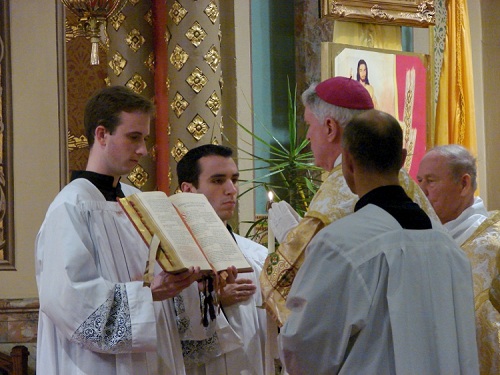
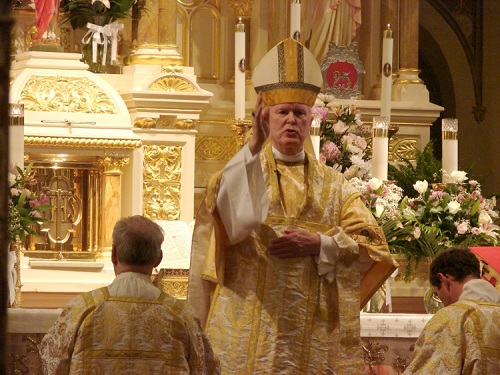
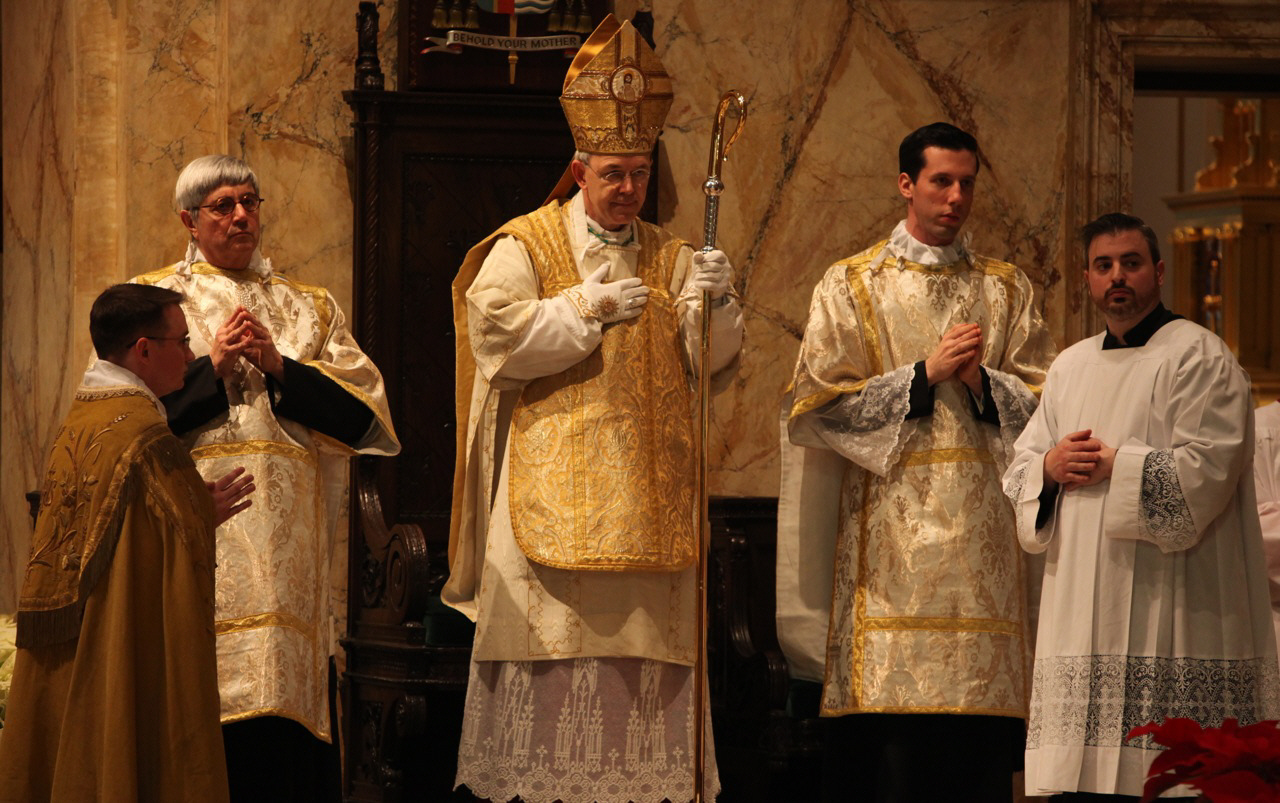
Completing our coverage of the Traditional services celebrated on Sunday, May 15, we are pleased to show pictures from the 25th Anniversary Jubilee Mass of the Saint Gregory Society, at Saint Stanislaus Church, New Haven. The Solemn Pontifical Mass in honor of Saint Gregory the Great was celebrated by the Most Reverend James C. Timlin, Bishop Emeritus of Scranton, PA.
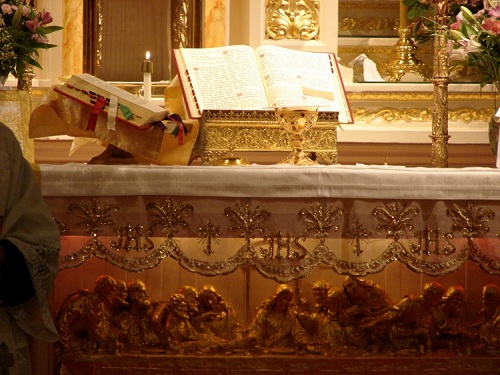
Pictures courtesy of Douglas Turecek; more pictures of this event at his site.
23
May
Freedom is restored to the Old Rite: Martin Mosebach on the recent papal letter on the Latin liturgy
By Paul Badde
(Die Welt, May 23, 2011)
Four years ago, Pope Benedict XVI, against the opposition of the great majority in the Catholic Church, restored the old Latin liturgy to equality with the new vernacular form of the celebration of the mass, which had been mandated since 1969. (The Latin liturgy substantially dates back to Gregory the Great (540-604) and was finally authoritatively fixed by the Council of Trent (1545-1563).) A week ago, the Vatican, in a papal letter, reaffirmed its determination of 2007 and clarified some disputed questions regarding its practical application. Martin Mosebach, the recipient of the Büchner prize, is one of the most fervent admirers and defenders of the old Liturgy.
Die Welt: In 2007, Pope Benedict XVI, in a special motu proprio (an apostolic letter), freed the ancient Gregorian liturgy for the Catholic Church. Why does the Vatican publish instructions four years later on how the will of the pope is to be implemented?
Martin Mosebach: The enemies of the great liturgical tradition of the Roman Church in many cases have not accepted the permission given to the Old Rite. They often tried to ignore the pope’s motu proprio and sought to maintain obstacles. They tried with bureaucratic methods to render ineffective the pope’s generosity. Therefore, the Vatican had to be clearer if it wanted to maintain the motu proprio.
Die Welt: The Instruction speaks of “two usages of the one Roman rite.” Doesn’t this open the door to a creeping new schism?
Martin Mosebach: There’s already a schism, not between supporters of the new and old rites, but between those Catholics who adhere to the old sacramental theology of the Church as was solemnly confirmed by Vatican II, and those who assert that Vatican II founded a new Church with a new theology and new sacraments. This latter doctrine has been diffused wholesale and against the better knowledge of its promoters, in the seminaries, universities and Catholic academies. This is what has fostered the danger of a schism.
Die Welt: “What was sacred for prior generations remains sacred and great also for us as well; it cannot be suddenly prohibited altogether or even judged harmful.” The Instruction cites here the pope. But wasn’t this the intention of the overwhelming majority of the Catholic bishops in the last 40 years?
Martin Mosebach: Yes, it is regrettably true that a not small part of the Catholic bishops, in a suicidal frenzy, attempted to separate from the Catholic Tradition and to cut the Church off from the source of her vitality. In the sentence you have cited, the pope has given them some tutoring in ecclesiology.
Die Welt: How can the Roman liturgy in the “usus antiquior “ be offered today “to all the faithful “ if only a fraction of the faithful understand Latin?
Martin Mosebach: At all times only a few Catholics have been able to follow the Latin Mass word for word. Europe looks back on well over a thousand years of glorious Catholic culture without the people being able to understand Latin. They understand something more important: that in the rite the Parousia – the mystic presence – of the Lord takes place. Without this understanding, a person has understood nothing of the Mass, even if he thinks he understands every word. Moreover, for a long time there have been wonderful bilingual missals with which we can pray the mass with the priest. But it is indeed correct: the Old Rite requires a certain effort, a readiness to learn.
Die Welt: And how will precisely the promotion of the “older” rite further “reconciliation within the Church” after it has led to so much conflict until now?
Martin Mosebach: The conflict essentially is due to the misunderstanding, so perilous for the Church, that Vatican II established a new Church. The struggle surrounding this misunderstanding must be endured to the end. Covering it up with peaceful phrases doesn’t help the Church.
Die Welt: Pastors are invited to show “a spirit of generous welcome” to groups of faithful who would like to celebrate the Old Mass in Latin. Isn’t this naïve after the last few decades, in which such faithful were considered hopelessly old-fashioned and retrograde?
Martin Mosebach: Indeed, the faithful, who have adhered to the Old Rite or have discovered it just recently, were reviled in manner that, I hope, is not revealing of the spiritual worth of the reform. Karl Rahner’s words have not been forgotten: the opponents of the reform of the mass are “tragicomic fringe elements, frustrated by humaneness .” Today, however, one surprisingly finds a great deal of understanding for the cause of Tradition among younger priests.
Die Welt: That the pope personally changed the old Good Friday petition for the Jews satisfied hardly a single critic or opponent. Doesn’t the new Instruction stir up the fire once more?
Martin Mosebach: The critics of the Good Friday prayer perceive the insistence of the Church that Christ is “the Truth” as creating scandal. But the Church must endure this anger. She cannot deviate from this conviction.
Die Welt: Now priests can once more celebrate mass by themselves (or with the assistance of a single server). Isn’t that a leap back into the age when the concept of “communio” had only a shadowy existence in the Catholic Church?
Martin Mosebach: The concept of “communio” never had only a shadowy existence in the Church. The “communion of Saints” is , after all, even an article of faith. The community of which the Church speaks, however, is much more than the people actually present. It is a community with the dead and with the angels – but it is especially a community with Jesus Christ. Experience teaches that this community can be intensively experienced in the old form of the mass and even especially in the low mass – in any case, for many people better than in the post-conciliar form, characterized by incessant talking and the singing of questionable songs.
Die Welt: The training of priests is supposed again to “offer the opportunity of learning the extraordinary form of the rite” to theology students. But who will teach it? There are, after all, almost no teachers left.
Martin Mosebach: There are a number of Traditional priestly societies which view as their mission the imparting of the old liturgy to young priests. One only has to turn to these priestly societies and ask. They are happy to provide information, but until now have been impeded by many bishops.
Die Welt: What surprised you the most in the new Instruction?
Martin Mosebach: What surprised me is how determined the pope is in the question of liturgy. In any case, he has created the legal prerequisites for returning the Old Rite to complete freedom. No bishop who would like to impede the Old Rite can cite legal reasons any more.
Die Welt: And what disappointed you the most?
Martin Mosebach: It was disappointing for me that the great rite of the old ordination ceremony can from now on only be celebrated in Traditional monasteries and priestly societies. It is a pity that this spiritual treasure, which defines the priesthood so exactly, is to be lost to the universal Church – at least for the time being.
Die Welt: How do you respond to the criticism that the debate over liturgy overlooks the plight of the Church and the world?
Martin Mosebach: The plight of the Church is precisely that she has forgotten where her center lies. Her mission is to proclaim the living Christ and the living Christ appears in the liturgy. If the liturgy is made subject to the fashions of the day, the living Christ becomes invisible. Then the Church is truly in a crisis.
© Paul Badde
(Translation by kind permission of Paul Badde; translated by Stuart Chessman.)
22
May
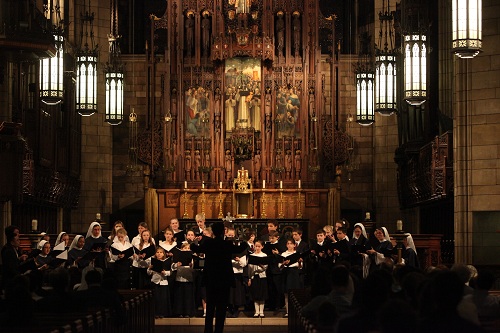
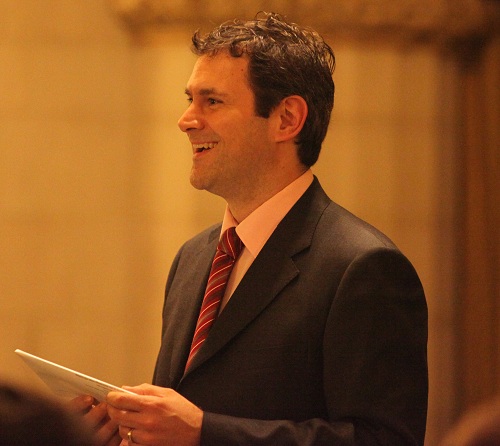
On Friday, May 20, David Hughes led the Student Schola of St. Mary’s parish, Norwalk, and the Schola of the Sisters of Life in a joint concert of sacred music. The venue was incomparable: St. Vincent Ferrer, the most magnificent Catholic church in Manhattan. The student schola has attained almost professional competence under Mr Hugh’s direction – and the sisters were splendid as well. The music (primarily plainsong and polyphony) illustrated the Church’s liturgical year. Thus, a direct link was established between the music and the Traditional liturgy. But this is the purpose of this schola. The Student Schola may be heard next on Thursday, JUne 2 at 5:30 PM at St. Mary’s Norwalk at the Solemn High Mass for Ascension Thursday.
This concert also served as a fund-raising event for the Student Schola. They have been invited to sing at World Youth Day and need to finance that trip. So far they have raised about half the sum needed. For more information on this trip and how to help see the Schola’s website.
17
May
Juventutem USA is preparing to travel to Spain for World Youth Day. They will leaving from Washington, DC – places are still available. Fr. Armand de Malleray, FSSP will serve as the spiritual director and Matthieu Bonnin, choir master at the cathedral of Blois, France, will serve as choir master for the Juventutem events. For more information see the website of Juventutem.
16
May
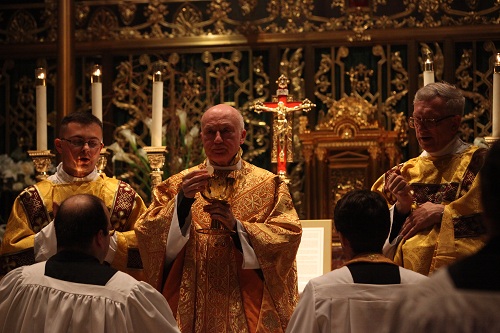
Continuing our coverage of Sunday’s “events”, the Catholic Artists Society sponsored its first Solemn High Mass for Artists at Our Saviour’s Church on Park Avenue in New York. A capacity congregation, very proficient in singing the responses, filled the church. But that seems to be the rule for Solemn Masses at this parish. David Hughes and the schola of St. Mary’s Norwalk provided the music – need we say that it was splendid? (Missa super Credidi Propter by Orlando di Lasso and works by Palestrina, Philips, Vaughan Williams, Bach and Messiaen)
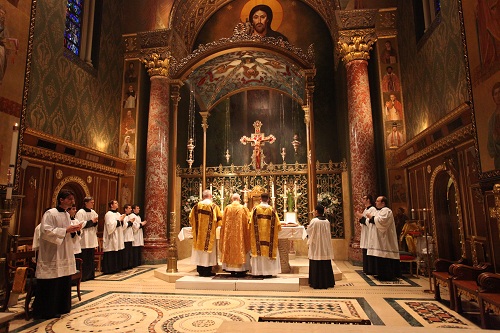
Mr. Eddy Torribio was Master of Ceremonies.
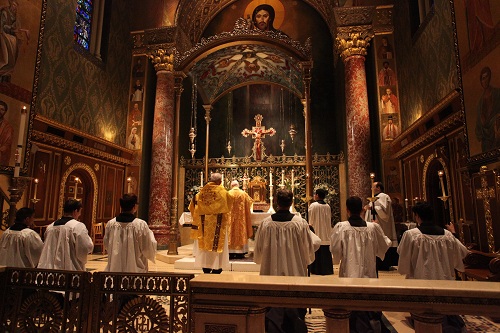
The celebrant (and superlative preacher) was Fr. George Rutler. Father Michael Barone was the deacon and Fr. Joseph Koterski, SJ the subdeacon.
Kevin Collins, the leader of this evening’s exceedingly well organized proceedings, introduced the speaker, Fr. Koterski.
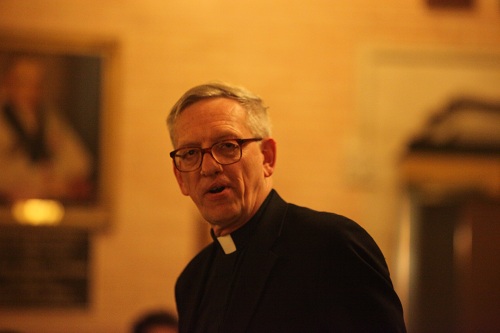
Fr. Koterski provided a much needed presentation on the Ignatian approach to the examination of conscience. The audience was enthusiastic.
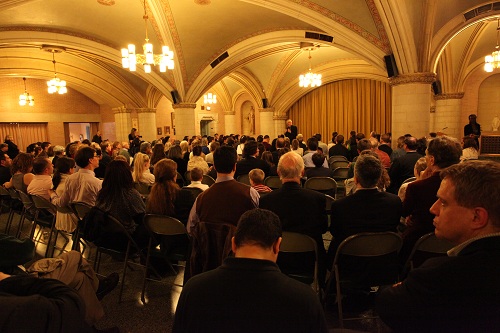
As already noted, there always seems to be a full house for a Solemn mass at Our Saviour’s. But the Catholic Artists Society has succeeded in bringing most of them down to the lecture hall as well. It was heartening to see so many artists – and would-be artists – especially given the nonexistent Catholic presence in the arts in New York. Perhaps these artists have only been waiting for something like the Catholic Artists Society to come along to draw them all out of the woodwork. In any case, we will be hearing more from this Society in the near future…..
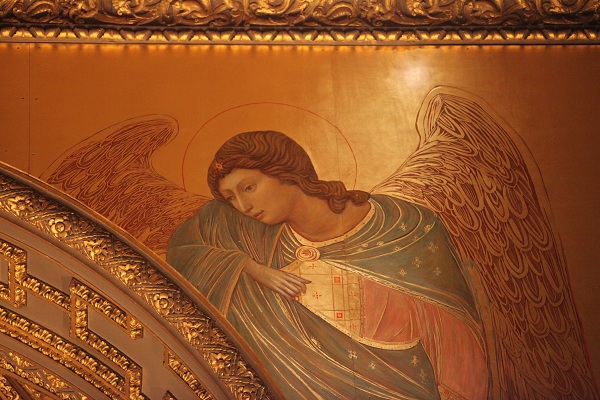
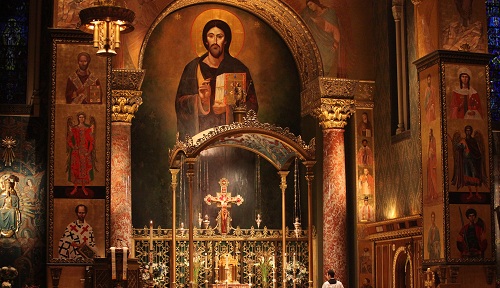
In attendance was artist Ken Woo, who painted all of the beautiful icons in this church. His Christ is in the apse (at top) and the angel on the arch over the sanctuary(above)
15
May
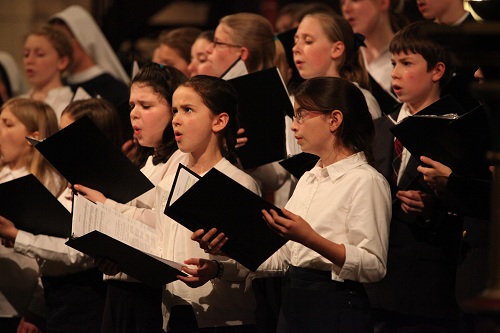
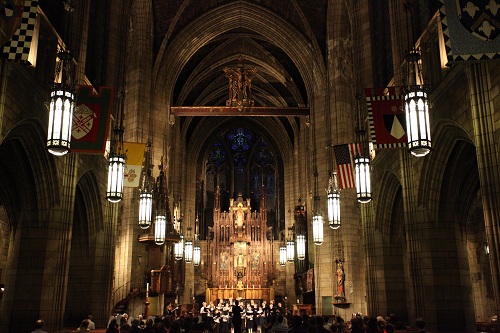
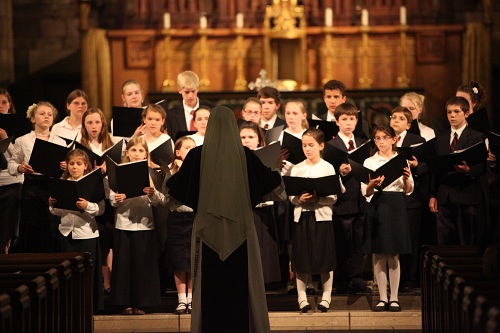
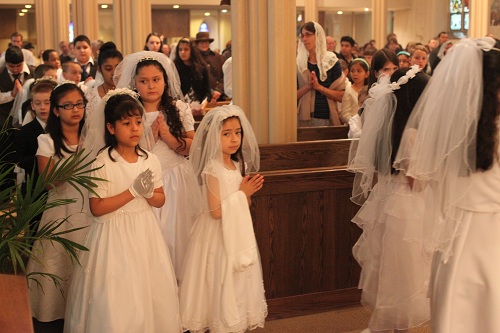
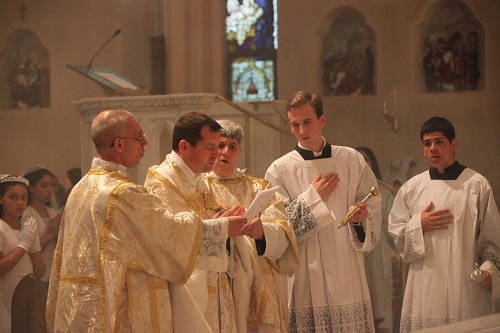
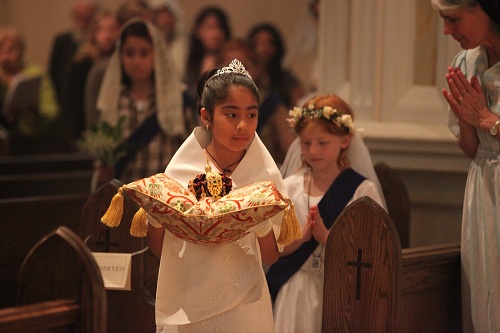
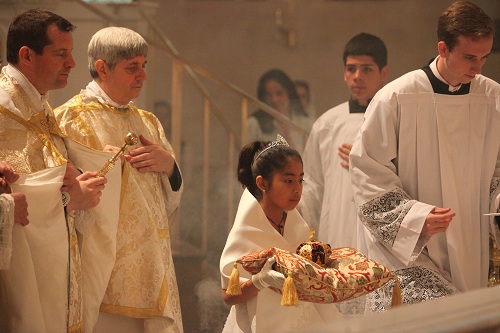
This Sunday was quite a day for the Tradition of the Church in the greater New York area. From New Haven to Park Avenue there were extraordinary events demonstrating the breadth and depth of Traditionalism in this region. Summorum Pontificum has found wide acceptance here – Friday’s “Instruction” only serves to reinforce an already active scene.
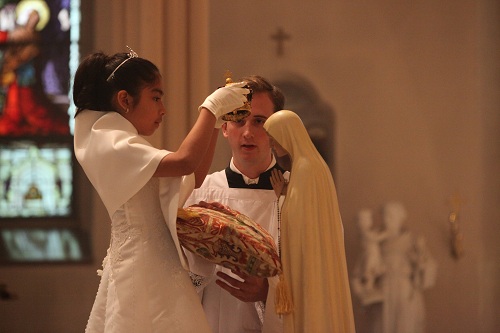
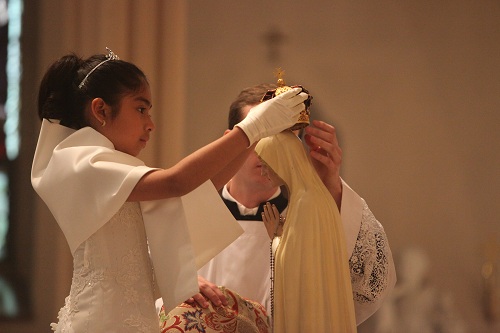
We first turn to St. Mary’s, Norwalk. A May crowning – but with magnifcent ceremony and music (provided mainly by the children’s choirs under the direction of David Hughes). It was an unforgettable experience – even if it had to take place indoors because of the inclement weather – and there was no “Bring flowers of the fairest..”