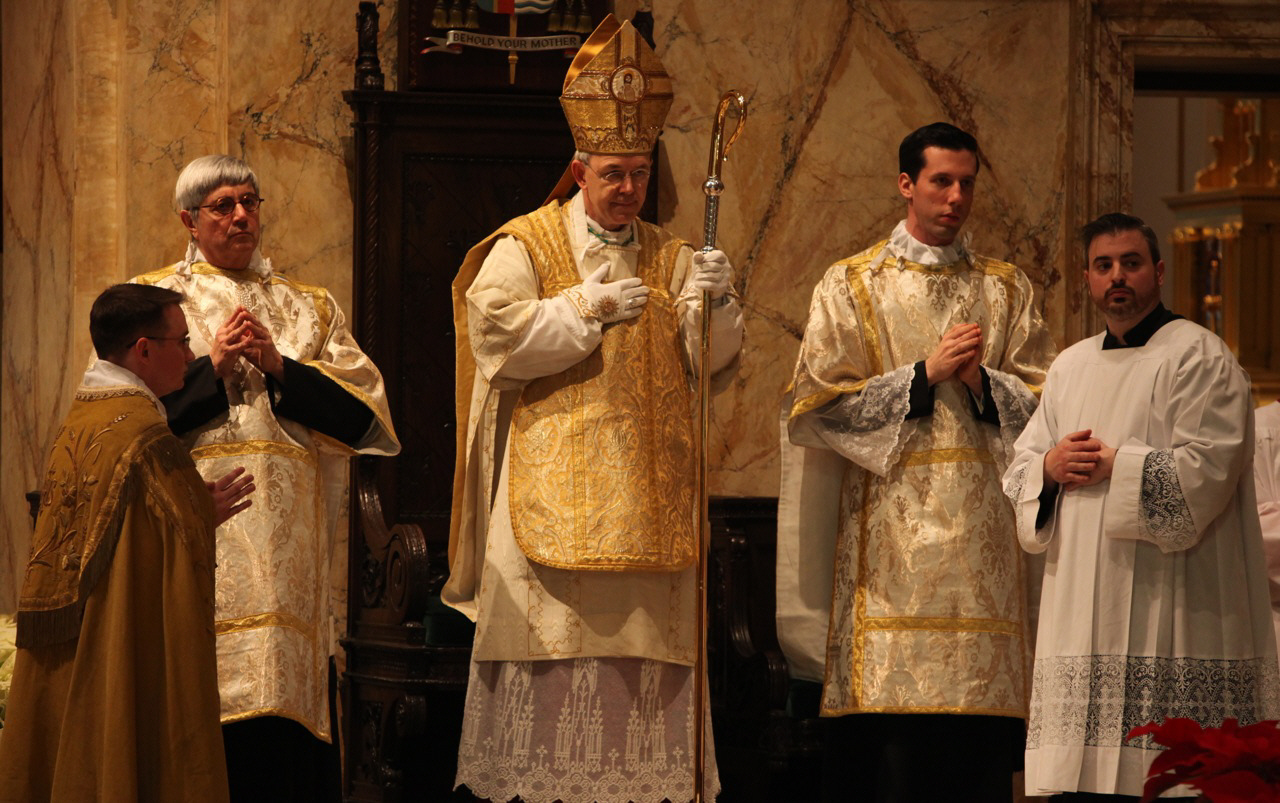
The Summorum Pontificum pilgrimage came to a close in Rome on Sunday October 29 with a Solemn Mass for the Feast of Christ the King at Santissima Trinità dei Pellegrini, the parish church of the FSSP.


On Saturday October 28, pilgrims met at the Basilica of Saints Celso & Guliano for Eucharistic adoration and the Rosary. Outside, pilgrims got ready to process to St. Peter’s Basilica.


The church of Sacro Cuore del Suffragio ( or Sacro Cuore di Gesù in Prati ) as seen on a sombre evening in Rome last week. Completed in 1917, its extravagent neo-gothic style is unlike any other in the center of Rome. The church overlooks the Tiber and is situated next to the truly monstrous court building ( a structure which, like the “Altar of the Fatherland,” is a legacy of the post-1870 regime in Rome).


Inside is a vast Gothic hall adorned with art in an extraordinary syle showing neo-Gothic, Pre-Raphaelite and Art Nouveau influences. A unified ensemble very much a part of its time: the 1890’s to the 1910’s. An underlying theme of the entire Gesamtkunstwerk is remembrance of the dead and prayer for the poor souls in purgatory.


But this church is most famous for the Museum of the Souls in Purgatory. It displays objects showing tangible evidence of visitations to the living of souls in purgatory. The exhibits typically are prayer books or articles of clothing that feature burn marks of hands or fingers left by the deceased. These testimonies have a common theme we should all remember: keep praying and offering masses for the souls in purgatory.

For a description of the church, see:
https://en.wikipedia.org/wiki/Sacro_Cuore_del_Suffragio#Façade
For an appreciation (in Italian)by famous traditionalist Cristina Campo, see:
https://it.wikiquote.org/wiki/Chiesa_del_Sacro_Cuore_del_Suffragio
1
Nov

(Above) Each morning at 6:30 – 7:15 during the week of the pilgrimage at the FSSP church of Santissima Trinità dei Pellegrini a priest celebrated at each side chapel, often before a congregation. This was in addition to the regular masses at the main altar.

(Above and below) Friday, October 27, the first day of the pilgrimage. Before the start of Vespers in the Pantheon (the Basilica of St. Mary of the Martyrs).


(Above) Bishop Athanasius Schneider presided and preached at the Vespers.


(Above) Bishop Athanasius Schneider processing from the Pantheon.
Connecticut
St. Mary Church, Norwalk, 8 am Low Mass, 7 pm Solemn Mass.
Sacred Heart Oratory, Redding, 6 pm
Sts. Cyril and Methodius Oratory, Bridgeport, 7:45 am Low Mass, 6 pm Missa Cantata
St. Patrick Oratory, Waterbury, 8 am Low Mass, 6 pm Missa Cantata
St. Stanislaus Church, New Haven, NO MASS SCHEDULED owing to the unavailability of a priest to celebrate the Mass.
St. Martha Church, Enfield, 7 pm
New York
Holy Innocents Church, New York, NY, 8 am Low Mass, 6 pm Missa Cantata
Our Lady of Mount Carmel, New York, NY, 7 pm
St. Josaphat Church, Bayside, Queens, 7 pm
St. Rocco, Glen Cove, Long Island, 7 pm
St. Matthew, Dix Hills, Long Island, 10:30 am
St. Paul the Apostle, Yonkers, 12 noon
Annunciation Church, Crestwood, lower church, 7 pm Missa Cantata
Immaculate Conception Church, Sleepy Hollow, 7 pm low Mass
New Jersey
Our Lady of Sorrows, Jersey City, 5 pm
Our Lady of Victories, Harrington Park, 5:30 pm
St. Anthony of Padua, West Orange, 9 am, 7 pm
Our Lady of Fatima, Pequannock, 7 am, 9 am, 12 noon, 7 pm
Corpus Christi Church, South River, 7 pm Missa Cantata
Connecticut
St. Mary Church, Norwalk, 8 am Low Mass, 7 pm Solemn Requiem Mass
Sacred Heart Oratory, Redding, 6 pm Solemn Mass with absolution at the Catafalque, 7:30 pm, Blessing of soul lights and distribution of soul cakes.
Sts. Cyril and Methodius Oratory, Bridgeport, 7:45 am and 8:25 am, Low Mass, 6 pm Solemn Mass and absolution at the catafalque
St. Patrick Oratory, Waterbury, 8 am Low Mass, 6 pm Missa Cantata
St. Stanislaus Church, New Haven, NO MASS SCHEDULED owing to the unavailability of a priest to celebrate the Mass.
St. Martha Church, Enfield, 7 pm
New York
Church of the Most Holy Redeemer, New York, NY, 7 pm, Solemn Requiem Mass
Holy Innocents Shrine and Church, 128 W 37th St, 8 am Requiem Low Mass, 5:15 PM Requiem Low Mass, 6 pm Requiem High Mass
Our Lady of Mount Carmel Shrine, 448 E. 116th St., 7:00 am Requiem Low Mass, 7:45 am Requiem Low Mass, 7 pm Solemn Requiem Mass
St. Josaphat Church, Bayside, Queens, 7:00 pm Requiem High Mass
Our Lady of Refuge, Bronx, 6:30 PM Requiem Mass
St. Rocco, Glen Cove, Long Island, 7 pm
St. Matthew, Dix Hills, Long Island, 10:30 am
St. Paul Church, Yonkers, 12 Noon Requiem Mass
Annunciation Church, Crestwood, lower church, 7 pm Missa Cantata
Immaculate Conception Church, Sleepy Hollow, 7 pm low Mass
New Jersey
Our Lady of Sorrows, Jersey City, 7 pm
Our Lady of Victories, Harrington Park, 5:30 pm
St. Anthony of Padua, West Orange, 9 am, 7 pm
Our Lady of Fatima, Pequannock, 7 am, 9 am, 12 noon, 7 pm
21
Oct
11
Oct
We return – for the last time, hopefully – to the topic of traditionalist pilgrimages with some corrections and additions. First, correcting my earlier post, after some additional discussion, I think there is no independent FSSP pilgrimage to Auriesville. The FSSP may be providing spiritual direction to the Pilgrimage for( the) Restoration, but that pilgrimage has been for many years directed by the National Coalition of Clergy and Laity (NCCL).
Second, I was already aware that this pilgrimage had been moved to Pennsylvania in 2020 and 2021 because of the COVID restrictions in New York State. In 2022 and 2023 it returned to Auriesville. There is an account online of the 2022 pilgrimage. It seems from this that the Pilgrimage for Restoration, while not returning to the larger scale of the assemblies of 2005 or so, nevertheless has recovered somewhat from a low point ten years ago. And their 2022 pilgrimage was accompanied by a sitting Bishop. Have the actions of Pope Francis, especially Traditionis Custodes, shaken some people out of their torpor and revived interest in the TLM – as has happened elsewhere?
As for the pilgrimage of the FSSPX (the “Pilgrimage of Tradition”), it too has continued despite the disdainful attitude of the authorities at Auriesville. It now seems to be roughly comparable in size to the Pilgrimage of Restoration. The FSSPX even claims that its pilgrimage started in 1993 – meaning that it predates the Pilgrimage for Restoration. I will leave it to experts to debate that point.
Dr. Peter Kwasniewski has informed me, however, that a newer, much more significant claimant to the honor of being the “American Chartres Pilgrimage” has emerged not in New York, but in Oklahoma. Since 2020, a “Three Hearts” pilgrimage to Clear Creek Abbey has taken place. With the blessing of Cardinal Raymond Burke, it grew from a few dozen pilgrims in the first year (2020) to more than 1,500 in 2022 – substantially larger than the older “competitors” in Auriesville. Now there is, of course, no tradition at Clear Creek of such a pilgrimage or devotion. However, the monks of Clear Creek Abbey – and Cardinal Burke – obviously are more welcoming to traditionalist pilgrims then the authorities in Auriesville. The fourth edition of the pilgrimage will be this weekend. This year Cardinal Burke will celebrate the concluding Mass. Information on the Three Hearts pilgrimage can be found here:
The Three Hearts Pilgrimage (Facebook)
There is undeniable vitality in the world of Traditionalist pilgrimages. In 2023 the pilgrims have continued to come. The desire to make a sacrifice for the Faith and to display it openly to the world, not just individually but in the company of many others, remains alive and well in the Traditionalist community. Up to now no pilgrimage having national recognition has emerged. Maybe that is attributable to the way we do things in America: spontaneous, independent (and uncoordinated) entrepreneurial activity. These efforts, however, have over the years overcome obstacles such as lack of communication, great geographical distances, lack of supportive national traditions such as still exist in Europe and, in Auriesville, changing relationships with the local establishment in charge of the goal of the pilgrimage. I do expect this post to generate even more responses with suggestions, corrections and clarifications. But is that not also a welcome sign of life?
8
Oct

Jan Bentz, Jochen Prinz (editors)
Einer, der nicht nach Utopia wollte: Thomas Molnar zum 100. Geburtstag
Patrominium -Verlag, Mainz, 2022
162 Pages
I was happy to see that last year a book was finally published dealing with Thomas Molnar. It has been a long time to wait for such recognition of a man who was once so prominent both in American conservatism and the French reactionary resistance. But finally in 2022 Molnar has received his own Festschrift – if a relatively short one. Contributors come from the United States, Switzerland, France, Hungary and Germany.
Now I certainly appreciate the efforts of all involved in putting this attractive tribute together. I cannot say, however, that A Man who didn’t want to go to Utopia is the best place to get to know Thomas Molnar. The tone of the book is too abstract. Molnar appears mainly as an academic dealer in ideas and concepts. The authors investigate the source of his ideas, try to identify influences on Molnar and discuss how Molnar fit into the conservative movement in the United States (or didn’t). Although such information has its value, it leads to a misunderstanding of the man and his work.
Of course, it is a bit unfair to expect those who are discovering Molnar primarily from his published works will form the same impression of someone with whom I conversed for many years. However, I think even a brief acquaintance with Molnar’s books and articles reveals an entirely different cast to his thought – that he was eminently practical and focused on the concrete political and spiritual problems of his time. That Molnar was, above all, a supreme analyst of culture.
His best writing usually responded to a specific contemporary development or tendency in education, politics, philosophy, ideology – or the Church. His interest was kindled by a news report, a casual remark in conversation, or something ordinary he had just seen. For Molnar such incidents of daily life could suddenly illuminate in a new way one of the “global” issues of our age. And Molnar’s perspective on these topics was not at all uninvolved but passionate and committed. Given the direction the world took over the course of his life, that passion often manifested itself in forceful criticism of the world’s dominant powers (including specific individuals and countries).
In his essay in A Man who did not want to go to Utopia, Zoltán Pető does focus on one overriding cultural concern of Molnar: the worldwide liberal hegemony of the United States that obtained its ultimate triumph in 1989/91. In a series of works from the 1970’s through the 1990’s he inveighed against the new “liberal” despotism, with its fusion of idolization of the market with the decline and disrespect of tradition, manners, and education . Molnar very clearly identifies our age with a previous era of transition and collapse: the fall of the Roman empire. And he compared himself with Symmachus, one of the “last pagans.”
Haven’t the events of the last 10 years furnished the best proof of the validity of Molnar’s arguments? The synthesis of capitalism and cultural/political totalitarianism that he denounced has become an everyday reality. But Molnar was prescient in so many other matters as well! The working out of the tendencies within the Church that he critiqued starting in the 1960’s has led to the reign of Francis. A particular target of Molnar’s almost from the beginnning of his writing career, American higher education, has culminated in the “woke” takeover and in the outright repudiation of Western civilization.
Especially in later years, Molnar turned more and more to the writing of philosophy. For he came to see as the hope for mankind not institutions but the innate, indestructible affinity and desire of man for truth and for God. It is regarding this aspect of Molnar’s oeuvre that the essays in A Man who didn’t want to go to Utopia are most helpful.
Despite the reservations I have set out, this Festschrift is a valuable contribution – especially to those intrigued by Molnar’s thought (and who can read German). I hope this book leads its readers to further investigate the works of a major figure of Catholic and counter-revolutionary thought.
In some respects, a recent (2021), much shorter, article by János Pánczél Hegedűs provides a better initial, general introduction to Molnar. ( Pánczél Hegedűs, János, “Thomas Molnar’s Lifelong Struggle against Modernism,” Hungarian Review, Vol XII, 11/24/2021). It also takes up certain issues that are still somewhat unexplored – Molnar’s biography, or his religious development (although I would not agree to some of this author’s assertions in the absence of specific authority). On a humorous note, Pánczél Hegedűs discusses rumors (which I never have heard) that Molnar had been a CIA agent!