20
Nov
20
Nov
12
Nov
11
Nov
How can I summarize the Pilgrimage Summorum Pontificum? What can I add to what already has been written concerning this event and Rome itself? The days of the pilgrimage were, as always, memorable. For this we owe a debt of gratitude to the organizers – not just for the smooth management of the divine services and the processions but also for making the pilgrimage possible at all by behind-the-scenes negotiations in what is undoubtedly a difficult situation. This year, of course, permission for a traditional mass in Saint Peter’s was refused. And, as in a least one prior pilgrimage, there was a substitution for one initially scheduled celebrant. Yet the masses, the vespers, the conference, and the procession took place as scheduled with great success. It appeared to me that the numbers attending the pilgrimage were about the same as last year – which itself was a considerable increase over 2021.
Of course, the pilgrimage was met with official silence on the part of the (establishment) Church. And it seemed to me that, in contrast with prior pilgrimages, the celebrants and presiders, although eminent, had no current official connection with the Vatican. As always, what is not said is as important as what is. In contrast to the past – even two years ago – there was no interest among the pilgrims in either the pope or the Vatican and at the services no unctuous professions of gratitude or loyalty to Francis were uttered.
That week the weather in Rome was perfect. Before the start of the pilgrimage, we walked about the city, visiting primarily the great basilicas of the counter-reformation (and Sta. Maria sopra Minerva as well). Every one of these churches holds relics of a major saint: Monica, Philip Neri, Ignatius Loyola, Catherine of Siena, etc. Today these churches stand as monuments of an earlier period of Catholic recovery after what had seemed after 1517 to be total collapse. Now of course, except for tourists (and sometimes even they are lacking), these overwhelming edifices are empty.
In the Gesu, however, the Jesuits have imposed upon this splendid space their own ideology. In front of the magnificent baroque and mannerist chancel the Jesuits have set up a “people’s altar,” a “presider’s chair” and a lectern set upon what appear to be cheap plywood bases. In the back of the church a painting has been inserted above one of the side altars depicting Fr. Arrupe SJ helping to carry Christ down from the cross. Visitors are invited to pray for the cause of Arrupe’s sainthood. Thus, one of the primary leaders of the dissolution of the global Roman Catholic Church from the 1960s onward is now proposed to be raised to the altars.
The pilgrimage, of course, brought together visitors from all over Europe and beyond. The FSSP church of Santissima Trinita dei Pellegrini served as a kind of spiritual headquarters, in which the clergy participating in the pilgrimage had the opportunity to celebrate their masses. It was a unique experience to see, from 6:30 in the morning, a traditional liturgy being celebrated on every side altar in this church simultaneously. And very often there was also a congregation before each altar participating in the mass being celebrated there as well.
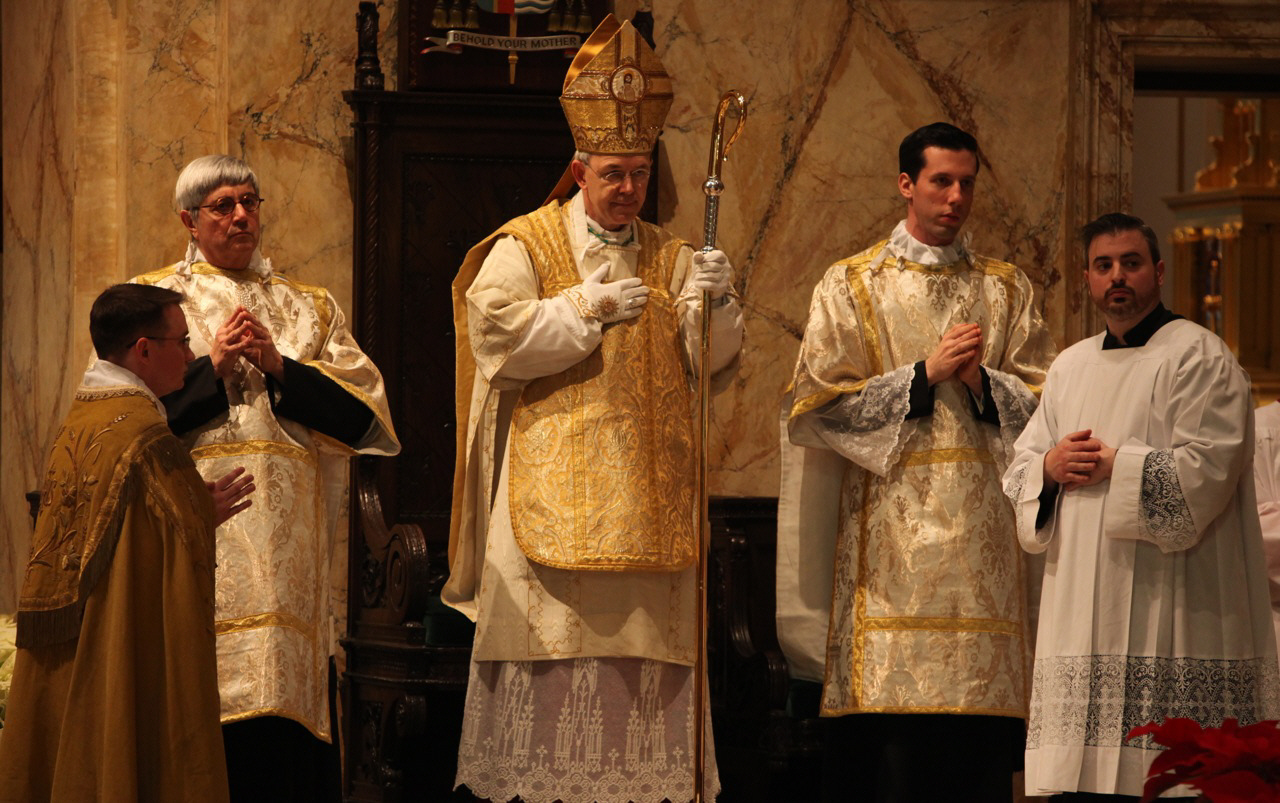
The first liturgical event on the agenda of the pilgrimage was vespers in the Pantheon, or St. Mary of the Martyrs. Bishop Athanasius Schneider presided and preached (he had also spoken at the conference held earlier that day). To participate in a sung Catholic liturgy in the evening in the incomparable surroundings of the Pantheon is a unique experience.
Did not the feast of All Saints, to be celebrated in the following week, have as one of its sources the dedication of this building to Christian worship at the beginning of the 7th century? Did not that dedication in 609 take place in a time of momentous cultural transition, as the ancient world and the Roman Empire were coming to an end while a new era of Christendom was emerging? Yet for contemporaries, of course, the outlines of the future could only be dimly perceived. Today, 1400 years later, we find ourselves in a new age of great cultural transition, in which the last vestiges of the Christendom appear to be disappearing from the West. This pilgrimage, however, testifies eloquently that at least some are not capitulating and remain willing to labor and sacrifice for the restoration of Christendom, however improbable that goal might seem at this moment . The means for starting that undertaking, however, are very clear and concrete: preservation of the liturgy of the Church .
On Saturday the heart of the pilgrimage, the procession to Saint Peter’s, took place. The procession, holding aloft the banners of all the countries involved in the traditionalist movement, looked wonderful and as always attracted a great deal of attention from tourists and spectators. Because of security concerns at the Vatican, there was a delay of an hour or more before the pilgrims could actually enter the basilica. Was this deliberate? We do not know. What occurred inside the basilica was reverent; but obviously chanting the hour of sext is an inadequate substitute for a solemn mass, pontifical or otherwise. The Vatican, however, by refusing permission to celebrate the Mass, drew more attention to the pilgrimage than even the most beautifully celebrated liturgy could have done.
On Sunday the concluding liturgy of the pilgrimage was celebrated at Santissima Trinita dei Pellegrini -splendidly, as usual. Of course, this church is totally inadequate for current dimensions of this pilgrimage. The same could be said, with even greater force, for the elegant but small ICRSS church of Sts Celsus and Julian, from which the procession to Saint Peter’s departed on Saturday. It is obvious, given the current numbers of pilgrims, that one or the other of the otherwise underutilized basilicas of Rome would be far more appropriate. After all, hadn’t the Vatican made available St. John Lateran to the Copts and the Anglicans to conduct their services? Traditionalists, however, are unlikely to enjoy similar favors under the current pontificate.
What was the mood of the pilgrims? To the extent I could judge it, the atmosphere was calm, recollected, and resolute. The focus was on participation in the religious services of this event, not on discussion or controversy. That is very much in line with the prior pilgrimages. The purpose of the Pilgrimage Summorum Pontificum, after all, is not to make overtly political statements – even on Church politics – but to show to the Church and to the world that the traditionalist movement is intact and even growing.
Of course, in private conversations, especially with clergy not directly connected with pilgrimage, concerns were voiced for traditionalism and even for the Church as a whole. I heard fears expressed – not regarding the pilgrimage – as to what photographs could be published or how the Vatican has reacted violently to the publicity given to certain masses. It is a sad reflection on the Roman Catholic Church that this pope has succeeded in establishing such a pervasive climate of fear. And this Church fancies itself to be “evangelical”?
This pilgrimage did not take place in a vacuum. It coincided with two major developments in the Catholic world at large. First, the first phase of the Synod on Synodality was coming to an end. Its discussions followed a completely secular format, and studiously avoided the main questions facing the Church today. And while couched in nebulous and noncommittal language, the synod’s closing summary left a clear expectation that radical changes in the Church’s morality and theology might well be forthcoming by the time of the next session of the synod in 2024. Again, it is a sad testimony to the state of the Roman Catholic Church that it can only communicate to the faithful and to the world employing such a convoluted and meaningless style.
But the end of the Synod on Synodality was overshadowed by the developments in the Rupnik case. First came the public announcement of this priest’s incardination in a Slovenian diocese, accompanied by statements seeming to exonerate him. Second, after the resulting entirely predictable media explosion, there followed an immediate dramatic reversal by the Pope of his decision not to lift the statute of limitations on certain allegations against Rupnik. All this occurred at the same time that the Vatican was (re)issuing platitudes on listening to the faithful and responding to the victims of clerical sex abuse. Once again, the leadership of the Roman Catholic Church demonstrated to the world its total lack of candor and honesty.
Yet, in the face of this universal confusion, thanks to the pilgrims, we had experienced for a few days the firm faith and solidarity of Catholic tradition. Despite the relentless continued persecution and official disdain, the pilgrims had assembled to witness to the continued vitality of the traditionalist movement. And the Pilgrimage Summorum Pontificum was not alone in Rome this autumn! It was preceded and followed by allied events (a book launch by Bishop Schneider and Cardinal Sarah; a forum sponsored by Life Site News). The message to traditionalists is clear: you are not alone!
A visit to the curious neogothic church of the Sacro Cuore del Suffragio, in the early evening . struck a somber and solemn concluding note. The extravagant neogothic façade of this church, completed in 1921, overlooks the Tiber next to the monstrous 19th century court building. Inside, this church is a veritable encyclopedia of the art of the Catholic Church in the first two decades of the 20th century. The pervasive theme is that of the reality of the poor souls in purgatory and of our duty to pray for them. Indeed, this church is most famous for the unique museum of the poor souls of purgatory, found in the sacristy. This museum features exhibits that offer tangible evidence of visitors from beyond the grave. These guests from beyond admonish those still in this world to remember the souls in purgatory in their prayers and to provide for the celebration of masses on their behalf. In the month of November, we pray for the dead, but a visit to this church had already focused my thoughts on the deceased. It was a fitting spiritual conclusion to this pilgrimage.
6
Nov
3
Nov

The Summorum Pontificum pilgrimage came to a close in Rome on Sunday October 29 with a Solemn Mass for the Feast of Christ the King at Santissima Trinità dei Pellegrini, the parish church of the FSSP.


On Saturday October 28, pilgrims met at the Basilica of Saints Celso & Guliano for Eucharistic adoration and the Rosary. Outside, pilgrims got ready to process to St. Peter’s Basilica.


The church of Sacro Cuore del Suffragio ( or Sacro Cuore di Gesù in Prati ) as seen on a sombre evening in Rome last week. Completed in 1917, its extravagent neo-gothic style is unlike any other in the center of Rome. The church overlooks the Tiber and is situated next to the truly monstrous court building ( a structure which, like the “Altar of the Fatherland,” is a legacy of the post-1870 regime in Rome).


Inside is a vast Gothic hall adorned with art in an extraordinary syle showing neo-Gothic, Pre-Raphaelite and Art Nouveau influences. A unified ensemble very much a part of its time: the 1890’s to the 1910’s. An underlying theme of the entire Gesamtkunstwerk is remembrance of the dead and prayer for the poor souls in purgatory.


But this church is most famous for the Museum of the Souls in Purgatory. It displays objects showing tangible evidence of visitations to the living of souls in purgatory. The exhibits typically are prayer books or articles of clothing that feature burn marks of hands or fingers left by the deceased. These testimonies have a common theme we should all remember: keep praying and offering masses for the souls in purgatory.

For a description of the church, see:
https://en.wikipedia.org/wiki/Sacro_Cuore_del_Suffragio#Façade
For an appreciation (in Italian)by famous traditionalist Cristina Campo, see:
https://it.wikiquote.org/wiki/Chiesa_del_Sacro_Cuore_del_Suffragio
1
Nov

(Above) Each morning at 6:30 – 7:15 during the week of the pilgrimage at the FSSP church of Santissima Trinità dei Pellegrini a priest celebrated at each side chapel, often before a congregation. This was in addition to the regular masses at the main altar.

(Above and below) Friday, October 27, the first day of the pilgrimage. Before the start of Vespers in the Pantheon (the Basilica of St. Mary of the Martyrs).


(Above) Bishop Athanasius Schneider presided and preached at the Vespers.


(Above) Bishop Athanasius Schneider processing from the Pantheon.
Connecticut
St. Mary Church, Norwalk, 8 am Low Mass, 7 pm Solemn Mass.
Sacred Heart Oratory, Redding, 6 pm
Sts. Cyril and Methodius Oratory, Bridgeport, 7:45 am Low Mass, 6 pm Missa Cantata
St. Patrick Oratory, Waterbury, 8 am Low Mass, 6 pm Missa Cantata
St. Stanislaus Church, New Haven, NO MASS SCHEDULED owing to the unavailability of a priest to celebrate the Mass.
St. Martha Church, Enfield, 7 pm
New York
Holy Innocents Church, New York, NY, 8 am Low Mass, 6 pm Missa Cantata
Our Lady of Mount Carmel, New York, NY, 7 pm
St. Josaphat Church, Bayside, Queens, 7 pm
St. Rocco, Glen Cove, Long Island, 7 pm
St. Matthew, Dix Hills, Long Island, 10:30 am
St. Paul the Apostle, Yonkers, 12 noon
Annunciation Church, Crestwood, lower church, 7 pm Missa Cantata
Immaculate Conception Church, Sleepy Hollow, 7 pm low Mass
New Jersey
Our Lady of Sorrows, Jersey City, 5 pm
Our Lady of Victories, Harrington Park, 5:30 pm
St. Anthony of Padua, West Orange, 9 am, 7 pm
Our Lady of Fatima, Pequannock, 7 am, 9 am, 12 noon, 7 pm
Corpus Christi Church, South River, 7 pm Missa Cantata
Connecticut
St. Mary Church, Norwalk, 8 am Low Mass, 7 pm Solemn Requiem Mass
Sacred Heart Oratory, Redding, 6 pm Solemn Mass with absolution at the Catafalque, 7:30 pm, Blessing of soul lights and distribution of soul cakes.
Sts. Cyril and Methodius Oratory, Bridgeport, 7:45 am and 8:25 am, Low Mass, 6 pm Solemn Mass and absolution at the catafalque
St. Patrick Oratory, Waterbury, 8 am Low Mass, 6 pm Missa Cantata
St. Stanislaus Church, New Haven, NO MASS SCHEDULED owing to the unavailability of a priest to celebrate the Mass.
St. Martha Church, Enfield, 7 pm
New York
Church of the Most Holy Redeemer, New York, NY, 7 pm, Solemn Requiem Mass
Holy Innocents Shrine and Church, 128 W 37th St, 8 am Requiem Low Mass, 5:15 PM Requiem Low Mass, 6 pm Requiem High Mass
Our Lady of Mount Carmel Shrine, 448 E. 116th St., 7:00 am Requiem Low Mass, 7:45 am Requiem Low Mass, 7 pm Solemn Requiem Mass
St. Josaphat Church, Bayside, Queens, 7:00 pm Requiem High Mass
Our Lady of Refuge, Bronx, 6:30 PM Requiem Mass
St. Rocco, Glen Cove, Long Island, 7 pm
St. Matthew, Dix Hills, Long Island, 10:30 am
St. Paul Church, Yonkers, 12 Noon Requiem Mass
Annunciation Church, Crestwood, lower church, 7 pm Missa Cantata
Immaculate Conception Church, Sleepy Hollow, 7 pm low Mass
New Jersey
Our Lady of Sorrows, Jersey City, 7 pm
Our Lady of Victories, Harrington Park, 5:30 pm
St. Anthony of Padua, West Orange, 9 am, 7 pm
Our Lady of Fatima, Pequannock, 7 am, 9 am, 12 noon, 7 pm