St. Gabriel Church in Stamford, CT will offer a Traditional Mass for the feast of Our Lady of Lourdes on Friday, February 11 at 7:30 pm. It will be Low Mass with organ followed by Rosary and Benediction of the Blessed Sacrament.
21
Jan
Published in Masses | no comment
21
Jan
There will be Solemn Vespers followed by Benediction at the Church of the Holy Innocents in Manhattan this Sunday, January 23rd at 3:00 PM. This Sunday Vespers will include a short sermon by the celebrant.
Published in Masses | no comment
21
Jan
The Most Reverend Joseph N. Perry, Auxiliary Bishop of Chicago, will celebrate a traditional Solemn Mass in the New Chapel at Holy Apostles Seminary in Cromwell, CT, on Monday February 7, at 11:00 A.M.
Published in Masses | no comment
21
Jan
Effective January 7, the Traditional Mass will be celebrated on the first Friday of each month at 8:30 a.m.at St. Stanislaus Church in New Haven, so that area Catholics devoted to the traditional Latin Mass can fulfill the requirements of the “nine first Fridays” in devotion to the Sacred Heart of Jesus as prescribed by St. Margaret Mary Alacoque.
Published in Masses | no comment
20
Jan
A short essay by Martin Mosebach, who will be returning to the New York area at the end of next week. For the schedule of events: “https://sthughofcluny.org/2011/01/visit-of-martin-mosebach.html”
The reform of the liturgy did away with four characteristics of the old Confiteor prayer:
The profound bow in which he prayer was spoken;
The structure of the prayer as a dialogue between the priest and the congregation;
The invocation of various saints by name; and, finally,
The sacramental of absolution.
The profound bow is the oldest part of the prayer. In the early days of Christianity every mass began with the prostration. A person threw himself on the ground in order to approach oriental kings. The early Christians for this reason chose this most reverent form of showing devotion and subjection when they had to enter the presence of the God-man and His sacrifice. At first nothing was said. In the 8th century the custom arose of saying at this point during the prostration (which had gradually evolved into a deep bow) the confession of sins as it had been prescribed from the beginning for the start of the sacrificial rite of the New Testament.
The dialogue form of the Confiteor derives from the divine office of the monks. It was always exchanged between two neighbors in the choir stalls; one monk confessed his sins to the other – the other monk begged God’s mercy for him. In the pontifical solemn mass of the old rite this tradition is preserved; here the Confiteor is recited by two canons. This form sprang from the insight that most sins against God are at the same time sins against one’s neighbor too, that repentance must lead to reconciliation and that every man must rely on the prayer of others. In order to really acknowledge one’s guilt a listener is necessary. In order that, after the confession, the intercessory prayer of the listener may effectively develop the confessing party is obliged to keep silence. A further element of meaning was added as the relation between neighbors on a bench became a relationship between priest and congregation. The priest, who had been called to perform the sacrifice in the person of Christ, confessed now before the entire community his imperfection and, profoundly bowing, awaited their intercession. One could say that only this gave him the courage to ascend the altar.
The formula “indulgentiam” which follows the confession of sins and the petitions for forgiveness is an early formula for absolution. The sign of the cross which the priest makes while speaking this prayer has taken the place of imposition of hands. The relationship of this absolution to absolution in the sacrament of penance will not be examined further here. In any case it is clear that the Church regarded the “indulgentiam” as a sacramental that absolves from venial sins. That the celebration of the sacrifice began with absolution was only logical for a cult that had as its object the representation of Christ’s sacrificial death – a death for the redemption of men from the burden of their sins.
These three elements of the Confiteor united the celebrating community with early Christianity and monasticism, made concrete the general confession of sin and revealed it as the first stage of the sacrifice. In contrast to their removal, the replacement of the individual saints’ names through the formula “and all the saints” is the easiest to accept. Heaven appears in these names as a hierarchically structured royal household. At the very top is the “Queen of angels, patriarchs and apostles”, then the “prince of the heavenly hosts”, thereafter the”first of those born of woman” and finally the “princes of the apostles.” Innumerable works of art have adopted this figurative language in perpetually new forms. Its nucleus is the insight that order is inherent in God’s creation; yes, that God Himself is order. Medieval man could still imagine that even among the saved there are different degrees of closeness to God and different kinds of relation to Him. Did the “reformers” believe at the end that they had to accommodate democratic conventions especially by emphasizing the equality of all “saints” effected by the redemption? Or did they only want to eliminate an intricate gothic frill when they banished from the Confiteor the hierarchically structured procession of saints?
The beauty of liturgical texts often lies in the fact that they disclose meanings on different levels. They move one to meditation and reveal themselves to meditation. The hierarchy of saints appears here as a metaphor for the Divine order in a prayer concerning the confession of sin, thus disorder. It is not surprising that all representatives of this order have something special to say to the disorder of sin that is revealed to them in the prayer.
The list begins with Mary. She represents the original form of man: God intended man to be what Mary is. Untouched by original sin and with undefiled virginity, she resembles man on the sixth day of creation: whole, the image and likeness of God, transparent for the unceasing stream of grace. As Mary is, so must the sinner be. The restoration of the sinner bears the features of Mary in iconic personalization.
The Archangel Michael is linked to the mystery of the genesis of evil. He fought Satan and therefore the source of sin and of every individual sin, which, like its diabolical model, consists in the rebellion against the divine order. But the Archangel Michel also reminds us that the devil has been defeated. He can tempt the individual sinner but never seize dominion over God’s creation. With a glance at the archangel the sinner recognizes the origin and the impotence of his deed.
John the Baptist shows the way of redemption: conversion. It is a spiritual act but must be expressed in activity in order to communicate to the sinner the reality of his decision. Water, which washes away bodily filth, also has to wash the soiled soul. Prayer has to distract from himself the spirit trapped in self-love. Corporal privation has to free the soul from the pressure of habit. John the Baptist embodies the practical steps that the sinner can take if he wishes to free himself from sin.
Peter holds the keys of the kingdom of heaven; he represents the power of absolution of the Church. He communicates to the sinner who wishes to convert the certainty that true forgiveness will answer his desire – even that this desire often enough will be accepted in place of the act. Christ, the forgiver of sin, is present in Peter and in the Church. Peter himself above all others had experienced His forgiving power. Peter is the sacrament, the unworthy vessel through the power of God flows.
Finally, Paul teaches the condition under which the sacrament develops: the belief of the sinner that Christ can heal him of his infirmities. This faith is a gift of grace. With this gift begins the labor of the restoration of the sinner. The objective of this restoration is man born again in grace. With this the circle is closed. The contemplative proceeded from Mary and returns to her.
In preaching her doctrines the ancient Church chose again and again the path of making them visible in the form of man. The countenance of man gave them a life lacking in theoretical formulations. The figures of the saints as understood by the ancient church are not pious decoration or mass –produced “Roman Plastic cardboard” (as Andre Gide wrote). Whoever believes he can eliminate them without diminishing the teaching of Jesus Christ misunderstands the essence of the Church – which consists above all of these very saints. In the case of the Confiteor prayer, it is these very saints who teach the worshipper to understand his confession correctly. For he will speak it differently when he knows that their eyes gaze upon him.
Martin Mosebach
Published in Essays, Martin Mosebach | 1 comment
WASHINGTON, D.C. – Following the reverent Pontifical Mass in the Extraordinary Form last April 24 at the Basilica of the National Shrine of the Immaculate Conception, The Paulus Institute is pleased to announce a Pontifical Solemn High Mass, to be offered Saturday, April 9, 2011, at 1 p.m., also in the Extraordinary Form at the High Altar of the Shrine, honoring Pope Benedict XVI on the 6th anniversary of his inauguration. All the Catholic Faithful are invited.
The celebrant, from the Vatican, will be the American Archbishop Joseph Augustine DiNoia, O.P., Secretary of the Congregation for Divine Liturgy and the Discipline of the Sacraments. His Excellency holds four theology degrees or certificates. He taught theology for 25 years at the Dominican House of Studies and was executive director for 7 years of the Secretariat for Doctrine and Pastoral Practices of the now United States Conference of Catholic Bishops.
Published in Events | no comment
17
Jan
Beginning Sunday, March 13th: 8:30 a.m. — Latin Mass in the Extraordinary Form (Low Mass).
Address: 279 Atlantic Street
Stamford, CT 06901
203.324.1553
Published in Masses | no comment
13
Jan
The conference is organized by Georgetown students and involves a number of students and priests who support the Traditional Latin Mass in both New York and Washington, DC. Fr. Stephen Fields, S.J., the main celebrant of the Solemn Mass at Fordham last February, will be giving a breakout session; and Fr. Joseph Koterski, S.J., who offers the Monday night Latin Mass at Fordham, will be moderating a panel featuring Archbishop Edwin O’Brien, Bishop William Lori, Mother Agnes Mary Donovan, S.V., and Helen Alvare.
Francis Cardinal George will offer the conference’s opening Mass on Saturday, January 22, and the main session of the conference will be held the next day, Sunday, January 23, the day before the annual March for Life—perfect for pilgrims! More details are available on the website HERE.
Published in Events | no comment
13
Jan
Visit of Martin Mosebach
Posted by Stuart ChessmanGERMAN NOVELIST RETURNS TO U.S. FOR PRESENTATIONS ON CATHOLIC MASS
New York, NY, January 13, 2010 – Martin Mosebach, celebrated German novelist and essayist, returns to
the United States to deliver two presentations on the traditional Roman Catholic Mass. Before each
presentation, there will be a celebration of this Mass in its solemn form. A reception and book signing will
follow each presentation. The events are sponsored by The Society of St. Hugh of Cluny.
Mosebach will first present a lecture in New York City entitled “The Old Roman Missal: Loss and
Rediscovery” on Sunday January 30 at the Church of Our Saviour. He then travels to St. Mary Church in
Norwalk, Connecticut, for a reading of his essay “„Tear the Images out of Their Hearts‟: Liturgy and the
Campaign against Images” on Wednesday, February 2. While in New York City, he also visits the Goethe
Institute for a reading and discussion of his novels with critic Liesl Schillinger of the New York Times Book
Review.
Winner of Germany‟s most prestigious literary award, the Georg Büchner Prize, in 2007, Mosebach‟s
critically acclaimed novels are not yet generally available in English translation. His essays have already
appeared in the United States, including his widely read New York Times op-ed piece on the election of
Joseph Cardinal Ratzinger, Pope Benedict XVI. Mosebach is still best known outside Germany for his
2002 tour de force, The Heresy of Formlessness (Ignatius Press, 2006), a sometimes controversial
collection of essays on the Mass and the radical changes made to it following the Second Vatican
Council. Mosebach‟s literary eminence drew international attention to his analysis of these changes and
propelled his conclusions into the middle of any future discussion of reform.
The Schola Cantorum of St. Mary Church, under the direction of David J. Hughes, choirmaster and
organist, will provide music for both of the Masses. On Sunday, January 30, the Fourth Sunday after
Epiphany, the choir will sing the Missa Ave maris stella by sixteenth-century Spanish composer Tomás
Luis de Victoria. For the ancient Feast of Candlemas on Wednesday, February 2, they will premiere
Hughes‟ Missa de Beata Maria. Each Mass will also include polyphonic motets by masters of the English,
Italian, and Franco-Flemish Renaissance styles (Byrd, Palestrina, and Josquin), as well as the timeless
melodies of Gregorian chant.
The Society of St. Hugh of Cluny was founded in 2007 shortly after Pope Benedict‟s Motu Proprio
“Summorum Pontificum” gave new impetus to the recovery of the traditional form of the Mass. The
Society sponsors lectures, workshops, and liturgical functions in the greater New York area, with a
particular emphasis on the intersection of religion, culture, and the arts. It seeks to contribute to the
“recovery of Catholic liturgy” and its restoration to the center of the life of the Church and society.
For more information, call 646-496-5470 or visit the website of The Society of St. Hugh of Cluny,
www.sthughofcluny.org.
New York
Solemn Mass: Fourth Sunday after Epiphany
Lecture: “The Old Roman Missal: Loss and Rediscovery”
Date: Sunday, January 30
Time: Mass at 5:00 PM; Lecture at 7:00 PM
Location: The Church of Our Saviour, New York, NY (59 Park Avenue)
Connecticut
Solemn Mass: Candlemas (The Feast of the Purification of the Blessed Virgin Mary)
Reading: “„Tear the Images out of Their Hearts‟: Liturgy and the Campaign against Images”
Date: Wednesday, February 2
Time: Mass at 6:00 PM; Reading at 8:00 PM
Location: St. Mary Church, Norwalk, CT (669 West Avenue)
The Goethe Institute event is on February 1 at 6:30 PM. For more information, call 212-439-8700
Published in Events | no comment
9
Jan
Arson in Solothurn Cathedral
Posted by Stuart Chessman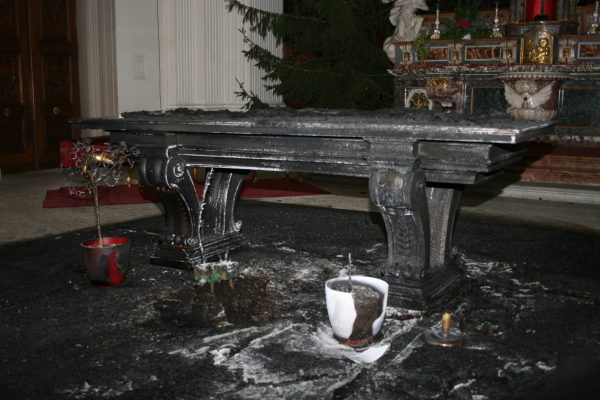
The Cathedral of Solothurn, Switzerland, is a late baroque/early Neoclassical structure. On January 4, a man, in a rage against the Church, set the interior ablaze. Extensive damage , especially from smoke, resulted. But the specific target of the arsonist – and the location of most of the damage from flames – is the new “versus populum” altar, known in German as the “Volksaltar” (“people’s altar”). Now, where exactly was this arsonist coming from?
(Photo: 20 Minuten, Peter Marbach)
Published in Uncategorized | no comment
Contact us
Register
- Registration is easy: send an e-mail to contact@sthughofcluny.org.
In addition to your e-mail address, you
may include your mailing addresss
and telephone number. We will add you
to the Society's contact list.
Search
Categories
- 2011 Conference on Summorum Pontifcum (5)
- Book Reviews (108)
- Catholic Traditionalism in the United States (27)
- Chartres pIlgrimage (17)
- Essays (181)
- Events (695)
- Film Review (7)
- Making all Things New (44)
- Martin Mosebach (35)
- Masses (1,381)
- Mr. Screwtape (46)
- Obituaries (20)
- On the Trail of the Holy Roman Empire (26)
- Photos (357)
- Pilgrimage Summorum Pontificum 2021 (7)
- Pilgrimage Summorum Pontificum 2022 (6)
- Pilgrimage Summorum Pontificum 2023 (4)
- Sermons (79)
- St. Mary's Holy Week 2019 (10)
- St. Mary's Holy Week 2022 (7)
- St. Mary's Holy Week 2023 (7)
- St. Mary's Holy Week 2024 (6)
- St. Mary's Holy Week 2025 (7)
- St. Mary's Holy Week 2026 (11)
- Summorum Pontificum Pilgrimage 2024 (2)
- Summorum Pontificum Pilgrimage 2025 (7)
- The Churches of New York (211)
- Traditionis Custodes (56)
- Uncategorized (1,409)
- Website Highlights (17)
Churches of New York
Holy Roman Empire
Website Highlights
Archives
Support the Society of St. Hugh of Cluny
[powr-hit-counter label="2775648"]