.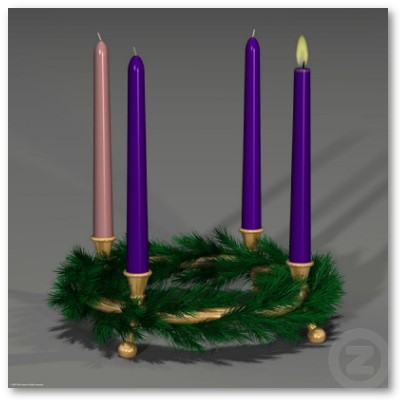
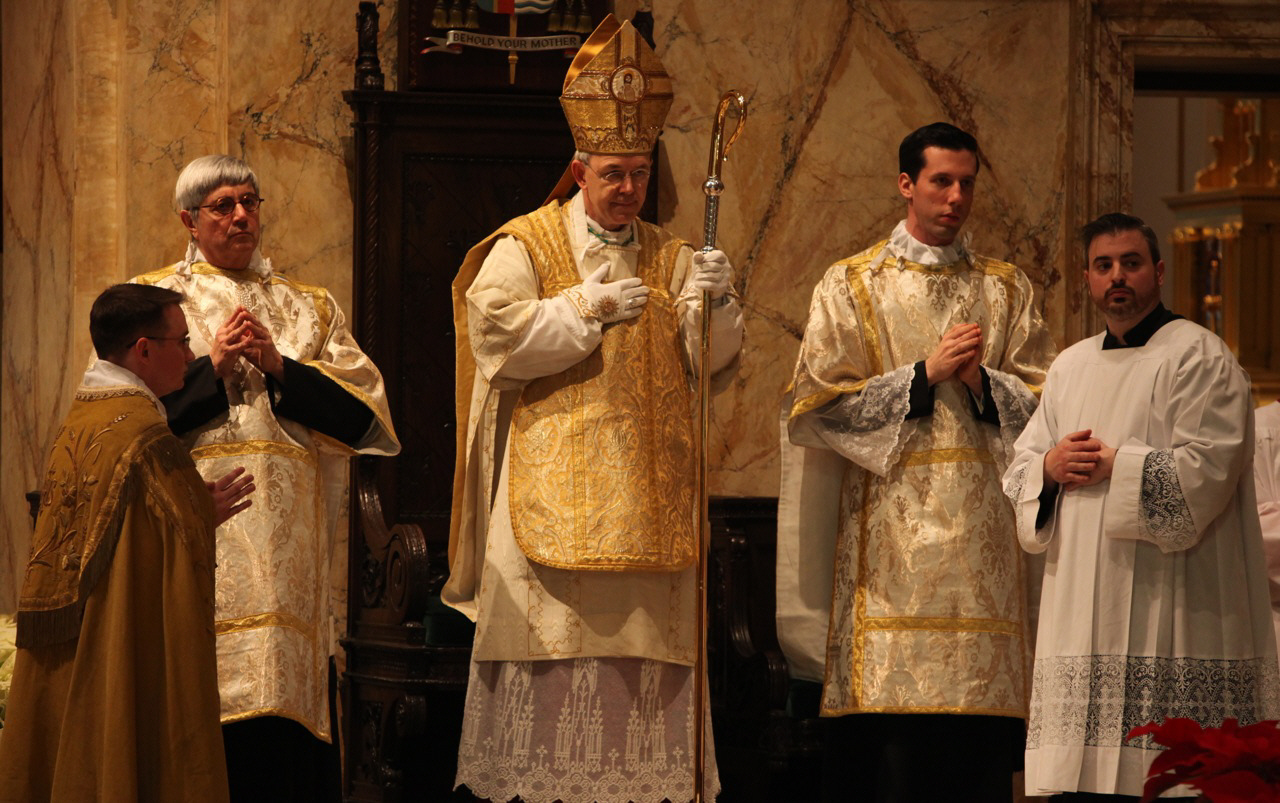
A sung extraordinary rite mass for the First Sunday of Advent,will be celebrated at 3:00 PM, November 28, 2010 at the Church of the Assumption,131 Union Avenue, Peekskill, NY 10566.
Rev. James McLucas will be the celebrant
.
A sung extraordinary rite mass for the First Sunday of Advent,will be celebrated at 3:00 PM, November 28, 2010 at the Church of the Assumption,131 Union Avenue, Peekskill, NY 10566.
Rev. James McLucas will be the celebrant
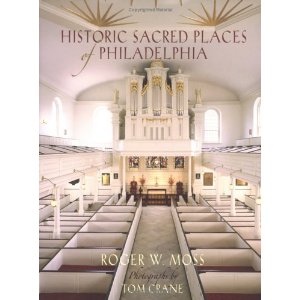
Roger W. Moss
Photographs by Tom Crane
(University of Pennsylvania Press, Philadelphia, 2005)
In the last decade or so we have seen growing efforts to evaluate and preserve the precious legacy of America’s religious architecture. These structures provide a unique point of reference for cities, neighborhoods and small towns. For example, monstrous commercial and apartment buildings may be the overpowering visual presence in New York today – but who can think of even Midtown Manhattan without St. Patrick’s or St. Thomas – or, further south, Trinity or Grace Churches? Yet, in the “official” story of American architecture only the secular is emphasized: residences, office buildings and colleges.
In this book, Roger Moss and photographer Tom Crane aim to remedy that defect – at least for the City of Brotherly Love. The author is Director of the Athenaeum of Philadelphia, an adjunct professor of architecture at the University of Pennsylvania and also a seasoned veteran of the local preservation wars. Moss has selected 50 of the leading houses of worship of Philadelphia to illustrate the heritage of religious architecture of this city. For each church he provides a short clear description (focusing perhaps too heavily on architecture) along with several splendid photographs.
Now this volume offers some surprises for those more familiar with the situation in New York. For the genius of Philadelphia ecclesiastical architecture seems to have remained close to its 18thcentury neoclassical roots, whereas on the Hudson, thanks to Upjohn, Renwick, Goodhue and Cram the Gothic predominated. Except for a remarkable series of (non-Catholic) Gothic structures starting from the middle of the 19th century onward, the classical and later the baroque remained the preferred idiom. Furthermore, although perhaps only due to the author’s selection, it seems that Philadelphia church architects, like their Chicago colleagues, had more opportunity to spread out and create more elaborate architectural forms – in contrast to the constraints imposed by the confined space of Manhattan.
Of course what primarily interests us are the Catholic churches of which the author provides a representative if not exceedingly large cross-section. A unique treasure is a set of three churches going back to the 18th century (even if later rebuilt or modified). One, Old Saint Joseph’s Church, is a kind of Catholic speakeasy, accessed through a gate leading to a European style courtyard. In another, Holy Trinity is a painting by Francis Martin Drexel from Tirol – who would later exchange his studio for a brokerage office and found the Drexel financial family (of which St. Katherine Drexel was a descendent). A remarkable number of these Catholic churches appear to have preserved their interiors and sanctuaries more or less intact. Indeed, the author is very much interested in the subject of preserving the original interior decoration. In that regard, what are the thoughts of the author regarding Vatican II and its fruits?
(On Holy Trinity) “…the present Victorian altar survived the misguided destruction prompted by Vatican II that was visited on nearby St. Mary’s. A simple oak table placed facing the congregation now serves as an altar, thereby preserving the white and gilt confection that stretches across the apse at the east end.”(p. 117)
(On the high altar of St. Augustine’s Church) “Fortunately it escaped the misinterpretation of Vatican II that led to the destruction of so many altars.” (p. 89)
(On Old St. Mary’s) “Efforts to modernize the interior of Old Saint Mary’s in the post-Vatican II era resulted in the destruction of many 19th century embellishments.” (p.59 – with a picture of the Victorian interior on p. 57)
(On St. Francis Xavier) “Following the Second Vatican Council in 1962, Saint Francis Xavier adopted the new form of Mass, which replaced Latin with the vernacular and began receiving communion in the hand. Fortunately, the parish did not vandalize its high altar, adopting instead the simple expedient of constructing a new wooden altar to face the congregation while saying mass, a solution that might have preserved the altars of many historic churches of several denominations during the revolutionary – some might say radical –days of the 1960’s” (p.233)
(On St. Vincent de Paul) “In 1978-79 the altar rail was removed as part of the alterations relating to liturgical changes following Vatican II.” (p. 274 – apparently the “revolutionary-some might say radical-days” didn’t necessarily end in the 1960’s)
(On St. Francis de Sales) “Liturgical changes following Vatican II created a quandary for Saint Francis de Sales Church. Desiring to protect the neo-Byzantine architecture of (the architect’s) original design” (the parish adopted in 1968 Moss’s favorite solution of positioning a “people’s altar” in front of the main altar). “The entire choir was then illuminated by a curved white cathode light described by one sympathetic critic as a ‘wall that is not a wall, an invisible wall, a symbolic line which defines the new space; it recognizes the history and aesthetic value of the traditional altar, yet defines it as history, a past out of which we are now reaching toward something new.’ To the congregation, however, the light suggested offensive commercial architecture, and it was removed.” (p. 226 – the communion rail gates were also removed)
The author laments that until recently very few churches were on the National Register of Historic Places, attributing that fact to US secularist traditions. But such a listing is certainly unpopular with the denominations as well – first and foremost with the hierarchy of the Roman Catholic Church. For such designations interfere with the ability of the clergy to realize the real estate value of the church buildings.
All in all, this work is not only a splendid introduction to Philadelphia church architecture but also a great handbook for the student and defender of local ecclesiastical architecture who seeks to understand and preserve his own city’s architectural past.
14
Nov
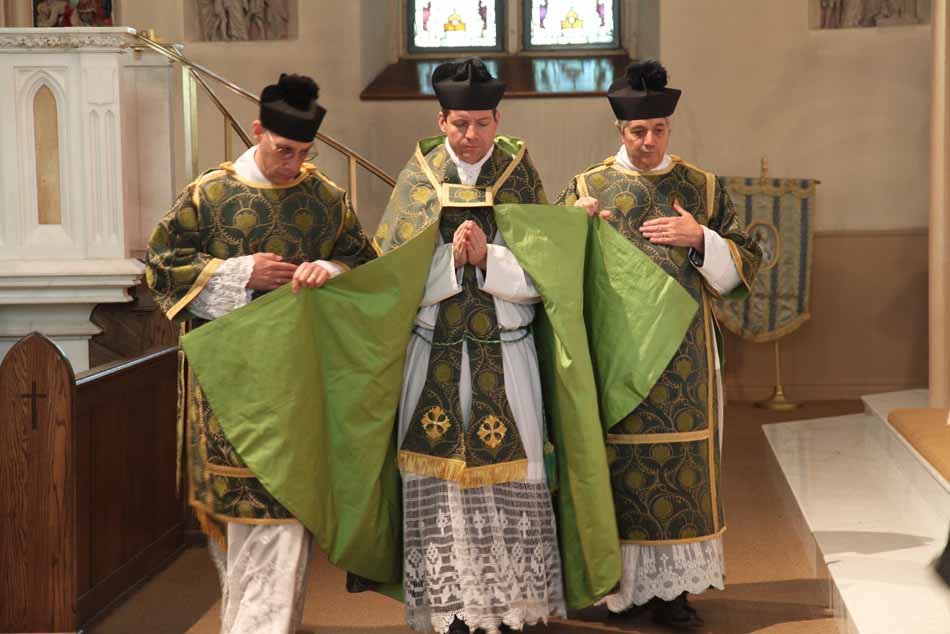
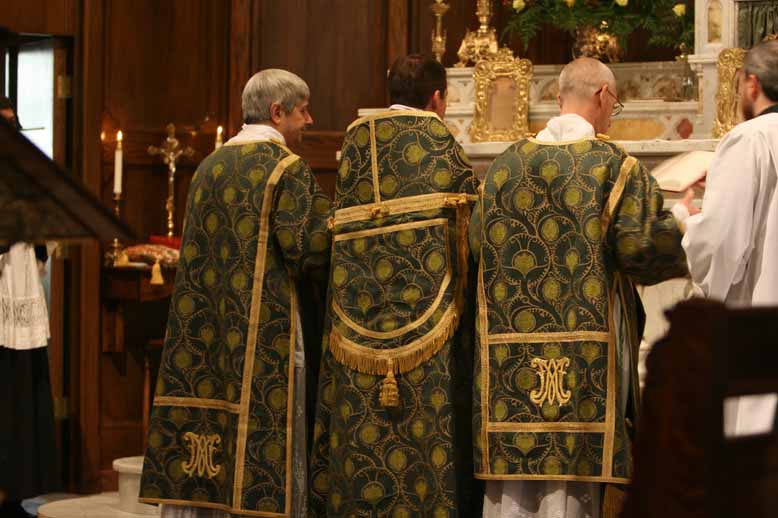
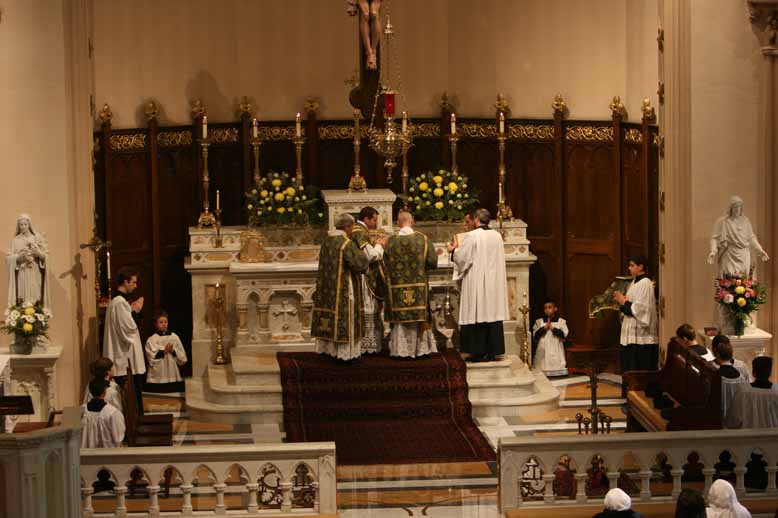
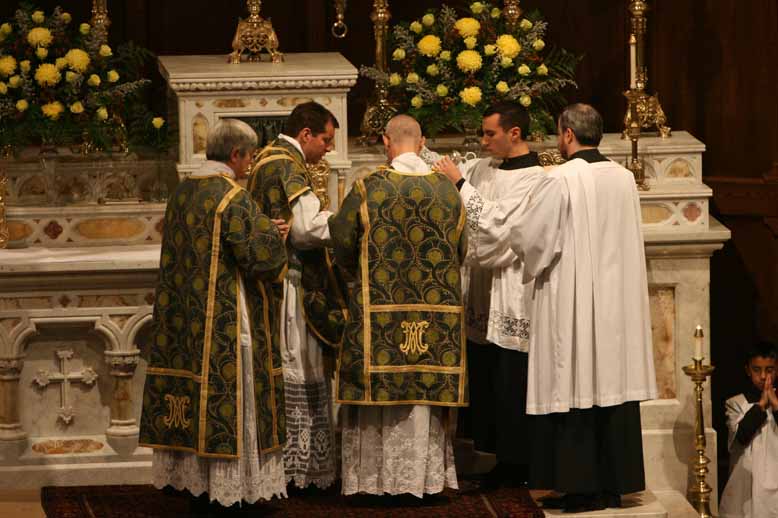
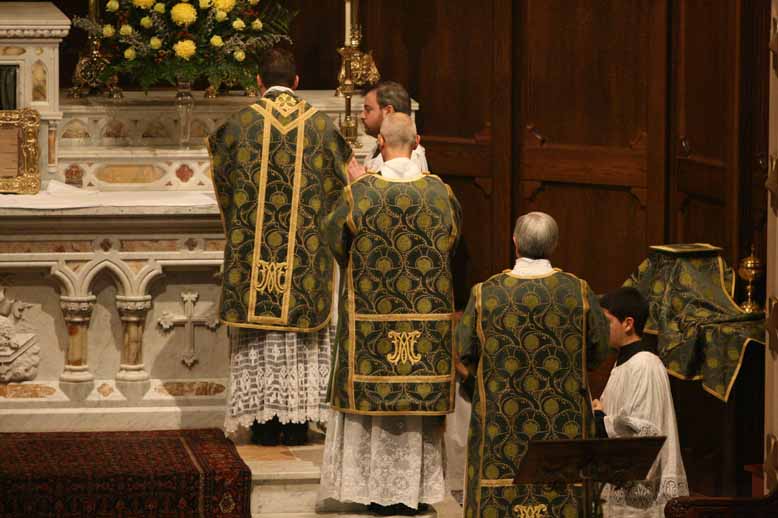
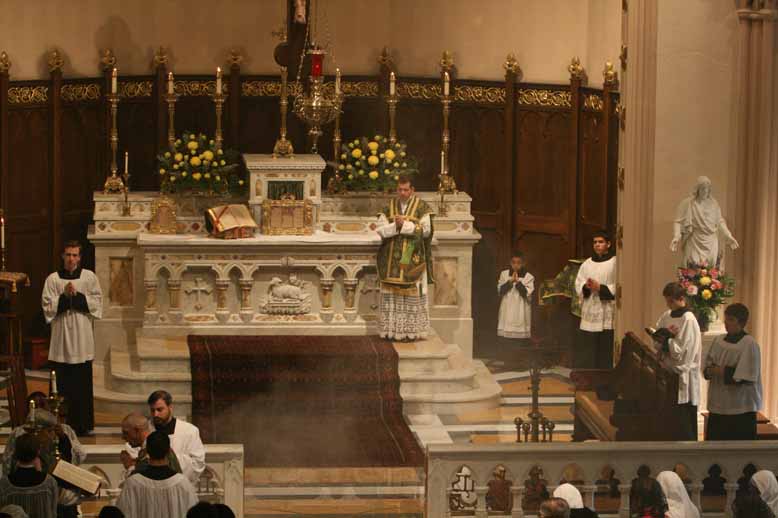
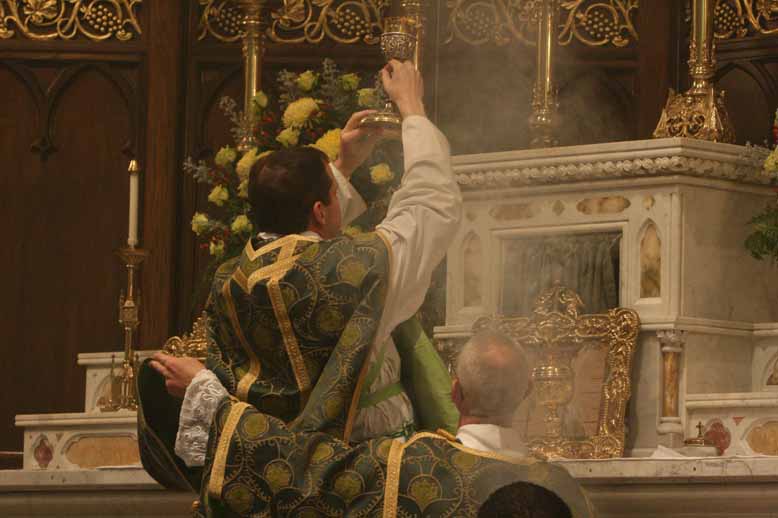
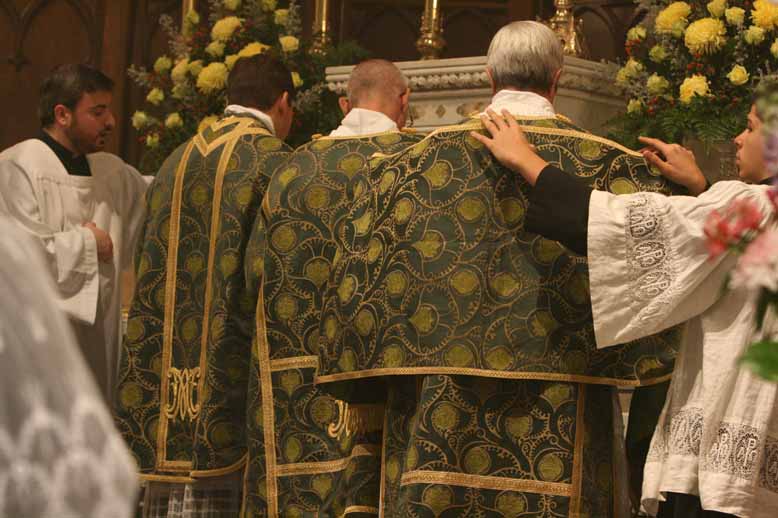
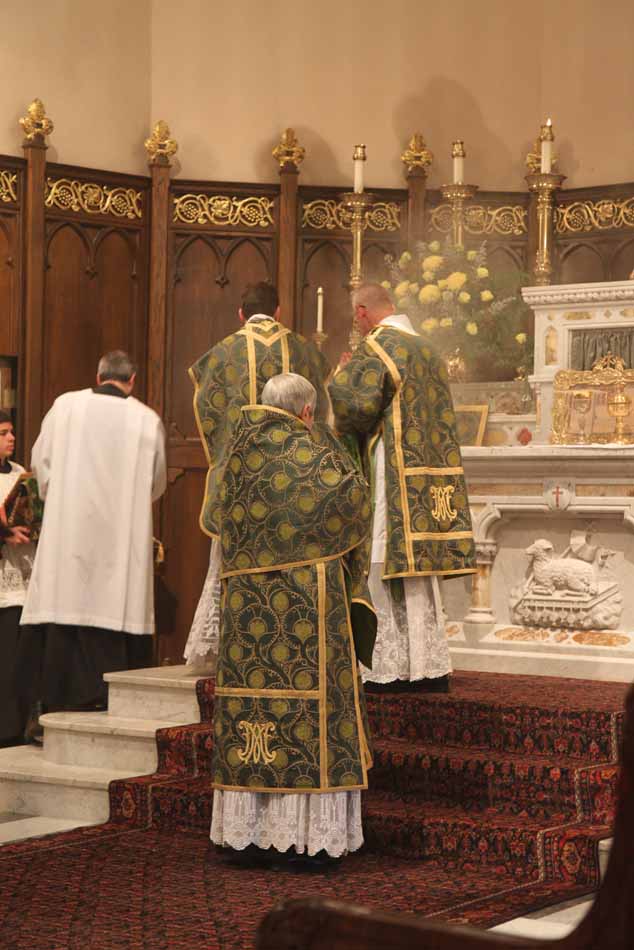
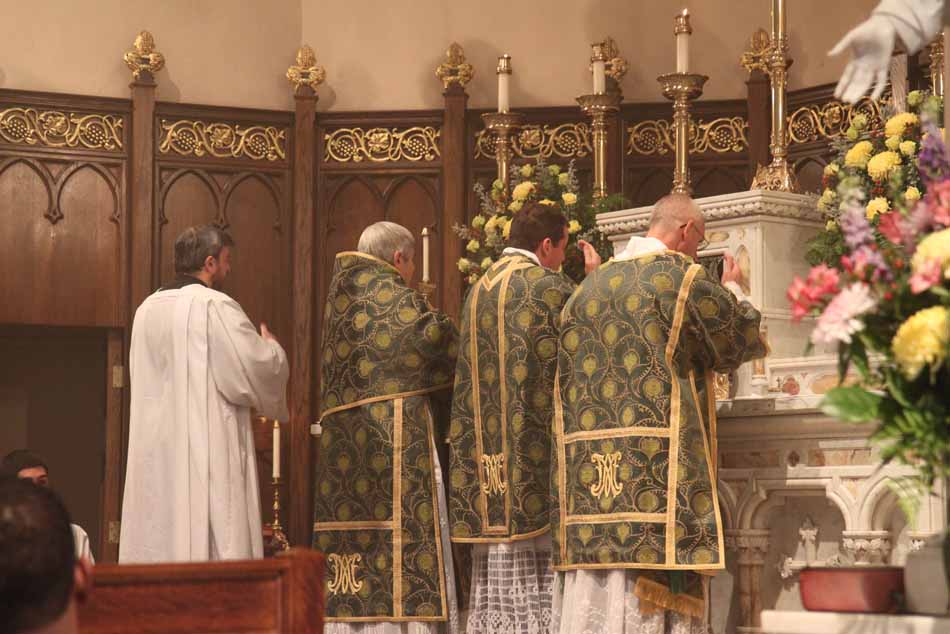
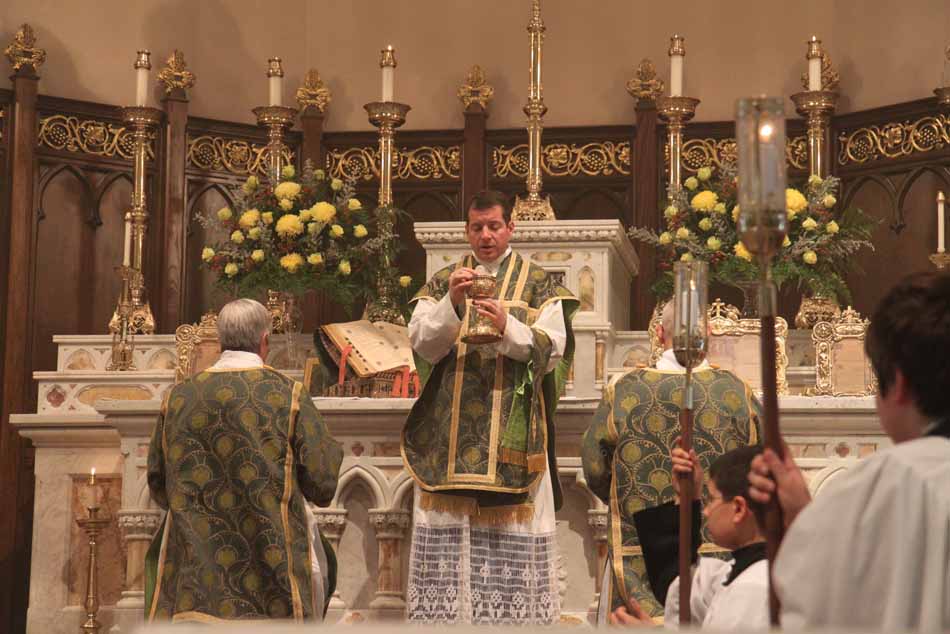
Thanks to a generous benefactor to our Society, St. Mary’s in Norwalk has available a new solemn green set of vestments. They were made by Ars Regia, also known as Tridentinum, located near Bologna, Italy. This enterprise provides reproductions of a many remarkable ancient vestments. Their site (www. Tridentinum.com) is extremely lavish; however, I find it exceedingly difficult to work with.


14
Nov

The Schola Cantorum of St. Mary’s Parish, Norwalk, CT (David J. Hughes, director) will give the third annual St. Cecilia’s day concert on Friday, November 19, at St. Marys’ parish. The schola will sing vespers (in the extraordinary form) of the feast of St. Elizabeth of Hungary at 7:00 PM. The concert will follow at 7:45 PM. A festive wine and cheese reception will conclude the evening. Please see the link on this page to St. Mary’s church for directions.
The concert will feature sacred music of the Iberian and Latin American Renaissance from the Codice del Convento del Carmen, Mexico City. The suggested donation for the concert and reception is $25 ($15 students and seniors). All proceeds will go to the St. Cecilia Society in support of the music program of St. Mary’s parish.

Vision
By Margerethe von Trotta
I can well understand why a Catholic might approach this film with trepidation. For St Hildegard in recent years has been transformed into a patron saint of feminism, New Age and holistic medicine. Certainly from the review in the New York Times one would anticipate a straightforward feminist political treatise with vague hints of lesbianism thrown in. But really the film is not bad at all. Although obviously made from a non-Christian perspective, Vision is actually far more understanding and respectful of the religious vocation than other films in high favor with some Catholics – including those in the Vatican. I need only name in this regard the two most recent, horrendous depictions of the life of St Therese.
Obviously, Vision includes much that is usual in a contemporary and specifically German film. There is an enigmatic opening sequence, for example, where a terrified people is told by clergy to expect the immediate end of the world. The next day (nothing having happened) children emerge into the beauty of the morning. It is similar to the emergence of Audrey Hepburn from the confines of the cloister into the light of the world at the conclusion of the Nun’s Story.
St. Hildegard is presented as an oblate to a double monastery of men and women laboring under dark, “patriarchal” oppression. The male superior, devoted exclusively to monetary gain and social-climbing, is played as a dastardly villain who does everything short of twirling his black mustache. The nuns practice savage corporal chastisements presented in gruesome detail. The representatives of the church tend to be grim, fanatical , blustering types – in contrast to the wise, understanding Hildegard. The film is studded with other clichés: we hear of the “40,000 books” of the emir of Cordoba compared to the Christians’ 400.
But as the film progresses, the stereotypes seem to recede into the background while the character of Hildegard and her fellow nuns comes to the fore. This film seems to make a serious effort to depict St. Hildegard in terms of her own time and as a religious woman. She and her sisters are happy in their vocation. We get a sense of a life of calm, spirituality and beauty. St. Hildegard’s convent is made up normal women with strong and sometimes sweet personalities finding fulfillment in their monastic vocation –not the neurotic, oppressed caricatures we would expect. And St Hildegard’s discourse is primarily that of a Christian, not a New Age votary. Her main task is making known the message of the Lord – as received in her visions. And not all the clerics are negative types – St. Hildegard’s confessor and (briefly) St. Bernard of Clairvaux appear in a much brighter light.
In the film’s longest dramatic sequence, St. Hildegard has an “emotional crisis” when her favorite pupil is elected to become the abbess of another monastery. She is devastated by the loss of one who had vowed to remain with her community until her death. Although St, Hildegard’s difficulty in coping with this “particular friendship” reveals a perhaps unsaintly weakness, these scenes have the advantage of injecting a note of complexity into her character. The clash also serves to shows a deeper, darker side of the younger sister, Ricardis, who had previously been played as a Maria von Trapp type.
The film does make an effort at historical authenticity. Errors are present but not overwhelming. It is unlikely, for example, that Margrave Hartwig would travel and appear at social events clad in chain mail armor. Similarly, the archbishop of Mainz probably did not receive St. Hildegard at his chancery desk dressed in chasuble and miter and accompanied by a cleric in a dalmatic. Some things, however that appear strange are (or may be) authentic. I can imagine, for example, that there was more demonstrative embracing and kissing in those days even in Northern Europe. The rules of enclosure were certainly much more relaxed in the Middle Ages then they became in the 16thcentury. And a scene where St. Hildegard and her nuns appear in elaborate white robes with their hair flowing down is authentic (although I doubt while doing so they were singing Hildegard’s Ordo Virtutum with the participation of a male cleric).
There are many other pluses. The film moves along at a brisk pace. Overall, the acting is impressive. The photography and costumes are beautiful. The locations include several well known medieval churches and monasteries in Germany. The film quotes liberally from the works and music of St. Hildegard. And there are numerous depictions of Christian liturgies and sacraments as the film understands them. More Latin is spoken and sung in this film than even The Passion of the Christ.
To conclude, even with some significant reservations, I would recommend this film as an attempt, far more honest than most, to deal with Christian sanctity and the monastic life.
Vision is being shown at the Film Forum in Manhattan.
UPDATE:
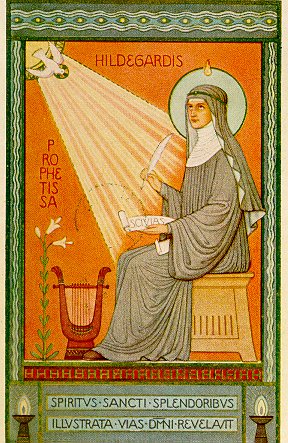
There are a number of resources for those wishing to find out more information on St. Hildegard and the region in which she lived and worked.
This website provides information on the saint and on the locations associated with her life.
Her own monastery of St. Rupertsberg and a sister foundation, Eibingen, were later destroyed. But the parish chuch of Eibingen preserves St. Hildegard’s own relics as well as a collection of relics she acquired during her lifetime. SEE the parish website. (in German)
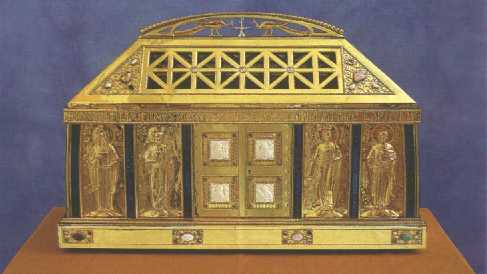
Her reliquary, created in 1929.
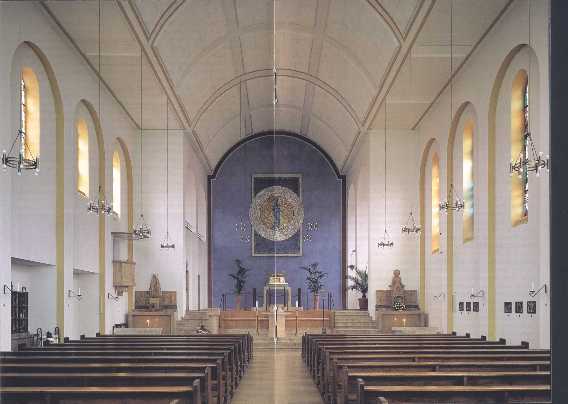
The parish church of Eibingen, finished in 1935. (Actually there are a number of churches erected in the 1930’s in Germany – and also a Russian Orthodox church in Berlin).
Finally, there is the extraordinary website of the Abbey of St. Hildegard. Thanks to the initiative of the local bishops and the generosity of Prince Karl zu Loewenstein-Wertheim-Rosenberg, the Abbey of Eibingen arose again between 1900 and 1904. The new foundation was a member of the Beuron congregation of Benedictines – the creators of a new sacred art in the second half of the 19th century. The abbey flourished and grew to include more than 100 nuns – despite setbacks such as the expulsion of the community in 1941 during the Third Reich and a period of use as a military hospital and a home for refugees.
The interior of the Abbey of St. Hildegard contains one of the most complete programs of Beuron mural painting in existence. Regrettably, much of this magnificent art was destroyed or painted over in 1967 in yet another example of a post-conciliar “restoration.” The Abbey’s splendid website thus has to resort to “virtual” images for much of its tour of the buildings and the images that adorn (or adorned ) them.
(The last three photos are from the website of the parish church of Eibingen.)
Stuart Chessman

Matthew Alderman recently wrote in the NLM about the results of the ongoing restoration project of the parish of the Holy Family, Vancouver, BC. Two weeks ago we had had the pleasure of visiting this parish. It is a remarkable example of the quality of the restoration work going on today in numerous parishes and communities. The Parish occupies a small, unprepossessing building that originallly served as a German ethnic parish.
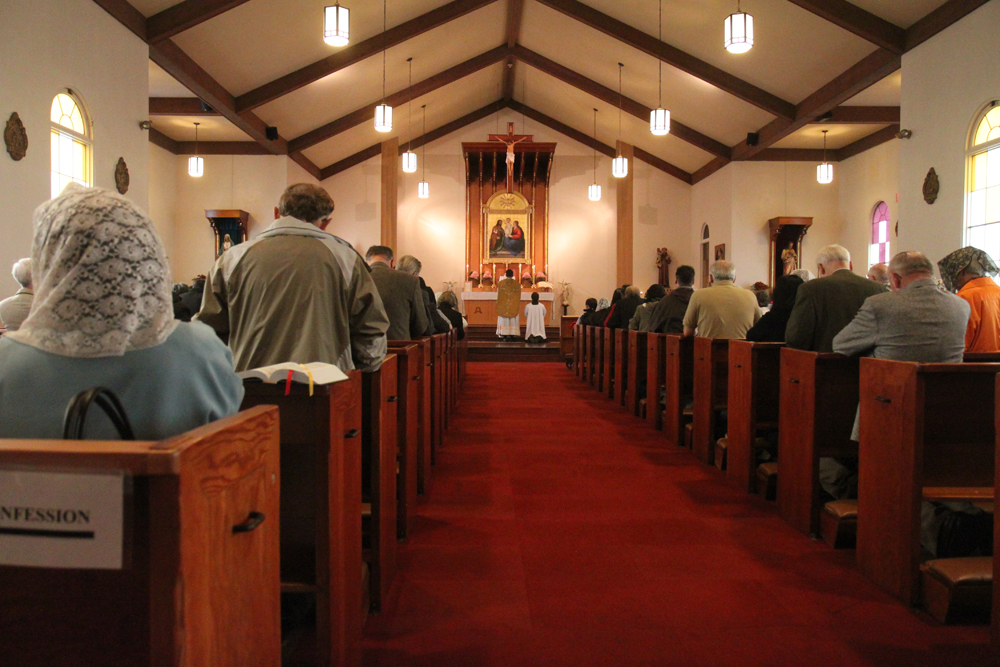
This parish, under the direction of the FSSP, celebrates the Traditional liturgy and has a large congregation of all ages. The parish is working to restore to the rather barren interior a richer Catholic dimension. The restoration goes beyond art, however – how many parishes in North America heard a sermon that week on the Feast of the Our Lady of the Rosary, the battle of Lepanto and how it all related to contemporary trials? (This parish has one advantage, however: the dedication of Vancouver Cathedral is to Our Lady of the Rosary).
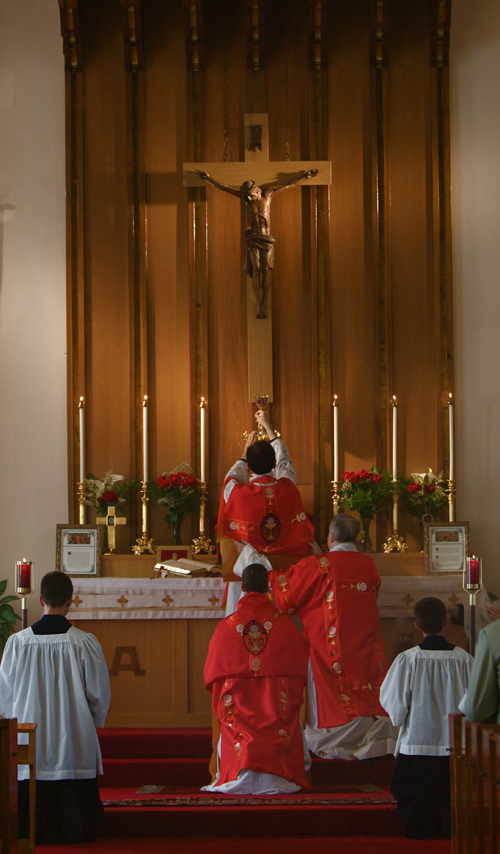
This is the Altar of Holy Family parish before restoration.

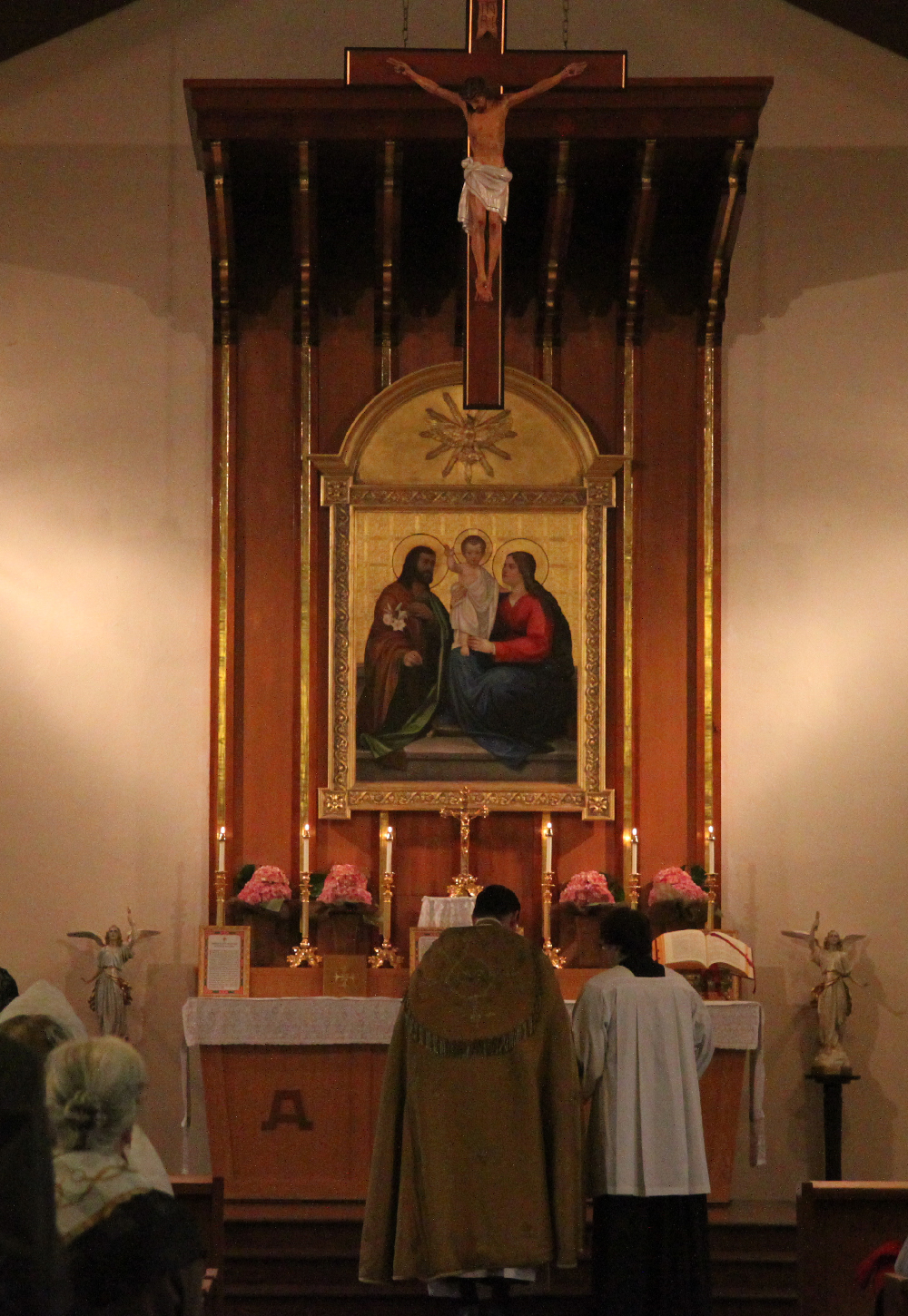
Center piece of the restoration is the new altarpiece.
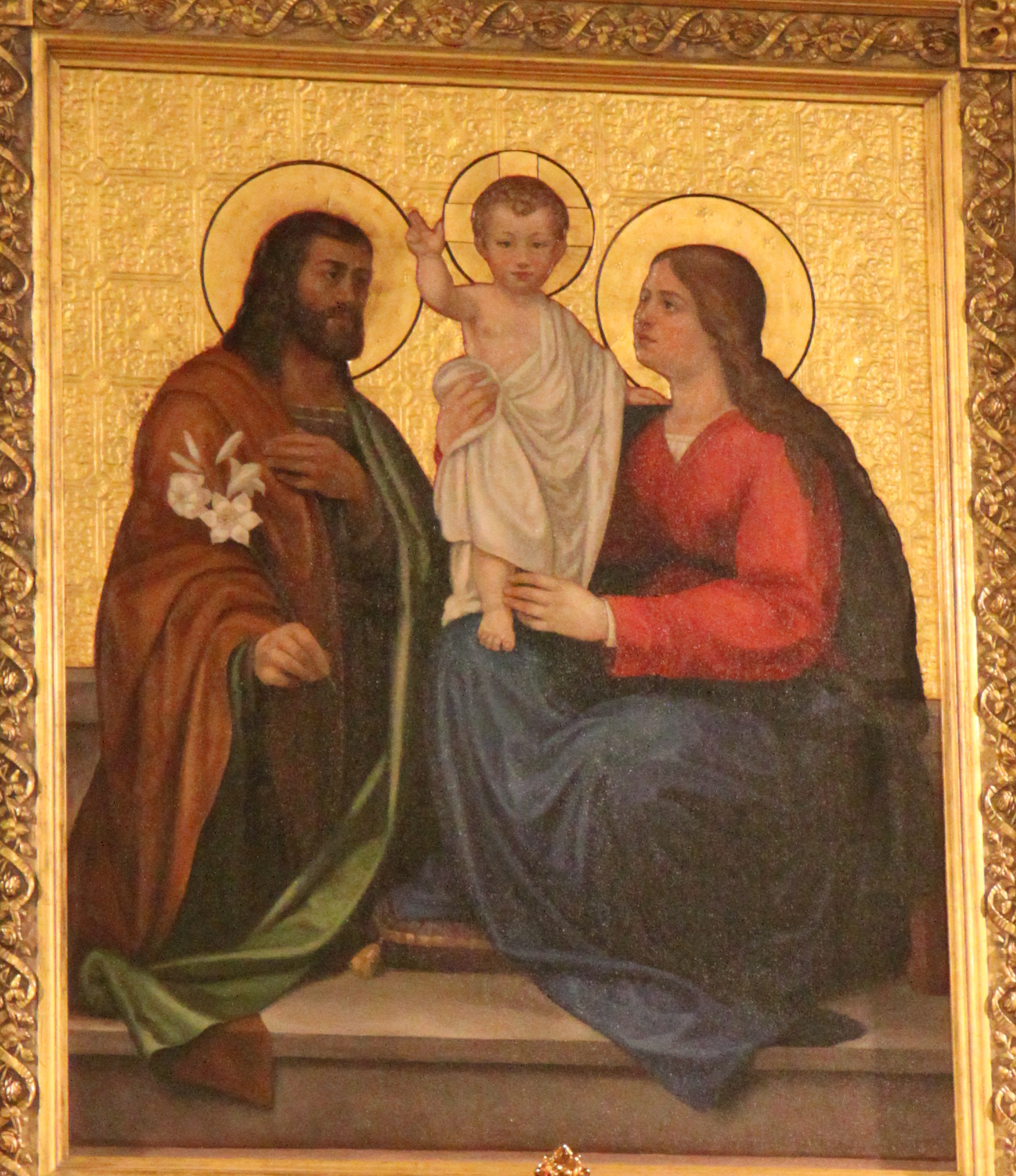
The artist is Mr. Michal Janek, a former parishioner of Holy Family parish who now resides in Ottawa, Ontario. He is
a parishioner at the FSSP parish there (St. Clement ). This is the 1st panel of a tryptich which Mr. Janek hopes to complete by Easter of 2011.
For further information on the renovations in this parish see the website of the parish.