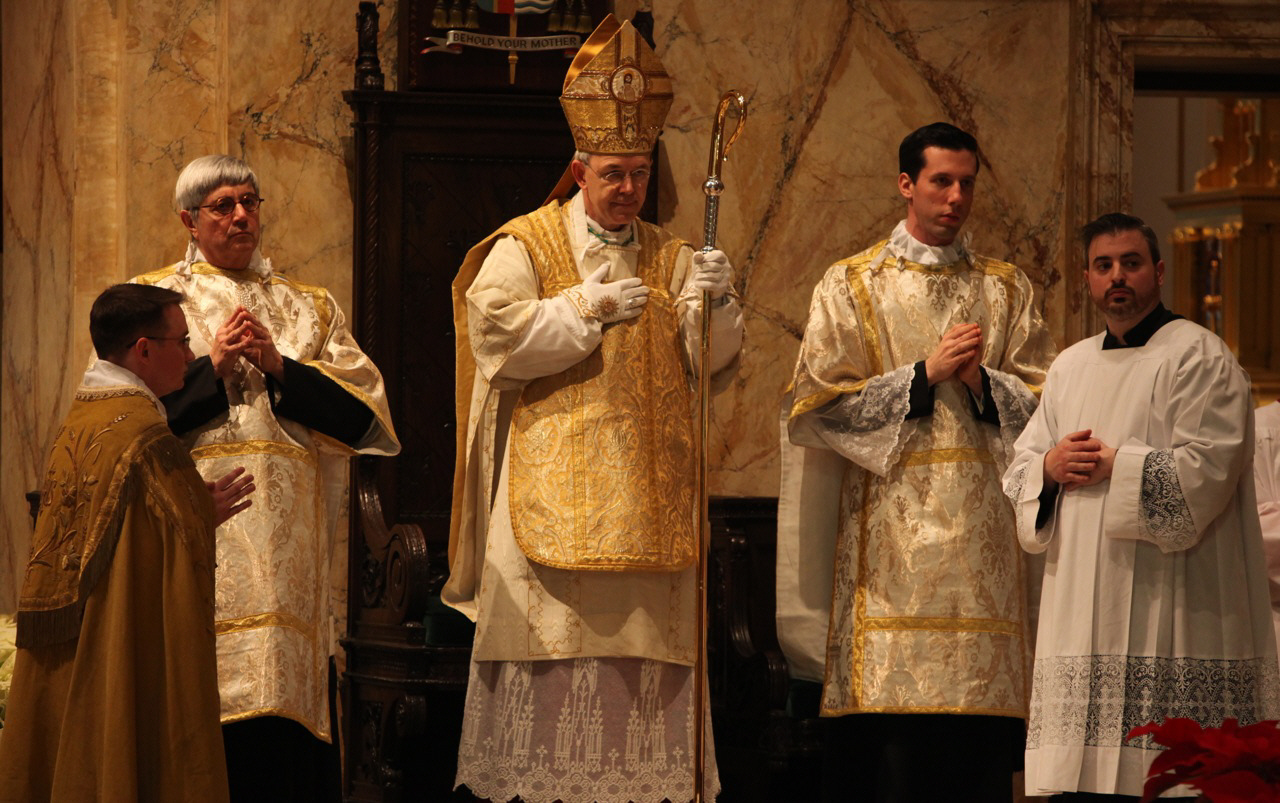
Starting in November, there will be a Traditional Mass every Sunday at 7:30 am at St. Peter’s Church in Hartford, CT. A Traditional Mass will also be offered on holy days of obligation and every first Friday of the month at 6:30 pm.
Starting in November, there will be a Traditional Mass every Sunday at 7:30 am at St. Peter’s Church in Hartford, CT. A Traditional Mass will also be offered on holy days of obligation and every first Friday of the month at 6:30 pm.

We know what occasioned the institution of this feast….

The battle depicted on the wall of a church in Seville – with the intercession of Our Lady.
On Sunday, October 3 at 2 PM, the St Gregory Society will sponsor the celebration of a Solemn Mass for the Feast of Our Lady of the Most Holy Rosary. It will take place at St.Stanislaus Church, State and Eld Streets, New Haven CT. Music for the liturgy will include Palestrina’s Missa Ave Regina Caelorum.
For directions call 203-562-2828 or consult the St. Gregory Society’s website (in our links).

Confession along the way of the pilgrimage.
Last Saturday, under nearly perfect weather conditions, the annual Pilgrimage for the Restoration concluded with a march of some 7 miles from the Shrine of Bl. Catherine Tekakwitha in Fonda, NY to the Shrine of the North American Martyrs in Auriesville NY. Certainly great enthusiasm was shown by the, on the average, very youthful pilgrims. The pilgrimage concluded with a Solemn Mass in the Coliseum church of the Shrine. For those who returned on Sunday, there was a moving Low Mass in the old chapel of Our Lady Queen of Martyrs that revealed how magnificent this form of the Traditional liturgy can be.
My other remarks would be similar to those of last year. (The Fourteenth Pilgrimage) It seemed that the number of pilgrims was even fewer this time (300-400 at most). This Pilgrimage lacks the deep historical tradition that underlies its model of Chartres. Yet it seems clear that North American Traditionalists need a major demonstration of numbers of their own. Or do they think that with Summorum Pontificum:
“the strife is o’er, the battle won”?
If so, they are very mistaken.
I would suggest that the organizers make efforts to develop further the concluding liturgy by exploring the celebration of a Pontifical Mass. Certain groups that originally participated are no longer present for whatever reason; other major Traditionalist organizations seem totally unaware of this event. The organizers of the Pilgrimage need to get in direct contact early with representatives of these organizations and parishes to recruit more participants for next year and to find out what is going on. There are some more technical points as well: for the first time this year I noticed that the sermon and some of the singing (the gradual, for example) were inaudible from certain spots in the church.
For some very promising competition north of the border see HERE. The website of the Pilgrimage is HERE.

The chapter or “brigade” of Una Voce Westchester.

Some familiar faces from St. Mary’s, Norwalk.


The goal: the entrance to the Shrine of the North American Martyrs.

The distance to be covered on this day may not be all that great, but the effort is certainly increased if one has to push or carry small children.

The schola.


The clergy are members of the Institute of Christ the King, which seems to be specializing in providing liturgical direction at major Traditionalist “events.” (The Institute was also the most prominent participant among the clergy in this year’s Chartres pilgrimage.)

The Basilica of St. John the Evangelist in Stamford, CT will be offering low mass in the extraordinary form each Tuesday at 9:30 am beginning on September 28. Father LaPastina of St. Gabriel Roman Catholic Church, also of Stamford, will celebrate this mass.

The site of St. Ann’s, immediately after the demolition of the church in 2005.
Before proceeding to examine more monuments still standing, let us reflect on some of the losses suffered in the last 12 or so years.

Strangely, the building of the parochial school of St. Ann’s, closed in the 1940’s, still survives. It is now an apartment building.

All that is left of the once glorious St. Ann’s – the church tower, bizarrely standing alone in front of an NYU high-rise. One of the most prominent parishes in 19th century New York, St. Ann’s was largely the work of Napoleon Le Brun (a parishioner), who incorporated components of an earlier building. It was later the “National Shrine of St. Ann” (apparently one of several), the Armenian Catholic Cathedral and, in the 1980’s, home to the first “official” regularly celebrated Traditional mass in New York.

A photograph taken in May 2009,just after Holy Trinity Chapel on Washington Square had been demolished. One of the most hideous Catholic churches in Manhattan, it was built as the NYU chapel between 1961 and 1964 with donations from the Generoso Pope family (who owned, among other things, the “National Enquirer”). This prominently situated Chapel was undoubtedly intended to make a public statement about Catholicism; its disappearance obviously makes an entirely different point. By the time I encountered it in the early 1980’s, the holy water fonts were being used as ashtrays.


Two photographs of a child’s prayer book of the mid 1960’s featuring Holy Trinity. Note the women wearing mantillas even though the priest is celebrating mass “versus populum” – this is before the Novus Ordo. The figure of Christ(?)shows only too clearly the spiritual crisis the church was beginning to face – even before the council ended.


Not a church but St. Vincent’s Hospital. The former crown jewel of New York Catholic hospitals, it was closed earlier this year. What Cardinal O’Connor had as recently as 1998 proclaimed to be a core function of the Archdiocese (in regard to St. Clare’s Hospital) now disappeared without a whimper from the Archdiocese or the laity. Indeed, the Archdiocese was undoubtedly trying to put as much distance as possible between it and the NY Catholic hospitals to avoid somehow ending up on the hook for their monstrous indebtedness. General Catholic hospital care in New York is no more. Lost too is a Catholic alternative for the issues surrounding maternity care.
In Boston, where the Catholic hospital system appears headed down the same path as St. Vincent’s, voices now arise denying the maintaining hospitals for the sick should be a part of the mission of the Catholic Church at all….

This nurse has glowered at passers-by for generations. On the buildings one encounters the great names of Catholic New York past: Alfred Smith, Raskob….

This empty lot is all that remains of the Redemptorist church of Our Lady of Perpetual Help (not to be confused with the huge church of that name still standing north of Bay Ridge, Brooklyn) on East 61st street. It was built in 1887 and was originally Czech. This parish was undoubtedly harmed very early on by the construction of the Queensboro bridge almost next door. By the time I paid a visit around 1990 only the lower church could be used. It featured a remarkable assortment of devotional statues. In 1998 the church was razed.

The somewhat forbidding rectory remains – now OLPH residence and apparently still very much in use. It is next to the lot where the former church stood.

The old OLPH parochial school, now the Manhattan “early learning” center.

Given the “split personality” the Catholic church has evidenced towards its historical and artistic inheritance, it’s good to know professional help is near at hand.(the Karen Horney Clinic next to the old OLPH complex)
D. W. Dunlap,From Abyssinian to Zion: A Guide to Manhattan ‘s Houses of Worship; (Columbia University Press, NY, 2004)at 104 (Holy Trinity) and 166 (Our Lady of Perpetual Help).

On Sunday, September 19 our Society sponsored at St. Mary’s church, Norwalk CT, Solemn Vespers and Benediction in honor of the beatification of John Henry Newman earlier that day.


Mr David Hughes conducted. Aside from plainchant and some extraordinary polyphony by Victoria and des Prez, the program also included,appropriately enough, English hymns, melodies and organ music.


The incensing of the side altar bearing the image of the new Blessed.


At the recessional “Lead Kindly Light ” was sung.

After the service, Fr. Richard Cipolla, our Chaplain, gave a talk on the “biglietto” speech of Cardinal Newman. this was the speech he delivered upon receiving formal notification that he had been made cardinal. In it, Newman spoke of his life-long struggle against religious liberalism.

,
Father Cipolla’s Talk:
If you expect a learned and scholarly lecture on Blessed John Henry Cardinal Newman’s famous Bigletto speech, you will not hear it from me this evening. For the context of this talk, following Solemn Vespers in the traditional Roman rite, is the years of personal love I have had for this singular man of intelligence, holiness and faith, who now, more than one hundred years after his death, is numbered among the Blessed. My bond with Newman began when I first discovered high church Anglicanism, but it was forged so very strongly and deeply during my years of study in Oxford. For Newman’s presence is still felt in that place of learning and great beauty, despite the near death of English Christianity. Newman said that it was Oxford not Rome that had made him a Catholic, for it was at Oxford that he studied and meditated on the writings of the Church Fathers that convinced him finally that to be communion with St Athanasius and St Augustine meant that he had to be in communion with that bishop who in the present presides as Bishop of Rome as the Pope. In his case that was Pius IX.
Newman’s Apologia pro Vita Sua, in which he lays bare in Augustinian fashion, his spiritual journey from evangelicalism to the Catholic Church, changed my life, especially when I read these words: “I came to the conclusion that there was no medium, in true philosophy, between Atheism and Catholicity, and that a perfectly consistent mind, under those circumstances in which it finds itself here below, must embrace either the one or the other. And I hold this still: I am a Catholic by virtue of my believing in a God; and if I am asked why I believe in a God, I answer that it is because I believe in myself, for I feel it impossible to believe in my own existence (and of that fact I am quite sure) without believing also in the existence of Him, who lives as a Personal, All-seeing, All-judging Being in my conscience.”
With these words in mind I too spent many hours reading the Church Fathers in the Bodleian Library and Pusey House. My reading of the Fathers, unlike Newman’s, was hampered by my less than stellar Greek and my not perfect Latin. And much of what I read was not, I blush to say, for merely spiritual purposes but rather to gather material for my thesis. I did get my thesis done and got my degree. But like Newman, or perhaps because of Newman, what I read set me on the path that brought me here this evening as a Catholic priest. I remember quite vividly being in Pusey House library where the temperature was in the 40s, wearing a muffler and those odd English gloves with the end of the fingers exposed, reading St Ignatius of Antioch’s Letter to the Romans. And I remember sitting there, when I had finished, saying to myself: if this is true, if this is what lies at the heart of the Christian faith, then I should be a Catholic. It took well over a decade of years after that day of awakening for me to act upon this knowledge. And, like Newman, I have never looked back, and despite, in Newman’s own terms, the trials and heartaches and misunderstandings that have marked my nearly thirty years as a Catholic, I am profoundly grateful that God bestowed upon me the grace that brought me into the true Church, the bark of Peter, the body of Christ in this time and place. And I cannot help but believe that I am among those less obvious and less important miracles that attest to the sanctity of John Henry Newman. For his caring about me for these many years and for his guidance from the farther shore that kept me on the right road I offer a profound Deo gratias.
Newman was a prolific writer and addressed topics not only related to theology. His treatise on education, The Idea of a University, remains today the classic text for understanding what liberal education really means. He wrote volumes of letters; he corresponded with countless numbers of people, some well-known, some not known at all except to him. His sermons are still models of what a sermon should be. To read them today is to marvel at his knowledge of Scripture and the Fathers, and his deep insights into human nature. His two greatest theological works, A History of the Development of Doctrine, and The Grammar of Assent, –both, by the way, difficult to read, requiring patience and stamina, but then deeply rewarding—both of these works have had a large influence in the Church down to the Second Vatican Council. How Newman’s understanding of the development of doctrine was used or misused by the Council and its aftermath is the subject of a different talk.
But what I want to speak about this evening is the speech he made in Rome at the residence of Cardinal Howard upon his reception of the Cardinal’s hat. It is called the Bigletto speech because bigletto is the name of the envelope in which is enclosed the official declaration of his being chosen as a Cardinal of the Church. The seal on the bigletto was opened by Newman and then handed over to the Bishop of Clifton who read the declaration. By this time Newman was 78 years old and quite frail. To say that he had not been always treated well in the Catholic Church by the hierarchy is a real understatement. And yet it was a graceful insight on the part of Pope Leo XIII that allowed the bestowal of this honor on Newman in the twilight of his life.
The Bigletto speech begins with these gracious words in Italian: “Vi ringrazio, Monsignore, per la participazione che m’avete fatto dell’alto onore che il Santo Padre si è degnato conferire sulla mia umile persona. And, if I ask your permission to continue my address to you, not in your musical language, it is because in the latter I can better express my feelings on this most gracious announcement which you have brought to me than if I attempted what is above me.”
So begins this brief but very important speech that is not only a summing up of Newman’s life as a Catholic but is also a prophecy that is so relevant for our own times. The heart of the speech which I shall quote presently must be understood in the light of Newman’s writings and in the context of the attacks on him throughout his Anglican and Catholic life, particularly the latter, from both what we would call the right and the left. The right attacked him because he refused consistently to become part of the cheerleading squad for a triumphalistic super-Catholicism that mistrusted the use of reason in faith. The left attacked him because he insisted on the central importance of dogma, things to be believed, the bed-rock of Tradition, the objectivity of the Natural Law, and his support of the Papacy as a divinely inspired organ of truth in the Church. For Newman, a religious conservative is someone, in his own words, “who defends religion not for religion’s sake but for the sake of its accidents and externals; and in this sense conservative a pope can never be, without a simple betrayal of the dispensation committed to him…..A great pontiff must be detached from everything save the deposit of faith, the tradition of the apostles an the vital principles of the divine polity.”
Now listen to his words from the heart of the Biglietto speech.” And, I rejoice to say, to one great mischief I have from the first opposed myself. For thirty, forty, fifty years I have resisted to the best of my powers the spirit of liberalism in religion. Never did Holy Church need champions against it more sorely than now, when, alas! it is an error overspreading, as a snare, the whole earth; and on this great occasion, when it is natural for one who is in my place to look out upon the world, and upon Holy Church as in it, and upon her future, it will not, I hope, be considered out of place, if I renew the protest against it which I have made so often.
Liberalism in religion is the doctrine that there is no positive truth in religion, but that one creed is as good as another, and this is the teaching which is gaining substance and force daily. It is inconsistent with any recognition of any religion, as true. It teaches that all are to be tolerated, for all are matters of opinion. Revealed religion is not a truth, but a sentiment and a taste; not an objective fact, not miraculous; and it is the right of each individual to make it say just what strikes his fancy.”
It is quite true that the term “liberalism” is subject to much misunderstanding. Newman is not specifically talking about political liberalism here, but there certainly is a link between political and theological liberalism, but this link is not facilely obvious. To further muddy the waters, the term liberal in English politics, where the term originated, cannot be pinned down since what was considered liberalism in the mid-nineteenth century with its doctrine of emphasis on the freedom of the individual and a belief in small government and a limited power of the Church morphed into something quite different by the end of the nineteenth century, where now liberalism looks to the government to mold society and provide for the people’s wants and needs. It is only one more step to the socialism that undergirded the modern Labour Party until recent times.
But what Newman is speaking about in the Bigletto speech is liberalism in theology. There have been not a few liberal theologians who have tried to highjack Newman to their cause. That this is impossible in the light of what Newman defines as liberalism in theology and his condemnation of it in the Bigletto speech is obvious. These theologians mistake Newman’s careful choice of words, his fairness, and his careful analysis of varied positions on a topic—they mistake this for a closet type of skepticism that is a reflection of their own liberalism. Because Newman refused to believe that truth can be locked up in a box, the key thrown away and swallowed to produce a counterfeit faith, it does not follow that truth is ultimately inaccessible and in the end relative. His whole life is a testament to the reality and accessibility of truth in the Church of Jesus Christ informed by the person of Jesus Christ and the Holy Spirit.
What Newman saw over one hundred forty years ago was that liberalism in Christian theology would cause devastation to both the Christian faith and to the Church if it were not fought against and somehow checked. His whole Christian life was involved in the struggle against liberalism, and he knew that this struggle was the equal of the fight against Arianism in the patristic Church, was the equal of the struggle against the churchless and individualistic version of Christianity that arose in the protestant reformation. Newman did not live to see the flowering of the historical-critical attack on the Bible in the 1920s down to our own time.. He did not live to see the ironical and pseudo-rational project of demytholization of Christianity that Bultmann and others inflicted on the Church and on believers. He did not live to see so-called Christian theologians declare that God is dead to great acclaim in the press and in certain quarters of Christianity. He did not live to see the acid of liberalism spread within the Catholic Church with its sad results with which we are now coping.
There are some listeners that are probably identifying Newman after what I have said as a classic conservative. But nothing could be farther from the truth. While Newman saw so clearly the necessary and God given role of the magisterium and the papacy in the preservation of Catholic truth, he was too intelligent and his mind too fine and nuanced to be opposed to growth and development of the Tradition he so loved and defended. He refused to see even a definition of a dogma as something completely done and finished. Rather a dogma is always something that begins thought and deliberation and inquiry as to its further meaning. He encouraged absolutely intellectual inquiry and discussion about the teachings of the Church rather than treat the great dogmas of the Tradition as something to be swallowed whole and regurgitated when called for by the Grand Inquisitors. In this Newman is a true liberal using that adjective as it is used in the phrase liberal education: the informing of the mind to be open to the Truth and instilling the courage to follow that Truth to wherever it lead.
Newman understood so long ago what we often do not seem clear about because of sentimentality and nostalgia for Christendom, that time when culture and the faith coalesced and the snow never turned dirty in Camelot. He understood clearly as he gave this prophetic speech that the great battle would not be between right and left, liberal and conservative, for those are political terms and are used by Catholic liberals to mask the real struggle and what is at stake. The battle within the Church is between Tradition and liberalism. The stakes are high. For only the Tradition and living in that Tradition as the living place of Truth can withstand the strong and determined forces that pant for the destruction of the Church.
The question is for us now whether the noxious pallidity of secularism will overrun the Catholic Church as it has the great majority of Protestantism, whether the American steam-roller of individualism will rip the heart out of the communion of those who call themselves Catholics. You reply: we have a promise: the gates of hell will not prevail against the Church. What would Newman say to that response? He would not disagree with the content of the response but he would say that it is not helpful. For one must allow for the possibility of mass apostasy in a situation like ours. And even worse, this apostasy may not even be readily perceived if the relativistic principles of liberalism are embraced by both the magisterium and the people of the Church. And I would even say that this may have happened already, perhaps not to the extent that one can talk of mass apostasy, but it has happened, and the tragedy is that most of us do not even know it.
I want to close this talk, this talk so woefully incomplete and so woefully inadequate on this momentous and joyful occasion of Newman’s beatification, with an affirmation that Newman would have real hope in our situation, for he was a man of faith and therefore a man of hope. I would also like to suggest that two things that Newman talked about so much as a Catholic must be addressed right now to assure that our hope in the future of the Church is something real. This is not to suggest that we will save the Church. Quite the opposite. But two things.
First, Newman advocated for and believed so deeply in a laity that was educated and that was holy. The Document on the Laity of the Second Vatican Council is surely inspired by Newman’s words and thoughts. I dare say, however, that the words of the Council sound dated and romantic and have no sound content when compared to Newman’s. In a society imbued with liberal principles, the role of the laity has been clericalized and therefore sterilized. All one hears is how the laity should be able to do what clergy used to do: from reading at Mass and functioning as extraordinary ministers of the Eucharist to being chancellors of the Diocese. This is a perversion of the role of the laity and has little to do with Newman’s hope. He hoped for an educated laity: and this means educated both in the intellectual sense and in the faith sense. It is certainly true that many of our Catholic laity are now educated in many of the elite colleges in this country. And it is true that that education is always a mixed bag, for to try to teach the liberal arts in an atmosphere that denies truth is, to say the least, difficult. It is also true that there are few Catholic colleges that truly teach the liberal arts and do so within a Catholic culture, Catholic culture not meaning sincere dorm Masses but immersion in the Tradition and facing the challenges of living within that Tradition. But the situation vis-a-vis spiritual or faith content education is much worse than the intellectual training of Catholics. Even those who are well educated seem lobotomized when it comes to knowledge of their Catholic faith. All this pertains as well to the clergy, who, however, come out second best in most cases to the intellectual training of the laity.
Newman saw how important it would be to have an educated laity and clergy who were living their faith in the world, in the world as it is, seeing the world as it is, secularized and increasingly anti-Christian and anti-religious in general, as the way God wants Christians to witness to the truth of the Christian faith and to see this as a positive and exciting opportunity to do so. The call to holiness of the laity is one of the marks of the Second Vatican Council, and surely here is Newman’s influence once again. But this call to holiness has fallen flat in reality, for it seems quaint to talk of a call to holiness in a world that is obsessed with the concerns of the self and material success, that denies the natural law, and in a culture that demands the privatization of one’s religious beliefs and practices, another legacy of liberalism in its most illiberal form. For the call to holiness does not mean only doing one’s private prayers every day and keeping a Christian home, as good and important as these things are. It means to live according to the Catholic faith in public. This does not mean displaying crucifixes and medals. It means believing that I have received the grace of God to live my life in his presence and this way of living informs my whole being and that this will be noticed by those around me. This may incur their displeasure and their persecution. But it may not. It may open them up to something they never even thought of, something they never considered really existed.
Newman believed passionately in the reality of Truth in the person of Jesus Christ and his Church. And he believed that the Truth will prevail. And so the ending of his Bigletto speech: Such is the state of things in England, and it is well that it should be realised by all of us; but it must not be supposed for a moment that I am afraid of it. I lament it deeply, because I foresee that it may be the ruin of many souls; but I have no fear at all that it really can do aught of serious harm to the Word of God, to Holy Church, to our Almighty King, the Lion of the tribe of Judah, Faithful and True, or to His Vicar on earth. Christianity has been too often in what seemed deadly peril, that we should fear for it any new trial now. So far is certain; on the other hand, what is uncertain, and in these great contests commonly is uncertain, and what is commonly a great surprise, when it is witnessed, is the particular mode by which, in the event, Providence rescues and saves His elect inheritance. Sometimes our enemy is turned into a friend; sometimes he is despoiled of {70} that special virulence of evil which was so threatening; sometimes he falls to pieces of himself; sometimes he does just so much as is beneficial, and then is removed. Commonly the Church has nothing more to do than to go on in her own proper duties, in confidence and peace; to stand still and to see the salvation of God.
Mansueti hereditabunt terram,
Et delectabuntur in multitudine pacis.
The meek shall inherit the earth, and they shall delight in the abundance of peace.

Some images from the Mass and dinner sponsored by St.Mary’s parish, Norwalk CT last night to support the continuing restoration of their church building. The solemn mass was celebrated the Church of our Saviour on Park Avenue in New York. The dinner then took place afterwards at the Union League club.


Richard Dobbins introduced the speakers.


Fr. Greg Markey spoke of the ongoing progress at the parish of which restoration of the building itself is one part.


Fr. Dennis Kolinski SJC was the guest speaker. A member of the Canons of St. John Cantius, he described the history of the restoration of that parish in Chicago which has led to the creation of a new religious order now active in several locations.

Our Lady of Peace
237 East 62nd Street
NY NY 10065
On East 62nd street, in close proximity to a very, very high rent district, there exists a small bastion of outrageous, unreformed and unapologetic Catholicism. The parish of Our Lady of Peace offers the church connoisseur a sexy Magdalene, a life size wax image of a saint holding her eyes on a paten, and innumerable statues and paintings. How did this come to be in such an elegant place?
Actually, the area extending east of Lexington and north of East 59th Street as far as East 96th Street – “Greater Yorkville” – was in bygone days not that fine an area at all. It was traditionally the home of various hard working, primarily Central European, peoples. Ecclesiastically this was reflected in a host of ethnic parishes – German, Czech, Slovak, Hungarian etc. that existed alongside the religious order churches (like St. Ignatius and St. Vincent Ferrer) or the mainstream “Irish” parishes ( e.g. St. Monica, Our Lady of Good Counsel). These ethnic groups, that were still a vestigial presence as late as the 1980s, have by now regrettably almost totally disappeared. But their parishes, with one or two exceptions, still remain, ministering to a totally different population.

Italians were not usually considered a main component of Yorkville’s ethnic mix. Our Lady of Peace, however, was established in 1918 as an Italian parish.

The pretty Victorian church – really just a large chapel – had been built in 1886 for a German Protestant congregation. (1) Like many New York churches, the rectory is integrated into the structure of the church to save space.

Inside, the small church presents itself as a simple space, with the northern half of the nave being slightly narrower than the other, and ending in a shallow apse with side chapels set into the walls.


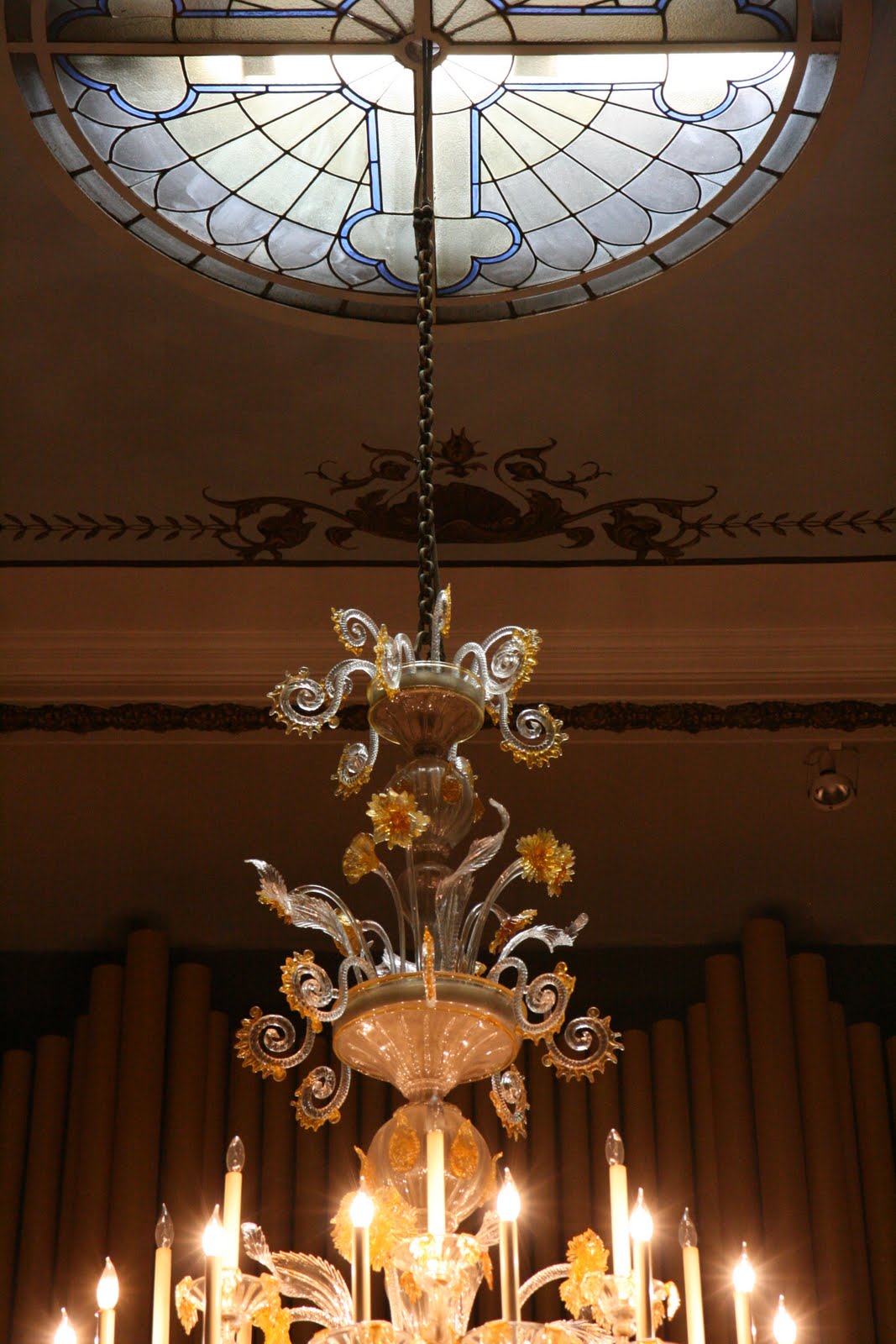
With its brilliant gold and white color scheme, Venetian chandeliers and double skylights this church indeed resembles the ballroom of an old hotel. But hasn’t the great German rococo church of Vierzehnheiligen also sometimes been called the “Tanzsaal Gottes” – God’s ballroom? Now Our Lady of Peace displays hardly any rococo ornamentation or architectural detail. Yet it has the same bright and joyous atmosphere of the Bavarian churches.

St Fara of Cinisi (in Sicily) greets the startled entering visitor from a glass case. The life size crowned figure of a nun bears a crosier in one hand and a paten with her eyes in the other. A Frankish princess of the 7th century, she wished to enter the religious life but her father tried to force an advantageous marriage upon her. Whereupon she developed an illness that blinded her. She was cured only after her parents relented and allowed her to become a nun. Not surprisingly she is invoked against illnesses of the eyes. In the 17th century her cult spread from France to Sicily. In addition to the crosier she holds 5 spikes of wheat. Now Louis Reau, in his authoritative work on iconography, mentions six spikes of wheat as St. Fara’s attribute. This discrepancy is unexplained.


Our only major disappointment in this charming church is the sanctuary, the victim of a thorough post- conciliar gutting. Only sections of the magnificent altar rail remain intact. It is disheartening, after experiencing the exuberant build up of images and color throughout the rest of the church to encounter such a void. Furthermore, most of the massed statues in the rear of the church are finished in plain wood – a distinctly un-Italian touch.

St. Lucy cannot fail to appear in a Sicilian church.

Resources were obviously limited.
Our Lady of Peace was involved at one time with the Philippine Catholic apostolate. Now it is in the care of an administrator. If the damage to the sanctuary is repaired, I imagine this church would be a wonderful location for weddings. We can only say that the early parishioners accomplished a great deal with very limited resources. Erected as a parish towards the end of the ”golden age” of Catholic Church architecture in New York, Our Lady of Peace obviously cannot compete with such contemporary masterpieces as St.Vincent Ferrer or Blessed Sacrament. Yet the founders endowed it with a festive, original and very Italian spirit – a remarkable testimony to the success of the ethnic parish ideal.
1. D. W. Dunlap, From Abyssinian to Zion: A Guide to Manhattan’s Houses of Worship, 2004 Columbia U. Press, NY at 165.
2. L. Reau, Iconographie de L‘Art Chretien, Vol III, at 485 (Paris, 1958)