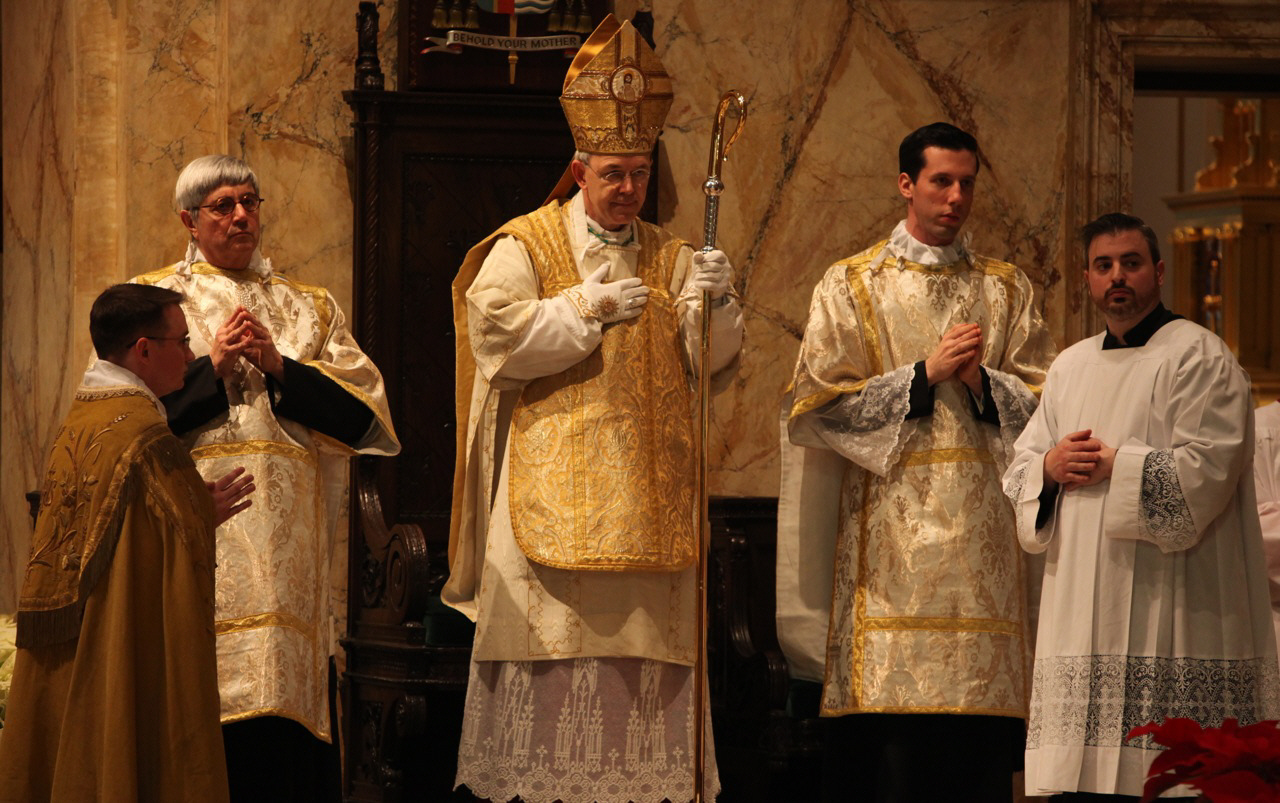
There will be a traditional Mass at the Church of the Holy Innocents (West 37th Street) on Monday, February 2nd for the Feast of the Purification (Candlemass) at 6:15pm.
The Celebrant of the Mass will be Fr. Richard Trezza.
14
Jan


On Saturday, January 10, 2009, during the midst of a blizzard, the Canons Regular of St. John Cantius hosted a workshop for laity in the Extraordinary Form at Saint Peter’s Church in Volo, Illinois. The parishioners of St. Peter’s Church in Volo, Illinois, braved the snowstorm and thoroughly enjoyed the day of Solemn Liturgies and classes.
Beginning at 8:00 a.m. Fr. Dennis Kolinski, S.J.C., Pastor of St. Peter’s, Volo, offered a Missa Solemnis, assisted by Fr. Anthony J. Rice, S.J.C., the Associate Pastor of St. Peter’s, who served as Deacon, and by Fr. Scott A. Haynes, S.J.C., an Associate Pastor of St. John Cantius, Chicago, who served as Subdeacon.
The schola cantorum chanted the liturgical propers from the Liber Usualis (1962). During the distribution of Holy Communion the choir sang Palestrina’s Alma Redemptoris Mater. The people joined in singing the Gregorian Chant setting of the Ordinary and the responses of the Solemn High Mass with full voice.
Altar servers from St. Peter’s assisted at the Solemn High Mass, as well as some of the brothers from the Canons Regular of St. John Cantius in Chicago.
St. Peter’s Parish in Volo, like St. John Cantius Parish in Chicago, preserving the tradition of men and boys serving at the altar, hopes to foster many vocations to the Catholic priesthood and to religious life.
Fr. C. Frank Phillips, C.R., Founder of the Canons Regular of St. John Cantius, gave a lecture on the beauty of the Sacraments offered in the Extraordinary Form and gave a beautiful meditation on the mystical theology of the ceremonies of the Traditional Latin Mass.
Using the handouts provided by the Canons Regular, the participants took many notes and asked their questions about the history, theology and spirituality of the Extraordinary Form.
The Traditional Latin Mass, which begins with the phrase: I will go unto the altar of God: to the God who gives joy to my youth, appeals today not only to those who remember it from days past, but also to the many young people who are attracted by its spiritual depth, by the richness of its ritual, and by the haunting power of its sacred silence.
Fr. Dennis Kolinski, S.J.C., Pastor of St. Peter’s, gave a talk on the history and development of the Roman Rite, explaining its slow and organic growth.
He contrasted it with the liturgies of the Eastern Churches, helping the participants understand the great treasure that has been entrusted to them through Pope Benedict XVI’s motu proprio.
Fr. Scott A. Haynes, S.J.C. presented a talk on Gregorian Chant as the staple of the music of the Roman Rite. The lecture described the various styles of chant, from processional chants like the Introit, to meditative chants like the Gradual.
The schola cantorum sang excerpts of various chants from the Graduale Romanum during Fr. Haynes’ lecture on Gregorian Chant as a demonstration. An explanation of the Divine Office was given as well as the importance of chanting the psalms.
After the lunch break everyone came to the church to learn how to sing Vespers in the Extraordinary Form. By the late afternoon everyone was prepared. The people joined in the recitation of the Holy Rosary in Latin. And all exuberantly sang with the priests and brothers for the Service of Solemn Vespers from the 1962 Liber Usualis.
To conclude the day, Fr. Anthony J. Rice, S.J.C. gave the Benediction of the Blessed Sacrament. The faithful chanted the traditional O Salutaris and Tantum Ergo. The Benediction concluded a wonderful day of prayer and catechesis.
Photos and text courtesy of Fr. Scott Haynes, SJC
Forthcoming Workshops
* The next workshop for the Traditional Latin Mass will be given to the Missionaries of Charity in Memphis, Tennessee, by Fr. Scott A. Haynes, S.J.C. from January 25-30, 2009.
* Another workshop for priests and seminarians is available at the Cardinal Stritch Retreat Center in Mundelein, Illinois, directed by the Canons Regular of St. John Cantius from Monday, February 9 – Friday, February 13, 2009.
* A Lenten Retreat for Laity will be given by the Canons Regular of St. John Cantius at the Cardinal Strtich Retreat House from Friday, March 13 to Sunday, March 15, 2009. Mass will be offered in the Extraordinary Form daily. Talks will be given on the Traditional Latin Mass and Lenten subjects.
* Other dioceses, parishes, religious communities or retreat centers who are interested for the Canons Regular to present a Workshop or Retreat in the Traditional Latin Mass should contact Fr. Scott A. Haynes, S.J.C. at St. John Cantius Church in Chicago.
http://www.sanctamissa.org/workshops/for-laity/LaityWorkshopofferedinVoloIllinois.htm
—

An interesting report from Germany: because of unusually cold weather the holy water of Cologne Cathedral has frozen. The cathedral is unheated except for one chapel….
Thanks to katholisch.de:
http://www.katholisch.de/Nachricht.aspx?NId=100

On Sunday, February 1, an anticipated Candlemas liturgy will be celebrated at St. Mary’s, Norwalk, including the blessing of candles, procession through the church, and Solemn Mass. This is one of the oldest rites of the Church, both in East and West, and is rarely celebrated in the solemn form. The setting of the Mass will be Byrd for five voices. There also will be Motets by Messaien and Bruckner and all the proper chants. Before the Mass there will be an organ recital (Alain and Bach, plus a Bach cantata sung by Josh Copeland). The organ recital will begin at 3 PM, the Mass at 3:30 PM.
This Mass will also be the joyous commemoration of the 25th anniversary of Fr. Cipolla’s ordination to the priesthood. I hope that many of you can attend! Let me take the occasion to thank Father Cipolla – our chaplain – for all the good he has done for our Society and St. Mary’s.

A message from Fr. Greg Markey, the pastor of St. Mary’s Norwalk:
The beginning of each year is often a time of “New Year Resolutions”. Over the next few weeks in this Pastor’s Column I would like to suggest some “New Year Resolutions” having to do with our Catholic Faith. My first suggestion is during 2009 start exercising the option of receiving Holy Communion on the tongue in Mass. Let me explain why.
This past summer Catholics were horrified when a professor at the University of Minnesota willfully desecrated the Eucharist. On the internet Professor Paul Zachary Myers invited anyone to obtain for him a consecrated Host from a Catholic Church so that he could desecrate It. Another man read about the request and took a Host from the London Oratory, videotaping Himself taking It from the Mass. He then sent the Host to Professor Myers and posted the video on the internet. Professor Myer then proceeded to drive a rusty nail through the Host in order to show the “absurdity” of the Catholic belief in the True Presence, and posted photos of the event on his website. Unfortunately the event set off a series of copycat crimes, and these desecrations are all over the internet.
What can be behind so much hatred? Even a child understands that it is not right to mock what others hold to be sacred. I have offered Mass in reparation for this sacrilege, and I know that many good Catholics have also done forms of prayer and penance in order to console the wounded heart of Our Lord.
Do you remember last year here at St. Mary’s when we found a Host under one of the pews in the church? I know from other priests that this happens every once in a while in other parishes as well. These incidents remind us that it would certainly be more difficult for people to take the Host improperly if everyone were receiving Holy Communion on the tongue. As the Catholic Church teaches, “If there is a risk of profanation, then Holy Communion should not be given in the hand to the faithful” (Redemptionis Sacramentum, 92).
Many people born prior to the Second Vatican Council will remember when everyone received Holy Communion on the tongue and kneeling. This has been the long held practice for thousands of years (although during certain periods of the early Church it did allow Communion in the hand). While many think that it was Vatican II that called for this change, it is important to note: Vatican II never called for Communion in the hand. Communion in the hand was the result of disobedience which forced the hand of the Church (no pun intended!).
After the Second Vatican Council some dioceses in the world started to make their own rules about receiving the Communion in the hand, disobeying the laws of the universal Church. Witnessing this practice without approval, the Vatican stated that it feared that this disobedience would lead to “…both the possibility of a lessening of reverence toward the august sacrament of the altar, its profanation, and the watering down of the true doctrine of the Eucharist” (Memoriale Domini).
Therefore in 1968 Pope Paul VI graciously sent out a questionnaire to all the bishops of the world asking if there should be a prudent change in the Church’s practice on how Communion would be distributed. The poll numbers came back overwhelming against Communion in the hand. Hence the Vatican concluded: “The answers given show that by far the greater number of bishops think that the discipline currently in force should not be changed. And if it were to be changed, it would be an offense to the sensibilities and spiritual outlook of these bishops and a great many of the faithful” (Memoriale Domini).
Nonetheless the disobedience continued and some of these dioceses petitioned Rome to officially permit Communion in the hand. A year later, in 1969, Pope Paul VI gave an indult to the French bishops permitting each bishop to decide the question in his own diocese (En réponse a la Demande). An indult is a special permission for a particular situation, rather than a universal norm. Nonetheless eventually the majority of dioceses in the world took advantage of the indult and simply permitted the practice.
Why did the Pope allow it? Perhaps it can be best summed up by the words of Our Lord about why divorce was allowed in the Old Testament: “For your hardness of heart Moses allowed you to divorce your wives” (Matthew 19:8). Their disobedience had reached such a point that it would have been difficult to have them return to the traditional practice.
Nonetheless some countries like Sri Lanka did not use the indult, and maintained the long held tradition of receiving only on the tongue. Recently there have also been dioceses around the world such San Luis, Argentina and Lima, Peru that have returned to the traditional practice and no longer permit Communion in the hand. This is an option fully supported by the Congregation of the Doctrine of the Faith.
Furthermore, if one does receive Communion on the hand, there is always the danger that particles may be remain in the hand. The Council of Trent infallibly teaches that Our Blessed Lord is truly present even in the particles as well: “If anyone denies that in the venerable sacrament of the Eucharist the whole Christ is contained under each form and under every part of each form when separated, let him be anathema” (Chapter VIII, Canon 3). For this reason the priest always purifies his hands of particles at the end of Mass, and uses a corporal (a small white cloth meant to catch the corpus, or body, of Our Lord).
Finally another major event occurred this past year when Pope Benedict XVI asked that from now on, all who receive Holy Communion from him must receive It on the tongue and kneeling. I am sure that by insisting on this ancient practice the Pope is trying to foster a deeper respect for the Eucharist as well.
When Rome did give the indult to the French bishops in 1969 it stated, “The new manner of giving Communion must not be imposed in a way that would exclude the traditional practice.” Therefore Communion is on the tongue is still the common practice for the universal Church. While both practices are permitted in the diocese of Bridgeport, I encourage parishioners to give prayerful consideration to following Pope Benedict XVI’s lead by receiving Holy Communion on the tongue in the new year.
Sincerely in Christ,
Fr. Greg J. Markey
Pastor


Three miracles are commemorated on this day: The Adoration of the Magi; the Baptism of Christ in the Jordan; and the Wedding Feast at Cana.
A traditional Missa Cantata will be celebrated at St. Cecilia’s Church, North Henry and Herbert St., Brooklyn, for the Feast of the Epiphany on Tuesday, January 6th, 2009 at 6:30pm. There will be a procession and veneration of the Child Jesus at the end of the Mass. The Celebrant of the Mass will be the Rev. Father Carlos Viego. Church website
There will be a sung Mass at 7:30 PM, Tuesday, January 6 at St Eugene Church, Yonkers, 707 Tuckahoe Road (corner of Tuckahoe Road and Central Park Ave).
Low Mass at 5:30 PM, Tuesday, January 6th at Holy Rosary Church, Jersey City, NJ.
Mass at 7:00 PM, Tuesday, January 6th at St. Anthony of Padua chapel, West Orange, NJ.
These are the only Traditional Masses we have confirmed for the Feast of the Epiphany (January 6th celebration).
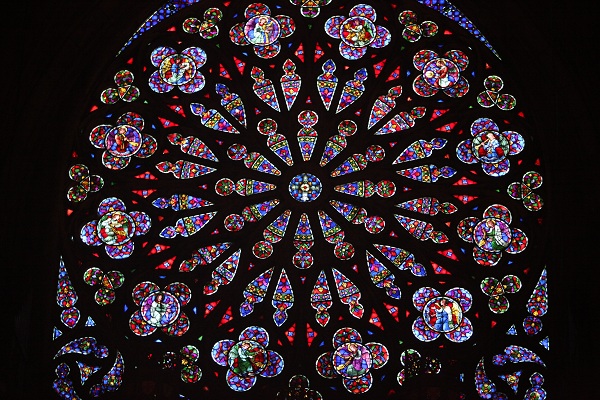
Photos are of the magnificent windows in the Church of the Most Holy Redeemer, 173 East 3rd St. NY.
26
Dec


The church is filling up….

At St Mary’s, Norwalk, a Solemn High Traditional midnight mass was celebrated before a nearly full church. Not a few seemed unfamiliar with the traditional liturgy, the midnight service or even the Catholic mass in any form – yet only one or two left before the conclusion of the lengthy service. Later at 9:30 AM, a congregation not that much smaller than usual attended a second Solemn High Mass (the 3rd Christmas mass). Could there be better evidence of the rapid acceptance of the Traditional liturgy in parish life since Summorum Pontificum?