


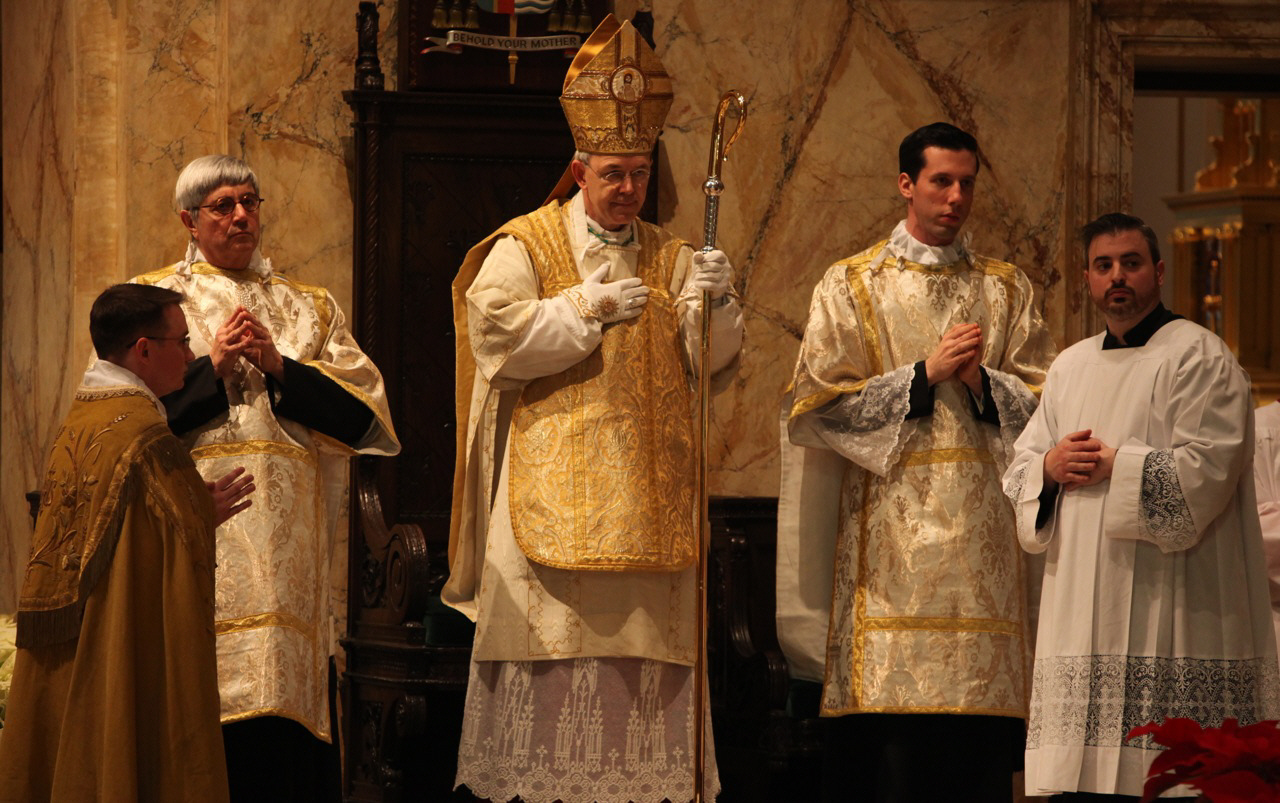
An island of faith in a sea of ugliness and unbelief: a reflective Ascension Thursday evening amid the Victorian splendor of Holy Innocents parish, New York.
23
May
Published in Uncategorized | no comment
15
May
The Crusades, Christianity and Islam
Posted by adminBy Jonathan Riley-Smith
(Columbia University Press New York 2008)
Jonathan Riley-Smith, the eminent English historian of the crusades, published last year a slim volume containing lectures originally given at Columbia University in 2007. In it, Prof. Riley-Smith challenges this consensus among the media, academia, Christian religious leadership and the Muslim world: that the Crusades were an evil, destructive event in history – perhaps even the origin of the current insoluble conflict in the Middle East. In particular, the statements of Archbishop Rowan Williams and the “apology” of Pope John Paul II (which Riley-Smith claims was not in fact such) are key evidence of the thinking of the Western Ecclesiastical Establishment. These contemporary Western religious leaders, moreover, make the further claim that the Crusades are an aberration in Christian history – that they are essentially alien to the Christian faith.
Riley-Smith’s book undertakes to refute these claims. Its first two sections define the correct nature of the Crusades. They were essentially a religious phenomenon – a penitential pilgrimage. There is no evidence that contemporaries viewed them as imperialistic or profitable ventures. There was no exclusive focus on the Moslem world, either: Crusades were called against pagan Prussian and Lithuanian tribes in the Baltic, against the Albigensian heretics and against other Christians opposed to the religious and even political agenda of the Papacy.
The entire logic of the Crusades is intimately connected with the Christian “just war theory”. Indeed, for much of the age of the Crusades the leading just war analysis (following Augustine) was even more supportive of war than its scholastic successor.
The Crusades fit into a pattern of later Holy Wars: the struggles of the Knights of Malta on land and sea, the battle of Lepanto – right up to the siege of Vienna and the Christian reconquest of Hungary at the end of the 17th century.
Riley-Smith illustrates the ongoing vitality of the theology of the Crusade in Christian tradition by Pope Leo XIII’s praise of the past efforts of the Knights of Malta and his support of a semi-ludicrous late 19th century attempt to organize a “Crusader” police guard for Catholic missionaries in Sub-Saharan Africa. To assert that the Crusades form an aberration in Church history and theology is simply wrong. Rather, it is the current theology of Western European Christianity that has radically broken with the consensus that obtained in the Middle Ages and beyond. Riley-Smith points out that up to the end of the 17th century Catholics Protestants and Orthodox were united in support of the ideal of holy war.
European views on holy war and the Crusades began to change radically with the Enlightenment. The new perspective was embodied in the novels of Sir Walter Scott. In them, the Crusaders are depicted as uncivilized barbarians and the Moslems as advanced Europeans of the 19th century. This obviously preposterous view became a new orthodoxy. Riley–Smith points out that the popular 20th century history of the Crusades by Sir Steven Runciman “is almost what Scott would have written had he been more knowledgeable.” By the way, Riley-Smith observes that the level of civilization in Europe and in Islam was far closer in the 12th century than Scott and his successors imagined.
Regarding current Moslem views equating the Crusades with “imperialism’, Riley-Smith shows that they date back no later than the early 20th century. Prior to that, Islam basically had no interest in events outside the Moslem world, They are essentially a regurgitation of one school of the western European thought regarding the Crusades: the predominant “liberal” view of the 19th century. Like the secular nationalism imported at the same time, it is a by-product of the intrusion of the imperialistic West into the Moslem world.
This work is a must for anyone seeking a succinct, informed introduction to the Crusades, the theology that prompted them as well as some insightful views on the present political situation. For the Catholic, it is a useful antidote to the “apologies” and historical and theological distortions of clerics eager to please the secular establishment
Published in Book Reviews | no comment
13
May
On Pentecost Sunday, May 31, St. Bridget of Kildare in Moodus, CT, will have a Missa Cantata with choir and Gregorian schola at 10:30 am. There will be on that Sunday no noon Traditional Mass. directions
Published in Uncategorized | no comment
13
May
Ascension Thursday Traditional Masses
Posted by admin
The following churches have scheduled Traditional Masses for Ascension Thursday, May 21. If you know of a Mass that is not on our list, please inform us so that we can add it.
Connecticut
St. Mary Church, Norwalk, Solemn High Mass, 5:30 pm
Sacred Heart Church, New Haven, 5:30 pm.
St. Bridget of Kildare, Moodus, low Mass, 10:00 am.
New York
Holy Innocents, 37th and Broadway, Manhattan,
May 20, Vigil of the Ascension 5:15 PM
Ascension Day at 6:15 PM
Our Lady of Mt. Carmel Church, 627 East 187th St. – the little Italy section of the Bronx, 8:30 am.
St Matthias, 58-15 Catalpa Ave. Ridgewood, NY 11385, Vigil of the Ascension (May 20) at 7:00 PM, sung Mass with choir.
Immaculate Conception Church, 199 N Broadway, Sleepy Hollow, NY (914-277-3368) Low Mass, 5PM
St Eugene Church, Yonkers, 10:00 am.
St. Matthew Church, Dix Hills, Missa Cantata, 10:30 am. Please note that this Mass will be held in the main church and not the parish chapel where Sunday Mass is held.
New Jersey
Holy Rosary Church, Downtown Jersey City, 344 Sixth Street,(201)795-0120, Missa Cantata, 5:30 pm.
Our Lady of Fatima Chapel, 32 West Franklin Avenue, Pequannock, NJ 07440, 7AM, 8AM, Noon and 7PM (Sung.
St. Anthony of Padua, West Orange, 9:00 am, 7:00 pm Solemn High Mass.
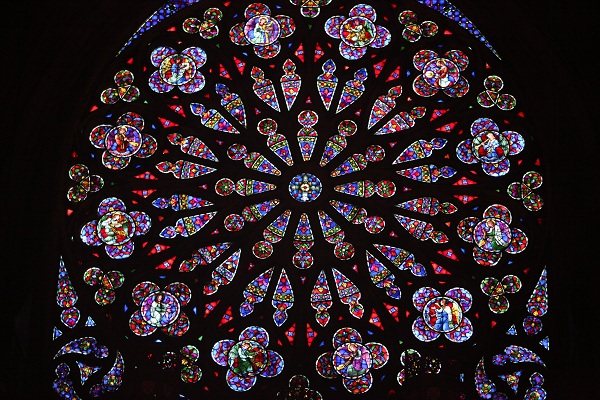
Stained Glass window from the Church of Notre Dame, 405W 114th Street, New York.
Published in Uncategorized | no comment
13
May
On Sunday, June 14, 2009 at 3:00 P.M., Fr. Peter Miara, Parochial Vicar at Our Lady of Mt. Carmel in the Bronx, will be celebrant of a Missa Cantata at Sacred Heart Church, 981 Castleton Avenue, Staten Island, New York for the Feast of Corpus Christi. The musical setting for the Mass shall be Missa de Angelis. In addition, traditional Catholic hymns such as O Sanctissima and Panis Angelicus, will be sung by the congregation. After Mass, a Solemn procession of the Blessed Sacrament will take place around the Church while Pange Lingua is chanted. This will be followed by Benediction of the Most Blessed Sacrament in Latin.
William J. Leininger, Chairman of the Staten Island based New York Latin Liturgy Association, stressed that Latin-English missalettes will be available to all those attending the Mass. Confession will be available prior to Mass. Gregorian chant practice will be held at 2:30 P.M.
Light refreshments will be served after Mass.
Published in Uncategorized | no comment
11
May

Fr. Greg Markey, pastor of St. Mary’s in Norwalk, CT, will celebrate a Mass of Thanksgiving for his 10th anniversary as a priest on Sunday, May 24 at 9:30 am according to the Extraordinary Form, at St. Mary’s. The Women’s Guild will host a reception afterwards in Msgr. Hajus Hall from 11:15 to 1:15. All are welcome. Directions to St. Mary.
Published in Uncategorized | no comment
27
Apr
Pontifical Solemn Mass in New York
Posted by adminOn Friday, June 19th, 2009, Feast of the Most Sacred Heart of Jesus, Bishop Fernândo Rifan (Campos, Brazil) will celebrate a (traditional) Pontifical Solemn Mass at the Throne at the Church of St. Jean Baptiste (East 76th and Lexington Avenue) at 7 PM.
This Mass would be the first Pontifical Solemn Mass in a long time in NYC. There will also be a Conference on devotion to the Sacred Heart and a Dinner in honor of Bishop Rifan on Saturday, June 20th, 2009.
For more information about this Mass and other events related to it, please visit: http://sacredheartconfraternity.org/
Published in Uncategorized | 1 comment
14
Apr
Sermon preached by Father Richard Cipolla, St. Mary Church, Norwalk, Holy Thursday, April 9, 2009
I remember when I was studying at the Yale Divinity School in the late 1960’s and early seventies, a prominent Catholic theologian was speaking about the problem about too much emphasis on the Mass in Catholicism. He summarized his position in this way: we have to remember that the Mass is not the Christian faith. Where this theologian was going with all of this is somewhere none of want to go and has led in part to the problems we face today because of the bad theology being spouted and taught after the Second Vatican Council. The Mass is not the Catholic faith. Of course that is true. Only a fool would not see this in its obvious sense. But the fact is this: that without the Mass there is no Catholic faith. It is not as if the Mass is just one element of the Catholic picture that can be erased or left out without too much damage. No. Why we come here tonight at the beginning of the Sacred Triduum is to remember and celebrate liturgically that event in salvation history that is at the very heart of the Church—not merely part of the body—at the very core, the heart of the Church. Those words of Jesus at the Last Supper, those gestures: this lies at the center of our salvation, for this event is the making present of the Cross of Christ, by which alone we are saved. By which alone. As oft as you do this, you do this in memoria mei, in memory of who I am and what I am doing and who I am is the Son of God through whom all things were made, and what I am doing is the showing forth in bread and wine of what I shall do tomorrow on the Cross.
The Last Supper is not merely a Passover meal that Jesus and his disciples share and where the Lord foretells his sacrificial death. This is where and when the Lord of creation by his presence and words makes present the sacrificial offering of himself that will take place physically in space and time on Good Friday. This is no mere anticipation, foreshadowing, playing with words and symbols. This is the institution of the Holy Eucharist, the gift of God to the Church of the saving grace of the blood of the Cross. And when the apostles ate and drank what Christ offered them there, they ate his life-giving body and they drank his saving blood. O wondrous gift, O salutaris hostia, the saving Victim opening wide to our space and time the gates of heaven to men below! And this grace is received by all, but not as magic, for the sacraments are not magic. For the Lord’s body and blood is received at the Last Supper by both Peter and Judas, both of whom betray Jesus within a few hours. That grace is received by the rest of the apostles who flee the cross in fear except for John. Their lack of faith objectifies the presence of Christ’s grace within them. Their fear and disbelief cover that grace so that it cannot be seen or known. And yet the grace is still there for those who believe or who come to believe. Peter’s denial of Christ is indeed a terrible thing. I do not know the man. When Peter breaks down and weeps, he realizes what he has done, he realizes the enormity of it all, and in his weeping recalls: this is my body, this is my blood shed for you. And he understands what this means: that the terrible sin that he has committed has been taken on by the man being crucified, and there arises in his heart hope, hope for himself and hope for all who have sinned. When Judas realizes what he has done, he weeps, he realizes the enormity of what he has done: he hears the words this is my body, this is my blood, he sees Jesus taking the bread and wine: and he says to himself. It is impossible. Such love cannot be possible. My sin is so great. There is no hope. He refuses to believe that he can be forgiven. He rejects the grace of Christ and kills himself.
Two priests: Peter and Judas. For the Last Supper is not only the institution of the Holy Eucharist, the Mass. It is also the institution of the priesthood. In those words to the apostles: do this, Christ makes them his priests whose purpose, whose life, whose reason for being is to do this: to celebrate the memorial of Christ’s saving death and passion until he comes again at the end of time. The Last Supper was not merely a Passover meal shared by Jesus and his friends. Jesus’ words; this is my body, this is my blood shed for you, do this: radically transform what was a Passover meal into the Mass: the re-presentation of the sacrifice of the Cross. What Christ was to do physically on Good Friday was already present in his words, his gestures, his person at the Last Supper. And what the apostles received in the bread spoken over by Jesus and the wine spoken over by Jesus was his very body and blood offered for the sins of the world. It is this sublime mystery given to the Church that we celebrate tonight, this divine gift that could not exist without the second gift, the gift of the priesthood. And yet, having received the saving grace of the Sacrament, Peter denies Christ, Judas betrays him to death, and the other disciples except for John flee in fear. How can this be? Because the grace of the Sacrament is not magic: the grace of Christ cannot be operative without the co-operation of the individual. It cannot save without faith, even implicit faith. And that was lacking in these men in that situation; fear drove out their precarious faith, the darkness of the situation made them forget Jesus’ words: Take eat. Do this. They forgot who they were. They forgot in the deepest sense that they were priests. They forgot that their job is to be present in the deepest sense at the passion and death of the Lord until the end of time.
That forgetting of their priesthood comes to an end with their resurrection faith for all but Judas. Judas forgets willfully that he is a priest; his denial of his priesthood in the darkness of his deep sinfulness makes him forget his own essence and that his own essence is bound to the essence of God that is love. This denial ends in death.
On this holy night we remember that the Church, at least in the West, finds herself in a deep crisis. The symptom of the crisis is the lack of vocations to the priesthood. The cause of the crisis is the forgetting of what it means to be a priest. How can one talk of a priestly vocation, a calling to DO THIS, if there has been a collective forgetting of what a priest is. We hear about the problem of priestly identity, and this is a problem, for if you went around in your life, your marriage, your family, your job, constantly wondering who you were, paralysis would set in. All sorts of remedies are offered for the crisis in vocations: abolish celibacy, let priests get married, abolish the male priesthood, let women be priests: all in the hope increasing the numbers. But do you see that all of this avoids the underlying problem and question of the essence of priesthood, of priestly identity. This essence cannot be changed, for it was instituted by Christ and is an integral and necessary element in the Church. The forgetting of what this essence is, is at the heart of the crisis in the priesthood, not only with respect to lack of vocations—and what good intelligent young man would devote his life to something that no one could any longer define—but also with respect to the life of priests today.
The Popes from Paul VI to Benedict XVI all have spoken of the crisis of faith that lies at the heart of the crisis in the priesthood. And this faith is not merely faith in Christ and the Church; it is faith in themselves as priests, and this lack of faith is the same as forgetting who they are. What are the forces surrounding the priests that undermine his identity? They are legion, they are indeed many in this age, this age that is affronted by any evidence of the holy, affronted because holiness, especially the holiness of the priest is a reproof to the gods of individualism and license masquerading as freedom. How easy it is to forget that the washing of the feet which follows this sermon is of the essence of the priesthood and to dismiss it as mere ritual, something nice to do to twelve good man of the parish. For this act lets you know who I am as a priest, a servant to all, meant to serve, to serve at the altar of God in the first place and offer myself on the altar with the host, and from this offering comes the courage and the desire and the will to serve others, the people of this congregation and to serve the sick, the lonely, the poor and the dying.
In an age in which men have forgotten what it means to be a man, how easy it is for the priest to forget his manhood, to forget that he is called not to be an asexual religious functionary but a vir, a man-hero, that man-hero that has nothing to do with machismo but everything to do with identifying himself with the manliness of Jesus Christ, in whose person the priest stands at the altar, in that manliness that demands that he preach the truth of the Gospel in season and out of season, that manliness that does not shrink from reproving sin and then offering the remedy of Confession, that manliness that embraces the beauty of the good and the true, that manliness that resists any attempt by people to turn him into a religious Ken doll to be put on a shelf like a harmless toy.
How difficult it is to remember that the heart of his priesthood is DO THIS, to offer sacrifice for and with his people, when contrary to the firm tradition of the Church and with no mandate from the Second Vatican Council he is so often constrained by an entrenched innovation to celebrate Mass as if he were praying to the people, as if the words coming out of his mouth are addressed to the people, as if the congregation is one focus of the Mass and the priest is the other, as if he and the people form a closed ellipse that impedes so deeply the unity of priest and people, that unity that is shown so wonderfully by facing God together to offer the sacrifice.
We need no reminders that God has entrusted the glory of his priesthood to weak vessels of clay. We priests of this parish do not need this reminder. Our unworthiness is obvious, but it is to us that God has given this power and mandate to DO THIS and to be priests. We have an obligation to do what we have to do spiritually to never forget the essence of our calling, what it means to be a priest and to carry out that calling among our people. But what we do need, and what all priests need, are laity who support them with their prayers, not in some general way, but in specific ways. First of all pray that you are never a stumbling block for a priest by encouraging him to give into his weaknesses of pride and self-love and sloth and worldliness in its many forms and mere religiosity. Instead, pray that we have the courage and the faith to be servants, pray that we have the courage and faith to be men, pray that we have the courage and faith to lead lives of sacrifice that come from our faithful offering of the sacrifice of the altar. Pray that we have the courage and faith to not water down the truth in our sermons, in the confessional and in our counseling and pray that our love and concern for our people shows when we speak the truth.
And now enough words, words that are caught on the wind and are borne away into nothing Instead let us do what we are here to do: DO THIS
Published in Uncategorized | no comment
13
Apr
Holy Innocents Church in Brooklyn will offer the Traditional Latin Mass on Saturday, April 18 at 2:00 P.M. Holy Innocents is located on East 17th St. and Beverly Road.
Subway directions: BMT (Brighton Line) to Beverly Road/East 16th St./ Q train 1 short block away from Holy Innocents Church.
Published in Uncategorized | no comment
5
Apr
Palm Sunday at St. Mary’s Norwalk
Posted by adminOn a beautiful Palm Sunday, the parish of St. Mary’s Norwalk celebrates (in just under two hours) the blessing of palms, the procession and the mass according to the 1962 liturgical books.

Outside altar prepared for the blessing of the palms.


Sprinkling the palms held by the people.

Incensing of the palms held by the people.

The gospel reading of Christ’s entry into Jerusalem.

Procedamus in pace.


The subdeacon strikes the door with the foot of the cross – the procession then goes into the church.

The singing of the Passion according to St. Matthew with polyphonic turba settings by T. L. de Victoria
Published in Uncategorized | 3 comments
Contact us
Register
- Registration is easy: send an e-mail to contact@sthughofcluny.org.
In addition to your e-mail address, you
may include your mailing addresss
and telephone number. We will add you
to the Society's contact list.
Search
Categories
- 2011 Conference on Summorum Pontifcum (5)
- Book Reviews (111)
- Catholic Traditionalism in the United States (27)
- Chartres pIlgrimage (17)
- Essays (182)
- Events (704)
- Film Review (7)
- Making all Things New (45)
- Martin Mosebach (35)
- Masses (1,389)
- Mr. Screwtape (46)
- Obituaries (20)
- On the Trail of the Holy Roman Empire (27)
- Photos (360)
- Pilgrimage Summorum Pontificum 2021 (7)
- Pilgrimage Summorum Pontificum 2022 (6)
- Pilgrimage Summorum Pontificum 2023 (4)
- Sermons (79)
- St. Mary's Holy Week 2019 (10)
- St. Mary's Holy Week 2022 (7)
- St. Mary's Holy Week 2023 (7)
- St. Mary's Holy Week 2024 (6)
- St. Mary's Holy Week 2025 (7)
- St. Mary's Holy Week 2026 (11)
- Summorum Pontificum Pilgrimage 2024 (2)
- Summorum Pontificum Pilgrimage 2025 (7)
- Summorum Pontificum Pilgrimage 2026 (8)
- The Churches of New York (224)
- Traditionis Custodes (57)
- Uncategorized (1,416)
- Website Highlights (17)
Churches of New York
Holy Roman Empire
Website Highlights
Archives
Support the Society of St. Hugh of Cluny
[powr-hit-counter label="2775648"]