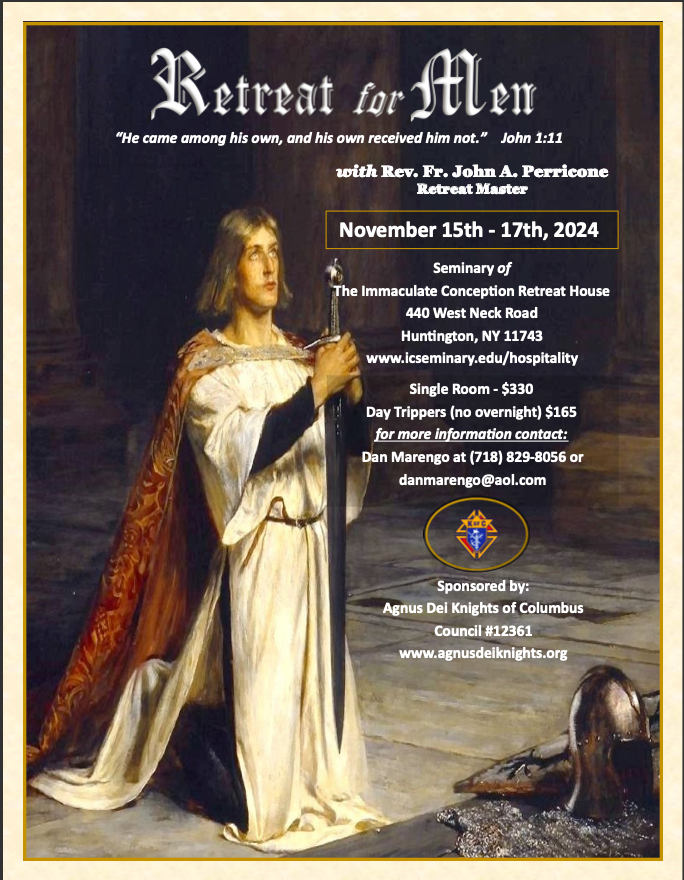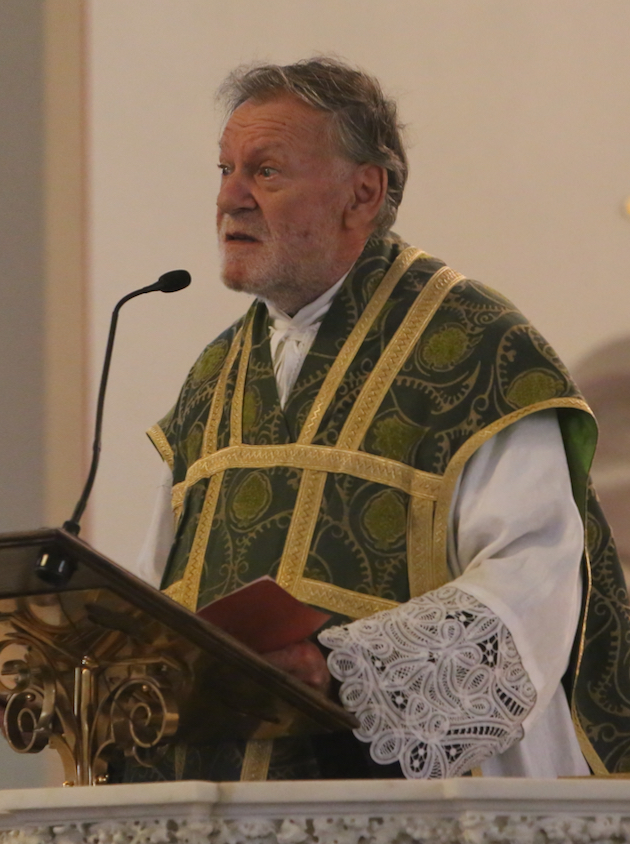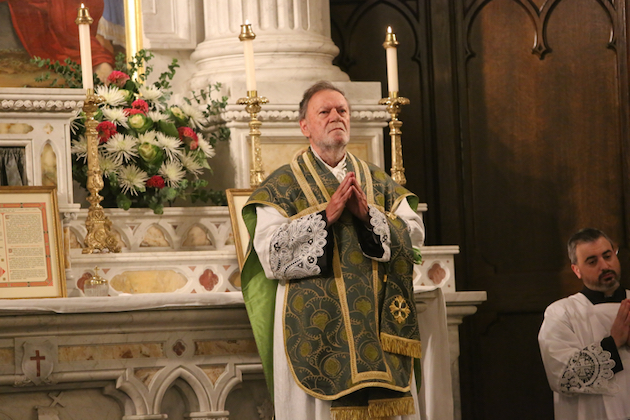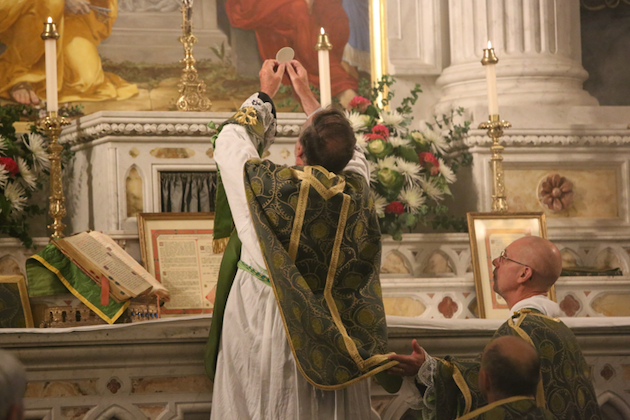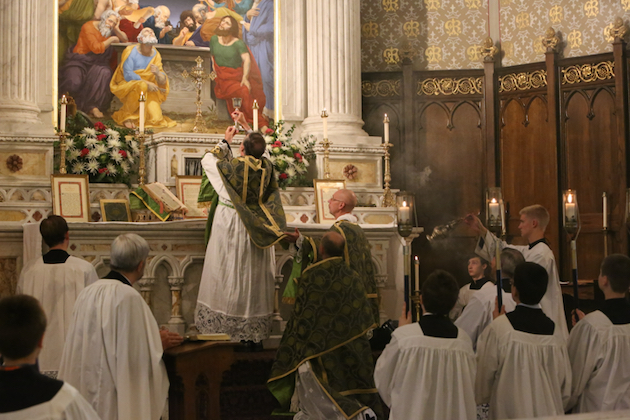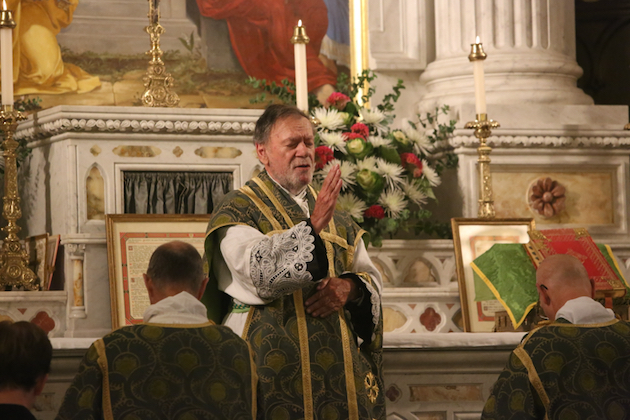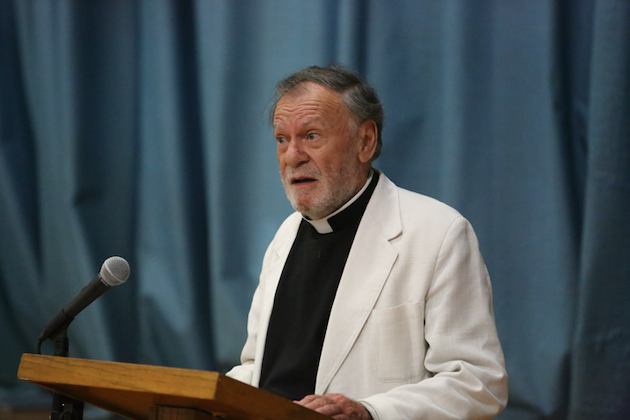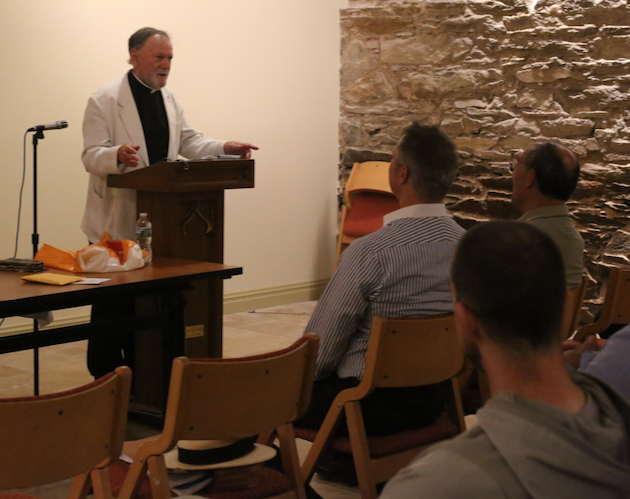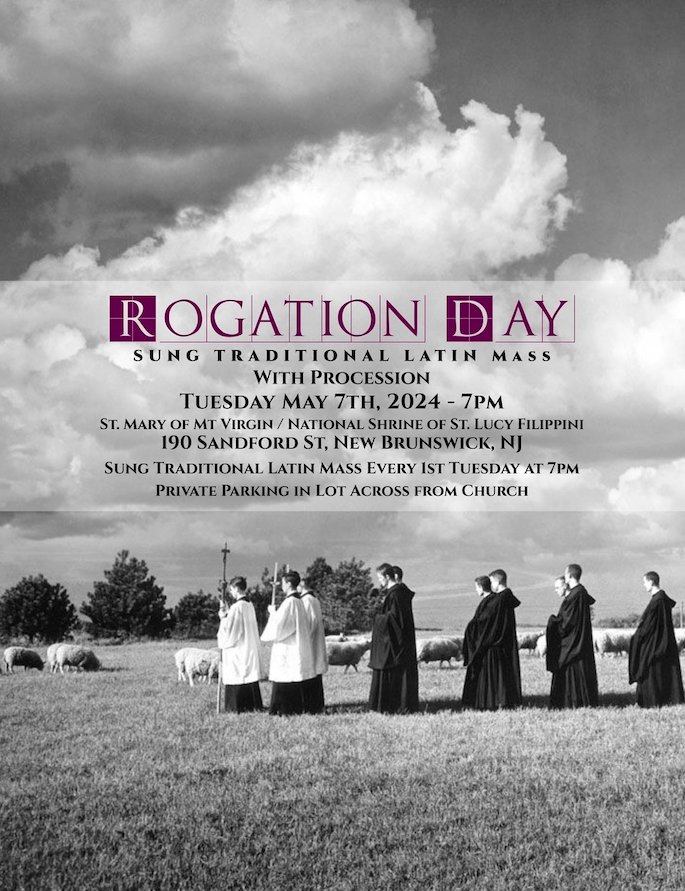
Fr. Perricone is conducting a Lenten Day of Recollection on Saturday, March 16th at St. Josaphat Church in Bayside, Queens, starting at 10am. It is open to all family and friends.
The Day’s format (which may run about 2.5 hours):
2
Mar

Friday was a very special evening at the Princeton University Chapel: First Vespers of St. Chad of Mercia, bishop, according to the use of the Church of Salisbury (the “Sarum Use”). The Use of Sarum was the main form of the Roman liturgy in Pre-Reformation England. It was celebrated now and then by Catholics as late as the 19th century, but was regrettably entirely superseded by the “Tridentine” liturgy. Perhaps that was because the Use of Sarum obviously makes considerable demands upon a church’s staff resources and available time….. First Vespers refers to the fact that St. Chad (whose feast is on the following day, March 2) was commemorated. 1)
Music and ceremonial were of outstanding quality. A congregation of around 1,000 was in attendance. The demeanor of all was reverent. An introduction preceding the Vespers and the informative program emphasized the spiritual nature of what was happening. In no way was this liturgy presented as a secular concert.
I must admire the creativity (in an appropriate sense) of the organizers. If the basic elements of ritual and music were supplied by authentic texts of the period, features of other traditions were freely drawn upon to complete the liturgy. So, German and English organ music of the 20th Century preceded and followed Vespers. A Byzantine icon was displayed. Benediction of the Blessed Sacrament ( a ritual not a part of the Use of Sarum) concluded the evening. It was a rare instance of how the various strands of Tradition can mutually complement each other without falling into arbitrary eclecticism.
Achieving all this was a truly a remarkable effort. 2) It illustrates that if such an effort is made, while preserving the spiritual basis of art, music and ceremonial, people will come. We were proud that the Society of St. Hugh of Cluny could be counted as one of the sponsors.


24
Feb

Today at noon, hundreds of Catholics came together to pray the Rosary in reparation for the sacrilegious funeral that took place last week in the cathedral. Fifth Avenue was bustling with tourists, shoppers and residents, some of whom joined the rally or stopped to take pictures. From our perspective, the event proceeded peacefully, with no sign of counter protesters.
There are also Rosary rallies scheduled for noon tomorrow and Monday.

23
Feb

Sacred Heart Cultural Center in Augusta, Georgia, was the Jesuit church of the Sacred Heart, built between 1898 and !900. It formerly was a center of Catholic faith, life and education in what was once a not-very-Catholic part of the United States. The church was closed and abandoned in 1971. For years the buildings lay vacant and were repeatedly vandalized. In 1987 the buildings were purchased and reopened as the Sacred Heart Cultural Center. Over the years, great efforts have been made to restore the bulding and windows. It now functions as a cultural center and as an “event venue,” especially for weddings.

(Above and Below) Sacred Heart. The very elaborate exterior brickwork reminds me of a somewhat earlier (1880’s) church in New York City, Sacred Heart of Jesus, in Hell’s Kitchen.


The church – now the “Great Hall” – is grandly dimensioned. It has been nicely restored and painted , except for the communion rail, visible in old photographs – but that may have already disappeared before 1971.


The pulpit with its sounding board or tester. The original pulpit in St. Patrick’s Cathedral, New York, had a similar feature.
The Center is particularly proud of the stained glass windows, most of which were creations of the firm of Mayer, Munich. The windows were installed at the time of the building of the church or shortly thereafter. Mayer provided windows to inumerable Catholic churches in the United States especially from the 1890’s to World War I. Indeed, Mosy Holy Trinity, the (still functioning) Catholic parish in downtown Augusta, also has a set of Mayer windows which it is currently restoring. The design of the windows of Sacred Heart closely resembles that of certain windows that can be found in, for example, Holy Innocents parish (installed twenty-five years or more after completion of the church), or Holy Name of Jesus parish (both New York City). The artists of the Mayer windows, however, while often relying on a common repertoire of designs or patterns, seem to have taken care to vary the details for each commission.
When the Jesuits left Sacred Heart in 1971 all this was left behind – good riddance, they undoubtedly thought. Nowadays, as church after church is closed in New York City and elsewhere, the windows, altars, stations of the cross, etc. are usually salvaged for disposition to other churches seeking to upgrade their modernistic buildings. The parish of St. Theresa, not too far from Augusta, is a very good example of this recycling.


In the former baptistery a small museum of Catholicism has been set up. It explains to visitors what once was done within these walls. Similar Catholic museums exist in Victoria, British Columbia and in Zurich. The materials published by the Sacred Heart Center that I have seen do treat the practices of those who used to worship here with respect.


(Above) This is a sanctuary lamp. (Below) The final sign for Sacred Heart Church. Note it is “post-conciliar” ( A Vigil Mass on Saturday is scheduled).

We applaud the Sacred Heart Center for the care and respect they have shown to this church, abandoned by its original spiritual leaders and congregation. It’s impressive to encounter this degree of appreciation for these old Catholic churches, which are still scorned by the clergy, at least in the Northeast. Yet we weep to see the art of the Catholic faith turned from its purpose and treated as a relic of some distant past. In this respect, the secular management of this Center is completely aligned with, for example, the New York Archdiocese, which has often described its architectural heritage as “museums.” Finally, we firmly hope that a recovering Traditionalism, made stronger through persecution, will continue as part of its mission the revitalizaion of the splended Catholic churches of the past. For after all, as Proust wrote of the French cathedrals, these grand old buildings were created for one purpose: the celebration of the Traditional Mass.
23
Feb
Members of Tradition, Family, Property (TFP) are organizing a Rosary rally to make reparation for a sacrilegious pro-LGBT funeral held in New York City’s St. Patrick’s Cathedral last week.

On February 15, transgender activist and prostitute “Cecilia Gentili,” a man who “identified” as a woman, was celebrated at St. Patrick’s by hundreds of people dressed in scandalous clothing.
A LifeSite petition launched in response to the event, which organizers have called a political protest, is urging Cardinal Timothy Dolan to exorcise the cathedral. As of the publication of this article, more than 10,000 persons have added their signatures to the petition.
TFP’s Rosary protest will be held at 12 p.m. noon EST on Saturday, February 24, Sunday, February 25, and Monday, February 26. “Our public rosary will be peaceful and legal. We ask for God’s mercy and offer public reparation,” the group said. St. Patrick’s Cathedral is located at 5th Avenue.
17
Feb

Jean Madiran 1920-2013
By Yves Chiron
(DMM, Poitiers, 2023)
Continuing our review of the recent flood of major publications on the sources of the Traditionalist movement, we come to Yves Chiron’s new biography of the towering figure of Jean Madiran (real name Jean Arfel). In many respects he was “Mr. Traditionalism” in France (next to Archbishop Marcel Lefebvre of course!) I find Chiron’s magisterial biography even more successful than his previous history of Catholic Traditionalism.1) Both books cover in encyclopedic detail a period of many decades starting from well before the Second Vatican Council and leading up to the present. Yet by its nature Chiron’s biography has greater unity and focus, for it enjoys a central point of reference: Jean Madiran. In the course of his long life, he interacted with almost everyone in the Traditionalist French “scene” – and beyond. Moreover, perhaps because the narrative ends with Madiran’s death in 2013, the author is free from the need to harmonize his history and the current regime in the Vatican.
Professor Chiron tells the story lucidly, not disguising aspects of the life of Madiran that may surprise some readers. Such as his initial career as a young Vichy supporter. Or certain marital complexities that Madiran experienced in his early years. And we are told of a festive celebration of Madiran’s 75th birthday during which a girl jumped out of the cake. At this same party Madiran received a gift of two tickets to Disneyland Paris, which he previously had found enjoyable. (p.473) Well, we all have our foibles….
Madiran embodied that intransigent form of Traditionalism from which so many supporters of the Old Mass would like to distinguish themselves: counter-revolutionary, “integrist,” Maurrassian! The largely imaginary “far right” political connections of Traditionalism remain a focus of rage for the Catholic establishment of the United States, Europe, and the Vatican. (The much more concrete and systematic ties of the institutional Church – including the so-called “left” – with the Western political establishment are of course never an issue for them). In the case of Jean Madiran, however, these rightist political commitments were very real. And this was for him a source of strength, not of weakness. For defense of the Catholic religion was for him inseparable from the defense of the French nation as it was concretely lived.
Madiran, of course, was a dedicated follower of Maurras, to whom he remained faithful all his life. Indeed, after the war, some of his earliest efforts were appeals on behalf of various Vichy figures facing imprisonment or worse under the new regime. Thus, his first engagement was political. Yet, in 1946-47, Jean Arfel discovered the priory of Madiran near a school where the was teaching. (He later took his penname from this priory.) He made a retreat there, discovering the Benedictine life organized around the singing of the divine office, the meals taken in silence and the primacy of contemplation. And he had a spiritual experience in which the gospel first began to speak directly to him. Years later he would refer quietly to this moment of enlightenment. (pp. 67-68)
Madiran developed into a redoubtable journalist and organizer. In 1956 the founded his own magazine Itineraires, which published contributions from a whole galaxy of writers from the religious and political Tradition (including those of my own revered friend Thomas Molnar) Later, in 1982, Madiran cofounded a newspaper, Présent.
Madiran had and has the reputation of a militant polemicist. Yet Chiron points out that he also showed considerable talent for compromise and cooperation (for example, in his friendly dialogue with Etienne Gilson after the Council). It also may surprise the “Anglo-Saxon” reader to discover how often – at least in the earlier years – Madiran would sit down with his journalistic adversaries (generally not his clerical opponents!)to discuss their contrasting positions. These encounters often took place in a restaurant – it is France, after all! Such exchanges of views would be unthinkable in the United States today, where both the progressive establishment and the feeble “conservative” centers talk only to themselves.
By the 1950s, Madiran began to focus on deviations in the Roman Catholic Church. in 1955 he wrote the first work that won him notoriety, They Know not What They Do, a critique of the drift of the French Church towards accommodation with communism. In one sense, this concentration on anti-communism was a retreat from his initial full-blown counter-revolutionary, even reactionary, cultural criticism. A loose contemporary analogy in the United States would be the focus of National Review magazine on anti-Communism. In that connection, on the religious front, William F. Buckley spoke out against both Dorothy Day and Pope John XXIII’s encyclical, Mater et Magistra.
Of course, the French situation was entirely different from that of the United States. In France, Marxism had acquired almost a dominant position in cultural life and even among the Church intellectuals. Madiran’s book was accordingly very ill received by the clerical establishment. The French bishops took Madiran’s book as an affront. He was denounced in pastoral letters and statements. Madiran’s attempts to obtain support from the Vatican (in 1955-58!) were fruitless. Indeed in 1958 , the substitute of the Secretary of State counselled Madiran “to act within the views of the hierarchy – don’t just inform them but consult then in advance.” Chiron comments that this was equivalent to counseling blind obedience or at least the acceptance of control. (p.152) Note that all this happened before the Council and indeed mostly under Pius XII.
With the Second Vatican Council, Madiran shifted his focus once again. Uneasy at Vatican developments as early as the publication of Mater et Magistra in 1961, Madiran grew increasingly critical as the Council and its aftermath unfolded. It is generally forgotten today that, except for some independent priests, opposition to the Council, its implementation, and its “spirit” in the early years of 1964-71 was led by the laity. One can compare, in the United States, the circle of writers involved with Triumph magazine.
In 1968 Madiran resolved henceforth to attend only the old liturgy. He became a tireless defender of the traditional Mass and fought first for its preservation and later for its official recognition. He fought other deviations in the French Church, such as communion in the hand and modernist catechisms. In 1968 he summarized his convictions in his main work The Heresy of the XXth Century. Madiran’s activism and criticism of specific bishops earned him the undying enmity of the French episcopate. Who has been proved right? – I believe the facts of the French Church today speak for themselves. Consider the title of a recent book on “FrenchChurch” written by two stalwarts of the local establishment; Vers L’Implosion? 2)
After 1971, Madiran became an active supporter of Archbishop Lefebvre as he built up his seminary and order. Yet in 1988 he broke with Lefebvre over his consecrations of bishops. Later, however, it seems Madiran had to grudgingly reconsider – at least in part -his criticism of Lefebvre’s actions at that time.
By 1989 the Soviet empire was well on the way to irreversible collapse. The Western establishment, instead of recognizing with either gratitude or an apology the superior judgment of those who, like Madiran, had for so long forcefully denounced the theory and practice of communism, instead turned even more strongly against these prophets. In Madiran’s case, it was in the 1990s that he suffered the harshest attacks, both journalistic and legal. Of course, Madiran himself gave his own answer to the politics of the new world order – he became a defender of the Front National.
Is the world not strange? Towards the very end of his life, during the pontificate of Benedict, Madiran finally enjoyed a modicum of official recognition from the Church – in the wake of Summorum Pontificum. He was kindly received by Pope Benedict and at the Vatican; he was also honored at a grand festive dinner in Rome surrounded by traditionalist representatives. It was a well-deserved reward for someone who had fought for Catholicism so long in the face of official clerical disdain. Of course, such gestures would be unthinkable today under Pope Francis and his team in the Vatican – both by reason of their ideology and their utter lack of manners.
Jean Madiran died in 2013 – his requiem was in Versailles at the famous church of Notre-Dame des Armées. 3) He had been a peerless champion in France of Catholic tradition and politics. Yves Chiron’s book will offer you a thousand additional details about his life and the saga of French traditionalism. I warmly recommend you discover it for yourself!
12
Feb

Edited by Joseph Shaw
Foreword by Martin Mosebach
(Arouca Press, Waterloo, Ontario Canada 2023)
Recent publications have enabled us to revisit, from the traditionalist perspective, the years of the Second Vatican Council and its immediate aftermath, as found in the writings of concerned contemporary observers. These records have a special attraction for us – these initial impressions often have an immediacy , frankness and freshness that disappeared later. After the early days, those struggling to preserve tradition often felt the need to make compromises or ingratiate themselves with the hierarchy. In our era when much of the clerical establishment once again has rejected all notion of compromise, it is fascinating to revisit these beginnings of the traditionalist movement.
Joseph Shaw has assembled in The Latin Mass and the Intellectuals a book of essays that is a major new contribution in the English language to the history of those times. It focuses on the two major petitions in 1966 and 1971 that were submitted to the Vatican for the preservation of the Latin mass. The book also covers other petitions in subsequent years – but these larer examples were more specific, and the signatories were predominantly individuals and organizations involved in one way or another in the traditionalist cause.
That certainly was not true for the 1966 and 1971 petitions. The signatories included a broad range of distinguished representatives of the arts and sciences. Contributions in this book by Joseph Shaw and Fr. Gabriel Diaz- Patri list the signatories and explain their accomplishments and connections. Some of the names may be surprising: Jorge Luis Borges, Jacques Maritain, Graham Greene, Francois Mauriac, Giorgio de Chirico, Rene Girard – and many more. Perusal of their biographies shows that many were not traditionalist, conservative or even Catholic. Indeed, there are some representatives of the far left among them. What united them all was concern for the preservation of the historic artistic heritage of the West. By the way, those who became more directly involved in early traditionalism were also by no means drawn exclusively from the ranks of the political right.
A forerunner of these post-conciliar initiatives was an essay (included in this volume) written by Marcel Proust in 1904 when the anticlerical French government was supposedly thinking of banishing Catholic worship from the cathedrals and churches it had seized. That work pointed out the intimate connection between the purpose for which the gothic buildings were created – Catholic worship – and the art and architecture of the cathedrals. Proust’s essay later was consciously drawn upon by those who formulated the petitions after the Council.
The heart of this volume are the chapters on Cristina Campo written by Fr. Gabriel Diaz-Patri. An outstanding Italian literary figure, Campo had gradually become immersed in the Catholic mystical and spiritual tradition. She “converted” around 1964 – perhaps after having been present at vespers.
Certainly, between 1964 and 1965 something spoke to her, reaching her from infinite distances. She spent hours of churches. She sat meditating in the monastery of Tre Fontane, she attended vespers at Sant’Anselmo, perhaps unaware that almost 30 years earlier, in May 1937, Simone Weil had sat on the same pews … (p. 113)
But Campo sprang into action as the first liturgical changes were imposed. It is due to her efforts that both the 1966 and 1971 petitions came into existence.
(A)ll the testimonies agree that the driving force behind Una Voce Italia at that time was Cristina Campo, not only writing what the institution published but also personally doing most of the work on the practical side. On this occasion too (the publication of the 1971 petition-SC), the letter was due, to a very large extent, to her. Her international contacts with a cultural world that might be willing to give its support were crucial in the success of the project outside the English sphere (p. 201)
This book offers the first detailed account in English of Campo – at least up to the point of publication of the petitions. We would like to hear much more about the few remaining years of her life (she died in 1977). Happily, Shaw tells us that the chapters in The Latin Mass and the Intellectuals are but a selection from a forthcoming new biography of Campo by Fr. Diaz-Patri.
Fr. Diaz-Patri offers a second extended biographical narrative – of Bernard Wall and his circle, the organizers of the English side of the 1971 petition. I confess I found this account of the meetings and interactions of Wall’s friends going back decades less interesting than the Italian events involving Campo. Still, it was fascinating to read how much time people of those days could devote to discussion, how the serious exchange of thought had not yet been drowned out by the media torrent of our days.
What was the motivation for organizing these petitions? I think it was to witness to the irreplaceable, intrinsic “objective” value of the forms of the old liturgy. This was something that could be understood and appreciated aside from any personal commitment to the religion those forms expressed. Thus, these petitions form an important witness in a Church which presented (and still presents!) the changes in the liturgy as some kind of unanimously accepted divine revelation.
The actual effect of the petitions was of course minimal. The 1971 petition did obtain some narrow freedom for the continued existence of the old mass for the UK – although I read that subsequent to 1971 the Vatican sought at times to revoke even that limited exception.
Now, of course, these intellectuals may have been foolish to expect that these petitions would have any effect on the conduct of the Vatican. Their arguments at the time in fact backfired, opening them up to the “indictment” of being “aesthetes.” Amazing – for many centuries the Catholic Church had been the main patron of the arts, now, in the 1960s, expertise in and commitment to the arts had become an accusation, an unforgivable sin.
What held true for the petitions of 1966 and 1971 did even more so for the later ones submitted by traditionalist or conservative proponents. In at least one occasion the receipt of the petition was hardly acknowledged – let alone any response being given. It’s instructive to read, in the case of these later petitions, of the arrogant and underhanded behavior of the Vatican officials – including those supposedly tasked with looking out for the traditionalists. Indeed, the chicanery and confrontational attitude we now associate with Pope Francis and Cardinal Roche already were current – if displayed less systematically and openly – under John Paul II.
Martin Mosebach writes a remarkable foreword. For the first time in history, he writes, the laity rose up to defend the hierarchical, priestly, and sacral character of the Church – against an initiative launched by the priests! This book describes the battle for the Roman liturgy, and those who fought it were convinced it was the most important of the twentieth century – because the survival of the Christian religion was (and is) at stake.
Joseph Shaw’s informative preface describes a primary purpose of The Latin Mass and the Intellectuals: to honor the memory of the petitioners who sought to preserve the Traditional Latin Mass – especially Cristina Campo, “the foremost of them all.” He further claims that the minor relief obtained in the “English Indult” was a precondition for the expanded indults in 1984 onward. Well, one could argue about that – I think the actions of a certain French archbishop had far more to do with it. On the contrary, I would guess most people would consider the efforts of Campo, Wall and their friends to have failed. Yet the witnesses of these early petitions, like the early martyrs of the Church, can never be seen as failures. Their full influence will only be known in the course of generations. Their testimony to the truth and the power of beauty remains vital for us who live once more in an age of doctrinal collapse and official persecution. The Latin Mass and the Intellectuals is essential reading!
12
Feb
This Wednesday, February 14 is Ash Wednesday. The followin churches will offer the Traditional Mass.
Connecticut
St. Mary Church, Norwalk, 8 am, 7 pm
Sacred Heart Oratory, Redding, 6 PM, music by the Viri Galilaei and followed by sung Vespers, as every Wednesday.
Sts. Cyril and Methodius Oratory, Bridegport, 7:45 am low Mass; 6 pm Solemn Mass
St Patrick Oratory, Waterbury, 8 am; 6 pm
New York
Our Lady of Mount Carmel Shrine, New York, NY, 7 AM Low Mass, 7:45 AM Low Mass, 7 PM Missa Cantata
Holy Innocents, New York, NY, 8 am, 6 pm
St. Patrick Church, Glen Cove, Long Island, 7 pm low Mass.
St. Paul the Apostle, Yonkers, 12 noon
Immaculate Conception, Sleepy Hollow, NY, low Mass, 7 pm
St. Mary St. Andrew, Ellenville, Missa Cantata, 7 pm
New Jersey
Our Lady of Sorrows Church, Jersey City, 8:30 pm
Our Lady of Victories, Harrington Park, 6:15 pm
Our Lady of Fatima Chapel, Pequannock, 7 am, 9 am, 12 noon, 7 pm
St. Anthony of Padua Oratory, West Orange, 9 am Low Mass; 7 pm Missa Cantata.
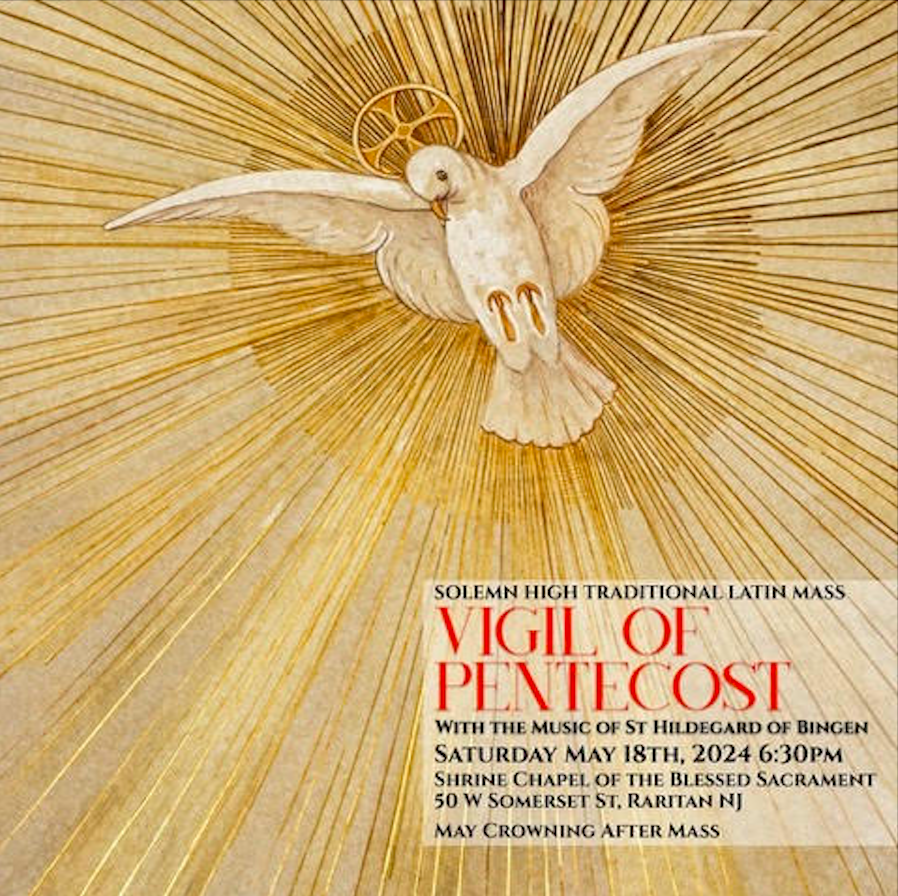
Shrine Chapel of the Blessed Sacrament, Raritan, 7 pm
Corpus Christi Church, South River, 6:15 pm low Mass.