

7
Jun
3
Jun
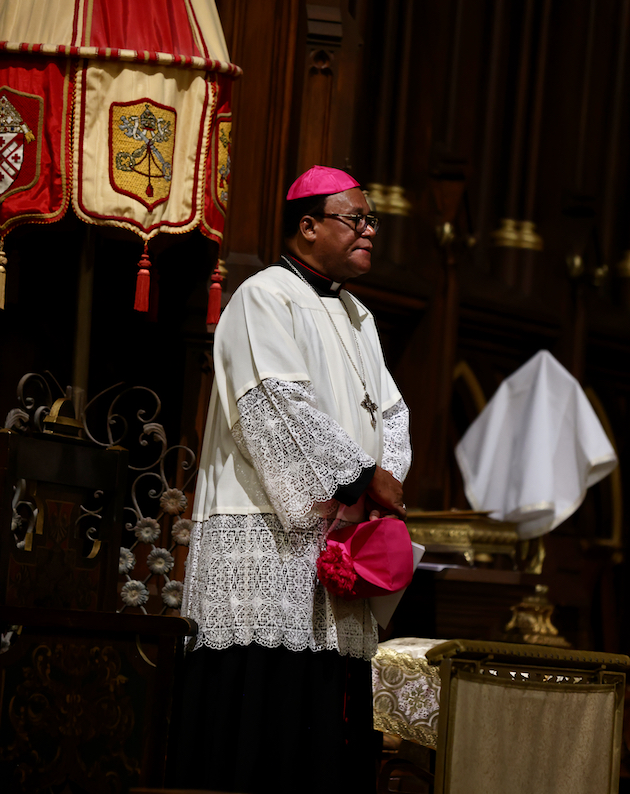
As Attorney General Merrick Garland targets pro-lifers, Pope Francis takes aim at trads.
In an article in The American Conservative (1) Nora Kenney examines the parallels between the developing persecution of pro-life activists and Catholic traditional groups by the United States government and the ongoing war against traditionalists waged by Pope Francis and the Vatican.
Such coverage of the FBI crackdown on traditional Catholics has, however, been somewhat misleading. Despite the document’s shoddily sourced contents, the real government crackdown is not on those Catholics who attend the Latin Mass, but on those who still adhere to traditional Church teachings on bioethics and sexual morality. Of the groups mentioned in the FBI’s now-infamous document, only a handful actively promote the Latin Mass over the Novus Ordo—yet all are outspoken in their support of traditional Catholic reproductive ethics and rejection of contraception and abortion.
To make matters trickier for those targeted by the document, traditional Catholics will soon represent some of the only voices in American public life who still defend such values.
All of this is not to say that antipathy to the traditional Latin Mass doesn’t exist and that all the public wrath is simply abortion-related. Latin Mass antipathy does exist. It’s just that it’s not coming from the government.
It is coming from within the Church’s own hierarchy. Even if they wanted to, federal officials could never stem the celebration of the Latin Mass as effectively as Pope Francis can.
I do have a reservation regarding Kenney’s citation here of Ross Douthat for a classic statement of the “middle-between-two-extremes” self-understanding of establishment Catholicism. Ross Douthat claims the Vatican is engaged in a two front-war: crushing Traditionalists but trying more gently to restrain the German Church. Stated in this manner, Douthat’s characterization is blatantly false. Francis is not waging any kind of war againt the German Church. He obviously agrees with some or all of the objectives of the German Synodal Path; he disagrees with the mode of implementation the Germans are pursuing. But the pope clearly understands that the continuing radical push forward of the Germans creates the danger of rallying those forces within the Church opposed to the Germans’ theological and moral agenda. A reaction that eventually might turn against his own policies. Therefore, the pope doesn’t confront the Germans but seeks to co-opt their movement – which has the effect of spreading it throughout the Church worldwide.
Similarly, Kenney has identified that the Pope’s war againt traditionalism is increasingly running ino passive resistance:
But in America, muted signs of hope for those Catholics who favor the centuries-old liturgy persist. Quietly, bishops across the U.S. are turning a blind eye to some of the restrictive demands of Traditionis Custodes, and in some cases, even celebrating the Latin Mass with local traditional parishes.
This is fortunate for the continued existence of Catholicism in this country:
These Church leaders seem to understand a finding [Mary]Eberstadt emphasizes in her book (Adam and Eve After the Pill: Paradoxes of the Sexual Revolution – SC) namely that a “strict church is a strong church”—that social science proves unequivocally that churches that adhere to strict teachings and resist the urge to devolve into “Christianity Lite” are the only ones that survive in decadent ages.
In May, Pope Francis called these (Traditionalist) Catholics symptomatic of “a nostalgic disease.” But for those who hope for holy, orthodox, diverse priests who can offer spiritual guidance and inspiration as Garland tightens the screws on pro-life Americans, we can only hope the disease spreads.
29
May

A new chapter participating this year in the pilgrimage (even though the emperor Charles was not the sovereign of the Holy Roman Empire!)
26
May

`
This Pentecost weekend the Traditional Paris-Chartres pilgrimage takes place. This year we read of a record number of pilgrims – some 16,000 (excluding those who are not actually walking the pilgrimage trail). So many, in fact, that days ago registration needed to be closed (an unprecedented step!). Instead of one American chapter, this year there are several. Let us remember that, on this same weekend, the FSSPX leads a similar but smaller pilgrimage from Chartres to Paris.
For the Paris-Chartres Pilgrimage, these numbers would be extraordinary in ordinary times. But these times are not ordinary. For the Pope since 2021 has been conducting a war against the Catholic Traditionist movement. He seeks to exclude Traditionalists from the Catholic community – to isolate, humiliate and eventually eliminate them. As far as Pope Francis and his entourage are concerned, there can be no more talk of liturgical peace, of the coexistence of the old and new rites. Yet, despite it all, a greater number of pilgrims than ever are now undertaking this arduous journey.
I myself have made this pilgrimage six times.1) In the early 1990’s the “Pilgrimage of Christendom” was a revelation for me: Solemn High Masses, encountering men like Michael Davies, Gary Potter, John Rao or Michael Matt, the magnificent concluding liturgy in Chartres Cathedral and above all the experience of living, singing and praying for three days among so many fellow traditionalists.

As time went on some of the initial elan seemed to dissipate. The general structure of the pilgrimage exhibited remarkable continuity. But there were years where the number of participants stagnated, where instead of the earlier militant traditionalism with all its political ramifications efforts seemed to be more focused on securing good relations with the hierarchy, the papacy and even elements of the secular etablishment.
By the early 2010’s these uncertainties of direction appeared to have been resolved. Perhaps this was attributable to Summorum Pontificum. By 2010-2012 the pilgrimage was more professionally managed than ever and was now welcomed in both Notre Dame de Paris and Chartres cathedrals (in the latter by the bishop himself). Bishops now celebrated the concluding liturgy in Chartres. As for the American contingent, what had once been a rather elderly group was now predominantly youthful like the vast majority of the European pilgrims. It seemed that a happy accommodation with the Church establishment had been finally achieved and a course of moderate growth by an upcoming generation assured.
Then came Pope Francis, the Covid restrictions and Traditionis Custodes. The pilgrimage, however, survived it all and even flourished. After the Paris-Chartres pilgrimage had been suspended for two years, the local and regional chapters in France took to the streets instead. In 2022, the pilgrimage was resumed. Record numbers braved perhaps the worst weather any pilgrimage had ever experienced – but eventually battled their way through to their spiritual destination.2)
This weekend the largest group of pilgrims ever assembled begins its journey. Is the challenge of adversity needed to help the Traditionalists refocus on their roots, to rediscover what a precious gift they have been given in the Traditional liturgy? For once again the Pilgrimage of Our Lady of Christendom has become the calm, measured but militant public assertion of the Traditionalist cause. The pilgrimage has explicitly recommitted to the Traditional liturgy despite pressure from unnamed parties. The message is clear: Traditionalists are not going away! Moreover, the pilgrimage also remains absolutely committed to the restoration of “Christendom”: “the light of the Gospel projected on our countries, our families, our morality and our work.” (from the twitter account of Notre Dame de Chrétienté)
This year’s pilgrimage has attracted more attention than ever from the secular French media. And the masses at the opening and close of the pilgrimage will still be celebrated in St. Sulpice (substituting for Notre Dame de Paris during the latter’s reconstruction) and Chartres cathedral.
I wish all the pilgrims well in the challenging yet rewarding days ahead! We will keep you in our prayers.
25
May
22
May
14
May
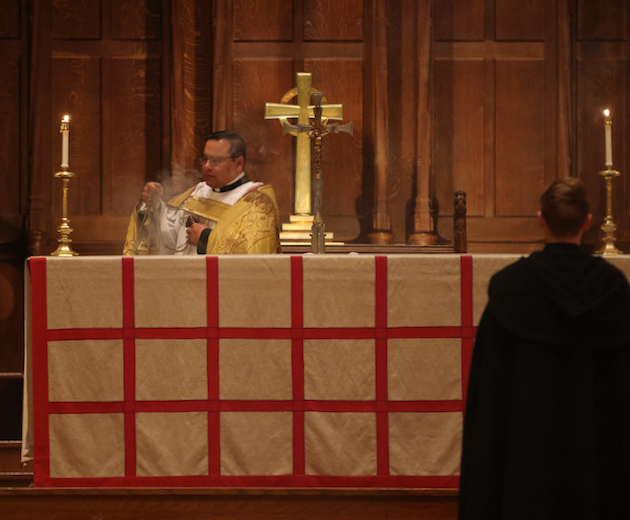
The Sunday Latin Mass that used to be celebrated at St. Marguerite Bourgeoys in Brookfield, CT, has been transferred to Immaculate High School Chapel, 73 Southern Boulevard in Danbury. The Mass is celebrated every Sunday at 12:30 pm, followed by a convivium. This Sunday Fr. Peter Lenox celebrated the Mass.