
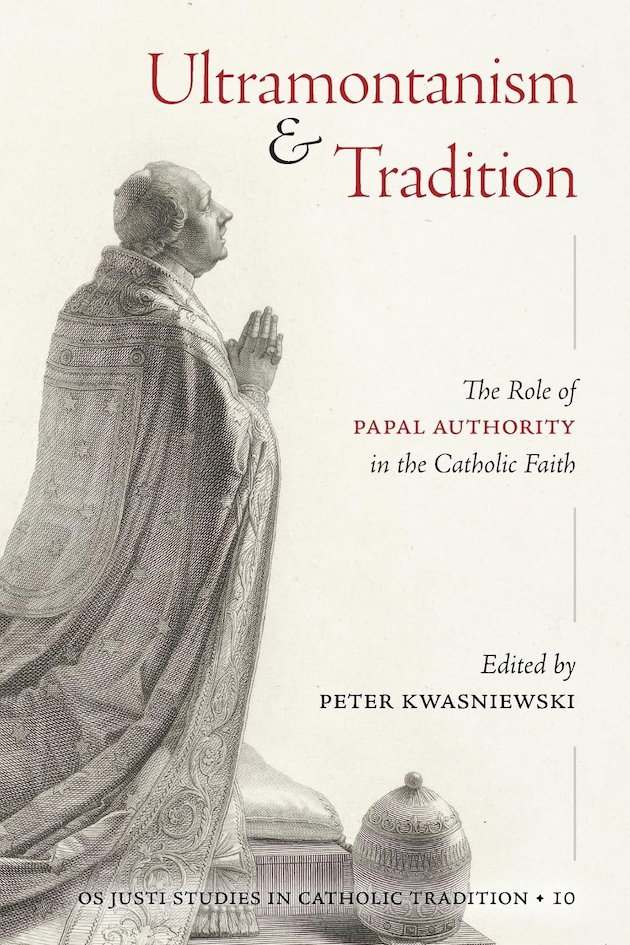
Edited by Peter Kwasniewski
Os Justi Press, Lincoln, Nebraska (2024)
493 pages
When it was recently suggested to me that I write a review of Ultramontanism and Tradition, I at first was hesitant. For a number of the essays in this volume are my own contributions and, as the saying goes, self-praise is no recommendation. But when I saw that Mary Ann Glendon has written a two-page review in Catalyst magazine of her own recent book In the Courts of Three Popes my reluctance dissipated. Moreover, her review is also relevant to Ultramontanism and Tradition. Do I not detect in her article an unanticipated tone of criticism of the “papal court”? This, from someone who in the now distant past of Popes John Paul II and Benedict was a showpiece of the papal and Catholic establishment.1)
Ultramontanism and Tradition witnesses to the growing awareness by the conservative and traditionalist camps of the decisive role of the governing structure of the Church in the crisis created by the Francis papacy. 30 or 40 years ago most “conservatives” and traditionalists seemed to have only a vague idea of these questions of Church organization and authority. If anything, they advocated rallying to the papacy – first that of Paul VI, then of John Paul II and Benedict. This attitude was understandable, for from 1968 to the accession of Pope Francis, the Catholic progressive establishment in academia and the religious orders was publicly and militantly opposed to ultramontanism, infallibility, centralized papal power, and clericalism. On infallibility, for example, see Hans Küng’s 2016 letter to Pope Francis.2)
Now of course the Vatican under Francis continues to pay lip service to these criticisms. But, as Ultramontanism and Tradition abundantly confirms, the regime of Francis is the exact opposite of the supposed “Conciliar” and Catholic principles of collegiality, subsidiarity and lay empowerment. And the likely disastrous outcome of these policies for the Church requires that those who wish to preserve the Catholic faith acquire a much deeper understanding of the nature and limits of papal power – from a Catholic and orthodox perspective.
Ultramontanism and Tradition is a substantial volume of 493 pages. The editor, Peter Kwasniewski, has assembled 50 essays and articles – as well as some intriguing illustrations. Most of these were published in the last four years and most originally appeared in various online publications. Four are original contributions for this book. Dr. Kwasniewski has done us a great service by collecting and preserving this material in one accessible book. But this volume could easily have been expanded further. Scholars like John Rist or Fr. Aidan Nichols have made major recent contributions to the analysis of exercise of papal power; members of the Catholic historical establishment have done so as well. And even Rusty Reno of First Things has now forcefully weighed in!
We find among the authors familiar names like Cardinal Raymond Burke, Bishop Athanasius Schneider, Roberto de Mattei, Thomas Pink, John Lamont, Joseph Shaw….. The contributors come from a wide variety of disciplines: theology, history, philosophy, canon law and political science. They discuss all issues currently swirling around papal authority: the power of the papacy over the liturgy, the possibility (or reality?) of a heretical pope, papal authority and “official theology,” etc. The essays illustrate the diversity of perspectives on these topics. Some contributors remain committed to ultramontanism; others subject it to relentless criticism. Thus, the reader seeking to orient himself in the chaos of today’s Church will find in this book a wide variety of views, diverse proposed answers to vexing questions and abundant resources for further research.
To illustrate some of the above tensions, among traditionalists, conservatives and progressives (the latter by now including most of official Catholicism) I would direct the reader’s attention to the final item in this book, reproduced and translated from the eminently official Herder Korrespondenz. “If it depended on Genius, this Office would be Madness” is a polemical dialogue between the author Martin Mosebach and Thomas Sternberg, a high-ranking lay member of the German Catholic establishment. Mosebach’s responses to an interviewer’s questions are concrete and colorful – Sternberg’s are more in the nature of platitudes. The traditionalist Mosebach’s understanding of the sources of papal authority is in fact that of the Catholic Church (on paper at least), while Sternberg, the man of the establishment, flatly denies Peter was the first Pope. Mosebach thinks Paul VI was the worst pope in history; Sternberg names him his favorite pontiff. Mosebach anchors the office of Peter in hierarchy and tradition: Sternberg waxes enthusiastic for a formless, emotional and charismatic papacy as embodied by Francis. Mosebach points out that such visions are dangerously akin to the style of totalitarian leaders – Sternberg takes umbrage at this characterization of Francis’s showmanship. It is characteristic that after this interview a German Jesuit attached to the Vatican then launched an attack on Mosebach. It doesn’t matter whose position accords most with (official) Catholic theology – the only unforgivable sin is criticizing Francis.
I hope this gives you a taste of the riches that can be found in this book!
- Glendon, Mary Ann, “Peering Inside the Vatican,” Catalyst: Journal of the Catholic League for Religious and Civil Rights (3/2024)
- Küng, Hans, Infallibility – Hans Küng appeals to Pope Francis, National Catholic Reporter (3/9/2016)
Published in Book Reviews | no comment
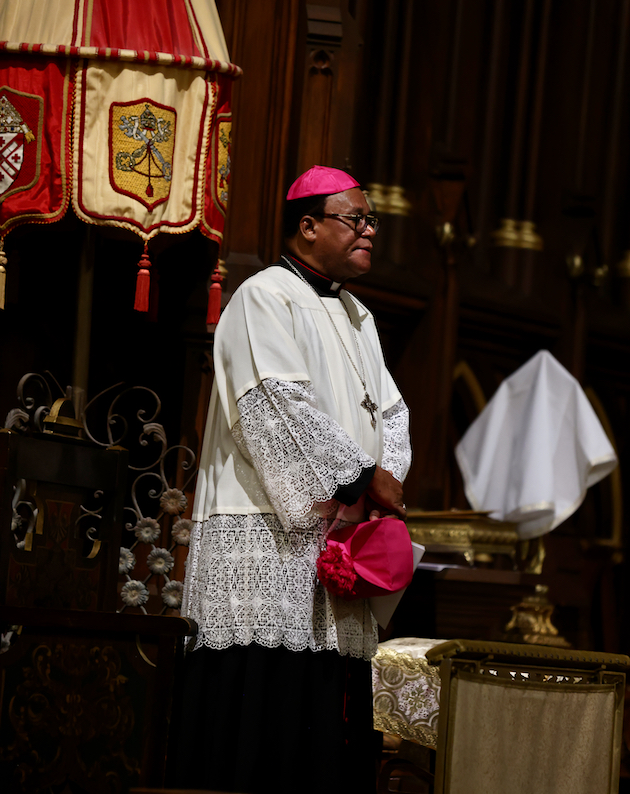
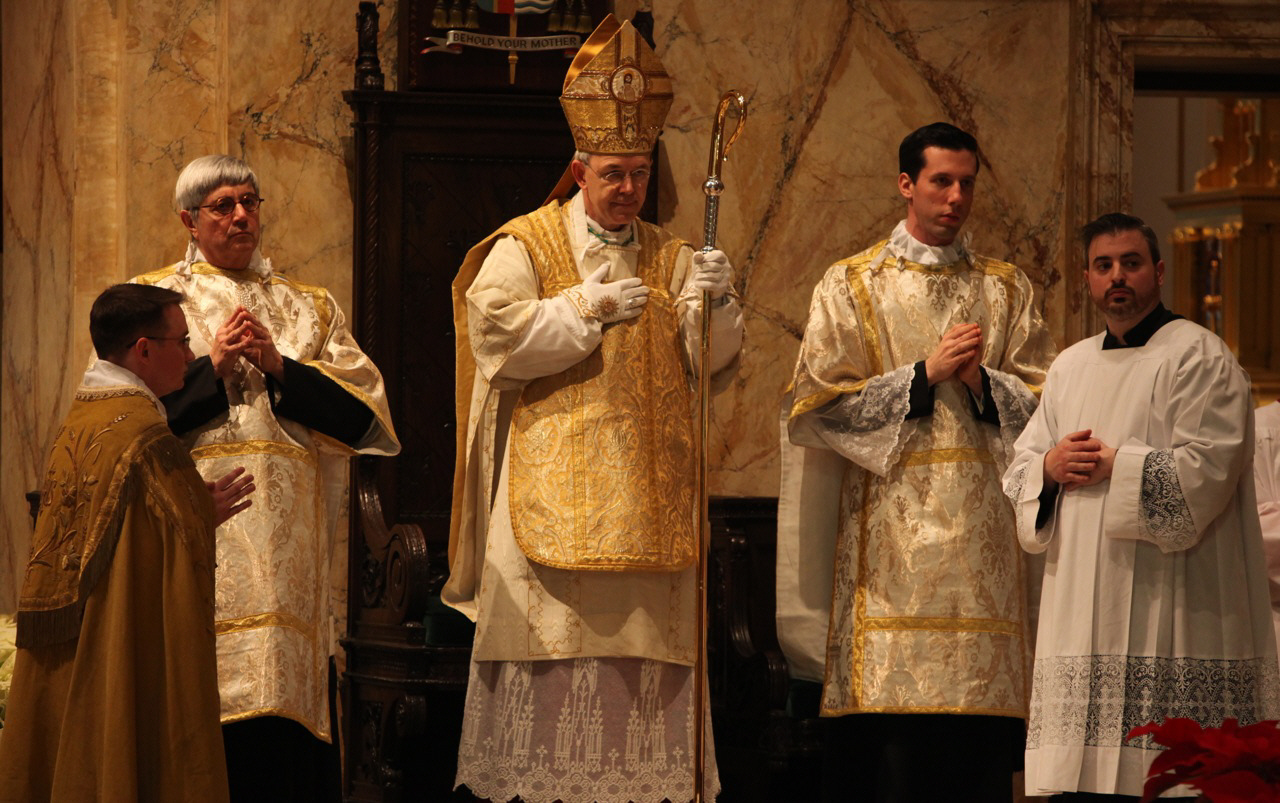
On February 18, Bishop Pierre-André Dumas of the Diocese of Anse-à-Veau/Miragoâneis (Haiti) was caught in an explosion in the Haitian capital of Port-au-Prince. As of February 20 he was reported to be in stable condition. Last September he presided at Solemn Vespers in Old St. Patrick’s Cathedral, New York. The Society of St. Hugh of Cluny co-sponsored that evening’s vespers. We pray for the bishop’s recovery and for the people of Haiti who at ths moment are undergoing such terrible trials.
Notice of the Bishops’ Conference of Haiti. (In French)
“Haitian Bishop in Stable Condition after Explosion in Port-au-Prince” (Catholic News Agency, 2/20/2024)
“Gangs in Haiti try to seize Main Airport after Thousands escape Prisons” (Catholic News Agency, 3/6/2024)
Published in Uncategorized | no comment
Churches of New York
Holy Roman Empire
Website Highlights
Archives
[powr-hit-counter label="2775648"]