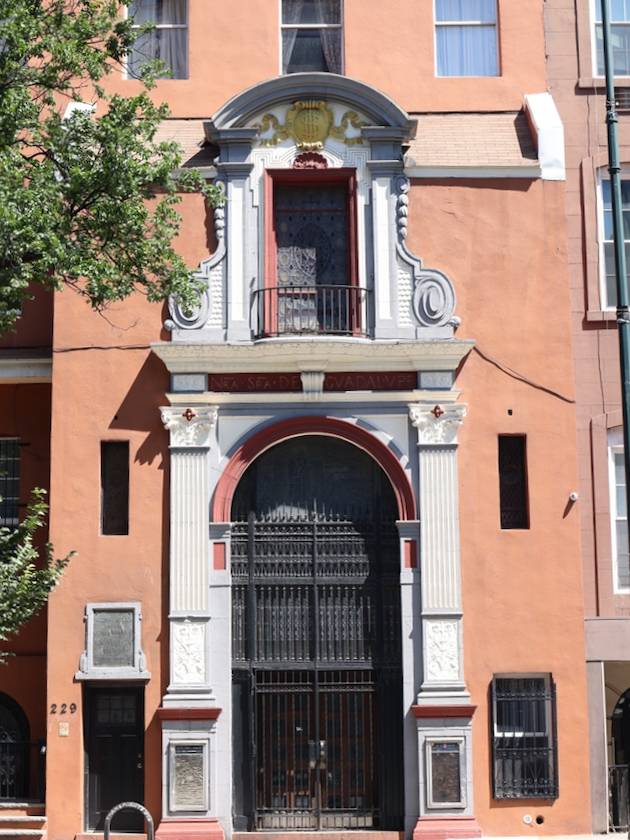
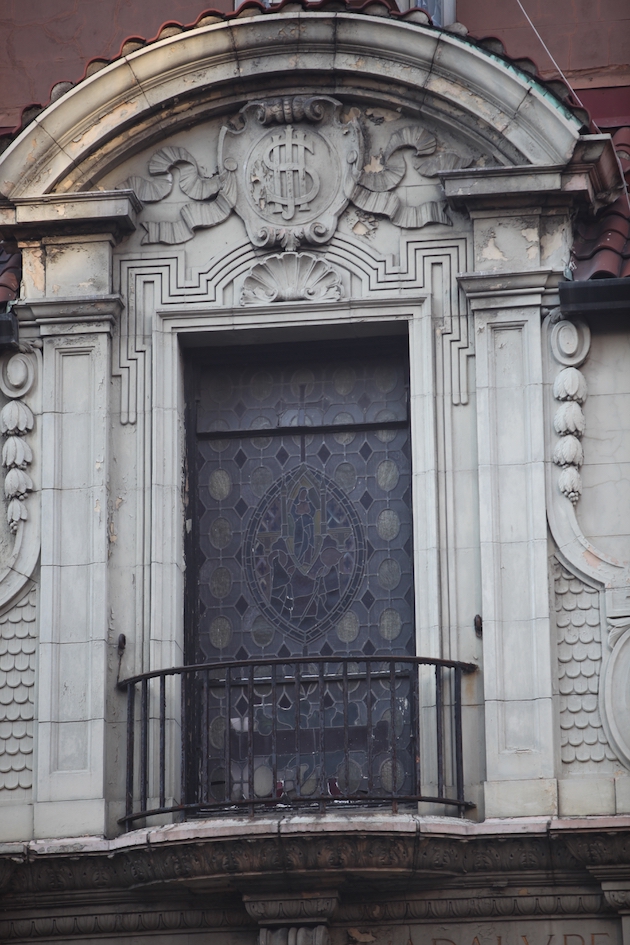
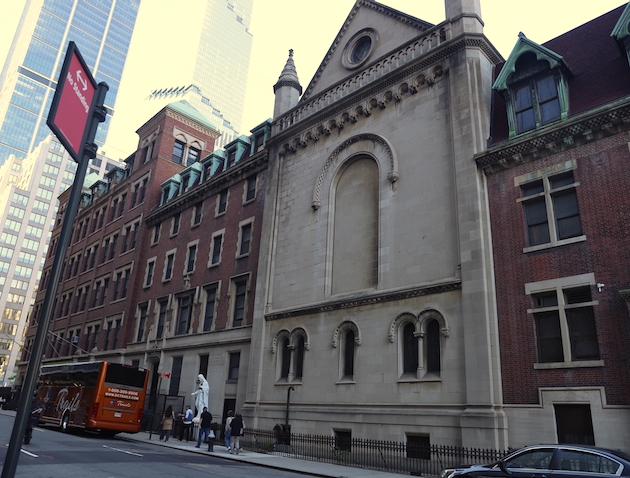
(Above) The former church of Our Lady of Guadalupe today. Sometime after 2012 an elaborate repainting of the facade was carried out. (photo 8/19/2026)
(We continue our discussion of the church of Our Lady of Guadalupe, now threatened with destruction:
The Sale of Our Lady of Guadalupe, etc. (8/18/2026)
For our description of this parish in its old and new homes:
The Churches of New York XXX: A Tale of Two Churches (12/14/2012))
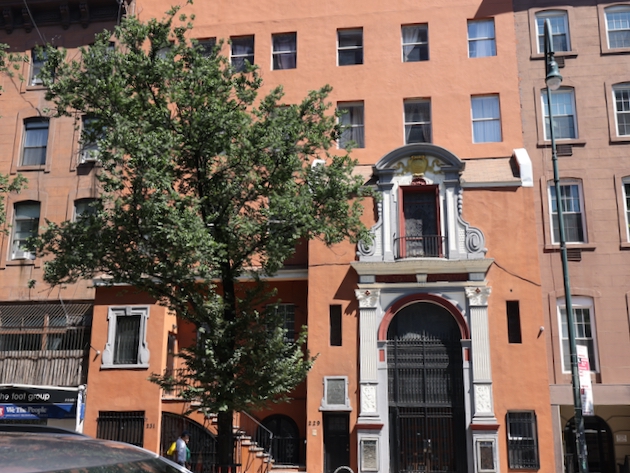
The former church of Our Lady of Guadalupe. Founded in 1902, it quickly had to be expanded, a second townhouse (left) was acquired for a rectory and in 1921 a Spanish-style facade was added.
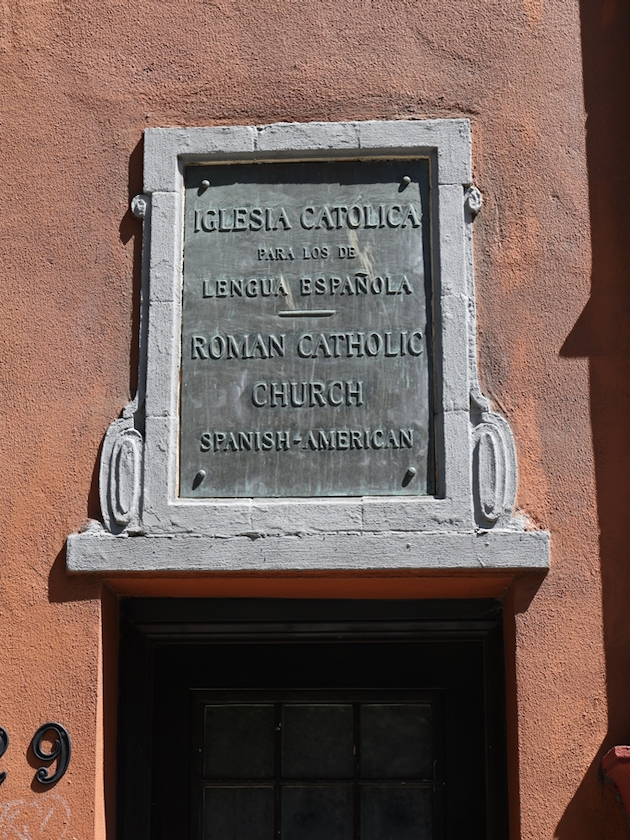
(Above) From these small beginnings… Perhaps surprisingly, in those early days the nascent “Spanish-American” apostolate in New York enjoyed significant institutional and financial backing. The Assumptionist order, which founded the church, was French, but their initial leadership in New York had had years of experience in Latin America. Their second church, and the second “Hispanic” church in Manhattan, Our Lady of Esperanza far to the north on West 156th Street, was financed by gifts from wealthy individuals (many non-Catholic) and the Spanish royal family and aristocracy. The 1921 addition to Our Lady of Guadalupe was the work of Gustave Steinback, one of the most important architects of Catholic churches in the interwar period. Let us also remember that this church was founded in the aftermath of the 1898 Spanish-American War, in which the American press (if only briefly) had demonized the Spanish (like the Germans later and the Russians today).
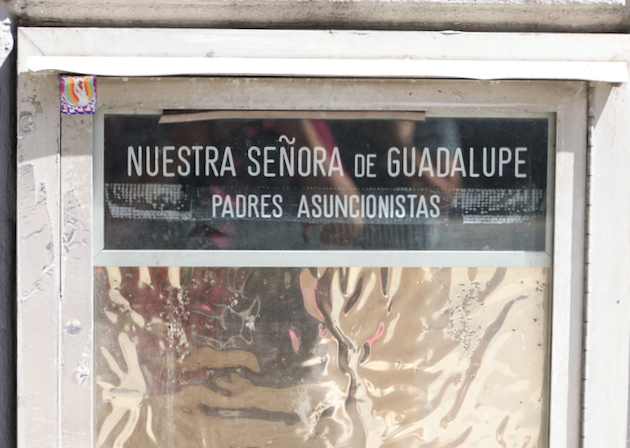
(Above) The desolate parish announcement board. The Assumptionists left the parish in 1998. (photo 8/19/2026)
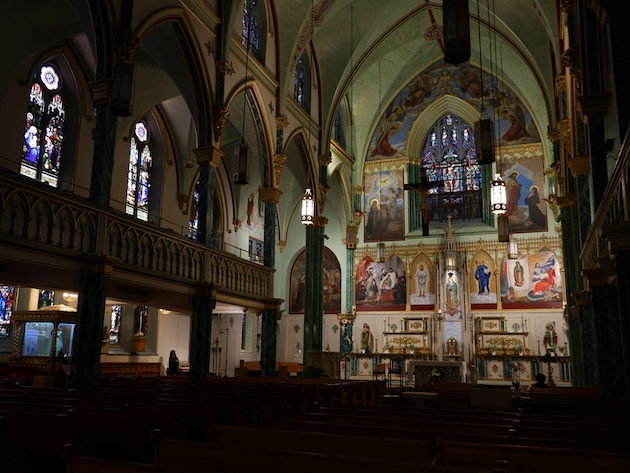
(Above) Our Lady of Guadalupe at St. Bernard’s. (photo 8/19/2026)
But what of the parish itself, now “Our Lady of Guadalupe at St. Bernard’s”? In 2003 the Archdiocese had moved it ino the church of St. Bernard. This parish, once grand, had by that date only an aging handful of parishioners – the effects of demographic change, economic troubles – and 40 years of Vatican II. In connection with this move, a thorough repainting and redecoration of the interior – of remarkable incompetence – was carried out. This was superimposed on the remnants of an earlier decor – mosaics, marble, statues and murals – which seems to date primarily to the years 1890-1920. Since 2012 work has continued and an attempt, if inadequate, made to remedy some of the worst features of this “restoration.”
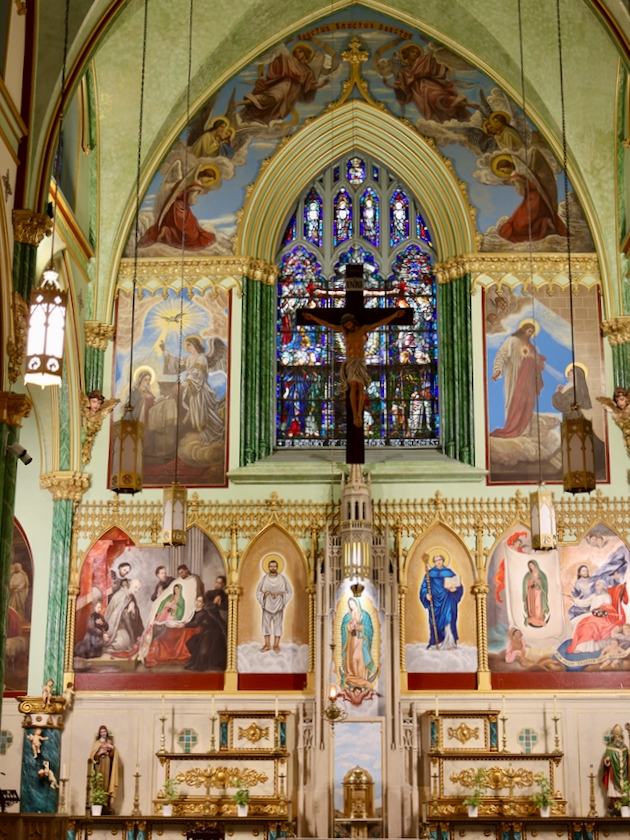
(Above) The chancel or sanctuary today (8/19/2026): (below) on 3/2/2011. Note that some murals have been repainted and a tabernacle, a sanctuary lamp and a large, suspended crucifix added. As recently as 2012 the Blessed Sacrament was reserved – disgracefully – in a room in the rear of the church (the former baptistry?)
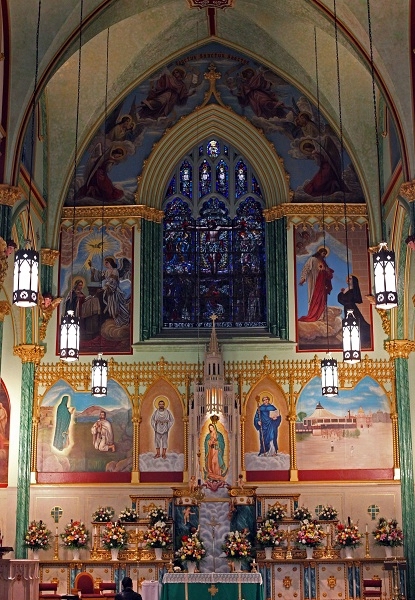
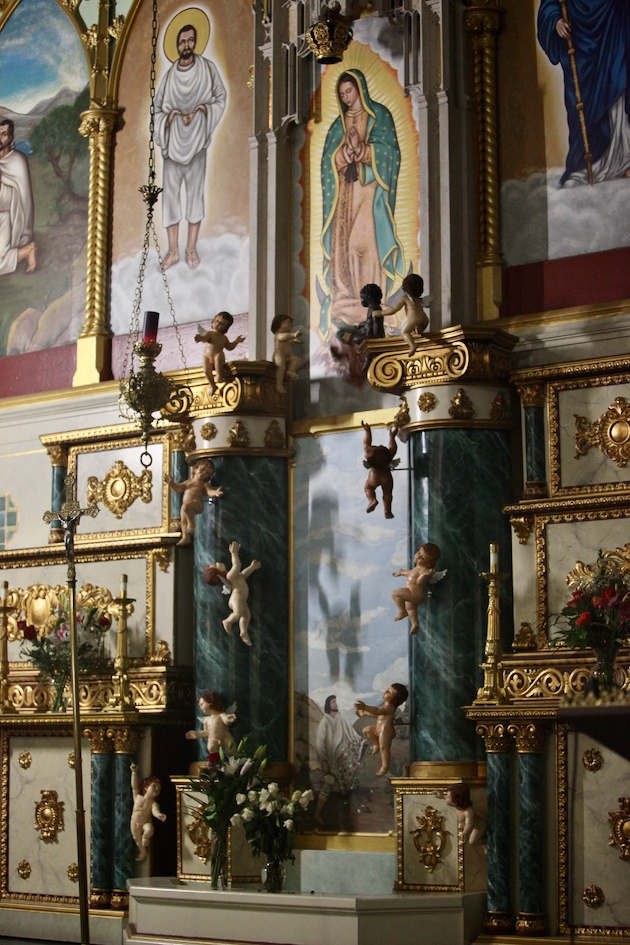
In addition to restoring a tabernacle, angels were removed. (Above) Photo 2/23/2012); (below) 8/19/2026)
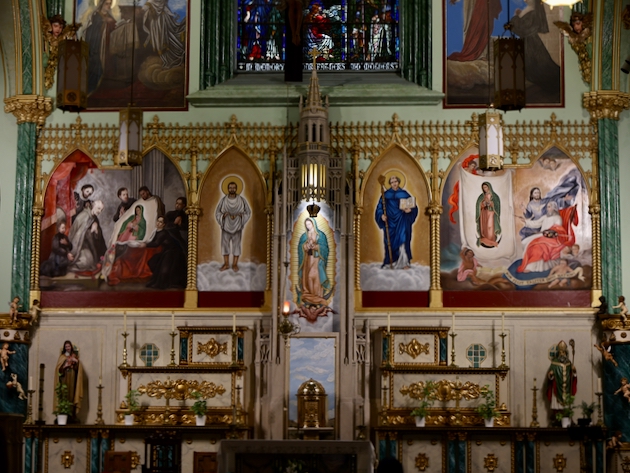
(Below) I cannot say the new murals are more than a marginal improvement over their predecessors – despite the unusual subject.
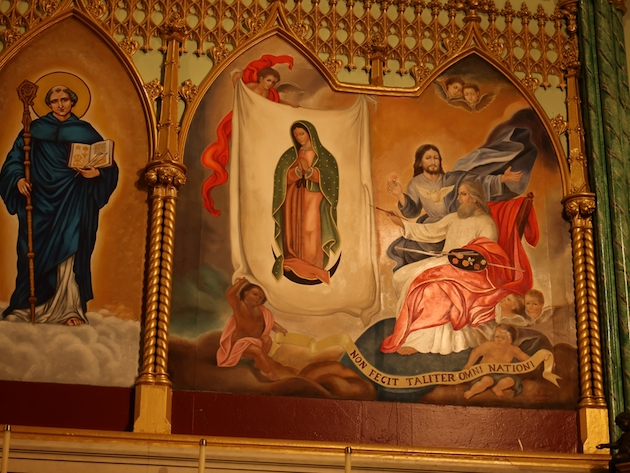
The church, like St. Paul in East Harlem, is a treasury of Hispanic devotions. Below are some of them.
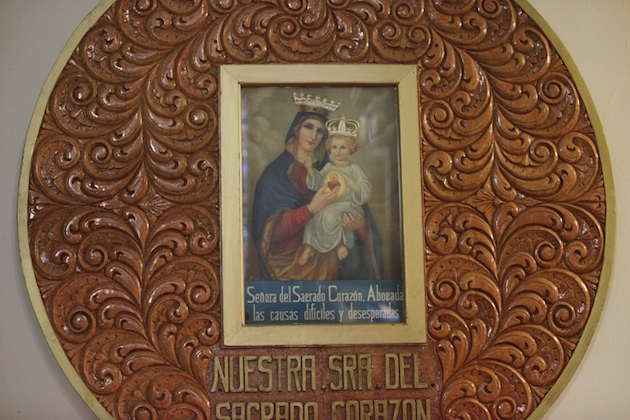
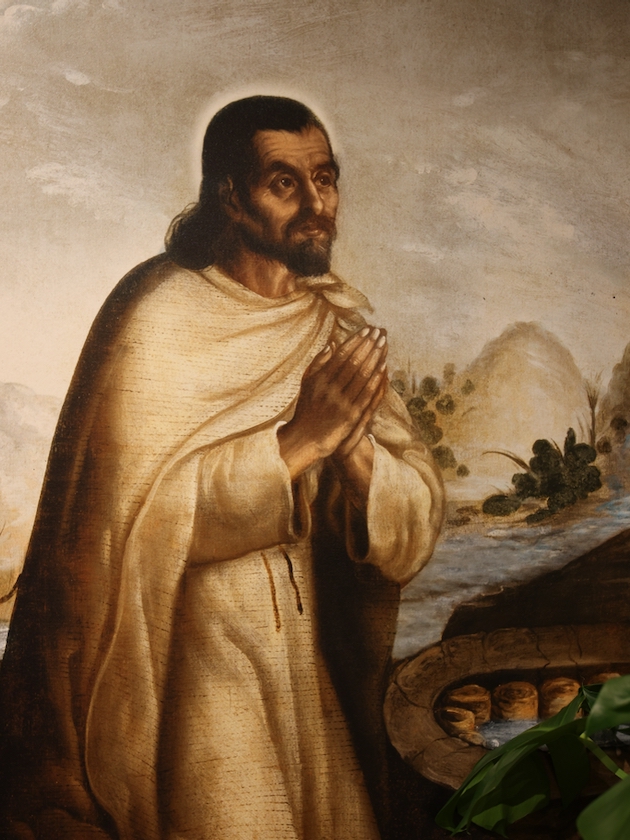
(Above) This image, I believe, was in the old church of Our Lady of Guadalupe
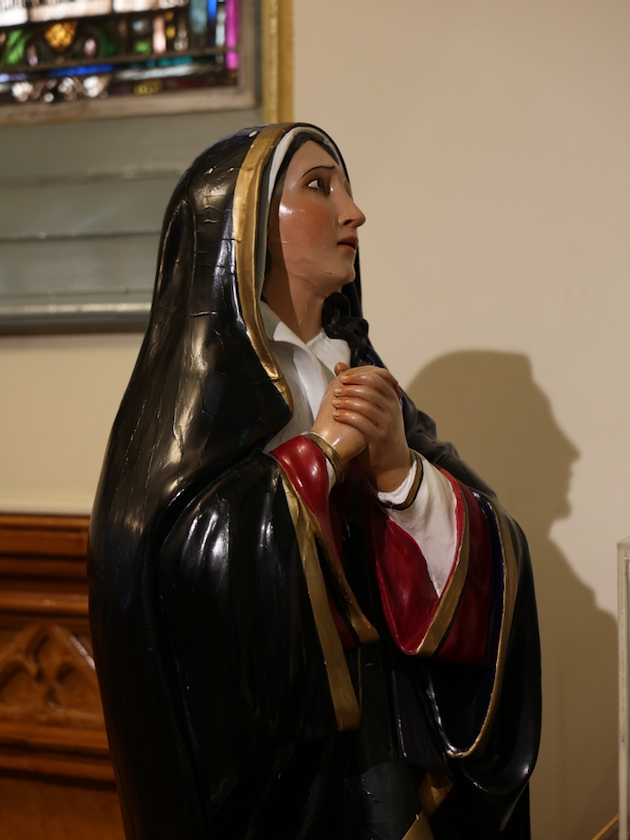
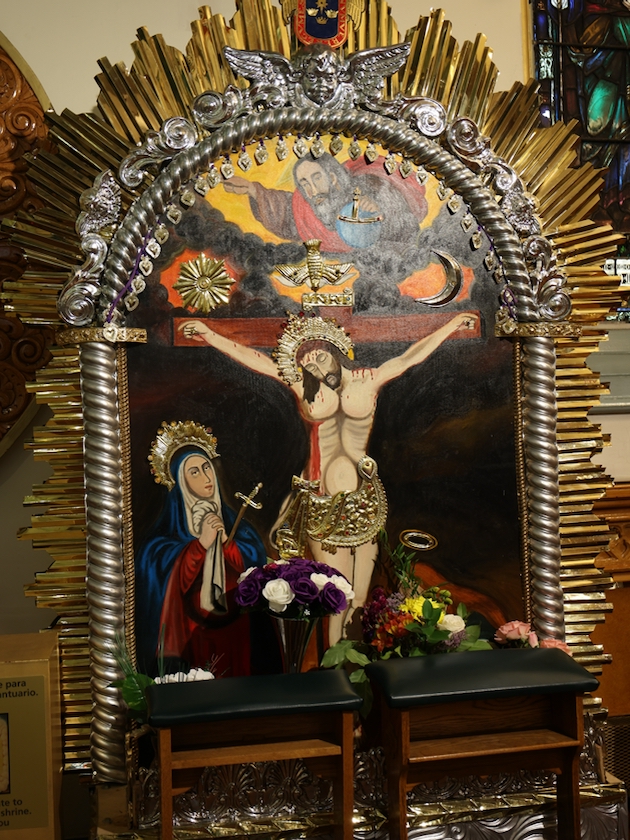
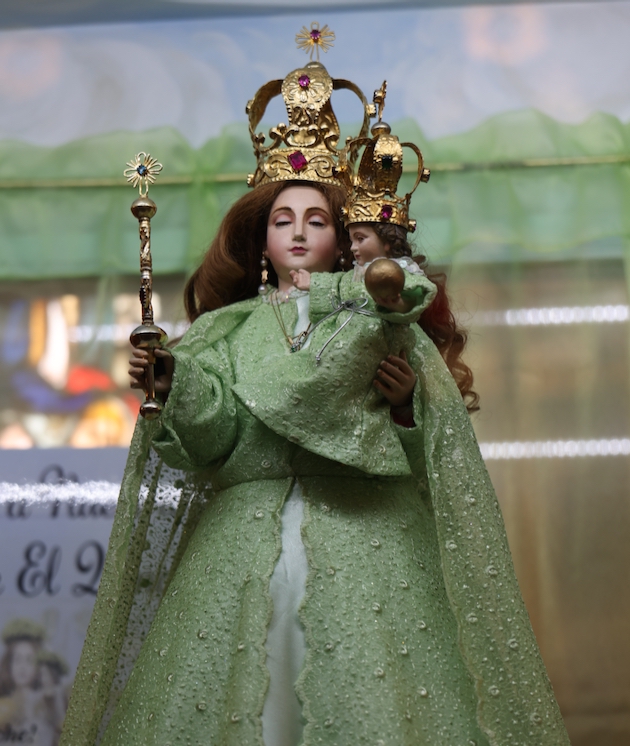
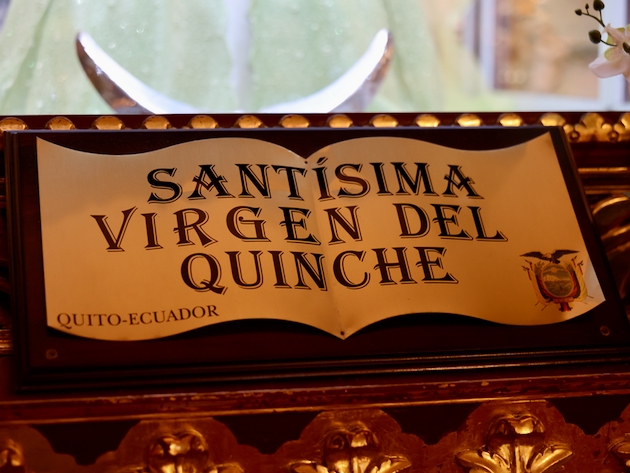
(Above and below) Our Lady of Quinche from Ecuador. As church after church has been closed in the Archdiocese, the Ecuadorians have had to repeatedly move their Madonna – from St. Ann on East 12th Street to St.Veronica and now to St. Bernard’s.
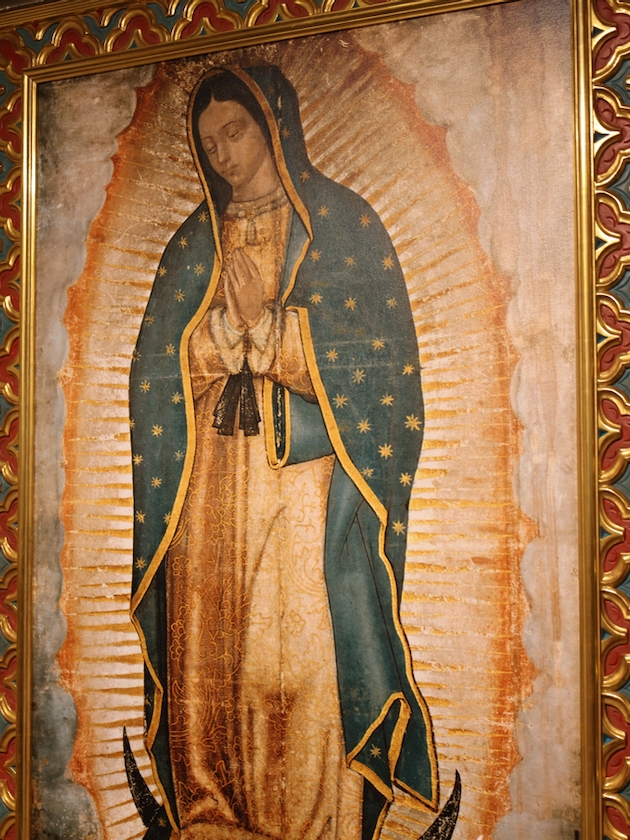
(Above) This fine reproduction – in contrast to what is seen on the reredos – may be the original image displayed in the old Church. Today it is in the back of the church. (photo 8/19/2026)
UPDATE: I now very much doubt this- the original image was a painting sent by a bishop in Mexico to the church shortly after it opened.
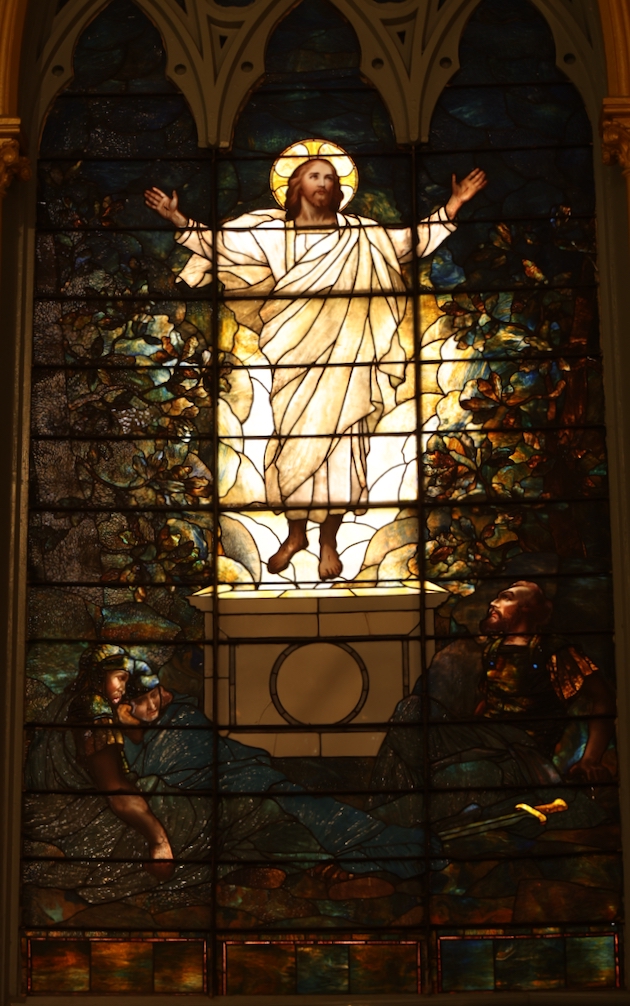
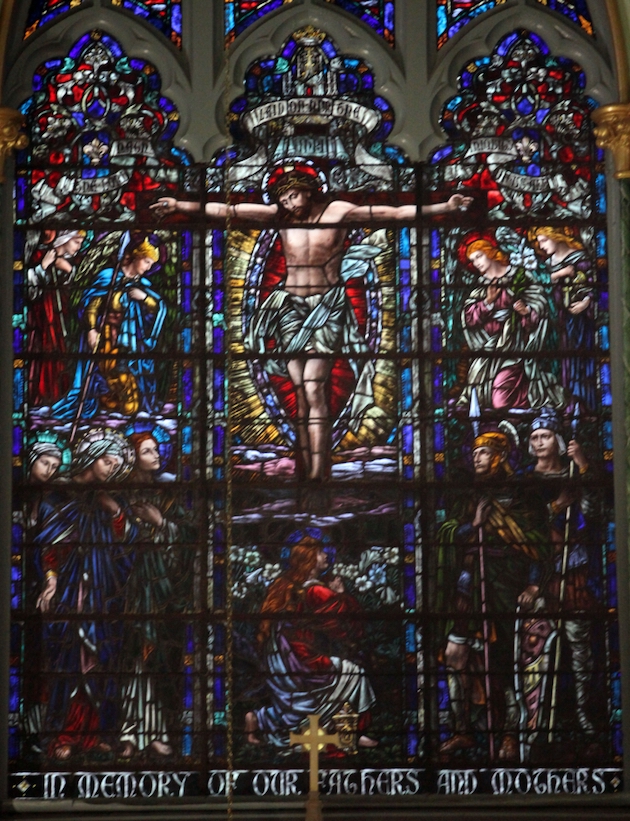
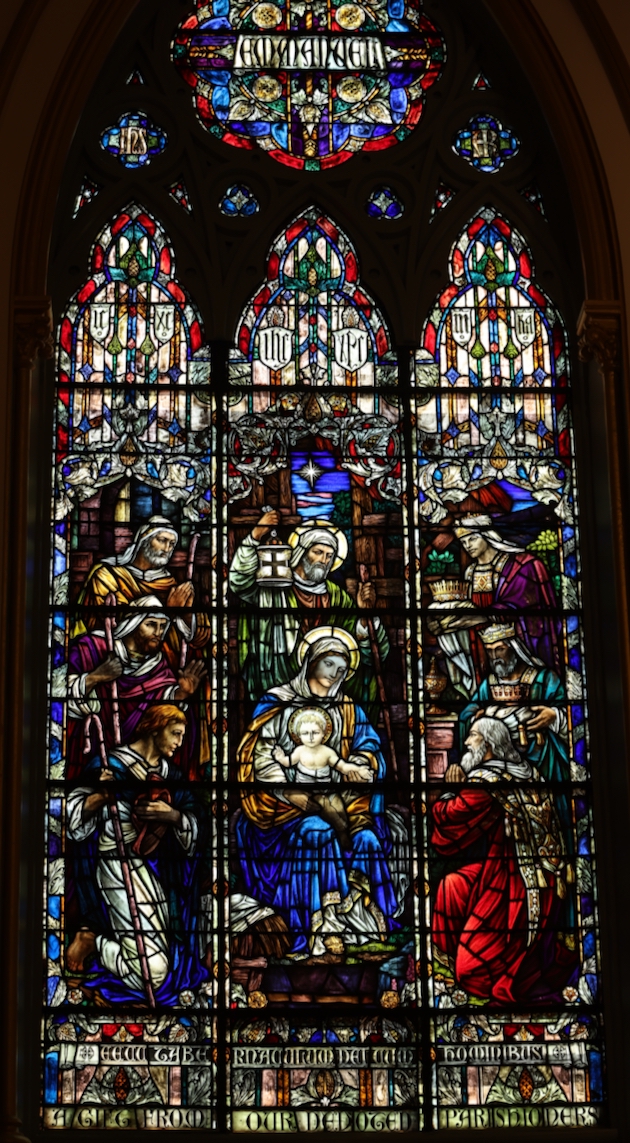
The aesthetic shortcomings of the recent art of St Bernard’s are particularly glaring in the context of three outstanding windows of the transept and chancel, installed after a disastrous fire in 1890. The 1910 catalogue of the Tiffany Campany lists among its products the above window of the Resurrection and notes it was in place by 1891. But the company’s catalogue also clearly states the same of the windows of the Crucifixion and the Nativity (below). But the latter two windows, although of exceptional quality, are executed in a syle completely different from Tiffany’s – they remind me of later stained-glass from England. How can this be explained? Does the 1910 catalogue reflect an order that was in fact never completed – or did the editors simply make a mistake? Did the church later replace the original Tiffany windows? Or did Tiffany on occasion produce glass to the designs of other artists? I leave it up to the connoisseurs to decide!
Has the fusion of the two parishes of Our Lady of Guadalupe and St. Bernard’s been a success? The jury is still out, even after more than 20 years. The merger involved the loss of the historic sanctuary (which, in addition, was not at all badly decorated!). A painful loss which is now being felt once again by the Spanish-speaking community. Too, the post-merger redecoration of Saint Bernard’s has been an abysmal failure. On the other hand, in contrast to the past, St. Bernard’s is now generally open. That seems characteristic of Latin American churches in the city today, with their many devotions inviting passersby to prayer. A visitor will generally find one or two people at prayer. To that extent, we can be grateful.
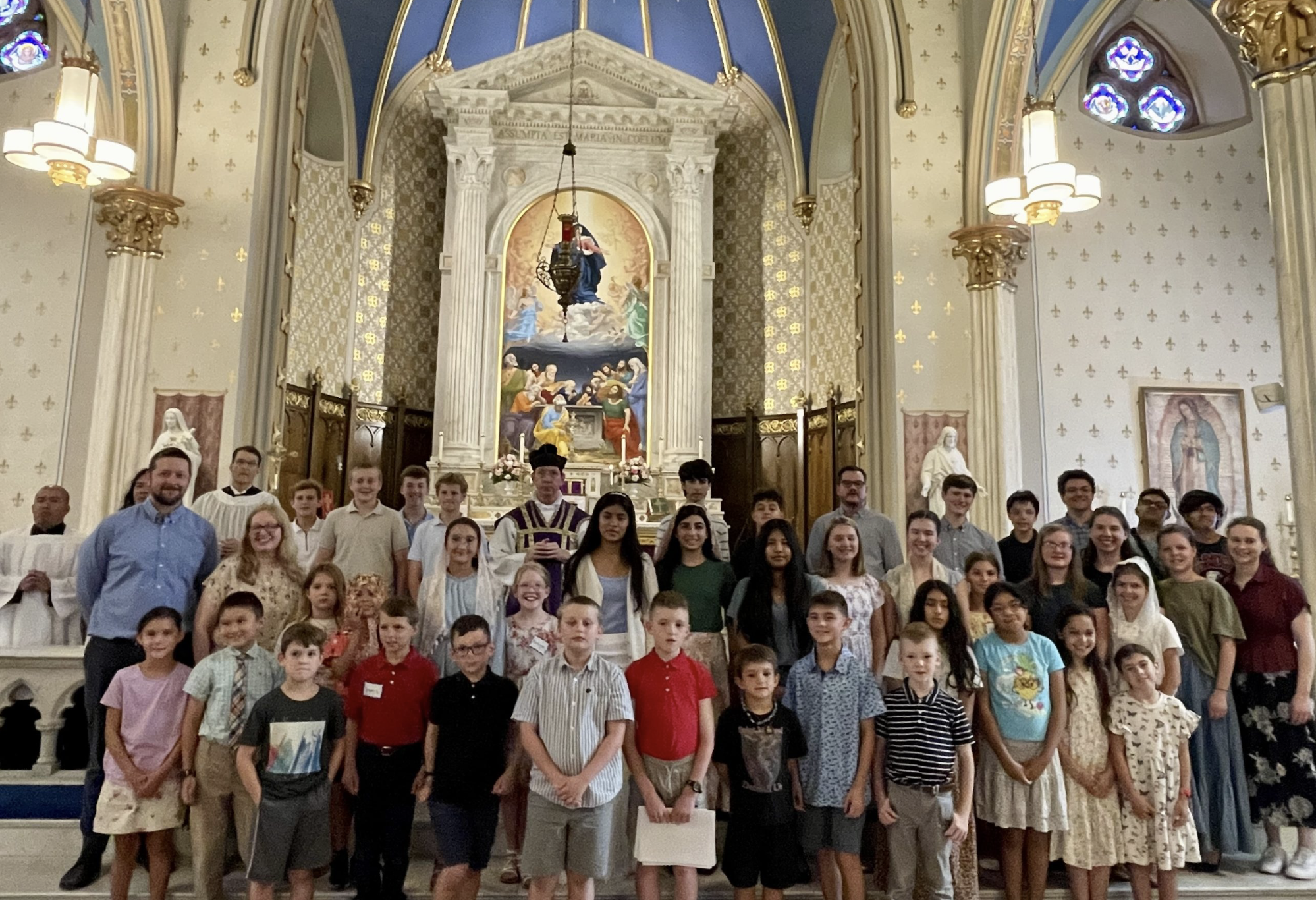
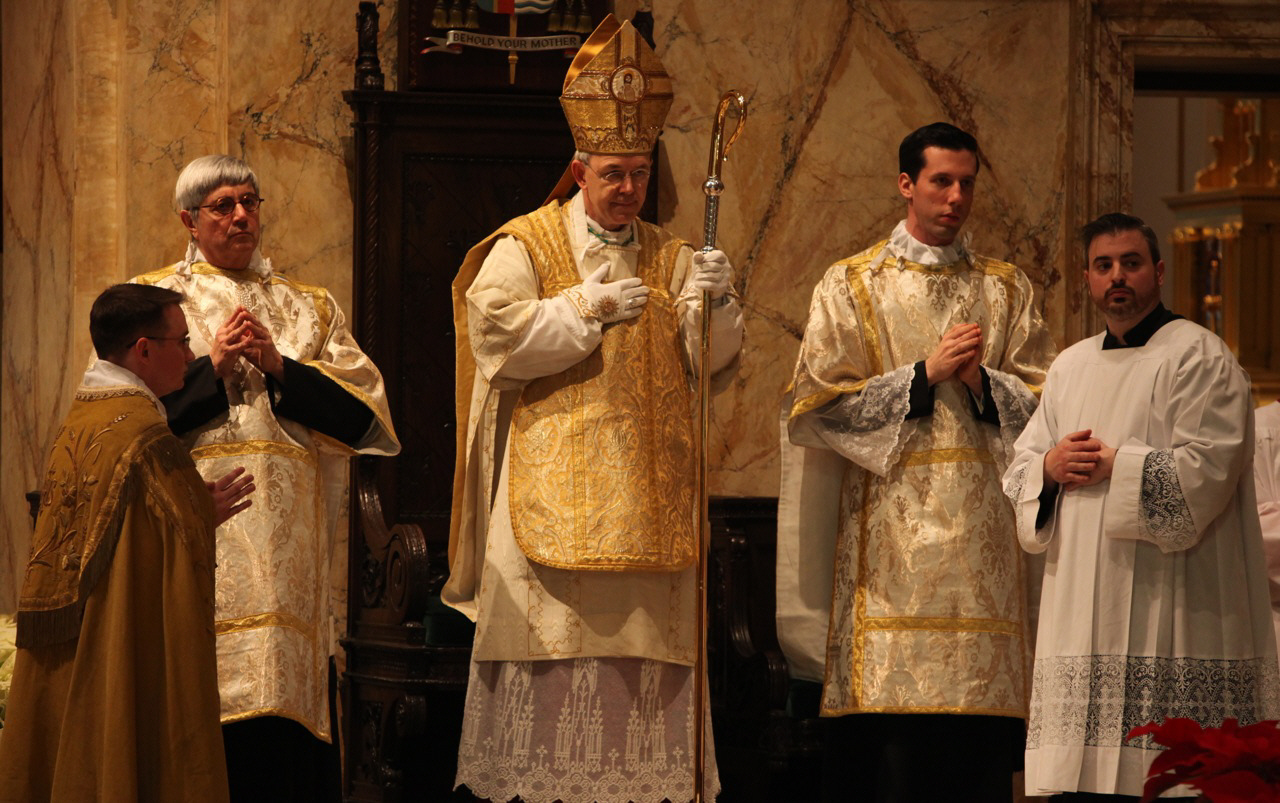
Last week another successful Chant Camp took place at St. Mary’s Church, Norwalk, CT, led by Charles Weaver, Elizabeth Weaver and Nicholas Botkins. The children sang a Missa Cantata every day at 12:10. The picture here is courtesy of Mark Bertotti.
Sources in New York City have received word that the Archdiocese of New York, faced with financing an $800M settlement for clerical sexual abuse, is proceeding to the sale of several properties:
Rallying to Save Our Lady of Guadalupe, Now Even More Imminently Threatened, villagepreservation.org (8/13/2026) (with links to presentations and a petition to landmark the building)
Kelly, Keith J., “Archdiocese Plans to Sell Church, 2 West Side Catholic Schools”chelseanewsny.com (8/14/2026) (also reporting on other recent sales by the Archdiocese)
These are churches and schools which had been previously closed. The Archdiocese reportedly responded by issuing a statement – which I cannot locate – stating that it is “merely” taking out a loan collateralized by six unnamed church properties. (Kelly, Archdiocese Plans to Sell Church, supra). Yet in a decree of 1/1/2023 Cardinal Dolan had in effect already put Our Lady of Guadalupe up for sale.
Now the former church of Our Lady of Guadalupe is of great historic value, for this modest structure was the first church for the Spanish-speaking peoples in New York City. Later of course these nationalities became totally dominant in most Manhattan Catholic parishes. In 2003 the Archdiocese moved the parish of Lady of Guadalupe into the nearby, much grander but semi-defunct, originally Irish church of Saint Bernard’s. The old Our Lady of Guadalupe was supposed to serve as a parish, and later an adult education, center. That now appears to be coming to an end – unless the opposition that is stirring can prevail.
I am always, however, surprised at the selective nature of politicians’ indignation. The sale of St. Benedict the Moor – the first black church in New York, and later an early center of the Archdiocesan “Hispanic” apostolate, did not arouse such a reaction. Nor did the closing of other major churches – such as Most Holy Redeemer – which in recent decades had served primarily Hispanic congregations. But I am glad for the (rather late) reaction.
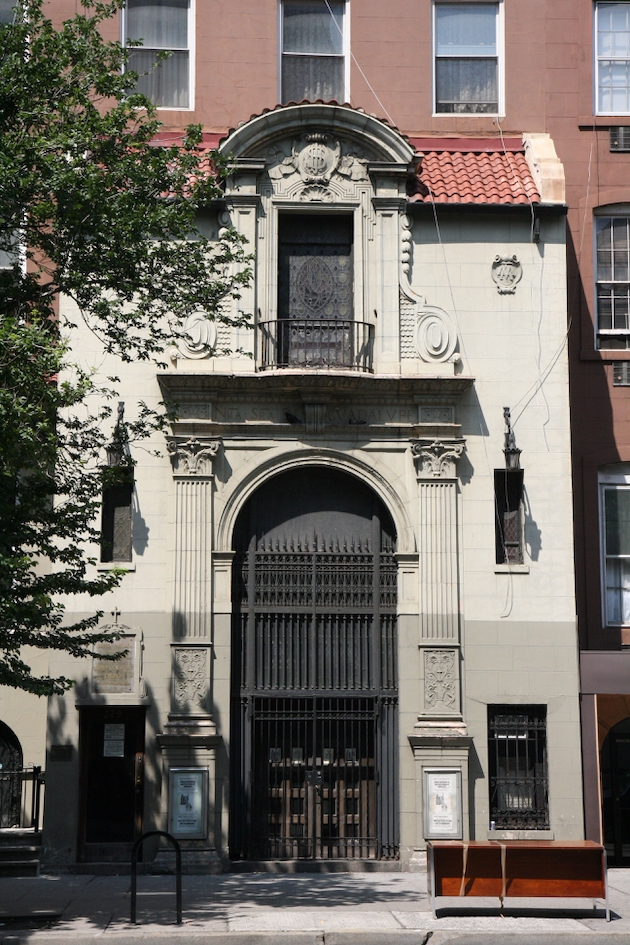
(Above) A 2009 photo of Our Lady of Guadalupe.(Below) in 2012. The church was built into a foermerly elegant 19th century townhouse – a facade was added later. Based on photos I have seen, the facade seems to have been recently garishly painted – we will have to investigate ourselves.
Aside from the former Our Lady of Guadalupe, two impressive school buildings of the once grand educational system of the archdiocese are said to be up for sale. These schools have all been closed relatively recently.
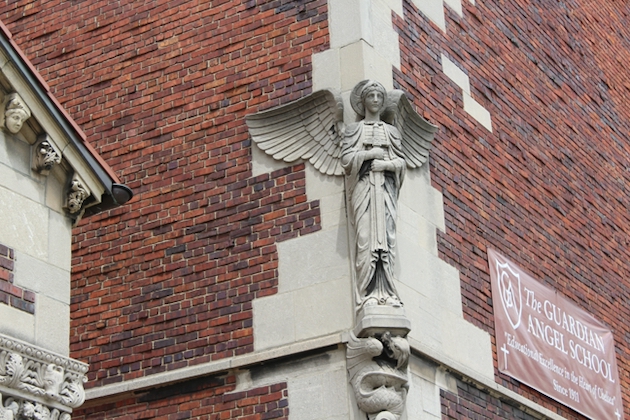
(Above) An angel looks down from the facade of the former Guardian Angel school in Chelsea(closed 2023). Photo from 2016.
(Above) an event easy to predict: reports indicate the first of the buildings of the massive St. Michael’s parish complex near the Hudson Yards – a school closed in 2010 – is now up for sale.
(all accesssed 8/18/2026)
13
Aug
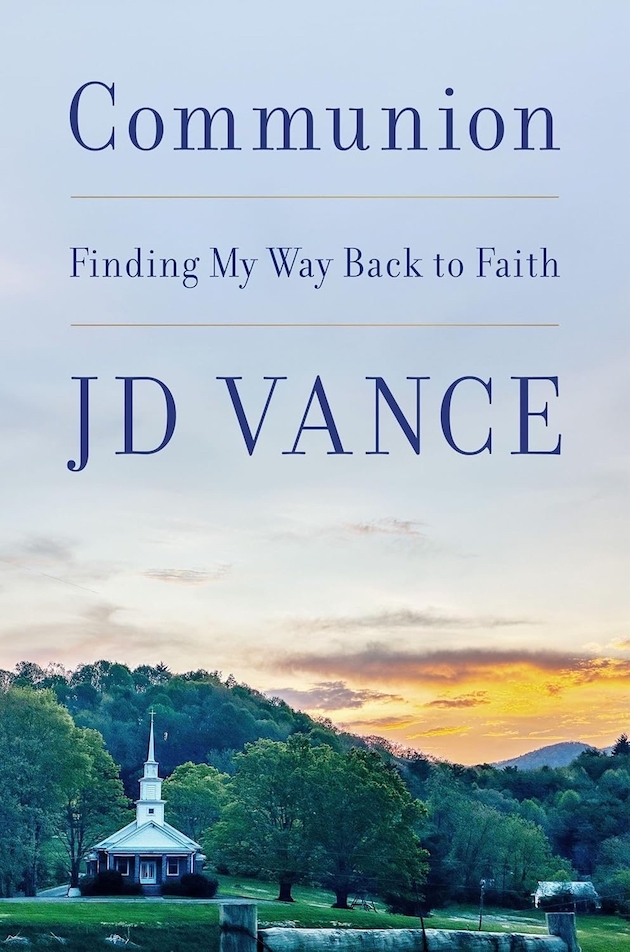
Communion: Finding my Way back to Faith
by JD Vance
(Harper, New York, 2026)
288 pp.
In Communion Vice President JD Vance gives us an account of his spiritual journey from evangelical Protestantism to atheism to Catholicism. He tells us that this book was largely written by 2019. As we shall see, there is evidence for that. However, it has been updated for intervening events and, more importantly, the position of the author has radically changed. In 2019 he was a successful writer just embarking on a political career in his native state of Ohio. Today he is the vice president of the United States, with a real possibility of securing the Republican nomination for the presidency in 2028. I would thus expect that before publication every line of Communion would have been examined from that perspective. The very fact of writing an autobiographical book in such a political context precludes an incisive, critical narrative of the author’s spiritual development.
For Vance at the very least must avoid antagonizing any one of the groups that would be essential to his candidacy later. Thus, although Vance has obviously transferred his allegiance to Catholicism, he is careful to honor the evangelical community and culture from which he springs. He offers effusive praise to Pope Francis, knowing that, for the bishops as well as for many of those among the Catholic laity that still practice their faith, devotion to the Pope is still a supreme virtue. And he favorably mentions the supposed highly religious nature of Israel. Vance must also avoid stepping on a land mine by violating one of the taboos of American pollical culture today. For example, while praising Confederate generals, he is also compelled to mention the evil of the cause for which they fought. The result is that Communion is necessarily somewhat mild and muffled.
Having said that, I was nevertheless impressed by Communion. It seems to be an honest, modest account of Vance’s own experiences – of gradual transitions from his youthful faith to unbelief, from the ruthless economic culture of American competition back to faith and then to the Catholic Church. Some of his observations are unexpectedly profound. And as we shall see, Vance does not shrink from making sharp criticisms of the contemporary order of society and of the world.
Vance eventually accepted the Catholic faith not as a set of certitudes and formulas but a way of living. Nor did he come out of the conversion process with a fixed plan for solving the problems of the world in economics, society and politics. This is a refreshing break from much of what one reads on Catholic media, whether establishment, progressive or conservative.
The author states that his initial attraction to Catholicism was prompted by intellectual reasons, specifically, by his reading about the social teachings of the Church. (Vance seems to approach major turning points in his life, like becoming a father or adopting a new faith, by omnivorous reading on the subject.). What attracted him about Catholic social theory was its balanced view of human nature – making room for communities and the family and rejecting both libertarian and liberal alternatives.
He later read much more and had conversations with Dominican priests. One of these Dominican fathers pointed out to him that:
“You don’t feel God’s presence and then change in an instant. Real grace comes through practice. That is why we demand that you live a sacramental life: going to church, taking communion, doing confession. This is a process. You don’t just accept Jesus into your heart – or get baptized – and fix everything.” ( p. 163)
And Vance realized:
(T)hat I had misunderstood the promise of the Christian faith. God could save your soul in an instant, but for most people, the transformation of that soul took time. And work. (p.163)
Hadn’t Gerald Manley Hopkins made the same point in 1876?
Not out of his bliss
Springs the stress felt
Not first from heaven (and few know this)
Swings the stroke dealt –
Stroke and a stress that stars and storms deliver
That guilt is hushed by, hearts are flushed by and melt –
But it rides time like riding a river
(And here the faithful waver, the faithless fable and miss). 1)
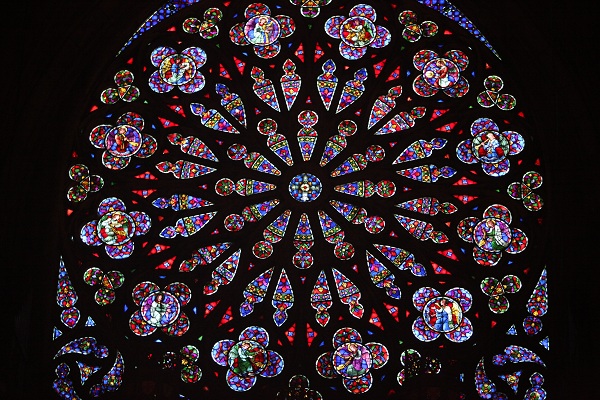
But Vance eventually does seem to have had an epiphany. After the birth of his son, he and his wife traveled to France. Vance, holding his infant son, entered an ancient cathedral, seemingly alone. There he was struck by the beauty of the architecture and the evening light shining through the stained-glass windows – in a cathedral empty of faithful. But as he sat there, he grew ever more reconciled with the Church. The cathedral, a work of great beauty, completed in a Christian age, was still standing after so many ages. God was there regardless of whether man was. Finally, although he had thought himself alone with his son, a woman appeared – an African immigrant, apparently – who had been worshipping in a side chapel. One other soul had been there with him all along! It was this experience that nudged him over the threshold to baptism. (pp.170-72)
Later in Communion, Vance expresses similar views in other contexts. While attending as a senator a security conference in Munich, he admired this European, originally Christian city with its beautiful monuments and human dimensions – contrasting it with the ugliness of modern cities and strip malls, But Vance also observed at this conference the conflict of such traditional Western values with his European dialogue partners: the class of decadent “boomers” defending the globalist order. Of course, Vance is obliged to add a more “nuanced,” understanding depiction of the latter….
A distinctive aspect of Communion is Vance’s consistent and forceful criticism of the culture of the United States as epitomized by his experiences at Yale Law School and at a law firm. He describes well how they foster an exclusive commitment to individual economic advancement, regardless of the alleged “humanist” values propagated by the same law school and regardless of the personal cost to those initiated into this system. “Liberal” academia and the capitalist economy are completely integrated. Vance himself was caught up in this trap before the recognized its perils. He repeatedly criticizes this ethos and argues instead for a culture open to the family. These thoughts distinguish Vance very much from the libertarian wing of the Republican Party – and from the actual practices of those who dominate the Democratic Party as well.
Vance regrettably has also absorbed some less attractive traits of his new co-religionists. He gushes over Pope Francis and relates an anecdote which he had already described in a 2020 article. 2) According to Vance, a conservative Catholic was engaged in criticizing Pope Francis when a wine glass sprang off a table and crashed on the floor. Both Vance and his dialogue partner took this as a sign from above. Thus, a flight to the irrational substitutes for an attempt to rationally understand the current situation of the Vatican. Next, Vance gives us a lengthy excursus on the crisis of sexual abuse in the Catholic Church. (pp.165-170) He quotes certain Catholic authorities to the effect that the doings of clerical child molesters are more understandable if viewed in the context of the misdeeds of the ancestors of the Lord – or of the chosen people in general – as set out in the Old Testament. And a Dominican priest opines that the clergy “need to do penance and build more virtuous structures of safeguarding and accountability.” I would contend that identifiable historical and theological reasons exist for the recent overwhelming scale of sexual abuse scandals in the Church. I don’t think relativizing these crimes or merely advocating bureaucratic solutions addresses the issue at all.
Vance’s attitude towards the higher authorities of the Church is not uncritical or merely defensive. He tells of his visit to Rome in which, among other encounters, he had an interview with Cardinal Parolin. The subject of immigration was raised. Vance was struck by the attitude of Parolin, who seemed to reduce the entire question to one simple moral assertion. This, for a phenomenon that involves all kinds of issues – of the economy, society and national security. Of course, we have seen the same phenomenon again in the recent statements of Pope Leo on war and peace – admittedly made after extreme provocation from President Trump. These statements tended in the direction of outright pacifism. Vance, however, is simply discovering the gulf between 21st century clerics, who are comfortable uttering platitudes for which they never will be held accountable, and those in positions of authority in government who have responsibility for the good of the commonwealth and of the whole people. The latter must take all aspects of an issue into account.
In summary, I thought Communion illustrated well issues of being both a Catholic – and a Catholic politician – today. And I appreciated that Vance, a Catholic secular politician, was able to confront honestly major questions raised by the American economy and society. I also liked the author’s modesty in not pretending to have a set of formulas or solutions ready at hand. In this regard, he is a welcome change from the prior “devout” Catholic president and similar representatives of the Democratic party, who proclaim themselves Catholics while following slavishly the dictates of the secular culture.
What the future will bring for JD Vance is of course uncertain. The actions of President Trump may be rapidly decreasing Republican electoral chances not just in 2026 but 2028 as well. Vance has become a bogeyman for the globalist European leadership. Israel too has developed a special dislike for him. Catholic clerical leadership in the Vatican and the United States(in contrast to the American Catholic population) seems much more comfortable with politicians like Joe Biden and Barack Obama (their positions on “life issues” are irrelevant to them). Moreover, even though Vance is reputed to be the front runner to be the 2028 Republican presidential candidate, he has made powerful enemies within the Republican Party as well. The neocon faction has become his bitter enemy – both for his foreign policy positions and also the economic ideas such as those found in this book. Whether anyone can obtain the nomination of a major political party – and be elected – in the face of such opposition I do not know. Yet I wish Vance all the best in his future endeavors – and I hope Catholics would give his book a look!
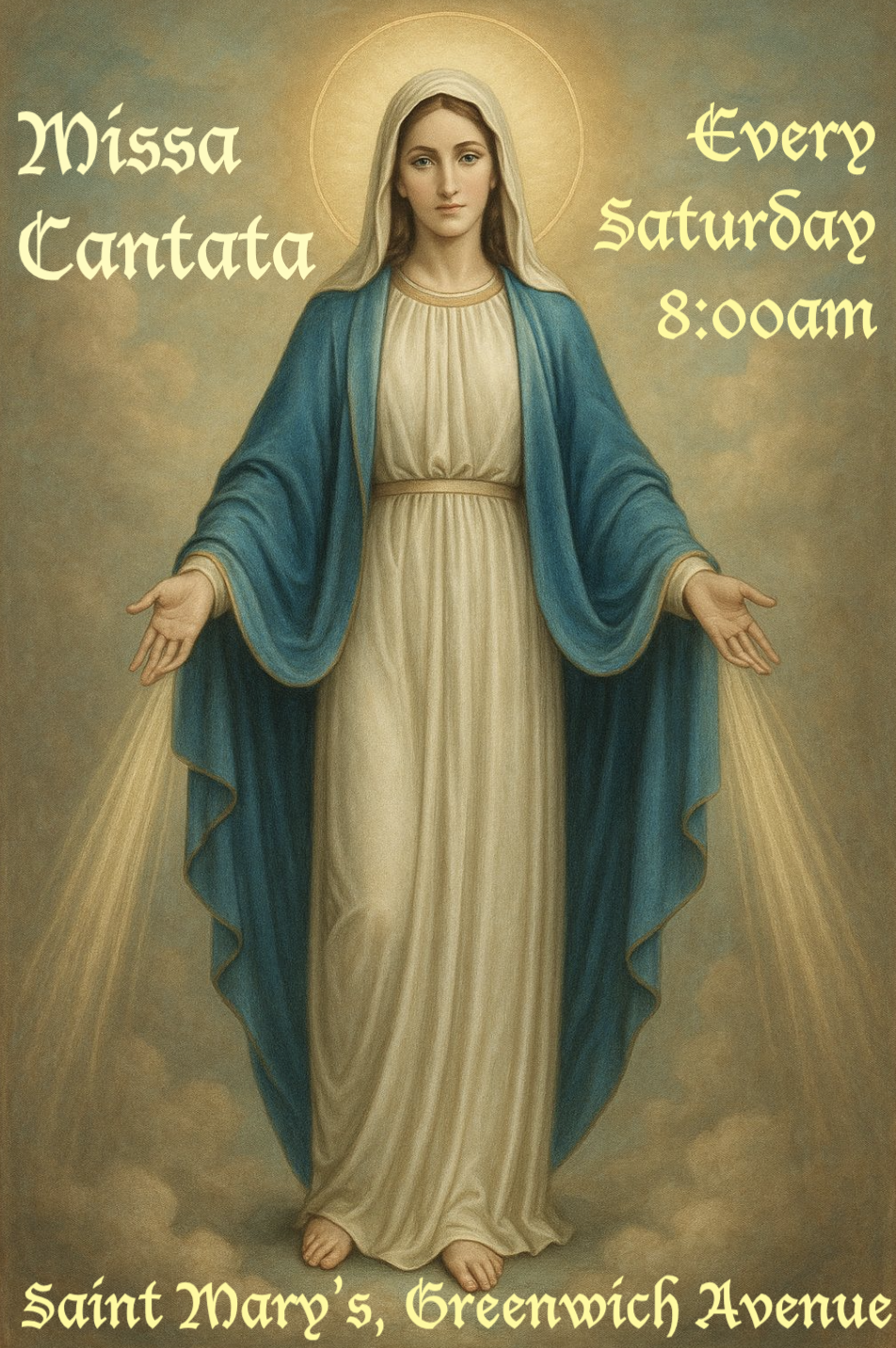
A beautiful sung Mass is offered every Saturday morning in Greenwich, CT. This Mass takes place in the lower chapel. You need to enter from the parish center door to the left of the church. Plenty of parking in front of the church.