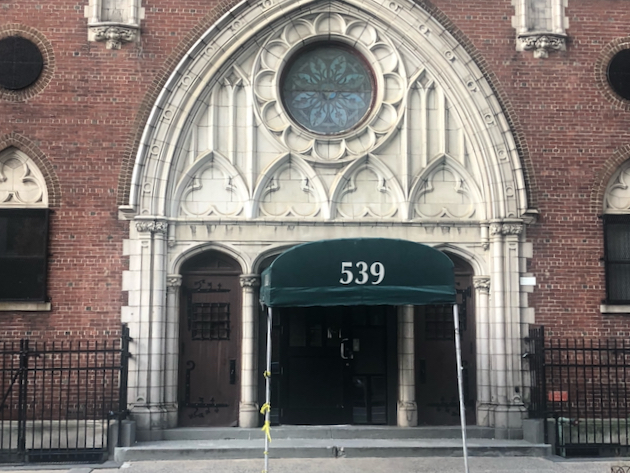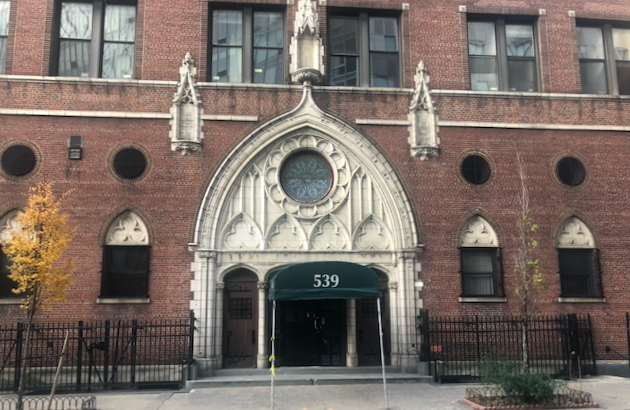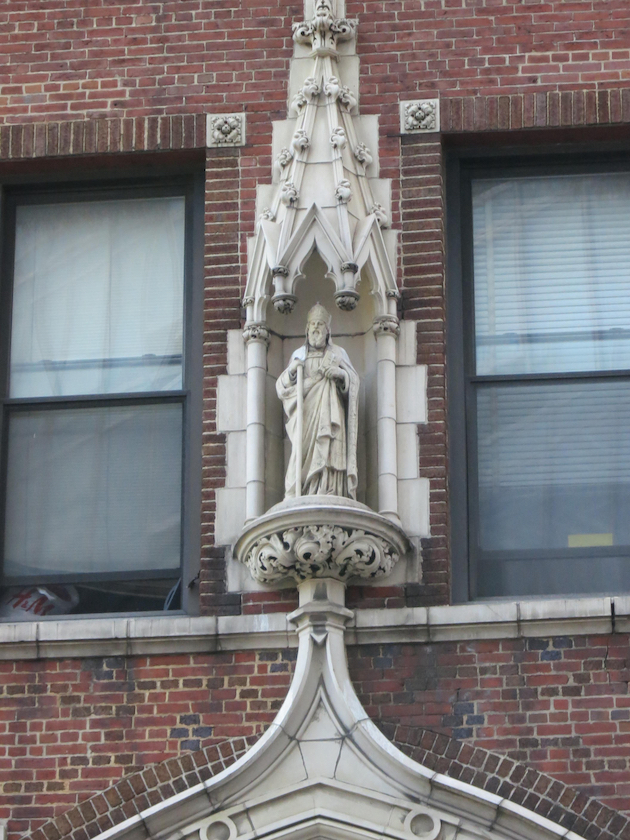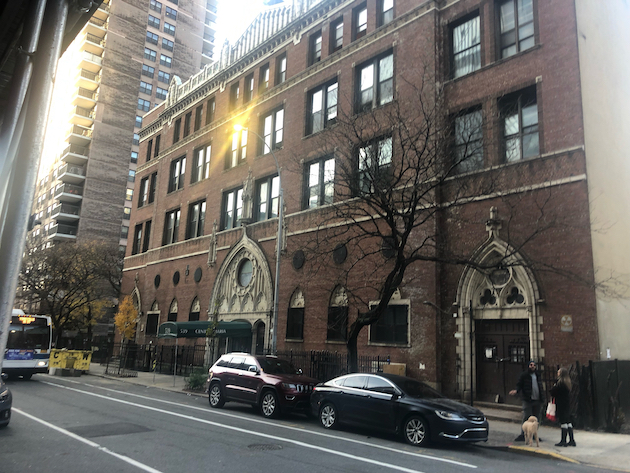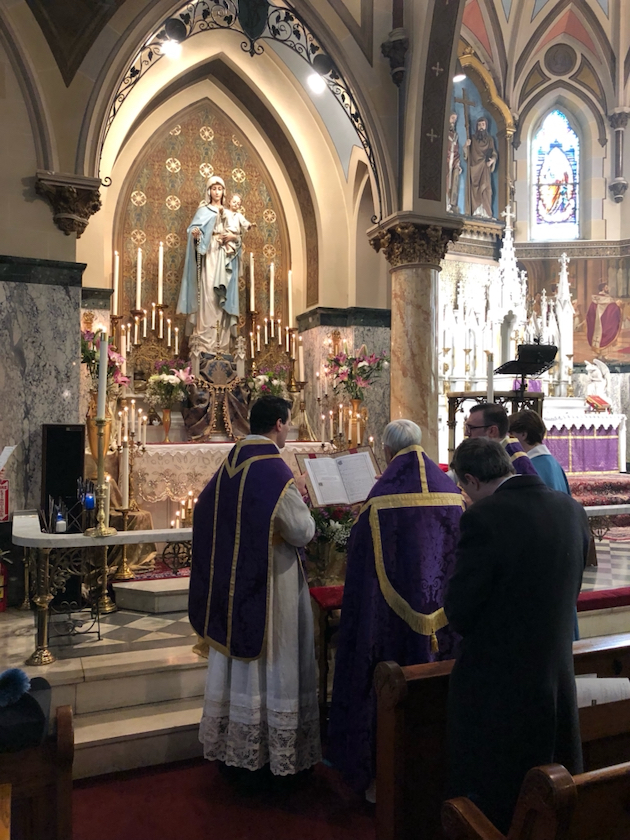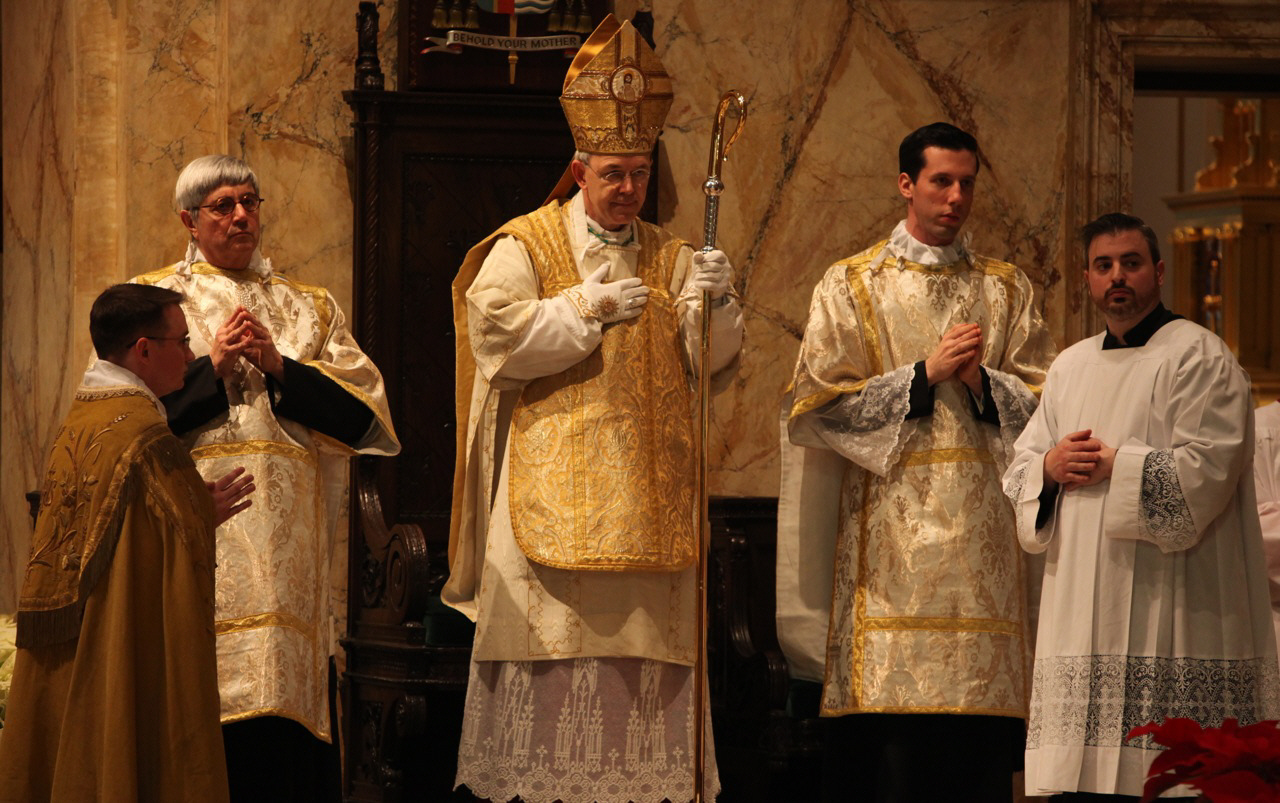
Congratulations to Fr. Cyprian La Pastina who celebrated the 25th anniversary of his ordination this weekend at the Basilica of St. John the Evangelist in Stamford.
26
May
Last Sunday, May 22, St. Mary’s Church held a beautiful May crowning after the 10 am Traditional Mass.


26
May
This message from the organizers of the Latin Mass in Newburgh:
This Sunday (May 29) St. Patrick’s Church in Newburgh, NY will have a Solemn Mass.. The last time a Solemn Mass was offered at St. Patrick’s was more than 50 years ago, so we are very, very grateful to the 3 priests who are coming to St. Patrick’s for this special Mass. May God bless them! May God also bless the visiting choir who will be singing for all of us!
And may God bless all of you for supporting the Latin Mass here at St. Patrick’s; both, spiritually and temporally. We are very grateful for all of your prayers and support, as they have helped us greatly.
24
May
Sts. Cyril and Methodius Oratory in Bridgeport, CT will have a Rogation procession and Solemn Mass Wednesday, May 25 at 6 pm, celebrated by Canon Matthew Talarico, U.S. provincial superior of the Institute of Christ the King.

This Thursday, May 26, is Ascension Thursday, a holy day of obligation. The following churches have scheduled traditional Masses.
Connecticut
St. Mary Church, Norwalk, CT, low Mass 8 am; Solemn Mass 7 pm.
St. Pius X Church, Fairfield, CT, Missa Cantata, 7 pm, Father Richard Cipolla, celebrant.
St. Marguerite Bourgeoys, Brookfield, CT, 7 am.
Sts. Cyril and Methodius Oratory, Bridgeport, CT, 7:45 am, 6 pm
St. Stanislaus Church, New Haven, CT, low Mass, 5:30 pm, Fr. Peter Lenox, celebrant.
St. Patrick Oratory, Waterbury, CT, low Mass, 8 am; Solemn Mass 6 pm celebrated by Canon Matthew Talarico
St Martha, Enfield, CT, 7 pm
New York
Church of the Holy Innocents, New York, NY, 8 am, 6 pm
Our Lady of Mount Carmel Pontifical Shrine, New York, NY, 7 am, 7:45 am, Missa Cantata 7 pm
Monastery of Our Lady of Mt. Carmel and St. Joseph, Brooklyn, NY, 7:30 a.m.
St. Paul the Apostle, Yonkers, NY, 12 noon
Immaculate Conception, Sleepy Hollow, NY, Low Mass, 7 pm
St. Josaphat, Bayside (Queens), NY, 7 am and 7 pm
St. Rocco, Glen Cove, NY, 7 pm
St. Matthew, Dix Hills, NY, 10:30 am
Sacred Heart, Esopus, 11 am
Holy Trinity, Poughkeepsie, 7 pm, Missa Cantata
St Mary’s St Andrews, Ellenville, 7 pm
New Jersey
Our Lady of Sorrows, Jersey City, 7:30 pm; followed by fellowship for young Catholic professionals at Zeppelin Hall Restuarant and Biergarten, 88 LIberty View Dr., Jersey City.
St. Anthony Oratory, West Orange, 9 am, Missa Cantata at 7 pm preceded by a Rosary procession at 6:15
Our Lady of Fatima Chapel, Pequannock, NJ, 7 am, 9 am, 12 noon, 7 pm
24
May

Krass
By Martin Mosebach
(Rowohlt Verlag, Hamburg, 2021)
(525 pages)
Krass, Mosebach’s latest novel, is more tightly focused than the “epic” Westend written some thirty years earlier. It is divided into three sections, each with its own style and coloration, much like the movements of a grand musical composition. Their titles reflect that: Allegro Imbarazzante, Andante Pensieroso and Marcia Funebre. The action of the novel is concentrated at three specific points of time – even if the first and last “acts” are separated by two decades.
However, while Westend is restricted to Mosebach’s native German world, Krass roams much further afield – sweeping from Naples to the French countryside to Cairo. Krass has similarities to Mosebach’s more recent novels. For example, in Krass we find a wonderfully detailed description of a third world culture (Egypt). Mosebach has done the same for Morocco (Mogador), India (Das Beben) and, again, Egypt (Was davor geschah and the non-fiction The 21). This allows Mosebach to make all kinds of contrasts between the world of Europe today and the more permanent (and in a certain sense more spiritual) life of these traditional cultures. Dr. Jüngel, one of the leading personages of Krass, also recalls a certain kind of grasping, manipulative yet ineffectual modern personality encountered elsewhere in Mosebach’s work – such as the German “anti-hero” of Mogador.
The novel commences (Allegro Imbarazzante) in late 1988 beginning, most appropriately, with a magic show in Naples. We are introduced to Ralph Krass, an intimidating German businessman, wheeler-dealer and “macher” whose personality differs in every respect from Eduard Has, the protagonist of Westend. Krass is domineering, imperious, controlling and decisive. He surrounds himself with an entourage of mainly middle aged and older individuals who he has reduced to total dependance. We also meet the second major character of the novel, a younger man, the aforementioned Dr. Jüngel. An art historian, he has made a “pact with the devil,” becoming Krass’s famulus and facilitator. His letters to his feminist wife chronicle much of the doings of the Krass’s coterie.
It’s an indulgent, carefree life, with Krass providing his retainers lavish food and drink as well as tours, shows and boating excursions in and around Naples. With Jüngel’s assistance, Krass is pursuing the purchase of a villa on Capri – the legendary island of hedonism. He also bent on attaching to his entourage a young Belgian woman, the unfaithful Lidewine, as a kind of mistress. For sex is also a part of the entertainment of Krass and company.

Yet amid the luxury and lavish amusements, some of the characters have disturbing premonitions. Jüngel lectures on the Alexander mosaic in the Naples Archeological Museum and, in particular, on one detail: an image of death. Krass himself, while swimming off Capri, is stung by a jellyfish and is nearly swept away by the current. His intended new villa is a mysterious ruin. And we gather that his business (arms trafficking?) rests on shaky and perhaps illegal foundations. So, the uninhibited lifestyle of Krass – and of Europe today – carries within it the seeds of its own destruction. Et in Arcadia ego! We view the beginning of this unraveling already in the last pages of this section.

Andante Pensieroso takes place in a remote corner of Central France late in the following year. Jüngel has taken refuge in the house of a friend after his world has collapsed. He has been expelled from Krass’s circle, his wife (whom he had left behind to join Krass), has deserted him and he has lost his job in Germany. He is flat broke and for want of a functioning CD player cannot even distract himself with (classical) music. He faces an emotional breakdown and, seeking a way out, desperately tries to contact Krass. It’s a traumatic fall from his previous fantastic, extravagant existence under the direction of Krass.
Yet in his isolation from the stimuli of the modernity, Jüngel is now open to a whole new world of reality. He perceives more directly the nature that surrounds him. That includes, in a very Mosebachian touch, meaningful encounters with two parakeets, a cat and a white wagtail (an Old-World bird). He visits a functioning monastery, ancient but rebuilt in the 19th century, in which the Latin plainchant is still sung:
The compulsory musical abstinence made me receptive to the severity and sobriety of this chant, for its renunciation of polyphony, atmospheric magic and 3/4 and 4/4 time. One can’t dance around to this music or march to it. Singing here was a higher form of speaking. The objective appeared to be the purification of the senses from confused emotions. That fit well with the chill of this church that made me shiver after a while – although I didn’t think of returning to the warm air outside. The half-light in the hall faded away; the two candles that were lit for the singing of the chant still shone as golden dots until a monk returned and extinguished them. Now it was night. (p. 238)
He is befriended by a cobbler, Desfosses, living in a room adjacent to that monastery. Desfosses, like Jüngel, is a refugee from the vicissitudes of modern life – if for other reasons. He is an upholder of older habits and customs, a practicing Catholic and happens to be a devoted fan of Marshal Petain. This man teaches Jüngel the lesson that not one shoe or tool should be thrown away – everything can be repaired and reused. In travels over the countryside the earthy Desfosses shares with the impecunious Jüngel hearty meals (Lievre a la Royale) and potent drinks.
Jüngel eventually succeeds to getting a call through to Krass who challenges him to go off on his own. A chance remark by Desfosses gives Jüngel an insight into the interrelationship of all things and events. These incidents, along with the “education” he has received in his exile, enable Jüngel to break free from both his dependance on Krass and his grief at his broken marriage. After this “resurrection” (as he calls it) Jüngel can face life again.
The scene of the novel’s final act, Marcia Funebre, is Egypt. It’s 2008 – 20 years later. We meet again Krass, but the supremely self-assured “master of the universe” of the past is gone; instead, he is a man desperately attempting to re-establish contact with his former friends in the government to order to stave off disaster. As the novel progresses, Krass is stripped of everything: his business, his money, his hotel room and, confined to a hospital bed, even the control over his own body and finally his very life. The account of his lingering decline is a fearful narrative. Krass’s only consolation is the devoted friendship of an Egyptian lawyer who strangely comes to consider him his “father.” The unselfish Mohammed, like Desfosses a sympathetic if flawed individual, is Krass’s only support in his last days.
Jüngel and Lidewine also have ended up in Cairo – for different reasons. Jüngel’s “resurrection” in France has unfortunately failed to bear lasting fruit. He has become a professor of “urban studies” at one of the most undistinguished of German universities. He is in the Middle East on a grant and is on the hunt for another. He has lived through two further divorces. Lidewine has taken up the art business of her parents. In Cairo she is pushing the work of a fraudulent local artist – and otherwise continues her promiscuous ways. Jüngel and Lidewine thus remain emblematic representatives of decadent Europe today.
After learning of Krass’s presence the pair set out to find him. Too late – his body has been taken away for burial! In an oppressive and disturbing scene Jüngel and Lidewine roam in the gathering dusk the endless “city of the dead” of Cairo, searching for his grave. But the body of Krass has disappeared completely among the anonymous myriads buried there – as if he never had existed.
Krass thus contrasts the superficial fantasy world of Western Europe, focused on food, sex, travel and entertainment – and, for some people, social climbing by linking up with those holding economic power – with the permanent values of the surviving remnants of Christian culture in provincial France and of the unchanging world of Moslem Egypt. And above all, with the final reality: death.
Strewn about this novel is the wreckage of Western civilization. Krass’s villa, appropriately named Faraone, is a decayed ruin – just crumbling “stage scenery.” The abbey in which Desfosses resides is, in large part, a not very successful mid–nineteenth century restoration – the original nave had been destroyed in the French Revolution. And a grandiose but dilapidated Cairo apartment to which Mohammed takes Krass is the haunted, empty relic of a half-Western, half-Oriental past. Mosebach enjoys depicting the decrepitude of structures that once were modern. For, as he writes, contrasting the quality of the abbey’s surviving medieval choir with that of the nineteenth century nave:
Ancient things cannot become old fashioned, that which is ancient has learned to wait. Before it, the fashionable continually passes away, even though it is the expression of life. As if only that which has thoroughly died can pass the real test of permanence. (p. 237)
Am I reading Krass in an excessively allegorical manner? Perhaps! In America – after Poe, Hawthorne, Melville and their successors – this perspective is second nature to us. And after all, Krass is not a treatise but a novel with colorful scenes, memorable characters and a fascinating narrative. Yet it seems to me that Mosebach is indeed showing to Europe – and the entire Western world – a great warning sign. He is holding up a mirror so that we in the West can gaze on our own terrible reflection. And is that not, returning to the start of these reviews, also a task of a Catholic writer?
21
May

The relics of St. Bernadette Soubirous, who received miraculous visions of Our Lady in Lourdes, France in the 19th century, are on a tour of the United States. They are currently at the Church of Our Lady of Lourdes on West 142nd Street in Manhattan. They will be at the church until Tuesday, May 24, with the exception of Monday, when they will be at St. Patrick’s Cathedral. A full schedule can be found here. Information on the US tour of the relics including a schedule of all locations are on this website

The church of Our Lady of Lourdes is one of the most curious in Manhattan. It incorporates many details from buildings that had been remodeled or demolished. We have previously written about it in The Recycled Church.


19
May

Westend
By Martin Mosebach
( Rowohlt Verlag, Hamburg 2019)
New Edition, 895 pages
Most readers of this blog are well acquainted with Martin Mosebach, internationally perhaps the most tireless advocate of traditional Catholicism. Yet Martin Mosebach’s day job is primarily that of novelist. In fact, he is one of Germany’s leading practitioners of that genre. Yet as far as I am aware only one of his novels has been translated into English: What was before (2010; English translation 2014). To remedy this defect, I’d like to bring to your attention two of his most remarkable works – one first published 30 years ago, another in 2021.
What is the connection between Martin Mosebach’s faith and his novels? He has specifically rejected any understanding of the role of the Catholic novelist as that of an explicit advocate for the Catholic Church and its clergy. In his novels there are no conversions, deathbed or otherwise, and no visions or miracles either. In fact, he has written of his dislike for the conversion of Lord Marchmain at the conclusion of Evelyn Waugh’s Brideshead Revisited. Yet he maintains that he is a Catholic novelist – but that means a novelist having a Catholic sensibility which informs all his writings. Now especially a novelist must start his work with what he sees about him. Martin Mosebach is the product of an overwhelmingly non-Catholic and even non-Christian environment. Similarly, I don’t recall that Flannery O’Connor, also the resident of a non-Catholic culture – if one very different from that of Martin Mosebach – included many Catholics in her writings.
Westend , a 1992 novel, deals with Mosebach’s own country, city, and people. The title is the name of a late 19th century neighborhood in Frankfurt. This district of splendid mansions and townhouses enjoyed its golden age prior to the First World War. Then came the chaos of inflation in the 1920s, the exile or worse suffered by the large Jewish community in the 1930s, and the allied bombing in the 1940s (which, however, largely spared the Westend). After World War II the once wealthy area endured further traumatizing changes in economics and direction. The grand houses were subdivided into apartments or even workshops. There was even a descent into a red-light district for a few years. Individual buildings were torn down or endured the “simplification” of their facades and decoration. All the while visions swirled among real estate speculators, politicians and city planners of leveling the Westend entirely and building a totally modern district of offices and apartment buildings. But at the end of the day this did not happen. Starting at the 1970s the value of these buildings was recognized and that part of the Westend that had not been destroyed was placed under architectural preservation. And today it flourishes once again as a luxury residential area.
Now in this novel the Westend is dominated by certain patently symbolic images. The bombed-out Christuskirche with its empty Gothic windows serves as the visual and spiritual focus of the neighborhood. For God is no longer here – in the course of this book we learn that His presence had become attenuated even before World War I. Over the facade of the nearby natural history museum stands a figure of Chronos (time) – or of Death – with hourglass and scythe. Within the houses of the neighborhood themselves we encounter paintings and furnishings which serve to anchor and link the succeeding phases of the novel.
The saga of the Westend reminds me of a place very familiar to me – Brooklyn, New York. There too, relatively intact neighborhoods built between 1865 and 1900 survive, like Park Slope, much of Brooklyn Heights, Clinton Hill, and more besides. They also, if on a somewhat different timeline and sometimes in a much more drastic fashion, went through a cycle like that experienced by the Westend: splendor in the 1890s, decline, as the 20th century advanced, into apartments for the middle classes and in some places even into outright slums, followed, starting in the 1970s, by the rediscovery of these attractive streetscapes. Now, the “brownstones” (as they are generically known) of these gentrified districts are among the most desirable dwellings in New York City.
Westend is set against the background of Frankfurt in the 1950’s and 60’s. Now Frankfurt, as I mentioned, is traditionally a very Protestant town – historically a free “Imperial City.” Yet even though the Reformation had triumphed in Frankfurt, a Catholic minority flourished under the protection of the nearby Elector (prince-bishop) of Mainz. In the 18th century the Catholic house of Thurn und Taxis ran the postal system of the Holy Roman Empire out of Frankfurt. In those same years the Catholic Brentano family rose to prominence – Clemens Brentano, the Romantic poet and champion of Anna Catherina Emmerich, was their most distinguished representative. And some of the main churches of Frankfurt remained in Catholic hands, above all the “Imperial Cathedral” of St Bartholomew’s, where the Holy Roman Emperor was elected, and, from the 16th century onward, crowned in magnificent ceremonies.

Mosebach refers frequently to the historical context in which his story takes place. His understanding of German history is vastly more subtle and profound than the simple dichotomy of evil Nazis and good modernity that governs thought in Germany today. Yet Westend is in no way a detailed social and political treatise on life in Frankfurt between 1950 and 1968. The author provides only such information that is relevant to his characters’ story. Key details – such as the exact date of certain events or the age of some of the main characters – is only given far into the novel or not at all. This creates now and then a feeling of timelessness.
The narrative of Westend begins after World War II in which the medieval city center of Frankfurt had been utterly destroyed. The novel tells of two families and two houses in the Westend. The first, the Labontés, are the heirs of the owner of a former grand wine, cigar and gourmet food business. Two maiden aunts manage the family’s ornate old mansion which has survived the war intact. The interior is crammed with magnificent pre-1914 furnishings and seems shrouded in a perpetual twilight or half-darkness. The household is run with proverbial German thoroughness and order by these aunts. A ne’er-do-well son of the family regrettably seems entirely lacking in admirable qualities but exits the novel early, leaving behind a son, Alfred Labonté. Since his mother also died young, his two aunts must take charge of his upbringing.
The second family – the Olenschlägers, represented by Eduard Has, has had a totally different experience. Their old home was bombed out in the war. But thanks to clever investments by Eduard’s mother, their fortune has survived intact. Eduard was able to ride out the war in Switzerland thanks to his posting to one such family-controlled company which, we gather, was of significance to the German war effort. Eduard thereby avoided the unpleasantness of the war years in Germany: the deportations, the bombing, the fighting, captivity or death at the hands of the Allies. He returns to Frankfurt committed to modernity. Has sets out to create a grand collection of German expressionist art. The ruins of the old family mansion will be replaced by a six-story apartment building. And the new building will be crowned by a stark glass penthouse in which he can dwell with his collections. All this activity is underwritten by his family’s firm which harbors dreams of totally rebuilding Frankfurt and plunges into the speculative real estate boom of the post-war years.
Eduard Has thus is representative of the higher bourgeoisie of Frankfurt and West Germany after the Second World War: conformist, anxious to be considered modern but driven by the need for self-display of earlier generations. Utterly lacking in judgment, vacillating and indecisive, he allows himself to be dominated in his choice of art and architecture by advisors who seek their own advantage. His morals are also extremely fluid – he collects other men’s wives as easily as he does pre-World War I expressionists. He does have great – perhaps excessive – affection, however, for his daughter Lilly.
We see his grand new house and gallery take shape. Of course, like all modern art, his rooftop residence is stark and bare. It also is totally inappropriate for the city’s weather conditions and as a dwelling for the family. The sun blazes in without hindrance. It is hard to find one’s way round the rooms given their arrangement and frequent mirrors. The specially designed furniture is impractical. Smells from cooking in an apartment in the basement waft up to the 6th floor. It is the greatest possible contrast to the comfortable old Labonté mansion of 1897!
Alfred Labonté is now growing up in the atmospheric surroundings of the latter house. Although Martin Mosebach has denied any autobiographical angle to this book, Alfred seems from an early age to be endowed with insights regarding his house, his neighborhood and art far more sophisticated and perceptive than anything Eduard ever expresses. Moreover, Alfred is raised as a Catholic, if only in a perfunctory manner, due to the obligation his aunts feel they owe to his dead mother. Other than the case of several minor characters, Alfred’s Catholicism is unique in the world of Westend.
Alfred early appreciates the ornate Victorian decorations of the facades and railings of the neighboring townhouses. Although he does not fully understand it, he is drawn to the beauty of the Catholic Mass (see the passage below). He experiences a spiritual vision of the Westend one evening in which the entire neighborhood seems ordered to, and subsumed into, a blazing sunset behind the ruined Christuskirche. But especially he is drawn to the 19th century paintings (of a “Victorian” local artistic school) on the walls of the LaBonte mansion, especially one specific work: The Departure of the Knight of Cronberg for the Holy Land, in which a crusader from the vicinity of Frankfurt bids farewell to his lady. The work fascinates the young Alfred and he gradually comes to see himself in the role of the knight, and Eduard Has’s daughter Lilly as his lady.
Yet, like life itself, there are many twists and turns to the novel. Both Alfred and Lilly stray from their apparent destiny, handicapped by their superficial education and weighed down by the “sins of the fathers.” Meanwhile Eduard Has continues his triumphant career, managing his wife, his mistress, his artistic and architectural influencers (as we would call them today), the people in his family firm who in fact control his business as well as a variety of colorful local characters. Externally it is a life of grand success: due to his collection of art, he and his wife receive upper society’s accolades, prestigious memberships and coveted invitations. His firm meanwhile is developing a grand plan to raze and totally rebuild the Westend to be an exemplary modernistic district – perhaps like La Defense outside of Paris.

(Above and below) In a dream Eduard Has sees, in the midst of a horrifying infernal landscape, two black marble busts of him and his mistress. He reads in bronze letters under his image NIHIL and under that of his mistresss UMBRA. Was Mosebach inspired by the white marble busts of the far more pious Altieri family in the Church of St Maria in Campitelli in Rome?

Mosebach writes in clear, “classical” prose, now elegant and sophisticated, now using colloquial speech. The analysis of what is going on the minds of the protagonists can be at times extraordinarily detailed. But Mosebach also draws on other techniques. He constantly accompanies and illustrates his story with symbols and images drawn from art, nature and Catholic tradition. The narrative switches abruptly again and again from one character and location to another without warning – one must keep reading carefully! Information is frequently laid out in a nonlinear manner: details foreshadow events only occurring later in the novel, while other incidents are only fully described much later than their first appearance. At times the author hints that he (and apparently one or two of the novel’s characters as well) are gazing back at these events from a point in the future – which must be 1992.
And, opera-like, the discursive “recitative” of the characters’ mental states, conversations and comings and goings is interrupted with startling effect by great visual “set pieces.” For example, Alfred’s father rows a boat dreamily down the river Main (on which Frankfurt is located) – and sees a murdered infant floating towards him. Eduard has a long emotional dialogue with his Swiss dealer in which both explore the nature of collecting art. Both Alfred and Eduard have extended, revelatory dreams. In a heart-rending sequence of scenes, Alfred experiences the greatest grief at the sudden death of a beloved aunt – all the more traumatizing for him since she had suffered a disabling stroke at her own birthday party which he had disdained attending. Alfred is not comforted when he is told how fortunate his aunt was to have a “merciful’ and “peaceful” death.
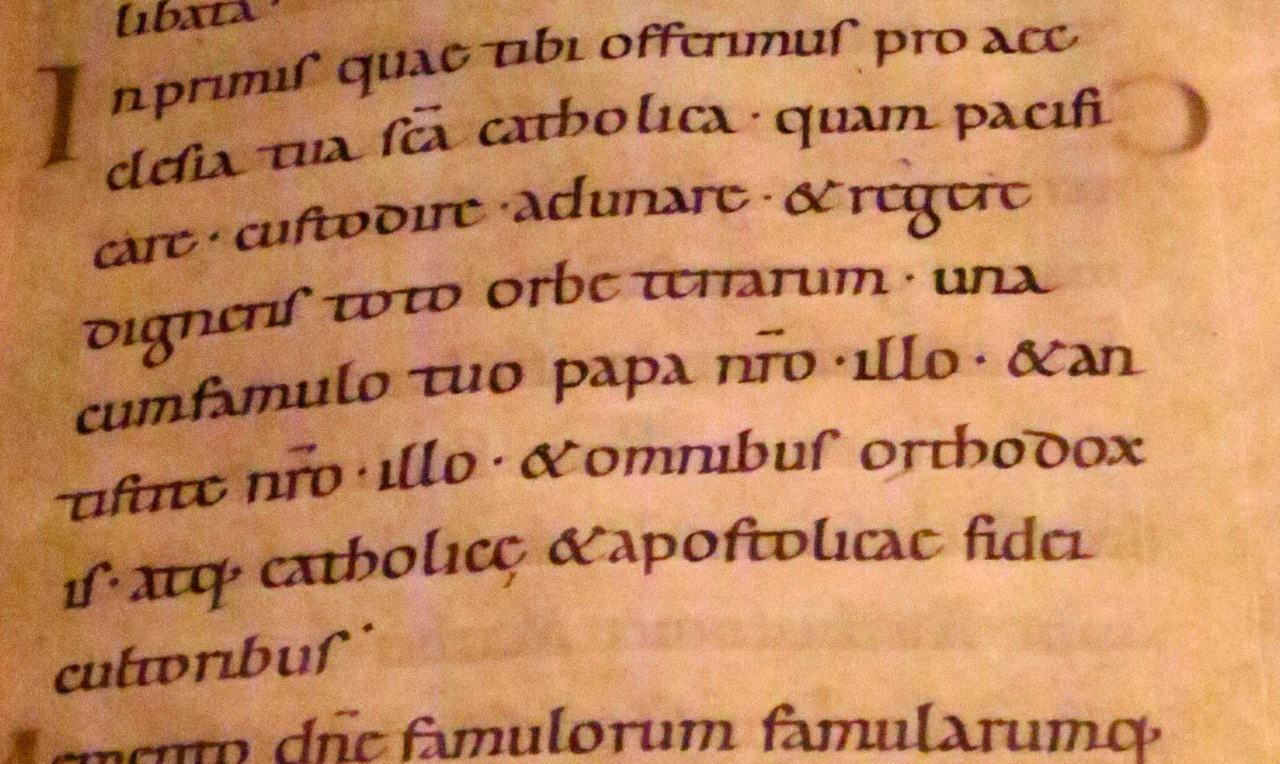
For Alfred felt the horror of a sudden and unprepared death expressed in the petition in the litany – long forgotten by him: a subitanea et improvisa morte libera nos domine. (pp. 722-23)
There follows a forceful depiction of a nonreligious “ceremony” for his aunt in a crematorium where a “pastor” delivers a bizarre, half-philosophical, half-pagan sermon. Amid this oppressive spiritual desolation, Alfred realizes that this entire “ceremony” is the greatest insult to his dead aunt.
But Eduard must face a day of reckoning. His company has overextended itself financially and its plans for the Westend are thwarted – apparently by a political switch in favor of the budding historical preservation movement. Eduard discovers to his horror that, like Madame Bovary, he “has signed too much paper.” The management of his own company pushes Eduard to the brink of financial ruin, his wife finally deserts him, his paintings are removed to the vault until the legal situation is resolved, and he must return to people he has come to despise. His world having collapsed, Eduard can only look forward to a meaningless void. In his deserted penthouse, only his daughter Lilly remains.
Alfred’s world too has turned upside down after his aunt’s death. As Mosebach has subtly pointed out to us now and then earlier in the novel, the aunts’ commitment to German tradition – symbolized by their venerable residence and its contents – is only the product of superficial habit. The surviving aunt brings in a television, substitutes snacking on “health food” for the substantial, regularly served mealtimes of the past, auctions off the entire contents of the Labonté house and finally moves out entirely. The painting of the Knight of Cronberg is donated to the Frankfurt art museum, where, we are told, it resided in the vault for many years. Alfred is left alone in a small room amid the empty and deserted spaces of the LaBonte residence – which he in fact has ended up owning. But his fate then takes a different turn from Eduard’s. He finally comes to realize who he is, and that he is destined in some mysterious way for Lilly. And the next day he in fact receives an imploring call from her – besieged in her rooftop home by one of her father’s consultants. Like the Knight of Cronberg so familiar to him, Alfred resolutely advances to her rescue.
What happens next, we are not told.
So, can we say Westend is a “Catholic” novel? It certainly testifies eloquently that “God is not here.” But many great novelists have made the point that God is absent in the modern world, without thereby necessarily being considered Catholic. We have to look for additional indicia of a Catholic sensibility. Mosebach shows in this work a great appreciation of the intrinsic value of things, of history and of people – even those individuals for whom he otherwise lacks sympathy. He admires that which has organically developed, in contrast to the modernist ideal of a clear break with the past; he supports reality against ideological dreams. He detests phonies and manipulators. Like Dostoevsky, he does not fear to assert the importance of beauty to life. I already mentioned this book’s numerous liturgical and spiritual references. But for me, Mosebach in this book conveys a definite sense that there is an underlying providential will present in this world. We usually perceive it only dimly or in fragments. We are free to reject its promptings. But is not such an affirmation preeminently Catholic?
Alfred and the Mass. (from Westend at pp. 254-255)
by Martin Mosebach
In the half year (of his preparation for First Communion) Alfred had been overwhelmed with impressions, but he had no vessels to capture the overwhelming riches. He was sprinkled with Holy Water before Mass began; he saw the pyramids of candles on the altar, the many white, lace trimmed altar cloths, the entrance of the priest in brocaded vestments and the black biretta with the black pompom on his head. He saw the deep bows, the prayers whispered while the congregation sang loudly and drowned out the words spoken at the altar. Alfred heard the language, foreign, musical and full of vowels, in which he later learned to navigate very assuredly. He heard the chanting of the priests, which ran like a creek snaking through a landscape without any restrictive rhythm, like water, which avoids obstacles, which sometimes is still, sometimes overflows, then in a thin jet falls one step lower and finally flows wide and gently. Alfred heard the little bells, at whose signal everyone dropped to his knees; he saw the cruets with water and wine which were brought up to the altar; he saw the tiny spoon with which the priest took a drop of water for the chalice, he smelled the incense, the fresh aroma of the first burning grains and the heavy clouds which had something of the odor of burnt sugar and which hung about in the front of the church towards the end of the Solemn Mass.. He saw the swinging thurible, the brief washing of the hands from the elegant water cruet and the fine white towel, hardly bigger than a handkerchief. Then came silence, the whispering at the altar, then the church bells began to ring, and the little handbells as well, and then there hovered above the head of the priest a small white disk. Alfred could never get used to the idea that this was bread since the white disk had nothing to do with the bread that he ate at breakfast.
Alfred’s extraordinary, profound emotion prevented him from understanding what he had beheld with the greatest amazement. After the Te Deum of the Corpus Christi procession Toddi Olsten (Alfred’s friend in school) observed that it really was first class. “My father says that nobody can equal the Church in this kind of production. Organ and bells together – it’s a terrific effect….” (Alfred) never would have had the idea of calling ringing the bells during the great hymn as a “terrific effect.” He excluded the possibility that calculation was at work here – everything happened the way in which it had to be done. What happened escaped his understanding, but it was obviously beyond any arbitrariness which would allow one to speak of a “production.” Given his temperament he could have grown into the liturgy of his Church without any difficulties. But for this he would have needed steady direction – in other words, education – just as the Church once understood her cult as a life-long education. But there was nobody who took up the education of Alfred beyond that provided by his aunts….
19
May