13
Jun
8
Jun

(Above) Pilgrims enduring the terrible weather of last Saturday. (Photo:Renaissance Catholique)
The 40th “Pilgrimage of Christendom” ended successfully Monday despite all the adversities of this year – from the weather and otherwise. A record number of pilgrims (at least 15,000) participated. For a report see:
Now, as many of us know, on the same Pentecost weekend a pilgrimage organized by the FSSPX travels in the opposite direction – Chartres to Paris. This pilgrimage unfortunately had to be cancelled because of the storm’s effect on their camping grounds. The organizers report 4,000 were underway at the time of cancellation.
Communiqué aux valeureux pèlerins
For a more detailed report on the FSSPX pilgrimage(with dramatic pictures of the storm):
Now on May 29 another event ended – the German Catholic Congress (Katholikentag). This is an event organized with the full support of the German Catholic Church – indeed, most of the participants are members of Church organizations in one way or another (in that respect it resembles the L.A. Religious Education conference). As always it is a celebration of Catholic progressivism – focusing on environmentalism, the syndodal path, female clergy, LGBTQ, Ukraine, sexual abuse, etc. The Congress’s materials are written in a nearly illegible German using “gender-neutral” forms. Most of the funding for this conference comes directly or indirectly from the German government. Yet despite all this massive support by State and Church, the number of attendeees of the full Congress this year was disastrously low – around 19,000 (including 7,000 engaged in some official capacity in the Congress itself):
Nach dem Katholikentag: Zeitansage für eine krisenhafte Kirche
Der Katholikentag braucht ein kompakteres Format
( “The Katholikentag cost 10 million Euro – mostly funded by the government.” “Since the pandemic the number of those who attend church has dropped by half.“)
19,000 at the Katholikentag of the German Catholic establishment and its allied progressive forces – compared to at least 19,000 walking the two Chartres pilgrimages of Tradition. Numbers don’t lie……
7
Jun
6
Jun
With the overwhelming participation of the pilgrim faithful at the concluding liturgy in the Cathedral of Chartres.
This year the many thousand pilgrims triumphed over seemingly insurmountable challenges of all kinds. Let it be a model for us!
4
Jun
The two traditional pentecost pilgrimages had set off today from Paris and Chartres, respectively, more numerous than ever. The vicinity of Paris was then struck by hailstorms and tremendous downpours. The camping sites for the pilgrims could not be used and 15,000 pilgrims were evacuated to other shelters.
The FSSPX pilgrimage (Chartres-Paris) has been cancelled. I do not see any aannouncement yet from Notre-Dame de Chrétienté.
Let us pray for all the pilgrims and the great unforeseen sacrifices they are making!
Orages violents dans les Yvelines : 15 000 pèlerins et 8 000 scouts sauvés des eaux (news eport)
Annulation du pèlerinage pour cause d’intempéries (announcement from the FSSPX)
Notre-Dame de Chrétienté website (with reports on the pilgrimage)
UPDATE: The direction of the Paris-Chartres pilgrimage announces the pilgrimage will resume and the Mass at Chartres on Pentecost Monday will be celebrated as scheduled.
1
Jun

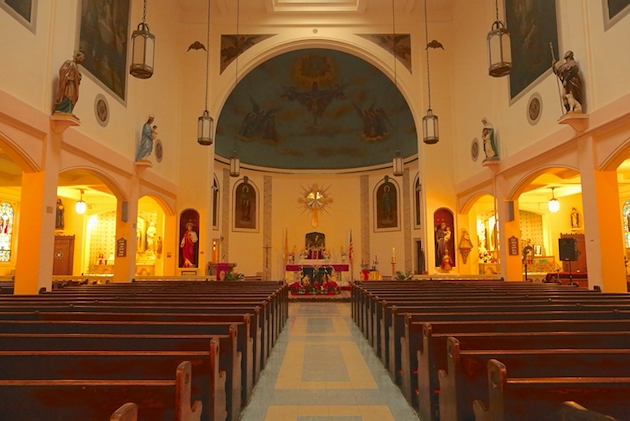
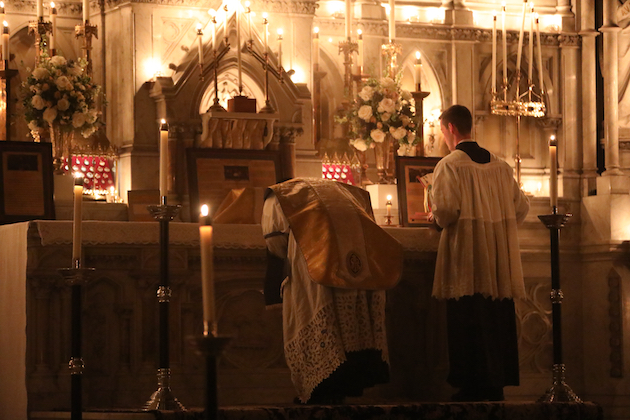
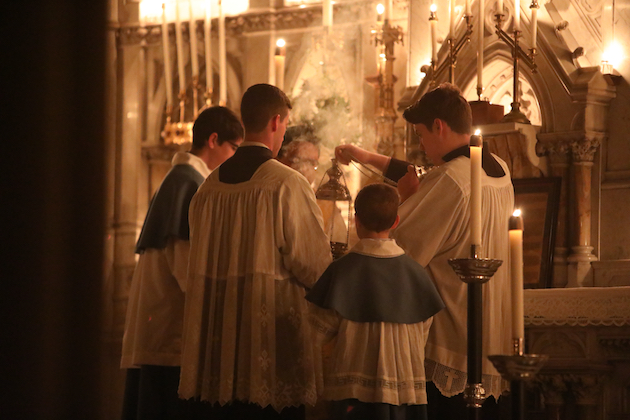
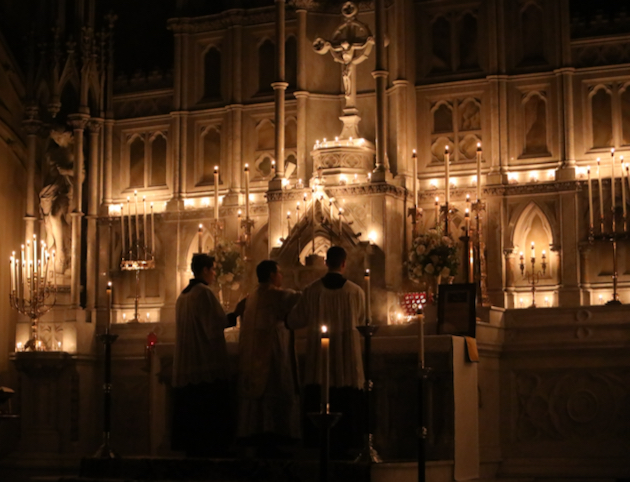
On Saturday June 4 at 10:15 am, the Oratory of Sts.. Cyril and Methodius, Bridgeport, CT, will offer the traditional Pentecost vigil ceremony consisting of six Old Testament prophecies, the bless of the font, Litany of the Saints and Solemn Mass.
Confessions will begin at 9:30 am. Please not that there will not be a 7:45 Mass or early confessions. Server practice will begin at 9:30 am
30
May

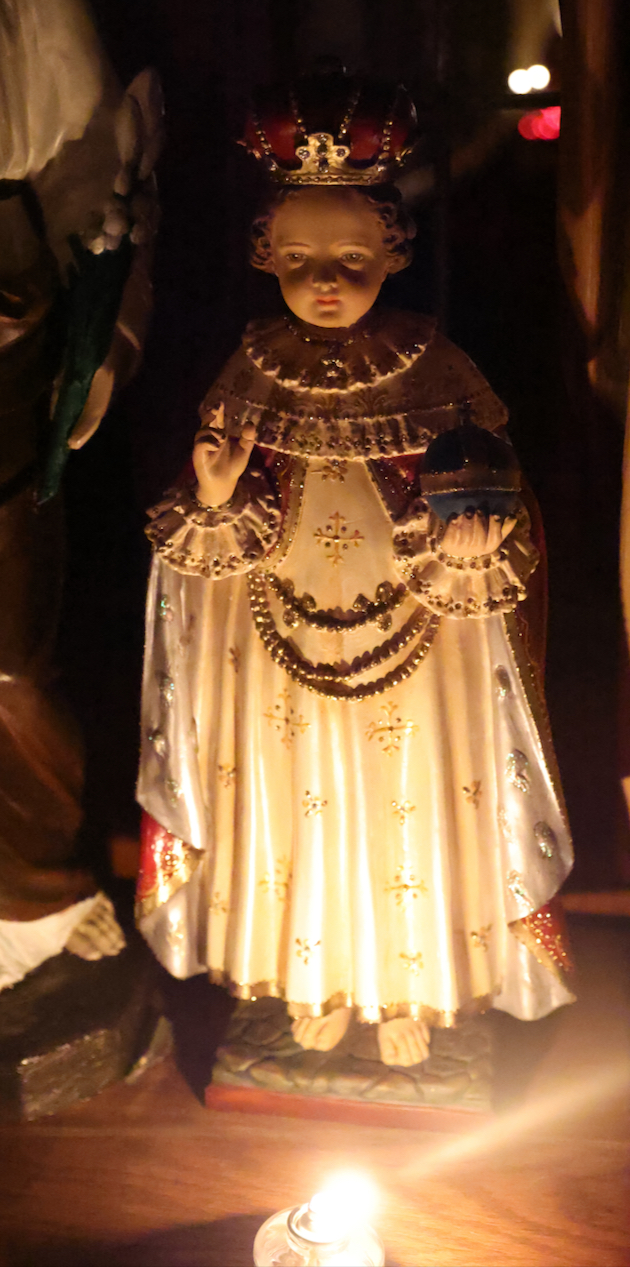
Next to the rectory of the closed church of St. Stephen on East 29th Street.

(Below) The same shrine in 2015.

29
May

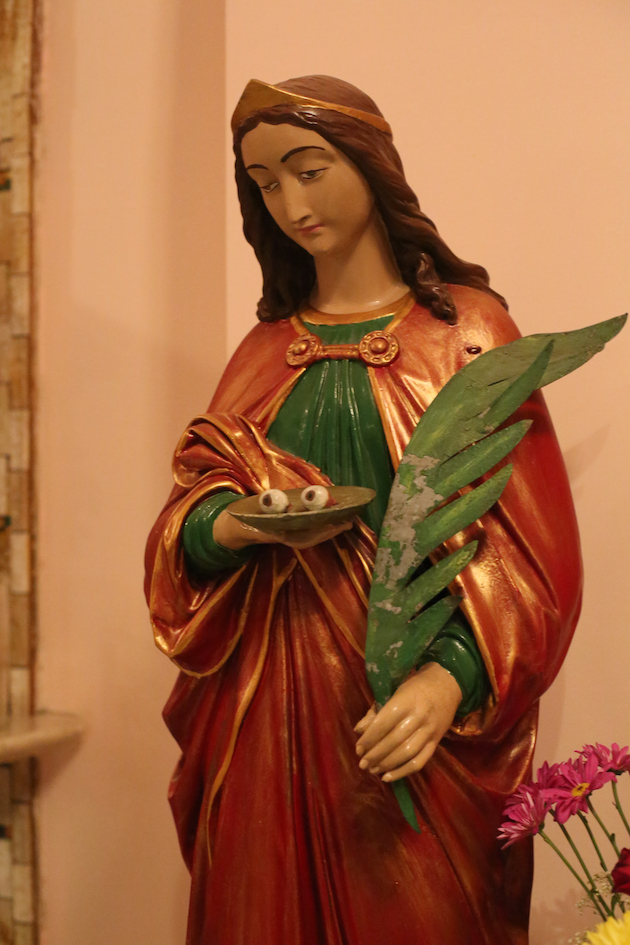
…of a tabernacle at St Augustine’s church in Park Slope, Brooklyn. There is no mention of the fate of the contents of the tabernacle.
https://nypost.com/2022/05/29/thieves-rob-nyc-church-of-2m-relic-decapitate-statue-cops/
Regarding this tabernacle (and the grand church of St Augustine):
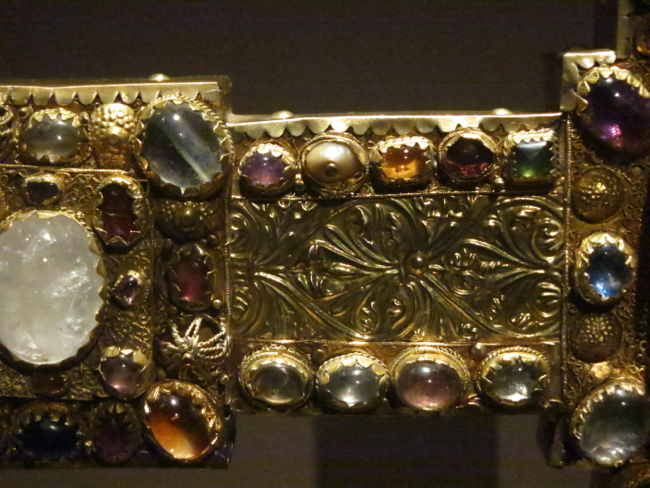
“The centerpiece is a silver and gold tabernacle (Alfred E. Parfitt,1895 ) adorned with gemstones. … It is a masterpiece and one of the most expensive tabernacles in the country, guarded by its own security sysem…..The electonically operated burglar-proof safe is itself of interest…..All the precious metal and the stones which adorn the tabernacle were donated by parishioners in the form of coins and jewelry. It is enclosed in marble with worshipping angels swinging censers.”
Guide to St. Augustine at 14. (accessible at https://sasfx.org/about/history#st-augustine-history)
More pictures of St Augustine HERE.
UPDATE: Statement of the Brooklyn Diocese (5/29/22):
Tabernacle dating back to the 1890s stolen from the altar at Brooklyn Catholic Church
The Roman Catholic Diocese of Brooklyn is announcing the New York City Police Department is investigating a brazen crime of disrespect and hate, which desecrated the most Holy Eucharist and the altar at St. Augustine Catholic Church, located at 116 6th Avenue in the Park Slope section of Brooklyn.
The burglar cut through a metal protective casing and made off with the Tabernacle, which dates back to when the church was built in the late 1800s. This holy sacramental receptacle is irreplaceable due to its historical and artistic value. The angels which flanked the Tabernacle were decapitated and destroyed, and the Holy Eucharist housed inside the Tabernacle was thrown all over the altar.
“This is devastating, as the Tabernacle is the central focus of our church outside of worship, holding the Body of Christ, the Eucharist, which is delivered to the sick and homebound,” said Father Frank Tumino, pastor of St. Augustine. “To know that a burglar entered the most sacred space of our beautiful Church and took great pains to cut into a security system is a heinous act of disrespect,” continued Tumino.
The burglary is suspected to have taken place on Friday, May 27, and was discovered by the pastor on Saturday, May 28. A safe in the sacristy was also cut open, but nothing was inside. Photos of the damage, as well as the video of the original Tabernacle, are attached.
Anyone who may have information that can help police with their investigation is asked to call the NYPD at 1-800-577-TIPS (8477).

27
May

Histoire des Traditionalistes
By Yves Chiron
(Tallandier, Paris, 2022)
637 pages
At long last we have a major history of Catholic Traditionalism. We should offer thanks to Yves Chiron, author of a vast series of works on modern Catholic history, for providing us this much needed account. Chiron’s review is by far the most thorough work on the history of Traditionalism available today. For anyone who wants to explore the roots of Traditionalism, I would highly recommend this book.
For Traditionalism has developed from a fringe phenomenon that both the Church establishment and the media could safely ignore, to a force having a major impact on life of the worldwide Church. Isn’t the best evidence of this presence the declaration of war against Traditionalism issued by Pope Francis? For the Pope and the Vatican judge Traditionalism, and none of the other adversaries in and outside the Church today, as their mortal enemy.
Histoire des Traditionalistes concentrates almost exclusively on French Traditionalism. That is not really a disadvantage, for it was in France – or at least the French-speaking world – that the Traditionalist movement was born and reached maturity. It was only later that other countries-most notably, the United States, joined France as focal points of Traditionalist life. But it was in France that the first Traditionalist critiques were written, where the first leaders like Archbishop Lefebvre arose, where the FSSPX, its allied institutions, and later the Ecclesia Dei communities were established. It is in France where great public events like the Chartres pilgrimages take place.
As someone who has written a history of the Traditionalist movement in the United States – a situation in many respects far simpler and more straightforward than France – I can appreciate the magnitude of Chiron’s accomplishment. For he has chronicled, relying heavily on primary sources, a diffuse movement extending over some seventy years sharing the same overall “spirit” but with many different and various directions, objectives, leaders and organizations. It was illuminating to read for the first time the full background of so many legendary figures. And the author concludes this book with an extremely valuable 125-page biographical dictionary of (mainly French) Traditional Catholics.
Yves Chiron devotes considerable space to the early years to help us understand how the movement arose. He delves back even before World War I. His narrative only reaches the Second Vatican Council on page 125! He usefully points out that not all Traditionalists had their roots in the “Maurassian” (Action Francaise) movement – although some certainly did (like the great Jean Madiran) Others spent World War II and the occupation in the Resistance. He shows the origins of future conflicts in the struggles of Catholic thinkers against the leftward drift of the Catholic Church in France after World War II. Thus, the initial clashes were over political, economic and theological – not liturgical – issues. These first conflicts prompted denunciations of “integralists” by the clerical establishment. Out of these debates arose leaders, publications and organizations that were soon put to a much more severe test. For an American analogy, one thinks of William F. Buckley’s Mater non Magistra (punning on the title of the 1961 left-leaning encyclical of John XXIII) and the initial focus of the Triumph magazine team.
The battle intensified during and after the Second Vatican Council. For it soon seemed that the whole doctrinal structure of the Church was collapsing. It was now that Archbishop Lefebvre started to assume an ever-greater role. And it was now that the Church establishment took its first repressive measures against Traditionalism. But the real turning point was the promulgation and imposition of the Novus Ordo. Archbishop Lefebvre and others were inspired to take direct action to preserve the Traditional Mass. The organized Traditionalist “resistance” was born. Chiron sets forth in detail the role of laity, secular priests and members of religious orders in the developing struggle.
Although it is not the primary focus of his book, in passing Chiron reveals much about the dysfunctional operation of the ultramontane Church. The work of devising the Novus Ordo was conducted by a committee of experts reporting directly to Pope Paul VI, bypassing the responsible functions in the Vatican. At no time prior to the 1980’s was there any real attempt by the establishment in Rome or France to “dialogue” with the Traditionalists. The actions of the French (and Swiss) bishops were limited to bureaucratic edicts and condemnations. It is no wonder that such bitterness arose in the relationship of Traditionalists and the hierarchy.
The main motive force behind Traditionalism in France became Archbishop Marcel Lefebvre and his Society of St. Pius X. The “dialogue” between him and the Vatican increasingly becomes the main theme of this book. Now our author seems to be of an irenic bent – sympathetic to Traditionalism, but also anxious to maintain good relations with the Pope and the hierarchy. This accords with the author’s mild, dispassionate, at times almost noninvolved style.
So, for example, when Archbishop Lefebvre felt compelled to ordain priests for his society (in 1975) and later to consecrate bishops, Chiron quotes abundantly from other followers of Traditionalism that advise against these steps. Of course, if Lefebvre hadn’t taken these decisions, there hardly would be any Catholic Traditionalism today. And in these years, he was not alone in feeling the necessity of taking drastic acts contrary to authority. Consider the seizure of St. Nicolas-du-Chardonnet in Paris! It remains a Traditionalist parish to the present day.
I do have some reservations regarding this magisterial work. Although I approve it in principle, the focus on France, with marginal references made to Brazil, the United Kingdom and the United States, does have its limitations. I have quibbles, for example, with some of the author’s implied judgments on developments in the United States. Father Gomar DePauw was a great pioneer of Traditionalism on these shores already in the 1960’s; he did not, however, found a nationally significant movement. The fact that Una Voce United States handed the Pope a petition in 1994 does not at all imply that it was speaking for U.S. Traditionalists as a whole (as their own petition makes clear!). Like other French Traditionalists who have written about the situation in America, Chiron ascribes too much importance to sedevacantism. Although that tendency is perhaps stronger here than elsewhere in the world, it in no way plays a leadership role among American Traditionalists.
Yves Chiron makes persuasive arguments and often reaches convincing conclusions (although I might not agree with all of them). He at times, however, falls into the mere reproduction of contemporary statements and petitions, without interpretative commentary, as if these were the essence of what went on in historical reality. But that is where the historian’s judgment is required. In a work of history, we look for not the mere recital of facts, but the author’s interpretation of them.
Chiron’s book lacks at times a wider historical context. The struggles of the Traditionalists did not occur in a vacuum but in the larger Church. At all times after the Vatican Council the Catholic Church in Europe was in a state of chaotic decline, bordering in certain places on total collapse. France is one of the leading examples. This dire situation is what motivated the Traditionalists. The lack of this context puts the Traditionalists in an unfavorable light, making them appear obstinate, aggressive and belligerent. Yet they were only reacting to the wasting away before their very eyes of the faith that they loved. A principled man often appears strident and opinionated compared to those indifferent or conformist.
Chiron also does not fully convey the militancy of the “Conciliar” establishment. From the 1960’s to the present day the Vatican, the episcopate and a large percentage of the clergy and religious lived through a revolutionary “conversion” to the “Council” abandoning much or all of a Tradition now understood as a barrier to the faith. Pope Paul VI’s discourse on the benefits of sacrificing the Catholic culture of the past is exemplary. And much of the laity (that minority who continued to frequent the churches, that is) followed the path of their spiritual leaders. This explains the animosity, even the hatred, felt by all these forces – and not just formal “progressives” – against Catholic Tradition and especially the Traditionalists themselves. It is the origin of the Church’s readiness to use coercion and intimidation against Traditionalists – but not against opponents allied with the secular establishment. For if you have given up everything in pursuit of a dream which has not materialized you do not look kindly on someone who, by his words or life, is reminding you of that fact. This is even more so when the governing powers of this world are applauding you at every moment. Again, Chiron’s failure to highlight these tensions and passions within the wider Church puts the entire Traditionalist struggle in the wrong light. I would admit, however, that many Traditionalists themselves have been reluctant to admit the truth about these divisions within the Church.
I regrettably have more significant reservations about the final two chapters on Popes Benedict XVI and Francis – particularly the last. These two also seem to have been written in a more summary manner than the rest of the book. This is a shame, because the motu proprios and other accompanying actions of Popes Benedict and Francis are the most crucial events of the post-Conciliar period regarding Traditionalism. As to Pope Benedict, I don’t think the author fully captures the significance of Summorum Pontificum. Perhaps that is because the embedding of Traditionalism in the ordinary life of the Church that Benedict’s motu proprio intended and, at least in some places, accomplished, had its greatest consequences not in France but in the United States. Chiron’s account of the final breakdown of negotiations between Benedict’s Vatican and the FSSPX in 2012 is both blander and more favorable to the Vatican than my previous understanding of the facts. Regardless of this, Chiron very accurately points out that at the end of the day Benedict was unable to achieve a full reconciliation of the FSSPX, just as he was utterly incapable of making any progress on the liturgical “reform of the reform” he supposedly favored.
Chiron’s chapter on Pope Francis completely misses the mark. The author’s desire to advocate peace between Traditionalists and the Roman Catholic establishment gets in the way of his judgment. Just the title of this chapter “Pope Francis – a Pastor above all” is ludicrous; I wouldn’t use the term “pastor” to describe a progressive ideologue and a tyrant – an extreme version of Francis’s own hero Paul VI. And when Chiron describes Traditionis Custodes as a “regression” compared to the acts of his predecessor, that is the understatement of the century. For it directly contradicts them; the Pope therein explicitly states his desire to annihilate traditionalism. And that is entirely in accord with his prior words and deeds both as Archbishop of Buenos Aires and Pope. Yes, it is true that, generally speaking, the Pope, prior to Traditionis Custodes, had focused his attention on things other than liturgy. But this was only to promote progressive initiatives in morality, theology and politics equally incompatible with Traditionalism. He did grant further legal accommodations to the Society of Pius X – but what does that matter in relation to the Pope’s implacable conceptual hostility to Traditionalism, so abundantly displayed in public, and his repeated measures against individual Traditionalist apostolates? Characteristically, Chiron quotes, apparently favorably, the first craven response of the French Ecclesia Dei communities to the French bishops in August 2021 – positions from which these organizations subsequently entirely departed. To fully explore the impact and implications of Traditionis Custodes, however, would have required Chiron to rethink and largely rewrite his prior conclusions on the reconciliation of the Church establishment and Traditionalism after 1982 – something he was understandably reluctant to do.
In his concluding thoughts, Chiron summarizes the significant influence, scope and numbers attained by Traditionalism in the world today. And the Traditionalists are unlikely to disappear anytime soon – Chiron himself thinks “some” bishops will apply Traditionis Custodes in a non-confrontational, relaxed manner. Broadly speaking, that has indeed been the experience up till now. Chiron ends his book by quoting Jean Madiran, who describes Traditionalism as a “way of life,” a “profession” a “devotion” and a “state of mind.” All this is very true – in a certain sense! But we would be mistaken if we understood this to mean that Traditionalism is some subjective mood, attitude or emotion. For what motivates Traditionalists is the fight for the objective truths of their religion, for the restoration of the Church and, in the climate of today, even the existence of objective reality about the nature of Man and the world. As Madiran states, this is not just an intellectual affirmation or an ideology but, like Christianity itself, informs and shapes the entire “way of life” of the believer. That is why Traditionalists have been fighting for 70 and more years – as Chiron chronicles in such detail. And it is why they will continue to do so.