Tomorrow (Saturday, October 22nd) at 9:30am, St. Vincent Ferrer’s Church in New York, will have it’s first regular traditional low Mass on Saturdays.

Tomorrow (Saturday, October 22nd) at 9:30am, St. Vincent Ferrer’s Church in New York, will have it’s first regular traditional low Mass on Saturdays.
19
Oct

We read much about the “Synodal Path,” the “Synodal Church,” the “Synod on Synodality” and “synodality” itself. Few, however, seem to have noted the remarkable agreement among all the actors involved in these events. The German Synodal Path supposedly was the product of the unique nature of the German Church: bureaucratic, historically antagonistic to “Rome” and enjoying the benefits of the Church Tax. Yet similar recommendations were soon forthcoming in France and Ireland. Then, the allegedly “conservative” Church of the United States issued its own “national synthesis” which has a surprising resemblance to the positions taken by the Germans. For example, the USSCB summary found among the main issues facing the Church:
Closely related to the wound of polarization is the wound of marginalization :
Those who experience marginalization, and thus a lack of representation in the Church, fall into two broad groups.16 The first includes those marginalized who are made vulnerable by their lack of social and/ or economic power, such as immigrant communities; ethnic minorities; those who are undocumented; the unborn and their mothers; people who are experiencing poverty, homelessness, or incarceration; those people who have disabilities or mental health issues; and people suffering from various addictions. Included also in this group are women, whose voices are frequently marginalized in the decision-making processes of the Church: “women on parish staff said they felt underappreciated, underpaid, not supported in seeking formation, worked long hours, and lacked good role models for self-care.”17 The second group includes those who are marginalized because circumstances in their own lives are experienced as impediments to full participation in the life of the Church. Among these are members of the LGBTQ+ community, persons who have been divorced or those who have remarried without a declaration of nullity, as well as individuals who have civilly married but who never married in the Church. Concerns about how to respond to the needs of these diverse groups surfaced in every synthesis.
Persons who have been divorced, whether remarried or not, often feel unwelcome within the Church.
The hope for a welcoming Church expressed itself clearly with the desire to accompany with authenticity LGBTQ+ persons and their families. …In order to become a more welcoming Church there is a deep need for ongoing discernment of the whole Church on how best to accompany our LGBTQ+ brothers and sisters.
There was a desire for stronger leadership, discernment, and decision-making roles for women – both lay and religious – in their parishes and communities.
Synodal consultations identified that more work is necessary to welcome diverse cultural and ethnic communities. 1)
This consensus extends not just across borders but up and down the chain of authority in the Church. The archdiocese of Philadelphia, for example, produced its own statement pf priorities completely in accord with those mentioned above. Artwork arising out of those sessions in Pennsylvania was subsequently republished by the Vatican. In Rome, Cardinal Mario Grech has defended the German Synodal Path against is critics in other hierarchies.
Finally, the continuity extends across time as well as space. In 1976 the famous Call to Action conference was held in Detroit with the support and participation of senior members of the American hierarchy. In substance, its characterization of the issues facing the church resembles closely those of the synodal reports of today. 2) In Germany, the Würzburg synod held between 1971 and 1975 anticipated in many respects the current Synodal Path.
The number and specificity of the demands or proposed actions vary among these declarations, conferences and “processes.” But the underlying issues that are identified are generally the same. How can we account for this extraordinary unanimity? After all, hasn’t the Church throughout the world and over recent decades been characterized by tensions between conservatives and progressives, traditionalists and liberals? Yet, when the Church undertakes a project to “listen” to its base, only one perspective emerges, only one set of priorities is deemed worthy of comment.
One obvious fact is that in all these meetings, conferences and sessions the same people and the same institutions are involved. They are the bureaucrats who in fact run the Catholic Church, regardless of post-Conciliar talk of an empowered laity, subsidiarity or synodal government by the bishops. They include the teachers and administrators at the Catholic educational institutions, the journalists of the Catholic press, the members of the mainstream religious orders, the administrators of dioceses, the staffs of national episcopal conferences and the leadership of catholic organizations of every kind. The Roman curia, along with its related and subordinated entities, is itself one of the foremost examples. Note that the administrators of the Church include (or form close alliances with) many not officially in the Church’s employ. Members of the “engaged” or ”activist” laity, for example, can be counted among the partners of the bureaucracy. Other allies have found a home as teachers or students at secular universities and divinity schools. The publication perhaps most representative of the views of the Roman Catholic bureaucracy – the National Catholic Reporter – was specifically founded in the 1960’s outside the formal perimeter of the Church.
The make-up of the bureaucracy has shifted over the years – there are far fewer priests and nuns today in comparison to 1976 or 1966 – but that has hardly diminished its role. Most of the few religious sisters that remain no longer serve in schools or hospital but as administrators of one kind or another. Jesuits today rarely are able to staff their own schools and universities but direct and decisively influence their lay disciples who manage these places.
The actual number of administrators has undoubtedly steadily increased. Many bishops and diocesan priests also have come to understand their function to be links in a bureaucratic chain. Moreover, the bureaucratic tide is daily conquering new territory. Pope Francis has just decreed that laymen and women can lead Vatican congregations and dicasteries. A woman has just been appointed as akind of “deputy vicar general” in a German diocese. 3)
These bureaucrats and their hangers-on are the ones who select the issues to be addressed in the synodal process and formulate the “solutions” for them. Not even the ”1%” supposedly surveyed in the synodal process has had any real say in the matter.
This institutional stability is linked with ideological uniformity. The ascendancy of the ecclesiastical bureaucracy, although its roots reach much further back, is really the product of Vatican II. For it was in the wake of the Council that the functionaries were empowered to assume the direction of the Church. They internalized and perpetuated the basic twofold nature of the Council: a revolutionary reaction against all forms of the past in Catholicism, combined with total openness to the norms of contemporary society. It’s easy to see how seductive such a message is for modern administrators. As against the laity and “reactionary” elements of the clergy they could pose as bold innovators in an ongoing, endless process of change. In relation to the powers of secular society – both in and outside of the state – they could appear as accommodating fellow citizens of modernity. Therefore, at all times the Church bureaucracy has remained the guardian of the progressive vision.
These continuities in structure and belief within the Catholic Church reflect the consolidation of the modern civil society of the West and of its ideology. As in the case of the Church, the cultural and structural unity of the secular world extends over all Western societies (cf. Thomas Molnar’s Atlantic Culture). Moreover, just like the Church bureaucracy, the secular power elite includes both state (governmental) and private institutions and players. The Church operates within this society, and after the Council explicitly has looked to it for guidance. In secular society too, there has been continuity in ideology since the 1960’s, even if developments steadily assume a more and more extreme form. The “woke” ideology dominant today would have exceeded the expectations of all but a fringe of extreme radicals fifty years ago. But on such issues as support of unrestricted abortion the secular establishment has been consistent over the decades.
Now the controlling influence of secular society is evident not only in the political and moral positions adopted by the Church administrative functions, but also in the very fact of the bureaucratic ascendancy within the Church. For is not the introduction of the managerial revolution one of the hallmarks of the contemporary world? Political conservatives have long lamented the deep state, impervious to political control and following its own agenda. A whole literature has arisen on these developments in the American educational system, where at every level the rate of growth of administrative staffs far exceeds that of both students and teachers.
Continuities of institutions, people, and ideology – all embedded in a supportive secular society – explain why the progressive Catholic vision has been so resistant to change – and now directs the synodal process. Catholic conservatives and traditionalists have been slow to understand or acknowledge these facts. Years ago, James Hitchcock wondered why conservative priests turn “middle of the road” or even progressive on becoming bishops. Others were amazed at how little headway the ideas of Popes John Paul II and Benedict seemed to make in the Church. The fact of Catholic bureaucratic continuity helps to clarify the situation. For those who dispute the consensus expressed in the synodal documents it will be insufficient to write grand speeches and articles and otherwise engage in intellectual debate. They must accept the necessity of relentless conflict with a concretely existing establishment holding all the power. It’s a struggle that, in the short term, has no immediately foreseeable resolution.
In the long term, as we know, the outcome will be quite different.


Saturday, October 15th at 2:00 p.m.Our Lady of Mount Carmel Church, 259 Oliver Street, Newark, NJ
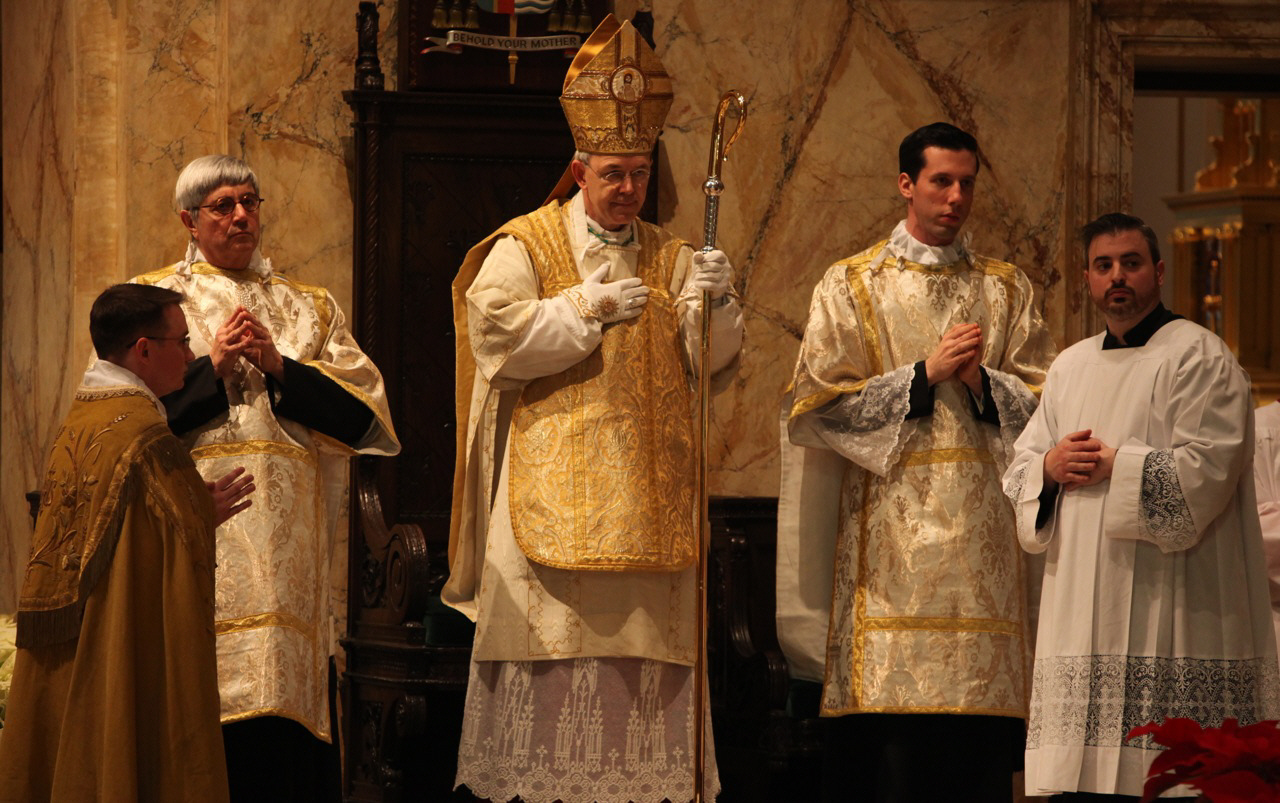
Pontifical Requiem Low Mass for the 2nd anniversary of Monsignor Ambrosio’s passing
Celebrant: Bishop Arthur Serratelli
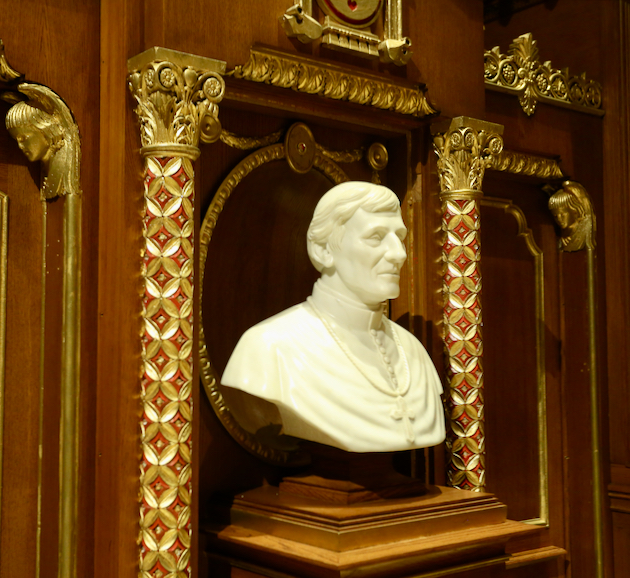
This evening at St. Pius X in Fairfield, CT, Fr Richard Cipolla celebrated the Votive Mass for St. John. Henry Newman whose feast was yesterday. Here is his sermon:
Yesterday was the feast of Saint John Henry Newman. We could not celebrate this
feast because yesterday was a Sunday. So this Mass is being celebrated as a
Votive Mass of St John Henry Newman. And why should we do this? Because it
is this saint who was canonized only 3 years ago that is truly a man for our times. I
must confess that my devotion to him is intensely personal, for it was he who
guided me into the Catholic Church and it was and still he who helps sustain my
faith in these times in which the faith handed down from the apostles is threatened
with ferocity by a non-believing and crassly self-centered world from without and
threatened by those within the Church who advocate for an abandonment of the
teaching Tradition of the Church from Jesus Christ himself in the name of
openness to the changing world.
Newman was one of the most brilliant minds of the second half of the nineteenth
century in England. His conversion from Anglicanism to Catholicism rocked both
the established Church and the intellectual centers of England, especially the
University of Oxford. His writings as a Catholic on the Development of Doctrine,
on the purpose of a University, on what it means to assent in faith, and his
understanding of the role of the laity in the development of doctrine, his
understanding of conscience in the life of the Christian, his poetry, his prayers and
mediations, his sermons: a truly remarkable Catholic man.
He had his detractors both outside and within the Church. He suffered both as an
Anglican and as a Catholic, and he understood this because suffering is the mark of
a man that is being conformed to Christ. He received a most wonderful surprise
near the end of his life when Pope Leo XIII made him a cardinal. His acceptance
speech made in the presence of the Pope in Rome should be read by every Catholic
today. The following are excerpts from that speech.
And, I rejoice to say, to one great mischief I have from the first opposed myself.
For thirty, forty, fifty years I have resisted to the best of my powers the spirit of
liberalism in religion. Never did Holy Church need champions against it more
sorely than now, when, alas! it is an error overspreading, as a snare, the whole
earth.
Liberalism in religion is the doctrine that there is no positive truth in religion, but
that one creed is as good as another, and this is the teaching which is gaining
substance and force daily. It is inconsistent with any recognition of any religion, as
true. It teaches that all are to be tolerated, for all are matters of opinion. Revealed
religion is not a truth, but a sentiment and a taste; not an objective fact, not
miraculous; and it is the right of each individual to make it say just what strikes his fancy. Devotion is not necessarily founded on faith. Men may go to Protestant
Churches and to Catholic, may get good from both and belong to neither. They
may fraternise together in spiritual thoughts and feelings, without having any
views at all of doctrine in common, or seeing the need of them. Since, then, religion
is so personal a peculiarity and so private a possession, we must of necessity
ignore it in the intercourse of man with man. If a man puts on a new religion every
morning, what is that to you? It is as impertinent to think about a man’s religion as
about his sources of income or his management of his family. Religion is in no
sense the bond of society.
Now, everywhere that goodly framework of society, which is the creation of
Christianity, is throwing off Christianity. Instead of the Church’s authority and
teaching, they would substitute first of all a universal and a thoroughly secular
education, calculated to bring home to every individual that to be orderly,
industrious, and sober, is his personal interest. Then, for great working principles
to take the place of religion, for the use of the masses thus carefully educated, it
provides — the broad fundamental ethical truths, of justice, benevolence, veracity,
and the like; proved experience; and those natural laws which exist and act
spontaneously in society, and in social matters, whether physical or psychological;
for instance, in government, trade, finance, sanitary experiments, and the
intercourse of nations. As to Religion, it is a private luxury, which a man may have
if he will; but which of course he must pay for, and which he must not obtrude
upon others, or indulge in to their annoyance.
I lament it deeply, because I foresee that it may be the ruin of many souls; but I
have no fear at all that it really can do aught of serious harm to the Word of God,
to Holy Church, to our Almighty King, the Lion of the tribe of Judah, Faithful and
True, or to His Vicar on earth. Christianity has been too often in what seemed
deadly peril, that we should fear for it any new, trial now. So far is certain; on the
other hand, what is uncertain, and in these great contests commonly is uncertain,
and what is commonly a great surprise, when it is witnessed, is the particular
mode by which, in the event, Providence rescues and saves His elect inheritance.
Sometimes our enemy is turned into a friend; sometimes he is despoiled of that
special virulence of evil which was so threatening; sometimes he falls to pieces of
himself; sometimes he does just so much as is beneficial, and then is removed.
Commonly the Church has nothing more to do than to go on in her own proper
duties, in confidence and peace; to stand still and to see the salvation of God. “The
meek shall inherit the land and delight themselves in abundant peace” (Ps 37:11).
What Saint John Henry Newman wrote over 100 years ago, applies in much
greater force in our own time. Would that the hierarchy of the Church today read
what Newman wrote about dogma, about liberty, about Tradition, about the
struggle between the world and the Church and apply it to these times of the de-
Christianization of our society and apply it with loving chastisement to those
within the bosom of the Church who have deliberately forgotten the source and
meaning of truth.