4
Sep
4
Sep
St. Mary’s Youth Schola registration is open for Fall 2025
First meeting: Thursday, September 18, 2025. (4:00–5:30 p.m.)
A program of musical and faith formation based on Gregorian chant and sacred polyphony
Weekly classes on Thursday afternoons, plus singing opportunities at parish Masses (2–3 per semester)
Open to ages 8–18
Fee: $125/semester (multiple-child discounts available)
Faculty: Charles Weaver, Nicholas Botkins, Elizabeth Weaver
Find out more and register at:
stmarynorwalk.net/youth-schola-program


2
Sep
Matthew Walther writes in The Wall Strreet Journal on the persistence of the Latin Mass and on a distresssing aspect of Catholic culture:
The best sermon I’ve ever heard was delivered by Father James Richardson in Kalamazoo, Mich., in 2018. It was the Sunday after news broke about the proclivities of the late Cardinal Theodore McCarrick. “I’m sick of the lying,” Father Richard began. For the next 10 minutes, he repeated “I’m sick of,” anaphora-like, with each instance followed by another scandal….
I still feel that way. Lies are the air Catholics have breathed for decades, which is why it was startling to witness a priest simply stop inhaling.
The stench of untruth, it seems is still with us.
(Mr. Walther goes on to discuss the revelations about the survey which allegedly supported Traditionis Custodes and the Vatican’s reaction to the disclosure.)
Walther, Matthew, “The Latin Mass Lives on,” at A13 The Wall Street Journal (8/29/2025)
Now I made the same point some years ago:
“But out of this seemingly inevitable tragedy (the likely collapse of the institutional Church as a result of the Francis papacy) may come at least one advantage: the truth. For far too long the Catholic Church has continued to take refuge in fantasies of stability and success, of secular standing and influence. You need look only at any of the official Catholic media to confirm this – isn’t the Al Smith Dinner in New York the incarnation of this self-deception? Even the supposedly hard-nosed liturgical traditionalists remained to some extent in thrall to these mirages. The poison of dishonesty has eroded the faith more surely than any persecution or loss of worldly advantages could do.
Let be be finale of seem! Jettisoning the Catholic culture of pretend is the first, most necessary step towards reform.” (“Let be be Finale of Seem,” The Society of Saint Hugh of Cluny ( 11/11/2017)
More recently, Ed Condon has asked: “Can Pope Leo resist the Vatican Culture of ‘Alternative Facts’?” (The Pillar, 8/19/2025)
Even from the outside looking in, it seems clear that, at least at some level, the Vatican’s official response to evidence of potential wrongdoing is to deny either the evidence or the wrongdoing could exist.
(Regarding the Vatican’s aggressive response to the disclosure of a letter by the late Cardinal Pell and a critical report on Vatican financial practices) In so doing, the press office appeared to prefer a version of events in which Pell’s letter and Milone’s report simply never existed, rather than engage with what either document said.
While there is no means for journalists to compel any different approach from a press office, the problems which would arise if the same “alternative facts” were imposed upon the pope by his officials are obvious.
As Matthew Walther says, the Catholic culture of deceit is alive and well. It remains to be seen whether and how Pope Leo will start to confront it.
1
Sep

In recent years the Archdiocese of New York has abandoned all pretense of planning and transparency regarding the continuing disappearance of parishes, schools, and shrines. Mergers and closures occur without any communication being made to media or to the laity directly affected. In the case of parishes, for example, a researcher needs to consult a page called “Decrees” listed under “Parish Planning” in turn listed under “Pastoral Offices” on the Archdiocese of New York website to find out what is going on. And even here, if one takes one’s attention away for even a week, a new announcement may well have appeared. So, on August 11th, 2025, the archdiocese announced the relegation – in other words, the preparation for sale- of the church of St. Veronica on Christopher Street in Manhattan. 1)
Now I had previously written about St. Veronica and the initial decision to terminate the parish in 2017. 2) But opposition soon organized and the “St. Veronica Moving Forward Committee” continued the struggle. Indeed, in 2020 the archdiocese reversed its 2018 decree. 3) That was a remarkable achievement. It has been claimed that direct intervention by the Vatican was involved; I have no concrete evidence of this. (4)
But in any case, the reprieve was short lived. Apparently, several masses were celebrated after the supposed resumption of religious life in the church but no regular services recommenced. And the disputes over the financial vitality of St. Veronica’s resumed – the archdiocese following its tried-and-true play book, e.g., identifying a leak in the roof which could only be repaired by a disproportionate expense.(cf. what is going on today at Most Holy Redeemer parish). And now the archdiocese has returned to the situation of 2017. I cannot find any explanation for this latest turn of events. The decree of 2025 does not mention the 2020 decree it revokes. In addition to the usual boilerplate and platitudes, the 2025 decree has enigmatic statements such as:
“(O)nly those things that serve the exercise or promotion of worship, piety or religion are permitted in a sacred place.”
“The bishop is to exercise vigilance that abuses do not creep into ecclesiastical discipline, especially as regards the ministry of the word, the celebration of the sacraments…”
One wonders to what Cardinal Dolan is referring.
It’s easy to identify the economic and societal trends that crippled this parish. For St. Veronica had always been poor – its original congregation consisted of longshoremen and others engaged in the maritime industry. That economy has long disappeared from the immediate neighborhood of the church. By the 1970’s the New York gay scene had moved in instead. Finally, the area took a new turn as a center of luxury housing. That last transformation is best illustrated by the monumental customs warehouse across the street from St. Veronica – a relic of the neighborhood’s industrial and maritime past. In the 1980s this building was redeveloped as luxury apartments. That trend has continued. To the extent there is non-residential, non-entertainment activity in this neighborhood today it seems to involve the digital economy: PayPal offices are nearby. Former piers have been converted into parks; a fountain plays in front of pier 45. The lifestyle of the locals seems to be that of the modern hedonistic West – but, in contrast to the past, appears more hetero- than homosexual.

(Above) Christopher Street viewed looking East. In the middle are the two towers of St. Veronica’s. On the right is the massive bulk of the old customs warehouse (now luxury apartments); in the left foreground is Weehawken Street and reminders of a grittier era.

(Above) The exterior still looks great. Note that the stained glass of the facade still seems to be in place – it is otherwise unclear how much of the once splendid furnishings of this church are still inside.

(Above) The last parish notice.

(Above) The basement of the church has been rented out (to a flamenco dance academy).
Strange! – a working-class parish that survived generations of economic hardship and then the tidal wave of what is now called the LGBT movement in the 1960’s through the 1980’s now succumbs to the prosperity of New York. 2025. One thing is clear, however: whatever spirituality the archdiocese of New York was offering at the Church of St. Veronica had absolutely no effect on the surrounding culture or society. What the New York archdiocese could not grasp was this: that while the LGBT wave and the subsequent speculative real estate wave involved forces that were not at all Christian, they did take what had been an obscure territorial parish and potentially thrust it into the national limelight. In this daunting environment, St. Veronica could have been a center of evangelization of more than local significance. This had happened in prior generations when parishes that had lost their original congregations had been recreated as “commuter churches’ such as St. Peter’s, St. Francis, St. Agnes, etc. (By the way, St. Veronica is near the Christopher Street PATH train entrance)
There were some timid attempts in this direction, such as the installation at this parish by Cardinal O’Connor of a “shrine to the victims of AIDS.” (which admittedly appears somewhat contrived) And later the Ecuadorian community, chased from St. Ann’s parish by Cardinal Egan, brought their own devotions (and sacrifices)to St Veronica. But at the end of the day the efforts of the archdiocese were totally inadequate to the task at hand.
At least as far as public presence and official recognition are concerned, other forces have triumphed. The length of Christopher Street and the Hudson River Park is adorned with LGBT flags. The Christopher Street Park itself has been repurposed into a (national) monument to the Stonewall incident. Since 2024 even the nearby subway station is no longer Christopher Street- Sheridan Square, but Christopher Street – Stonewall. The Roman Catholic church, on the other hand, which by means of St. Veronica’s church had visually dominated the streetscape since 1903, may now be departing the scene. 5)
(All accesssed 9/1/2025)

(Above) Immediately west of the church is an area more typical of the 1960s – 1970s than the present. The sign for a marine repair business that departed in 1984 is a relic of an even earlier age. It has attracted as much or more online commentary as St. Veronica’s. And note the belligerent yellow sign on the right: don’t dare to park here! Several cars have.

(Above and below) Weehawken Street, west of St. Veronica’s, is one of the shortest and most decrepit streets in Manhattan. It is a relic of the area’s industrial/maritime past.


(Above) The “Weehawken Street Historic District” – the condition of the sign matches that of the street. The street includes a wooden building from around 1840.
31
Aug

Last year I visited the Elizabeth Ann Seton Shrine (the church of Our Lady of the Rosary) in Downtown New York and found it closed. I recently decided to return and check on its current status.
The website of the parish of St. Peter and Our Lady of Victory – into which Our Lady of the Rosary was merged in 2015 – devotes a page to Our Lady of the Rosary/Seton Shrine. It declares that:
Since April 2023, the Sisters of Life are the custodians of the Church and the Facilities.
No public religious services or hours are listed. Even an upcoming September 14th Mass commemorating the 50th anniversary of the canonization of Mother Seton will be held at St. Peter’s church, not at the shrine.
To enter the shrine a visitor has to be “buzzed” in. A sister of life who opened the door greeted me in a very polite manner and asked why I was visiting – to pray? I said yes. The sisters now conduct some aspects of their apostolate out of the shrine (a crisis pregnancy center). ( I believe the Seton Shrine is the third location in succession to which the archdiocese has transferred the sisters. Two previous parishes had been closed by the archdiocese. )
The sister explained that the church is the sisters’ chapel. It appeared much the same as on every previous visit. All seems to be in very fine condition – although I have always found this 1965 church one of the least Catholic interiors in New York. (I hope the sisters forgive me for taking a picture in addition to praying.)
Two other visitors to the shrine appeared during my visit. One was a man who seemed to work in the vicinity. The other was a priest visiting from the Midwest. Tables are still spread with brochures and other materials on the Sisters of Life and Mother Seton. Cardinal O’Connor is commemorated in several publications of the Sisters of Life – after all, he was their founder. His smiling face now seems like a memento of a distant golden age ( I regret to say it wasn’t). There’s also an illustrated story of Mother Seton’s ’s life published by the Sisters of Charity of New York – the same congregation that recently ceased accepting postulants (they hadn’t had any for decades anyway).
So, the Seton Shrine is at the present time a private chapel of the Sisters of Life. No religious services open to the general public are provided. Yet to some extent shrine activity continues. Opening times are given on at least one site- not that of the parish of St. Peter/Our Lady of Victory – so I would call ahead. Visitors are given access upon request. In summary, I would describe the current status of the Seton Shrine as ambiguous.
It’s sad how the archdiocese honors its native saint – and treats one of the most historic buildings in New York City.

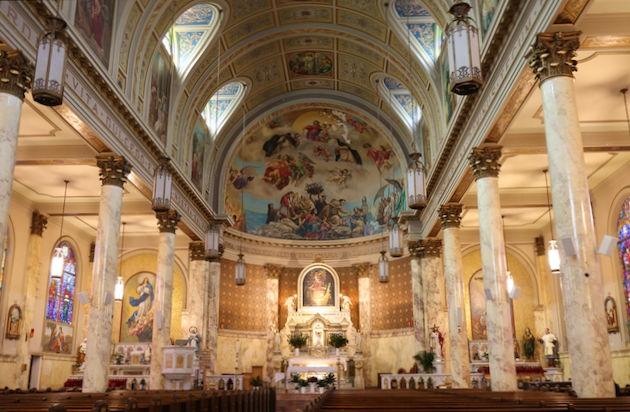
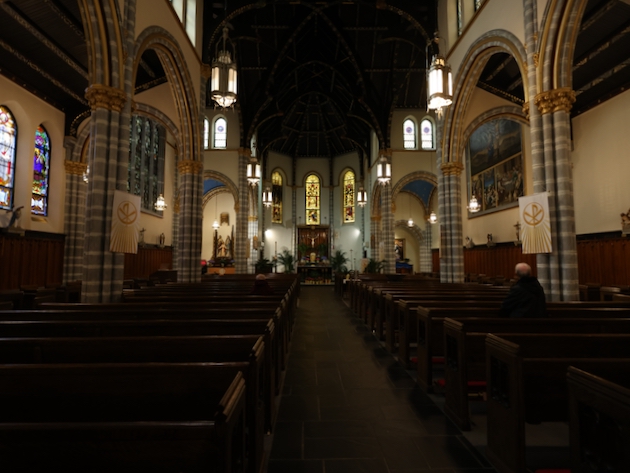
St. Patrick’s Old Cathedral interior at a recent concert(photo taken 4/24/2025).
We read that the “Basilica of St. Patrick’s Old Cathedral” has now been “entrusted to the care” of the Legion of Christ:
“Legionaries of Christ assigned the Basilica of Old St. Pat’s in New York City,” legionariesofchrist.org (8/30/2025)
So one of the most historic churches of New York City is given to the Legion of Christ. This, after some 20 years of efforts to raise the profile of this church as an archdiocesan showpiece – spending so much on the restoration of the interior, the “crypt,” the organ, and the churchyard. This project, of course, was also accompanied by the sale of the historic orphanage/school (now luxury appartments); the marketing of the churchyard as a unique burial “opportunity” and the expulsion of St. Michael’s Russian Catholic chapel from the former diocesan chancery. The old cathedral did in recent years attract events of more than local appeal: the Society of St Hugh of Cluny sponsored several of them and reported on others. And it also allegedly became a draw for “the sexiest congregation in New York.” Yet, at the end of the day, the archdiocese was unable to staff even this monument and had to turn to the Legion of Christ. Certainly, that is a major coup for that organization!
For what we wrote about St Patrick’s and its surrounding buildings (prior to recent restoration) see:
“An Old Cathedral and a New Basilica,” The Society of St. Hugh of Cluny (11/28/2013)
For vespers sponsored by this Society:
“Vespers at St. Patrick’s old Cathedral New York,” The Society of St. Hugh of Cluny (5/5/2014)
For a detailed description of the old school and its fate:
“Old St. Patrick’s Convent and Girls” School – 32-36 Prince Street ,” Daytonian in Manhattan ( 2/6/2025)

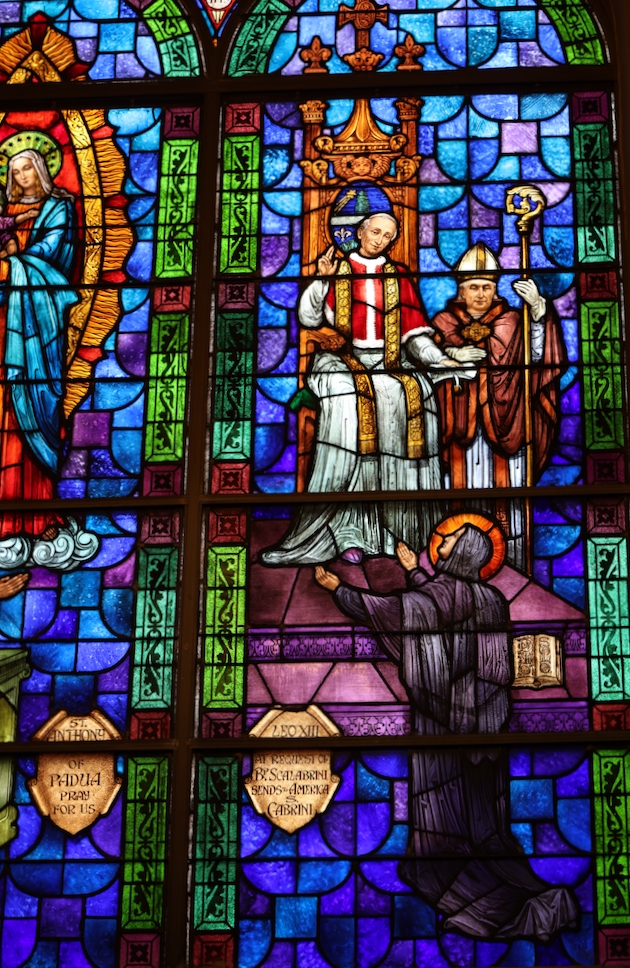
(Above) In 2013 this window could still be seen in the old school. In 1817 the diocese of New York (as it was then) had requested Mother Seton’s help in staffing the school (originally an orphanage)of St. Patrick’s.

(Above) Solemn Vespers (traditional) in Old St. Patrick’s, April 2014.
ADDENDUM: I have been informed that the name of the relgious organization is the “Legionaries” not the “Legion” of Christ. However, I find that the designation “Legion of Christ” remains in wide use.
We welcome this history of the Viri Galilaei written by member Steven Merola:
On September 9, 2015, a group of men under the direction of David Hughes met in the basement chapel of St. Mary’s parish in Norwalk to begin to learn to chant the office of Vespers. They toyed with several ideas for a group name, including the incipit of Psalm 132, Ecce quam bonum (Lo how good and pleasant it is, for brothers to dwell in unity). Ultimately, they settled on the name Viri Galilæi, Men of Galilee, the incipit of both the first vespers antiphon and the introit of the Ascension. This name, connected both to the traditional Office and Mass, would prove fitting: after a year of practicing Vespers, the Viri began to sing the propers and ordinary of the Wednesday night Mass at St. Mary’s.
Throughout the past decade, Viri Galilæi has met continuously on Wednesday evenings to chant a Missa Cantata and the office of Vespers. The group has also studied medieval polyphony like Machaut’s Messe de Nostre Dame and the chants of the Codex Calixtinus. After an initial four years at St. Mary’s, the Viri has traveled all over the Diocese of Bridgeport and brought sung Mass and Vespers to no less than six different parishes and visited many more. The group has provided music for weddings, Requiems, first Masses, Tenebrae, and other occasional liturgies throughout the tristate area. At present, Viri regularly sing for a Wednesday Missa Cantata and Vespers at the Oratory of the Sacred Heart in Georgetown, CT.
In honor of their tenth anniversary, the Viri Galilæi will be chanting Solemn Vespers at St. Cecilia Church in Stamford, CT on the day of their founding, Tuesday, September 9th, 2025 at 7:00 PM. Fr. Richard Cipolla will officiate. All friends of the Viri are most warmly invited to attend to celebrate this milestone.


Jesse Russell at Catholic World Report has provided a review of Yves Chiron’s Between Rome and Rebellion: A History of Catholic Traditionalism with Special Attention to France ( Angelico Press, Brooklyn, 2024 (John Pepino, translator)):
Russell, Jesse, “French historian delves into the tumultuous history of traditionalism,” Catholic World Report ( 8/20/2025)
Now in reviewing a book it is always a great temptation to substitute the reviewer’s ideas for those of the book being reviewed. But rarely have I seen such an example so extreme as Russell’s review. I think it’s fair to say a reader of his review would hardly have any idea of the tone and contents of Chiron’s book. Indeed, in most respects it is the exact opposite of Russell’s description. 1)
Let’s start with this review’s title: a “tumultuous history” – compared to what? Has Russell considered, for example, the vicissitudes of the career of Fr. Fessio, the founder of the organization that publishes Catholic World Report? And the issues within traditionalism pale in comparison with the conflicts that have bedeviled the establishment Church since 1962. This, however, was an issue I also had with Chiron’s history, in that it dealt with traditionalism in isolation. The reader would have little idea of the chaos afflicting the “institutional church” through most of the period covered by Chiron’s history. Events in traditionalism were often a reaction to developments in the broader Church.
Next, Russell adds significant new material of his own. Notably, there is an account of the history of “conservatives” and “traditionalists” in the United States which is entirely absent from Chiron’s book which deals with America only tangentially. And what Russell does say about this history is debatable – to put it mildly. First, he describes the Catholic Church in the United States in 1993 as caught between two pillars or forces. First, was the Catholic laity who “pursued the faith of their immigrant ancestors, attending mass, joining the Knights of Columbus, wearing Saint Anthony medals and sending their kids to parochial schools.” Is this an accurate depiction of the life of the Catholic laity in 1993? I don’t think anyone with memories of that period would agree. Please also note the thinly disguised contempt for the laity that one so often encounters in Catholic establishment (or would-be establishment) publications.
The second major force in the American Catholicism of that era Russell calls “old liberal” Catholicism. Russell seems to be only mildly critical of the so-called old liberals. Nowhere does he indicate that there’s a fundamental institutional and sociological difference between them and the first mentioned group. The “old liberals” were dominant in the institutional church, the Catholic media, the schools, the religious orders etc. of the Church. So, it was not at all a contest between equal forces.
Russell then describes the conservative Catholics and their institutions with some accuracy and correctly notes that as of 1993 they were still a minority. According to Russell, John Paul II’s visit to the United States in 1993 propelled the conservative Catholics to a dominant position within American Catholicism. That is exceedingly dubious, because between 1993 and the death of John Paul II conservative Catholics suffered travails and major reversals. They still remained on the fringes of the Church establishment, even though some of their works, like those of George Weigel, were starting to receive favorable commentary in Rome. Their liturgical ideas (like reform of the reform) had been summarily rejected in the United States( e.g., the controversy over the proper posture for receiving communion). John Paul II was in no way following a consistent policy of appointing “Wojtylian” bishops to consolidate conservative positions. Ominously, the ever-increasing pressure of sexual abuse scandals during this entire period was undermining the conservatives’ defense of the hierarchy and the Vatican. And contrary to what Russell writes, by the 1990’s the traditionalist movement, if still small and facing its own difficulties, was no longer so “marginal.” It had become a real competitor for the conservatives – a thing they had believed to be impossible. The conservatives’ anxieties at that time prompted increased polemics against traditionalists – hardly a symptom of a triumphant movement.
Remarkably, Russell does concede that the alleged dominance of conservative Catholicism has now ended. He admits that today traditionalism is the greater force in the American Catholic Church. How did this come about? Russell attributes the current situation primarily to the development of an “internet conspiracy culture.” Really? Wasn’t there a papal document called Summorum Pontificum in the meantime ? Weren’t the Ecclesia Dei communities expanding their presence? And then if we turn our attention to the Church as a whole, wasn’t there the pontificate of Pope Francis? That pope specifically rejected the liturgical, political and economic positions of the conservative Catholics and unleashed a tidal wave of abuse – in all senses of the term – which motivated more and more Catholics to turn to traditionalism instead of conservative Catholicism. I should add that some of the earliest and most prominent internet personalities were not traditionalist at all but conservative Catholic: Mark Shea, Amy Welborn …
To the extent Russell deals with Chiron’s book it is only to take isolated passages out of context to support the positions Russell himself is advocating. His review is a long diatribe against traditionalists, who are painted in the darkest of colors. Russell concedes repeatedly that Chiron’s book is sympathetic to traditionalism. However, he then claims it debunks “myths” of the traditionalists and contains “shocking” revelations about them and their leaders. They subsist on conspiracy theories and exhibit “pathological” behavior. Russell seeks to fit Chiron into a conservative Catholic framework of analysis, in which obedience to a presumably impeccable authority is the supreme, even exclusive virtue. Those who do not obey have only themseves to blame for whatever actions Church authorities take against them. Chiron does seem to favor irenic policies and recoils from the hard decisions men like Archbishop Lefebvre felt they had to take. But in no way does he advocate blind obedience to authority and throughout the book criticizes the actions of Church authorities in France and elsewhere.
To cite one example of his method, Russell singles out a supposed vision of Archbishop Lefebvre regarding founding a seminary, subsequently confirmed in a visit to French visionary Marthe Robin, as demonstrating the alleged reliance of traditionalists on private revelations disfavored by the Church. This topic is only the matter of a few sentences on one page in Chiron’s book, but Russell develops it into a major indictment. But does he know who Marthe Robin was? She’s much more strongly associated with the French clerical establishment and especially various officially recognized charismatic groups rather than with traditionalism. In recent years many of these groups have been rocked by major scandals. Of course, Russell insinuates that sexual abuse scandals are significant within traditionalism. There have indeed been such scandals, that is clear, but they are as nothing compared to the (ongoing) situation in the “establishment” Catholic Church.
Russell seems to end his review of Chiron’s book by discussing events in the mid 1970s. I wonder if he stopped reading at that point. I would have expected, for example, that someone with his biases would have something to say about the concluding chapter of Chiron’s book dealing with Pope Francis.
Russell’s review of Chiron’s history says very little about that book but much about one subset of conservative Catholic culture in the United States. Conservative Catholicism is a movement currently lacking a head (at least until we find out more about the positions of Pope Leo). Once again, their liturgical ideas have been directly attacked – this time by the bishops of Detroit and Charlotte, both acolytes of the late Pope Francis. And they seem to be up in the air regarding their attitude to Trump. It is a major dilemma for a movement posing as an omniscient “party of the establishment.”
As we have chronicled it in the past, the response to this situation by many conservative Catholics has either been to fall silent entirely or to resume advocating their favorite issues but avoid commenting on the role of the papacy. But for a minority, the reaction to this period of uncertainty has been to renew savage attacks on traditionalists. 2) And these conservative Catholics, such as Russell, show a remarkably understanding attitude to the progressives. That’s very strange, because, after all, it was the conflict with the Catholic progressive “forces” (Russell’s word) which gave birth to conservative Catholicism in the first place. Is this all just a tactical move to curry favor with the hierarchy? Perhaps – although in the light of the experience of recent decades it is a fond hope. And I doubt the rediscovered belligerent demeanor towards traditionalists will stir up support for the conservative Catholic cause among the steadily diminishing ranks of the laity. For it doesn’t suffice to repeat, as Jesse Russell does, conservative Catholic and establisment Catholic platitudes like:
(Catholics should) seek to be, first and foremost, simply Catholic and a follower of Jesus Christ.
For the point is that there is no longer a “simply Catholic” position but antagonistic theological and political forces which exist within the Church. This struggle involves not theoretical debates at some remote level but fundamental issues which confront the life of the believer: the basics of the faith, the nature of the liturgy, divorce, marriage, contraception, abortion, homosexuality, euthanasia. It is becuse of these issues that the traditionalist movement exists – and why it will not go away.
23
Aug
21
Aug

The nave of St. Patrick’s cathedral today – pews and side altars – was mostly occupied by images of fentanyl victims. It seemed as if worshippers were only in only a few pews at the very front…..