
1 November 2021
Solemnity of All Saints
Dear Brothers and Sisters in Christ,
In these troubled times of recovery from two severe hurricanes, a three-day ice storm in January, and a natural disaster of flooding in May, all in the space of nine months, I am writing to address the implementation of Traditionis custodes.
Thousands in our diocese remain displaced, living in temporary housing. The Federal Government has not been forthcoming with assistance, as in the past. To further compound our difficulties, we are dealing with the pandemic, burying our deceased, and addressing the controversies over vaccinations, quarantines, and masking. Given these burdens and the emphasis on mercy exhibited by our Holy Father, I am prompted to address this implementation, where appropriate, in a spirit of epikeia and with the application of Canon 87.
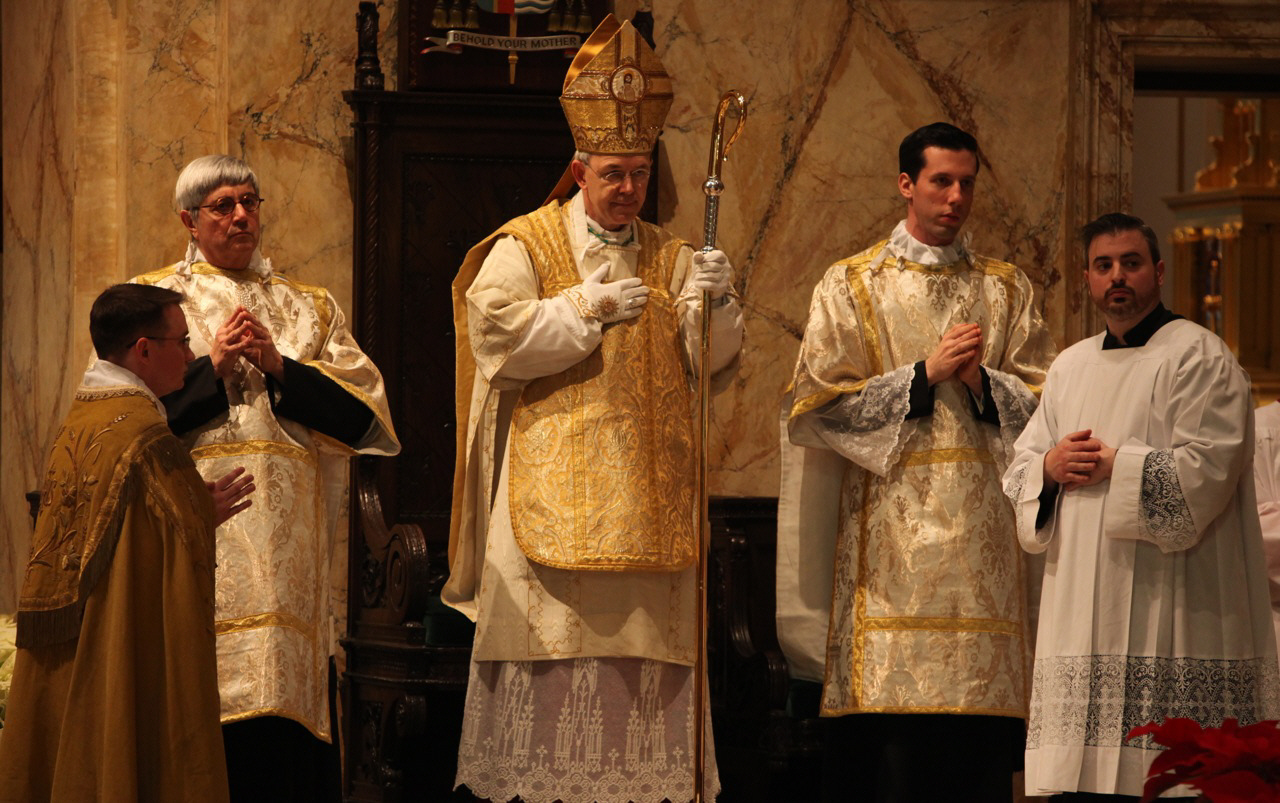
I am issuing this Decree for the implementation of Traditionis custodes in compliance with its prescriptions. As a pastor and a bishop, I am aware of the needs of the flock and address them. We do so liturgically for numerous groups that require special attention, such as our University students, the Hispanic community, and the hearing impaired. Our pastoral concern extends as well to those who worship in the usus antiquior, that is with the Roman Missal of 1962, and who have done so since the establishment of the Diocese. I am unaware of anyone in this community who has expressed opposition to the Second Vatican Council, much less denied its legitimacy. As well, those who have chosen to discuss with me their devotion to the usus antiquior have insisted upon the validity of the reformed liturgy. With this in mind, I would be grossly negligent, if not callous, to implement any restrictive law while at the same time ignoring these realities.
In my many years of having the privilege of celebrating the Sacraments in the Diocese of Lake Charles, I have been continually struck by the tender devotion of the faithful. I am also aware, as well as can be, of the needs of the people as they have expressed them to me. Whether at Masses in newer or older rites, I know the people with their concerns. There are those with terminal illnesses, genetic diseases, and psychological problems that make all else pale by comparison. There are many burdened by financial difficulties, unemployment, and estrangement in marriage. They have lost loved ones to a virus whose origins and nature they do not understand. They strive amidst great trials to protect and provide for their spouses and children. They suffer quietly, not advertising their problems, seeking some solace in the rites of the Church, whether in the vernacular or in Latin. If we, as pastors, do not acknowledge these realities and instead continue to engage in arguments that the faithful find incomprehensible, then we truly risk becoming a “resounding gong and clashing cymbal” ( cf. I Corinthians 13: 1) and just as irrelevant.
In offering this preface to my Decree, I ask your prayers for the Church. As She journeys cautiously over these troubled waters, pray that God will guide Her as He promised and that the gates of Hell shall not prevail ( cf. Matthew 16: 18).
As I remain with prayers for you and your families, be assured of my blessings for all in need.
Sincerely yours in our Lord,
Glen John Provost
Bishop of Lake Charles
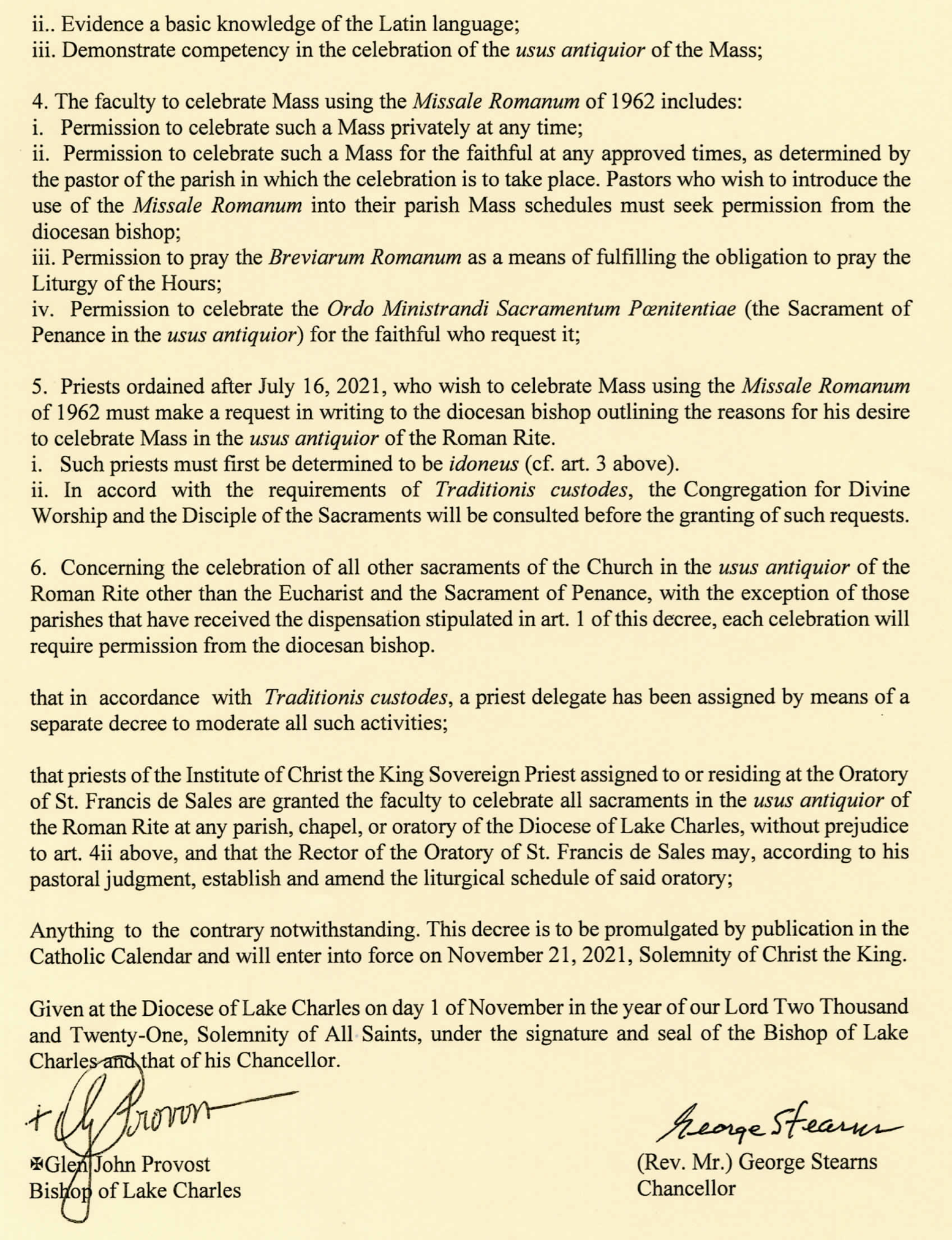
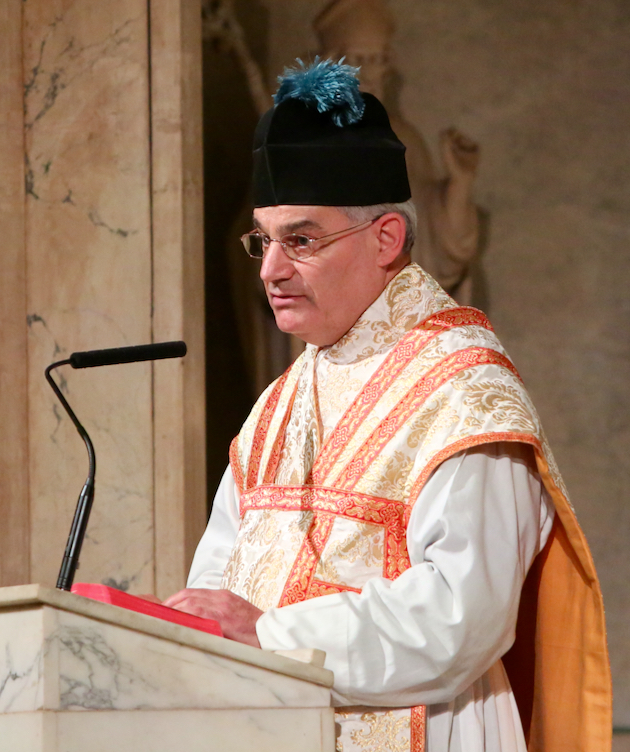
A much more generous application of TC than elsewhere! And some complimentary and encouraging language for traditionalists. Perhaps the Bishop’s experience with the Oratory of St Francis de Sales, led by a priest well-known to us in the New York area, had something to do with it:
Published in Traditionis Custodes | no comment
UPDATE:
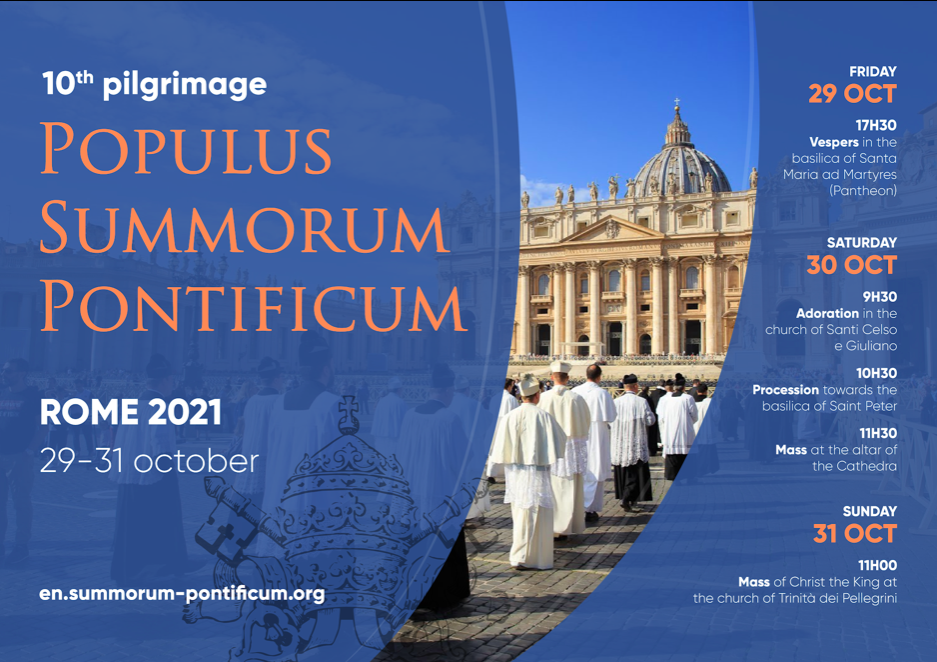
It is reported that the Masses for this pilgrimage have been confirmed. However, the Mass in St Peter’s will not be celebrated by Archbishop Cordileone as had been scheduled. A priest will be celebrating this liturgy: in prior years it had been a Cardinal or bishop. These are the celebrants for the liturgies of the pilgrimage, according to the Italian site Messainlatino:
Come è ormai consuetudine, il pellegrinaggio sarà preceduto venerdì 29 ottobre, alle ore 17:30, nella chiesa di Santa Maria dei Martiri del Pantheon, dal canto dei Vespri presieduto da mons. Marco Agostini(cerimoniere del Papa).
– Il giorno dopo, sabato 30 ottobre, alle ore 9:30, nella chiesa dei Santi Celso e Giuliano (retta dall‘ICRSS), in via del Banco di Santo Spirito, 52, non lontano dal Tevere, ci incontreremo per l’adorazione del Santissimo Sacramento guidata da don Antoine Landais ICRSS (canonico priore a Roma)
alle ore 10:30, dalla chiesa dei SS. Celso e Giuliano si partirà in pellegrinaggio per la Basilica di San Pietro, attraverso il Ponte Sant’Angelo e Via della Conciliazione.
alle ore 11.30, la S. Messa del pellegrinaggio sarà celebrata da mons. Patrick Descourtieux, nella Basilica di San Pietro all’altare della Cattedra.
– domenica 31 ottobre, alle ore 11:00, nella chiesa della Ss.ma Trinità dei Pellegrini (parrocchia tradizionale personale retta dalla FSSP, p.za della Trinità dei Pellegrini, 1), ci sarà la S. Messa “di chiusura” del nostro pellegrinaggio celebrata da don Claude Barthe (cappellano del Pellegrinaggio “Populus Summorum Pontificum”).
From Messainlatino.it
Published in Events | no comment

Address from Archbishop Blair dated October 21, 2021 https://archdioceseofhartford.org/announcement-from-archbishop-blair-regarding-new-haven-churches/
To the Catholic Faithful of New Haven,
“To those who love God all things work together unto good” (Romans 8:28). These words of St. Paul have given strength and encouragement to the Church through the centuries. Today we are confronted with a number of challenges, as are many other religious bodies, posed in particular by the diminishing practice of the Faith and of church attendance by any number of Catholics, which is matched by the ever diminishing numbers of priests to serve our parishes, many of which were established in the heyday of Catholic practice and housing expansion in Connecticut. This was evident before the crisis of the COVID-19 pandemic and will require close monitoring post-COVID.
It is with this in mind that in recent years the Archdiocese of Hartford has embarked on a process of Pastoral Planning. The goal is to take an honest look at the situations and structures of the Catholic population of the Archdiocese in order to begin making changes that will assist in re-organizing the local Church not just for today but also into the future. Sometimes this has involved difficult choices – reconfiguration, mergers, closings – but these changes have already led to rejuvenation in a number of our parishes, cities, and towns.
While the churches in the city of New Haven experienced some alteration during the first wave of Pastoral Planning in 2017, the plan now is to initiate an even more substantial change to support its Catholic population. Instead of simply closing or merging weakening or failing parishes, the goal is to bring the priests, churches, ministries, and resources of the city together, uniting them in the hopes of creating a stronger, more vibrant Catholic community and culture. Thus the Archdiocese will now be implementing a new, united “municipal model” for the city of New Haven. The several parishes in New Haven will be brought together into a single new entity, still keeping a number of existing church buildings and serving thousands of diverse parishioners.
To begin this process, effective December 1, 2021, St. Mary Parish will have a new Pastor appointed who eventually will serve as what Church law calls a priest “moderator” (CIC 517.1), a “first among equals” collaborating with some of the current Pastors and other soon to be named clergy, as together they take up the various pastoral ministries of New Haven. All will be united together in their efforts to minister in a comprehensive way. The Vincentian and Dominican Fathers who have served New Haven were offered the opportunity to participate in this new configuration but for various reasons they declined. The Dominicans in particular were presented with several options which would have provided a house for them in the Archdiocese and even in the City of New Haven. However they determined that these alternatives were not feasible for them at this time. I am happy to say, however, that some of these Religious will remain in ministry in the Archdiocese.
The St. Mary’s Church campus was chosen to be the center of the new plan after extensive study because it is perfectly situated to be the geographical and spiritual focal point of a municipal model for New Haven. With its centralized location and functional rectory space, so much of what needs to be done to serve the Faithful can be most effectively coordinated from the St. Mary’s facilities. The church also houses the tomb of Blessed Michael McGivney, a priest of the Archdiocese of Hartford on a path to canonization, God willing. We earnestly seek his intercession as we embark on this new plan to revitalize the Faith in our Archdiocese.
As noted earlier, there was a time when New Haven, like many cities, was teeming with immigrant Catholics. In the 1930’s New Haven was home to over 70,000 Catholics. Today that number is approximately 10,000. While St. Aedan, St. Anthony, St. Francis, St. Rose, St. Michael, St. Stanislaus, St. Bernadette, St. Martin de Porres, St. Joseph, and St. Mary’s Churches all remain open in various pastoral configurations, a substantial number, including Sacred Heart, St. Brendan, St. Boniface, St. Casimir, St. Donato, St. John the Baptist, St. John the Evangelist, St. Louis, St. Patrick, and St. Peter Churches, all once proud churches of New Haven, have closed out of necessity. Likewise, 20 parochial schools have closed as well.
With regard to the Catholic presence in the city of New Haven, there is no doubt that besides the configuration of parishes, account must also be taken of institutions like the Knights of Columbus with their international headquarters, Yale University with the Saint Thomas More Catholic Chapel and Center, Albertus Magnus College, All Saints Catholic Academy located on Ferry Street, and the privately run St. Martin de Porres Academy.
All of this requires a diversity of pastoral care for ministry to Spanish-speakers and various Hispanic/Latino cultures, as well as Black Catholics; ministry to traditional ethnic groups, including the strong Polish and Italian communities; ministry to the young adult and university students; assistance to the Knights of Columbus; and service to the people of the broader Archdiocese of Hartford. This is what the municipal model in New Haven must supply, and it will require a collection of motivated and very capable diocesan priests to provide this array of ministries.
Change is not easy and transitions are challenging, but I am confident that just as linkages and mergers elsewhere in the Archdiocese have been successful, they can also be successful in New Haven. I ask you to join me in praying for a return to participation in the life of our parishes by our many non-practicing Catholics and for a great increase in priestly ordinations for our Archdiocese, and please know of my appreciation and prayers for all of you.
Sincerely yours in Christ,
Most Reverend Leonard P. Blair
Archbishop of Hartford

The Dominican and Vincentian religious priests are removed from their parishes. We have received a preliminary report that the 2:00 PM Latin Mass at St. Stanislaus (sponsored by the St. Gregory Society) will be terminated at the end of the year. That Mass has been celebrated in New Haven at one church or another since at least 1988. We will try to obtain further information regarding this Mass as it becomes available.
Published in Traditionis Custodes | no comment
Lately we’ve read a series of appreciations of the past great men of the “Conservative Movement” in Chronicles magazine and elsewhere. These remembrances come at a time when the establishment of the United States is deploying its power in unprecedented ways in the courts, in academia, in the media, in the government, in the economy, in the government bureaucracies and even on the streets and at dinner tables in support of a quasi-totalitarian ideology. In so doing, it also demonstrates the abysmal failure of the said conservative movement to effect the slightest cultural change. But it also awakens in us a feeling of gratitude for those in the past who, sometimes at great professional cost to themselves, pointed out truths and pronounced opinions regardless of their acceptability to the establishment. Was that not something that, once upon a time, Americans, even progressives, professed to admire? ( e.g., John F. Kennedy’s Profiles in Courage)
So far, among these published remembrances, I have missed the name of Thomas Molnar (1921-2010), although, especially in the light of the events of the last two years, I believe him to be by far the most perceptive of all these figures. When I last checked, only one of his many books has enjoyed a recent reprint.1) His many French books remain untranslated (into English, that is). I have found on the internet only one attempt to describe the man and his thought – and that from 2013. 2) It offers insights and provides valuable context – nevertheless, I was surprised to read a number of views attributed to Molnar which differed not only from what I had heard him say in private conversation, but also from what he had expressed repeatedly in his published works. Now Molnar was anything but a systematic ideologue – a role and a concept he detested. He loved to toss out new theories for discussion – even if his views on a given topic were still a work in progress. He definitely liked, when the occasion presented itself, to tweak the nose of “conservatives” and especially of “conservative Catholics.” So I could see encountering here and there unexpected and apparently contradictory views in his books, articles and correspondence. But certain remarks attributed to Molnar in this 2013 appreciation had the definite tendency of harmonizing his views with those of the American conservative mainstream, of reconciling him to their shadow establishment. But that is the very thing that Molnar utterly rejected – in fact he described the American conservative movement as a “failure.”
What is the best way to describe Thomas Molnar? I am sure you want to hear in the first instance about his work and intellectual achievements, not about his biography and personality. I met him frequently, starting in the early 1980s. I last spoke with him shortly before his death in 2010. Molnar himself rarely talked about his life, except where necessary to illustrate an argument he was making. Even his own late, supposedly autobiographical Moi, Symmaque (1999 ) draws on his own experiences not for their own sake, but to provide the concrete setting for his savage critique of this age.
Was Molnar a Catholic philosopher or intellectual, as he is so often characterized? To answer that question we have to define “Catholic philosopher.” Molnar’s philosophy was the product of great erudition and of profound meditation on European and Catholic philosophy and history. This informed all his works. Molnar drew on the ancient philosophers with whom the medieval scholastics later contended and finally absorbed into their synthesis of Christianity and Greek thought. He often wrote on the role of the Church in history – ancient, medieval, and modern – and of the need of the sacred to leaven the culture and partner with the state. Molnar always asserted the spiritual nature and destiny of man and fought against ideological deviations of both left and right. The tragic fate of the Church in post-World War II modernity affected him deeply. If these are attributes of a Catholic thinker, then Molnar was preeminently such a man.
But if we mean by “Catholic” an author devoted to explaining and defending the politics, institutions, and personalities of the Church; an academic expounding and interpretating the texts of councils, encyclicals, and other ecclesiastical documents; a writer engaged in agitating and even proselytizing on behalf of the institutional Church – then Molnar was most definitely not a Catholic intellectual. A review of his works shows that the official pronouncements of the Church play only a subordinate role in his understanding of the world.
His comments to me about alleged Catholic greats and institutions of the 1980’s onward could be very unflattering indeed. After a notorious incident in which a lecture by Cardinal Ratzinger was interrupted by loudly demonstrating homosexuals, he remarked that, given Ratzinger’s mumbled delivery and unprepossessing appearance, “no wonder a homosexual would confront him!” ( Much later Molnar had a couple of personal encounters with Pope Benedict but remained cool regarding him). He attended a meeting in New York between Cardinals O’Connor of New York and Lustiger of Paris, Yes, Molnar said, one shouldn’t expect Richelieu meeting St. Augustine, but this was more like a get-together of two labor union bosses and their staffs. On several occasions in my presence he raised the ire of younger conservative Catholics by politely but emphatically stating his views of John Paul II. He also talked of the “super-puritanical” Thomas Aquinas College and characterized the magazine First Things as the “black fruit” of the accommodation of Catholicism to American civil society.
This attitude reflected his experience of the Church. Regarding Catholicism, it was the sincere faith of one Catholic sister he had come to know in San Francisco that had made the greatest impression on him. It’s not by chance that in Molnar’s works Simone Weil is repeatedly favorably mentioned. And of course there was the idiosyncratic Georges Bernanos, for Molnar the model of a Catholic intellectual and the subject of Molnar’s first book. (Bernanos: his Political Thought and Prophecy, 1960) One weekend Molnar even took the time to lead a session of a book club for us young (or at least younger) Catholics at the old St. Agnes church in New York – the topic was Bernanos’s The Diary of a Country Priest.
This serves to introduce one of his characteristics: he was a great listener. He would talk with everyone: college students, a Haitian taxi driver, assorted eccentric Traditionist Catholics, a dear Russian Orthodox friend and, at least once, a late-night radio host. From every encounter he seemed to gather new insights and new facts. Molnar was ever the central European gentleman; however, you may gauge from the remarks quoted above that his observations could be biting and he did not necessarily suffer all fools gladly.
Related to this openness to new encounters was his love of travel. Obviously, he journeyed repeatedly to France and Spain but also, when the opportunity presented itself, to Africa, Asia and throughout the “third world.” I recall, for example, him talking about his recent journeys to Peru and Korea. The fruit of these encounters is found in early books on Africa, in later essays analyzing the developing world, as well as in anecdotes scattered throughout his works. After the fall of communism in Europe, of course, he regularly travelled to his native Hungary but also to places like Prague – which impressed him greatly (the architecture, not what was going on there at that time).
To get an idea of Molnar’s thought, let’s start with his notion of “civil society.“ Characteristic of modernity is the domination of all aspects of life by civil society: the complex of economic powers, media, educational and other institutions which actually rules today throughout the western world. Now civil society essentially reduces man to a consumer and a producer, to a cog in the economy. According to Molnar, the only role for man under the regime of civil society is business. Molnar described the ascent and supremacy of civil society and its culture, in both the United States and then in Europe, in a series of critical works, mostly written in French and untranslated into English: Le Modèle Défiguré: L’Amérique de Tocqueville à Carter (1978); L’Americanologie: Triomphe d’un Modèle Planétaire? (1991); L’Hégémonie Libérale (1992); The Emerging Atlantic Culture (1994).
For Molnar, the cultural horrors of today are inherent in the ideologies of democracy and liberalism. But above all else is the direst crime of modernity: the severance of the sacred from the state and society. – the separation of Church and state. By cutting off the state from its transcendent support and from its natural ally, the Church, profane civil society had drastically weakened both, opening the door to the total secularization of society.
The exemplar and current leader of the resulting culture is the United States. For here the liberal culture is innate and not, as in Europe, an imposed regime, or the product of imitation. Additionally, the puritanical foundation of America ultimately gave birth to the characteristically American missionary zeal combined with the desire to reduce all issues to formulas that can be readily disseminated and applied. After World War II this culture conquered Europe, assimilating and incorporating related local tendencies.
The despotism of modern civil society has brought about an unprecedented leveling and coarsening of the inherited cultures. In lieu of the rich European (and non-European) traditional cultures, civil society has imposed a uniformity disguised by relentless activity. To the extent culture exists at all under civil society it inevitably assumes arbitrary and preposterous forms. Representative examples of this in Paris are the glass pyramid stuck in the courtyard of the Louvre or the Centre Pompidou. Everywhere he went, Molnar saw the triumph of ignorance, licentiousness, and rudeness. Again and again he was shocked by the rising tide of incivility he encountered on his annual trips to Europe: topless women on the beaches of a Spain so recently traditional, drivers running one off the road in France. On this side of the Atlantic, he was particularly horrified by the rudeness displayed by American children to their parents in the presence of strangers.
Molnar had written frequently and forcefully against leftism of all kinds (e.g., La Gauche vue d’en Face (1970); Utopia, the Perennial Heresy (1967); Sartre: Ideologue of our Time (1968). Yet he saw the United States as being a “new Utopia” sharing the same problematic features with the leftist would-be transformers of the world. As he once put it, the first step of political wisdom is to perceive that communism is wrong. The next is to realize (as had Orwell) that communism and the “West” are the same. But the final insight is that communism is only the preparation for the further expansion of the liberal cultural hegemony. Such views brought him into direct conflict with the champions of the “American experiment” who grew increasingly dominant among American conservatives from 1989 onwards.
His views of the Second Vatican Council were similarly negative. For Molnar, the Church at the Council surrendered its claims to unique truth and definitively accepted its subordinate status as a citizen of civil society, as one “pressure group“ (Molnar’s term)among many. This was illustrated by Church’s adoption of the techniques of the media – such the endless series of papal interviews, starting with John Paul II. In these the popes lower themselves to the level of their journalistic partners in dialogue. Further, by diminishing cultic life by its liturgical changes, the Church opened the door further to the depredations of the surrounding desacralized society.
I recall many instances of Molnar’s disdain for modern society in both Europe and the United States. When I told him that my employer at that time was installing television screens in elevators he only remarked “you people are sadists!” He was always a savage critic of the news media, their lies, malicious intent, and ignorance. The way society and government are ruled by the news media was one of the most disastrous aspects of contemporary life. His contempt for American education at every level was equally great. Molnar saw the problems with American education as a pathology inherent in the fundamental principles of those institutions which had abandoned the purpose of education in favor of functioning as an instrument of modern secular society. I told him of a lecture by a visiting German academic who had advocated a great expansion of the student body at German universities in order to catch up with the situation in the United States. Molnar only commented what that professor really intended was the destruction of education in Germany – to finally reduce the German system of higher education to the level found the United States. Do I need to say that subsequent developments at both German and American higher education have only verified Molnar‘s observations? In contrast, Molnar was overjoyed to witness the application in his homeland of Hungary of tough requirements for admission to university – as it should be for the future leaders of the nation.
Thomas Molnar’s thought has stood the test of time better than that of almost all of his colleagues of the earlier days of the conservative movement. They devoted their energies primarily to defending the “free world” against communism, the capitalist system against “liberals” and socialists. On the religious front, the Catholic conservatives – at least most of them – profiled themselves as champions of the Pope, the Vatican, and the institutional Church against “dissenters” of all kinds. Yet are we not seeing today the commitment of the “feudal powers” (Molnar’s term) of Western civil society ( law, finance, industry, education, think tanks, NGOs etc.) to radical progressive ideology? Hasn’t the government bureaucracy (the military, police, the intelligence services, prosecutors, courts, etc.) also united with them in this endeavor? And how different is the current “woke” frenzy of the West – and, increasingly, the details of its concrete application – from the practices of the Soviet empire? Similarly, the institution of the Roman Catholic Church under Pope Francis has reaffirmed its final capitulation to these same secular forces and their ideology. By any objective measure, moreover, in the West religious practice itself – even baptisms and weddings – seems to be in irreversible decline.
Molnar already had chronicled this accelerating decadence of Western society, its increasingly closed mind. He (and others as well) had still been able to publish fairly freely books and articles through the early 1960s – now, these would not be permitted to see the light of day (Thomas Molnar made this remark, I recall, in the 1990s!). In 1961, Molnar’s Decline of the Intellectual, perhaps his best-known book, was accepted for publication even though the editor of that publishing house openly disagreed with what Molnar had had to say (The Decline of the Intellectual, Introduction to the 1994 edition). As we all know, that doesn’t happen anymore.
Now Thomas Molnar was not only a keen analyst of the politics and culture of modernity but ranged over many other topics in his books and essays. As I noted, he devoted a great deal of interest over the years to the so-called “Third World.” (Le Socialisme sans Visage: l’Avènement du Tiers Modèle, (1976); Tiers–monde: Idéologie et Réalité (1982)) His thought here was less systematic and is less well-known than his reflections on the West. In part, this is so because there is no one “non-Western” world: Black Africa is not India; the Islamic countries are not East Asia. Molnar emphasized above all the otherness of the Third World. An example of that are the overwhelmingly strong tribal identities encountered especially in Africa. After the departure – or flight – of the Western colonial powers, older local forms of loyalty and administration – tribes, families, and villages – regained their significance. Furthermore, in most of these countries, religion remains a major integrating force. In contrast, the central governments of these states remain corrupt, remote and generally irrelavant to daily life. In the future, Molnar saw the developing world as trending towards monolithic, “socialist” and nationalist forms of government. These countries will not conform to Western capitalist society , but neither will they adopt the Communism of the old Soviet Union. Could this third “way” or “model” be called “fascist”? Perhaps, but this is also imposing a Western political concept. Of course, Molnar was initially reacting against the ideas of the United States and the United Nations, which, in the early 1960s, were forecasting an easy transformation by stages of the former colonies into copies of the West. I cannot say Molnar worked out a systematic theory for the non-Western world – but he had identified the issues that even today need to be considered in dealing with it. After the catastrophes in Afghanistan and Iraq, have we not all seen the futility of trying to impose a Western model on a society having radically different beliefs, ecomomy and social stucture? And is not “communist” China, a socialist and very nationalistic power, now rising up to challenge the United States for domination – first in the South China Sea and afterwards, who knows?
Molnar himself described a bleak picture in Moi, Symmaque( I, Symmachus). The title of this late work reveals Molnar’s personal identification with Symmachus, one of the last of the articulate Roman pagans in the 4th century, who saw Christianity sweeping aside his pagan world. In this book, Molnar tells of his ideals and their subsequent betrayal. He cherished a love of France, its culture and language – only to see that crushed by the modern “Atlantic culture.” He took up an academic career – only to experience higher education being reduced to a farce. He supported the Church – and endured the greatest betrayal of all in the 1960s. Indeed, Molnar’s situation was worse than that of Symmachus. For if that Roman author saw his temples and gods being erased, he could at least take comfort that another regime of the sacred was taking its place: the new alliance of the Christian Church with the empire. In contrast, Molnar could only see in his time an accelerating “eclipse of the sacred” with no institutional way out.
Yet Molnar did not despair. He didn’t pose as the last of the Christians or of the cultured Europeans. He viewed with the greatest pleasure the recovery that took place starting in the 1980’s in Hungary and elsewhere in Central Europe – of nations who in the face of the greatest hardship had fought for and recommitted to Christianity and to their links to Western Europe, rejecting both Marxist ideology and “Asia.” He couldn’t help admiring, for example, a kind of Hungarian “rock opera” about St. Stephen, the apostle of Hungary. Today, we are witnesses of the continuing resistance of Hungary, of Poland and others – this time, against the EU and United States – led modernity.
More importantly, Molnar deeply believed that the soul of man is open to the sacred – that God is closer to every man than that man’s very self. In union with the ancient and the scholastic philosophers, Molnar affirmed that contemplation is the highest calling of man. In his later years, Molnar increasingly wrote works more purely philosophical in nature: God and the Knowledge of Reality(1973); Theists and Atheists: a Typology of Non-belief (1980): Archetypes of Thought (1991, 1996); Return to Philosophy (1996). The philosopher’s vocation to explore truth and the real is eternal – the modern robotized and secularized world of this age will have no permanent victory. Upon the ruins of European culture, in ways, in places and in the souls of men unknown to us, a new civilization will arise with the “same quest for harmony, the same thirst for the transcendent.” 3)
- The Church and the State (Cluny Media, Providence, RI, 2018)
- Mezei, Balasz M., “Thomas Molnar’s Place in American Conservatism” (Intercollegiate Studies Institute, 6/10/2015; originally published in Modern Age, Summer 2013)
- Cf. Molnar, Thomas, Moi, Symmaque at 103-104
Published in Essays | no comment
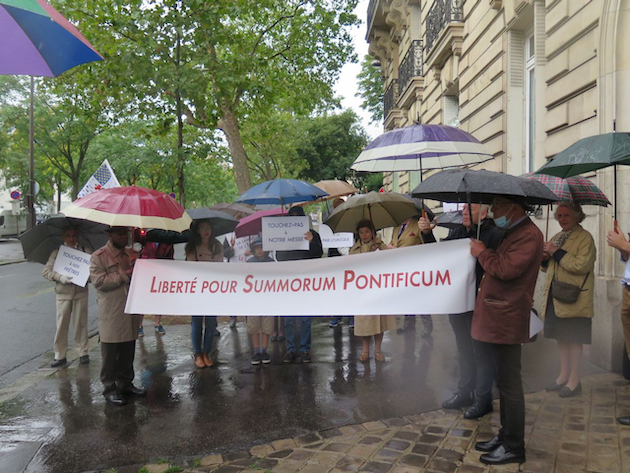
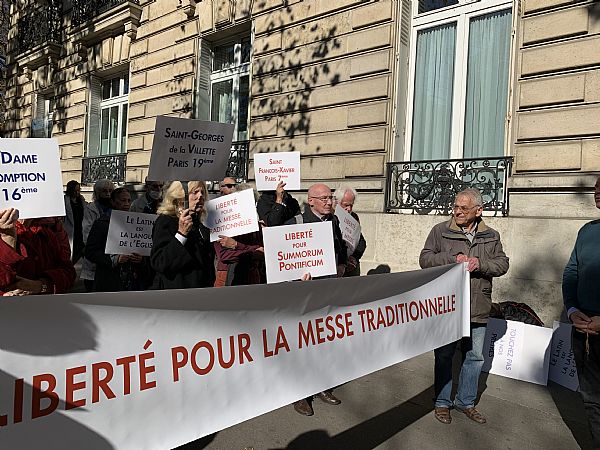
On Saturday, October 16th the 16th successive demonstration “for the defense of the Traditional Mass” will be held before the Vatican’s embassy in Paris. Other demonstrations are multiplying in France – both in Paris and elsewhere. But we would of course expect, given their long history, that French traditionalists would be in the forefront of the resistance!
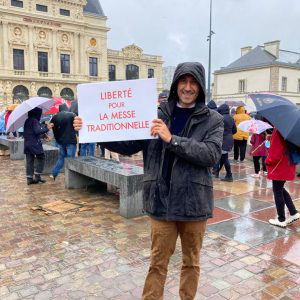
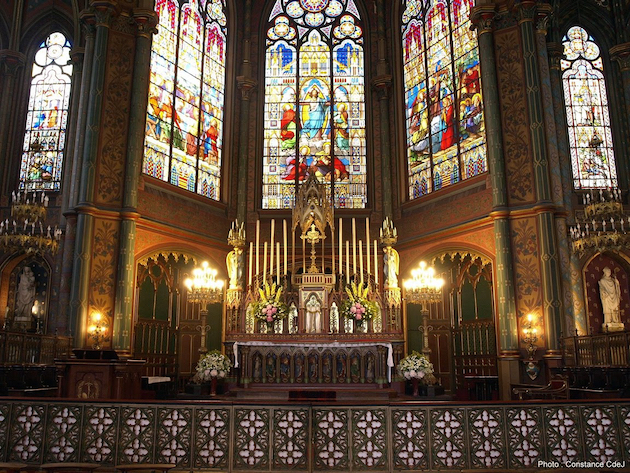
Rosaries also are being recited at the churches where traditional masses have been cancelled by the Archbishop of Paris, Monseigneur Aupetit. Numerous such rosaries are being organized or supported by the society Juventus Traditionis. In addition to protests and prayer, the Paris traditionalists have been trying (with little or no suceess) to initiate a dialogue with Msgr. Aupetit (who amazingly claims he has done nothing to restrict the traditional Mass!) and his auxiliary bishops.
For a summary, in French, of the most recent traditionalist activity and the stand-off with the archdiocese of Paris, see the post La Situation à Paris on the Juventus Traditionis website. See also the site Riposte Catholique for reports on these developments.

UPDATE:
Communiqué of 10/16/2013 from:
On Saturday 16 October, we were more than 100 demonstrators in front of the Apostolic Nunciature.
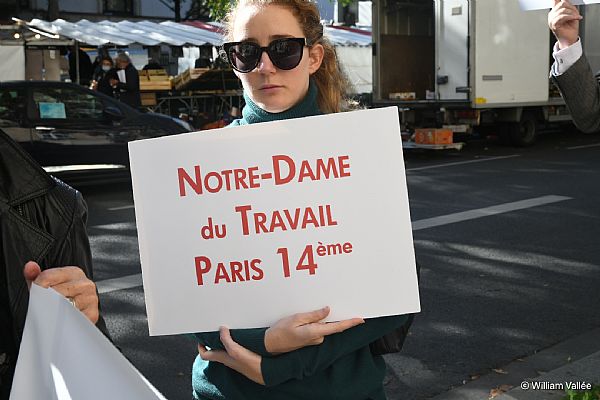
The refusal of dialogue is now confirmed: at Saint-Eugène, on Sunday 3 October, Mgr Thibaud Verny, auxiliary bishop, had run off, sneaking away to avoid meeting the faithful of the parish who wanted to talk to him about the restrictions imposed upon the traditional celebrations in Paris, including in their own parish, because of the ban on “exclusivist” priests celebrating in the diocese. And at Saint-Dominique, on Sunday 10 October, the dialogue between Mgr Aupetit and the parishioners of Notre-Dame-du-Travail was limited to the reiteration of the archbishop’s diktat, who used the classic “Nuremberg defence”: he obeys the Pope. Strange “guardian of tradition”…
The parish priest of Saint-François-Xavier, Mgr Lefèvre-Pontalis, was touched by the emotion aroused by the disappearance of the youth mass on Wednesdays. But the diocese has contented itself with a sort of “barrier or confinement gesture” by re-establishing this mass, not at Saint-François-Xavier, but at Notre-Dame-du-Lys, in order to stick to the diocesan rule: to limit the “contagion” of the traditional mass.
But the most serious thing is that traditional catechesis are being banned in Le Havre, Grenoble and Tours. This goes beyond the application of the text of the Pope’s motu proprio: there is now a “spirit of the motu proprio”, as there is a “spirit of the Council”. It is above all the missionary aspect of these catechisms that is targeted: in fact, they bring together not only children from families who attend the traditional Mass, but also children from families who practice according to the NOM and who are frightened by the lack of catechesis in their parishes. Here again, the order is to limit the “contagion”.

Published in Traditionis Custodes | no comment
Churches of New York
Holy Roman Empire
Website Highlights
Archives
[powr-hit-counter label="2775648"]