18
Aug
18
Aug
On July 16 Pope Francis started a war. Regardless of the specific provisions of his motu proprio, all Catholic Traditionalists, as such, have been declared enemies of the Church. They are deprived of all liturgical rights and are to be segregated from the body of Catholics. The bishops of the Catholic Church are, in practice, empowered to tolerate or absolutely prohibit the Traditional Mass – in their arbitrary discretion. The ultimate objective is the total disappearance of the Traditionalists. At the Vatican further measures accompanying Traditionis Custodes (“TC” – by this term I also include the Pope’s cover letter) are reported to be in the course of preparation: restrictions to be imposed on the Ecclesia Dei orders, and even more restrictive regulations implementing TC.
It is a war not just against “groups” (the contemptuous terminology of TC) but families, young children, diocesan and religious priests, seminarians, established parishes and dedicated congregations. It is a struggle against a movement that is spread, to a greater or lesser extent, over the entire world. This conflict will also be played out in religious communities, schools and even individual families. It will even spill over into the “conservative” Novus Ordo realm, given the close ties of every kind that exist between the adherents of that tendency in the Church and the Traditionalists.
Everywhere there’s a sense that a boundary has been crossed, that the Church has moved into new and uncharted waters. War does have the advantage of clarifying issues and power relationships, of advancing from mystification to reality. However, the “fortunes of war” are inherently unpredictable. A nation, like France in 1870, may enter into war, as its prime minister at that time, Émile Ollivier, said, “with a light heart.” So did all Europe in 1914, Germany in Russia in 1941, Japan at Pearl Harbor later that same year, and the United States subsequently in Vietnam, Iraq and Afghanistan. In all these cases, the confrontation that emerged was unimaginably different from the assumptions governing at the beginning. The Roman Catholic Church will shortly be experiencing the same.
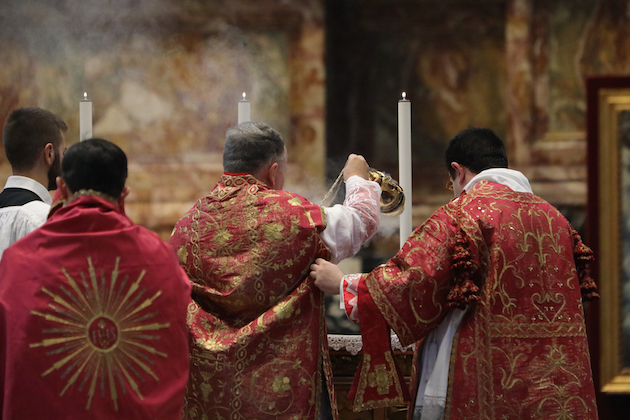
Moreover, Pope Francis has declared his intent to conduct that most difficult of martial undertakings, an aggressive war of annihilation. As Martin van Creveld points out, such a war, by leaving the enemy only two outcomes: victory or extinction, dramatically solidifies his will to resist regardless of what his previous political or military weakness may have been. In this respect, TC is the “Operation Barbarossa” of the Church.
So far, the Traditionalists have stood fast. With a few exceptions, the laity have not yielded to anger, panic or despair. Nor have they surrendered to the establishment, even though confronted by a hostile papal will. Quite rightly, they have “stayed the course,” letting the hierarchy take the first steps. Public prayers and recitations of the rosary have multiplied. According to my observations – as well as those of several other informed observers – attendance at local Traditional masses has actually increased. And this jump in attendance in the “off-season” of Summer is not just due to the revived piety of the Traditionalist communities! For one consequence of TC and the resulting uproar is that, among those Catholics who actually practice their faith, many more people have now heard of “Traditionalism” and wish to experience what all the fuss is about. From what I know, the clergy who celebrate the Old Mass – in the New York area overwhelmingly diocesan priests – have also calmly, collectively and with dignity defended their adherence to Catholic Tradition.
The hierarchy are the designated enforcers of TC. So far, the bishops fall roughly into two camps. In those dioceses where there is a significant Traditionalist presence the policy so far generally has been to preserve the status quo. Perhaps this is because such bishops have had the opportunity over the years of working with Traditionalists and thus cannot share the indictment set forth in TC. More cynically, these bishops realize that they would be the real point men of Pope Francis’ war and foresee the adverse personnel, finance and media consequences that an all-out attack on a substantial Catholic community might entail. For example, in one diocese in the New York area with which I am familiar more than 10% of the diocesan priests celebrate the Traditional Mass. if we counted only active priests that percentage would be greater. I should add that in some prominent dioceses neither the bishop nor the Catholic media has made any mention of TC at all up till now – testimony to its explosive nature. However, it is also true that major and minor incidents of harassment have occurred in certain of the “status quo“ dioceses – like the cancellation of a Pontifical Mass in Washington DC.
In the other camp are those dioceses where Traditionalist Catholics are few or where the bishop is more fanatically ideological. Here drastic restrictions or even prohibitions on the Traditionalist Mass have been immediately and summarily imposed. Fortunately for most Americans, such dioceses are more frequently found outside the United States and especially in the Latin world. Some of the harshest anti-Traditionalist measures, moreover, have been taken in regions, such as the Czech Republic or Central America, where the Catholic Faith is in complete collapse. Is it not strange? For a Catholic bishop to prohibit masses, expel religious orders, prevent pilgrimages and shut down parishes – as did the communists and anticlericals of yore – is now a badge of loyalty to the Pope!
I have been heartened by the amazing outpouring of commentary on TC – mostly sympathetic to Traditionalism and from a broad spectrum of Catholics (and non-Catholics). It is hard to single out individual contributions in such a bountiful harvest. But are we really surprised that one of the earliest and at the same time most “theological” analyses came from the hand of Michel Onfray, a French atheist? If someone had told me in 2005 that the quintessential “conservatives” Amy Welborn and George Weigel one day would be writing in defense of Traditionalists I would have considered him mad – yet both now have given us perceptive contributions. In the context of their names I might also cite Rod Dreher (now Orthodox). The “traditional” experienced advocates of the Old Rite or at least of Catholic Tradition have of course been outspoken. I might mention, among many others, Cardinals Burke, Zen and Sarah; Martin Mosebach; Fr. Hunwicke; Bishop Athanasius Schneider; and Peter Kwasniewski. Even certain major progressive Catholic media such as katholisch.de, the house organ of the ultraliberal German Catholic Church, have been decidedly ambivalent on TC, with articles criticizing the Motu Proprio appearing in these forums. Perhaps one reason for their reserve (and that of certain progressive clerics) is that TC took most of them completely by surprise too.
The pro-Traditionalist reaction has not been confined to the Catholic media: articles defending Traditionalism have appeared on the pages of the Wall Street Journal and the New York Times! Cardinal Sarah’s powerful essay appeared in Le Figaro in France and Michel Onfray’s in Figaro.fr. I look forward to a publication of an anthology of these contributions, each of which illuminates the issue from a different perspective and the whole representing a veritable encyclopedia of Traditionalist belief. It will be an invaluable reference for Catholic Traditionalists – or for the curious outsider who wants to discover what motivates these people.
We ask ourselves: what has prompted TC? I do not believe for a minute that it was occasioned by the Traditionalists’ “rejection” either of Vatican II or of the validity of the Novus Ordo. In most Traditionalist communities and events I hear little or nothing on these subjects. Rather, 99.99% of the recent criticism of the Church has related not to Vatican II, but to the actions and initiatives of Pope Francis over the last eight years: his management of the Vatican with its unending series of scandals, Amoris Laetitia, his treatment of the Church in China, the “Amazonian” synod and Pachamama, the mishandling of the ongoing sexual abuse crisis, the pope’s ambiguous response to the Synodal Path in Germany, his intervention in the abortion debate in the United States – to list only some of the “highlights” of his papacy. The overall tendency can be summarized as a return to progressive radicalism in theology, morality and politics – to an understanding of Vatican II and its liturgy as a clean break with the Church’s past.
Opponents of all these developments soon made themselves heard. Traditionalists represented only a minority of these critics. But it is true that, consciously or not, those who object to one or all of these policies start to gravitate to the Traditionalist movement – even if they do not at first become committed Traditionalists. This is because Traditionalism represents not only liturgical, but also moral and theological continuity with the Church of all time. As a result of these controversies, initiated by Pope Francis, Traditionalism paradoxically received a new impetus.
But the expansion of Traditionalism is not just because of conflicts over fundamental issues at the highest level of the Church. A growing number of families found Traditionalism the best practical way to live the faith, to raise their children as Christians and to experience stability, beauty and community in the Church. The same can be said of the growing number of young priests who celebrate the Old Mass for they have discovered in Catholic Tradition a fuller priestly life. These younger clergy are found not only in the Ecclesia Dei orders and Traditionalist monasteries – which, at least in the United States, have to turn away aspiring seminarians for lack of space. They include graduates of the diocesan seminaries and members of the “establishment” religious orders, who have discovered Traditionalism – often in the face of bitter hostility from their superiors and bishops. In most cases, these priests have had no objections in principle in celebrating the Novus Ordo when that is appropriate. In the case of this younger rising generation of priests and the laity, moreover, Catholic Traditionalism has not been a legacy from the past, but an entirely spontaneous and freely chosen expression of the Faith.
This vitality contrasts with the irreversible decline of the official Church and its institutions. Only 20-30% of Catholics regularly practice the faith in the United States – and these statistics are excellent compared to Germany or France. In more recent years “non-practicing Catholics” turn more and more frequently into outright nonbelievers. In addition, in the United States, and to much greater extent in most of Latin America, there is steady hemorrhaging to fundamentalist Protestantism. The establishment has discovered no answer to the crisis of vocations. Nor has it been able to put its finances on a sound footing or end the relentless pressure of lawyers and prosecutors on the sex abuse front.
The contrast, at least in the developed world, between the progress of the Traditionalist movement – despite its limited absolute numbers – and the ineffectiveness of the official Church was growing ever greater. For just the very existence of the Traditionalists is eloquent commentary on the failures of the institutional Church. The youth and spontaneity of the Traditionalists contrasted more and more strongly with the centralization, bureaucracy and ever-growing average age of the clergy, religious and laity in most of the establishment Church. And the celebration of the Old Mass was spreading from the nations where it had been “traditionally” strong (like the United States) into new territory (like Italy). Moreover, as we have seen, Traditionalism serves as a focus for those deeply disturbed by the dire non-liturgical problems in the Church. For all these reasons, the leadership of the Catholic Church, instead of addressing the causes of its underlying problems, has now launched a campaign with the ultimate aim of eliminating the Traditionalist movement entirely.
Now the Church does not exist in a vacuum but always is situated in a concrete historical context. It is, after all, no coincidence that Vatican II took place in the same decade as did the student revolts (of 1968 in Europe, earlier in the United States) and even the Chinese “Cultural Revolution.” These were all movements of massive change emanating not from the grassroots or the revolutionary masses but instigated and led by institutional leadership or a privileged elite. Similarly, the secular background of TC is the rising totalitarian tide in the United States and Western Europe evident, at the latest, since the 2016 United States presidential elections. It involves the consolidation of all the institutions of Western civil society (government, law , education, business etc.) into a unified bloc with a defined ideology (ecology, anti-covid, movements of social revolution summarized as ”woke”). Enemies, dissenters or those who simply remain silent are demonized in the media, censored, subjected to punitive consequences regarding their business or employment, compelled to confess their “guilt” or undergo reeducation and, in some situations, physically threatened. Even more so than in the 1960’s, it is a “revolution from above” of the rich and the powerful.
These tendencies of course influence the Vatican, especially given its eagerness to please the secular media and economic powers of the West. Indeed, the Vatican has been in direct contact with the secular leaders of some of these specific initiatives which the Church has endorsed or at least benevolently tolerated. So in a sense TC can be seen as the transposition into the Catholic Church of the West’s current “totalitarian moment,” sharing its insistence on external unity as an absolute value and its demand for unquestioning adherence to the ruling establishment. Some of the confrontational rhetoric of the letter accompanying TC and of the motu proprio’s defenders is even identical to that of the secular establishment: the need to combat with punitive measures “divisive,” “ideological,” “aggressive” extremists who “endanger unity” and “expose (the Church) to the peril of division.”
In a sense, TC should encourage Traditionalists, for the Pope has singled out them and the Traditional Mass as the one true alternative to the current regime and its ideology. This time of purgation may also be helpful for us, because despite its successes, all was not well in the movement. The real problems were not the anti-institutional zealots active on the internet or elsewhere. On the contrary, the real difficulties resulted from the ever-greater integration of the Traditionalists into the structures of the establishment with all its associated defects. Traditionalism, for example, has not at all been immune from instances of clerical sexual abuse. The celebration of the Old Mass, if it occurred in a parish, remained very much contingent on the attitude of the pastor – a change in leadership often brought drastic consequences for the community given the different theological “universes” that the clergy often inhabit today.
Certain Traditionalist orders and organizations gradually slipped into a fantasy world regarding the benevolence of the institutional Church, their influence on it and their insight into its doings. Others, imitating the practices of groups like Opus Dei, tried to resurrect the pristine, intact, pre-Conciliar world by a highly selective reading of Vatican actions and documents (e.g., by emphasizing Pope Francis’s 2021 “Year of St. Joseph”). Then, there were those who tried to tone down Traditionalism, to censor sermons and conference speakers, and to control public perceptions of reality – all in the fond hope of obtaining the favor of bishops and mainstream religious orders. I don’t know about Traditionalists’ alleged hostility to “the Council,” but I can certainly testify to the animosity that could crop up in dealings among the Traditionalists and pseudo-Traditionalists themselves in the two years prior to TC. I would hope that the new hot war can at least alleviate these grudges and make the Traditionalists refocus on their foundational principles. For we will all now be forced to work together for the sake of a cause much greater than ourselves and need to put aside the petty grievances of the past.
I’ll conclude these reflections with one more historical thought. William Lind has observed that just when the established order deems everything to be fixed, settled and secure and the future looks predictable, history goes off in a wildly different direction. So it was in Europe in August 1914. We see the same phenomenon unfolding in Kabul in these very days. Lind, drawing on an obscure book by a minor British novelist of the 1930’s, calls this God’s Fifth Column. His message Is that the structures of Church and state that we assume to be so solid as to stand forever can collapse with amazing speed. 1)
We do not know what the future may bring for the Church and for Traditionalism. And neither does the Vatican. What we do know are the very great graces we and our families have received by adhering to the fullness of Catholic Tradition. We also know that Someone else is at work whose active will is usually left out of our calculations. Therefore I would recommend prayer and patience and trust that God, who does not lead anyone who trusts in Him astray, will take care of things in ways now unforeseeable by us.
18
Aug
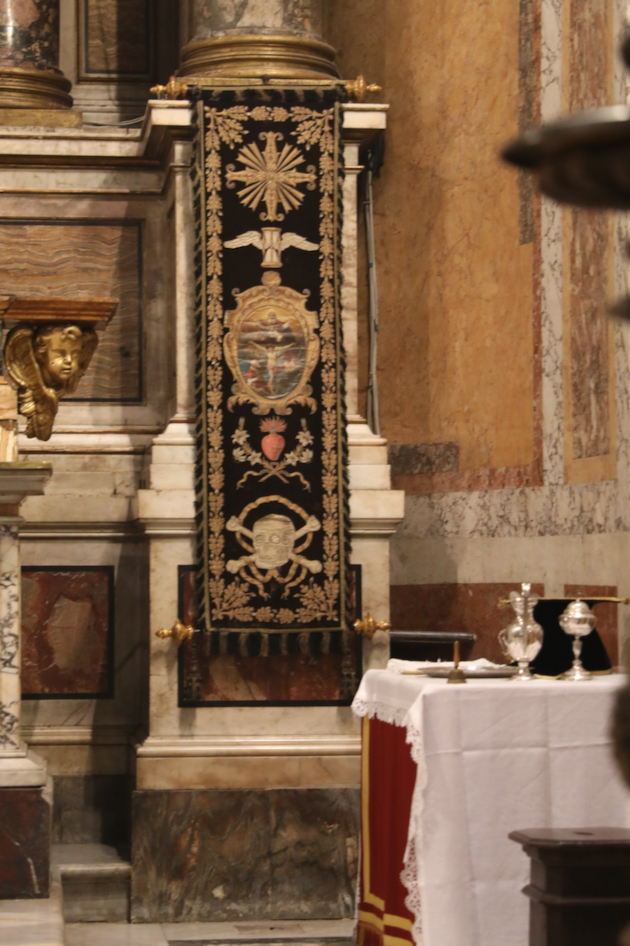
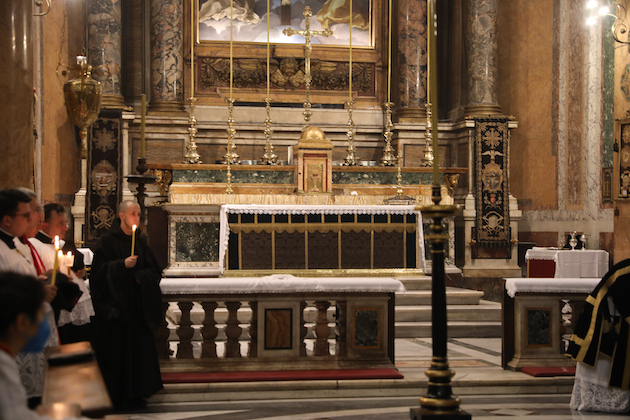
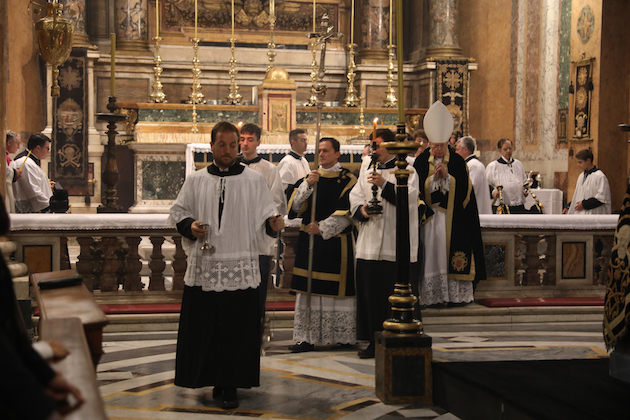
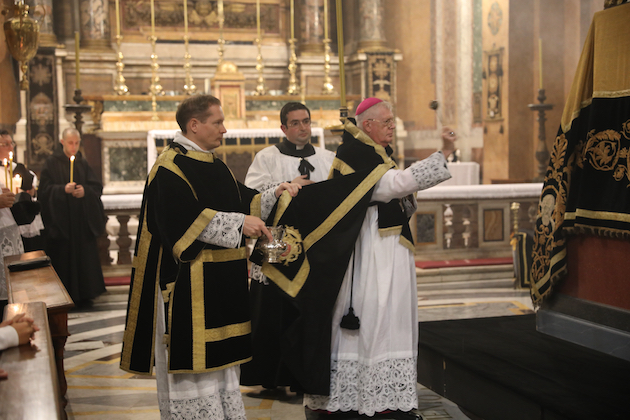
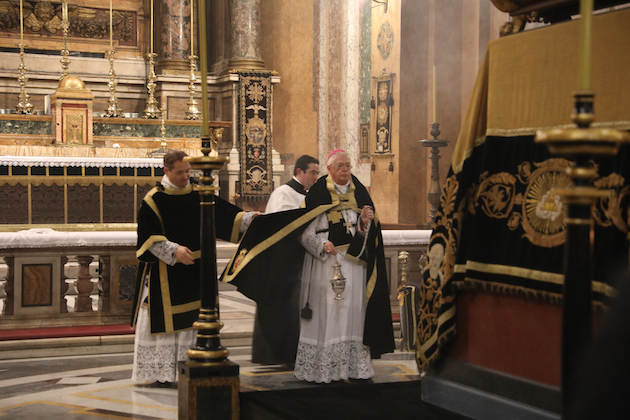
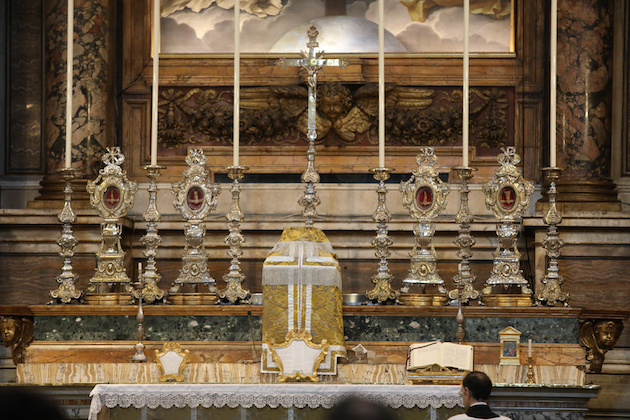
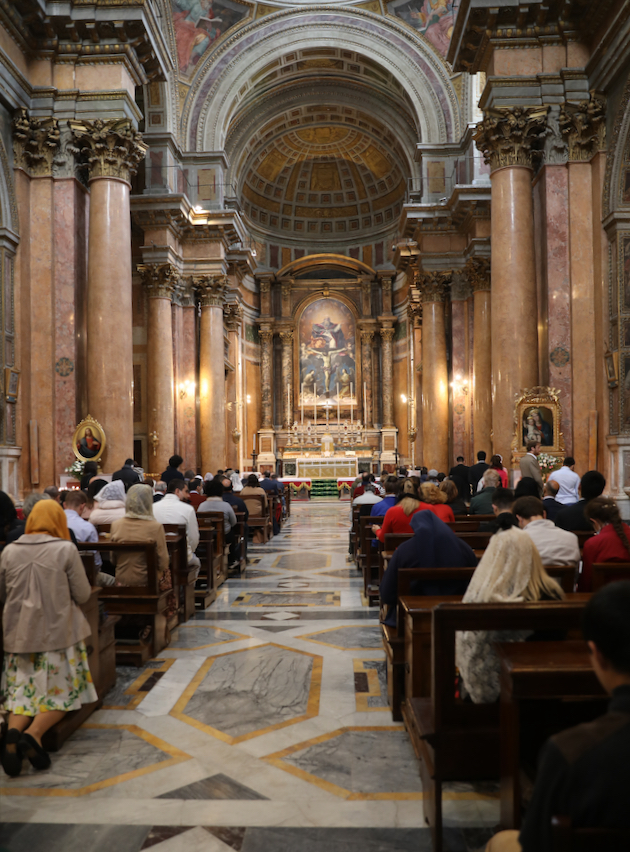
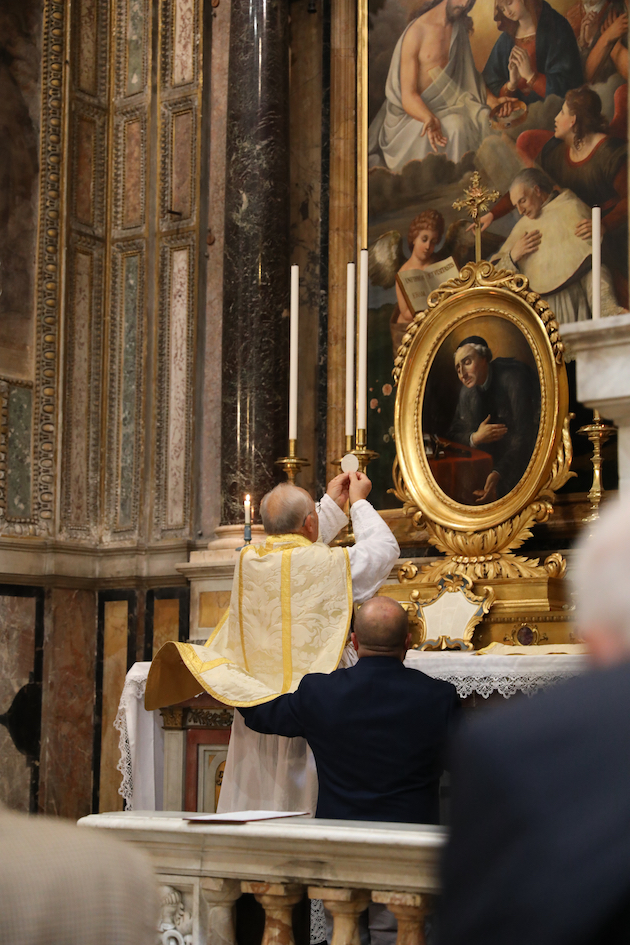
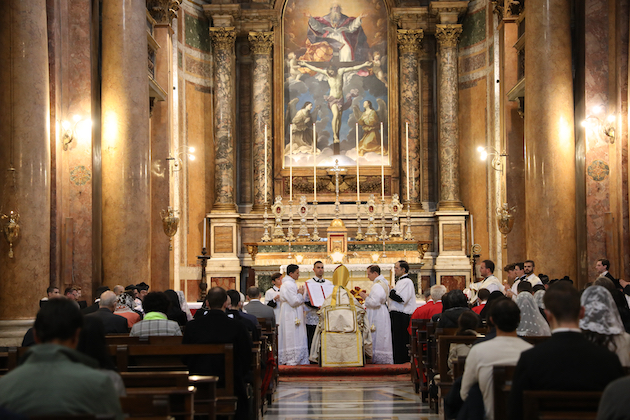
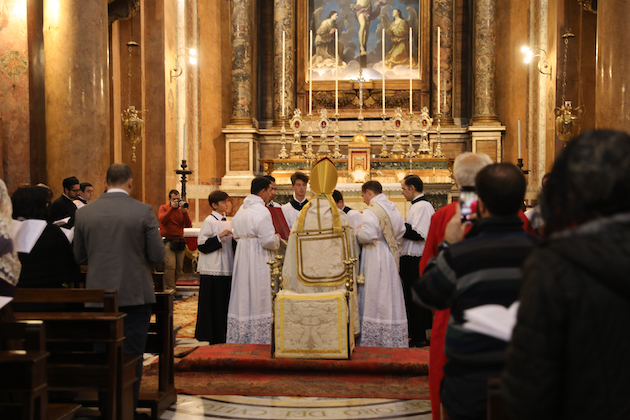
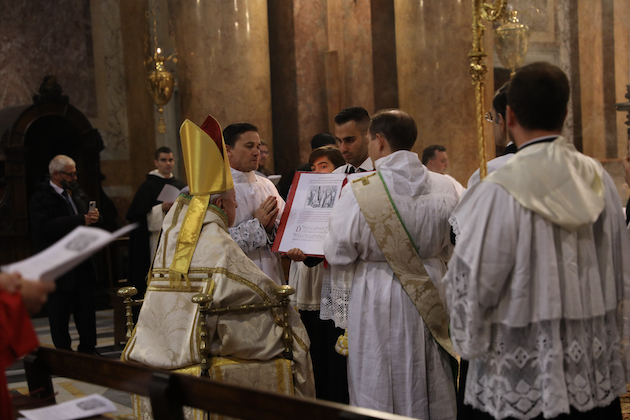
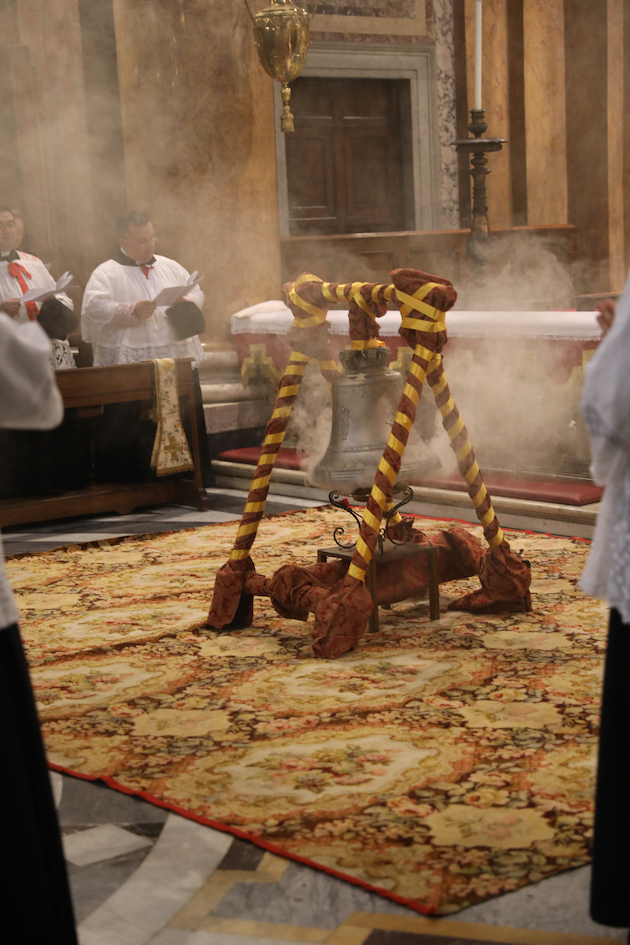
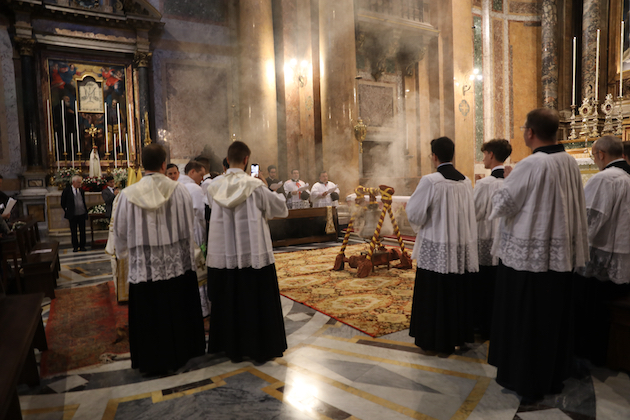
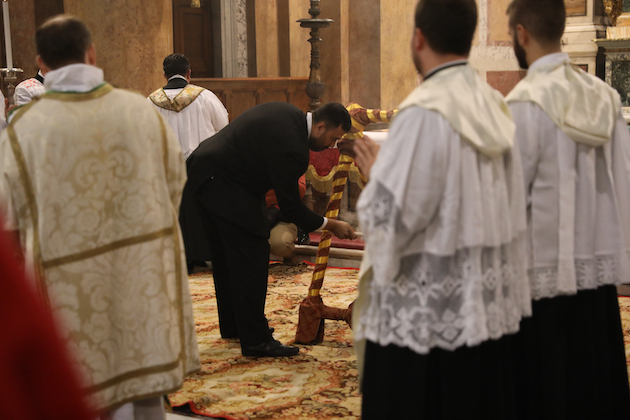
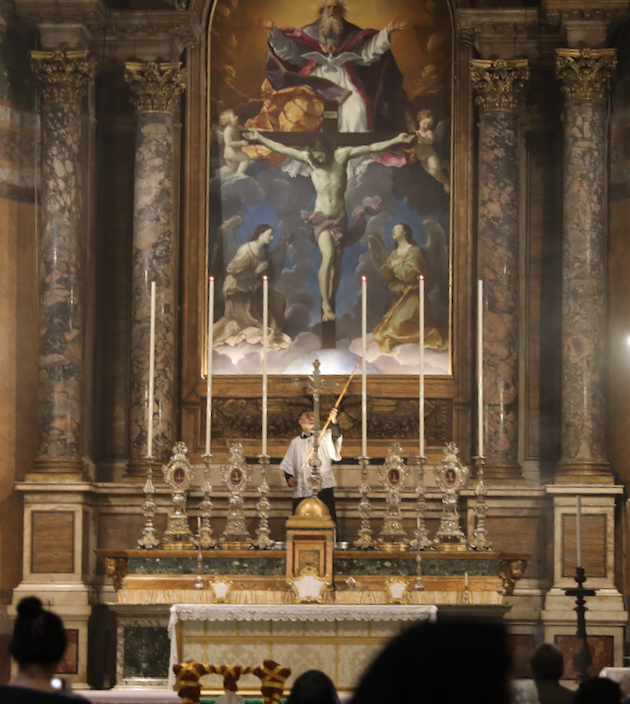
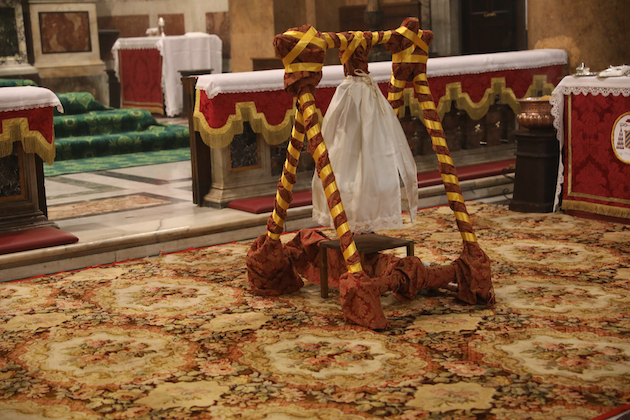
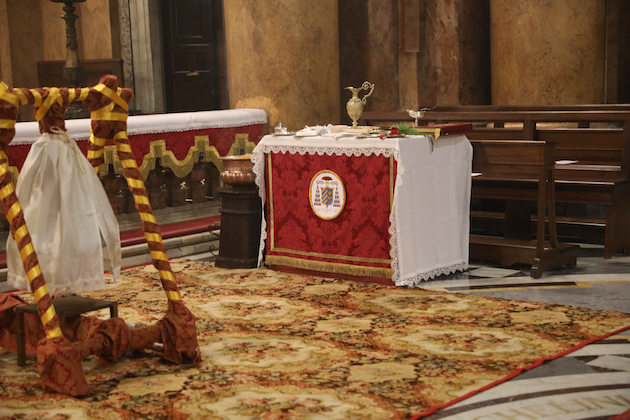
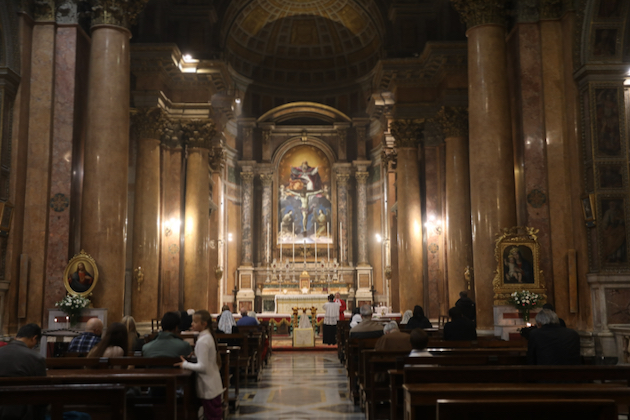
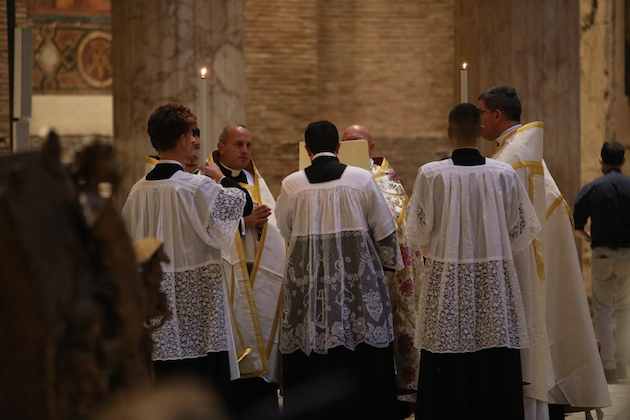
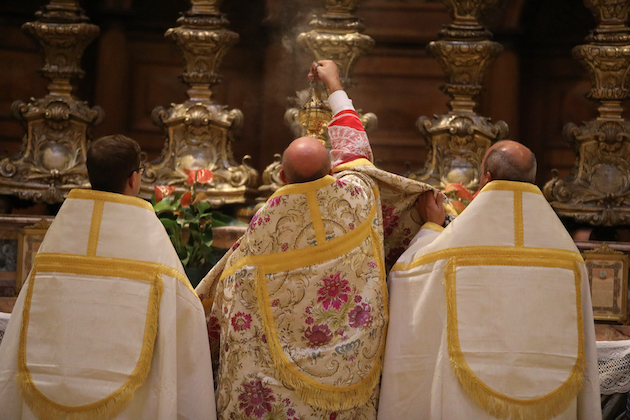
On July 31, Father John Perricone gave a day of recollection at Our Lady of Victories Church in Harrington Park, NJ. Photos courtesy of John Stulich.


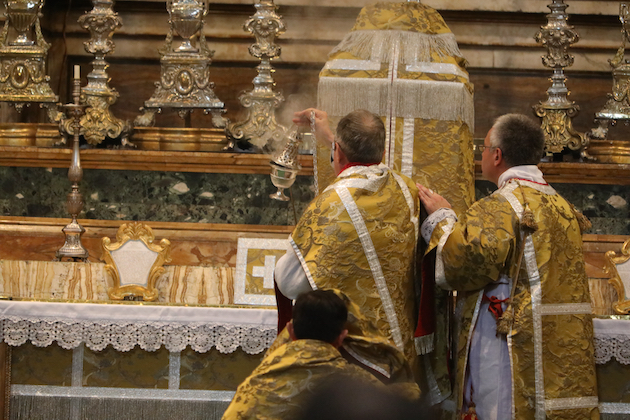
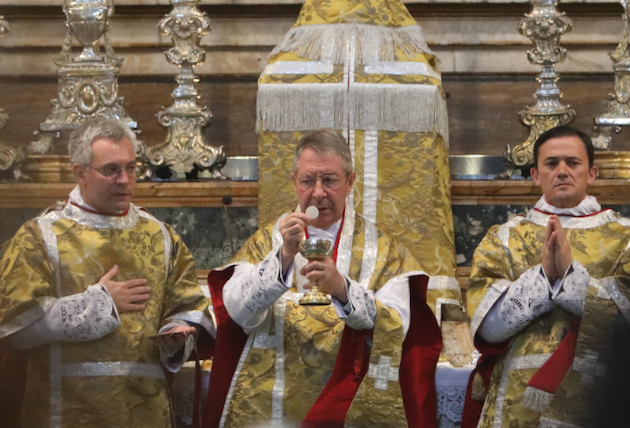
On August 3, newly ordained Fr. Gregory Zannetti celebrated a solemn Mass at St. Mary of Mount Virgin Church in New Brunswick, N.J. Photos courtesy of John Stulich.


18
Aug
16
Aug
16
Aug

For the second famous image of the Assumption in the German lands, we must go back to between 1505 to 1510 – still very much the era of the late Middle Ages. The Herrgottskirche (Church of Our Lord) in Creglingen is a chapel, built around 1400, that takes its name from the miraculous finding of a Host by a ploughman. A pilgrimage soon arose and this small church was decorated with a number of carved wooden altars that have miraculously survived until today. This, even though Creglingen became part of a principality whose ruler joined the Reformation later in the 16th century. But when the altar of the Assumption of Our Lady was created these developments still lay in the future.
The altar of the Assumption was called, at the time of its creation, the Corpus Christi altar in keeping with the dedication of the pilgrimage chapel. One of Tilman Reimenschneider’s greatest masterpieces, it’s also one of the earliest works of art to depict the Assumption of Our Lady – as opposed to the traditional Byzantine/medieval image of her Dormition. Yet the image of Our Lady in Creglingen is still that of the Middle Ages: calm, transfigured and sunk in contemplative prayer. The back of the altar is opened up, as if by the windows of a Gothic church, allowing light from the background to surround and illuminate the spiritual action taking place. Here we find no ecstatic, almost explosive rush towards the heavens (as in the Assumption of Egid Quirin Asam) but serene union with – even absorption into – God. One senses the lingering presence of the sprituality of the German mystics of the 14th and 15th centuries: Meister Eckhart, Tauler and Suso. And, of course, also of their contemporaries in other countries: think of Julian of Norwich, Walter Hilton and the author of the Cloud of Unknowing – just in England alone.


The creator of the altar, Tilman Riemenschneider, was the premier artist of the city of Wuerzburg located, like Creglingen, in the region of Franconia. At that time it was ruled by a prince-bishop, and Creglingen was under his spiritual (but not temporal) jurisdiction.Riemenschneider worked in both stone and wood. About this time, perhaps influenced by the first stirrings of the Rennaissance north of the Alps, Riemenschneider and other German artists started to abandon the medieval practice of painting religious statuary. Among this artist’s greatest works are his wooden altars. This kind of grand reredos, often featuring movable carved or painted wings, enjoyed a magnificent flowering in the Holy Roman Empire between 1450 and 1530.


The art of the great wood altars of Germany ended in the turmoil of the Reformation. In the tremendous religious struggles that followed, the precious contemplative heritage of the Middle Ages went underground. Yet that mystical spirituality did not go utterly extinct. It flamed up again and again in the Holy Roman Empire in the wake of the Catholic Reformation. It resurfaces, for example, in the Asam brothers’ mystical use of light at the church of St. John Nepomuk. And this spirituality lives once more in the poetry of Angelus Silesius (1624-1677) – such as in the following poem, which proclaims the bond between the Assumption and the Eucharist – the origin of Riemenschneider’s altar.
The Virginal Body that enclosed our Bread from Heaven.
Is truly no longer dead,
No ceder of Lebanon rots: otherwise it not be so fine,
For her to be, besides the Temple of God, His Ark of the Covenant.
Angelus Silesius, Cherubinischer Wandersmann, Book III, 66 “On the Most Blessed Virgin” (1675)
See Kahsnitz, Rainer and Bunz, Achim, Die grossen Schnitzaltaere 238-253 (Hirmer Verlag, Munich, 2005)

The brothers Asam, architects, sculptors and painters, represented the epitome of the baroque in the first half of the 18th century in the Holy Roman Empire of the German Nation. They resided and did much their work in the electorate (principality) of Bavaria – an entity much smaller than the subsequent kingdom and present Land of that name – but were active in many other locations as well. But they only rarely had the opportunity to create an entirely new church, uniting all their talents in one unified work of art. Earlier, I have described one such example: their own house “chapel” of St. John Nepomuk in Munich. Another is the monastery church of Rohr, near Regensburg. Here Egid Quirin Asam created one of the three most famous images of the Assumption in European art. 1)
Rohr, now an out-of-the-way village, was in the time of the Asams the site of a monastery of the Augustinan canons. When we admire the almost innumerable number of baroque churches in 18th century Germany we forget that so many of these masterpieces were monastic churches. The eighteenth century in Germany was indeed the time of a great monastic flourishing after the tribulations of the Reformation and the wars of the 17th century – and before the destruction of the French Revolution and the subsequent secularizations (confiscations) by the German states. It was the patronage of these monks that in large part made possible the last great flowering of art in Europe in the age of the baroque and rococo. 2) The dedication of the Rohr monastery was to Our Lady of the Assumption.

The nave of Rohr is in a rather severe style, leading the visitor onwards to the main altar shimmering in the distance. Egid Quirin Asam was responsible for the decor and likely for the architecture as well.

The altar depicts the Assumption of Our Lady. Below, the apostles, in agitated conversation among themselves, marvel at finding her empty tomb strewn with flowers. Above, the Trinity and angels await the crowning of Our Lady as Queen of Heaven. The altar was the creation of Egid Quirin Asam in 1722-23.


Come away my Love,
Come away my Dove
Cast off delay:
The Court of Heav’n is come,
To wait upon thee home;
Come away, come away.
The ecstatic art of Egid Quirin Asam in Rohr corresponds to the expressive religious poetry of Richard Crashaw in the preceding century.
Thy sacred Name shall be
Thyself to us, and we
With holy cares will keep it by us,
We to the last,
Will hold it fast,
And no Asumption shall deny us.
All the sweetest showers,
Of our fairest Flowers
Will we strow upon it:
Though our sweetnees cannot make
It sweeter, they may take
Themselves new sweetness from it.
Richard Crashaw, “On the Assumption of the Virgin Mary”
10
Aug
I was fascinated to read the recently published Report in Paix Liturgique on the “epic” of Traditionalism in the United States. And not just because of the complementary reference therein to my own series on the history of Catholic Traditionalism! It’s always useful to get an outsider’s view of one’s own world – even though one may not agree with all his conclusions. The French believe, for example, that The Trouble with Harry is Alfred Hitchcock’s greatest film. It isn’t, but by understanding their logic one learns a lot about Hitchcock and his movies. On the other hand, Michel Houellebecq’s short book on H.P. Lovecraft is the best criticism of that American author published so far anywhere.
The Paix Liturgique Report, in eight installments, is attributed to the late Daniel Hamiche and is largely structured as an interview between him and the publication. It deals primarily with the present and benefits from “field work”: surveys on the current views of American Catholics. In certain areas the Report provides unique information – such as the installment on the sedevacantists and the independent priests. Given its French audience, the Report of necessity needs to set its discussion of Traditionalism in the wider framework of American Catholicism, both past and present. The Report accordingly starts with a brief historical review of American Catholicism from the 16thcentury to Vatican II. Actually, I have more critical comments on certain factual statements and judgments in this installment as opposed to the content of later chapters dealing with Traditionalism itself.
For example, we read that “only two colonies, Maryland… and Rhode Island (which practiced a “blind welcome” that is, without religious exclusion) had a Catholic population….” Rhode Island was actually militantly anti-Catholic. Perhaps the author really means Pennsylvania, the second British colony with a significant Catholic population, which just before the American Revolution was far more tolerant of Catholics than the original Catholic home of Maryland. Katherine Drexel was not a convert. Elizabeth Seton founded the Sisters of Charity in the United States, not just those of New York (that designation relates to a split later in the 19th century).
As one might expect, the Report describes with justifiable pride the major contribution of French Bishops in the early years of the US : some dioceses – New Orleans, Bardstown/Louisville, Vincennes/Indianapolis – were largely or totally in their hand, while Boston, New York and Baltimore each had at least one French prelate. However, although I haven’t attempted to make a complete tally, I am not totally sure that French bishops were a “majority” of the U.S. episcopate in the first half of the 19th century.
Of more substance are some nuances that I don’t think the author got exactly right. The domination of Irish Catholicism from 1830 onward is not attributable to the sudden appearance of the Irish: they always had been a strong component of American Catholicism from the founding of the United States. Rather, it was the radically increased number of the Irish (and also the German ) immigrants in the decades preceding the Civil War that by 1860 transformed the Catholic Church in America from an exotic fringe to a significant presence at least in most urban areas. The author also seems to think that the status of Catholics as a “closed society” prior to the Second Vatican Council is attributable to the multiplication of ethnic parishes. That was hardly the case – the alleged Catholic pre-Conciliar “ghetto” was typified by the mainstream “American-Irish” parishes, not Italian or Polish national churches.
Finally we note with some humor (and perplexity) our author’s assertion that:
“One hears now and then that American Catholics are more pious and practicing (compared to those of Western Europe) … . It’s hardly astonishing that 25% of baptized Catholics attend Mass every Sunday and of the remaining 75% a good proportion attends Protestant services, depending on the region.”
Perhaps this level of religious practice is acceptable, even admirable, compared to France or Germany – it is absolutely catastrophic, however, for the Catholic Church in America and for its finances. And the author attributes even these statistics primarily to the social pressure of an allegedly Protestant society. Now, as indicated in the very quote above, the Report is well aware of the “regional” differences in the United States. I am not sure though, that the author fully appreciates how radical those differences can be. For example, whatever the situation in “Trump country” may be, NO conformist pressure supporting religious practice exists in any of the places that control the secular power in the United States: New York City, Los Angeles, Washington D.C, Chicago, Silicon Valley/San Francisco, the suburbs of all these places, almost all of higher education – to name only the most prominent examples. Indeed, in this stratum of American society the public hostility to Christianity of any kind is strong and growing ever stronger. Like many European Traditionalists, Paix Liturgique is perhaps a bit too enthusiastic about the American scene.
The chapter of the Report on independent priests and sedevacantism is a unique contribution and fills a gap in my own essay. I would, however, wish to see the support for the author‘s estimate of the number of independent priests: it seems extraordinarily high to me. At least today in and around New York they are (perhaps with one exception) hardly found at all. The significant presence of various sedevacantist sects(as well as other FSSPX offshoots) is duly noted, as is the fact that such movements seem more numerous in America than elsewhere. But, if we consider sedevacantism to be the flip side of extreme ultramontanism, does not the Irish, papalist heritage of the “American Catholic Church” explain this phenomenon?
I would also highlight the installments of the Report on Traditionalism in the religious life, particularly that of the female religious. He also deals with the Society of St John Cantius at some length. Yet in his enumeration of “Traditional priests,” he considers the FSSPX, the FSSP and the ICRSS – who celebrate the Traditional Mass exclusively – to be the sole “traditionalist” clergy of the United States. I have noticed this attitude in other European publications.
Now I have attended celebrations of the Traditional Mass since 1988. Except in the very last year, almost all my experiences were with diocesan priests or members of “mainstream” religious orders who celebrated both the Traditional Mass and the Novus Ordo. Thus this essay very much underestimates the actual scale of Traditionalist activity. Of course the author is aware that there are a great many celebrations of the Traditional Mass in addition to those of the above orders and dedicated Traditionalist “chapels” (his term) and that many diocesan priests are involved. The author rightly points out the remarkable number of diocesan priests that have received training in the Traditional rite. He seems to think, however, that the activities of the diocesan priests are a kind of underground. That has not been the case for many years – Traditionalism in many places has become a normal aspect of American Catholic life.
Indeed, our author is heartened by his surveys that indicate that 72,7% of practicing Catholics find the simultaneous practice of both the Novus Ordo and the Traditional Mass pursuant to Summorum Pontificum “normal” and that 41.5% of these Catholics could well see themselves attending the Traditional Mass if it were offered at their parish. That’s impressive testimony to how, in the United States at least, the Traditional Mass has joined the mainstream of the Church as a significant and beneficial force. It is precisely for this reason, of course, that Pope Francis has now determined to destroy Catholic Traditionalism. What will be the result of his campaign in the United States? The facts set forth in this essay, demonstrating the growing strength and acceptance of Traditionalism among the laity, priests and religious, give me some confidence that it will survive the trials that are to come.