Saturday, May 22, the Vigil of Pentecost
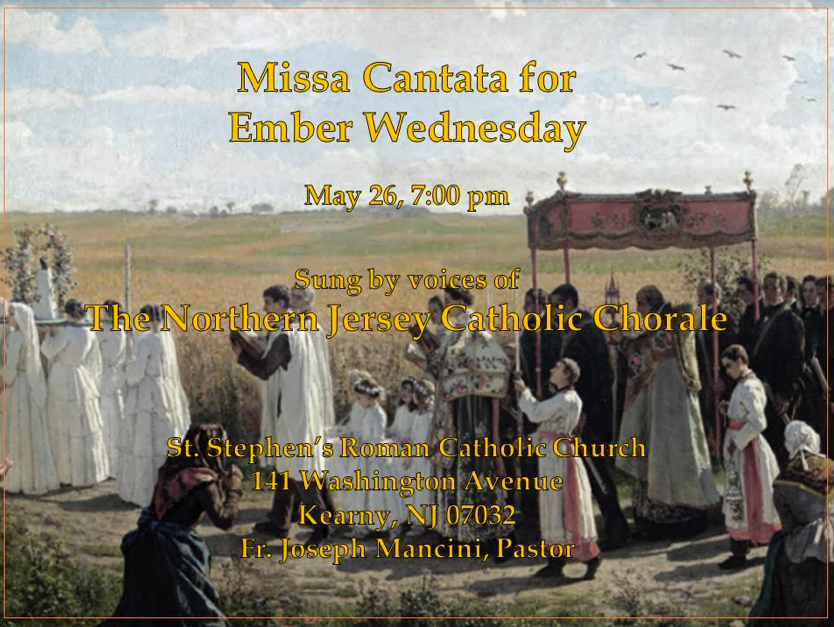
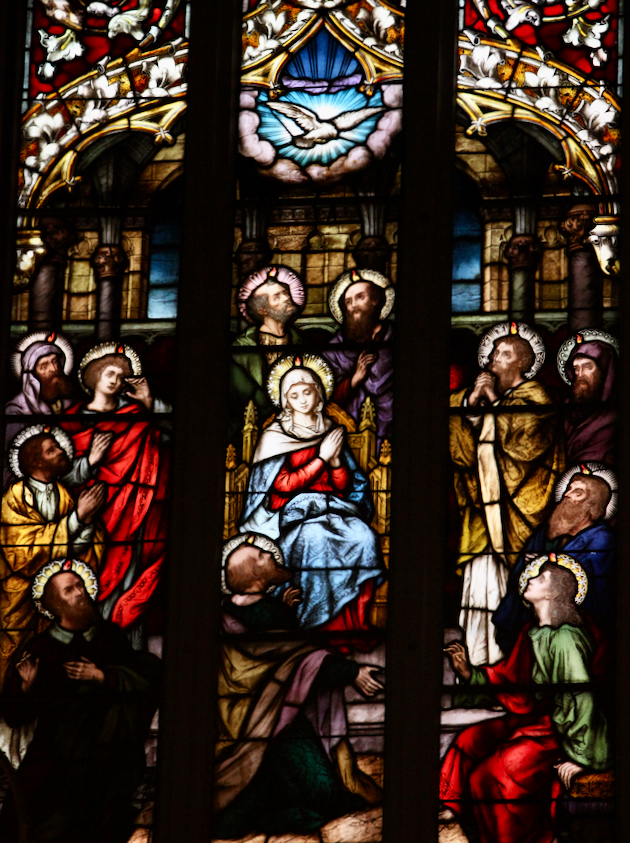
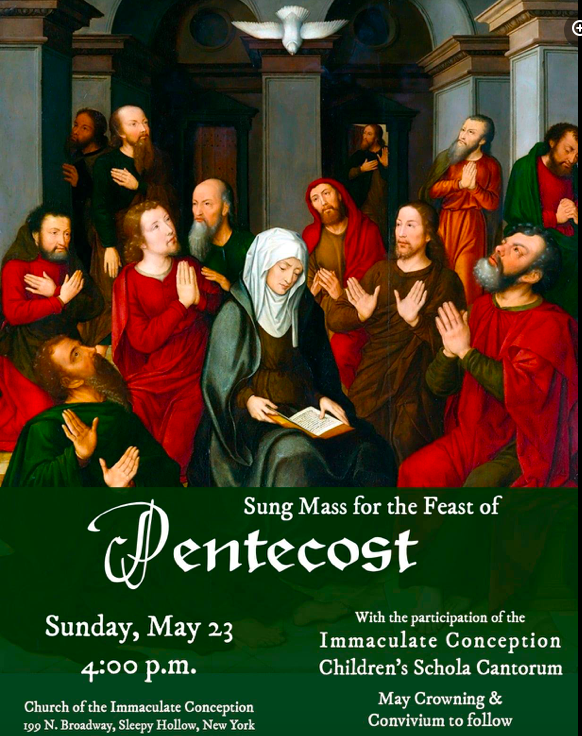
For the Vigil of the Pentecost, on Saturday May 22, Sts. Cyril and Methodius in Bridgeport, CT will offer a high Mass at 9 am, including the Prophecies, blessing of the font and Mass.
St. Patrick Oratory in Waterbury, Ct will follow the same schedule: at 9 am, the Prophecies, blessing of the font and a high Mass.

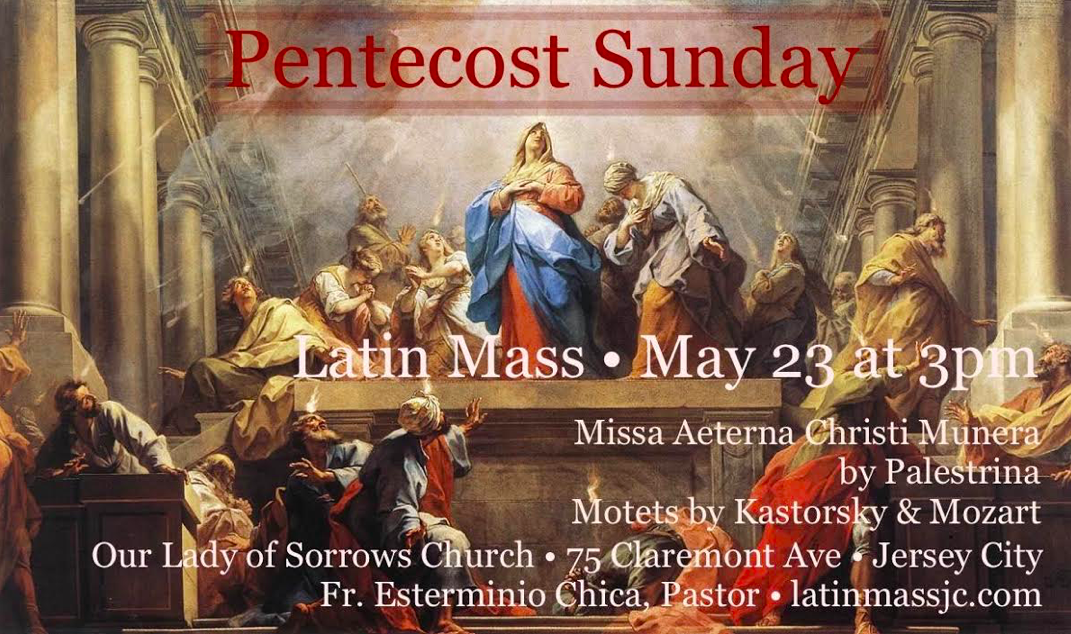
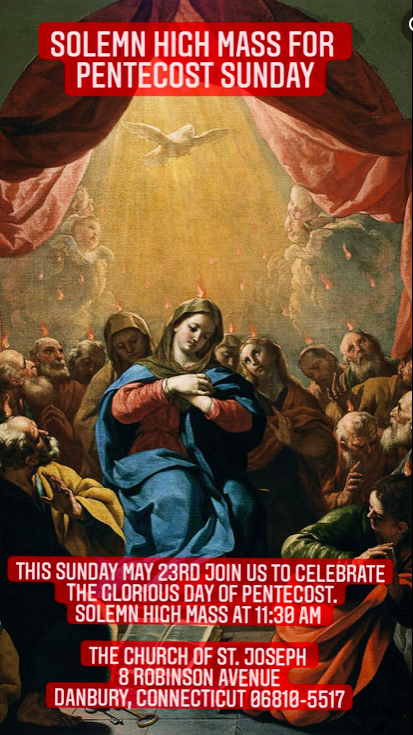
Pentecost Sunday, May 23

Published in Masses | no comment
16
May

Integralism: a Manual of Political Philososphy
by Thomas Crean and Alan Fimister
(Eurospan, Editiones Scholasticae, Neunkirchen-Seelscheid, 2020)
Politics and the Sacred – an eternal theme. A whole series of thinkers on the right have denounced the “original sin” of the modern democratic state, whether liberal on authoritarian: the severance of the political from the sacred order. Among the Catholics, we could mention, for instance, the fundamental editorial positions of Triumph magazine from its very first issue in 1966. Thomas Molnar – who early on had also been associated with Triumph – wrote often and eloquently on this topic, e.g., Twin Powers: Politics and the Sacred(1988), Moi, Symmaque (1999). This line of thought contrasts, however, with the current position of the Catholic Church, which had embraced the “sound laicity” (Ratzinger). of the modern Western states. Indeed, the Church establishment has often gone further and claimed the modem political world to be the inevitable product of Christianity. Thus, the non-Christian polity of today paradoxically receives divine sanction – a weird second-coming of Christendom!
Challenging the latter views is integralism, a movement, mainly among academics, which in essence aims to recover the principles and positions of Catholic political philosophy as it existed prior to the last Council or even prior to 1789. Integralism (2020) by Thomas Crean and Alan Fimister is a “manual of political philosophy” summarizing the positions of the movement. It is a remarkable survey of all aspects of political philosophy: the philosophical foundations, the forms of political organization, the relation of state and Church, economics, warfare etc. The authors distinguish the political relationships in Christendom from those that exist outside of it (such as in the world of today). As sources the authors cite primarily Neo-scholastic philosophy and theology, the ancient philosophers, papal declarations and decrees from many eras and thinkers ranging from Thomas Aquinas to Robert Bellarmine and Alasdair MacIntyre.
Integralism summarizes for us the many political positions taken by the Church both in the age of Christendom and later – including those that the Church today would like to forget – such as those on religious toleration, just war, slavery, the death penalty, etc. Crean’s and Fimister’s “manual” is succinct and clear. To be sure, I was startled now and then by certain expressions and turns of phrase. For example, “[T]he entity (the C of E – SC) created by Henry VIII and his natural daughter is notoriously founded upon attempted divorce.” On the whole I thought the authors did a good job of presenting this vast subject matter. I might of course question the basis for one or other of their claims,- such as that English Common Law parallels the Roman Jus Gentium.
My fundamental criticism though, regards what I perceive to be a lack of historical context inherent in the integralists’ philosophical/theological/legalistic approach. For politics, after all, deals with the real – as it is encountered in the present day but also in history. Yes, political action should be informed by theological and philosophical principles – but it cannot simply be deduced from them.
This historical gap can be illustrated the authors’ discussion of the scope of papal authority in temporal affairs. The authors seem to regard as exemplary the period of the papacy that, historically speaking, existed in “Christendom” between 1050 and 1300 – and then really only fully in a small subset of that era: from around 1200 to 1230. The authors rely on Boniface VIII’s Unam Sanctam as a source – yet even when that was written (1302) it no longer accurately described reality. At the same time, the authors describe a constitution of the Church as it was perfected after 1870. But this structure in large part only became possible in the regime of post-Christendom liberalism. I was also unconvinced when the authors seek to establish the continuity of their description of papal authority with the practices of the Church prior to 1050 or, even more so, with the positions set forth in Vatican II documents and encyclicals and statements of recent popes.
We might add that the “rulers” and “temporal authority” discussed in this book have also changed radically over the ages: from Roman emperors to anointed medieval rulers to the modern state to the current postmodern despotism of “civil society.” A complete Catholic manual of political philosophy would have to devote much more space to these specific facts. The authors are of course aware of the differences among these forms of polity. I was intrigued by their very interesting discussion of “shadow politics” – where the official possessors of power are not those who exercise it in reality (such as a plutocracy). Or by their use of the Platonic term “theatrocracy” – “where poets corrupted the judgments of citizens by vicious music” to describe “a state of affairs where men are ruled by those who possess the means of mass communication.”
Indeed, it is this aspect of integralism – the authors’ unambiguous assertion of papal rights in temporal affairs – that has stirred up the greatest resistance. To be fair, at least as presented in this “manual,” the topic of the pope’s temporal authority is just one of many. Yet it does illustrate well the authors’ relative lack of concern with either historical reality or the actual expertise of the papacy in temporal affairs. For even in the 13th century – the golden age of papal rule – the political decisions of the popes were highly controversial and often laid the foundations for subsequent conflicts. The same is true of the political decisions taken by the post-1870 popes – from the ralliement to the French republic to the condemnation of Action Francaise to the concordat with the Third Reich.
And what of the Church of today? How could anyone seriously consider entrusting political authority to an institution like the Vatican? From the pontificate of Paul VI to the present day we have witnessed an unending series of financial, political and sexual scandals. Works like Gone with the Wind in the Vatican ( Via col Vento in Vaticano(1999)) reveal the Vatican to be an abyss of corruption, dishonesty, incompetence, careerism and exploitation of subordinates. And what are we to think about the ruling style of the current pontiff: despotic, arbitrary, having profound disregard for all laws and customs – yet at the same time totally subservient to the forces of the secular “power elite.” It seems incredible to appear to argue that this man and this institution in its current form are capable of assuming any role in temporal affairs. For let us remember that in the great era of medieval papal power the Church and the curia offered men real secular advantages over the feudal powers of that day: a better judicial system, a better organized and more efficient bureaucracy, the beginnings of an informed patronage of the arts.
So I applaud the initiative of the integralists – even if I cannot endorse all aspects of their program. The disconnect, created by modern secularism, between politics and the sacred is something that for the sake of human society must be healed. How that will happen, though, is something I do not know. One thing seems clear – the foundation of such a restored political order presupposes the conversion to Christianity of the people who make it up. And achieving that conversion should be the focus of all our efforts.
Published in Book Reviews | no comment

Published in Uncategorized | no comment

Published in Uncategorized | no comment
Churches of New York
Holy Roman Empire
Website Highlights
Archives
[powr-hit-counter label="2775648"]