20
Oct

20
Oct

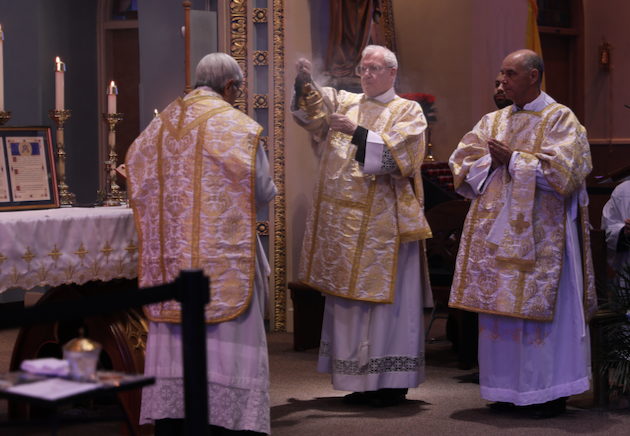
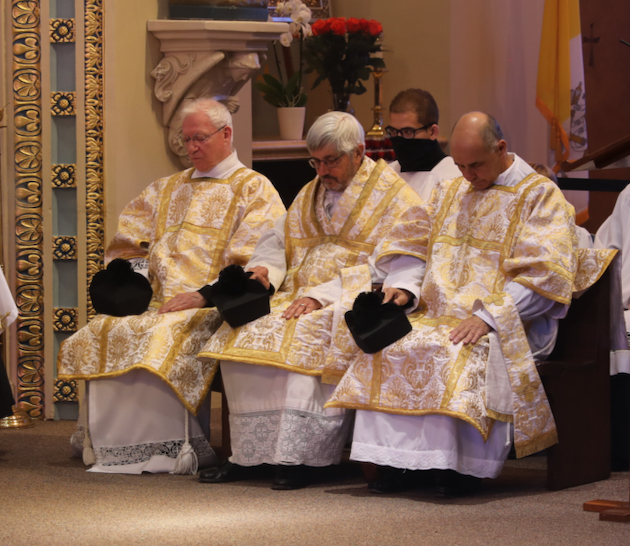
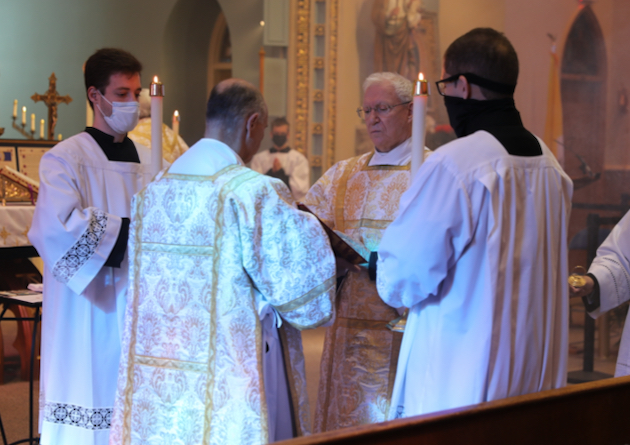
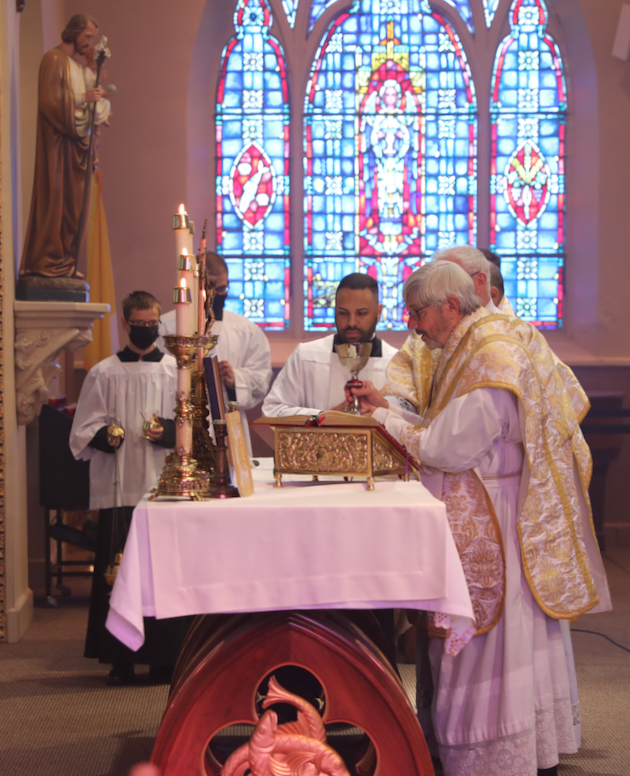
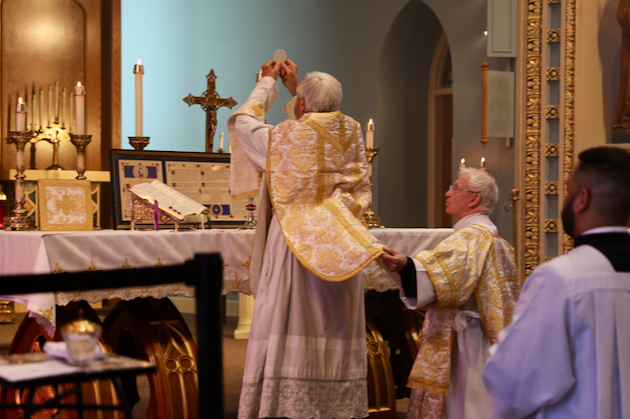
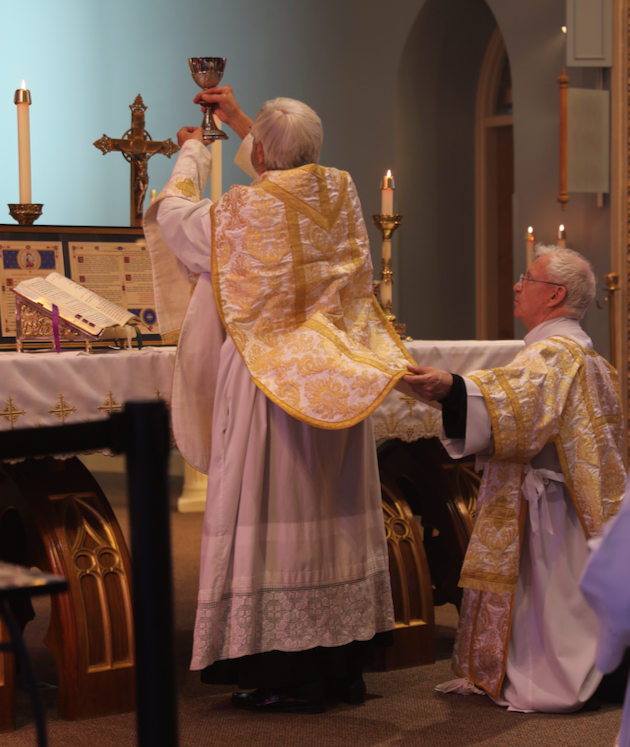
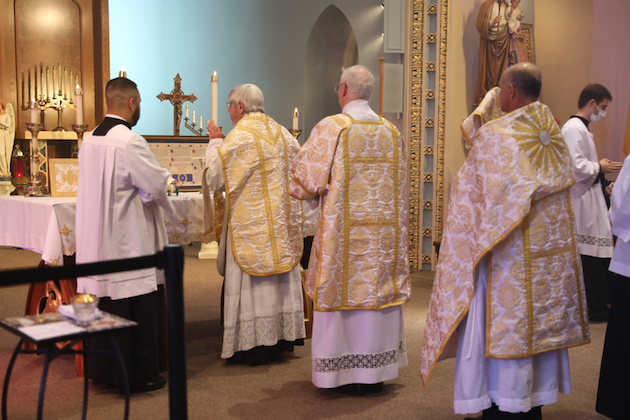
The Church of the Holy Innocents in New York will start its annual Forty Hours Devotion THIS COMING Friday, October 23rd, 2020.
First Day: The opening Mass will be on Friday, October 23rd at 6PM, and it will be a Votive Mass of the Most Blessed Sacrament.
At the end of the opening Mass, the Blessed Sacrament will be solemnly exposed: there will be a Eucharistic procession inside the church, and the Pange lingua, the Litany of the Saints, and some other special psalms, versicles, and prayers will be chanted.
–The church doors will be closed and locked at 9PM and only those who have signed up for the night adoration will remain in the church keeping vigil before Our Lord until 6AM.
Second Day: On the second day, Saturday, October 24th at 1PM, we will have the traditional Votive Mass Pro Pace.
–The church doors will be closed and locked at 9PM and only those who have signed up for the night adoration will remain in the church keeping vigil before Our Lord until 6AM.
Third Day: The closing Mass will be on Sunday, October 25th at 10:30AM, which will also be the 1st class Feast of Christ the King. This closing Mass will be celebrated coram Sanctissimo (in the presence of the Blessed Sacrament exposed).
At the end of the closing Mass, the Litany of the Saints and other special psalms and prayers will be chanted and we will have another Procession of the Blessed Sacrament inside the church.
The Forty Hours Devotion is surrounded with 3 special dimensions:
1) The protection from evil and temptation;
2) Reparation for our own sins and for the poor souls in purgatory; and
3) Deliverance from political, material and spiritual calamities.
This beautiful devotion was permanently established by Pope Clement VIII “in order that day and night the faithful might appease their Lord by prayer before the Blessed Sacrament solemnly exposed, imploring there His divine mercy.“


St. Mary’s Church in Norwalk will hold Eucharistic Adoration in the downstairs chapel from 8 pm on November 2 to 6:30 pm on November 3.
On Monday, November 2 at 7 PM Father John Ringley will offer a Solemn Mass for All Souls. After Mass at 8 PM Father will have Exposition of the Blessed Sacrament in the chapel with Adoration all night long AND all day Tuesday, Election day until 6:30 PM November 3.
We are asking parishioners to sign up for one or more hours of adoration. Sign up sheets are on the table in the chapel foyer with your name + your contact information. We also need one gentleman at each hour between 11 PM to 5 AM Monday night during nocturnal adoration. We will need coverage during both the 8 AM and 12 noon Masses on Tuesday, Election day.
The regular parish Adoration will resume on Wednesday, November 4 from 1-4 PM.
Any questions, please contact Jacquie at 475-206-7109 or email jacquelinejuh@gmail.com.
17
Oct

The “Italian Cathedral” – thus does the church of St Lucy in Newark, New Jersey, assert its claim to preeminence among Italian churches of the New York area. And with some justification! St Lucy’s may not quite attain the size and splendor of the “Polish cathedrals” of Chicago and elsewhere in the Midwest. Yet its architecture is impressive – unconstrained by the narrow lots of New York. And, in my view, its decoration exceeds in its extravagance and quality that of its Italian competitors – most notably, Our Lady of Pompeii in Greenwich Village, built and decorated about the same time. We had a chance to visit St. Lucy’s today on the weekend of the celebration of the festa of St. Gerard Majella – whose national shrine is found here.

(Above)The sober exterior of St Lucy’s, executed in a kind of Romanesque – Renaissance idiom. Construction started in 1925. The church presides today over a combination of plaza, parking lot and outdoor shrine offering the opportunity for all kinds of devotions. (Below) Peering over St Lucy’s parish complex are the towers of Newark’s grand Sacred Heart Cathedral (presumably the “Irish” Cathedral).


But it is the architecture and decoration of the interior that is the glory of this church. For here the local Italian community was able to achieve an amazing recreation of the 18th century Southern Italian Baroque. The parish is dedicated to St Lucy of Syracuse; the paintings and inscriptions emphasize strongly this Sicilian connection. But in fact people from many other Southern Italian villges, towns and regions participated in the life of this parish and in the construction of the church. (Below) The high altar.

The real heart of this decorative program, however, are the murals of Gonippo Raggi (1875-1959) who worked on the decoration of many other important Catholic churches – especially in New Jersey. Above all the paintings of the cupola and of the huge ceiling of the nave recall to the visitor not only Italy but, in their wild exuberance, even the visionary ceiling paintings of the German baroque.

(Above) The cupola.(Below) The apse mural, complete with the Syracuse cathedral on the left and Mount Etna on the right.


(Above) Detail of the apse.

(Above and below) Details of the martyrdom of St Lucy on the celing of the nave.

(Below) From the same mural.

Today, perhaps, St Lucy’s is best known as the shrine of St Gerard Majella. In contrast to the deserted shrines of most Manhattan churches, devotion to St Gerard is very much alive and well. I hear many come from all over the country to participate in the festa. This year was, obviously and unfortunately, a great exception.
St. Gerard Majella is most often invoked as an intercessor for a safe childbirth. At one time St Lucy’s had 20,000 parishioners, and in one year there were over 1,000 baptisms. So his assistance was very much in demand!

The statue of St. Gerard is adorned by the faithful not merely with strips with dollar bills attached – that happens in every other Italian church festival – but with whole coats covered with greenbacks. At least on this weekend, the stream of visitors never let up. The quantity of (real) candles to be found everywhere in the church is amazing. A notice is provided, however, that candles will be extinguished in the evening but relit in the morning.
(Below) The miraculous safe delivery of a child, depicted here, started the devotion to St. Gerard as a patron saint of expectant mothers.


After the murals, what catches the vistor’s attention are the innumerable, mostly large-scale statues around the church. It seems like every saint and every Marian devotion of Southern Italy is represented here. And the Hispanic peoples subsequently have added their own devotional images to this collection.


St Lucy’s is still kept in beautiful condition. Almost all the Italian population of what once was Newark’s “Little Italy, ” however, had left the immediate neighborhood long ago. The final straw was a series of disastrous urban renewal projects, which had the same results here as everywhere else – Chicago, St Louis, Bridgeport etc.. Most of the old Catholic ethnic neighborhoods of these cities, like those of Newark, were destroyed long ago . But St Lucy’s old parishioners and their descendants have been more dedicated than most in maintaining their old parish, its devotions and its church.
17
Oct

..above the choir loft of St. Lucy’s church, Newark, New Jersey. This church was built and decorated 1925 onwards. As is customary for the decoration of this corner of a church, King David and St.Cecilia are depicted. But in this window two others, both popes, find a place as well.

St. Gregory the Great, so strongly associated in Tradition with the development of the liturgy and of chant, sits on the left.

On the right is pope Pius X, the great champion of Gregorian chant in the early 20th century. The scroll he holds is not in chant notation, though.
8
Oct

An award from the Federation of German Architects is bestowed upon this new church of the Archdiocese of Munich. Built from 2015 to 2018, the church of Blessed Father Rupert Mayer is thus entirely of the era of Francis. Yet it documents the continued fanatic commitment of the clerical establishment of the Catholic Church to the “eternal verities” of the 1960’s, regardless of all the talk and contrary aesthetic movements of the intervening years. And why not, if the secular world is so forthcoming with its recognition? For this is only the latest prize this structure has won. It’s only a shame there are so few faithful left in Germany to take advantage of it.
The media outlet of the Archdiocese of Munich provides a video (see below) of the dedication of the church by Cardinal Marx ( he of “Synodal Path” fame). Aside from giving you a more complete view of the building, it’s very instructive regarding the situation of the Church in Germany – even if you do not understand German. Note how many of the ministers (other than the priests) and of the congregation are female – such as the acolytes in their alternating green and red attire. And how so many of the adults, both male and female, have gray hair. The filmmakers carry out interviews of the congregation, asking “What do you think of the new church?” Naturally, only a pair of very old women unreservedly condemn the new architecture – every one else is accepting to enthusiastic. Cardinal Marx conducts the proceedings more or less as folklore ( like the knocking with the crozier on the church doors), somewhat like the funny hats and dirndls worn by certain of the laity. It’s all very, very sad.
It is stated in the video that this building cost 15 million Euro. Cardinal Marx is very pleased with it.
Katholisch.de: New Church Building in Poing receives architectural Award. (The video is embedded in this article)
7
Oct

On this October 7 let us reflect on today’s Feast of Our Lady of Victory (or Our Lady of the Rosary). We know that the spread of this feast throughout the Catholic world is owed first of all to the great victory of the Christian allies (mainly Spanish and Italian) over the Ottoman naval forces on this date. And afterwards Our Lady was invoked under this title in other conflicts with the enemies of Christendom; for example, after the victory of the forces of the Holy Roman Empire led by Prince Eugene over the Turks at Peterwardein in 1716 this feast was extended to the whole Church. The present bishop of Rome in his new encyclical has recently reminded us of his view that there can never be a just war; the sense of the Church – and for that matter, her doctrine – took a very different position regarding war up to the last Council. The following images illustrate that.

In the Bavarian town of Ingolstadt is one of the most extraordinary creations of the brothers Egid Quirin and Cosmas Damian Asam, 18th century German masters of the baroque. The church of Maria de Victoria was built and decorated between 1732 and 1736 as a oratory for the Marian congregation of the former University of Ingolstadt (a Jesuit university situated in the Electorate of Bavaria and the alma mater of Baron Frankenstein). The simple hall is rendered extraordinary by the immense ceiling fresco as well as by further decorations and furnishings added in the decades after completion of the church – and in some cases even in the 19th century.

The magnificent painting of Cosmas Damian Asam shows the Incarnation set amid symbols of the continents of the earth as they were then understood. The fresco abounds in unusual tricks of perspective.


(Above and below) In this church can be found the Lepanto Monstrance of 1708, claimed to be the most valuable in the world. Created by the Augsburg goldsmith Johannes Zeckl, it depicts the naval battle of Lepanto as exemplified by a Christian ship overpowering a foundering Turkish vessel.


Near the monstrance is a cross carried by Tilly, the commander of the Catholic League army in the Thirty Years’ War, who died from battle wounds in Ingolstadt. To complete the picture we should add that the town of Ingolstadt itself was a key military stronghold of Bavaria for many years into the 19th century. A “Museum of the Bavarian Army” is located here.

Closer to home – if on a considerably lower artistic level – is the huge apse painting in Our Lady of Pompeii in Greenwich Village (the dedication to Our Lady of Pompeii is a variant of that of the Our Lady of the Rosary). In the section shown above is a reference to the battle of Lepanto, as is in the text surrounding the back of the sanctuary. This painting is actually a recreation of the original, which had beeen destroyed after the Second Vatican Council.

Indeed, Our Lady of Victory continued to be invoked once more later in the Twentieth century: here is the downtown New York church of Our Lady of Victory erected in 1947 by Cardinal Spellman. It has this dedication:
This Holy Shrine is dedicated to Our Lady of Victory in Thanksgiving for Victory won by our Valiant dead, our soldier’s blood, our Country’s tears, shed to defend men’s rights and win back men’s hearts to God.
Although we may wonder about the dedication’s concluding sentiments regarding a war fought mainly against and with formerly Christian, secular states, there is sincere sorrow for the dead and wounded and gratitude for the nation having prevailed in the struggle.
For more on the church of St. Maria de Victoria, its art and its meaning see Hofmann, Siegfried, Die Kirche Maria de Victoria. (with contributions by Kurt Scheurer)
A Missa Cantata will be offered at Sacred Heart Church in Georgetown, CT tomorrow evening, Oct. 7, at 6 pm in honor of Our Lady of the Holy Rosary. There will also be a candlelight procession. The celebrant is the new administrator of the parish, Fr. Peter Lenox. Fr. Lenox was recently the pastor at St. Joseph in South Norwalk, where he had also celebrated the traditional Mass.