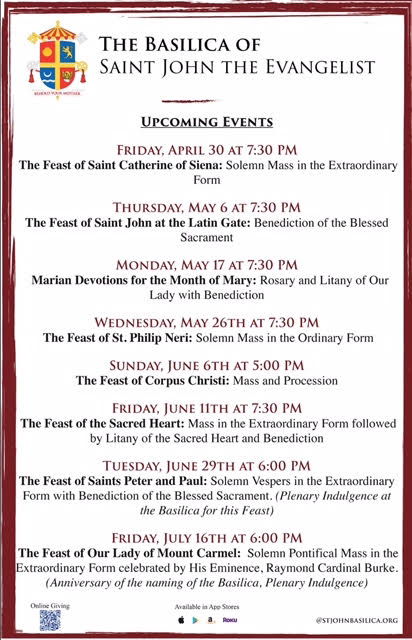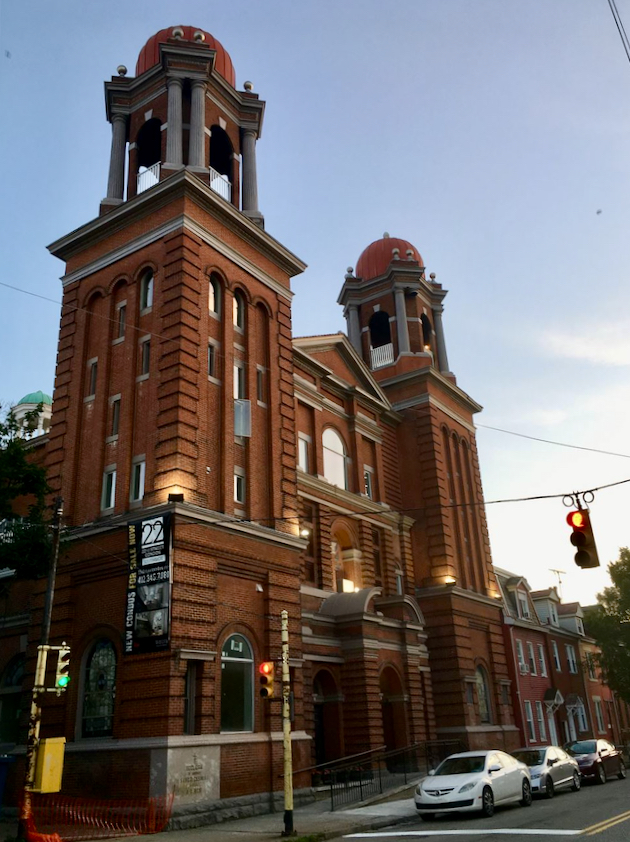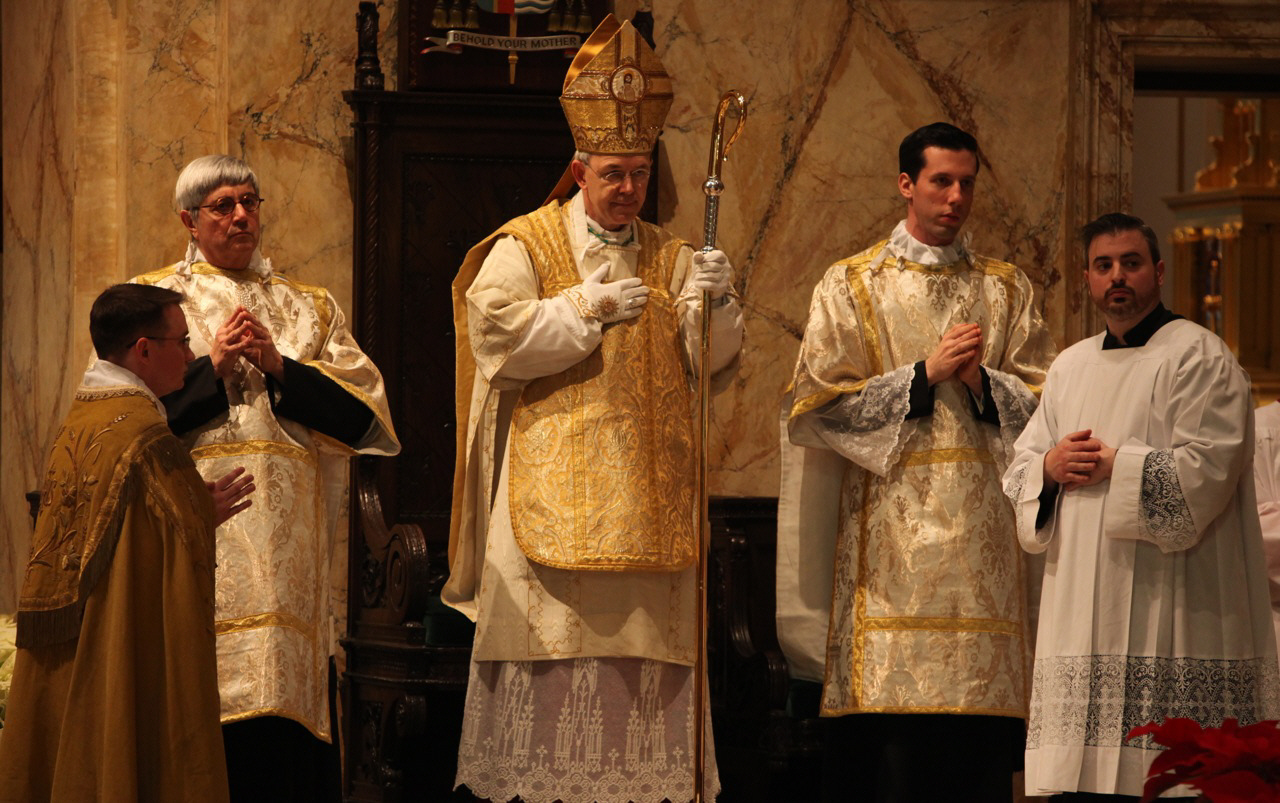
Traditional Mass is now offered every Sunday at 11:30 am at St. Joseph Church in Danbury, CT by Fr. Michael Clark. Saint Marguerite in Brookfield also has a weekly traditional Mass every Sunday at 12:30pm.
24
Mar
Traditional Mass is now offered every Sunday at 11:30 am at St. Joseph Church in Danbury, CT by Fr. Michael Clark. Saint Marguerite in Brookfield also has a weekly traditional Mass every Sunday at 12:30pm.
23
Mar
23
Mar
The Viri Galilaei, under the direction of David Hughes, will be singing two Masses for feasts of Our Lady later this week. The first will be on Thursday, March 25th, at 6:00p at St. Joseph’s in Danbury, for the Feast of the Annunciation. The second will be on Friday, March 26th at 7:30p at St. Josaphat’s in Bayside, Queens. At both Masses, they will be singing Machaut’s magisterial Messe de Nostre Dame, the earliest polyphonic Mass by a single known composer. According to David Hughes, “As part of our Lenten practice, we’ve been working on the piece every Saturday this Lent, and hope that it will bear good fruit at these Masses.”


21
Mar

By Father Richard Gennaro Cipolla
Because I tell the truth, you do not believe me. Which of you convicts me of sin? If I tell the truth, why do you not believe me? (John 8: 45-47)
So the scene is set for the final confrontation on this first Sunday of the Passion. It is from here that we enter Jerusalem with our Lord and watch in the garden and walk the Via Dolorosa with him and climb that hill to see and to know the greatest act of love that has ever been made and will ever be made. For it is the act of the love of God.
And today’s Gospel focuses on the roots of the conflict. The conflict here is the historical one between Jesus and the Jews of his time. Among these Jews in conflict were the religious leaders, the Chief Priests and the Pharisees. We forget, because of the negative casting of these men in the Gospels, that these were those men who knew deeply of the roots and teaching and practice of Judaism. These were those who offered the sacrifices in the temple; these were those who were experts in the Law; these were those who knew of the covenant between God and the Jewish people. These were those entrusted to lead the people in the teaching and practice of their faith. But in this crowd there were also those who had believed in Jesus but now found him too much to take. It was bad enough when he said: “Unless you eat my flesh and drink my blood, you have no life in you”. But now: “Truly, truly, I say to you, before Abraham was, I am.” Those words” I am”, the name of God heard by Moses from the burning bush, the name never pronounced by a Jew because of its terrible holiness. “Before Abraham was, I am.”
But the conflict here goes far beyond the historical conflict with the Jews. If it were merely history, then we would dismiss it as something in the past and move on. But the conflict here is the very center of the opposition to the person of Jesus and his claims in all ages, in every generation. Jesus says: “But because I tell you the truth you do not believe me.” And again: “ If I tell the truth, why do you not believe me?” The latter question is asked of us today, is posed to the whole world, whether the world is listening or not. Why is it that when people confront the truth they do not believe? And this is true of people who do not scorn the notion of truth. Why even the secular post-modern New York Times would defend the truth in some sense. The most secular person would not deny the quest for truth wherever it is found. The motto of Harvard University is Veritas, truth. The motto of Yale University is one better, Lux et Veritas, light and truth, both of which are seen as ends to the whole education process. The motto of Villanova University, a professed Catholic college, is Veritas, Unitas, Caritas: Truth, Unity, Charity. And yet, without being prejudicial, can any one of these institutions of higher learning answer the question Jesus poses? No, they cannot, for when truth is abstracted into the realm of ideas, when truth becomes some nebulous goal to which education strives, when truth becomes disembodied and not something one can touch, feel, hear, know, have a relationship to, then Jesus’ question becomes meaningless. It has no context. When truth becomes a concept divorced from God, then not only is its deepest meaning lost in the miasma of individualism and relativism, but also truth loses its pungency, its sharpness, its ability to judge.
This confrontation: why does it necessarily involve the religious leaders of Jesus’ time? Because these are those in the know, those who are supposed to teach the people the truth. And these religious leaders do know the truth in an objective way; they know the facts of the truth, so to speak. But yet, they do not know the truth in the deepest sense, because they have failed to or are unwilling to make that truth part of their lives, of their very existence. They are fond of delivering powerful sermons about the truth, about the Commandments, about the special relationship of the Jewish people to God, but they have refused to make this ultimately real for this truth is not a part of who they are. They live their lives as if truth does not exist, as if God does not exist. And so when they are confronted with that very person who is the Truth, not some abstract notion of truth that can be manipulated at will, but the very embodiment of the Truth, standing there speaking: they do not believe. And they do not believe in the Truth standing there, because they have never made truth of part of themselves. These men are terrified by the one who says: “before Abraham, I am”. For if this is true, then their lives have been only religious posturing, playing at religion, leading people astray with a facile and false religion.
But once again we cannot take the sting out of Jesus’ words, which are the heart of the conflict, by retreating into history, into the past. This is true both of our religious leaders and of ourselves. We leave aside those charlatans who fill the airwaves on Sunday morning masquerading as Christian preachers of the truth and who fill the people with false hopes of self-fulfillment and cheap grace. We look instead at our own religious leaders, those who are entrusted with the passing on of the sacred Tradition, of the teaching of the Catholic faith, those burdened with the truth of God in Jesus Christ, a burden real but easy to bear in faith. How easy it is for these men to appeal to the truth of Scripture, the Creeds, of the Catechism, of the moral teaching of the Church and yet to treat it as if it were something out there, something purely objective, which has no relationship to their own lives pr the lives of their people?
I am always amused and perplexed when a conservative Catholic says to me about a certain bishop: “You know, he is orthodox”. I never know what to respond. Does this mean that he accepts all of the teachings of the Church, and if so am I supposed to offer some encomium of praise for this man for he happens to hold these opinions? What does this have to do with that confrontation with truth that demands that making that truth the center of one’s life and therefore taking on suffering, for the conflict we see in today’s gospel always demands and ends up with suffering, for if the truth of God in Jesus Christ is taken seriously and is made a part of one’s life at the very center, and now we are talking about ourselves, each other, you and I: if the truth of God in Jesus Christ is taken on as the center of one’s life, then conflict becomes the mode of one’s life, and suffering an inevitable part of that life. That is true. And it is Jesus who tells us that today. But this is not bad news, not something to get depressed about and wring one’s hands and dismiss Christianity as a dour, oppressive religion. The good news is that if one makes Christ the center of one’s life and conforms one’s own will to his and therefore to the will of God and therefore to the truth about the world and about oneself, one is freed in the deepest sense to be fully who each of us is called to be: the truth makes us free. And it is the Cross of Jesus Christ that is the only possibility of human freedom. For the cross is the judgment of truth on the world that refuses to see the truth. But the Cross is also the only hope, spes unica, that we who are blind because of sin may see the wonderful and amazing and hopeful and joyful love of God that breaks the bonds of the lie that is death and opens us up to the truth of eternal life.
And yet the delicious and wonderful liturgical irony embedded in the Tradition is that on this Passion Sunday, the Cross is hidden from our eyes. It is said that in the papal liturgy, in times now made hazy by historical mist, at the moment the words in the Gospel, “Jesus abscondit se”—Jesus hid himself and left the temple—all the crosses in the papal chapel were covered until after the liturgy of Good Friday. And so do we. “Jesus hid himself”. The Son of God hides himself from those who are trying to kill him, and he does so not because of cowardice but out of humility, knowing that he had not come to die the death of a religious martyr at the hands of a few wicked men, but that he had come to be handed over to death by the final encounter with the forces of sin and death. He had come for the awful humiliation of the Cross, the Cross as the triumph over sin and death from the deepest parts of the cosmos itself. You and I hide from God like Adam and Eve because of our sin. Jesus hides himself on this Passion Sunday to empty himself even more deeply and so submit himself to death for love of us.
20
Mar
The word “conservative” does not belong among the happiest formulations. It conceals a character related to the temporal and fastens the will to the restoration of unsustainable forms and conditions. Today, he is the weaker who would retain something.
It would do us good, therefore, if we endeavor to separate the word from Tradition. Rather, what is important is to find or even rediscover that which always was the foundation of a healthy order and which will be so again. This, however, is outside of time and neither progress nor regress leads to it. Movements therefore circle around it. Only the means and the names change. In this sense we have to agree with the definition of Albrecht Erich Günther, who didn’t understand conservatism as “an attachment to that which was yesterday, but a life out of that which is always valid.” But only that which is removed from time can be valid always. That asserts itself, and, in fact, disastrously so, when it isn’t respected.
Ernst Jünger, Rivarol, at 47 (Ernst Klett Verlag, Stuttgart 1989) (my translation)
19
Mar
18
Mar
The following is a translation of a review by Veronica Rasponi that appeared on Corrispondenza Romana of Professor Roberto de Mattei’s just published book (in Italian) called “On the Moral Liceity of the Vaccine”. As many Catholics who know and love the Catholic Tradition and the Traditional Mass know, Professor de Mattei is one of the most important leaders of the Traditional Movement not only in Italy but throughout Europe. His conclusions are very important for those who are weighing a decision whether to receive one of the Covid-19 vaccines. He concludes, after a rigorous discussion using the methodology of some of the greatest moral theologians of the Church, that the vaccine is morally licit. In that conclusion he is in agreement with the recent statements of the Pontifical Academy for Life and of the Congregation of Doctrine and Faith. The review below offers highlights of what Professor de Mattei writes in his book. All the quotes are from de Mattei himself unless noted.
Father Richard Gennaro Cipolla
The anti-Covid vaccination is today at the center of a debate that is both political and medical, but often also in the sphere of morality. This debate is taking place in an atmosphere that is often emotional, thus distorting the terms of the question. It is timely, therefore, that Professor Roberto de Mattei has made a contribution to this debate with a study called On the Moral Liceity of the Vaccine. This study is being presented as “a clear and thorough answer to those who consider the vaccine against Covid-19 illicit in itself.”
The problem in short is this: “from the view of both Catholic and natural morality, is it licit or not to be vaccinated against the coronavirus SARS-CoV-2, given that the vaccines now available use cell lines originating from aborted fetuses”? In receiving these vaccines, or, if I am a medical doctor, in injecting these vaccines, am I making myself complicit with abortion, thereby committing a grave sin?
Professor de Mattei first of all distinguishes between the scientific and the moral problem. To examine this crucial point, he calls to mind the principles on which moral theology is based, discussing the teaching of Saint Alphonsus Maria de’ Liguori and of the most trusted moral theologians of the nineteenth century, down to the Magisterium of John Paul II, in his encyclical Veritatis Splendor. On the basis of these premises, one must study the problem of cooperation with evil, applying this to the concrete case of the current vaccines using fetal cell lines.
There are basically two theses that deny the liceity of the anti-Covid vaccines. The first thesis considers the vaccine illicit in terms of its relationship to the abortion industry; the second considers it illicit because it may be a threat to one’s physical health. Professor de Mattei confronts thoroughly both theses. He also confronts other objections, reminding everyone of his own sense of responsibility.
The position that Professor de Mattei takes is not that different from that of the Congregation for the Doctrine of Faith as expressed on September 8, 2008 and December 21 2020, but he distances himself from statements made by some prelates on December 12, 2020. At the same time he distances himself forcefully from many positions that are diffused on the internet that have no basis either in science or in theology or in morality.
Quoting the author:
“The Church is not a liquid society, but an institution that issues juridical and moral norms, to which one needs to adhere, as long as they do not enter into contradiction with the continuing Magisterium of the Church, with the teaching of the Popes, and with the doctrine of the Gospels. A position that is proposed by the Congregation for the Doctrine of Faith is not in itself infallible, but should be considered at the very least probable, or the most probable among other possibilities. The Church has condemned whoever affirms that “it is not licit to follow a probable opinion or the most probable among those that are probable.” This is the case with respect to the liceity of the vaccine against the Coronavirus. We are experiencing a sad chapter in contemporary history whose weight we must bear, but we must do so with a deep trust in Wisdom and divine Goodness that never allows us to find ourselves confronted with a moral situation that is unsolvable.”
This deep study by Professor de Mattei has gathered much support in the international community. Among these supporters are Professor Giorgia Brambilla, considered one of the most respected voices in Catholic bioethics in Italy, and Doctor Thomas Ward, president of the John Paul II Academy for Human Life and the Family, one of the most strenuous opposers of abortion in Great Britain. Professor Brambilla writes: “Confronted with the timely question of the liceity of the vaccine against the Coronavirus, the consciences of many are crushed and weakened by certain approaches that, on the basis of a false heroism, spread views that are unnecessarily rigid and at odds with Morality. This compendium, in coherence with the Magisterium of the Church, analyzes in a clear and complete way this difficult moral question, responding in an efficacious manner to the various theses that are involved. There was a real need for this study.”
Doctor Ward affirms in turn: “I am profoundly grateful to Professor Roberto de Mattei for his lucid and authoritative clarification of the liceity of using or administering Covid vaccines during this pandemic. Dissipating courageously the confusion caused by the promotion of personal opinions in opposition to the coherent, proven and true moral doctrine of the Church, he has defended the consciences of doctors and Catholic health workers who are pro-life, and he has protected the consciences, the health and life of old people and of Catholics with pre-existing conditions who through fear of gravely offending God would have been led to think that they did not have the moral option to use the vaccine.”
18
Mar
17
Mar
This Friday, March 19, is the Feast of St. Joseph. The following churches have scheduled Traditional Masses:
St. Mary Church, Norwalk, CT, low Mass, 8 am, Solemn Mass 7 pm.
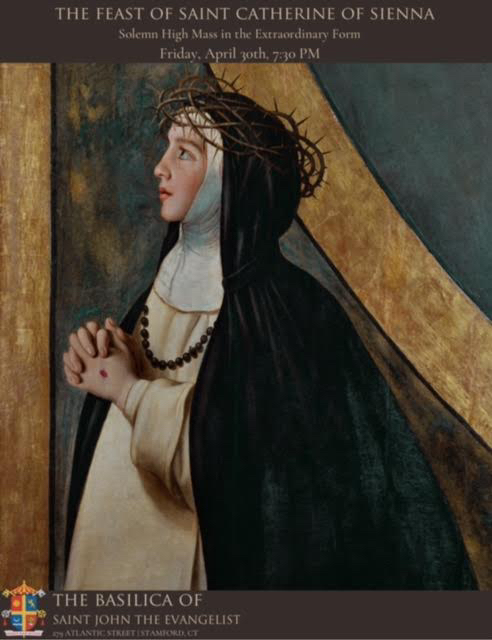
Basilica of St. John the Evangelist, Stamford, CT, 7:30 pm
St. Pius X Church, Fairfield, CT, Solemn Mass, 7 pm.
Sacred Heart Church, Georgetown, CT, 12 noon.
St. Joseph Church, Danbury, CT, March 18, 6 pm: Solemn First Vespers; March 19, 6 pm Solemn Mass (See poster below for more details)
Sts. Cyril and Methodius Oratory, Bridgeport, CT, low Mass 7:45 am, Missa Cantata, 6:45 pm
St. Patrick Parish and Oratory, Waterbury, CT, low Mass 8 am, Missa Cantata 6 pm.
St. Augustine Church, 30 Caputo Road, North Branford, CT, Missa Cantata, 6 pm. Father Robert L. Turner, celebrant.
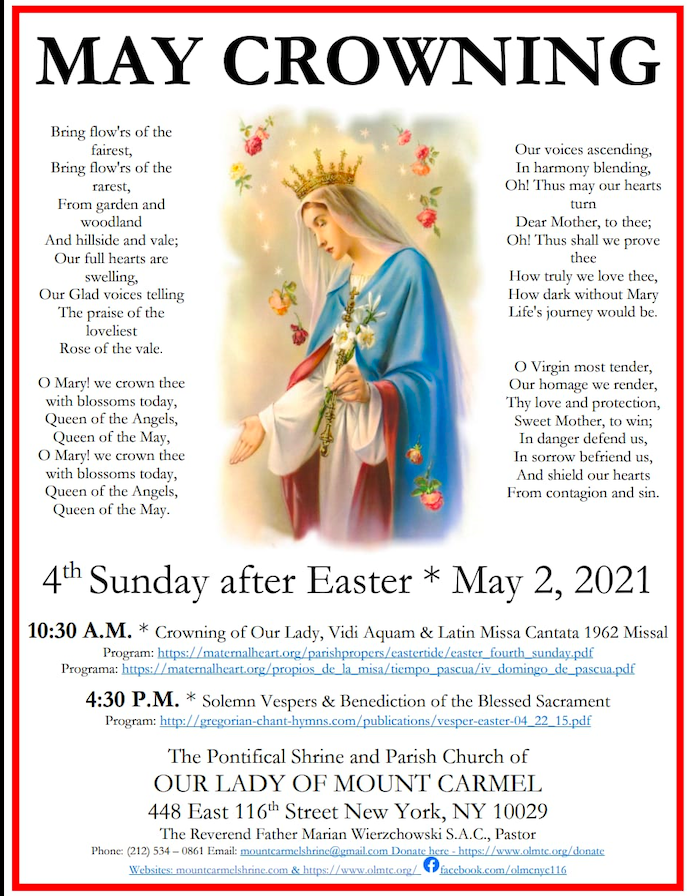
Our Lady of Mount Carmel, New York, NY, 7:00 A.M. – Low Mass; 7:45 A.M. – Low Mass; 7:00 P.M. – Missa Cantata 1962 and Blessing of St. Joseph’s table
Church of the Holy Innocents, New York, NY, 6 pm.
St. Claire of Assisi Church, 1918 Paulding Ave, Bronx, NY, Missa Cantata, 6 pm.
St. Josaphat Church, Bayside, Queens, NY, Missa Cantata, 7:30 pm.
St. Paul the Apostle Church, Yonkers, NY, 12 noon.
St. Barnabas Church, Bellmore, NY, (Long Island), Missa Cantata, 7 pm. The celebrant is Father Jeff Yildirmaz, the pastor of St. Barnabas. A new Latin Mass location on Long Island!
Notre Dame Church in New Hyde Park, NY (Long Island), Solemn Mass, 7:30 pm
Our Lady of Mount Carmel, Newark, NJ, Missa Cantata, 7 pm.
Corpus Christi Church, South River, NJ, Missa Cantata, 7 pm