1
Sep

30
Aug

It is just one more chapter in a long, sad story. Untapped New York reports on the 26 Catholic schools of the New York Archdiocese and of the Brooklyn diocese that are closing this year. 1) Others closed in 2019 – and many more before that! No restructurings, refinancings or other new programs seem able to stop the hemorrhaging,
But what caught my eye is that two of the schools highlighted in the Untapped New York report – the former parochial schools of St. Anselm and of Our Lady of Angels – are in my home town of long ago, Bay Ridge, Brooklyn. St. Anselm’s was my own school up to the third grade. My mother had attended it too. Many other relatives of mine on my mother’s side had attended nearby Our Lady of Angels. Like many other parishes in the New York area, St. Anselm’s had built its school – in the 1920’s – some thirty years before its church. That’s how important the Catholic school was to the diocese and the parents at that time. Later, St. Anselm’s added a more modern kindergarten in the back.
It seems now like a fond memory of a distant vanished age. My teachers were mostly School Sisters of Notre Dame who at that time still wore their original beautiful habits. Like myself, most of the children walked to school. I remember so well the rehearsals for our planned grand entrance into the church on the occasion of our first communion. Unfortunately it rained heavily that day – so we substituted a much more interesting (for me) trek through the linked cellars of the school and the church. I so enjoyed the few years I spent there – and was unhappy to have to leave the school when my family moved out of Bay Ridge.
What will be done with the buildings after the Catholic schools have closed? Nicholas Loud notes that a number are the work of Gustave Steinback, (1878-1959) prolific architect of Catholic churches and institutional buildings. He was the architect of Blessed Sacrament church on the Upper West Side, perhaps the finest Catholic church building in Manhattan neither a cathedral nor the establishment of a religious order. Speaking of Blessed Sacrament parish, Blessed Sacrament school, apparently successful and apparently still affiliated with its parish, took over in 2019 the building of the former parochial school of Sacred Heart of Jesus parish on West 52nd street to create an “upper school.”2)
Why is this happening? Officially blame is being placed on the coronavirus. It seems to me, however, that clearly lack of faith (or as Nicholas Loud puts it, a “declining of religious participation”) is the root cause. For the Catholic parochial school system was created to pass on the faith in an indifferent or even hostile American society. Regardless of what a “Priest In-Residence and Post-Doctoral Fellow at Notre Dame University,” quoted in Nicholas Loud’s article, implies, the parochial school was emphatically not intended primarily as a kind of poor relief for immigrant families – although it of course it did and does give them educational opportunities. Bay Ridge in the 1950’s was not a poor neighborhood by any stretch of the imagination, yet the parochial schools were flourishing. But when the level of “religious participation” has fallen to 15-20% of the nominal Catholic population the side effects on Catholic education will be immense.
That precipitous drop in the practice of the faith came, of course, in the wake of the Second Vatican council. That’s when the sisters first modified their habits and then discarded them entirely. And a short time after that they themselves disappeared from the classrooms. The growing reliance on lay teachers caused costs to skyrocket. An increasingly religiously indifferent Catholic community no longer perceived a need for this education – certainly not at this now substantial price. Those who indeed were poor found Catholic eduction increasingly difficult to afford. And many of the minority who did remain committed in principle to Catholic education were increasingly dissatisfied with the evolution of the religious and secular content, thus giving rise, for example, to the Catholic home schooling movement.
As I mentioned above, the New York City Catholic school began to be perceived as a secular welfare program. In many cases much or even most of the student body became non-Catholic – inevitably leading to conflicts and compromises. This had the effect of further restricting the potential pool of students.
Over the years all kinds of new structures have been devised to try to stem the tide – yet the decline of the school system goes on. It is in some ways amazing – in these decades in which the even more catastrophic decline of the public schools should have opened up opportunities, the Catholic school system instead seems gripped by an irresistible process of decay.
The story of my own former school is instructive. St. Anselm’s and Our Lady of Angels’ parochial schools had previously been converted into “charter schools”: St. Anselm Catholic Academy and Holy Angels Catholic Academy In 2019 it was suddenly announced that St. Anselm Catholic Academy and Holy Angels Catholic Academy would join together to become Bay Ridge Catholic, an academy operating out of St. Anselm’s building. Its leadership offered this not totally coherent explanation:
“Over a 10-year period enrollment has declined, but there has been some recent student growth at St. Anselm and there is positive energy,” St. Anselm Board of Directors Chairperson John Quaglione told the Eagle. Still, there are troubling signs, Quaglione said. “We saw projections that enrollment would continue to decline. The student population will continue to go down. The pool as a whole is shrinking,” he said.
By combining the two schools into one entity, leaders at both schools said they believe they can help save Catholic education in their section of Bay Ridge. 3)
Bay Ridge, for those unfamiliar with Brooklyn, remains, as it has always been, a decidedly middle class – even upper middle class – place. (To be fair, a third Catholic academy in Bay Ridge (or Fort Hamilton), the St. Patrick Catholic Academy, stated in 2019 it was doing well.)
And what is the curriculum of the new combined Bay Ridge Catholic Academy? The school’s website claims it will be centered around faith, arts and engineering.(!) But it is the latter that receives all the emphasis:
The curriculum will be focused on engineering and inspired by the arts.
It seems so very different from the St Anselm’s I knew in the early 1960’s! Please excuse my pessimism, but I foresee only continued decline of the once grand Catholic school system.
29
Aug

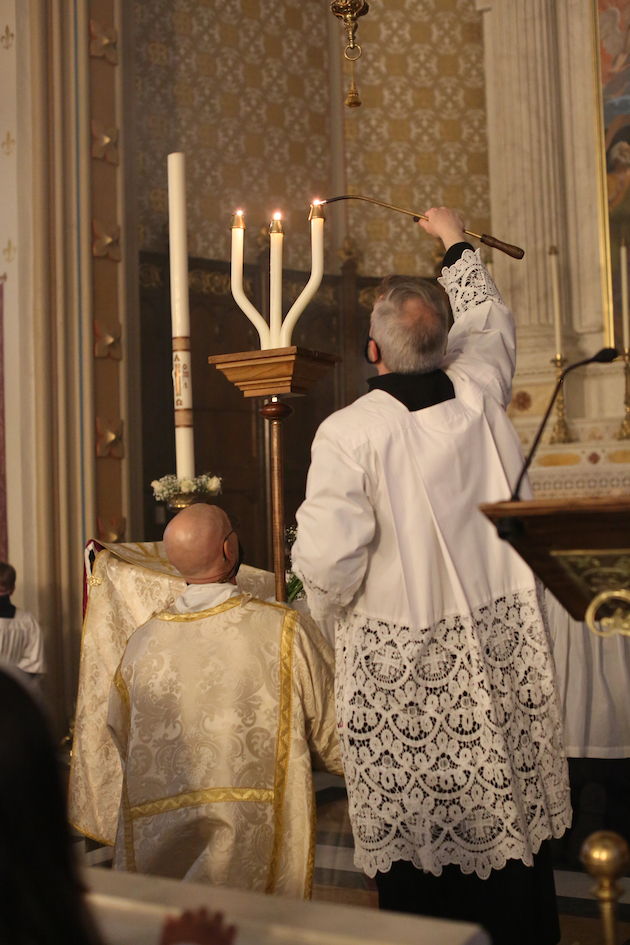
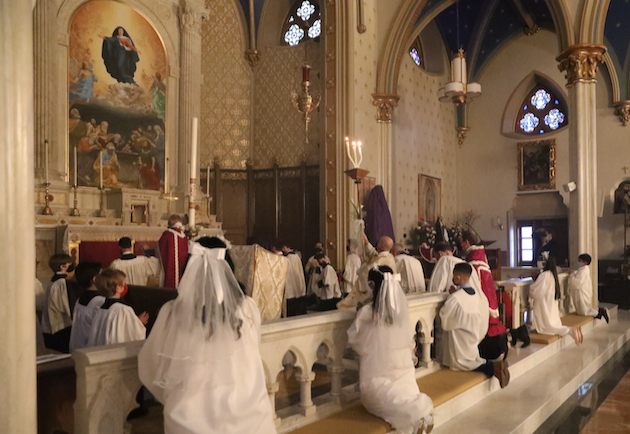
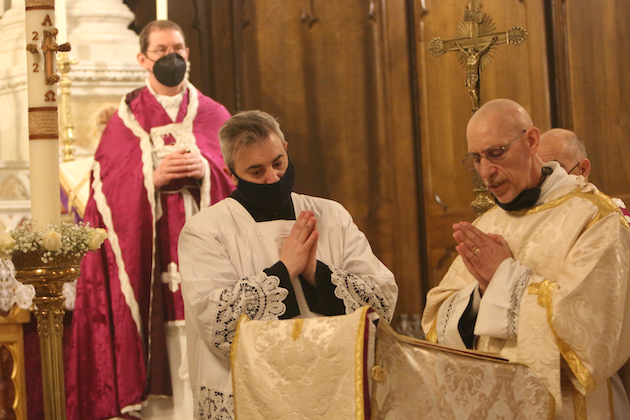
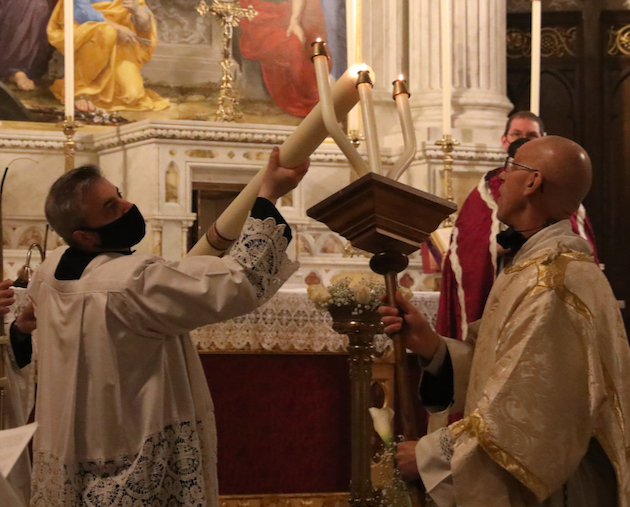
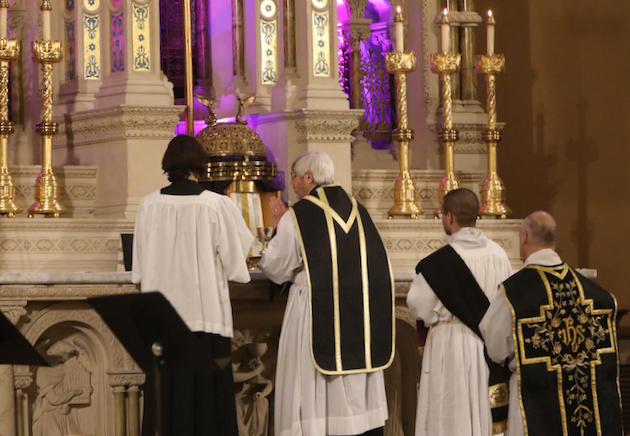
This morning Fr. Michael Novajosky celebrated at Missa Cantata for the Feast of the Beheading of St. John the Baptist at St. Augustine Cathedral in Bridgeport, CT.


27
Aug
Which Canon Jean-Marie Moreau, ICKSP, has been building up in Sulphur, Louisiana. From Hurricane Laura.


25
Aug

Most Holy Trinity church in Mamaroneck, Westchester county, scheduled to be closed has been saved after a decison by the Vatican – the consequence of a tenacious campaign by the parishioners.
Whereas on May 26, 2018, we gave a decree relegating the church of Most Holy Trinity in the Parish of Saint Vito-Most Holy Trinity, Mamaroneck, New York, to profane but not sordid use according to the prescripts of canon 1222 §2 for the grave causes mentioned in said decree;
The decree of May 26, 2018 relegating the church of Most Holy Trinity in the Parish of Saint Vito-Most Holy Trinity, Mamaroneck, New York, to profane but not sordid use according to the prescripts of canon 1222 §2 for the grave causes mentioned in said decree is herewith rescinded.
Decree of the Archdiocese of New York of July 2, 2020.
A Vatican-appointed priest assigned to oversee the case recently ruled that the arguments put forth by the parishioners had merit, Maver said.
Then, last month, Dolan wrote in a decree that, “after prayerful consideration, having weighed all the reasons and causes” he had decided to rescind the 2018 ruling closing the church.
Source. (NY Post 8/12/2020); see also Patch (8/13/2020
It is a remarkable reversal of fortune – one much more significant than it first appears, given the direct Vatican involvement. For in July of this year the Congregation of the Clergy suspended the massive diocese-wide parish restructurings of least two dioceses of Germany. We covered this development HERE. The instruction, The pastoral conversion of the Parish community in the service of the evangelising mission of the Church, among other provisons, reiterated at VIIa 46-51 that procedures and canon law must be followed in carrying out the suppression of any parish. This, and the Mamaroneck decison above, indicate that for the time being a much stricter review of diocesan parish reduction programs can be expected.
Thanks to James P. Maver, Esq. ( a leader of the parishioners’ fight to save their church.)
25
Aug
From the post on the great site Ephemeral New York
St. Monica’s – my old parish in 1982-83, and now, after Making all Things New “The parish of St. Monica, St. Elizabeth of Hungary and St. Stephen of Hungary.” As you can see below, a section of old tenement buildings on the corner has been torn down, exposing the brick side of the church to view for the first time in ages.


I have to differ from the erudite author of Ephemeral New York in one respect, though. St. Monica’s, like many other Manhattan churches, was meant to be viewed only from the front. Like many others, only the facade of St. Monica’s is finished in stone. The church was thus intended from the beginning to be a part of streetscape over which it presided but did not overpower or crush.


Thus, the current appearance of the church is anomalous. But what may come is far worse. For it could well be that a gigantic high rise may be built on the now empty lot. The neighood is already up in arms about that possibility. If such a bulding is erected, it would dominate and overpower the immediate neighborhood – including St Monica’s. Depending on what is built, it might also cast into permanent darkness the wonderful windows of St Monica’s on the west side of the nave – and perhaps some of those of the apse as well?
Our 2011 article on this parish.
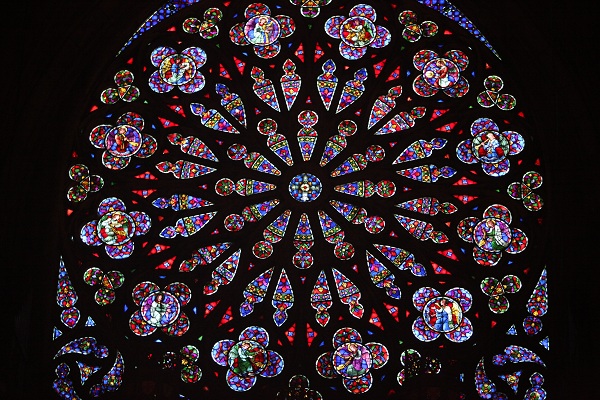
(Below) St Elizabeth of Hungary- one of the splendid windows of St Monica’s church. St. Monica’s has some of the most beautiful decoration and furnishings of any Manhattan Catholic parish.

.
25
Aug

From the Philadelphia Inquirer: “At Philly Catholic churches, secret renovations expose rift between traditional and Neo-Catechumenal members” (By Valerie Russ, 8/19/2020)
For the last 12 years, Donna Panno, who leads the singing for Sunday Mass at St. Michael Roman Catholic Church in North Philadelphia, sat in the first pew. It was the same pew in which her mother, now 91, fainted as a 6-year-old from a fever.
But while St. Michael was closed because of the pandemic between March and early June, that pew, along with many others, was ripped from the historic church’s hardwood floors, the altar rails removed. The center-aisle marble floor — down which members and their parents before them had marched to be married — as well as the hardwood floors beneath the remaining pews were covered in bright red carpeting.(See photo above; my bolding)
It all happened under the direction of the Rev. Arturo Chagala, who, since 2014 has led both the traditional Catholic congregation at the church, at Second and Jefferson Streets, as well as the members of the Neo-Catechumenal Way, an evangelical ministry that’s been acknowledged by the Vatican since 2008 and that at St. Michael comprises about 10% of the almost 250 parishioners.
Obviously parishioners – of the “traditional Catholic congregation,” that is – were upset. But this is not the only church where this has taken place:
The uproar marked the second instance this summer where members of a Catholic parish have publicly condemned a Neo-Catechumenal Way leader for major overhauls of their sanctuaries without their input, exposing a growing rift between longtime parishioners and Neo-Catechumenal members.
At St. Charles Borromeo in South Philadelphia, parishioners have taken to public protests, alleging that the Rev. Esteban Granyak made renovations to the chapel without consulting its longtime, predominantly Black, parishioners. Among other changes, he converted the basement gym into a separate worship space for Neo-Catechumenal followers, even though its longtime members used it to gather for repasts after funerals. Also, the marble altar railings used when kneeling for prayer or Communion were removed.(my bolding)
Others, besides the parishioners of St. Charles and St. Michael, are not amused:
Architectural historian Oscar Beisert said his “blood boiled” when he saw pictures of the remodeled St. Michael sanctuary. Although its historic designation by the city only protects a building’s exterior, he called the changes a travesty.
“He took a classically beautiful building and vandalized it,” he said. “I call it architectural vandalism.”
Even Massimo Faggioli is quoted in this article making distinctly critical remarks about the Neocathecumenal way. And the new Philadelphia archbishop, Nelson J. Pérez, has intervened in the matter. The pastor of St Michael’s had to issue an apologetic letter to his congregation:

The case is currently under consideration at both churches. How many of these changes will be reversed – and when – is as of now undecided. Actually these specific “renovations” are very similar to so many others imposed on parishes in the past. What is new is the organized articulate opposition to them – and the hearing given to the protestors by the local archdiocese.
(Below: the wreckage of the Communion Rail at St. Michael’s. Photo:Philadelphia Inquirer)

(Thanks to a friendly reader for the tip.)
25
Aug

Reclaiming Our Roman Catholic Birthright: The Genius and Timeliness of the Traditional Latin Mass
by Peter Kwasniewski
Angelico Press, Brooklyn, NY, 2020
It’s amazing for a traditionalist “old-timer” – which I guess I now am – to experience the breadth and maturity of American Traditionalism today. The best evidence of that, in addition to the ever growing number of Traditional Masses, parishes, monasteries, and internet apostolates of all kinds, is the extraordinary new literature on the old rite. Earlier this year the English translation of Fiedrowicz’s authoritative The Traditional Mass appeared. Now Peter Kwasniewski gives us Reclaiming Our Roman Catholic Birthright. It is an open, unabashed and unashamed apology ( in the early Christian sense) for the Traditional Roman Catholic liturgical life.
The first noteworthy thing about Reclaiming our Roman Catholic Birthright is that we have this book in the first place. With the conspicuous exception of Martin Mosebach’s landmark 2002 Heresy of Formlessness – and perhaps Fr. Claude Barthes’s more specialized 2011 La messe : Une Forêt de Symboles – I do not recall previously encountering such books on the liturgy itself from the Traditionalist perspective. Moreover, I am not sure such works were published even before the Vatican Council. For the pre-conciliar works I have seen tended to be either picture books or descriptive manuals – sometimes with an apologetic (in the contemporary sense!) flavor. The vision that the Traditional Mass – as it then existed – was the central point of Christian life and could be even a “selling point” for the Church to evangelize its own flock and the rest of the world seemed to have been obscured.
Now Kwasniewski eloquently and passionately advocates the celebration of the Traditional Mass. He concentrates more on the advantages of the old rite, not the deficiencies of the new. Furthermore, Kwasniewski does not shrink from the conclusion that the old rite is intrinsically superior to its successor; that it should be once again the norm for all Roman Catholics. What is implicit in Mosebach’s and Fiedrowicz’s works is here boldly proclaimed:
From this vantage we can see, more clearly than ever. the vital spiritual, psychological and sociological need in our time for the usus antiquior. The reintroduction of the traditional Mass is not merely a matter of superior aesthetics, rather it concerns all of the crises we face us a society, as a race, as a planet.
In many ways Reclaiming our Roman Catholic Birthright complements Fiedrowicz’s work. The latter is primarily a description of the Mass and a historical account of its formation, while Kwasniewski systematically presents the arguments why we should frequent and love this Mass – and how to defend it from its enemies. It is remarkable that Kwasniewski draws overwhelmingly on the insights and experience of the last few years under the reign of Pope Francis; indeed, much of the book reflects articles of the author and others from just 2018 to 2020! Could there be any better evidence of the vitality of today’s Traditionalism? Most of this material appeared first on the internet, once again demonstrating the decisive role it plays in the Traditionalist movement.
The solid grounding of this book in experience of the current liturgical practice of the old rite is everywhere evident, such as where Kwasniewski points out that young children can be better behaved at a lengthy Solemn High Mass than at less elaborate liturgies, because there are so many more things to see and hear. This observation exactly agrees with my own experience in the now distant pre-Vatican II days. Back then he usual Sunday mass I had to attend was a low Mass organized for the pupils of the parochial school. The music was limited to four English hymns. How dazzled I was by the parish Solemn Mass the few times I had the good fortune to be taken to it by my parents.
Kwasniewski reminds us of the continuing hostility of large parts of the Catholic clergy and laity to the Traditional Mass. Much of Reclaiming our Roman Catholic Birthright is therefore devoted to discussing and refuting the arguments against the Traditional mass. Kwasniewski, in my view correctly, attributes this opposition less to the strength of rationally formulated arguments but to the perception that the celebration of the Traditional Mass is a repudiation of the “Vatican II event” to which, voluntarily or not, the members of the Church Establishment have irrevocably committed themselves. One more reversal of their liturgcial principles would be an incalculable mental blow.
As an illustration, Kwasniewski presents a kind of dialogue with a representative “Conservative Catholic”, Msgr. M. Francis Mannion. (who elsewhere has described the Traditional Mass movement as “idolatry”!) Msgr. Mannion is of the view that the Traditionalist movement will “fade away” if young people can’t “understand the language” (even if they are doing exactly the opposite of that right now).
Let me digress a bit. Msgr. Mannion cites in support of this assertion a “study” by Professor George Demacopoulos of Fordham University (naturally!) that supposedly concluded that Greek Orthodox parishes in the United States are losing members (especially the young)because of the use of Byzantine or liturgical Greek, instead of modern Greek or English. How similar to what was being touted in the Roman Catholic Church circa 1963! But, on closer examination, the support for Msgr. Mannion from the Orthodox quarter is not all that strong. At least in his online post on this topic, Prof. Demacopoulos qualifies his view on the subject: the use of Byzantine Greek is just one contributing factor in the alleged attrition of the younger Greek Orthodox population in America, and in fact a number of other factors are more important. I believe that significant Orthodox jurisdictions such as the Russian Orthodox Patriarchy and the parent Orthodox Church of Greece have emphatically rejected changing the liturgical language, explicitly condemning the abandonment of Church Slavonic/Byzantine Greek, among other liturgical innovations. My conclusion is that those hostile to Catholic Traditionalism are grasping at straws to find reasons to support a position based not on facts or theology but upon ideological conviction reinforced by the fear of the consequences of being proven wrong.
One of the best parts of this book is Kwasniewski’s discussion of the view, explicit in the views of Msgr. Mannion, that direct communication of understandable texts is the most effective mode of liturgy. Rather, the transparency of the new mass, the absence of challenging symbolism, tends to decrease, rather than increase, participation by the congregation(much in the way we mentally “turn off” repetitive political harangues on television.) The Traditional Mass, in contrast. affords many different ways to “actively participate” in the liturgy. I also liked Kwasniewski’s opinionated (the author’s word), argumentative and at times humorous glossary of liturgical terms appended to this book.
I can personally testify to the discomfort aroused among the ranks of the so-called conservative clergy and their lay hangers-on by Peter Kwasniewski’s fearless and eloquent championship of the Traditional Mass. For he is just as convincing in person as on the written page! If you, however, are seeking a great one-volume exposition of the value and even the necessity of the Traditional Mass, you have found it with this book.
20
Aug

Polyphony has returned to St. Mary Church’s in Norwalk. Bishop Caggiano has granted permsion for a 4-voice schola. This Sunday, August 23, the Schola will sing William Byrd’s Mass for Four Voices at the 9:30 a.m. Solemn Mass.
Since the 9:30 a.m. Mass at St. Mary’s now regularly reaches its mandated capacity of 100 people, a Missa cantata (Extraordinary Form sung mass) will be added to the Sunday schedule at 11:30 a.m. Charles and Elizabeth Weaver will provide music at the 11:30 Mass this Sunday, August 23, including Ludovico Viadana’s Missa Dominicalis for solo voice with lute accompaniment.
Please call the church office at 203-866-5546 x 101 to make a reservation (as with all our weekend Masses).