14
Nov
11
Nov
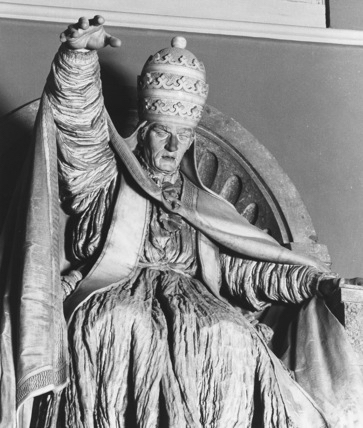
(Above) Pope Clement XIV (1769-1774) was a spineless individual who labored to please the powers of this world – in his day, the absolute monarchies – by abolishing the Jesuit order and imprisoning its leaders. His sympathizers financed well after his death this great monument by Canova, that disingenuously depicts this pope as a grandly authoritarian, Caesar-like monarch.
Gibbon wrote his massive Decline and Fall of the Roman Empire in the era of the late Enlightenment, a time of profound spiritual change in Europe. More recently, some notable authors have applied Gibbon’s framework of “decline and fall” to Christendom and the Roman Catholic Church itself. Noteworthy examples are The Decline and Fall of the Roman Church by Malachi Martin (1981) and The Decline and Fall of the Catholic Church in America by David Carlin (2003). Just in this year, Michel Onfray has contributed Decadence: the Life and Death of Judeo-Christianity. On closer inspection such works describe three distinct historical phenomena.
The first “decline and fall” is the secularization of the West, eventually culminating in the disintegration of “Christendom” as a cultural, religious and political reality. Loss of faith was accompanied by the evaporation of papal political power. We perhaps can place the beginnings of this development around 1300. By the time (1799) Novalis wrote Christendom or Europe in the wake of the French Revolution, this phase could be considered over. Even the pope died that very year in exile, as a prisoner of the French.
After the collapse of Christendom, however, the Roman Catholic Church was able to reorganize itself internally under the leadership of the ultramontane papacy. Ultramontanism in the 19th century sense contested the growing hegemony of liberalism yet also depended on it. The renewed stature of the papacy presupposed liberalism’s eliminating or weakening other competing centers of material and spiritual power in the Church (especially the absolute monarchies, but also the landed contemplative monasteries, the state churches of France and the Holy Roman Empire, etc.). What emerged by 1870 was a rigidly centralized Church organized around the clergy and the pope. All authority in matters of doctrine, liturgy and to some extent politics was reserved to the Pope and Vatican. The Church strived for uniformity in worship, music, philosophy and theology. Obedience to authority was elevated to an almost mystical value.
The second decline (and fall) dates to the Second Vatican Council and its aftermath. As a consequence of the Council and contemporary secular cultural revolutions, the uniform, centralized structure perfected between 1870 and 1958 collapsed. A great diversity of ecclesiastical organizations, “theologies” and liturgies emerged among the more “engaged’ members of the church. As Malachi Martin perceptively remarked, these new forms of “doing Church” were not just autocephalous but autozoic: not just autonomous in regard to Rome but having fundamentally different structures, practices and philosophies. What resemblances existed, for example, between the Catholic Church of the Netherlands (with its “Dutch Catechism”) and that of Poland, the Jesuit order and Opus Dei, the Catholic University of Louvain in Belgium and Thomas Aquinas College in California? Over all this chaos the centralized administrative structure of the Vatican and hierarchy remained intact – but the pope hardly dared take action against the (progressive) centrifugal forces even if he wanted to do so. The result, as to the mass of Catholics, was continued erosion of religious belief and practice – not only among the laity but even the clergy and religious.
With the election of Pope John Paul II, however, the Church experienced a “Wojtylian Restoration” with a renewed focus on the pope and the Vatican. The pope reoccupied the center of attention, even if stylistically now more as a secular political leader than as a religious figure. The journeys, public appearances and media interviews of Pope John Paul II were the defining characteristics of his renewed papacy.
Yet the ultramontane revival of John Paul II remained only a “Great Facade” (Chris Ferrara). Aside from insisting on a limited external conformity and firing warning shots at the most egregious progressive offenders, the Vatican made no attempt to recreate the uniformity of doctrine and morals that existed the pre-Conciliar years. At all times in the papacy of John Paul II, Catholic hierarchs, religious orders and schools embraced and agitated for the most diverse and contradictory positions. The Vatican’s solution to mounting massive problems – like declining numbers of clergy and religious; clerical sexual abuse, financial corruption and above all the decline in the West of belief and religious practice among Catholics – was to sweep them under the rug.
Now the start of the third “decline and fall” can be placed in the reign of Pope Benedict XVI. Pope Benedict had continued in most respects the regime of his predecessor. He departed from it, however, by taking a marginally more conservative teaching line and implementing significant legislative changes in the field of liturgy. This naturally aroused a storm of opposition both within and outside the Church, both in public and behind the scenes. Pope Benedict was utterly incapable of mastering the powers challenging his papacy: the establishment religious orders, the Vatican bureaucracy, the mass of Catholic “academics” and “scholars,” the Western European episcopates (especially that of Germany!). These more or less open opponents had no intention of yielding the positions of power they had acquired over the Church since the Vatican Council. Moreover, they acted in the closest alliance with the secular media and to some extent even the secular political powers. They rendered the Church almost unmanageable for Pope Benedict, whose ultimate answer was capitulation. Pope Benedict’s resignation was a staggering blow to papal authority.
In Pope Francis, the Catholic progressive forces finally established a man of their own as the supreme power in the Church. There followed an unprecedented outpouring of progressive words, gestures and deeds – often in direct contradiction to what had been considered settled (at least on paper) in morality, theology and philosophy. The supposed bastions of Wojtylian conservatism, like the Italian and United States hierarchies or the Knights of Malta, fell almost overnight. Supposed “Wojtylian” bishops, publicists and scholars (like Cardinal Marx of Munich) quickly became bellicose advocates of the new order.
A ”cult of personality” around Pope Francis arose dwarfing anything in the past. The Pope also employed authoritarian, not to say crudely manipulative, means in furthering his agenda. Indeed, Francis and his clique have sought to address the rising number of critics of Bergoglian policies by reviving ultramontane rhetoric in its most extreme form. The Pope himself talks of his “magisterial authority” and of the “irreversible” reforms of Vatican II. The canonization or beatification of every pope since 1958 – excluding perhaps Pope Benedict – also fits into this pattern. The paladins of Team Francis accept as at least de facto infallible every document of Pope Francis – even his uncontrolled ramblings in planes, interviews and, daily, in the Casa Santa Marta acquire in their eyes magisterial force. Substantive criticism of the current regime is triumphantly countered by accusations of “criticizing the pope” of “disloyalty to the Holy Father” and of course, “creating scandal.”
It’s all a delirious and previously unimaginable alliance of dissent and ultramontanism, of the National Catholic Reporter and L’Osservatore Romano, of the Jesuit order and the Knights of Columbus. We believe though, that this novel Bergoglian ultramontanism is inherently unstable. The notion of a “progressive” a “dissenting” or even a “heretic” pope is simply too outrageous and contradictory for too many people. The sudden reversal of principles – like that on marriage – that only yesterday were proclaimed immutable will prove even more destabilizing than the changes of the 1960’s. And just a cursory look reveals that Pope Francis can only be authoritarian and decisive when conforming to the dogmas and expectations of Western civil society.
At least as of this moment, hardly anyone in the Catholic establishment will take on Pope Francis. Yet outside of the mainstream institutions, the Bergoglian revolution has aroused a storm of criticism. It’s quite a contrast to the initial unopposed implementation of Vatican II, which built on the legacy of centralized ultramontane control. The main effect so far of the reign of Francis is to compound the already existing fractures and chaos of the post-conciliar Church. Pope Francis professes to endorse such “diversity” as a positive development conducive to ongoing change. We see the early quantifiable results already in the free fall of vocations and of the practice of the faith. Truly this is the third “fall” of the Catholic Church since 1789!
But out of this seemingly inevitable tragedy may come at least one advantage: the truth. For far too long the Catholic Church has continued to take refuge in fantasies of stability and success, of secular standing and influence. You need look only at any of the official Catholic media to confirm this – isn’t the Al Smith Dinner in New York the incarnation of this self-deception? Even the supposedly hard-nosed liturgical traditionalists remained to some extent in thrall to these mirages. The poison of dishonesty has eroded the faith more surely than any persecution or loss of worldly advantages could do. Moreover, in addition to obscuring reality, the culture of ultramontanism also inculcated habits of spiritual torpor, passivity and blind deference to authority (by extension, also to secular authority!) that have left Catholics ill-equipped to navigate the unprecedented post-Conciliar crisis.
Let be be finale of seem! Jettisoning the Catholic culture of pretend is the first, most necessary step towards reform. To that extent we owe Pope Francis a debt of gratitude. Does not the shipwreck of a mythical centralized day-to-day magisterium make possible a return to the Catholic spiritual “basics” of prayer, penitence and evangelization? And, doesn’t the Tradition of the Church, present before us in the Fathers and Doctors, in history and art and, above all, in the liturgy as it is lived every day remain to us as a surer guide?
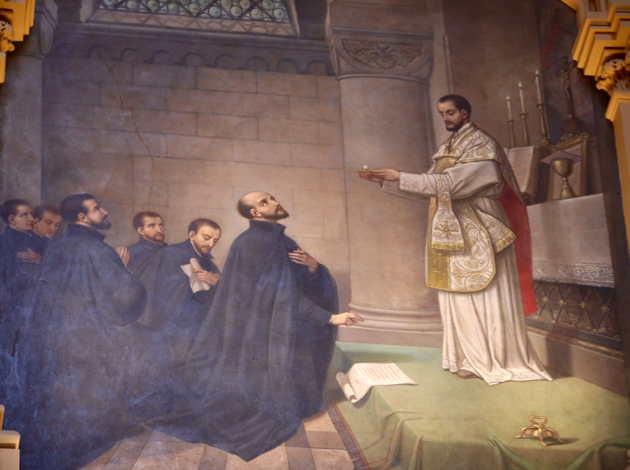
(Above) Fall and renewal. On September 25, 1534 the disastrous papacy of Clement VII came to an end. Just over a month earlier in that year, before dawn on August 15, the first Jesuits had taken their vows (before Peter Faber, the only priest among them). (Mural in the church of St. Francis Xavier, New York)
11
Nov
Monday, November 13
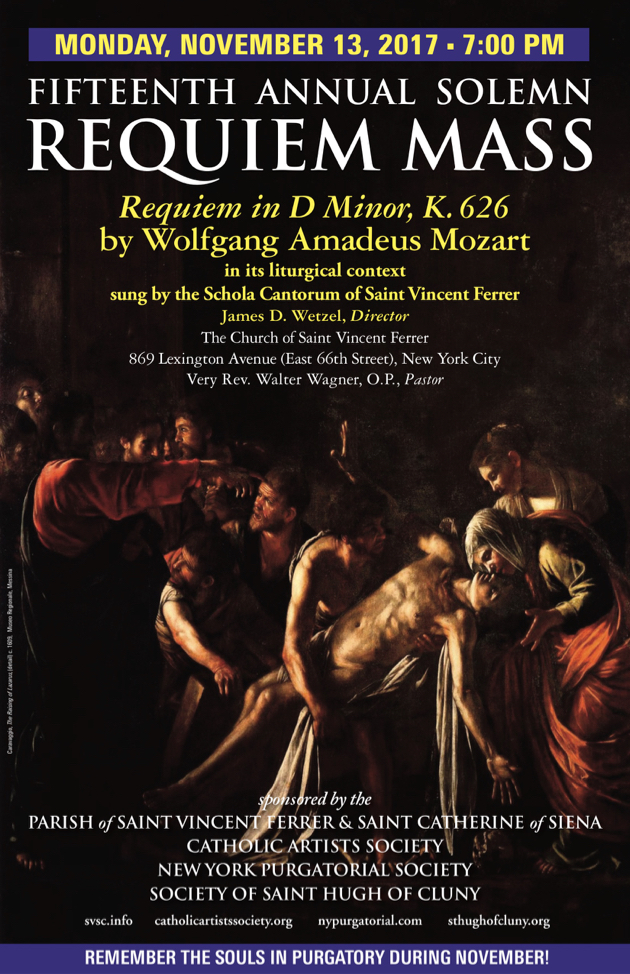
Solemn Requiem Mass in the Dominican Rite, St. Vincent Ferrer Church, New York, 7 pm, featuring Mozart’s Requiem in D Minor, K. 626. information
Solemn Requiem Mass, St. Mary Church, Greenwich, CT, 7:30 pm.
Tuesday, November 14, Votive Mass for the Dead, St. Stanislaus Church, New Haven, 7 pm.
Wednesday, November 15, Missa Cantata for the Feast of St. Albert the Great, St. Vincent Ferrer Church, 7 pm. information
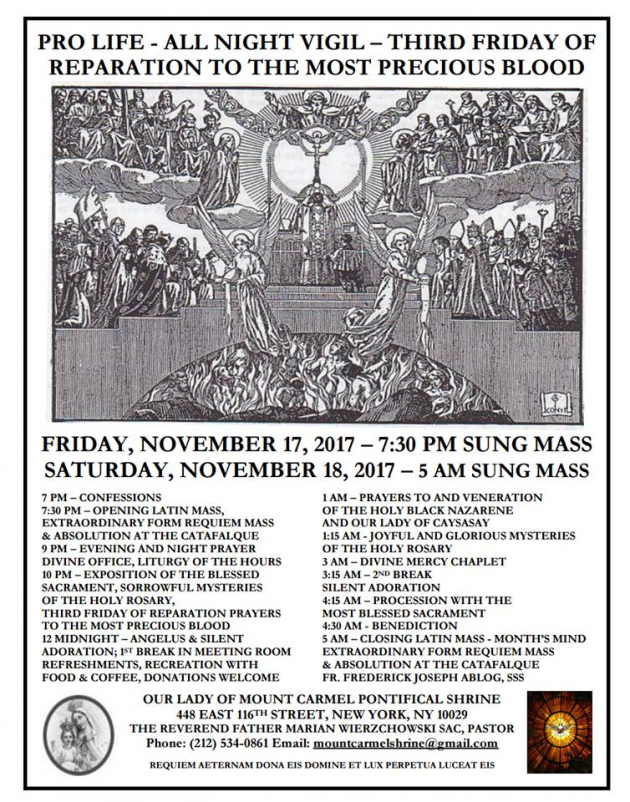
Friday, November 17-18 All Night Vigil in Reparation to the Most Precious Blood, Our Lady of Mount Carmel, New York, begins at 7:30 pm, ends with 5 am sung Mass on Saturday. information
Tuesday, November 21, Solemn Mass for the Feast of St. Cecilia, Church of St. Cecilia, Brooklyn, 7:30pm. information
Also Tuesday, November 21st at 7:30 p.m., Solemn Mass for the Feast of the Presentation of the Blessed Virgin Mary at the Pontifical Shrine of Our Lady of Mount Carmel in East Harlem, New York. The sermon and readings from the pulpit will be in Spanish. After Mass there will be devotions to Our Lady of Divine Providence, Patroness of Puerto Rico, whose feast falls on November 19th.
Sunday, November 26, 12:30 pm, Solemn Mass for Feast of Our Lady of the Miraculous Medal, ST. John the Baptist Church, Allentown, NJ. information
Sunday, December 3rd, Rorate Missa Cantata in the Dominican Rite to conclude the parish’s all-night watch, 6:30 AM at St. Vincent Ferrer, New York.
.
Tuesday, December 12th, Solemn Mass for the Feast of Our Lady of Guadalupe, sponsored by the Society of St. Hugh of Cluny. Music of Ignacio de Jerusalem with period instruments, Church of the Immaculate Conception (414 East 14th Street, New York), pm time to be announced.
Saturday, December 16, Rorate Mass in honor of Our Lady, St. Mary Church, Greenwich, CT, 6:30 am.
Monday, December 18, Sung Requiem Mass, Church of St. Vincent Ferrer, NY, 7 pm. Sponsored by the NY Purgatorial Society
Monday, December 25th, Missa Cantata in the Dominican Rite for Christmas, St. Catherine of Siena Church, New York, 12 Midnight. Featuring Tomas luis de Victoria’s Missa Alma Redemptoris
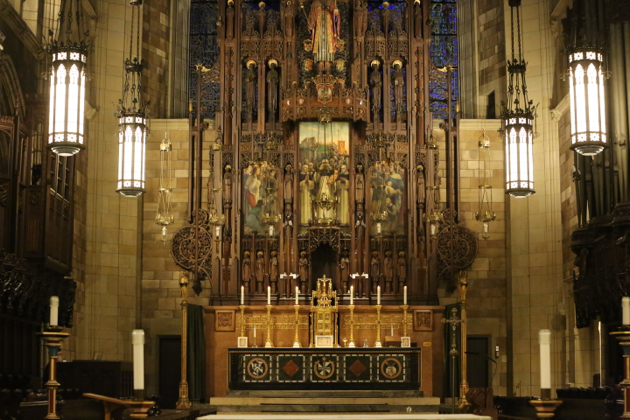
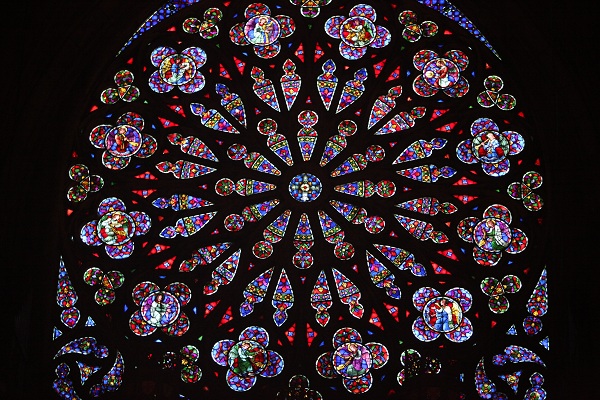
Stained glass window in the Cathedral of St. James, Brooklyn.
11
Nov
The church of St. Vincent Ferrer in New York will offer a Missa Cantata in the Dominican Rite for the Feast of the Saint Albert the Great, a Dominican bishop and teacher of Saint Thomas Aquinas, on Wednesday, November 15th at 7 pm.
The Schola will sing the Taverner’s Missa Sancti Wilhelmi devotio, Palestrina’s Justus ut palma (I); and Willaert’s O salutaris hostia.
11
Nov
9
Nov
8
Nov
The Costume Institute of the Metropolitan Museum of Art has announced a major exhibit planned for 2018 which examines how fashions have been inspired by Catholic iconography and style. It will feature a large collection of garments and accessories on loan from the Vatican. The show is entitled “Heavenly Bodies: Fashion and the Catholic Imagination.” The New York Times reported on it today see link.
Mr. Andrew Bolten, curator of the exhibit, admitted that it could be a provocative exhibit. But he said that he has “consulted with representatives from different Catholic groups including Cardinal Timothy M. Dolan.” So I guess we can assume that all will be in the best of taste.
We will at any rate look forward to viewing the collection that is being brought over from the Vatican.
7
Nov
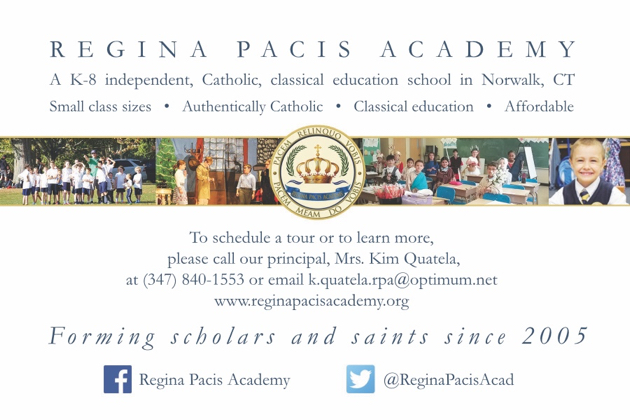
Regina Pacis Academy, an independent Catholic K-8 school in Norwalk, CT, will be holding an open house this Sunday, November 12 from 1 pm to 6 pm. The school is located on the grounds of St. Mary Church at 8 Leonard Street. Students have the opportunity to attend traditional Low Mass every morning at the church.
Interested parents may also contact Mrs. Kim Quatela, the school principal to schedule a tour or learn more. The school website: https://www.reginapacisacademy.com
Third and fourth graders perform at the recent visit of Bishop Athanasius Schneider to the school
7
Nov
The Metropolitan Catholic Chorale under the direction of Dr. Jennifer Donelson, will sing the Palestrina Missa Veni Sponsa Christi, motets by Howells and Palestrina, and the propers of the Mass in Gregorian chant.
6
Nov