Friday, May 26 is the Feast of St. Philip Neri. St Mary Church, Greenwich, CT will have a Solemn Mass at 7:30 pm.

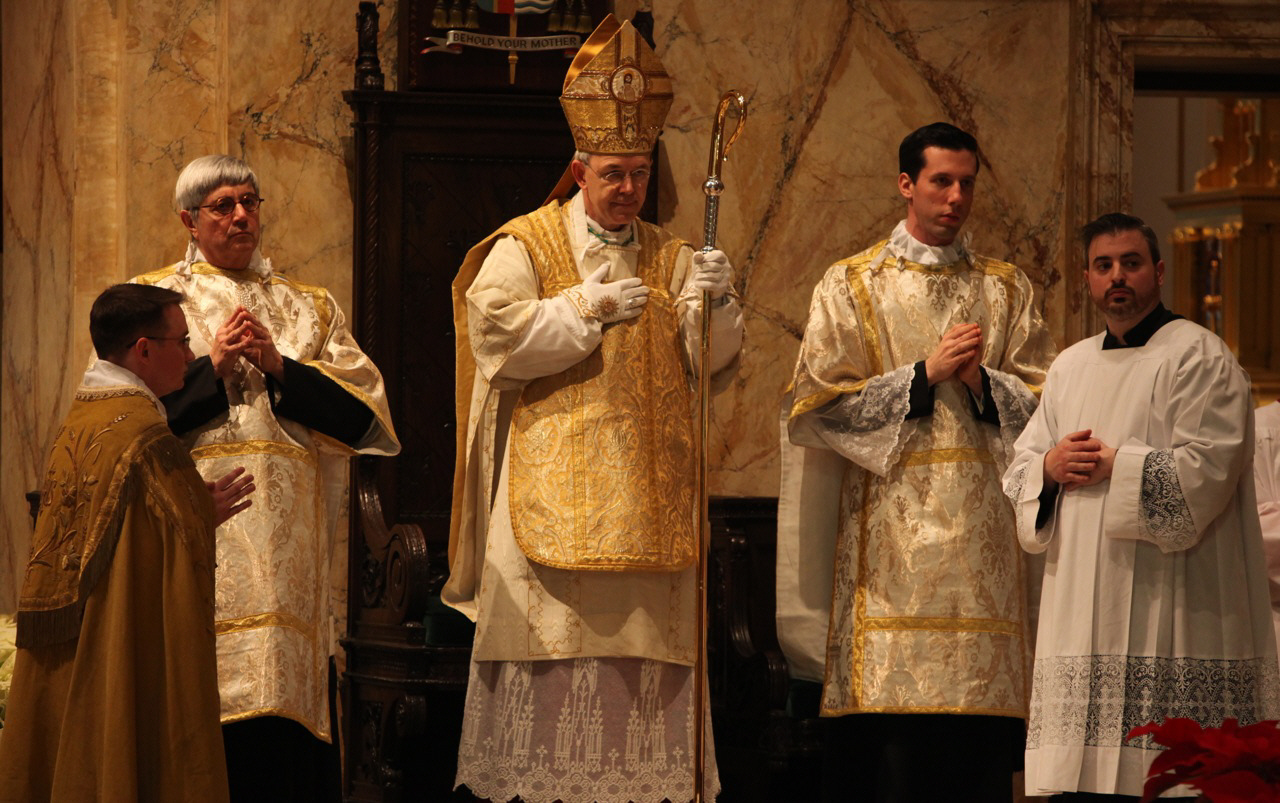
Friday, May 26 is the Feast of St. Philip Neri. St Mary Church, Greenwich, CT will have a Solemn Mass at 7:30 pm.

Fr. Leonard F. Villa offered traditional Sung Mass at his parish in Yonkers (St. Paul the Apostle) for the 100th Anniversary of the Apparition at Fatima, Portugal. During Mass, Fr. Villa consecrated the parish to the Immaculate Heart of the Blessed Virgin Mary. Photo Courtesy of Diana Yuan.

Chanting of Te Deum in thanksgiving for the 30th Anniversary of Ordination to the Priesthood of Fr. Marian Wierzchowski, SAC at the Pontifical Shrine of Our Lady of Mount Carmel, New York, May 19. Photo courtesy of Diana Yuan.

New York Purgatorial sung Requiem Mass in the Dominican Rite at St. Vincent Ferrer Church on Monday, May 22. Photo courtesy of Diana Yuan.

(above and below) Solemn Mass, Procession, & Feast in honor of Madonna del Sacro Monte di Novi Velia at Holy Face of Jesus Monastery in Clifton, NJ, May 21. Photos courtesy of Anthony Scillia and John Napoli.


 Sermon for the Fifth Sunday after Easter
by Father Richard Gennaro Cipolla
St. Mary’s Church, Norwalk, CT, May 21,2017
You are my friends if you do what I have commanded you to do. Love one another. (John 15:14)
For me those chapters of the gospel of St John that we call the Farewell Discourse, parts of which are read before Pentecost, are remarkable in their teaching about love with respect to Christ, and for me, defines what friendship really means. We live in an age in which the word friend has become debased. In the world of Facebook the word friend has become a verb: to friend someone, to establish a cyberworld relationship that has nothing to do with friendship as classically conceived and deepened in Christian thought, ultimately grounded in the love between two persons that is a gift from God and that finds its completion in the person of Jesus Christ.
When I taught the advanced Latin class in my former life as a Latin teacher, a vocation graced in so many ways, I always chose Cicero’s treatise on friendship as one of the works we read. Cicero’s difficult and elevated style and syntax is a challenge for even the brightest students, but invariably De Amicitia, (On Friendship), and Augustine’s Confessions were the two works that the students seemed most interested in. This is how Cicero defines friendship: “Friendship is agreement in things human and divine, with good will and charity”. Based on that definition of friendship he claims that friendship is the greatest gift of the gods to man. And it is that definition of friendship, quite good in itself, that became the basis of the Christian understanding on friendship, from St. Augustine to the medieval mystics to St. Francis DeSales and St Jeanne de Chantal to St. John of the Cross to Pope Benedict XVI.
In his treatise On Spiritual Friendship Aelred of Rievaulx, a monk of the 12th century and abbot of his monastery in Yorkshire, points out how the word for friend, amicus, comes from the word for love, amor, and it is amor as well that is the basis for amicitia, the word for friendship. He places friendship at the very creation of man, in that longing to love another: and God saw that it was not good for the man to be alone. The very first love song, as I always say in my sermon for a wedding , is when Adam recognizes Eve as the one whom he can love and in that love complete himself. “Bones of my bones, flesh of my flesh!”Thus the longing for friendship, to love the other and be loved by the other, is a part of what it means to human. After the fall, friendship became distorted by jealousy, control, possessiveness, egoism and so forth. But the longing for friendship was still there, We think immediately of the deep friendship between David and Jonathan in the Old Testament, and friendship found the ground for its purification and the reality of its possibility in the person of Jesus Christ.
We can say that there can be love without friendship, in that as Christians we are called to love even our enemies. And there are those, especially in our families and those in our communities that one must will to love. My admonition to many people including myself: Love is an effort of the will. But there can never be friendship without love, because it is love for one’s friends that defines and is the essence of friendship. In a real sense two people are called to be friends. They meet, they discover mutual interests, in speaking they realize they understand important things in the same way, there is a mutuality, so to speak, that promises to blossom into that relationship of mutual love and affection. And this relationship transcends sex and age. Cicero limited this deep friendship to men. But that cannot be true in the Christian understanding since the capacity and longing for friendship was there at the very beginning. One of the great friendships of my life was with my grandmother, Nonna Marietta. From an early age I knew that there was a bond between us that the other members of the family did not have. I remember my visits to her when I was in college, when we would sit and talk about her life as a young woman in Galluccio, about my grandfather, who died before I was born, watching her cook with love and instinct, watching her face that had a distinct beauty of its own, not conventional but there. I remember the silences in our conversations when we allowed each other to reflect on what this all meant.
The enjoyment in true friendship is a foretaste of heaven. Friendship springs directly from God who created humanity, who created them to share his love with each other:” Love one another as I have loved you.”The human heart has impressed upon it the desire for friendship. True spiritual friendship perfects love, perfects creation itself. CS Lewis said: “Friendship is unnecessary, like philosophy, like art…it has not survival value; rather it is one of those things that give value to survival. “
There are friendships that are carnal, relationships that exist to satisfy sexual and other such desires. There are friendships based on mutual use of each other to gain something worldly. But these friendships have nothing to do with friendship as defined by the ancient Romans nor with friendship that is truly spiritual. The book of Proverbs says: “A friend loves always”. St Jerome also said: “Friendship that can end was never true.” We talk about past friendships, friendships that had their time and place and then we both moved on in our lives and that friendship is now part of the past. But what St Jerome is talking about is a truly spiritual friendship. Once again Aelred says: “The one who remains in friendship remains in God and God in him.” And one of Aelred’s more startling statements is this: “God is friendship.”
And that forces us to get to the real heart of the matter of friendship. It is after the Last Supper in his farewell discourse to the disciples that Jesus transforms friendship from the greatest gift of the gods to something coming from incarnate Love: This is my commandment that you love one another as I have loved you. Greater love has no man than this, that a man lay down his life for his friends. You are my friends if you do what I command you. No longer do I call you servants, for the servant does not now what his master is doing; but I have called your friends, for all that I have heard from my Father I have made known to you. You did not choose me, but I chose you and appointed you that you should go and bear fruit…This I command you, to love one another.
Those words define spiritual friendship in the Christian understanding. They need to be read and pondered and prayed over one’s whole life. And they are followed by the promise of the coming of the Holy Spirit. And why is this, why is this necessary? Because the disciples really do not know what he is talking about, they are thinking about themselves as he is speaking–What do these words about laying down his life for them mean? They will each betray him in their own way, they will be stubborn and refuse to believe, even before the Ascension itself. They need and receive the presence of the Holy Spirit in their lives to understand what friendship in Christ means: to love the other at the expense of one’s own self.
And this brings us to the relationship between spiritual friendship and silence. Conversation between friends is a part of what it means to be true friends. The delight in sharing in conversation with someone you trust and love is a wonderful thing. But It is also true that a number of writers have said things like this: two friends who are real friends can be happy sitting in silence with each other, not being embarrassed to not be talking, not being threatened by that silence that the world misunderstands as non-communication. Cardinal Sarah’s new book on Silence is remarkable in so many ways. I recommend it to you all. And at the heart of the silence of friends in the presence of each other is the Silence of God, that is the Silence of Love, and all that that silence means. At the heart of the silence of God is his infinite Love. That infinite Love is silent, it never screams, it never entices, it never speaks except in the whisper that can barely if ever really heard. And that is the Silence of God letting be, and that part of that letting be causes suffering for the one who loves and for the one he loves, the suffering of the world, the suffering of men and women who find themselves in places in which they feel abandoned, those places of sickness and of famine and of war and pestilence, which the world translates as the non-existence of a God who really cares. But remember this: that Jesus knew that each of his apostles with the exception of John would deny him and flee from the Cross. And except for his oblique reference to Judas in the farewell discourse he allowed them to betray him in silence. And it is out of that terrible silence of God on the Cross that the cry of dereliction comes; and the answer to the cry of forsakenness is the silence of God.
And in true Christian friendship, there must be that silence, that silence that is from the love of God, that silence that lets the other be, that silence that can cause suffering, but it is that silence that is the silent sound of the Word of God who entered into this world from the silence of his mother’s womb into a world that above all fears silence. “ I call you friends and give you a new commandment: love one another as I have loved you.” And then He is silent. And so must we be.
Father Richard Gennaro Cipolla

This Thursday, May 25, is the Solemnity of the Ascension of Our Lord. The following churches will offer traditional masses.
St. Mary Church, Norwalk, CT, 5:30 pm, Solemn Mass
St. Stanislaus Church, New Haven, CT, Low Mass, 5:30 pm
Church of the Holy Innocents, New York, Low Mass 8 am, Missa Cantata 6 pm
Our Lady of Mount Carmel Pontifical Shrine, New York, NY, Solemn Mass, 7:30 pm.
Church of Saint Anthony, 1496 Commonwealth Avenue, Bronx, NY, Low Mass, 8:00 p.m.
St Matthew Church, Dix Hills, NY (Long Island), 10:15 am.
St. Ladislaus, Hempstead, NY, Low Mass, 9am
Immaculate Conception Church, Sleepy Hollow, NY, Low Mass, 7 pm
Our Lady of the Way at the Culinary Institute, Hyde Park, NY, 5:30 PM
St. Anthony of Padua, Jersey City, 8 pm
Our Lady of Victories, Harrington Park, NJ, 6 pm
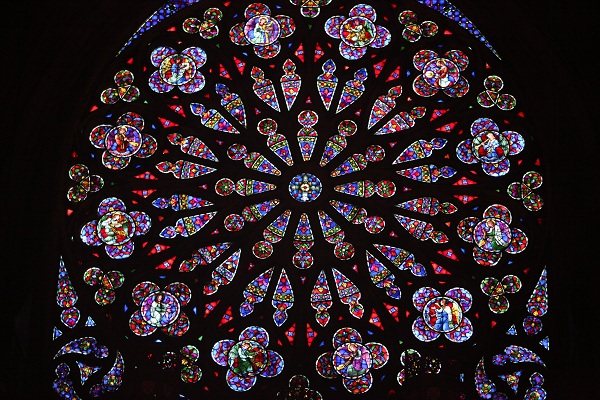
Stained glass window in the Church of St. Vincent Ferrer, New York

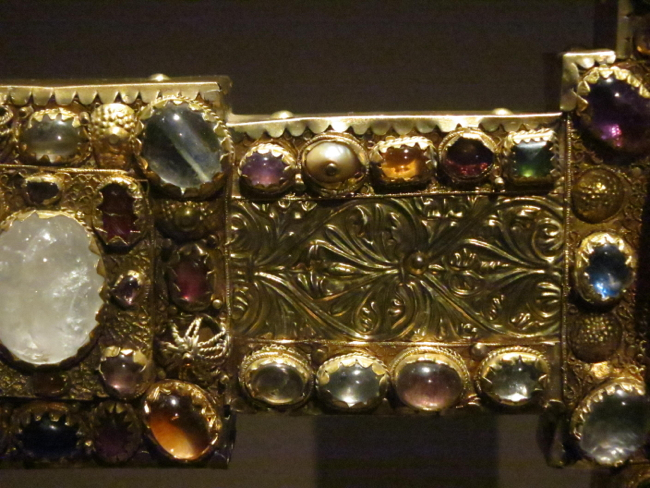
“Le Musée d’Art Religieux de Fourvière” (attached to the church of Fourvière in Lyons) has been burglarized. Among the objects taken is a crown for a statue of the Virgin Mary donated in 1899 by families of Lyons. HERE is a description of the museum’s treasury

Yesterday evening, Father Robert Boyd, FSSP, celebrated a Missa Cantata at Holy Family Chapel in Convent Station, NJ to honor Blessed Miriam Teresa Demjanovich, whose body is interred there. Blessed Miriam Teresa was beatified in 2014 and is New Jersey’s first blessed. Born in Bayonne, NJ in 1901, Teresa became a Sister of Charity in 1925. While still a novice, she wrote of series of conferences, which were published posthumously in a volume entitled Greater Perfection. According the the biographical sketch available in the chapel “Teresa’s life in religion was short but filled with much work and suffering of both body and soul. Like St. Therese of Lisieux, she apparently lived a long time in a short space. She died May 8, 1927.”
Holy Family Chapel, where yesterday’s mass took place, is on the campus of the College of St. Elizabeth next door to the motherhouse of the Sisters of Charity of St. Elizabeth.

The motherhouse, where Blessed Miriam Teresa lived as a novice.

Holy Family Chapel


The schola from Our Lady of Fatima Chapel, Pequannock, NJ

(Above and below) Blessed Miriam Teresa’s relics are interred in an octagonal wooden box, in what used to be a confessional in the transept. A guidebook to the chapel explains that she used to go to confession there. A Sister of Charity, (standing to the right of the reliquary) explained about Teresa’s life. The photo at the base of the reliquary shows Teresa in her college graduation photo before she entered the order.

The chapel is well preserved and has many fine details.