

This Thursday, May 25, is the Solemnity of the Ascension of Our Lord. The following churches will offer traditional masses.
St. Mary Church, Norwalk, CT, 5:30 pm, Solemn Mass
St. Stanislaus Church, New Haven, CT, Low Mass, 5:30 pm
Church of the Holy Innocents, New York, Low Mass 8 am, Missa Cantata 6 pm
Our Lady of Mount Carmel Pontifical Shrine, New York, NY, Solemn Mass, 7:30 pm.
Church of Saint Anthony, 1496 Commonwealth Avenue, Bronx, NY, Low Mass, 8:00 p.m.
St Matthew Church, Dix Hills, NY (Long Island), 10:15 am.
St. Ladislaus, Hempstead, NY, Low Mass, 9am
Immaculate Conception Church, Sleepy Hollow, NY, Low Mass, 7 pm
Our Lady of the Way at the Culinary Institute, Hyde Park, NY, 5:30 PM
St. Anthony of Padua, Jersey City, 8 pm
Our Lady of Victories, Harrington Park, NJ, 6 pm
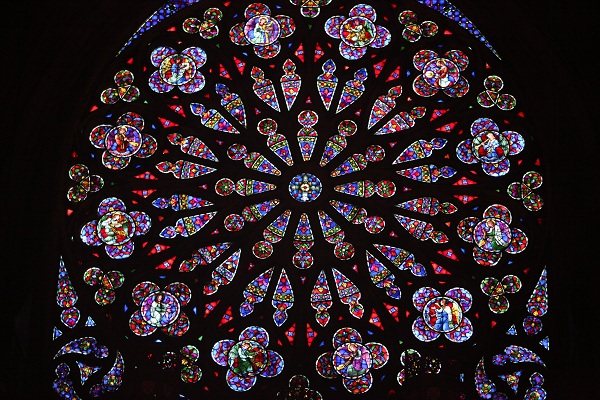
Stained glass window in the Church of St. Vincent Ferrer, New York
Published in Uncategorized | 1 comment


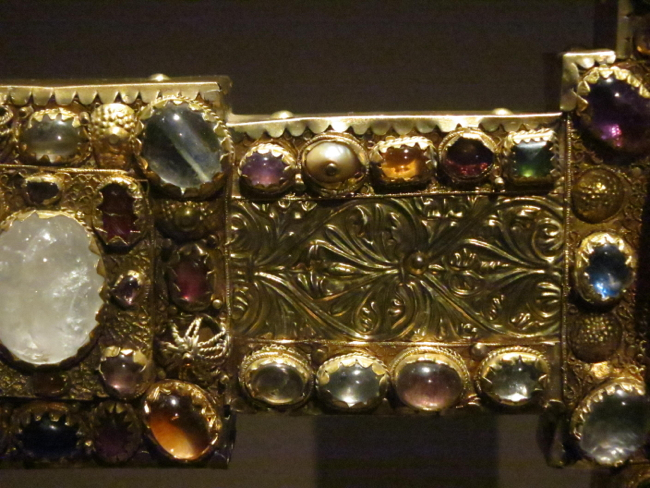
“Le Musée d’Art Religieux de Fourvière” (attached to the church of Fourvière in Lyons) has been burglarized. Among the objects taken is a crown for a statue of the Virgin Mary donated in 1899 by families of Lyons. HERE is a description of the museum’s treasury
Published in Uncategorized | no comment

Yesterday evening, Father Robert Boyd, FSSP, celebrated a Missa Cantata at Holy Family Chapel in Convent Station, NJ to honor Blessed Miriam Teresa Demjanovich, whose body is interred there. Blessed Miriam Teresa was beatified in 2014 and is New Jersey’s first blessed. Born in Bayonne, NJ in 1901, Teresa became a Sister of Charity in 1925. While still a novice, she wrote of series of conferences, which were published posthumously in a volume entitled Greater Perfection. According the the biographical sketch available in the chapel “Teresa’s life in religion was short but filled with much work and suffering of both body and soul. Like St. Therese of Lisieux, she apparently lived a long time in a short space. She died May 8, 1927.”
Holy Family Chapel, where yesterday’s mass took place, is on the campus of the College of St. Elizabeth next door to the motherhouse of the Sisters of Charity of St. Elizabeth.

The motherhouse, where Blessed Miriam Teresa lived as a novice.

Holy Family Chapel


The schola from Our Lady of Fatima Chapel, Pequannock, NJ

(Above and below) Blessed Miriam Teresa’s relics are interred in an octagonal wooden box, in what used to be a confessional in the transept. A guidebook to the chapel explains that she used to go to confession there. A Sister of Charity, (standing to the right of the reliquary) explained about Teresa’s life. The photo at the base of the reliquary shows Teresa in her college graduation photo before she entered the order.

The chapel is well preserved and has many fine details.


Published in Photos | no comment
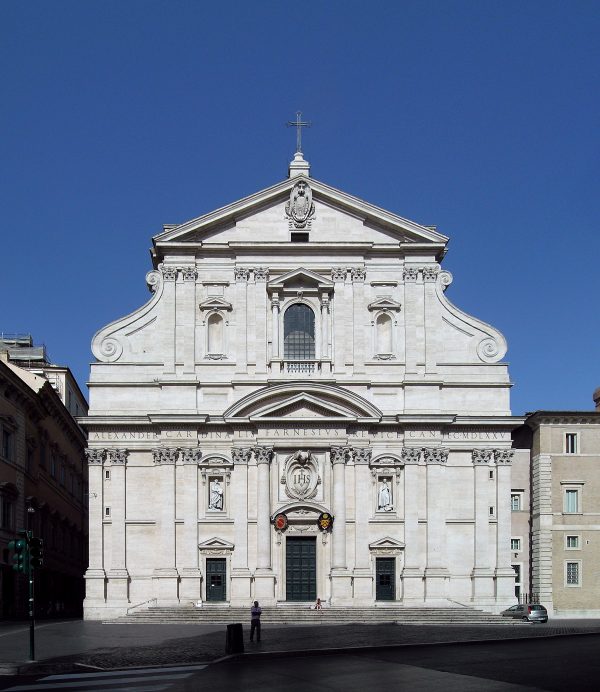
Photo of the Gesu Church, Rome by Alessio Damato
Sermon for the Third Sunday after Easter by Father Richard Cipolla
May 7th, 2017, St. Mary Church, Norwalk, CT
One thing I have asked from the LORD, that I shall seek: That I may dwell in the house of the LORD all the days of my life, to behold the beauty of the LORD And to meditate in His temple. (Psalm 27:4)
From the Confessions of St. Augustine: “Lately have I loved you, beauty so ancient and ever new; late have I loved you. And see you were within, and I was in the external world and sought for you there.” And from Dostoevsky’s novel The Idiot: “Is it true, prince, that once you declared that ‘beauty would save the world’”
The names of God: truth, goodness and beauty. The transcendentals. So I stare at the façade of the Gesù church in Rome: almost quite the opposite of the interior of sumptuous baroque. And I am struck by the beauty of the façade, and I am fascinated by the sumptuous interior. And I am confused. They are different yet share something. I am lifted up by both, I am caught up by both, and in some ways more by the lapis lazuli of the tomb of St Ignatius of Loyola, by the remarkable illusionist ceiling of Gaulli that is like an opening to heaven itself. And I spend time wandering about the church and then I leave the church and I confront once again the façade: that extension of the classical that replaces columns with pilasters and seems in its own way a severe representation of a Greek temple, taking the intensity of the three dimensionality of the Greek temple and replicating the wonderful symmetry of the temple and yet pointing to something new and yet old. And when I bring people to this church I give a brief lecture outside about the façade. And I say that this is the extension of Greek and Roman classicism, and I see the signs of incipient boredom on their faces and know I have to take them inside to the obvious sumptuous beauty of the later baroque.
One of Augustine’s constant themes is that beauty must not be divorced from truth. It is only when he discovered the truth of God that he could understand and affirm the beauty of God. He indulged for so many years in the beautiful pleasures of the world and did not live a life of virtue. But it is precisely those same passions that were redirected towards the pursuit of truth that enabled St. Augustine to undergo that deep transformation of soul that enabled him to confront and love the beauty of God.
You called. You shouted. You battered my deafness. You shone. You glistened. You shattered my blindness. You radiated and I breathed into you spirit, and I desired you. I tasted you and hungered, thirsted after you. You touched me and I burned for your peace.
But St. Augustine also recognized the temptation of beauty. Truth never tempts. Goodness never tempts. It is only beauty that has the power to lead souls to God and to lead them away from God. The word sinus in Latin: its many meanings. It means a curve. What we call a sine wave in mathematics comes from this word, the regular undulation of the sine function, reflecting the pure beauty of mathematics. But it also means as an extension a harbor, the shape of a woman’s breast, her lap, those curves that have erotic overtones. It goes all the way to describe the serpent as sinuous. Augustine says: If beauty is in the image of the creator God, it is also the child of Adam and Eve and so in turn is marked by sin. The human person risks falling into the trap of beauty taken for itself, the icon become idol, the means that swallow the end, truth that imprisons, trip into which people fall, due to an inadequate formation in the senses and the lack of a proper education regarding beauty.” The beauty of creation is a confession and invites contemplation of beauty in its source. That beauty that is the beauty of God never dwells on itself, never is the source of mere sensual pleasure, but always points to the source of real beauty who is God himself.
This dual nature of beauty must be always understood by Catholics who describe themselves as traditional, immersed in the sacred tradition of the Church. The traditional Catholic must always be on guard against confusing the beauty of material things with the beauty of God. Sumptuous interiors of churches, lovely vestments, achingly beautiful music, even in the context of the Holy Mass, can be temptations to substitute the austere beauty of God with merely aesthetic delights. One of the terrible temptations for the traditional Catholic is aestheticism: the delight in the beauty of the Tradition of Catholicism, its art, its music, its liturgical forms, that becomes an end in itself and never looks beyond to whom all of this points. It is no secret that many young seminarians, when exposed to the beauty of the Traditional Mass, are deeply moved by its beauty. And rightly so. But if the result of this is an obsession with chalices and vestments and beautiful religious objects d’art, then this encounter with beauty is a dead end and does not lead to the austere beauty of God. It is precisely this aestheticism that clothes itself in religiosity that destroyed the Anglo-Catholic movement within Anglicism. What began as a spiritual movement to bring Anglicanism back to its Catholic roots decayed into religious foppery. And the same will be true for young Catholic priests who are bogged down by material beauty and therefore will never encounter the beauty of the sine function that is close to the beauty of God.
But this is also true in a parish like St. Mary’s. We are blessed especially at this Mass by the intrinsic beauty of the Traditional Mass manifested by the meticulous attention to details by everyone who participates in the Mass in whatever function or role. Not least of all is our schola, who sings some of the greatest music ever written not only for the Mass but great per se in an objective sense. And yet even here can the ugly head of aestheticism rise. I remember when I was studying in Oxford going to the Solemn Eucharist in Christ Church Cathedral that was so beautifully carried out. The music was superb, men and boys singing deep and difficult settings of the Mass. And some people would come to the Eucharist with their scores of the Mass setting, following the singing of the parts of the Mass, and nudge each other at aesthetic high points in the singing of the Mass. Like a night at the opera. Deadly. Beauty that fails to point to the author of all beauty because of an obsession with the beauty of music per se with no grounding in the simple beauty of God.
One of the few insightful and true statements of the Second Vatican Council in the document on the liturgy is this: The Church acknowledges Gregorian chant as specially suited to the Roman liturgy: therefore, other things being equal, it should be given pride of place in liturgical services.
But other kinds of sacred music, especially polyphony, are by no means excluded from liturgical celebrations, so long as they accord with the spirit of the liturgical action.
It is chant in the deepest sense that is the music of the Roman rite. As much as we love polyphony that is sung almost every Sunday at this Mass, the origins and roots of polyphony are in that austere beauty of chant that like the severe façade of the Gesù, like the earlier tower at Chartres, like the early iconic art of the Church, point in the deepest way to the beauty that is ever ancient and ever new, and that is that beauty that points to the God who has and who is and who will save the world.
George Herbert’s poem “Sacred Music”, written when church music was being attacked by the Puritans.
SWEETEST of sweets, I thank you: when displeasure
Did through my body wound my mind,
You took me thence, and in your house of pleasure
A dainty lodging me assign’d.
Now I in you without a body move, 5
Rising and falling with your wings:
We both together sweetly live and love,
Yet say sometimes, God help poor Kings.
Comfort, I’ll die; for if you post from me,
Sure I shall do so, and much more: 10
But if I travel in your company,
You know the way to heaven’s door.
Published in Sermons | no comment

The Catholic Artists Society cordially invites all members and friends to the annual Mass for Artists, Sunday, May 21, at 4 o’clock, at the newly restored Basilica of St. Patrick’s Old Cathedral in Soho. The Mass is offered for all artists, that their hearts might be cleansed and their minds enlightened by the inpouring of the Holy Spirit. Fr. Sebastian White, O.P., will offer the Mass according to the Missal of Bl. Pope John XXIII.
A reception will follow in the Basilica courtyard, weather permitting.
Published in Masses | no comment
Churches of New York
Holy Roman Empire
Website Highlights
Archives
[powr-hit-counter label="2775648"]