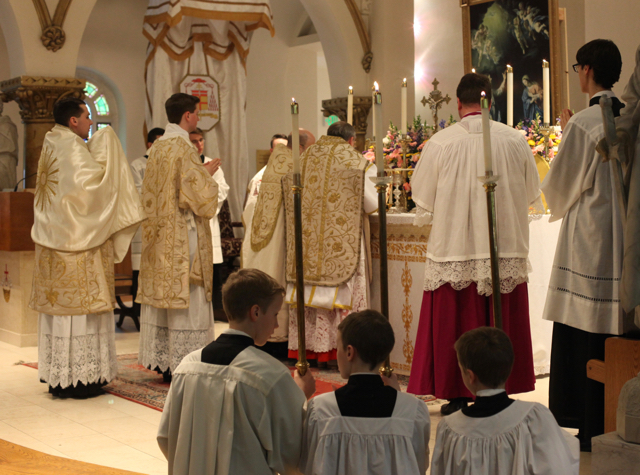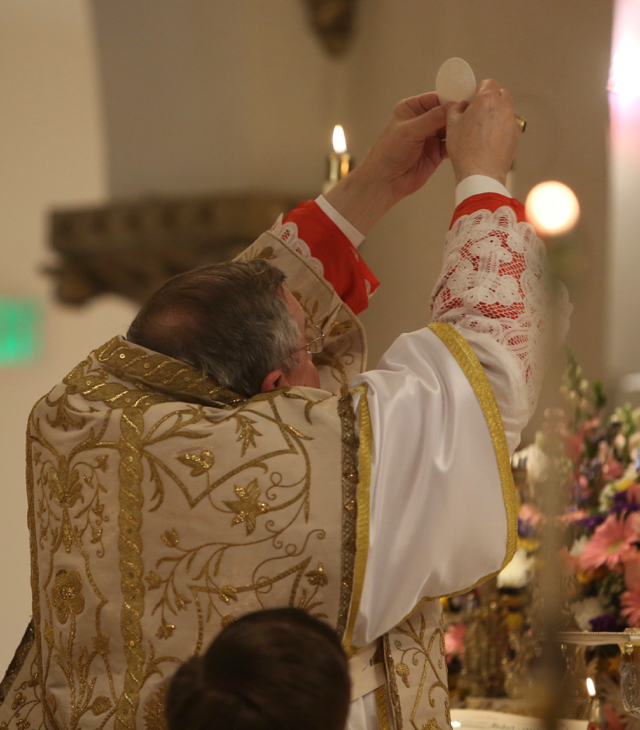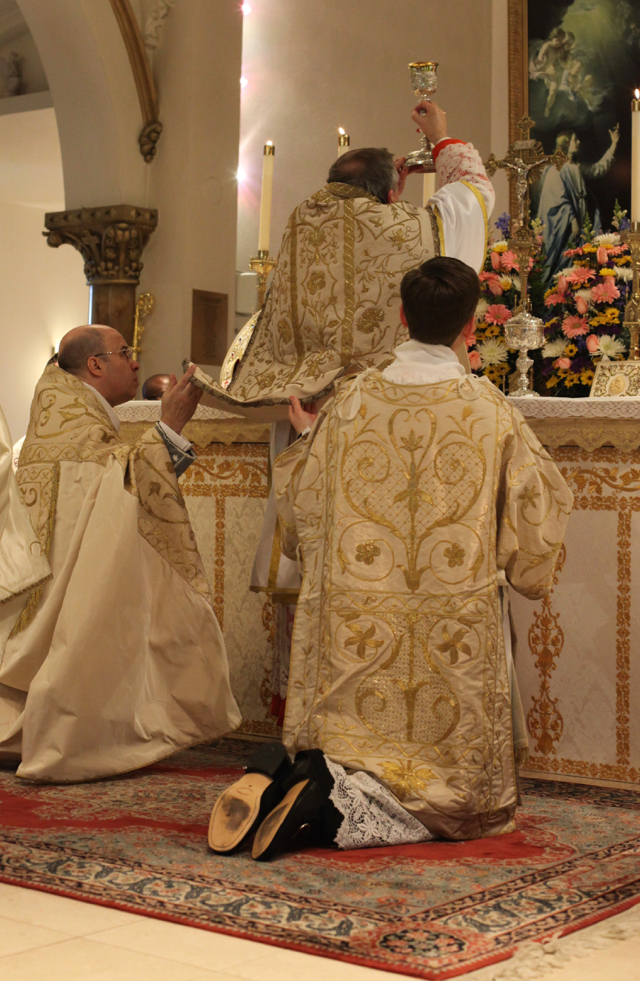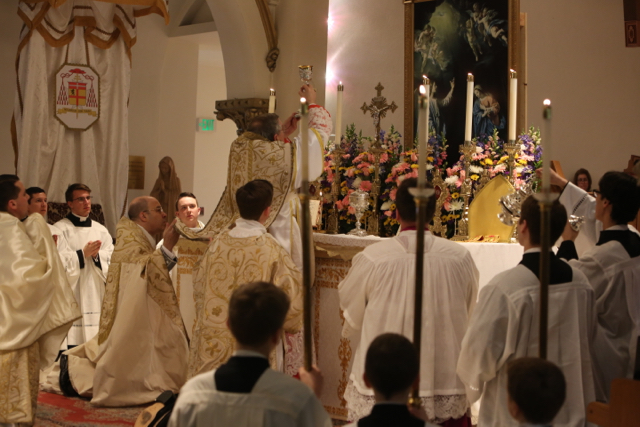
Amid the towers and new construction of the London City – a stark reminder to the obsequious servants of mammon. The churchyard gate of St. Olave’s, Hart Street.
For to me to live is Christ, and to die is gain. (Phil. 1.21)
6
Feb
Amid the towers and new construction of the London City – a stark reminder to the obsequious servants of mammon. The churchyard gate of St. Olave’s, Hart Street.
For to me to live is Christ, and to die is gain. (Phil. 1.21)
6
Feb
St Gregory the Great – the “parish without a church” on the Upper West Side – is closing, it was announced Sunday to parishioners. Both parish and school are being shuttered:
Dear St. Gregory the Great School Community: As you may be aware, at the 11:30 Mass today, Feb. 5th, Father Lawrence Ford OFM made an important announcement regarding our school and parish communities: St. Gregory the Great Church will no longer celebrate Masses and sacraments on a regular basis. As a result, it has also been decided that St. Gregory the Great School will close at the end of the current academic year. We understand that this is concerning news, but rest assured that additional information on this development, as well as the resources to ensure that our students can continue their education at an excellent Catholic School nearby, will be forthcoming this week and posted on a special web page we have created for parents: http://buildboldfutures.org/st-gregory/, where additional information and resources will be available and updated regularly.
(From the parish Facebook page)
On February 5, 2017 the Archdiocese of New York announced that St. Gregory the Great School in Manhattan, whose parish was merged with a neighboring parish as part of the archdiocesan-wide planning initiative Making All Things New, will cease operations at the end of the current academic year as a result of this process.
Despite the Archdiocese’s best efforts to maintain the operational and financial viability of the school in light of the closure of their co-located parish, continuing to educate students in a school where a significant portion of the facility is unutilized has proven infeasible.
Students from St. Gregory the Great School will have the opportunity to continue their education at nearby Ascension School. You may also consider any of the additional neighborhood Catholic schools listed below.
All students will be guaranteed a seat in a Catholic school within the Archdiocese of New York.
All very anonymous and institutional – and apparently to be processed online. Although “we (the clergy?) do understand this is concerning news.”
The parishioners had fought hard for their parish and school in the first round of “Making all Things New.” It was a reprieve of only a year and a half.
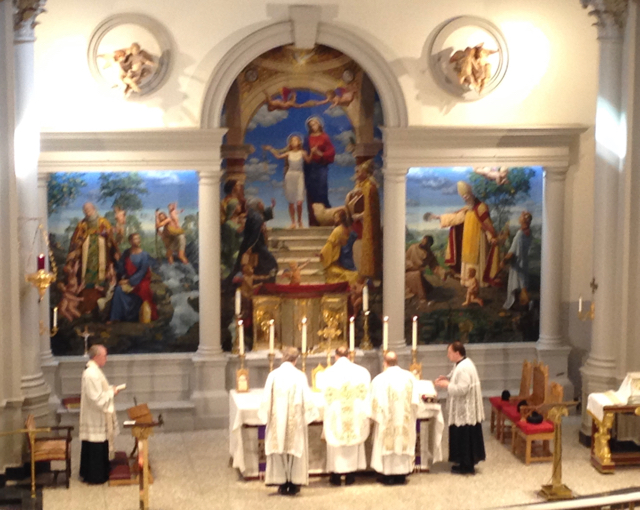
(Above) The hall of the school building that has been used as a church from the beginning has murals painted by a variety of artists: a priest in residence there in the 1930’s; a noted illustrator of the first decades of the 20th century, Louis Bernecker…
30
Jan
30
Jan
Daniel McInerny is a playwright, novelist, screenwriter, and philosopher. After receiving his doctorate in philosophy from The Catholic University of America in Washington, D.C., he spent some sixteen years in academia, teaching and working at various universities in the United States, including the University of St. Thomas (Houston), the University of Notre Dame, and Baylor University. He is the author of the play, The Actor, about the young Karol Wojtyla’s transformation from aspiring actor to seminarian during the crucible of the Nazi occupation of Poland; as well as the play, Switcheroo, a farcical “heist plot of ideas.” His one-act play, Big Crush, was a finalist in the Arts Club of Washington’s 2015 One-Act Play Competition.

28
Jan
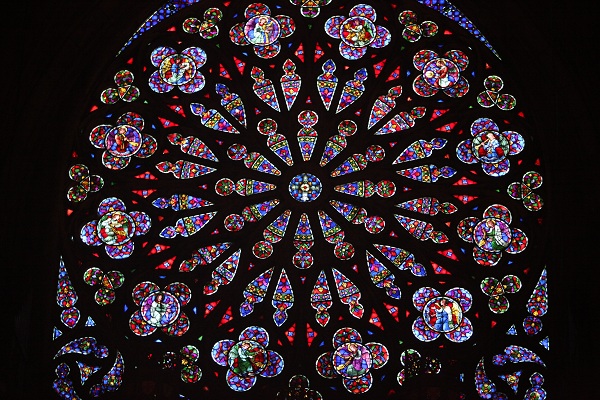
Detail from a window in St. Vincent Ferrer Church, New York
The following churches will offer the Traditional Mass for the Feast of the Presentation (Candelmas), this Thursday, February 2.
St. Mary Church, Norwalk, Ct, Solemn Mass with blessing of candles and procession, 6 pm
Church of the Holy Innocents, New York, blessing of candles, procession and Solemn Mass, 6 pm
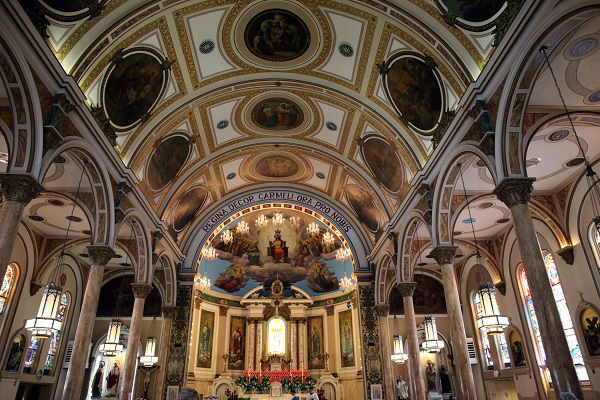
The Pontifical Shrine and Parish Church of Our Lady of Mount Carmel, 448 East 116th Street New York, Blessing of Candles, Procession and High Mass, 7 pm.
St. Rose of Lima Church, 130 Beach 84th St., Rockaway Beach, NY, 7:30 pm. Fr. Sean Connolly, of the Archdiocese of NY, will be the celebrant. This Mass is sponsored by the organization Catholics Who Homeschool.
St. Mary’s Church, 110 Bryant Ave., Roslyn Harbor, NY, blessing of candles, procession and Missa Cantata, at 7 pm. Please join us for Marian Carols to conclude the Christmas season before Mass, beginning at 6:20 pm. Fr. Walter Kedjierski, Celebrant
St. Anthony of Padua Church in Jersey City, 5:30 p.m. including blessing of candles and procession before Mass.
Oratory of St. Anthony of Padua, West Orange, NJ, High Mass, 7 pm
28
Jan
28
Jan
St. Mary Church in Greenwich, CT will offer a Solemn High Mass on Friday, February 3rd for the Feast of Saint Blaise at 7:30 in the evening. The traditional blessing of throats will follow Mass
The statue of St. Blaise is in St. Blaise Abbey in the Black Forest of Germany
26
Jan
The Council of the Bookkeepers: the Destruction of the Sensuous; a Critique of Religion
by Alfred Lorenzer
Europäische Verlagsanstalt, Frankfurt am Main 1981
It is a rare pleasure to return once more to a book, which I had first read so many years ago. As far as I am aware, Alfred Lorenzer’s Council of the Bookkeepers is the first attempt to analyze, in a rational framework, the Second Vatican Council in the context of the political, economic and sociological developments of the contemporary Western world. What has happened since 1981? To what extent has time validated the author’s conclusions?
Our author introduces his book with “this is the book of an atheist written for readers that probably in the great majority are also atheists.” (p. 9) But may not an atheist have decided advantages over the believer in writing about the affairs of the Roman Catholic Church? For the contemporary Catholic author inevitably feels compelled to defer to some “infallible” authority – the pope, the Council or the entire episcopacy – which remains beyond analysis and criticism. We have seen this clearly in the “theological” discussion of hermeneutics of “reform in continuity” or “rupture” as applied to the Vatican Council. Closely connected with the foregoing, most “professional” Catholic writers have difficulty in registering the full range of facts – especially those that seem to contradict their conclusions. Now any observer of the contemporary academy can testify that the limitations on thought found there are also great and growing ever stronger. Nevertheless at least the theoretical possibility of apprehending reality still exists.
After his introduction, Lorenzer cites Marx, Nietzsche and Freud, and proceeds to rage against a recent document of the German Bishops conference attacking the liberalization of abortion. (How many of those have there ever been?) Presumably this is to establish the author’s “street cred” with his left-wing readership. For, as we shall see, his conclusions are not at all what one has come to expect from either secular or Catholic progressives.
At the risk of oversimplification, I would attempt to summarize the author’s point of departure as follows. Psychological analysis establishes the importance of symbols in the development of the human personality. Of the greatest importance is the “presentative” character of the symbol. In other words, the sensuous symbol offers itself to the observer as a whole, as something to be freely explored and understood. The author contrasts this with the didactic, rational, “discursive” nature of modern communications, especially, under modern civil society, of advertising. In the latter, opinions and ideologies are imposed upon the recipient. The loss of symbols creates a personality which cannot mature, and thus necessarily remains unemancipated and unfree.
Now the Council and specifically the decrees on the reform of the liturgy substituted a didactic, discursive approach for the previous symbolic essence of the liturgy. The new function of the mass was to deliver content to the assembled congregation. In so doing, the office of the priest or “presider” paradoxically acquired a greatly increased importance. In other words, far from fostering an allegedly “mature” laity, the Council actually had exactly the opposite consequence. This corresponds to modernity and its endless bombardment of its denizens by advertising.
The Council itself instituted the disastrous tendency of reinforcing the central authority instead of reducing the hierarchy as had been so often rhetorically invoked…. The reform of the curia “in the spirit of the Council” produced a stripped down, effective organization on the model of a large business enterprise with an age limit for all the top managers (except the pope himself). If the pope previously had been a sacred figure in the solitude of the apostolic palace, distant from the events of the world, who in his remoteness “proclaimed,” “reaffirmed” and “expressed concerns,” Paul VI insisted on his (political) influence on his travels to the UN and to focal points of political events…. John Paul II gave to this exercise of power the practical and effective form by flexible adaptation to a modern leadership style. (For example) accompanied by a horde of reporters, on his flight to Puebla, he granted the journalists “a conversation – previously unheard of in this form – of one and a half hours.” …. John Paul II provides on a daily basis new examples of this transformation of the pope from a sacred and remote “successor of the prince of the apostles” to a popular leader:
“The pope drops the old fashioned “We” in his addresses. He tries on cowboy hats and mountain climbers’ caps. He abolishes the “sedes gestatoria.” (but) walks on foot through the crowd and answers their applause with de Gaulle-like gestures. He takes “a bath in the crowd.” He is driven in a jeep through St Peter’s Square….. (pp.74-75)
And Lorenzer rightly insists that “the twofold structural change in hierarchical behavior – renunciation of the traditional, solemn image and the strengthening of directing authority – is no invention of John Paul II. ..It is undoubtedly is not a characteristic specific to a personality but typical of a structure. (p. 76)
As we see from the above, Lorenzer has the merit of not merely propounding theories but of illustrating them throughout by practical examples. He quotes from insightful observers like Pier Pasolini and also tells us what he himself has seen in the churches of Europe and Latin America. They provide a scathing indictment of the Council’s liturgical and cultural devastation – in particular, in the sixth chapter ”The Vandalism of the Second Vatican Council.”
In the Church there took place – at least unwittingly – a profound dissolution of religious values. As a consequence, the masses of middle and south Italy were handed over to the power of the media and therefore of the ruling ideology: to the hedonism of the consumer society. (p. 179 (quoting Pasolini))
What does Lorenzer mean? In the reform of the liturgy he sees the loss of the sensual and the symbolic in favor of the ideological transmittal of texts. Put more in technical terms:
Let us stress that the council, with its reform of the liturgy
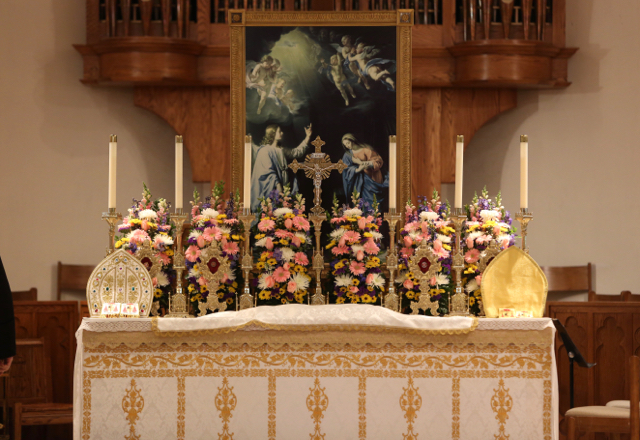
Historically, every detail of a church was invested with symbols, from the great works of art (architecture, painting, sculpture, music) to the creations of artisans (candles, floral arrangements, ex votos). But all circled around the altar and the celebration of the liturgy.
The cultic “ accessories” on every baroque altar are constitutive elements of the work of art. Just removing the altar linens ruins the altar. (p. 205)
All that is gone now. In the new liturgy:
Nothing of what celebrant does or omits is hidden from the “spectator.” … Not only does the microphone make public every rustling and every breath. The image the public sees is closer to the setup in front of a TV chef than to the liturgical forms of even the Calvinist churches. (p 192)
The utensils of a strange, archaically exaggerated lecture hall take the place of the old sensuous symbolism: sacrificial stone and druid’s chair, microphone and loudspeakers (which are never absent even where the church is tiny and has room for only a couple of dozen people) (p. 206)
Furthermore, the altar of gothic or baroque churches is often moved forward to the front of the sanctuary or into the crossing of the transept, destroying the entire harmony and equilibrium of the interior, centered as it was on the original position of the altar. In other churches the old altars are simply destroyed.
Even where churches have been preserved as museums there is no relief:
In Tepozotlan in Mexico is one of the most beautiful monasteries of the Churriguerescan (elaborate baroque) style of the 18th century – arranged as a museum of religious art. But whoever hopes to find at least one authentically preserved church amid the mass of those destroyed by the Council will be disappointed. … The restorers have contributed their own form of spatial destruction – specific to their trade: the very last corner of the church vaulting is illuminated by electricity, so that the interior has entirely lost its atmosphere. The original mixture of light has been replaced by electric sources, which run along the ledges like absurd garlands of light. And naturally the altars are bare…. (p. 210 )
Is not St Patrick’s Cathedral the best New York example of precisely such actions?
Lorenzer helps us to understand many of the things we ourselves have experienced over the last 50 years. His analysis anchors the Council firmly in the secular trends of the dominant “Atlantic culture” of Western Europe and North America. It clarifies why at all times the Church establishment has seen the FSSPX and the Traditionalist movement in general as a greater threat then all the forces of the Catholic progressives, which, on paper, might seem to the outsider to be more in conflict with Church doctrine. It explains why liturgical movements such as “reform of the reform” must inevitably fail, because they tack on to a fundamentally alien body the trappings of a prior symbolic system. It is also makes clear that a clergy, who created the new system in the 1960’s and now, 50 years later, are largely the product of it, would be utterly unreceptive either to reform of the reform or the traditional liturgy. Most importantly, his analysis furnishes a convincing explanation of the radical decline in Catholic religious practice since the Council.
Further confirming Lorenzer, we now have a pope who has dropped the last vestiges of a “religious style” and has assumed an almost totally secular approach both in content and form. His controlling initiatives (like climate change, migrants, ecology and divorce) are difficult or impossible to distinguish from the views of the secular establishment; the style of his public appearances and interviews is a more radical development of those of John Paul II.
Of course, when we return to a text that we have not read for years we do encounter defects that had slipped our mind. The many lengthy digressions, particularly those in which the author expounds his psychoanalytic theories, make for difficult reading. If Lorenzer laments the then current lack of interest in psychoanalysis, he should have examined the passages he himself wrote as evidence of one obvious cause. Lorenzer also does at times fall into a more conventional leftist discourse, fulminating about “fascism” and seeing the products of the “conciliar church” as a “mask” for political objectives.
Statements similar to Lorenzer’s observations on symbols, desacralizing modernity and liturgy have of course been made by others over the years. He himself cites Max Weber who in turn reaches back to Hegel, Schiller and the Romantic poets. In The Stripping of the Altars, (1992) Eamon Duffy described how, starting under Henry VIII, changes in ritual practice produced changes in religious belief in 16th century England. One also thinks of the discussion at pp. 23-41 in Fr. Uwe Michael Lang’s recent Signs of the Holy One (2015) – some of the sources quoted there pre-date the Council of the Bookkeepers. Finally, at the 2015 New York Sacra Liturgia conference one speaker – whose name escapes me – noted the significance of the reversal by Pius XII of the order of Lex Orandi and Lex Credendi. By asserting the primacy of the Lex Credendi over the Lex Orandi, Pius XII had – even before the Council – identified catechesis or indoctrination as the primary task of the Liturgy.
A critique of the ideological positions of the German left is outside the scope of this review. But it is instructive to see how in this work the pseudo–economic and pseudo-medical foundations of Marx and Freud have entirely disappeared. (Cf. Paul Gottfried’s The Strange Death of Marxism: the European Left in the New Millennium (2005)). And Lorenzer’s mix of psychoanalysis, Marxism and (unacknowledged) Americanism by today has hardened into an ideology that dominates Germany and Europe. We doubt that our author would have been totally happy with that. In the Council of the Bookkeepers no system escapes his criticism – not just the capitalist west, but also the “really existing“ socialism of the Soviet bloc, Western leftism and even Latin American liberation theology. I feel sorry for Alfred Lorenzer! He seems to have been one of the few leftists – like George Orwell – who, while sincerely believing the “liberating” promises of progressive doctrines, could never look away from the facts. But, by so doing, has not the author, without necessarily admitting it himself, taken his first step away from modernity and its ideologies? In conclusion, does that not leave us with at least a slim hope:
Maybe the end of the Church has already been sealed by the “treason” of millions and millions of the faithful (particularly the peasants who have converted to secularism and consumerist hedonism). Maybe the end has been sealed by the “decision” of the rulers who are meanwhile certain of getting in their clutches the ex-believers – given the affluent conditions and an ideology that has been imposed on the masses. An ideology, moreover, that does not even feel it to be necessary any more to act as such. That may be. But one thing is sure: the Church has certainly committed many awful mistakes in the long history of its regime, but she would commit the worst of all if she passively stood by while she was liquidated by a power that mocks the Gospel. In the context of a radical, possibly utopian or – here one really has to say it- eschatological perspective, it’s clear what the Church has to do to avoid an inglorious end. She has to go into opposition. (p 180 (quoting Pasolini))
25
Jan
On Thursday, February 2, at 7:30pm, a Mass will be offered for the Feast of the Purification at St. Rose of Lima Church, 130 Beach 84th St., Rockaway Beach, NY. Sean Connolly, of the Archdiocese of NY, will be the celebrant. This Mass is sponsored by the organization Catholics Who Homeschool.
25
Jan
The Feast of the Purification of the Blessed Virgin Mary, a.k.a., Candlemas, will be celebrated at St. Anthony of Padua Church in Jersey City on Thursday, February 2nd at 5:30 p.m. with a Traditional Latin High Mass preceeded by the ancient blessing ceremony of candles and procession before Mass.