28
Dec
25
Dec

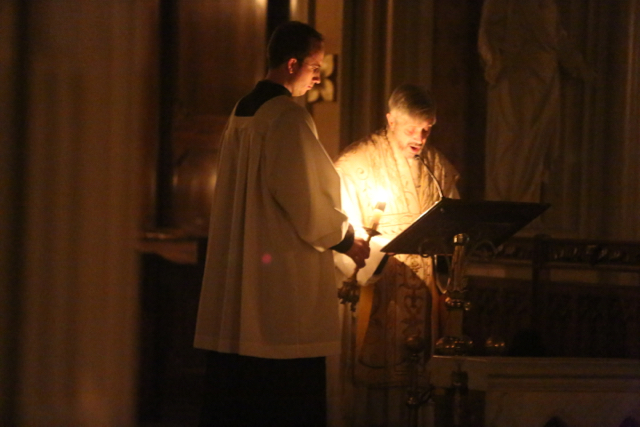
The precentor proclaims the birth of Christ, chronicling the ages leading up to His birth.
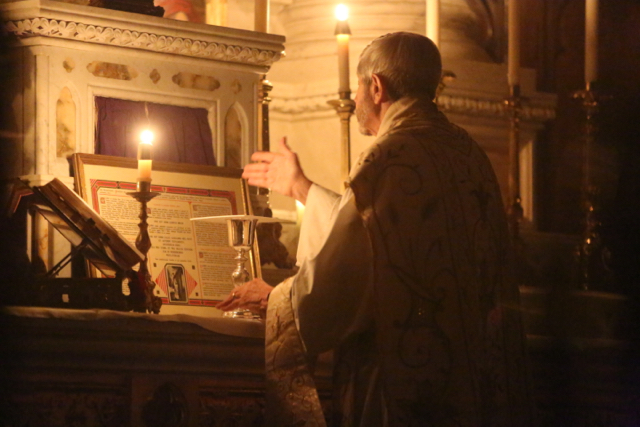
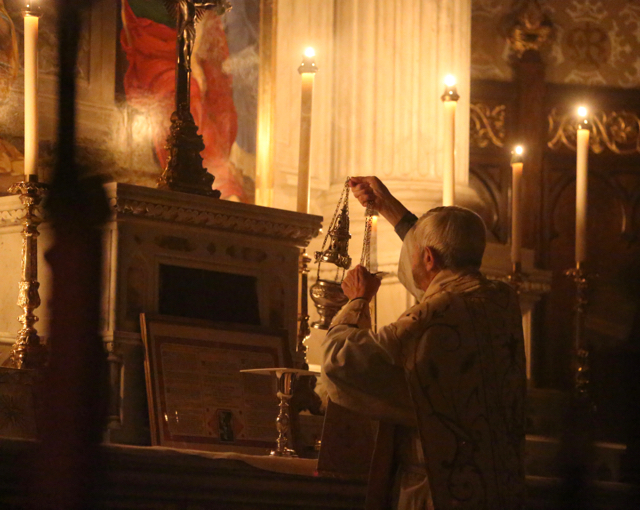
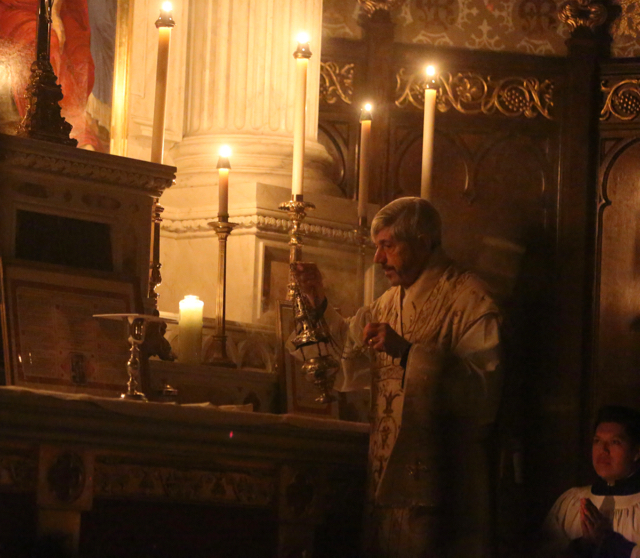
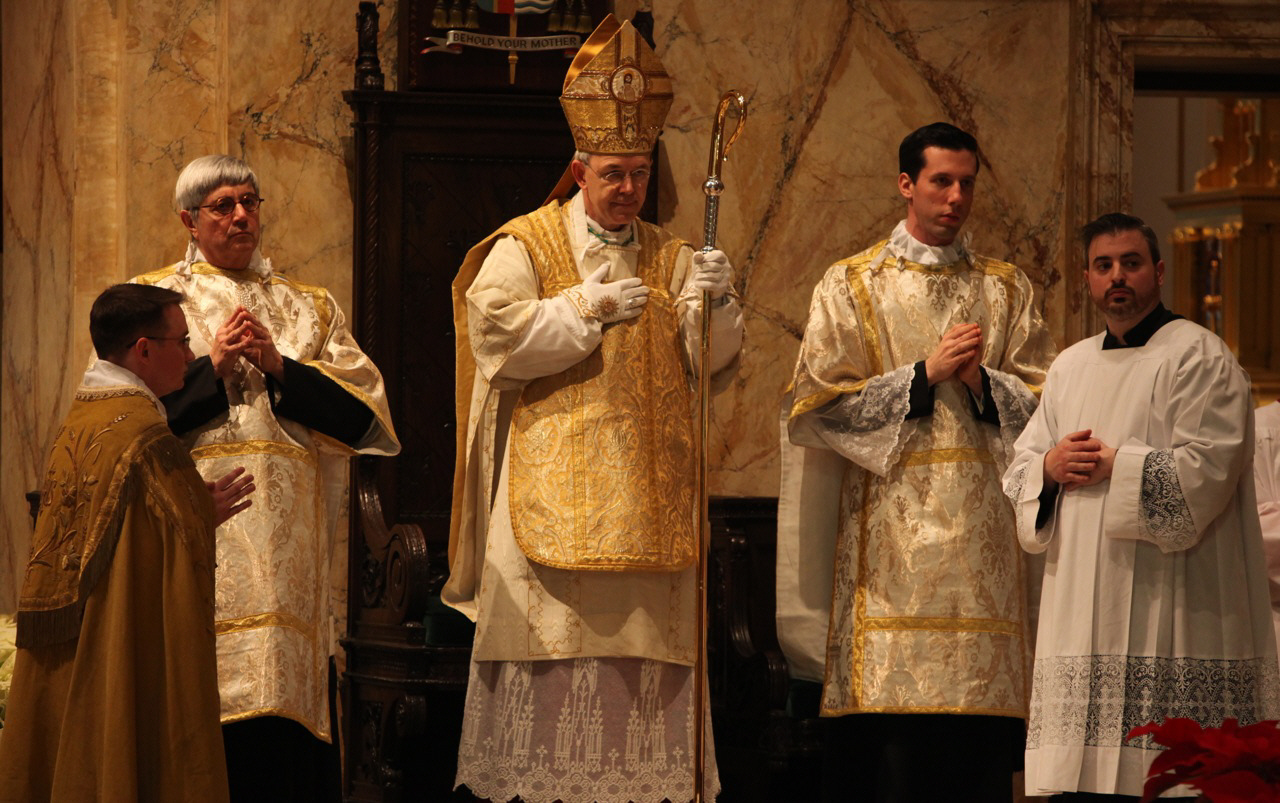
Midnight Mass at St. Mary’s, Norwalk, CT. (Fr. Richard Cipolla, pastor, was the celebrant)
(Below) The celebrant, accompanied by his ministers, carries the statue of the Christ Child, which is placed in the creche.
(Below) The procession and start of the mass.
(Above and below)The music included Charpentier’s “Messe de Minuit pour Noel, ” directed by Charles Weaver.
(Below) The Gospel.
The Sermon and the Mass of the Faithful:
24
Dec
In the last few days before Christmas an apparently minor internal conflict within the Order of Malta has exploded even in the international secular media. A senior officer – Albrecht von Boeselager – of the Knights of Malta has been suspended from the Order and removed from his positions by the Order’s Grand Master. And Pope Francis has installed a five-man commission to study the situation. It is reported that the members appointed to the panel are favorably predisposed to Albrecht von Boeselager – and that the Grand Master has rejected the panel as outside interference in the internal affairs of the Order.
The Knights of Malta here in the United States have been traditionally known for their charitable work and fundraising for the Church. In recent years, however, they have assumed a more active role in true liturgical renewal, taking a leadership role in several major Traditional events in and around New York. The same is true elsewhere in the world. We all know, moreover, who has been the Cardinal patron of the Order since 2014….
Now what exactly is going on? As always in such cases, the European media provide more details than one gets here. In fact, I first read of this situation in a curious anonymous article of December 15 in the website Kath.net. 1) Now this site is hardly traditionalist – it is “conservative Catholic,” fawns over Pope Francis (or did so until recently) and still makes unsuccessful efforts to ingratiate itself with at least some members of the German and Austrian hierarchies. According to this:
“A small circle from the German-speaking countries wishes to preserve the advantages of exclusivity and Sovereignty but to loosen somewhat the ties, in their opinion too constricting, with the doctrine of the Church and the Pope. … The Grand Hospitaller of the Order at that time, Baron Albrecht von Boeselager, took over the already almost finished recommendations (apparently, to intensify the lived spirituality of the order and to revitalize to the Order’s fundamental mission of defending the Catholic Faith – SC), rejected everything in favor of a watered-down recasting of the old statutes and rules, which thereupon disappeared into a filing cabinet. Also in his area of responsibility were humanitarian actions of the Order in Africa including the distribution of UNHCR aid packages, which also happened to include condoms. Similar activities were repeated in the following years. A commission, established by the Vatican, to examine these accusations, which identified violations against the teachings of the Church, was simply ignored by Boeselager and the German section of he order from which he came. Additional problems came up especially in and from Germany … nevertheless the influence of the German Association continued to increase.
In the meantime Boeselager had risen to the number three position in the Order, that of Grand Chancellor. But his problems from the past and the resulting tensions with other members of the Order’s government got in his way. That led the head of state and Order, Grand Master Fra (Brother) Matthew Festing to request his resignation several times. Every time, however, Boeselager refused…. This serious breach of the rules of the Order led immediately to a disciplinary procedure and thus to the suspension of (Boeselager’s) membership in the Order. Since Boeselager was no longer a member of the Order, the Grand Master had to remove him from all his offices.”
This article reads like a response to the article “A Combat Group against the Pope?” by Jörg Bremen, which had appeared on December 13 in perhaps the leading German newspaper, the Frankfurter Allgemeine Zeitung (“FAZ”). Now in recent years the FAZ has become a authoritative mouthpiece for the German hierarchy. For example, it published a hit piece against Bishop Tebartz-van Elst, so hated by the German clerical Establishment. Martin Mosebach wrote an impassioned protest against that article (without naming its title or author) which contributed to the bishop’s removal. Then, while this September rumors were flying about an imminent regularization of the FSSPX by Bergoglio, I myself remained skeptical. For hadn’t the same FAZ a few months earlier published (one more) article viciously attacking the FSSPX? Given how beholden to the German church Bergoglio seems to be, I very much doubted that, whatever his own views might be, he would cross them on this issue!
Now according to this inflammatory article on the Order of Malta:
(Boeselager) will not yield. He even views the work of the order as endangered: service to the sick and needy of every kind. We hear in the Vatican that Boeselager has … some powerful supporters who know of his work from Asia to Lebanon.
Fra Matthew Festing, rather, appears to have fallen under the pressure of groups in the Order, which are trying with Cardinal Burke to transform the Fraternity into a battle group against the Pope. In so doing Festing is probably allowing himself to be utilized by Burke. The Pope had dismissed him as the head of the congregation of bishops and in 2014 had made him, much to the annoyance of many on the Order, the head cleric of the order. (sic – this account is factually inaccurate – SC) Burke wants, for example, to preserve as solely valid the “old” Tridentine mass and appears in the vestments of the 19th century.
While the Pope has received on Friday the leadership of the protestant Order of St. John … to discuss the unconditional service in the name of Christ to the refugees and needy, Burke and Festing apparently want to return the Order to the age of (separate) confessions. Burke also belongs to the four cardinals who put the Pope under pressure with their demand that he should give clear directions in the pastoral guidance of families, while Francis makes central the fate of the individual and the mercy of God to the penitent.
In the case of Boeselager many now hope for clarification by the pope, for Festing’s ability to lead is in question. … According to reliable sources in the Vatican on Tuesday, the dismissal of Boeselager from his offices was not at all desired by the Holy See – rather, his work was appreciated there.
So the internal dispute between Boeselager and Grand Master Festing is “ideologized” as a massive clash between enemies: Burke – described as a reactionary manipulator seeking to take over the Order – and Bergoglio, the supposed champion of ecumenism, service to the poor and the mercy of God. Our German reporter depicts love for the Traditional liturgy and a commitment to a stronger Catholic identity as opposed to Christian charity and the mission of the Order. And what is at stake are the jobs of Burke and Festing, not that of Boeselager. (While “clarification” of Amoris Laetitia by the bishop of Rome is not forthcoming, the reporter’s sources evidently expect it in the case of Boeselager.)
Bremen’s FAZ “news” piece undoubtedly accurately reflects the views of the German Church – and probably that of the Vatican as well. Unsurprisingly, it is also entirely in accord with a series of recent articles on the subject in The Tablet. It’s sad evidence both of the journalistic decline of the once-reputable FAZ ( pointed out by Martin Mosebach) and the radical coarsening of language and thinking introduced into the Catholic Church by Bergoglio and his team.
In my own view, I would be surprised if Boeselager had undertaken his course of direct disobedience to the leader of the Order without previously assuring himself of cover from the Vatican. The (publicly disclosed) story is all very reminiscent of the Friars of the Immaculate – but the Order of Malta is made of sterner stuff than an Italian group of clerics.
Now in the last few weeks have seen developments in another “ chivalric order” – the Knights of Columbus. Several councils of the Knights have very active in the cause of the Traditional liturgy. For example, this year just in the New York area they organized the visit of Bishop Athanasius Schneider and the recent mass at St Patrick’s Cathedral. Yet conspicuously absent from the splendid mass in St. Patrick’s was the sponsor, the fraternal order of the Knights of Columbus themselves– as evidenced by several empty pews in the front of the cathedral. I was told that time had been too short to organize an honor guard….
In the last few weeks startling articles by Austen Ivereigh have attracted considerable attention. In the first, Ivereigh (a veteran spokesman of the English clerical establishment) denounced critics of Amoris Laetitia as reprehensible “dissenters.” He followed it up with comments supporting the Enneagram – and claiming approval by Bergoglio of its use. These articles appeared in Crux, an online alleged “news” site. But the interesting thing is that since March 2016 the patron of Crux has been the Knights of Columbus. It’s a surprising turn of events indeed for an organization that up till recently has had a rather stodgy, even conservative reputation. And, given its origin and history, the notion of Crux publishing an article attacking “dissent” is even more surprising.
Now Crux started in the activities of John Allen as a reporter of the – allegedly “dissenting” but actually establishment – National Catholic Reporter. Like several others (e.g. Rocco Palmo), Allen took the line of advocating the progressive Catholic agenda while flattering liberal hierarchs like Mahoney or Martini. In 2014, when the leading progressive hierarch was no longer a German, American or Italian Cardinal but the bishop of Rome, Allen moved his expanded operation to the Boston Globe. Crux was established – obviously intended to be a source of sycophantic coverage of Bergoglio’s papacy, a role very much like that of the Italian Vatican Insider, created about the same time and also under secular media patronage (La Stampa). Apparently Crux was anything but a financial success. The Boston Globe dropped the operation in March of this year. The Knights of Columbus, however, immediately picked it up as a”partner.”
At no time in this progression of owners from “dissenting” Catholic newspaper to mainstream liberal secular publication to Catholic fraternal order has the party line of Allen and company actually changed. A glance at Crux verifies that: amid bland “softball” reporting on the Church in general such as you would expect to find in your diocesan paper, we find a separate rubric “Pope Francis.” An even if he is more restrained than Ivereigh, John Allen can’t conceal his enthusiasm for the “Boston- Washington – Chicago” axis – soon to be joined by Newark – representing the spearhead of Bergoglio’s remaking of the American hierarchy. 2)
The Knights of Columbus play a direct, sometimes controversial, role in the finances of the Vatican. I don’t think that their leadership was at all unaware that stepping in to preserve a Bergoglio-friendly “news” source would be viewed favorably in the current climate of the Vatican.
What can we make of all this? On the one hand, the bishop of Rome and his partisans are pursuing a hardline progressive course in morality, theology and politics, rooted in the clerical establishment and couched in ever more incendiary language. On the other hand, we have a contrary reform movement, bubbling up from below, for a more intense Catholic life and a return to Traditional liturgical practice and piety. These conflicting trends will place the institutions of the Church under increasingly great stress. It will no longer suffice for organizations like the Knights of Malta and the Knights of Columbus to muddle through as under Pope John Paul II, concentrating on charity, fundraising and socializing. They must now choose.
22
Dec
The Roman Forum
11 Carmine St., Apt. 2C
New York, New York 10014
www.romanforum.org
drjcrao@aol.com
December 22, 2016
Dear Friends,
The Roman Forum is once again seeking $50,000 in tax-deductible donations in support of its Twenty-Fifth Annual Summer Symposium. This program will be held from July 3rd through July 14th, 2017 (11 nights) on the topic: Setting Right a World Turned Upside Down—Transformation in Christ Versus a Sickness Unto Death. We need this sum to provide travel, room, and board for our international faculty of sixteen speakers and our musical director. The funds are also used to aid the many priests, seminarians, college students, and others from across the globe who, without at least some help, would be unable to attend.
You may remember that the Twenty-Fourth Annual Summer Symposium, Half a Millennium of Total Depravity (1517-2017): A Critique of Luther’s Impact in the Year of His ‘Catholic’ Apotheosis”, was dedicated to the consequences of the first “reformer’s” thought and action. This was done so as to prepare a “truth serum” to work against the distorted adulation of the founder of Protestantism that will most certainly characterize the entire commemorative year of 2017. The working title for the book that this “truth serum” takes is Luther and His Progeny: 500 Years of Protestantism and Its Tragic Consequences for Church, State, and Society. Angelico Press will be releasing the text sometime in the next few months, and I am attaching a brief description of its contents. Very importantly, however, this book, and the program on which it is based, could not have become a reality without your generous donations.
Two commemorations will provide an extremely joyful framework for the Roman Forum’s next Summer Symposium in Gardone Riviera. 2017 will mark the twenty-fifth anniversary of this annual spiritual, academic, fraternal, and strategy-planning program of indispensable importance to the traditionalist world internationally. It will also be the tenth anniversary of Summorum pontificum, with all that that motu proprio has contributed to the advance of the cause of the “Mass of the Ages”.
Unfortunately and in all too many respects, 2017 threatens to be a much more troubled moment in Catholic time than twenty-five or even ten years ago. The erratic character of the current pontificate—and fears for what may follow it—are proving to be extraordinarily disturbing not just to the cause of the Faith but to that of human Reason as well. One has the sense of a “free fall”, with the “salt” having lost its savor. Too many Catholics, clerical and lay, happily support a global political and social order suffering from a “sickness unto death”; smiling as that order commits suicide and works to bring the Church down with it. Gardone, 2017 will address this problem thoroughly—with another book to follow from its labors.
The ethos for that second book will, as always, be the one laid out for us by Professor Dietrich von Hildebrand through his concern for rooting all of our work in an ever-deeper study of the theology of the Mystical Body and the exalted understanding of “transformation in Christ” that this probing of the full significance of the Incarnation yields. It is that Christological approach, closely connected with devotion to the Sacred Heart, that has made the Roman Forum so eager to work to cure our world’s “sickness unto death” by insisting upon the need to infuse all aspects of natural life—philosophical, political, economic, familial, fraternal, artistic, sportive, culinary; the serious and the festive together—with that Catholic teaching and grace that correct their flaws and raise them up in a hymn of praise to God. It is this approach that caused von Hildebrand already in 1970 to insist that the Roman Forum fight for the full restoration of “a liturgy that does not turn its back against God”. And Gardone 2017 will insist upon the validity of this Christological path, in all realms of human activity, as the sole, infallible guide to choosing the fullness of life instead of naturalist, secularist death. A second attachment describes the program and application process in detail. Come choose life with us if you can do so!
Please do give a tax-deductible donation to support the attendance of a speaker, a member of the clergy, a seminarian, or a student and make this twenty-fifth anniversary session possible. Send all donations, made out to the “Roman Forum”, either through PayPal (on our website) or directly to me at the address indicated above.
Sincerely yours in Christ,
John C. Rao (D.Phil., Oxford)
Chairman, Roman Forum
Associate Professor of History, St. John’s University
“Even if the wounds of this shattered world enmesh you, and the sea in turmoil bears you along in but one surviving ship, it would still befit you to maintain your enthusiasm for studies unimpaired. Why should lasting values tremble if transient things fall?” (Prosper of Aquitai
22
Dec
21
Dec
Today a friend asked me for the contact information of Helmut Rückriegel; I soon found to my great sorrow and surprise that he had died on January 25 of this year! I unfortunately only had a few occasions to meet Ambassador Rückriegel. He would visit New York where his son lived. I would meet him in a restaurant in the company of his friend Arkady Nebolsine. Helmut Rückriegel was a true Christian gentleman. A man of great culture, he had represented his country in various assignments – notably in Israel and Thailand. Possessed of a keen intelligence and a great sense of the real, he had the ability to understand and appreciate the merits of other peoples and cultures without falling into the servile obsequiousness so typical of the West and particularly of Germany today. Devoted to the Church and to the Traditional mass, he was utterly without the “churchy” Catholic’s cant and fawning airs. Ambassador Rückriegel had put his practical talents to use in promoting the Traditional Latin Mass – he held a leading role for years in the Una Voce Federation. To me he seemed a reminder of a bygone age, of the former greatness of German culture – which in its great days had sought to comprehend and embrace all the cultures of the world. I regret so much that through my own fault I had not had the chance to get to know him better!
Martin Mosebach has written the following obituary.
Obituary for Helmut Rückriegel by Martin Mosebach
An extraordinary man has left the earth. Standing at the grave of Helmut Rückriegel his friends conceive the whole truth of the discernment that with the death of a man there is a whole world that perishes. What pertains to everyone is most evident for such an overabundant nature as it was with our deceased friend Helmut. He was allowed to live a long life, and, we can say, to live in mindfulness and intensity. He finished the wine of life completely and entirely, including even the very last and then most bitter drops. Furthermore it was granted to him to maintain his entire strength of mind until his last moment; in complete alertness he witnessed his time and all its phenomena until the last moment. His participation in the world was insatiable; he was a pious Christian – the archaic term ‘piety’ in its comprehensive meaning like the antiquity knew it – was fitting for him. A life in the presence of the supernatural and a joyful discovering of this supernatural in the inexhaustible statures of the created world – but without suppressing the reality of the mortality of all life on earth, he lived as if there was no death.
Until his painful last sickbed he was seized with the fascination of languages – recently he started to learn Turkish, a language that is extremely far from all Indo-Germanic familiarity – joyfully entering into a totally different kind of thinking and feeling. I always wondered why he, whose sense of language was infallible, did not write himself. But in return his sentiment for the great German poetry was so profound that the verses of Goethe and the Romantics, of Hölderlin and Stefan George constituted deeply and totally his inner life. He was the reader and reciter that poets desired, drawing from a great pool effortlessly the most remote lyric creations to engender an awakening to melody and life.
His artist’s nature became apparent in the invention of his garden that he created in Niedergründau, the village where he came from, after the end of his working life: he cultivated rambler roses, growing into the old, partly withered apple trees high as a house, to create real snow avalanches of white blossoms; in May and June they were phantasmagorias of surreal, sheer beauty. Here, the gardener who planted hundreds of sumptuous roses, turned into a wizard. ‘Il faut cultiver son jardin.’ are the last words of Candide, Voltaire’s wicked satire in which the hero, after having underwent the horrors of a world falling to pieces, is forming the conclusion of his experiences. And it was in this awareness that Helmut created his garden. The experiences of this great connoisseur of the art of living had made him learn, no less clear than Voltaire’s Candide, that the earth is not a peaceful place, not a paradise.
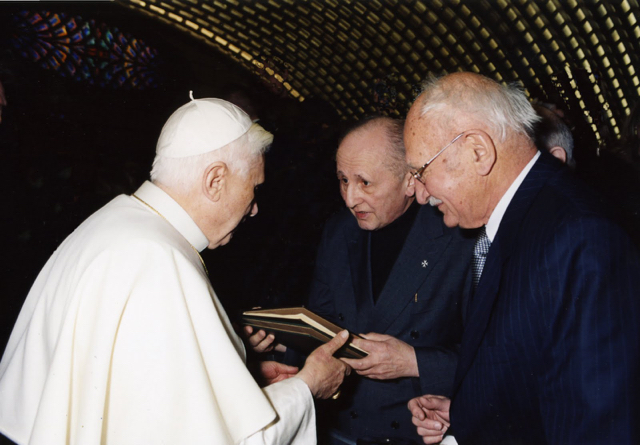
As a pupil and young man during the years of Nazism he thanked his teachers for the discernment that Germany was ruled by criminals; in these years he also experienced the Catholic Church as a place of resistance against the despotism. As a diplomat he travelled widely; but his most important positions for him were in New York and Israel – in the Holy Land, this small spot of earth, where also in his life all spiritual and demonic forces that agitate us as well today, collide; there he found the proximity of the truth of his faith, especially there, where it seemed to be completely unreachable. And very early he discovered for him the obligation to serve the Roman Catholic Church, his mother, for whom he saw himself as a faithful son, in her great crisis in which she had fallen after the Second Vatican Council. Helmut Rückriegel, who loved the oriental Churches, especially the Orthodoxy, the friend of many Jews, who – together with his friend, the great Annemarie Schimmel, admired the Sufism; he was a Catholic, as ‘the tree is green’ to say it with a word of Carl Schmitt. From his universal culture, from his enthusiasm for the masterworks of language, from his detailed knowledge of history and the cultures of the world Helmut Rückriegel was convinced that the Roman Church was – by its cult which has been transmitted from the late antiquity – a melting pot of all beauty and holiness that is possible on earth. In a decades-long friendship with Josef Ratzinger, Pope Benedict XVI., he helped to ensure that the Church did not completely abandon this treasure that belongs not to her alone, but to the whole mankind.
Helmut Rückriegel the diplomat must occasionally have been rather undiplomatic – he was full of passion, a battler who did not spare himself and his adversaries. A man made for being happy – but still often enough desperate of the vainness of all struggles of the best, putting up resistance against the spirit of the times. The old Helmut Rückriegel did not become wise of age – a wonderful trait he had and that conjoined him with his younger friends. A consistent one, also in his matrimony that lasted nearly fifty years: after his rich life that she shared for so long with him, Brigitte Rückriegel accompanied him faithfully unto death – for this long companionship and the synergy during the working years in many positions she is, as she told me, profoundly grateful, and Helmut’s friends have today to be grateful to her for all that she did for him, especially during the darksome days.
The cosmopolitan German patriot Helmut Rückriegel embodied the best aspects of Germany; to have known him is for me and certainly for many others an infinite well of encouragement and hope.
19
Dec
In the current published financials of St.Agnes parish we find this:
“Contribution from St. Agnes to Archdiocese of NY 1,250,000”
That’s a remarkably large amount from a parish – as its 2015-16 financial report reveals – so deeply in the red. And that’s in addition to the Cardinal’s appeal and the Archdiocesan assessment. Perhaps an explanation is in order?
19
Dec
Donald W. Wuerl, Bishop of Pittsburgh 1988-2006:
Wuerl closed 73 church buildings, which included 37 churches, and reduced 331 parishes by 117 through merging while bishop of Pittsburgh; he was managing the remaining 214 parishes when he left in June 2006. Wuerl’s plan, The Parish Reorganization and Revitalization Project, is now used as a model for other dioceses seeking parish suppression. 1)
Now, in 2016:
The number of active Catholics within the Pittsburgh diocese has declined rapidly in recent decades, from 914,000 in 1980 to 632,000 in 2015, diocesan figures show.
Since 2000, weekly Mass attendance has dropped by 40 percent — for almost 100,000 fewer regular churchgoers; K-8 Catholic school enrollment fell by 50 percent; and the number of active priests plummeted from 338 to 225.
By 2025, if trends hold, the diocese projects that just 112 active priests will remain. 2)
A new massive reorganization program is scheduled f0r 2018:
In designing the “On Mission” initiative, (Bishop) Zubik said he drew from elements of the Archdiocese of Boston’s long-term planning efforts. 3)
And I almost forgot the brilliant assessment of John Allen:
Finally, there’s Wuerl in Washington, who may actually be the most important “Francis man” in the States of all.
The Archbishop of Washington since 2006 and a cardinal since 2010, Wuerl has long been seen as one of the most effective behind-the-scenes figures among the American bishops, engendering wide respect for his intellect, his management skill, and his almost preternatural sense of calm.
At the two Synods of Bishops on the family in 2014 and 2015, Wuerl was the only American named by Pope Francis to the drafting committees for the summit’s final documents.
That was in part likely because Wuerl had dropped strong hints that he was open to a “pastoral” solution to the debate over Communion for divorced and civilly remarried Catholics, and has since emerged as one of the most forceful defenders in the States of the pontiff’s apostolic exhortation Amoris Laetitia.
1. https://en.wikipedia.org/wiki/Donald_Wuerl
2. http://triblive.com/mobile/10970880-96/zubik-parishes-church
3. http://triblive.com/mobile/10970880-96/zubik-parishes-church
4.https://cruxnow.com/analysis/2016/12/15/chicago-boston-d-c-axis-key-franciss-agenda-america/
(Thanks to the Liturgy Guy)
17
Dec
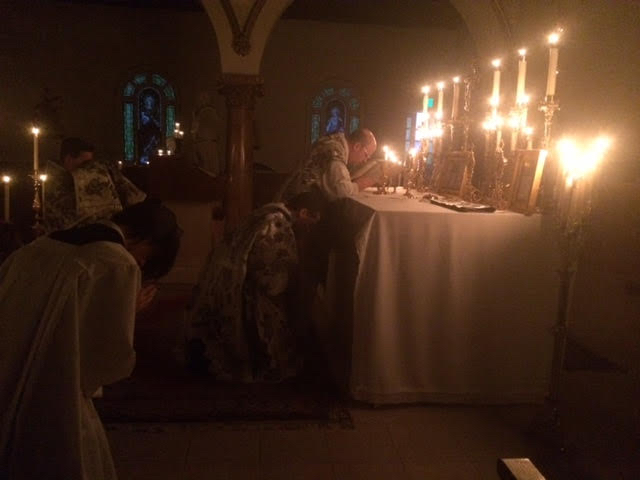
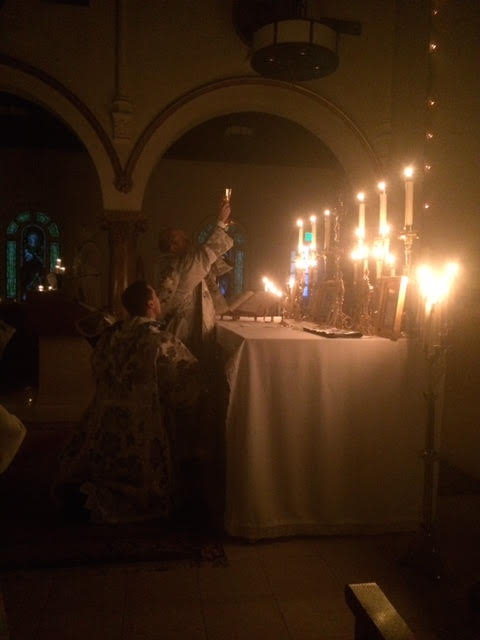
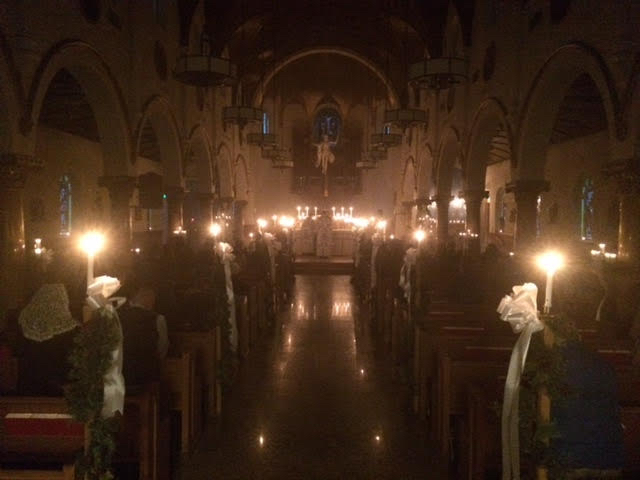
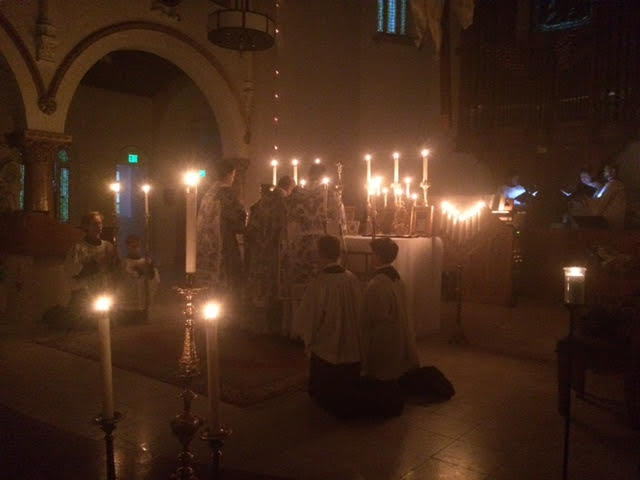
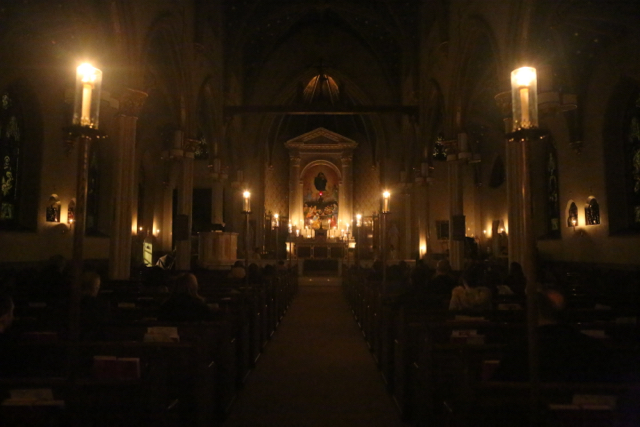
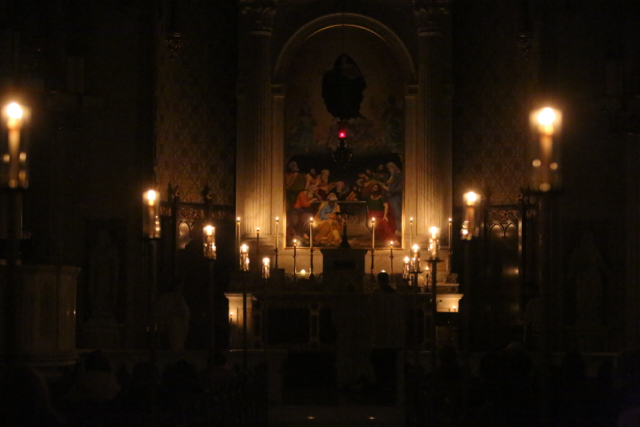
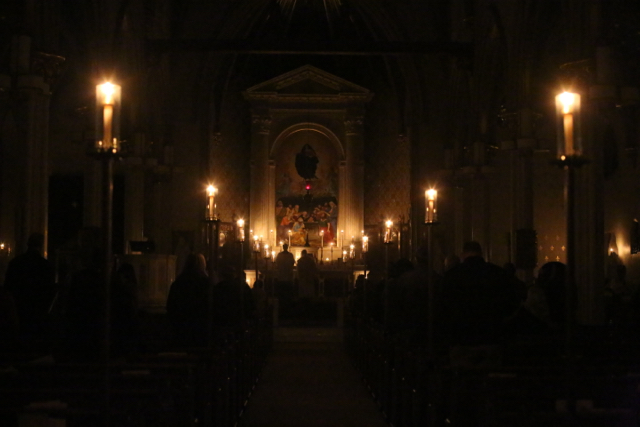
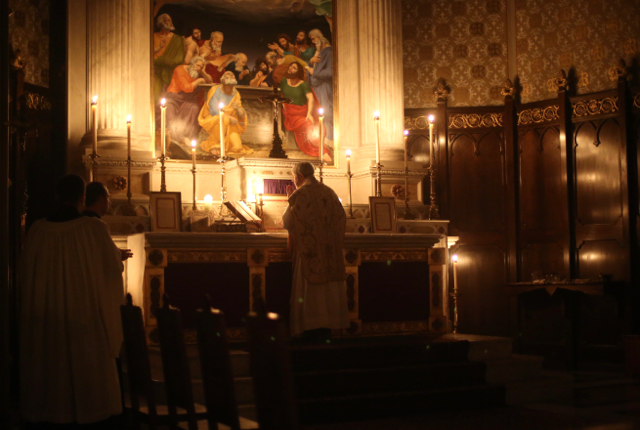
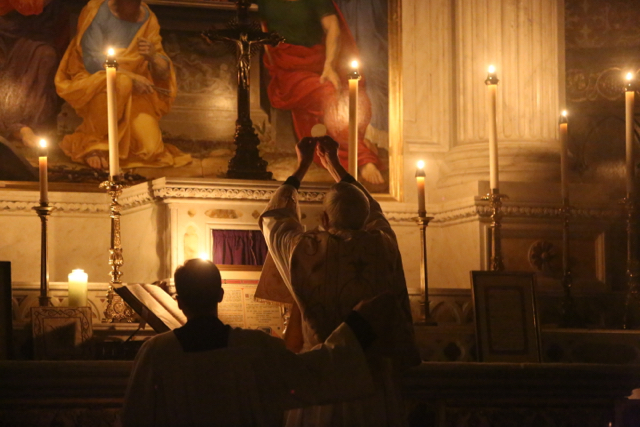
Rorate Mass this morning at St Mary’s Greenwich. As you can see from these pictures and the prior post of this day, the inclement weather was no obstacle to this newly popular Advent devotion. (St. Mary’s Greenwich and St. Mary’s Norwalk are roughly 12 miles apart)
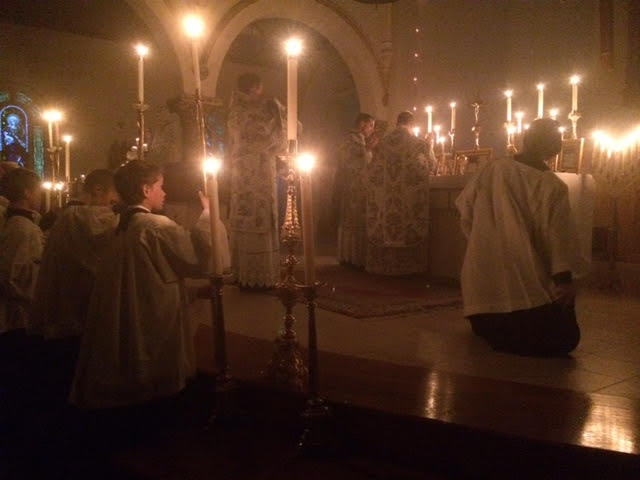
(Photographs courtesy of Father Cyprian P. La Pastina, Pastor, Saint Mary Church
Greenwich)
17
Dec
Before dawn this Saturday morning an impressive congregation braved the darkness, snow and ice of an early winter storm to participate in the celebration of a Rorate Mass. Fr. Richard Cipolla celebrated the missa cantata.
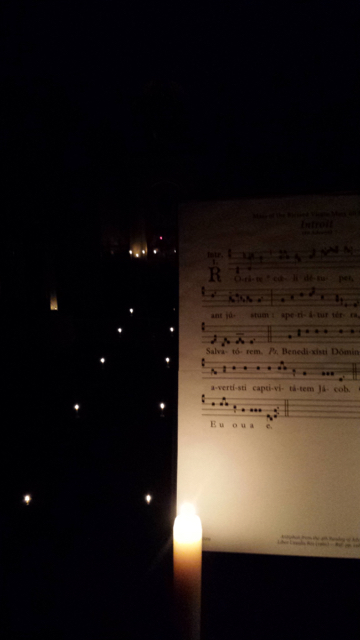
(Above) The view from the choir loft (photo courtesy of David Hughes)