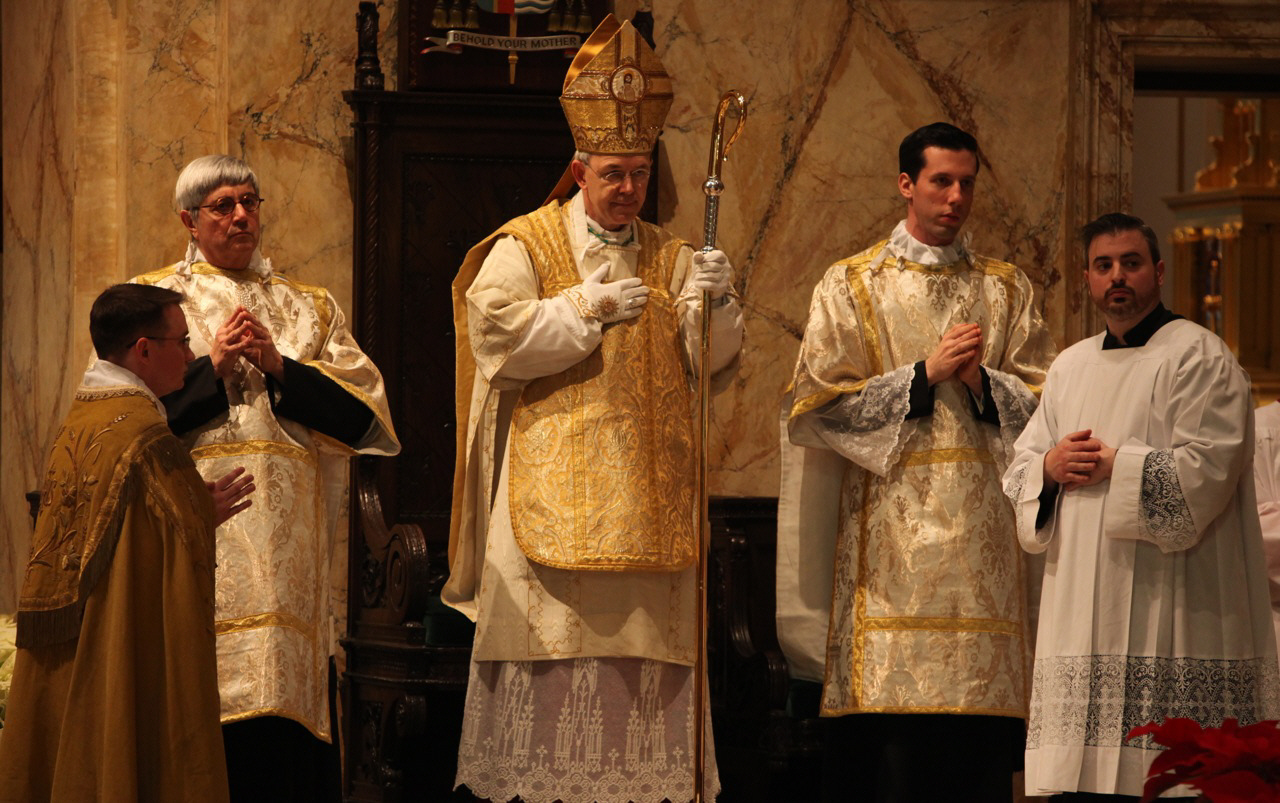
On July16th we commemorated the feast of Our Lady of Mount Carmel. For unclear reasons, by 2013 this feast had become, at least in the New York area, associated with the festive celebrations of the Traditional Latin Mass (“TLM”). 1) But there is a more sorrowful aspect to this day – on this same date in 2021 Pope Francis issued Traditionis Custodes (“TC”) which, with its implementing rules, aimed at the complete extirpation of the TLM. What can we expect from the new Pope Leo on this issue? What is the current state of the traditionalist movement?
- Pope Leo XIV
Weeks into his pontificate Pope Leo still remains something of an enigma. From the perspective of a traditionalist or conservative, Pope Leo has brought a welcome change in style compared to the previous pontificate. He has sent out all kinds of signals indicating a return to “normalcy” – in his speech, in methods of leadership and in his general demeanor. On the other hand, the policies of Pope Francis continue to run in their accustomed course. The synodal path and the environmental mass have received official endorsement. The appointments to the episcopacy and other major offices also are hardly distinguishable from the choices Francis would have made. Thus, Pope Leo gives the impression of a careful, methodical manager who only gradually seeks to put his own stamp on the administration of the church.
Major decisions, however, which will clarify where Pope Leo stands, can only be deferred so long. Doing nothing is also a decision. Leo Is facing making hard choices in the near-term on a number of issues – some known to the public, others not. Here is a (non-exhaustive) list:
The war of TC against traditionalists is still proceeding with drastic actions taken (or proposed to be taken) in dioceses such as Charlotte and Detroit.
A conflict between the Spanish Church (and the Vatican) with Opus Dei is continuing on several fronts including a decision on that organization’s revised statutes.
Campaigns inherited from Francis against several other monasteries and congregations (such as the visitations of Heilgenkreuz Abbey and the FSSP) will have to be addressed.
The worldwide synodal path continues, with ever more radical demands for change being made especially in Germany, while the clashes over Fiduciam Supplicans remain unresolved.
In France and in the Vatican, priests convicted of abuse or possession of child pornography have been promoted to highly visible public offices. 2) The Rupnik affair in Rome has not been resolved at all.
The Vatican is by all accounts teetering on the verge of insolvency.
And all this is in addition to whatever personnel decisions the Pope may have to make in the next few months – both in the Vatican and at several major sees.
It is still not clear what direction Pope Leo will take on any of these matters. That is a cause of unease for conservatives. Will Pope Leo emerge as a competent (in the best case) administrator of the Vatican on behalf of the establishment created by Pope Francis? Or will he discern the need to make to make major adjustments?
In fact, the most hopeful indications regarding the Pope’s future stance come from the progressive Catholics and from the secular media. Pope Leo is described in the Catholic progressive media in reserved, and in some isolated cases, downright hostile terms. Adulation by the secular media is sparse compared with the situation under Francis. Even where progressive writers seek to claim Pope Leo as one of their own and to advise him accordingly, their forceful language has more the character of a demand, even of a warning. They are letting Pope Leo know in no uncertain terms what the policies of the Vatican must be.
They also make clear what the consequences may be if the Pope diverges from the progressive party line. For the Chicago Sun-Times and the New York Times (seconded by the Washington Post) have run a series of articles detailing the failures of Robert Prevost in managing sexual abuse both as an official of the Augustinians and as a bishop. Now if Pope Leo adheres to the progressive agenda nothing more may come of this. After all, for 12 years the media and the Catholic Church covered up much more egregious acts of Jorge Bergoglio committed both during and prior to his papacy. But if Pope Leo is not docile, these matters from his past as a Catholic administrator will be immediately moved front and center. Let’s remember that in Germany the media hounded Pope Benedict literally to the day of his death for far less – with the “Pope Emeritus” receiving only polite support from the Vatican and the German Catholic Church.
But Pope Leo is likely not to have the option of returning to the laissez-faire policies of John Paul II, of ruling as if no conflicts or issues exist within the Church. For the progressive forces empowered by Pope Francis and installed in the various national hierarchies, the religious orders, Catholic media and education and of course in the Vatican itself are too active and aggressive. Provocative actions on the part of the controlling progressive forces recently have crystallized some of the critical issues. The expansion of the blessings of same-sex couples in Germany, the appointment of a convicted abuser as chancellor of a French diocese and the radical anti-traditionalist actions in Detroit and Charlotte (although the latter have been deferred) in the United States are all examples. Moreover, revelations regarding the malfeasance of Pope Francis and his followers are likely to keep trickling out. These too will require Pope Leo to provide verbal clarification and to act more rapidly than he perhaps would have wanted. The disclosure of the true results of the alleged survey conducted by Francis prior to promulgating TC may well be only the start.
B. The Traditionalist Movement.
While Vatican policy remains in a holding pattern, where does the traditionalist movement stand? We recall that in 2021 TC and its implementing measures launched a radical campaign of annihilation against traditionalism. Almost immediately, however, the Vatican had to modify its tactics, most notably in reference to the Ecclesia Dei congregations. So instead of attempting an immediate ban of the TLM, along the lines of Paul VI’s implementation of the Novus Ordo in 1969-70, the Vatican sustained an ongoing and relentless war of attrition. By taking punitive actions against individual bishops, through diocese-by-diocese appointments, through Apostolic visitations of monasteries and orders, and by restrictions imposed on individual priests the traditionalist movement would be gradually strangled. Corresponding actions were often implemented on the diocesan level as well.
In one key respect, however, the war of Francis exceeds the actions of his great role model, Pope Paul VI. In the 1970s and 80s the Church was reluctant to admit a total break with the past, to explicitly outlaw the celebration of the TLM as such. It was too important to the Church to retain at least the appearance of continuity with the past. Then, there were arguments that it was inappropriate to force those adhering to tradition out of the Church; that something should be done to cater to their “sensibilities.” Further, depending on the circumstances, adaptations of the Novus Ordo liturgy to incorporate prior liturgical tradition were tolerated.
Under Pope Francis all such considerations were swept aside. Acolytes of Francis frankly declare that the Novus Ordo embodies a different theology from that of its pre-conciliar predecessor. Further, the advocates of TC are unconcerned with the impact of their actions on the Catholic faithful – whether they leave the Church or not is of no importance to therm. Finally, incendiary statements by the most ardent supporters of the late Pope – such as Cardinal Cupich, Andrea Grillo and Bishop Martin of Charlotte – clarify that not just traditionalism, but the entirety of prior Catholic liturgical tradition will be subject to attack.
TC obviously has failed to intimidate, let alone destroy, the traditionalist movement, taken as a whole. Traditionalist masses continue to be celebrated. Where that can occur, growing congregations can be found – including many entirely new to the TLM or even the Catholic faith. The outpouring of traditionalist literature continues, providing an increasing solid intellectual basis for the movement. Priests continue to be ordained to the Ecclesia Dei communities (and the FSSPX). Traditionalism has acquired several advocates in the hierarchy – few but of great character and intellectual stature. Once again in 2025, the Chartres pilgrimage in France had another overwhelmingly successful year in spite of the threats of the Vatican and the French church. Here and there traditionalists have even received favorable notice in the leading secular media – after being identified as “terrorists” by the FBI under President Biden. Finally, in our area, there have been hopeful administrative developments, both great and small, regarding individual parishes. Traditionalism has indeed been passed down to a new generation.!
The strength of the continuing traditionalist movement obviously varies from diocese to diocese, from country to country. Recently, in several cities in England I was able to participate in traditional masses celebrated by mainstream religious orders. And at one historic church in London – not directed by one of these orders – the TLM is regularly celebrated but not advertised.
In Germany the situation is more dire, but the traditionalism nevertheless continues. One leader in an apostolate to university students told me, in almost a covert manner, of the regular celebrations of the TLM in the vicinity. This need for clandestinity does not, however, necessarily hinder the intellectual defense and understanding of Catholic Tradition, where in Germany a new generation of outspoken Catholic leaders is in formation. And even outside the ranks of those committed to the TLM, I found signs of an interest in tradition among younger people that you would not guess existed reading the official Catholic media.
But, as these descriptions illustrate, a clandestine, even fearful atmosphere often prevails in Traditionalism today. TLMs are often not disclosed, let alone advertised. At least in the New York area, the expansion of the TLM into new locations has stopped. And the anti-TLM campaign is having an effect on much of the diocesan and religious clergy. Priests who formerly celebrated the TLM do not want to be identified – or try to expunge the historic record that they did so! Others have resurrected a “reform of the reform” approach (the Novus Ordo in Latin). Conferences originally Traditionalist-friendly have been “repurposed “ in this sense.
I understand why some are motivated by “prudence.” But I find this approach ineffective and, in the end, suicidal. For, as it always has been from the beginning, the reform-of-the reform depends on the Church bureaucracy for its primary support. It is an attempt to preserve some external aspects of tradition while leaving the ideology of the establishment unanalyzed and unchallenged. The advocates of the Catholic tradition are being asked to give up spiritual values and treasures for the political advantage of temporarily remaining in the graces of the hierarchy. For, as has been amply demonstrated in Charlotte, Chicago and elsewhere, the anti-traditionalist movement also aims at the total elimination of all traces of Catholic tradition.
This further illustrates, moreover, the root deficiency of TC – the use of physical coercion to combat a spiritual movement. Bishops and clergy have made threats and given orders, they have expelled the TLM from parishes and exiled clergy – yet the organized resistance – open in the case of the laity, largely behind-the-scenes in the case of the clergy and hierarchy – continues. At no time has a real attempt been made, aside from a few publications more in the nature of pamphlets, to convince traditionalists of the folly of their ways. The use of quasi-totalitarian methods to stifle traditionalism by force only reveals the weakness of a system that employs these techniques. As Mikhail Bulgakov wrote, “manuscripts don’t burn.”
For the Catholic progressives, who think only of obtaining and preserving political power, cannot grasp a movement that seeks to advance the Catholic faith in its totality – in doctrine, in morality, in the traditions and above all in the liturgy. These traditionalists work for these things not in theory, by living them concretely in their home, parishes, chapels and schools. For this they are willing to make great sacrifices. For example, I am heartened by so many people, younger than I, who commit to moving to the vicinity of a traditionalist parish or monastery for the sake of themselves and for their families. After Washington and Arlington, Detroit and Charlotte they are aware of the risks. Nevertheless, trusting in the Lord, they are glad to undertake this great venture. For what else can we call Catholic traditionalism, which has aroused such hatred among those who have made peace with this world?
- The Society of St. Hugh of Cluny, “Masses for the Feast of Our Lady of Mount Carmel” ( July 9, 2013).
- The Pillar, “Vatican Official jailed for Child Pornography returns to Work” (July 16, 2025): Flynn, J.D., “Will Leo weigh in on France’s Criminal Chancellor”? ( July 11, 2025) (all accessed July 21, 2025)