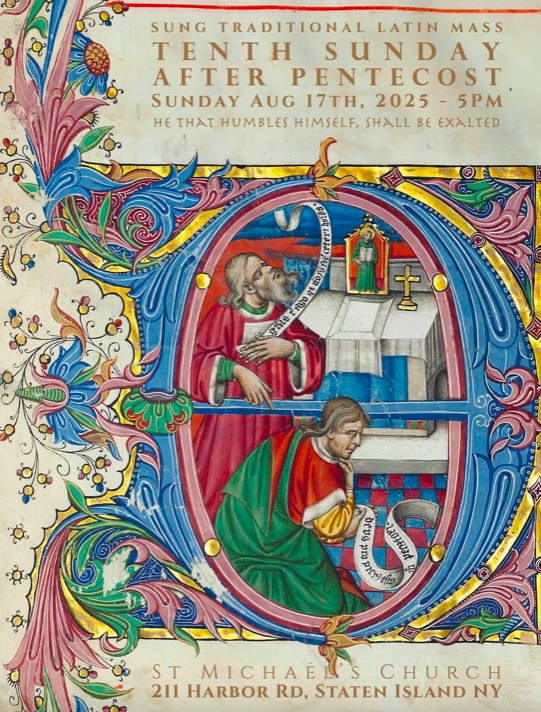
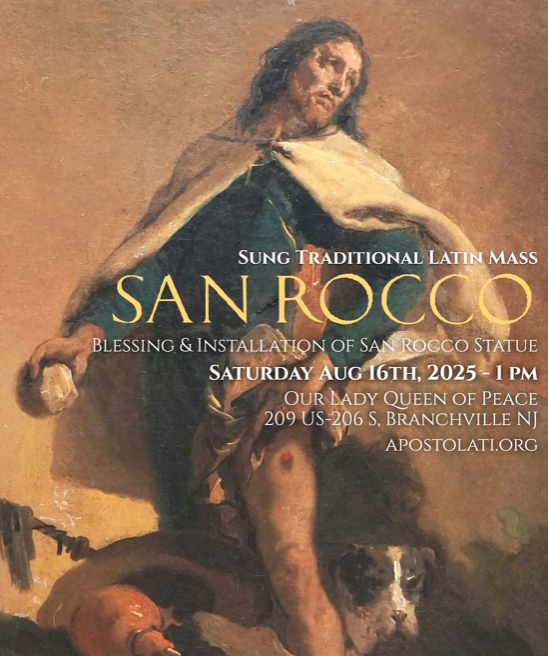
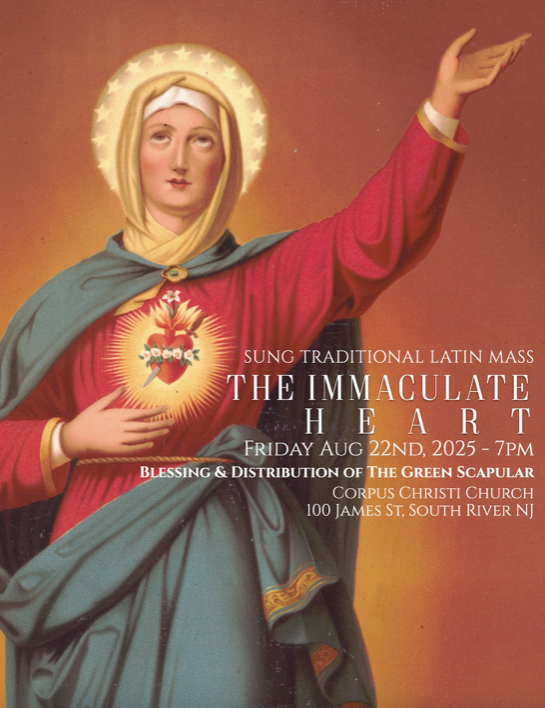
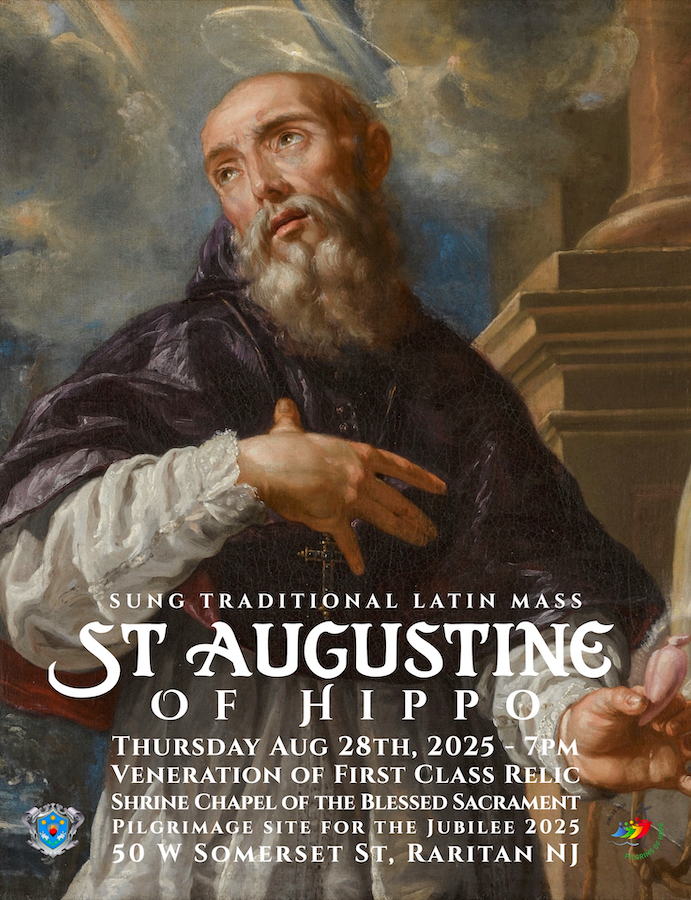
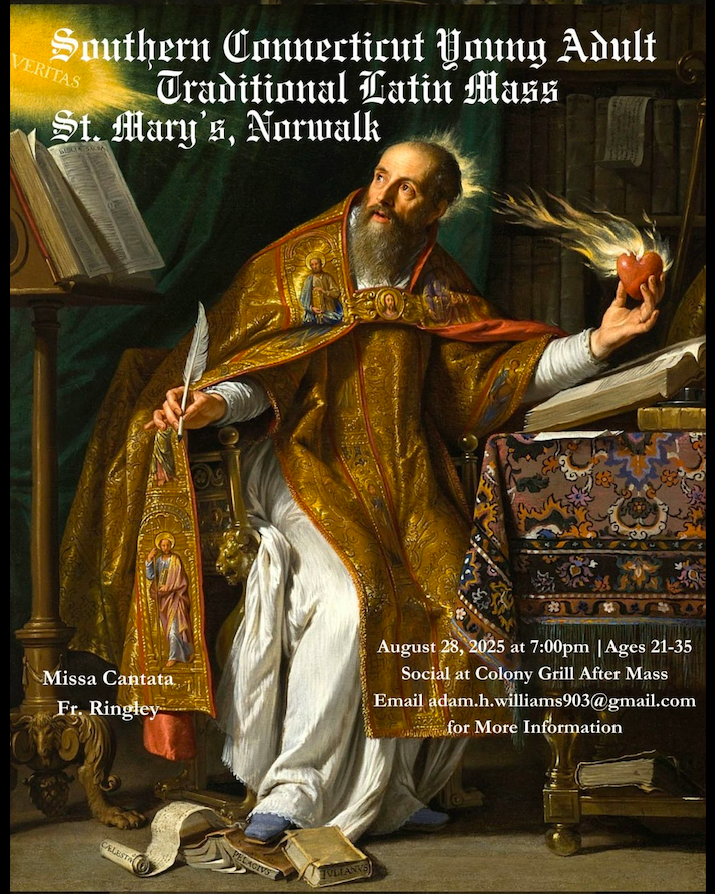
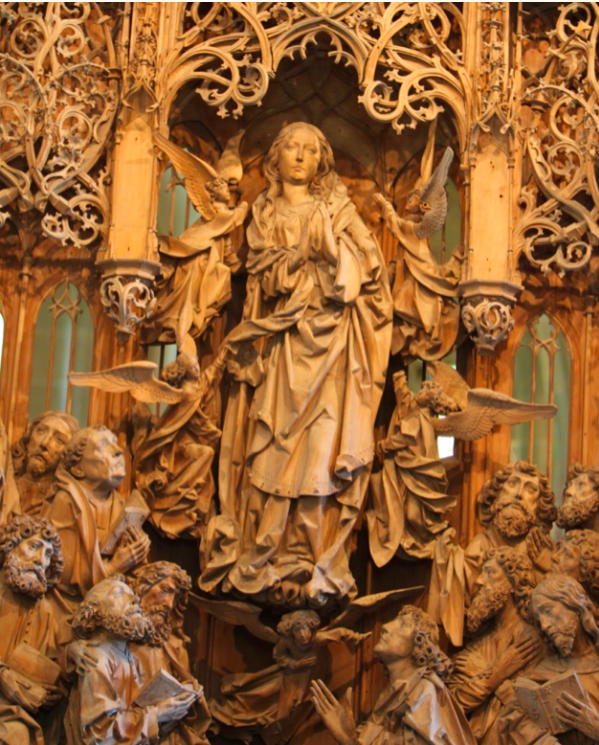
This Friday, August 15, is the Feast of the Assumption of Mary, which is a holy day of obligation. The following churches will celebrate Traditional Masses. Please notify us if you know of a Mass that is not on this schedule.
Connecticut
St. Mary Church, Norwalk, 8 am, 12:10 pm, 7 pm
Sts. Cyril and Methodius Oratory, Bridgeport, Low Mass 7:45; High Mass 6 pm followed by procession and blessing of herbs and fresh fruit. Please place your herbs and fruit on table provided before Mass begins.
St. Patrick Oratory, Waterbury, Low Mass 8 am; High Mass 6 pm
St. Martha, Enfield, 7 pm
New York
Holy Innocents, Manhattan, Low Mass 8 am; High Mass 6 pm
Our Lady of Mount Carmel, Manhattan (Harlem), 7am Low Mass, 7:45am Low Mass, Adoration from 10am to 4pm, 3pm Rosary and Divine Mercy Chaplet , 6pm Confessions , 6:30pm Rosary, 7:00 PM Missa Cantata
St Josaphat, Bayside (Queens), Low Mass 7 am; Missa Cantata 7 pm followed by procession and blessing of flowers and herbs.
St. Rocco, Glen Cove, Long Island, Missa Cantata, 7 pm
St. Matthew, Dix Hills, Long Island, 10:30 am
St. Paul the Apostle, Yonkers, 12 noon
Annunciation Church, Crestwood, Missa Cantata, 7 pm. (Missa Cantata every Sunday at 2 pm)
Immaculate Conception, Sleepy Hollow, Low Mass, 7 pm (Traditional Mass every Sunday at 4 pm)
Sacred Heart, Esopus, 11:30 am
St. Mary and St. Andrew, Ellenville, 7 pm
New Jersey
Our Lady of Sorrows, Jersey City, Missa Cantata 5 pm
Our Lady of Victories, Harrington Park, 5:30 pm
Our Lady of Fatima, Pequannock, 7 am, 9 am, 12 noon, 7 pm
St. Anthony of Padua Oratory, West Orange, Low Mass 9 am; High Mass 7 pm
Corpus Christi, South River, Missa Cantata 7 pm
Shrine Chapel of the Blessed Sacrament, Raritan, Missa Cantata 7 pm
St. John the Baptist, Allentown, Low Mass 8 am
Here is the schedule for AUG 2025 Traditional Latin Masses at the Shrine Chapel of the Blessed Sacrament in Raritan, NJ
Additionally, a Sung TLM is celebrated every Sunday at 10:30 AM.


31
Jul
In a recent visit to the cathedrals of England we encountered the traces of the prior occupant: the Catholic Church. Here and there the memory – and sometimes the tombs – of the medieval saints are preserved. For the devotion to the saints was and still is characteristic of the Catholic Church in England. Many of the great cathedrals owe their architectural splendor to the medieval pilgrims who thronged to the graves of the saints revered there.
Of course, the most famous saint was Thomas Becket. His shrine in Canterbury Cathedral was the main pilgrimage destination of England – as immortalized by Geoffrey Chaucer.

(Above and below) The place in Canterbury Cathedral where St. Thomas Becket’s magnificent shrine once stood. The Church of England seems to have no difficulty in commemorating “St. Thomas of Canterbury” – whose cult in England was extirpated by that denomination’s founder.


(Above and below) Where St. Thomas was martyred.


Saints often had been outstanding bishops of their diocese and leaders both in Church and state. (Above) The (former) tomb of St. Osmund in Salisbury Cathedral: pilgrims could see or touch the relics of the saint through the openings. The famous reliquary was destroyed in the Reformation. (Below) The tomb of St. William, the patron saint of York. (York Cathedral)


Durham Cathedral still contains the tombs of two early English (Anglo-Saxon) saints. (Above) Saint Cuthbert (ca. 634 – 687) (Below) The tomb of Venerable Bede (672/3 – 735) in the “Galilee” chapel. They both were instrumental in the founding and consolidation of the Catholic Church in England. The relics of both had been translated (moved) to Durham early in the Middle Ages.

Such was the faith of Catholics in medieval England. But what of the age of the Reformation and beyond?
Canterbury Cathedral still houses the grave of another more recent Catholic archbishop. Cardinal Reginald Pole, the last Roman Catholic archbishop of Canterbury, was one of the most outstanding prelates of Europe and even was considered for the papacy. He was archbishop under Queen Mary I and supported her in an ultimately unsuccessful attempt to restore Catholicism as the official faith of England. The extent to which he was involved in her campaign against heretics is disputed. But scholars like Eamon Duffy think that despite this “failure” of a Catholic restoration, Mary and Pole planted the seeds fof the recusant resistance of the next 270 years. Tragically, Pole died in 1558 while under bitter attack by the possibly crazy Pope Paul IV.

(Above) The tomb of Cardinal Pole in Canterbury Cathedral.

(Above) The tomb of the repudiated Queen Catherine of Aragon in Peterborough Cathedral (up to the time of Henry VIII, an abbey). She was buried here in 1536. Her tomb was subsequently destroyed by the Puritans – the existing decorative slab is a contribution of the late 19th century. We should reflect on her life and its lessons for the Church of Amoris Laetitia. A second tragic Catholic queen, Mary Queen of Scots, was once also buried in Peterborough. But her son, King James I, eventually had her body moved to Westminster Abbey after he ascended the English throne in 1603.

(Above) A list of the martyrs of York displayed in the York Oratory (Roman Catholic!)
The English Catholic Church especially reveres the martyrs of the Reformation period onward. Their relics, of course, are not found in Anglican cathedrals! One of the chief of these was Margeret Clitherow of York. She was put to death in a particularly gruesome manner in 1586 (she was pressed or crushed to death). A relic of her survives in the Bar Convent ( a clandestine convent and school established in the 17th century by the Mary Ward sisters)

(Above ) A chapel of St. Margeret Clitherow in the picturesque “Shambles” of York. This was thought to have been her house – but a subsequent renumbering of the houses on the street had been ignored. Her real house still exists, across the street from the chapel. Note the arrangement of the altar….. (Below) The relic of St. Margertet Clitherow – her hand – in the chapel of the Bar Convent.


Finally, not a tomb, but, like the Bar Convent, an ancient reminder of the penal times. The former chapel of the Bavarian embassy – now known as the Church of Our Lady of the Assumptionn and St. Gregory – dates to the period when London Catholics could only worship in chapels of embassies of Catholic countries. The Bavarian chapel, after having been destroyed by the mobs of the anti-Catholic Gordon riots of 1780, was rebuilt around 1790. It is thus one of the oldest Catholic churches built after the Reformation in England. It was, however, extensively redecorated in the 19th century. After a number of recent vicissitudes, it has been entrusted to the Personal Ordinariate of Our Lady of Walsingham. As in the case of the chapel of St. Margeret Clitherow, please note the arrangement of the altar.
These mementos of the English martyrs and the sufferings of the penal times are especially relevent to traditionalists. For we are still officially persecuted – this time by the establishment of our own church. Reflection on the history of the Catholic Church in England helps put our situation in perspective. Consider the surrender of almost the entire English hierarchy under Henry VIII – except for one bishop, St. John Fisher of Rochester. The persecution of Catholics that began then lasted, with a few reprieves, almost 300 years! And if physical violence had (mostly) died down after the 17th century, at all times in these years English Catholics were denounced, segregated, and excluded from most aspects of public life. Yet they persevered and in the 19th century a Catholic renaissance did indeed take place. One of the main spiritual leaders of that recovery, St. John Henry Newman, is about to be made a doctor of the Church. But this renewal was only possible by virtue of previous generations of Catholics who had kept the faith through seeemingly hopeless times. And also by the sacrifice of so many who paid the ultimate price for that faith.
30
Jul

Close the Workshop: How the Old Mass isn’t Broken and the New Mass can’t be Fixed
By Peter A. Kwasniewski
431 Pages
Angelico Press, Brooklyn, NY 2025
Peter Kwasniewski has said that Close the Workshop completes and summarizes his vast written labors for the Traditional Mass. I can only agree with him on this! Kwasniewski approaches the Traditional Mass (“TLM”) as a writer, theologian, philosopher, musician, organizer, editor and activist on behalf of Catholic tradition. Accordingly, Close the Workshop deals with both the theory and practice of the TLM.
One word of warning to the reader; Close the Workshop is not the product of a would-be ecclesiastical politician, attempting to win the favor of Church authorities. The author is passionate and forthright, unafraid of ruffling the feathers of the hierarchy. This substantial book is directed to those who love the TLM and want to find a resource to help them understand, defend, explain and celebrate the TLM.
The author’s uncompromising position is evident from the full title of this book. Kwasniewski acknowledges that the TLM and the Novus Ordo stand in direct contrast to each other and spells it out in great detail. And Kwasniewski frankly argues for the superiority of the TLM over the Novus Ordo. Further, he disputes any need for ‘mutual enrichment” of the two liturgies. The TLM does not need enrichment from the Novus Ordo; the importation into the Novus Ordo of elements of a prior liturgical tradition contradicts the liturgical principles of the new rite (such as the exclusive emphasis on the verbal communication of content, or the priority placed on the spontaneity of the “presider” ).
In my immediate vicinity a good illustration can be found of this fundamental divergence in practice between the two liturgical forms. Not too far from where I live is a “conservative “ parish devoted to the Novus Ordo but incorporating traditional artistic and musical elements. Then, there is a second church that regularly celebrates a most complete Solemn TLM. In the former church, members of the congregation discuss how each priest celebrates the Mass, and whose “style” is more congenial to them. In the second, the TLM remains the same, even though that church over the last 20 years has seen it celebrated by three pastors with radically different personalities. 1)
Close the Workshop repudiates the modern compulsion to constantly change or “update” the liturgy. This urge first arose out of the liturgical movement, reached a climax in the era of Paul VI and Bugnini and continues unabated today in the Novus Ordo. ( see recently, for example, the “Amazonian” rite, the “Mayan” rite, a potential change to the method of determining the date of Easter)
Close the Workshop is especially timely today, when certain of the clergy, previously inclined to the TLM but unable to stand up to the persecution of Traditionis Custodes, have resurrected the ”Reform of the Reform” as a supposedly viable alternative to the TLM. This seems incredible, given the condemnation of such practices (and the use of the very term) by Francis, and the explicit attacks on all elements of prior Catholic tradition made by the late Pope’s most devoted followers: Cupich, Grillo, Weisenburger, Martin etc. As Kwasniewski points out, “Reform of the Reform” seeks to placate the Church establishment by introducing forms which that same establishment condemns.
Conclusions similar to Kwasniewski’s were already implicit in Martin Mosebach’s seminal 2001 Heresy of Formlessness. The first book review published on this blog pointed out that, in this work, Mosebach portrayed the TLM not as an option for gratifying the subjective aesthetic or nostalgic feelings of a few, but as an objective necessity, even a universal requirement for the Church.2) And, during his 2007 visit to the U.S. presenting that book, Mosebach expressly rejected suggestions from the audience to restart tinkering with the TLM. He stated that what is needed is liturgical consolidation, not another wave of change.
But since those days there have been many years of practical experience with the TLM as it developed after Summorum Pontificum. Many studies have been published which analyze the liturgical texts and music and elucidate their history (including the relation of the Novus Ordo to the documents of the Council and the actions of Paul VI), These works make possible a more detailed understanding of each liturgical form and of the scope of the changes the Novus Ordo introduced. Close the Workshop draws on the author’s extensive participation in these developments.
The late Pope Francis and his close liturgical associates would also agree with the view that the TLM and the Novus Ordo reflect different theologies and should remain separated. In contrast to Kwasniewski, of course, they view the TLM as the defective product of a superseded past. And their words and policies make clear that the TLM (and all cultural aspects associated with it) should not be allowed to contaminate the Novus Ordo. As a technique of harassment, however, Novus Ordo forms on occasion have been imposed upon the celebration of the TLM. Kwasniewski devotes a special chapter to the “hybridization” threat. (“The Liturgical Rollercoaster”)
The second half of Close the Workshop is primarily devoted to practical responses to specific issues of the TLM today. Some chapters answer specific objections to the TLM and traditionalism. Suggestions for “improvements” to the TLM are considered at length and rejected. Kwasniewski then offers practical advice on celebrating the TLM. He even has a few words of advice (and comfort)to those who feel they can only celebrate the Novus Ordo whle incorporating elements of tradition. For, although that practice somewhat contradicts the thesis of this book, the author understands the need for guidance in this area. Moreover, Kwasniewski does discuss suggestions for improving the celebration of the TLM (“Modest Proposals for Improving Low Mass”).
Is it not strange? – the TLM, as it is frequently celebrated today, actually comes closer than the monotonous chaos of the Novus Ordo to realizing some key concepts of the Council (insofar as these had any real meaning and were not merely a code word for overthrowing the historic culture of the Church). For example, ecumenism. The Byzantine divine liturgy has strongly influenced the liturgical sensibilities of so many traditionalists. Kwasniewski himself has extensive direct experience of the Byzantine rite and its music. The TLM, as a bridge to understanding the Divine Liturgy, can serve as a link with the Orthodox. And as for active participation, the intensity of the devotion of a congregation at a Solemn TLM has always amazed and inspired me. And that devotion rests on a solid understanding of the texts and participation in the music, where appropriate. These are real achievements – and Peter Kwasniewski’s book is an invaluable resource for deepening that devotion and understanding.

(Above) Notice attached to the door of the former parish of St. John the Evangelist.
The church and parish of St. John the Evangelist is no more. It is the end of a parish founded in 1840. But it is also the end of a modern liturgical and artistic dream – a new church built and decorated 1970-73 to witness to the “new Spring time” of the Council and its liturgical vision:
(Msgr. George A. Kelly, the first pastor of the new church)then describes what he audaciously calls the “Fifth Spring of the Parish.” St. John’s had to start all over again “as if it were 1840.” Kelly writes that “1973 not only marks the end of four years of stress and unhappiness but hopefully the beginning of a new parochial dream.” 1)
Well, as some feared at the very beginning, this dream of the clergy has come to a crashing end. The Archdiocese has had to sell its headquarters – in which the new St. John’s has been located since 1970 – becuse of its dire financial condition.
Prior to the closing of the Catholic Center there was a final Mass for the clergy, executives and staff( parishioners unconnected with the headquarters are not mentioned):
Archdiocese of New York Staff Gather for Final Mass at New York Catholic Center


The facade on 7/28/2025 with the Catholic symbols ripped off.

(Above)The now desolate interior. (Below) The forlorn entrance to the church (with an unobtrusive crucifix above the doors already removed).


(Above) The latest bulletin of Holy Family parish.
These Manhattan parish names keep getting longer and longer and the parish territory larger and larger. I can think of the names of two additional Catholic institutions that could be added here, just limiting ourselves to churches/chapels that were still in existence in 1980. The archdiocesan headquarters is now in rented quarters near St. Patrick’s Cathedral. The pastors who have succeeded Fr. Gerald Murray at Holy Family both have or had senior functions in the archdiocesan administration. Who knows, perhaps Holy Family parish itself will one day be folded into St. Patrick’s!

(Above) Solemn vespers at Most Holy Redeemer church in 2013, with Bishop Athanasius Schneider.
Stacie Joy of East Village Grieve reports that regular masses are being terminated at Most Holy Redeemer Church starting in September. 1)
Most Holy Redeemer-Church of the Nativity will no longer hold a regular mass schedule starting in September, according to parish and Archdiocese officials.
At a meeting held Monday night at St. Brigid’s on Avenue B, Monsignor Kevin J. Nelan of Immaculate Conception on 14th Street and Eileen Mulcahy, the vice chancellor for parish planning of the Archdiocese of New York, addressed continued speculation that Most Holy Redeemer would close outright. They emphasized that while the church isn’t officially closing, its operations will undergo significant changes.
Regular weekly masses will end, and in their place, the church will offer only occasional services, such as weddings, funerals, or what was described as “once in a blue moon masses” for long-time parishioners.2)
Masses are being shifted to St. Brigid’s. Readers may recall that that church was restored only after the Archdiocese had fought tooth and nail to shut it down. St. Brigid’s now features horrendous art in the apse.
Most Holy Redeemer, in contrast, is one of the most historic and beautiful churches in the city. 3) It has a magnificent shrine of Our Lady of Perptual Help and a once famous collection of relics. It also contains, downstairs in an elaborate crypt, so many tombs of the Redemptorists (what’s going to happen to them?). We at the Society of St Hugh of Cluny have had a long association with this parish, sponsoring all kinds of events there over the years. (A search of this blog will lead the reader to photographs of many masses and events.) There always seemed to be activity going on in this church. Even after the Redemptorists suddenly up and left, this grand church seemed to be enjoying a renaissance that attracted favorable media attention. But it was not to last. Last year the young pastor was transferred out and Most Holy Redeemer placed in the hands of a priest managing a number of other churches in the area. 4) It looks like the Archdiocese is following the usual playbook: priests are unavailable, the building allegedly has structural problems, the faithful can best be congregated in one church. The parish even has had to vacate its offices from the rectory (which actually is still in the hands of the Redemptorists).

(Above) Vespers with Bishop Schneider in 2013: (Below) Most Holy Redeemer in 2019.

The loss of Most Holy Redeemer would be a tragic blow to the Catholics of the Archdiocese. The Village Preservation Society is circulating the following urgent petition to landmark this church (incredibly, that appears never to have been done):
Save historic Most Holy Redeemer Church in the East Village

(Above) The arms of Maximilian I, Holy Roman Emperor in the apse of the Freiburg minster. (1512)
The town of Freiburg lies in the south of the German region of Baden, near the Rhine and what is now the border with France. But originally it was not so. The Breisgau (in which Freiburg is located) in the 12th century was controlled by the dukes of Zähringen. They founded Freiburg in 1120 (along with Freiburg (Friburg) in Switzerland and Bern) as a kind of real estate investment. The town prospered, among other reasons, because of nearby mines. Around 1200 the town’s famous church or minster was begun (even though it was ecclesiastically just a parish church!).
In 1368 Freiburg came under the direct rule of house of Habsburg as part of the area of “Further Austria” in which it remained until 1805. After 1438, the Holy Roman Emperor was almost always the Habsburg archduke of Austria. Accordingly, Freiburg was subject to him not just in his imperial capacity, but as the direct ruler as well. In the 15th century the famous university was founded
Freiburg enjoyed a special time of glory around 1500-1535. Noted scholars (Erasmus) lived there; great artists left their work in and around the city (Hans Baldung Grien, Hans Holbein). It was during this period that the Freiburg minster was completed by around 1513 . The minster and other buildings in the town preserve many reminders of the Hapsburg Holy Roman Emperors and other members of that family.

The Freiburg MInster with Maximilian’s arms high in the apse window

The picturesque Kaufhaus (Merchant’s hall) of 1520 with statues of Hapsburg rulers.

(Above) Maximilian I.(Below) The arms of the Holy Roman Empire.


The “Haus Zum Walfisch” where Erasmus resided. It is famiiar to those who have seen the film”Suspiria.”

(Above and Below) Emperor Maximilian I in the minster. Note the fine renaissance inscription. (Some of these windows are copies; the original are in the town museum).


(Above) Philip the Fair, King of Spain (died 1506, never became Holy Roman Emperor)

(Above) Ferdinand I, later Holy Roman Emperor. (Below) Charles V Holy Roman Emperor)

Subsequent ages were not kind to this city. As a result of the Thirty Years’ War, it suddenly became a border outpost. Strasburg to the north eventually suffered a similar fate (but on the other side of the border!) Freiburg was repeatedly fought over in the Thirty Years’ War and in the subsequent wars of Louis XIV; its surroundings were devastated. The outpouring of South German baroque art in the 18th century only just touched this landscape. This part of Germany bears mute witness to the declining fortunes of the Holy Roman Empire all along the Rhine River after 1618.
Finally, Austria abandoned the entire region, primarily to the German states of Baden and Württemberg (which are now united). Freiburg lived on as a picturesque university town. In 1944 most of Freiburg was destroyed in an air raid. Fortunately, the minster and a few other key buildings and streets survived largely undamaged.

(Above) Carving in the minster.


(Above and Below) The visitor can discover more traces of baroque art outside the city of Freiburg itself. This is the abbey of St. Peter in the Black Forest, dating to the 1720’s, where Zähringen rulers are buried.