

We read in the Brooklyn Tablet that another Catholic parish in the New York area is in danger of closing. 1) Transfiguration church (by now in a combined parish with St. Stanislaus Kostka) was a Lithuanian national parish in Maspeth, Queens. Time has not been kind to the Lithuanian presence in New York – remember the old parish of Our Lady of Vilna in Manhattan. We read that nowadays only one mass a month is offered in Lithuanian at Transfiguration. In 2024 a congregation of, on the average, five people attended this mass. Total attendance for the three “weekend” masses is around 150. Massive repairs to the church and rectory are also needed.

This parish was of some interest to us because in the not too distant past a traditional mass was regularly celebrated there. 2) I do not read any more about that in the current discussions within the parish on how to rescue the church. Quite the contrary! – ideas suggested to keep the church open include “seeking landmark status, applying for grants to pay for repairs and reaching out to underserved communities.” Adds one parishioner: “one of those underserved groups is working people.”
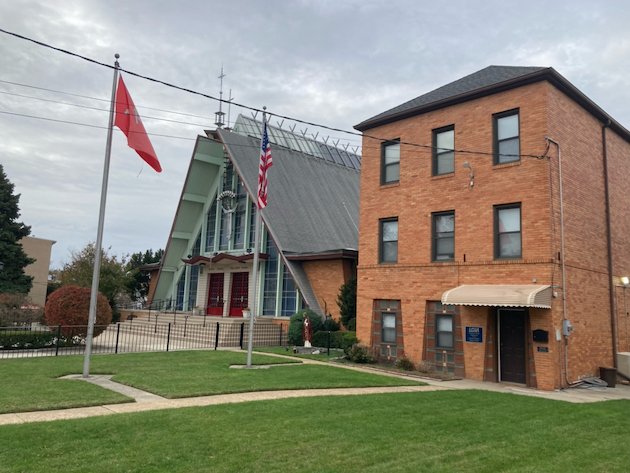
We cannot say that Transfiguration church is a masterpiece of architecture. The current parish church from 1962 reflects the uneasy transition, typical of that time, from traditional architecture to modernity (or at least what passed for modernity in the Catholic Church)

The diocese of Brooklyn has not yet made a final decision whether to keep Transfiguration church open.

From the Assam Kirche in Munich
The Wednesday, March 19, is the Feast of St. Joseph. The following churches will have traditional Masses.
St. Mary Church, Norwalk, CT, 9:15 am Solemn Mass (organized by Regina Pacis Academy)
Sacred Heart Oratory, Redding, CT, 6 pm
Sts. Cyril and Methodius, Bridgeport, CT, 7:45 am low Mass; 6 pm high Mass
St. Patrick Oratory, Waterbury, CT, 10 am -12 noon Eucharistic Adoration; 12 noon, High Mass for all volunteers and workers of St. Patrick’s parish.
Our Lady of Mount Carmel, New York, NY, Low Masses at 7am and 7:45am; Missa Cantata at 7pm followed by the blessing of Saint Joseph’s table.
Holy Innocents Church, New York, NY, 6 pm
St. Margaret of Cortona, Riverdale, Bronx, NY, Solemn Mass, 6:30 pm, reception to follow
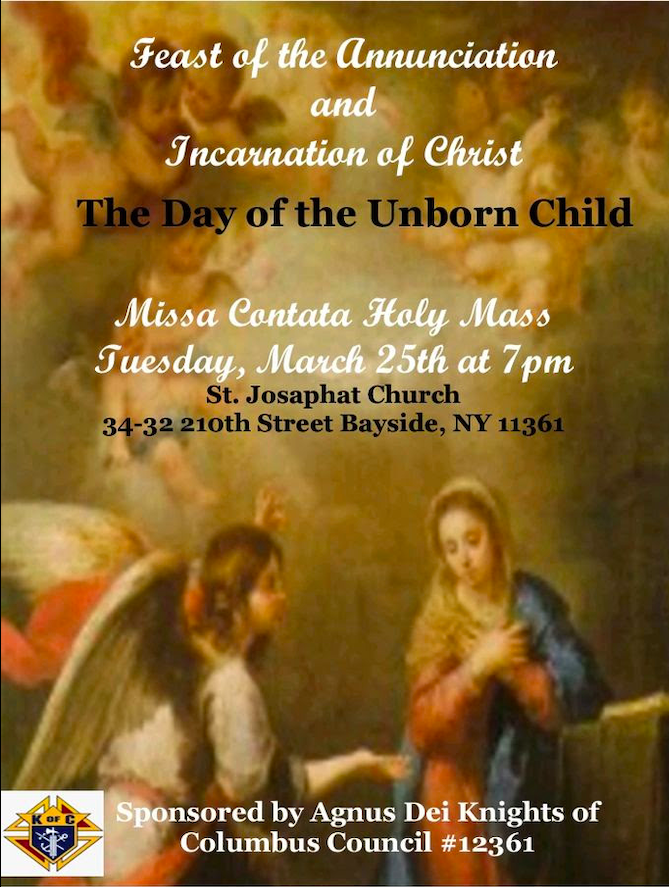
St. Josaphat Church, Bayside, Queens, NY, 7 pm
St. Paul’s Church, Yonkers, NY, 12 noon.
St. Patrick Church, Huntington, NY (Long Island), 7:30 pm Missa Cantata.
Sacred Heart, Esopus NY, 11:30 am, Low Mass
Our Lady of Mount Carmel Newark, NJ, Missa Cantata 7pm
Oratory of Saint Anthony of Padua, West Orange NJ, 9 am low Mass, 12 noon low Mass, 7 pm Solemn Mass
Our Lady of Fatima, Pequannock, NJ, 7 pm high Mass.
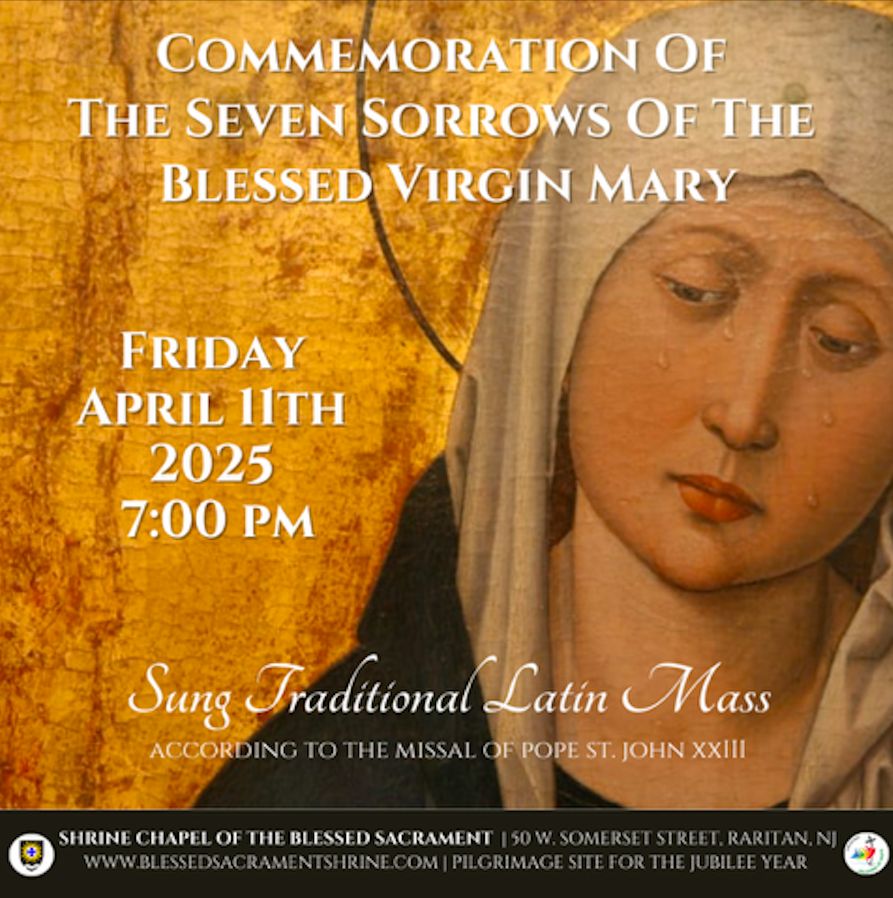
Shrine Chapel of the Blessed Sacrament, Raritan, NJ, Missa Cantata, 7 pm
Corpus Christi, South River, NJ, Missa Cantata, 7 pm, procession and veneration of the cloak of St. Joseph relic, blessing with St. Joseph oil from shrine in Montreal, St. Joseph table with pasteries in parish hall after Mass.


10
Mar

When the Sea Recedes: The Tragedy of the Church in the 21st Century
By Jean-Pierre Maugendre
(Éditions Contretemps 2024)
When the Sea (or Tide) Recedes is a major new addition to the traditionalist library. It’s a selection of essays that chronicles life in the Catholic Church and in Western Europe between 2005 and 2023.
I do have to warn the American reader. This is a very French book. It is Maurrassian, rightist, political and traditionalist – all anathema to mainstream Catholics (to the extent they still exist) in both France and the United States. Jean-Pierre Maugendre tells his story with intensity, panache and personal commitment. His speech is clear, decisive yet controlled. His positions are unambiguous – but hysteria, eccentricity and fanaticism are absent. Although some of his views – such those regarding the French abandonment of Algeria – may send “middle-of-the-road” Catholics into uncontrolled rage.
A further warning to the American reader relates to the subtitle of this book. Much of the book in fact deals not with the Church but with French politics and society. Indeed, it presupposes some knowledge of what has happened in France over the last 20 years. But again, this is very characteristic of the French right, which acknowledges and affirms the political dimension of the Catholic faith. The side-by-side narrative of When the Sea Recedes, covering events both political and religious, makes clear the unavoidable interaction between the Catholic faith and politics.
And this link with the political world cuts both ways. The French right engages in politics on the basis of its faith. On the other side of the coin, as the ruling culture of Western civil society becomes ever more anti-Christian and totalitarian, those same tendencies become manifest as well in the “establishment” Catholic Church under Pope Francis. For although the Catholic mainstream and progressives rage against the political commitment of the French Catholic right, this is only because (a) they reject the right’s political positions; and (b) they themselves are infinitely more political than the right ever has been. Anyone who reads the National Catholic Reporter, the official media of the Catholic churches of France and Germany or has followed the actions of Pope Francis and the Jesuit order can verify this. The politics of the progressives, however, is a pale copy of that of the secular establishment. In contrast, what Maugendre calls, quoting sociologist Yann Raison du Cleuziou, “observant” Catholicism: “sets as its top priority the integral transmission of the Catholic faith and does not give up enriching civil society by the values of the Gospel.” (p.398)
I have to admire the author and the French right for their indomitable spirit. On the French political front, they suffer defeat after defeat on issues like abortion and same-sex marriage. Despite the grave failings of Macron over the last three years, the French political establishment continues to be able to exclude the rightist party from any role in the French government. And despite intermittent widespread public outrage over uncontrolled immigration, gay marriage and disastrous economic policies, the French right never is able to capture a majority of the electorate. Yet, there’s never any slacking off of the intensity of the right’s engagement.
The same can be said in relation to the Church. In the first ten years covered by this book the Catholic traditionalists received unprecedented recognition from Rome, if far less so on the national level. Since the accession of Francis, of course, all this has been reversed, and the Vatican has undertaken a new campaign against Catholic tradition. And while these struggles convulse the Church, Maugendre reminds us again and again of the relentless, drastic collapse of the Faith, as evidenced in the statistics of declining baptisms, marriages, and vocations in France – things that don’t seem to perturb the hierarchs of the Church. More recently, the cause of the French Catholic traditionalists has experienced fresh defeats in Pope Francis’s all-out war against Catholic tradition, such as the deposition of Bishop Dominique Rey. To continue Maugendre’s metaphor – is the sea still retreating?
….
The sea of faith
Was once, too, at the full, and round earth’s shore
Lay like the folds of a bright girdle furl’d;
But now I only hear
Its melancholy, long, withdrawing roar,
Retreating to the breath
Of the night-wind down the vast edges drear
And naked shingles of the world.
Ah, love, let us be true
To one another! for the world, which seems
To lie before us like a land of dreams,
So various, so beautiful, so new,
Hath really neither joy, nor love, nor light,
Nor certitude, nor peace, nor help for pain;
And we are here as on a darkling plain
Swept with confused alarms of struggle and flight,
Where ignorant armies clash by night.
“Dover Beach” by Matthew Arnold (1822–1888)
Yet Maugendre rejects such a mood of resignation. In all the trials he describes he finds much about which to rejoice. Such as the recent overwhelming turnout for the traditionalist pilgrimage from Paris to Chartres. (We just now hear that the French episcopate – and the Vatican – have backed off from ideas of closing Chartres cathedral to the pilgrims in 2025.) Or in his retelling the stories of those who, in one way or another, had fought the good fight in politics or in the Church. Maugendre celebrates in this book the legacy of such varied personalities as Benedict XVI, Helie Denoix de Saint Marc and Jean Madiran. And although it undoubtedly took place after the work on this book closed, I’m sure Maugendre has welcomed the “miracle” of Donald Trump which has unleashed a counter-woke wave throughout the world. Maugendre was fighting the same struggle years ago. For example, in June 2010 Maugendre already anticipated J.D. Vance in stating the obvious truth of the “hierarchy of charity.” (p.121).
As Maugendre tell us, such events and people confirm that situations are never hopeless. “Because that which seems inevitable never is, it’s never in vain to resist it.” That’s especially true in religion where the ultimate triumph of the truth is assured. “It isn’t the hope of victory, but the necessity of struggle that makes the Christian warrior.” (p.21)
We know the sea of faith will return again!

The Right Hand of the Lord is Exalted: A History of Catholic Traditionalism from Vatican II to Traditionis Custodes
by Aurelio Porfiri
Sophia Institute Press (Manchester NH 2024)
The Right Hand of the Lord is Exalted, (“The Right Hand”) is a new contribution to the growing literature on the history of the Catholic traditionalist movement. The author, Aurelio Porfiri, has been writing for years on cultural and liturgical themes. I have appreciated very much his collaborations with Aldo Maria Valli. In these, Valli plays the role of the impassioned critic and visionary, while Porfiri poses as the calm voice of reason. Yet he makes his own trenchant points as well – while considering life in the modern world and the Church from the perspective of a practicing musician
If we view The Right Hand as an extended essay on the development of traditionalism since the Council this new book offers much that is positive. It is a leisurely ramble through the 60 years following the beginning of Vatican II. Porfiri structures his chronology around the reigns of the post-1958 popes. He also mentions cultural and world events occurring in each year; some of these examples from the outside world are insightful, others mildly amusing. It is important, however, to situate internal Church affairs in the context of secular history.
Porfiri’s views are solid and perceptive on such topics as the relation of the Vatican Council to the subsequent creation of the Novus Ordo, the role and real opinions of Pope Paul VI or the exact nature of the plans of Francis for the traditional liturgy. In the earlier years covered by this book, they are – perhaps surprisingly – aligned to a great extent with the positions of Archbishop Lefebvre.
Now I was looking forward to reading Porfiri’s insights into the traditionalist scene in Italy. Compared with the United States and especially France, Italy remains somewhat of a ”black hole” in the history of traditionalism. Here in the States, we know of the glorious early days of Italian traditionalism up to the 1970s. We’ve heard of the role of various noble ladies in Rome and elsewhere. And then there is the Italian internet presence, established by both traditionalists and conservatives, which has steadily developed over the last 25 years. Sites such as Sandro Magister’s Settimo Cielo, Silere non Possum, the late Il Sismografo, Valli’s Duc in Altum, Messa in Latino, to name only a few, have become required reading in the traditionalist scene worldwide, For example, Silere non Possum has been revolutionary in opening up the inner workings of one diocese to the public view – that diocese, of course, happens to be that of the pope, Rome.
Porfiri provides helpful information on patrons, organizations and authors. He chronicles the positions of these participants in the traditionalist scene over the decades. His information, however, is often too summary to really give us an idea of what these people believe. There is no detailed account of the contributors in the online community.
The only significant Italian-based community of which I am aware that was not an intellectual or journalistic organization was the Friars of the Immaculate, originally not traditionalist but later tending in that direction. In 2013 Francis set out to destroy them as one of the first shots in his war against Catholic tradition. Porfiri does describe this event but in a summary manner that doesn’t do justice to the topic and its worldwide significance. And contrary to what Porfiri says, the war against the spiritual descendants of these friars continues to this day. (e.g., the recent expulsion of the “Marian Franciscan Sisters and Friars” in the UK.)
I do have more significant reservations which relate to the subtitle of this book: A History of Catholic Traditionalism from Vatican II to Traditionis Custodes. The Right Hand is a serviceable introduction for someone who is absolutely new to the subject. It is short and easy to read. But it has serious limitations as history. For The Right Hand is in no way a thorough, scholarly history like the works of Yves Chiron, Joseph Shaw, Guillaume Cuchet or Roberto de Mattei all of which deal with aspects of the same years.
For starters, Porfiri allocates the 306 pages of his text as follows:
Introduction, 3 pages;
Pope John XXIII, 56 pages;
Pope Paul VI, 152 pages;
Pope John Paul II, 43 pages;
Pope Benedict XVI,17 pages;
Pope Francis, 17 pages (plus 6 pages on Traditionis Custodes).
Thus, the last two papacies, in which traditionalism achieved its most complete recognition by the Church and then became the target of a total war launched by the same Church – are covered in some 13% of the text.
Furthermore, I do not understand why, in Porfiri’s view, each pontificate since 1958 (except that of John Paul I!) constitutes an “era” in the life of the Church or of traditionalism. It seems to me, for example, that the papacies of John Paul II and Benedict constitute a separate era on their own.
Porfiri’s impressionistic, personal approach to the topic by its very nature raises questions of focus and completeness. For example, regarding the Church as a whole, he discusses in some detail events in the 1960s and 70s yet, other than the Vigano affair, says virtually nothing about the sexual abuse crisis which has shaken the Church to its foundations since the 1990’s. Nor does he write of the unending series of financial scandals of the Vatican since the late 1970’s. As The Right Hand approaches the present day, Porfiri’s judgments tend to become more summary and attenuated. We read that a book or issue is “complex,” “important” or “interesting.” I don’t think these adjectives aid the reader, who is looking for the historian’s assessment of the significance of a fact or event.
Porfiri’s narrative also leaves out important aspects of traditionalism itself. In contrast to the extensive coverage of the earlier literature, more recent books related to traditionalism go unmentioned. Porfiri says little regarding the United States – but for him to summarize American traditionalism since 1964 by referring to Fr. Gommar DePauw, Patrick Henry Omlor, Francis Schuckardt and Fr. Gruner’s Fatima Crusader is simply preposterous. Even in Italy, Porfiri says nothing about the role of Cristina Campo in the early traditionalist initiatives, although all this is clearly spelled out in a book by Fr. Francesco Ricossa, which in 2023 Porfiri himself recommended as a source on the subject. In this regard, I note that Una Voce (both in Italy and internationally), which understood itself as the center of the traditionalist world over the decades covered by The Right Hand, is mentioned only in three or four scattered pages!
In my opinion, Porfiri frequently describes groups and individuals without considering their actual strength and significance. So, in United States, even if sedevacantist groups are represented (and thus in Porfiri’s view constitute “traditionalisms”) only three traditionalist “denominations” are predominant: the FSSPX, the Ecclesia Dei societies/communities and the Summorum Pontificum communities. Porfiri tends to devote substantial space to the more fringe elements within traditionalism, which may have contributed to skewing his judgment. For small conventicles and sects, without the responsibility of dealing with the Church and society as a whole, are freer to take up radical, aggressive and uncompromising positions.
Perhaps as a consequence of this, Porfiri exaggerates the significance of the divisions among “traditionalisms.” For what unites all traditionalists is devotion to some form of the pre-conciliar liturgy and adherence to Catholic doctrine and morality as they were understood in the continuous tradition of the Church. There do of course exist belligerent groups, particularly in the sedevacantist sphere. Yet differences among traditionalists are minor compared to the variety of views among “conservative Catholics “ in the United States – to say nothing of the chaos that prevails in the “official” Church. Didn’t Malachi Martin many years ago foresee the Catholic Church disintegrating into entities not just autocephalous but autozoic – a development being realized in our own day?
I also wonder what exactly Porfiri understands traditionalism to be. It’s not, as described by him, a succession of declarations and actions by the Pope, bishops and the Vatican, on the one hand, and responses of diverse traditionalist groups in the form of statements, publications and organizational acts, on the other. Nor is it a series of books being published(although I spend a lot of time reviewing them! ). Rather, traditionalism is about Catholics who concretely experience the catastrophe unfolding about them at the level of parishes, schools, religious orders, universities, individual families and the entire society – a catastrophe which the Church has never acknowledged. Traditionalism is about the efforts and sacrifices these Catholics (predominantly the laity) make to save the faith of their families and their children by handing down to them “the faith of our fathers” in the liturgy, the sacraments, Catholic culture, and in doctrine and morality. And this engagement frequently spills over into political activity as well. For traditionalism is not at all merely a defensive response: it ultimately wants to restore the entire Church and even reach out to all men – but as Catholics. I am especially disappointed in this regard because Porfiri’s collaborations with Valli demonstrate that he is very much aware of what is happening on the ground in the Catholic Church today and what it’s like living in the desacralized world of modernity.
In conclusion, I would recommend The Right Hand – with the above reservations. It provides a handy, understandable review of developments in the Church and among traditionalists since 1962. On many of the points this chronicle raises the author and I agree. But we are still waiting for a complete history of Catholic traditionalism as an international phenomenon.