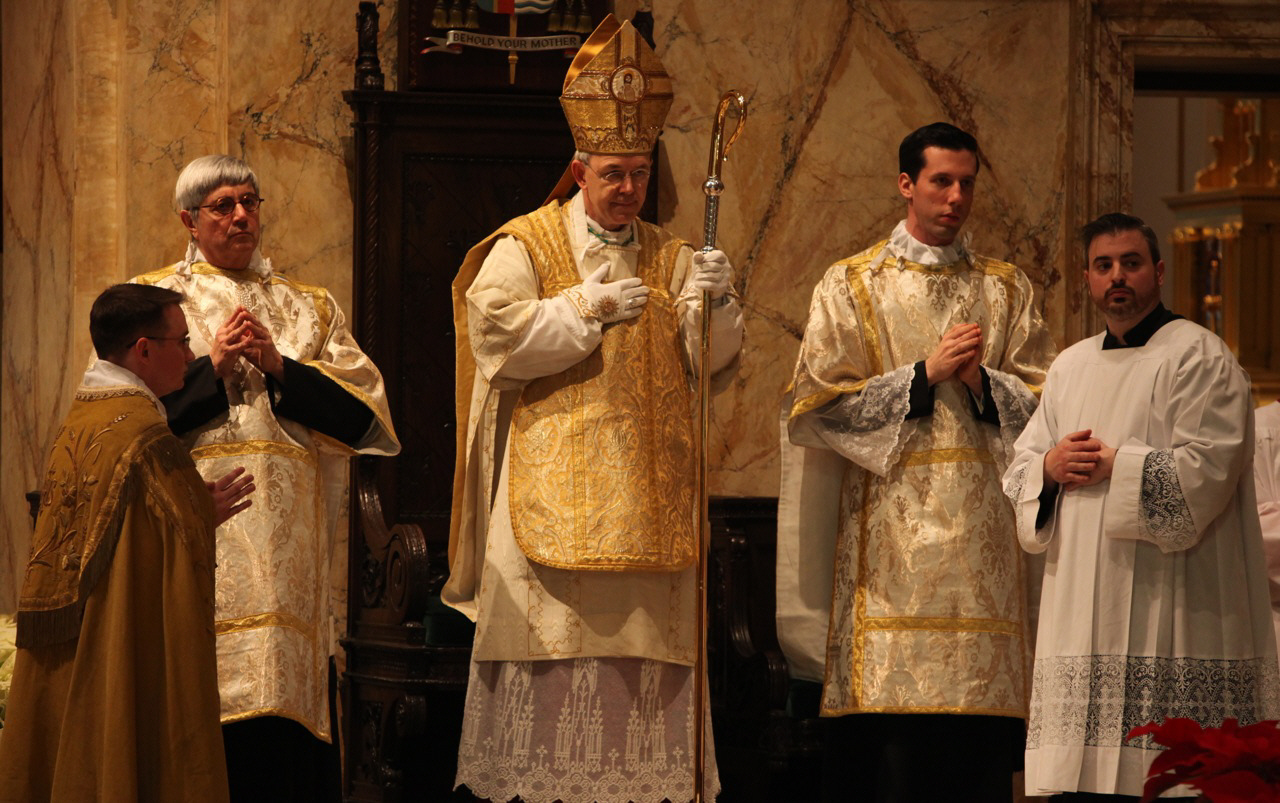
At the Basilica of St. John the Evangelist in Stamford, CT.

12
Feb

Edited by Joseph Shaw
Foreword by Martin Mosebach
(Arouca Press, Waterloo, Ontario Canada 2023)
Recent publications have enabled us to revisit, from the traditionalist perspective, the years of the Second Vatican Council and its immediate aftermath, as found in the writings of concerned contemporary observers. These records have a special attraction for us – these initial impressions often have an immediacy , frankness and freshness that disappeared later. After the early days, those struggling to preserve tradition often felt the need to make compromises or ingratiate themselves with the hierarchy. In our era when much of the clerical establishment once again has rejected all notion of compromise, it is fascinating to revisit these beginnings of the traditionalist movement.
Joseph Shaw has assembled in The Latin Mass and the Intellectuals a book of essays that is a major new contribution in the English language to the history of those times. It focuses on the two major petitions in 1966 and 1971 that were submitted to the Vatican for the preservation of the Latin mass. The book also covers other petitions in subsequent years – but these larer examples were more specific, and the signatories were predominantly individuals and organizations involved in one way or another in the traditionalist cause.
That certainly was not true for the 1966 and 1971 petitions. The signatories included a broad range of distinguished representatives of the arts and sciences. Contributions in this book by Joseph Shaw and Fr. Gabriel Diaz- Patri list the signatories and explain their accomplishments and connections. Some of the names may be surprising: Jorge Luis Borges, Jacques Maritain, Graham Greene, Francois Mauriac, Giorgio de Chirico, Rene Girard – and many more. Perusal of their biographies shows that many were not traditionalist, conservative or even Catholic. Indeed, there are some representatives of the far left among them. What united them all was concern for the preservation of the historic artistic heritage of the West. By the way, those who became more directly involved in early traditionalism were also by no means drawn exclusively from the ranks of the political right.
A forerunner of these post-conciliar initiatives was an essay (included in this volume) written by Marcel Proust in 1904 when the anticlerical French government was supposedly thinking of banishing Catholic worship from the cathedrals and churches it had seized. That work pointed out the intimate connection between the purpose for which the gothic buildings were created – Catholic worship – and the art and architecture of the cathedrals. Proust’s essay later was consciously drawn upon by those who formulated the petitions after the Council.
The heart of this volume are the chapters on Cristina Campo written by Fr. Gabriel Diaz-Patri. An outstanding Italian literary figure, Campo had gradually become immersed in the Catholic mystical and spiritual tradition. She “converted” around 1964 – perhaps after having been present at vespers.
Certainly, between 1964 and 1965 something spoke to her, reaching her from infinite distances. She spent hours of churches. She sat meditating in the monastery of Tre Fontane, she attended vespers at Sant’Anselmo, perhaps unaware that almost 30 years earlier, in May 1937, Simone Weil had sat on the same pews … (p. 113)
But Campo sprang into action as the first liturgical changes were imposed. It is due to her efforts that both the 1966 and 1971 petitions came into existence.
(A)ll the testimonies agree that the driving force behind Una Voce Italia at that time was Cristina Campo, not only writing what the institution published but also personally doing most of the work on the practical side. On this occasion too (the publication of the 1971 petition-SC), the letter was due, to a very large extent, to her. Her international contacts with a cultural world that might be willing to give its support were crucial in the success of the project outside the English sphere (p. 201)
This book offers the first detailed account in English of Campo – at least up to the point of publication of the petitions. We would like to hear much more about the few remaining years of her life (she died in 1977). Happily, Shaw tells us that the chapters in The Latin Mass and the Intellectuals are but a selection from a forthcoming new biography of Campo by Fr. Diaz-Patri.
Fr. Diaz-Patri offers a second extended biographical narrative – of Bernard Wall and his circle, the organizers of the English side of the 1971 petition. I confess I found this account of the meetings and interactions of Wall’s friends going back decades less interesting than the Italian events involving Campo. Still, it was fascinating to read how much time people of those days could devote to discussion, how the serious exchange of thought had not yet been drowned out by the media torrent of our days.
What was the motivation for organizing these petitions? I think it was to witness to the irreplaceable, intrinsic “objective” value of the forms of the old liturgy. This was something that could be understood and appreciated aside from any personal commitment to the religion those forms expressed. Thus, these petitions form an important witness in a Church which presented (and still presents!) the changes in the liturgy as some kind of unanimously accepted divine revelation.
The actual effect of the petitions was of course minimal. The 1971 petition did obtain some narrow freedom for the continued existence of the old mass for the UK – although I read that subsequent to 1971 the Vatican sought at times to revoke even that limited exception.
Now, of course, these intellectuals may have been foolish to expect that these petitions would have any effect on the conduct of the Vatican. Their arguments at the time in fact backfired, opening them up to the “indictment” of being “aesthetes.” Amazing – for many centuries the Catholic Church had been the main patron of the arts, now, in the 1960s, expertise in and commitment to the arts had become an accusation, an unforgivable sin.
What held true for the petitions of 1966 and 1971 did even more so for the later ones submitted by traditionalist or conservative proponents. In at least one occasion the receipt of the petition was hardly acknowledged – let alone any response being given. It’s instructive to read, in the case of these later petitions, of the arrogant and underhanded behavior of the Vatican officials – including those supposedly tasked with looking out for the traditionalists. Indeed, the chicanery and confrontational attitude we now associate with Pope Francis and Cardinal Roche already were current – if displayed less systematically and openly – under John Paul II.
Martin Mosebach writes a remarkable foreword. For the first time in history, he writes, the laity rose up to defend the hierarchical, priestly, and sacral character of the Church – against an initiative launched by the priests! This book describes the battle for the Roman liturgy, and those who fought it were convinced it was the most important of the twentieth century – because the survival of the Christian religion was (and is) at stake.
Joseph Shaw’s informative preface describes a primary purpose of The Latin Mass and the Intellectuals: to honor the memory of the petitioners who sought to preserve the Traditional Latin Mass – especially Cristina Campo, “the foremost of them all.” He further claims that the minor relief obtained in the “English Indult” was a precondition for the expanded indults in 1984 onward. Well, one could argue about that – I think the actions of a certain French archbishop had far more to do with it. On the contrary, I would guess most people would consider the efforts of Campo, Wall and their friends to have failed. Yet the witnesses of these early petitions, like the early martyrs of the Church, can never be seen as failures. Their full influence will only be known in the course of generations. Their testimony to the truth and the power of beauty remains vital for us who live once more in an age of doctrinal collapse and official persecution. The Latin Mass and the Intellectuals is essential reading!
12
Feb
This Wednesday, February 14 is Ash Wednesday. The followin churches will offer the Traditional Mass.
Connecticut
St. Mary Church, Norwalk, 8 am, 7 pm
Sacred Heart Oratory, Redding, 6 PM, music by the Viri Galilaei and followed by sung Vespers, as every Wednesday.
Sts. Cyril and Methodius Oratory, Bridegport, 7:45 am low Mass; 6 pm Solemn Mass
St Patrick Oratory, Waterbury, 8 am; 6 pm
New York
Our Lady of Mount Carmel Shrine, New York, NY, 7 AM Low Mass, 7:45 AM Low Mass, 7 PM Missa Cantata
Holy Innocents, New York, NY, 8 am, 6 pm
St. Patrick Church, Glen Cove, Long Island, 7 pm low Mass.
St. Paul the Apostle, Yonkers, 12 noon
Immaculate Conception, Sleepy Hollow, NY, low Mass, 7 pm
St. Mary St. Andrew, Ellenville, Missa Cantata, 7 pm
New Jersey
Our Lady of Sorrows Church, Jersey City, 8:30 pm
Our Lady of Victories, Harrington Park, 6:15 pm
Our Lady of Fatima Chapel, Pequannock, 7 am, 9 am, 12 noon, 7 pm
St. Anthony of Padua Oratory, West Orange, 9 am Low Mass; 7 pm Missa Cantata.
Shrine Chapel of the Blessed Sacrament, Raritan, 7 pm
Corpus Christi Church, South River, 6:15 pm low Mass.
11
Feb

by Aidan Nichols
(Gracewing, Leominster, 2023)
Fr. Aidan Nichols, the outstanding English theologian, has given us a succinct memoir. Apologia is the odyssey of a theologian and writer in the Catholic world after the Second Vatican Council. We travel to various places: from England to Norway to Jamaica to even (potentially) Sikkim (to name but a few). We meet religious orders and congregations of all kinds and character: Fr. Nichols’s own Dominicans, the Benedictines, the Traditionalist Dominicans and finally the Norbertines (Premonstratensians). Given the state of the Church today, Fr. Nichols’s saga may at times remind us not so much of Homer’s odyssey but of those written by the Greek poet’s 19th and 20th century successors: Flaubert, James Joyce, and Celine. Yet Fr. Nichols never succumbs to bitterness, rage and certainly not nihilism and despair – despite what he sees about him. He maintains throughout a serene and dispassionate attitude. Coming from an English writer, of course, this book now and then exhibits a sly humor;
(The parish church) was the work of the Clifton family…John Talbot Clifton, an explorer, turned out to be the last sane(and Roman Catholic ) squire…One of the richest families in Lancashire, occupying its finest Georgian house, their only son managed to bankrupt the Cliftons – and conform to the Church of England. (p.4)
We see also the author’s fine sense of detail – here describing his home county of Lancashire. Indeed, some of the intriguing, colorful information on the author’s life in his native country may be challenging for the reader not from the UK.
Fr. Nichols is a convert from a kind of nebulous Anglicanism. An encounter with an icon of the Virgin in an Orthodox church prompted his conversion. From that point forward Fr. Nichols was sensitive to the role of beauty in Christianity. He also retained from this experience a lifelong professional interest in the Eastern Churches and their theology.
At Oxford the joined the Dominicans. Now at that moment that order was going through a “revolution’ in the wake of Vatican II. Nichols was aware from the very beginning that the Dominicans were all over the map. And the state of their studies left much to be desired:
The word “shambolic” would scarcely be too harsh. (p.25)
Harsh conflicts soon developed in the community on, for example, the role of Marxism. Yet, despite it all, a younger generation of solid Dominican priests and scholars did arise out of the chaos of the post-conciliar years. Fr. Nichols was among them.
Fr. Nichols describes some of his intellectual guiding lights – especially Aquinas and Hans Urs von Balthasar. Later, Joseph Ratzinger’s book of interviews Rapporto Sulla Fede (the “Ratzinger Report”) was “life changing.” As noted, he also explored deeply Eastern Orthodox and patristic theology and has written about everybody from Sigrid Undset to Matthias Joseph Scheeben. In contrast to what you would have perhaps expected, Fr. Nichols does not present a detailed narrative of his writings. At times in this book, he gives only a rapid-fire list of his numerous contributions.
Fr. Nichols is no liturgical traditionalist; he states the is “moderately content” with the new rite. (p.73) Indeed, liturgical issues of any kind play a minor role in Apologia – as opposed to the author’s search for a community of religious brethren leading an orderly life under a rule. However:
At the Abbey of Einsiedeln, in the chapel of the Black Madonna, I had my first experience as celebrant of how the liturgy could go awry. Beautifully set up with a (Novus Ordo) Latin missal at an east-facing altar and a lay monk to make the responses, I became aware of a sudden commotion behind me. A coachload of Swiss housewives had descended unexpectedly. Without consultation the monk snatched the missal off the altar and replaced it with its German equivalent. With – surely – preternatural assistance, I managed. (p.39)
Fr. Nichols does not dwell on the situation in the Dominican order. But as early as 1995 he took a leave of absence to explore a vocation with the Fraternite Saint Vincent Ferrier (“an Old Rite community in the Dominican community but outside the Order.“) He found the life there:
(A)ltogether admirable, noting especially the care with which the Offices and Mass were celebrated, the atmosphere of silence, the warm fraternal relations at recreation….. Furthermore, the cuisine was wonderful. (p. 77)
Yet, Fr. Nichols decided not to stay. He alludes to conflicts I sense he anticipated regarding some of his current or forthcoming theological writings. He also felt that he had work to accomplish in England or at least in the English-speaking world.
Fr. Nichols of course had to face the “new crisis” in the Church created by the Francis papacy. He of course was a great advocate of developing the riches of the Catholic Church, for Fr. Nichols, that includes the Anglican and the Eastern Orthodox traditions. Yet as he puts it:
The greater the richness the more decisively is clarity required. And Rome is the location identified by apostles, attested by the Fathers, whence that clarity comes. (p.101)
Accordingly, Fr. Nichols felt compelled to sign two letters, one on Amoris Laetitia, the other on the Abu Dhabi declaration. The second letter “raised the issue of a pope, who by negligence or misdirection, strays into doctrinal error(heresy).”
The language of the second letter was certainly strong. But the seriousness of the situation called for a kind of description that eschews diplomatic formulae of an ambiguous kind. (p. 103)
Fr. Nichols then elegantly and honestly lays out the reasoning that led him to sign these letters.
There’s an intriguing chapter on a visit to Moscow. Fr. Nichols apparently hoped that, in the spirit of ecumenism, the Russian Orthodox might intervene in some way at the Vatican to arrest “the advance in the Roman Church of opinions incompatible with sanctity of the moral law.” (p.111) Fr. Nichols does not know if anything followed from this. And then these relationships were overshadowed by the war in the Ukraine. But Fr. Nichols believes that:
The Church of Russia is too important a potential contributor to the survival of Christendom to be made a corporate pariah. (p.112)
In the wake of the two letters Fr. Nichols himself became somewhat of a pariah in the Dominican order. But then came an invitation from St Michael’s Premonstratensian Abbey in California. This seemed an answer to Fr. Nichols’s prayers (he calls the Abbey Rivendell!). St. Michael’s has long been theologically Thomistic yet Novus Ordo. In a chapter written in a rapturous tone different from the rest of Apologia, Fr. Nichols describes the life, the architecture, and the landscape of the Abbey.
Fr. Nichols hadn’t reckoned, however, with the long reach of the institutional Church. Bishop Vann of the diocese of Orange found that Fr. Nichols posed a threat to the peace and good order of the diocese. There was no real dialogue about the matter. The Bishop of Orange summarily imposed these restrictions:
I could not preach or celebrate mass publicly in the Abbey church (assuming non Norbertines are present which they always were) nor hear confessions (except those of Norbertine canons) nor could I teach a course in theology or any related discipline to the Abbey’s “seminarians.” Much less could I carry out any version of these activities beyond the Abbey’s territorial limits. The effect of these inhibitions was to call into question the entire process whereby I was contemplating a move from the Dominican Friars to the Canons Regular of Premontre.
Fr. Nichols surmises Rome and Washington were also involved in the matter; it was noted that Fr. Nichols’s correspondence with the Dominican leadership in Rome suddenly was routed through the US nunciature.
The contemptuous treatment the Roman Catholic Church accords one of her most distinguished theologians is amazing. For this book was published several months ago, and the lack of any uproar among scholars, clergy and laity since its appearance indicates to me they are comfortable with these actions. In 1979-80 the progressive forces of the Church raised an unholy uproar about the treatment of Hans Kung, who suffered nothing like these indignities. And later, Hans Kung was treated to a full day private audience with Pope Benedict, including a working lunch. Indeed, throughout Apologia you will find numerous other examples of questionable actions of ecclesiastical and religious authorities.
But Fr. Nichols also has his own supporters. The Abbot of Saint Michael’s was already in the process of setting up a new priority in Illinois; Fr. Nichols could go there with the blessings of the local bishop. For the time being, however, he returned to England to live at a vestigial Norbertine outpost close to the place of his childhood. An English bishop has written an appreciative note at the beginning of this book.
Where things stand now I do not know. The narrative breaks off in August 2023 with Fr. Nichols still in the UK. Father Nichols is listed as a member of the Abbey of Saint Michael’s. I hope things work out for him after so much seeking. This book is the moving record of a cleric who mostly lived the retiring life of a scholar. He made many distinguished contributions in so many aspects of his field. And, as you can see from the above, he was anything but belligerent or polemical. Yet when the time of decision came, he could not shrink from telling the truth regardless of the consequences.
9
Feb
By George A. Kendall
(“The liturgy from Hell,” Chronicles Magazine, 38-40 (February 2024))
George A. Kendall settles accounts with the Novus Ordo regime in a blazing article – and suggests a path going forward. It’s a forceful response to the increasingly rabid attacks on traditionalists in Catholic media in Europe and the United States. 1)
The Chronicles editor comments:
George Kendall tells us that for much of his life he has been a conservative Novus Ordo Catholic but says traditionalist arguments have recently convinced him. He writes: “I am deeply indebted to Peter Kwasniewski…..for helping me to clarify my thinking on the Church’s need to restore her ancient liturgy.”
I would add that George Kendall wrote regularly for The Wanderer. For those of us familiar with that publication in the past (I don’t think I have read it since the mid 1990’s) Kendall’s change of position is almost unimaginable. For The Wanderer, one of the original “Conservative Catholic” publications, used to define itself by opposition to Catholic traditionalism and uncritical exaltation of the papacy. Not that it did them any good, in my experience, in their relationship with most of the clergy!
Let me give you some excerpts from Kendall’s article.
53 years ago, in 1969, a terrible act of vandalism was committed against the Catholic Church, an assault, not only on the Catholic faithful but on the very heart of the Church, the Eucharist, hence an attack on Christ himself. That crime consisted in the scrapping, on orders from the pope, of the Traditional Latin Mass, not only getting rid of the Latin language but butchering many of the texts of the liturgy, carving it up into a liturgy different in kind from the traditional one.
…..
Then, in July 2021, Pope Francis issued his infamous document on the liturgy, titled Traditionis Custodes (“Guardians of Tradition”), which was, in fact, a wholesale attack on tradition. The new document takes away the hope of correcting Pope Paul’s mistake ( the Novus Ordo- SC), seeking to suppress the old Mass by regulating it to death, contradicting Summorum Pontificum which stated that no one in the Church had the authority to do such a thing.
….
Kendall squarely addresses the question of authority:
Does anyone have the authority to do what Pope Francis has tried to do in Traditionis Custodes?….. I find it hard to imagine that the Holy Spirit guided the development and continuation of the Latin Mass for so many centuries, then suddenly decided to make a U-turn, guiding the Church to adopt a wholly different and incompatible liturgy. The Traditional Latin Mass has the authority of the Holy Spirit behind it. The Novus Ordo does not. Just as clearly, neither the Novus Ordo itself nor Traditionis Custodes has legitimate authority behind it, and we are not obliged in conscience to obey either.
…..
The strategy of the Catholic faithful should be to forget about Vatican politics and to work at the local level (the diocese and the parish) to establish as many Latin mass communities as possible. Ideally they should exist under the authority of the local Bishop, where that is possible. Where it is not, we’ll have to go underground, operating in secrecy, perhaps celebrating the mass at one another’s homes, using canceled priests. ….
Kendall recognizes that this goes against authority but:
When the Pope or Bishop tells us we must comply with Traditionis Custodes, which is an attack on Christ and on his Church, we can and must disobey.
…
Kendall sees two advantages to this course of action:
First, as the number of Latin mass communities grows throughout the world, the number of Latin Mass Catholics in the world will increase.
Second, the number of Novus Ordo Catholics will continue to decline, as it has for the last 50 year. Novus Ordo Catholics have a problem reproducing themselves because they typically have small families, while traditional Catholics who still adhere to the prohibition against birth control affirmed in Paul VI’s encyclical Humanae Vitae have bigger families. This is also because the children of Novus Ordo Catholics tend to abandon the faith. I am constantly meeting young people who tell me they were brought up Novus Ordo Catholic but “don’t go anymore.”
……
Kendall’s article is eloquent witness to the unheard-of stress on the Church created by the Francis papacy.
ADDENDUM: In another article in the same issue of Chronicles, Anthony Esolen has this to say:
But even if all the traditionalists were kindly and reserved, and even after they have amassed all the historical evidence for their liturgical claims and argued cogently about both the beauty and the spiritual effectiveness of the Tridentine rite – and I speak here as someone who does not attend that rite – it would not matter. They are opposed not because the rite in question is ugly but because it is beautiful, and the opponents sense it. They are opposed not because they are all hypocrites when they kneel but because most of them are not hypocrites; they are opposed not because they pretend to believe but because they believe too ardently. They’re the last people a priest whose faith has shriveled up wants to be near.
Esolen, Anthony, “Culture War, whether we like it or not,” at 17 (Chronicles Magazine, February 2024)
9
Feb

The Unforgivable: And Other Writings
by Cristina Campo (Author), Alex Andriesse (Translator), Kathryn Davis (Introduction)
(New York Review Books Classics, New York, 2024). Available on Amazon.
Finally there appears an English translation of the major essays of Cristina Campo. This edition consists of the book I had previously reviewed (“The Unforgiveable”) plus several additional essays. For a discussion of this volume see my review of the original text.
The proper recognition of Cristina Campo by Catholics is long overdue. As Kathryn Davis writes in her introduction to this book:
“It was also while living in Rome that Campo – who had grown up in a nominally Catholic household – underwent a religious conversion, her newfound relationship to Catholicism as uncompromising as was her relationship to everything else in her life. Together with the philosopher and religious historian, Elemire Zolla, she edited the 1963 anthology I Mistici dell’Occidente and was among the members of Una Voce, an international group fierecely opposed to the liturgical changes made by the Second Vatican Council – changes she castigated as “leprosy.” Christ’s parables, the Gospels in general, Scripture, had always been mainsprings of her life and work; following her conversion they became the prime undercurrent.”
To read this book is to undertake a magical voyage of discovery!
9
Feb

Stained glass window in St. Peter’s Cathedral, Regensburg, Germany. The saint is shown with a two-handed grip on her attribute: pincers holding a tooth. A difficult shot at an angle!


Saint Apollonia on the facade of the Basilica della Collegiata, Catania, Sicily.


Sermon for the Feast of St. Agatha 2024
On one of the many tours I organized and led to Italy, we stopped in Padua and visited the shrine church of Saint Anthony. The saint’s body is under the altar in a special chapel to the left of the high altar. But if you go to the area in back of the high altar, there one sees in reliquaries some parts of St. Anthony’s body, namely his larynx and his tongue, preserved in a chemical preservative. I took the group there and pointed out these relics of the saint. The reaction was not positive. Most could not understand why his tongue and larynx were displayed in this way. I pointed out that these two body parts were preserved for display because St. Anthony was known as a great preacher. But they still thought it weird. Many Americans, even those who are good Catholics, breathe the air, especially in the Northeast, that is still imbued with the Puritan negative view of the human body.

Some years ago– more than some, I think– I was in lower Manhattan and walked by a church I had never seen. It was dedicated to St. Anthony of Padua. I walked in and was amazed at the number of statues along the side aisle of the nave. I knew this had to be an Italian church. Everyone was there, including local saints from Italy that meant a lot to those who built this church so many years ago. And many carried or displayed the body parts that were involved in the torture they underwent for the sake of Christ and his Church. I immediately recognized St. Lucy because she was holding her eyes on a plate. Part of her torture was the ripping out of her eyes from her head. There was a statue of St. Lawrence holding the gridiron on which he was tortured. I came to a statue of a woman whom I did not recognize until I saw what she was carrying on her plate with arm outstretched. It was a pair of breasts. Ah, I said to myself, here is St. Agatha, the third century saint from Sicily, who was martyred for her Christian faith after undergoing terrible bodily torture, which included having her breasts chopped off. On her feast day in Sicily special pastries are made called Minne di Sant’Agata. They are in the shape of breasts covered in white frosting and a cherry on top. I doubt if these pastries were available today here in Whole Foods.
St. Agatha, like the other women that are in the Roman Canon at the Mass– Felicity, Perpetua, Agatha, Lucy, Agnes, Cecilia, Anastasia– are all women martyrs who sacrificed their lives because of their faith in Jesus Christ. The Roman Canon used to be the only Eucharistic Prayer in the Mass. Only after 1970 were a number of new Eucharistic Prayers written and included in the Missal. Although the Roman Canon was kept as one of the Eucharistic Prayers, it is not used that often, because it is longer than the rest. And when the Roman Canon is used at Mass, the celebrant has the option of skipping the names of those brave women saints of the early Church.
We remember St. Agatha today at Mass today in thanksgiving for her courage, her example of faith and her imitation of Christ. And we remember her as a part of that remembrance that lies at the very heart of the Mass: Hoc facite in meam coomemorationem: Do this in remembrance of me. St. Agatha, who is present at this Mass, pray for us.

Excursus: Students of papal history may find interesting the dedicatory inscription of the chapel in which the above image of St. Agatha is be found:


Pontifical Vespers for Candlemas at Old Saint Patrick’s Cathedral in New York – a magnificent liturgical and musical presentation that took place on Friday evening. It was co-sponsored by the Society of Saint Hugh of Cluny. The music, in addition to chant, was by Italian composers of the first half of the eighteenth century – especially Vivaldi. In particular, his Dixit Dominus (one of several settings of this text that Vivaldi composed) was a revelation in its expressiveness. We should be grateful to the otherwise disastrous liturgical developments of the last 60 years, which, by freeing us from the misguided strictures of Pius X against women singers and orchestral instruments, have enabled us to hear once again this music in its proper liturgical context.


3
Feb
Regina Pacis Academy celebrated a Solemn Mass for the Feast of Candlemas yesterday which included the students, parents and friends of the community.