
St. Columba
343 West 25th Street
Up to recent decades Chelsea – the area on the West Side between West 14th Street and West 29th street – had remained one of the more obscure areas of Manhattan. The 1939 WPA Guide to New York referred to its “preserved “ quality. Starting from the 1820’s until after the Civil War it had actually been primarily a residential area for the well-to-do. Later, it took on an increasingly industrial aspect with a working to middle class population. The great docks on the Hudson set the tone. Since the 1970’s all that has changed. Chelsea’s lofts and townhouses became increasingly trendy. The neighborhood then succeeded the Village as the reputed center of New York homosexuality (a status that may be disappearing at this time). Nowadays starting from the Meatpacking District on Chelsea’s southern border, the Highline wends its way north attracting crowds of the trendy. And so sexy has the Chelsea moniker become that this district also has advanced north – all the way up to 34th street ( at least in the minds of the real-estate industry).
In 1845 Bishop Hughes of New York founded St Columba as one of the first parishes erected under his episcopate. Dedicated in honor of one of the great “Triad” of Irish national saints (St. Patrick and St Bridget being the others) the parish was born in the midst of the massive Irish immigration of the 1840’s. Indeed it is recorded that one of the claims to fame of the founding pastor was his command of the Irish language. The church was completed entirely in the course of 1845. Although a remarkable spiritual leader, the first pastor, Fr. Bourke, was a poor administrator and Bishop Hughes has to replace him within a year. His successor, Father McAleer, stabilized the parish and was still in office thirty-two years later. And although a number of new parishes had been hived off from the original bounds of St Columba’s the parish population in 1878 was substantially greater than in 1845 – such was the expansion of the Catholic Church in New York in the 19th century. 1)
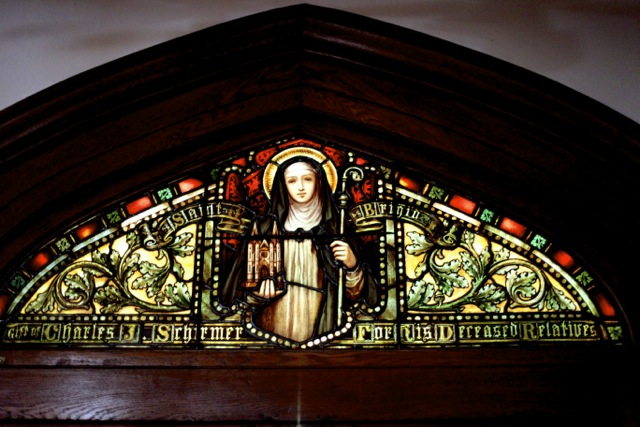
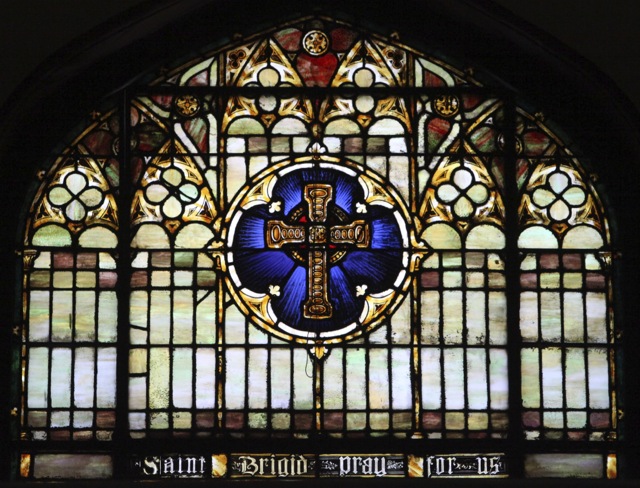
We’ve noted the dedication to St Columba – a great Irish monk and missionary of the 6th century – the evangelizer of the Picts (in present day Scotland) and the founder of the great monastery of Iona. We have elsewhere made reference to the perhaps curious fact that despite its reputation for being aggressively Irish, the church in Manhattan has relatively few dedications to saints of the Irish calendar: St. Columba, St Bridget; St. Malachy; St. Lawrence O’Toole (now St. Ignatius Loyola) – and of course St. Patrick’s (twice).
We have seen how St Columba parish was founded in the dramatic 1840’s and its modest church erected so rapidly thereafter. It was little more than an expanded chapel – a large hall. We can now understand why the construction of the church of St Bridget in 1848 was greeted with such enthusiasm. Next to St Columba, the church of St Bridget appears grand, spacious, airy – and built in a proper Catholic Gothic style! But the curious thing is that despite its limitations of style and size the church of St Columba was never replaced. It survives to this day as one of the earliest structures built specifically as a Catholic church.
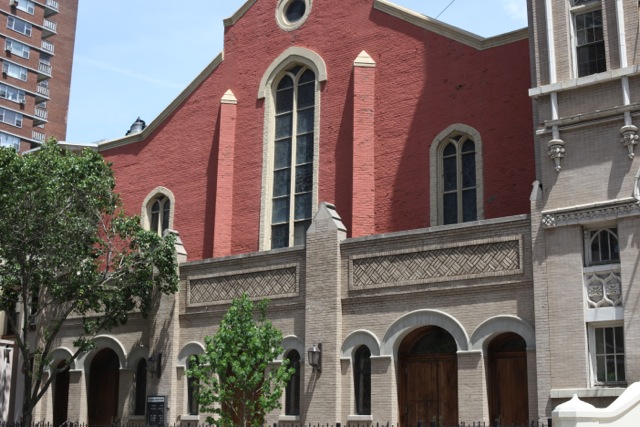
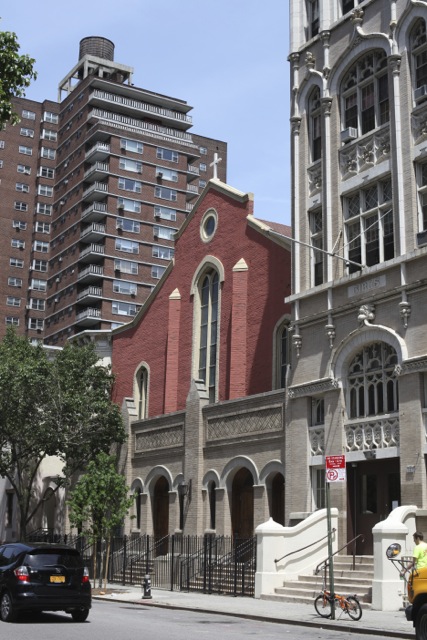
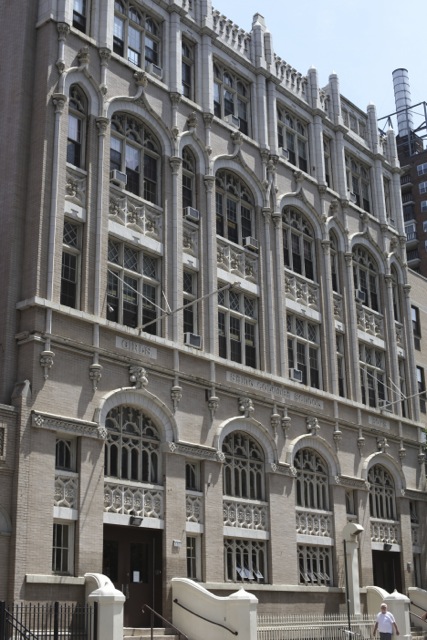
St Columba parish sits in the midst of a depressing very un-Chelsea- like landscape of high- rise housing projects and apartments. Its low redbrick façade presents one of the most unprepossessing exteriors of any Catholic church in New York. Originally, however, it was not so unrelentingly plain – Gothic pinnacles that once graced the exterior have since disappeared. A simple narthex was added in 1915; just as in the 19th century an exposed bell peers over the side of the façade (a tower was never built). But towering over the church is one of the grandest parochial school buildings in New York – built in 1909 and covered in Gothic tracery with separate Boys’ and girls’ entrances. But do not get your hopes up – the Archdiocese closed the school in 2007. It is now occupied by a private school for children with certain learning disabilities – strange, how such a building can be successfully reused by a private secular school….
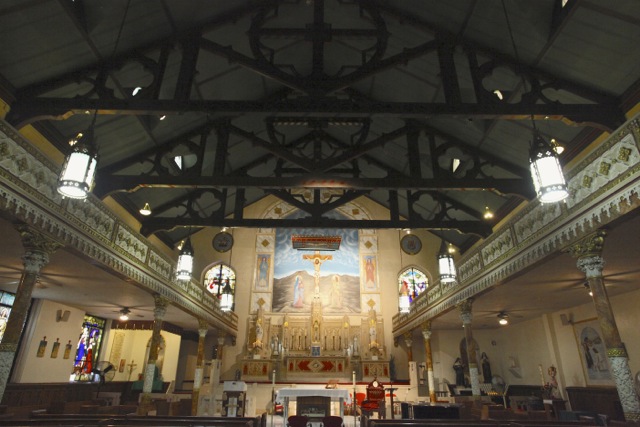
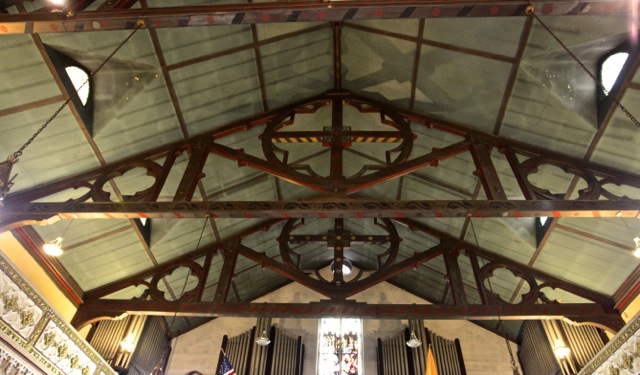
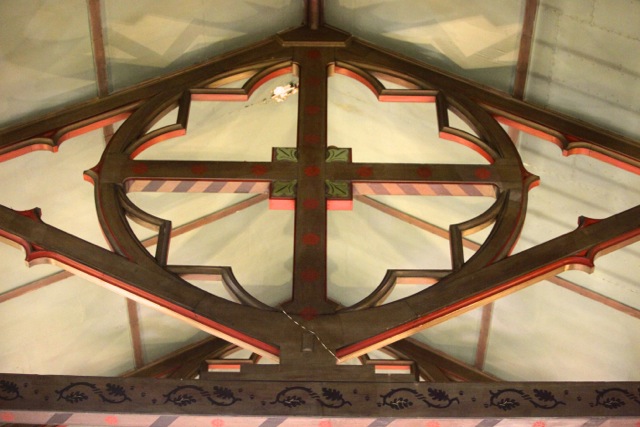
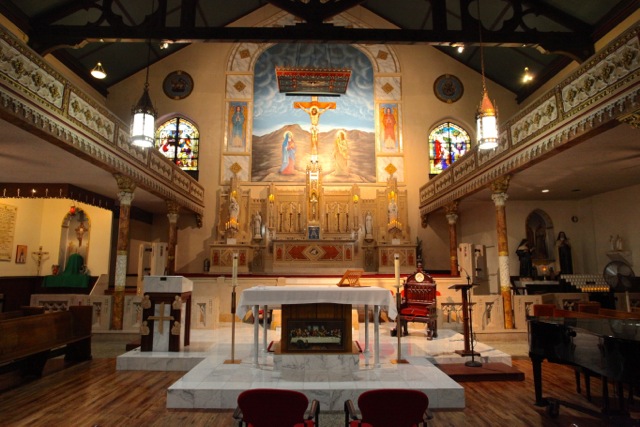
The surprising, colorful interior of St Columba’s, however, richly rewards the visitor. Most extraordinary of all are the beams supporting the ceiling – as at St. Bridget, they tell stories here of the presence of Irish shipwrights…. Indeed, St. Columba’s is one of those ancient New York churches housing at treasure chest of artifacts from the earliest times through to 1930 and later. The furnishings transform a simple hall into an unmistakably Catholic place of worship. The statues and devotions seem virtually innumerable. Yet, in contrast to some old churches (like the former St Agnes), the interior is not an incoherent jumble. The rich brown wood of the pews, the confessionals and the roof beams sets a strong unified accent. The windows, of many different eras and hands, provide contrasting colorful illumination.
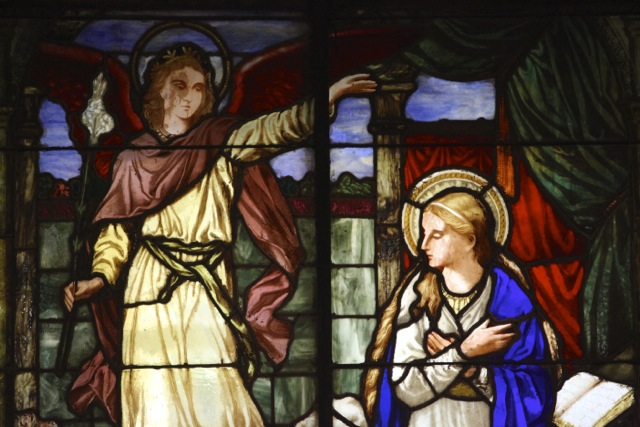
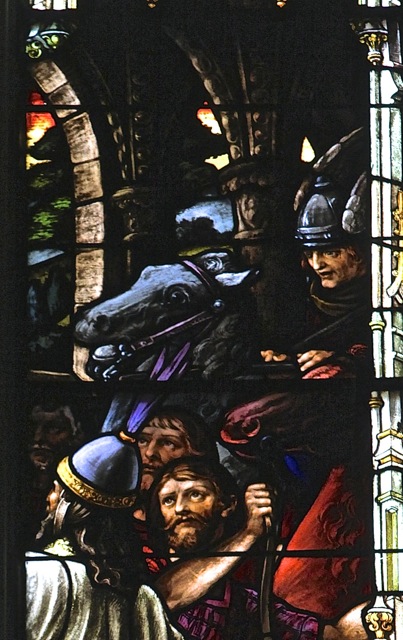
(Above and Below) Windows illustrating the life of St Columba from Munich or Austria.
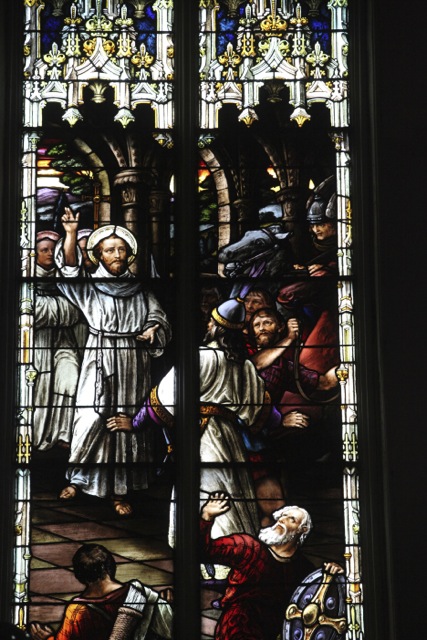
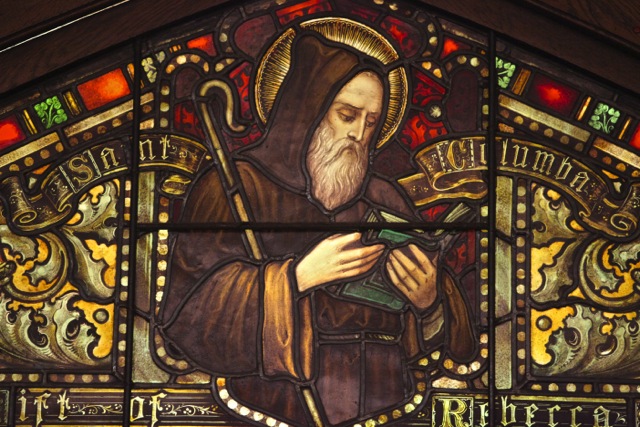
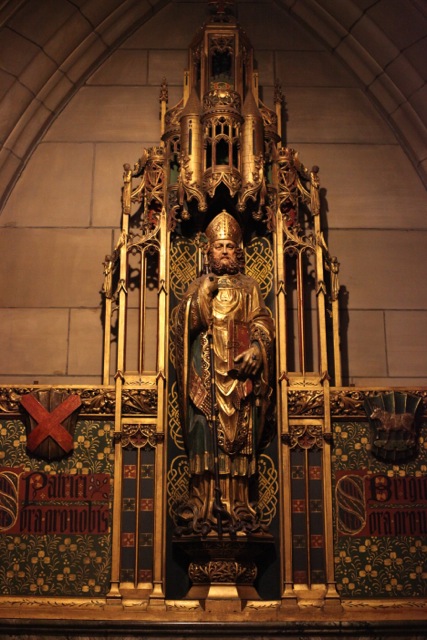
(above and below) The patron saint of the parish – and the other members of the “big three” of Ireland.

Dominating the interior is the massive, unique two-level stone high altar of 1930 – really three altars with a reredos – complete with protective railings above and a communion rail (only partially preserved?) below. Its dimensions would seem more appropriate for a much larger church – yet here it fits and successfully unifies the entire space around the center of the church: the altar of sacrifice.
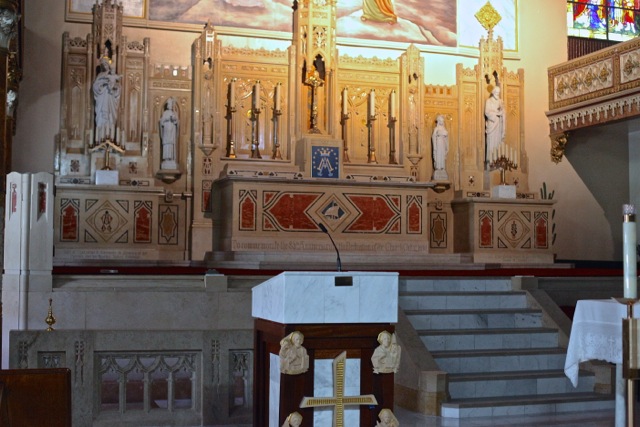
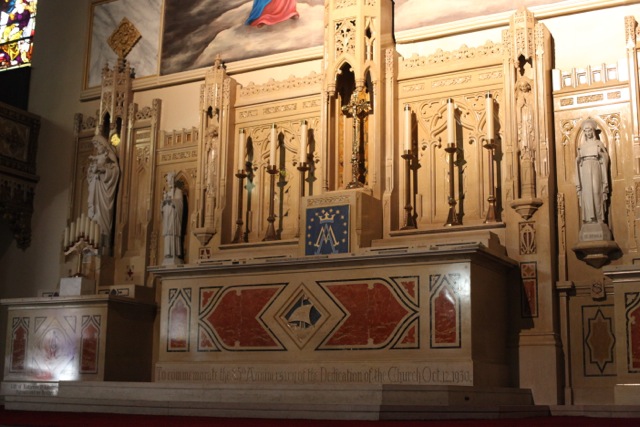
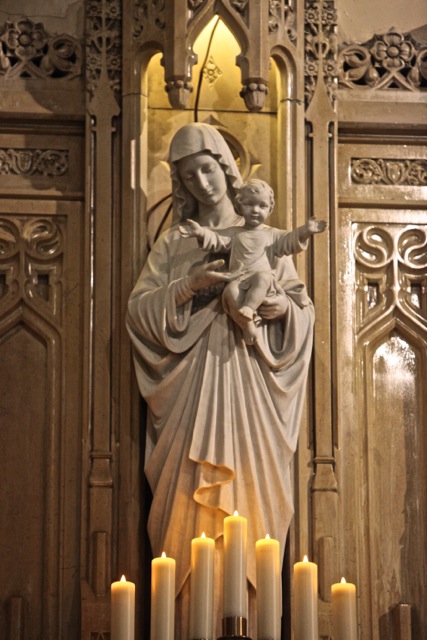
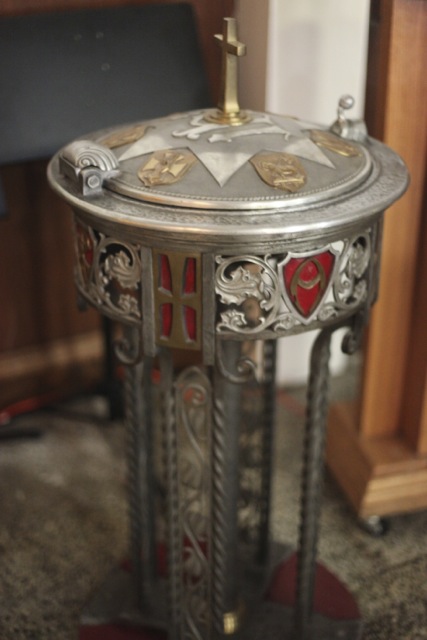
As is usually the case, post conciliar developments are best rapidly passed over. At some point in the not too distant past there was one or more restorations. The façade was freed from a depressing whitewash. In the interior, however, the conciliar “people’s altar” was made permanent and situated directly before the old sanctuary. It sits there today, sporting a pedestrian version of Leonardo da Vinci’s “Last Supper” and surrounded by a lectern, movable chairs and a piano. In a 1976 episode of Kojak filmed inside this church, appears what seems to be a monumental, baroque marble baptismal font – today there is a nice but much smaller metal font. Against the walls of the sanctuary and elsewhere in the church are paintings of an “artist” – apparently the same individual whose products are found in several other New York City parishes. They add a touch of color but nothing more.
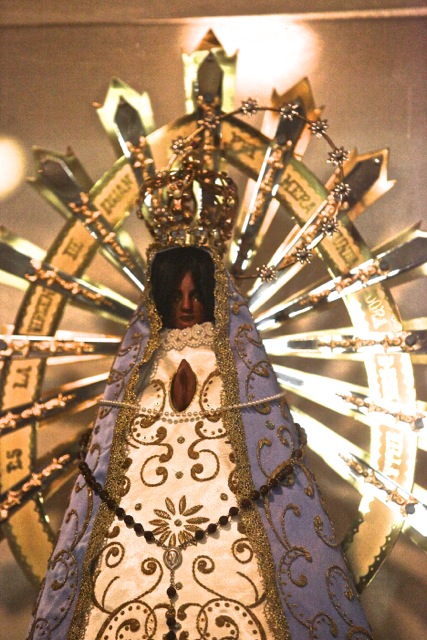
A devotion to Our Lady of Lujan (Argentina) reveals the large Hispanic presence – as in the case of most Manhattan parishes.
St. Columba’s s indeed a survivor – born amidst the crises of the Irish immigration, the Famine, the cholera epidemics, and the conflicts of the early New York diocese – yet enduring, to great extent unaltered, to the present day. It offers a wonderful lesson in history and Catholicism in a part of town where otherwise trendiness increasingly reigns. 2) An austere visitor from a more traumatic time, St.Columba’s is an admonishing presence in the surrounding hedonism of Chelsea and the spiritual indifference of the Archdiocese.
1) On the early history of St Columba’s see generally Shea, John Gilmary, The Catholic Churches of New York City at 246, 250 (Lawrence G. Goulding & Co., New York, 1878)
2) For further information and many magnificent pictures (including scenes from the 1976 episode of Kojak filmed in the church) see the very informative website of the parish.
Published in The Churches of New York | no comment
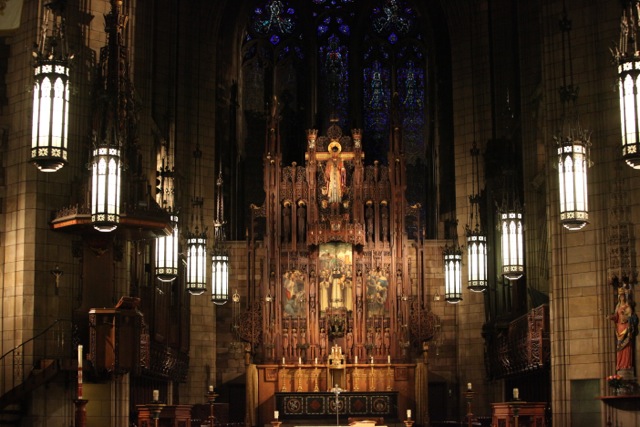
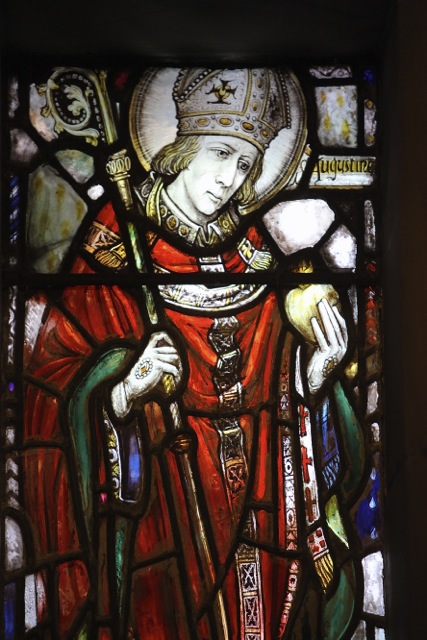
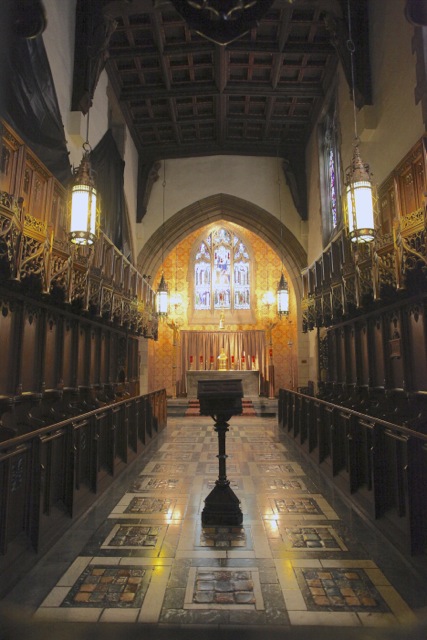
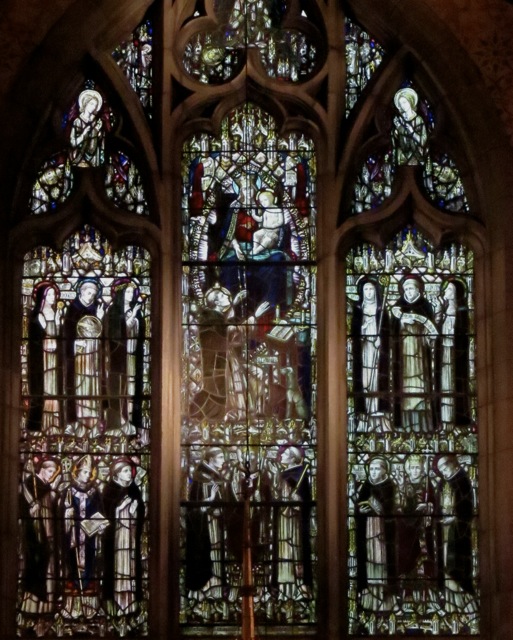
Inside, St. Vincent’s offers a dark, mystical atmosphere. There is immensity and strength in the many powerful arches that create the interior. It is a place of prayer at any time of the day – what contrast to the non-stop chaos further south on Fifth Avenue and East 50th. In the obscurity glow the magnificent, predominantly blue windows – mostly the work of Charles Connick. The stained glass tells in extraordinary detail of the Faith and especially of the Dominican order. Careful examination of the architecture reveals that the architect has simulated here and there the appearance of slightly irregular, organic growth.
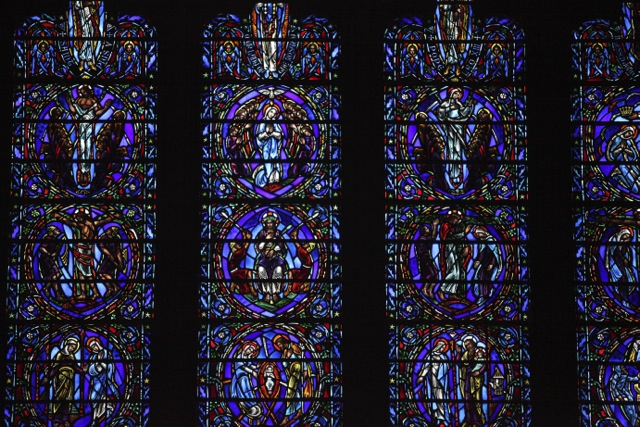
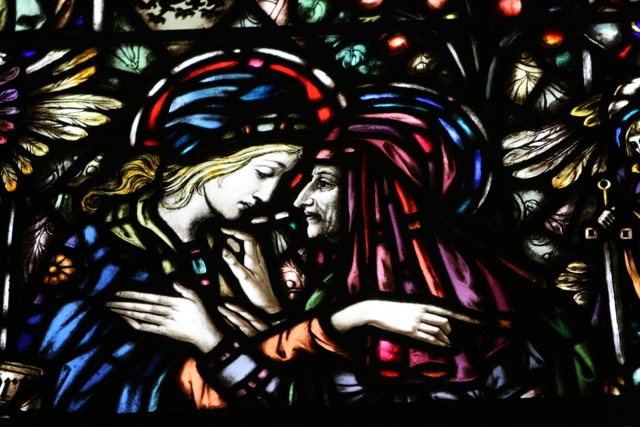
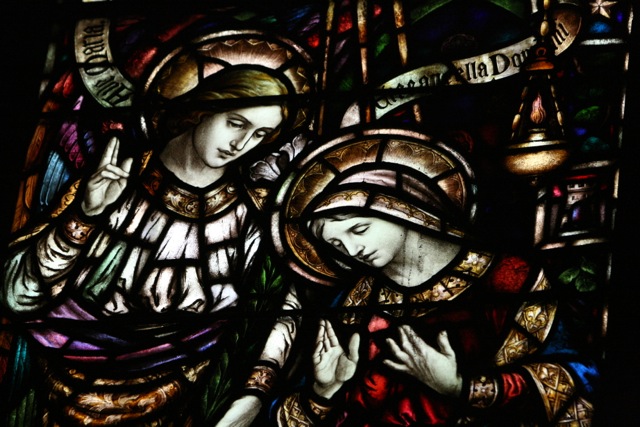
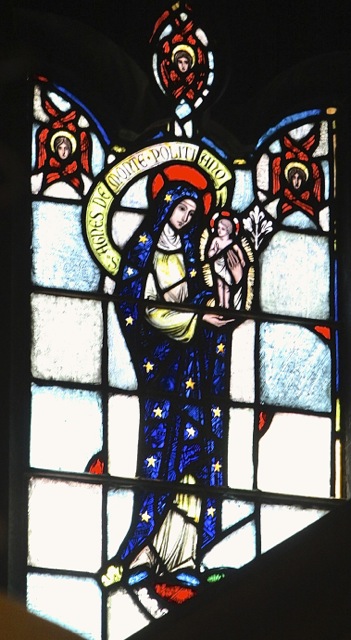
The stained glass fills almost every corner: a small window of St. Agnes of Montepulciano (above): St Augustine in the narthex(below)
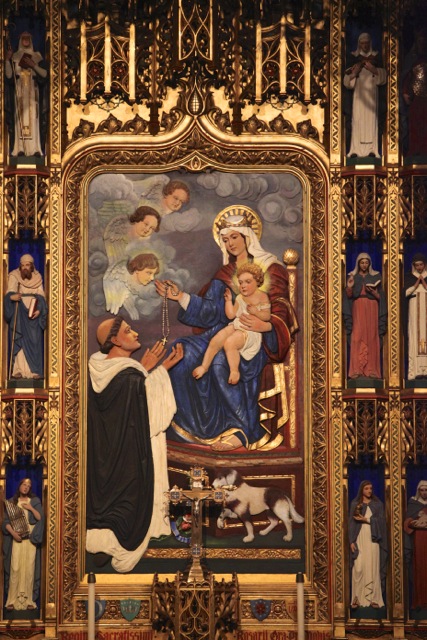
The decoration in stone and wood – above all, the splendid reredos – perfectly compliments the architecture. Although the totality of sculpture and painting is overwhelming, all is planned and carefully designed. Every devotion has its place in St. Vincent’s. Yet all these statues and altars take a supporting role in the vastness of Goodhue’s space. Once again the artful symmetry and planning are disguised. One has the impression of an accumulation of items assembled over the ages – although the bulk of the decoration was finished according to the original plan by 1940, And where extraneous items of décor have appeared they do not disturb the grandeur of the surroundings.


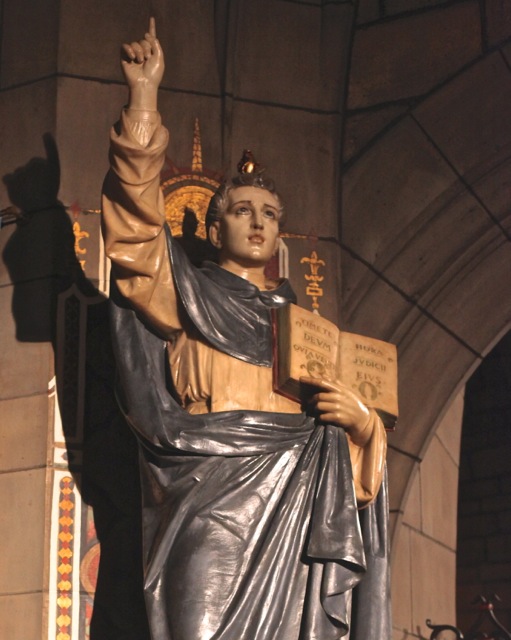
St. Vincent Ferrer. The pre-conciliar Church did not mind that he backed the “wrong” side in the Great Western Schism. Th post-conciliar Church studiously avoids mentioning his contemporary fame for converting Moslems and Jews.
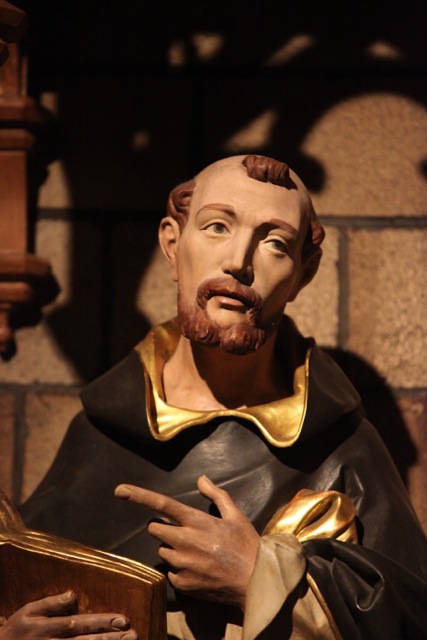

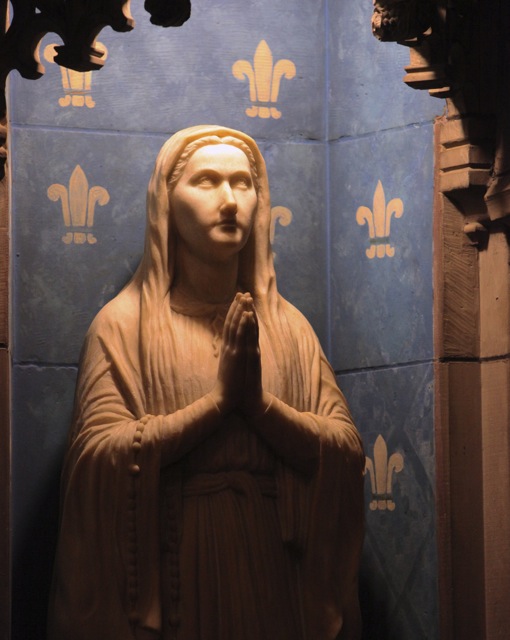
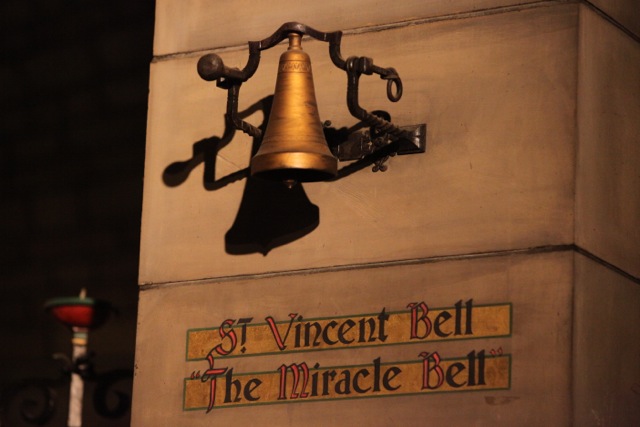
Every devotion can be found at St. Vincent’s, both familiar -a very original image of Our Lady of Lourdes (above) – and obscure – “St. Vincent’s Bell” (below).
The dedication of the church in 1918, in the midst of the World War, was a grand affair recorded in great detail in the Guide. The mass was celebrated by the apostolic delegate, Archbishop Bonzano, in the presence of Cardinal Farley (what liturgical complexity that must have entailed!). The future Cardinal Hayes gave the sermon – he succeeded Cardinal Farley as Archbishop of New York in 1919. The music was provided by an orchestra of 45 musicians, a choir of 85 (20 men and 65 boys) and tenor Giovanni Martinelli and baritone Mario Laurenti of the Metropolitan Opera. These forces were lead by Constantino Yon. As in the case of St. Patrick’s cathedral, New York at that time seems to have been as yet unaffected by Pius X’s strictures against orchestral music. 5)
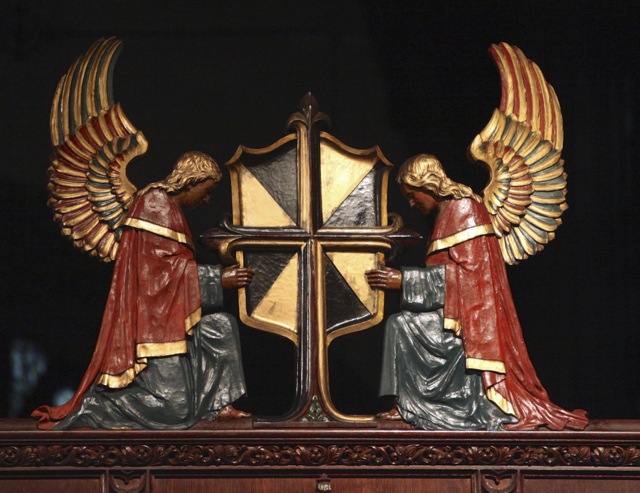
The coat of arms of the Dominicans above the chapel of the friars (below). The great window of the chapel of the friars (last image).
St. Vincent’s since its completion has continued to preside over a well-to-do corner of New York City. It is is surrounded by other buildings of the Dominican Order- the priory, schools – built both before and after the church. There is comparatively little to report of the long history of this parish other than the overwhelming fact of the building of the church itself. 6) Cardinal Pacelli – the future Pius XII – visited St Vincent’s in the 1930’s. Andy Warhol is reported to have attended services here – Wikipedia describes him as “devout.” Hildreth Meiere, who worked with Goodhue on the Nebraska State Capitol, and went on to decorate innumerable buildings, secular and ecclesiastical, had her requiem mass here in 1961.
The Dominican Fathers in their 1944 Guide could look back with justifiable pride on the grand edifice that had been built and decorated. In the midst of a terrible conflict they had told the story of the premiere Catholic church of Manhattan, built in the midst of an earlier worldwide catastrophe. Amid these terrible tragedies St. Vincent’s stood as an amazing recreation of the spirit of the European cathedrals, erected with the talents and resources of the New World. How could they have foreseen that in just 20 years new forces would arise in the Church that called into question the artistic and theological basis upon which St. Vincent’s rested? The Dominican rite for the celebration of which St Vincent’s was expressly designed, was abandoned; a subsequent generation even laid hands on Goodhue’s magnificent sanctuary. But fortunately most remained intact. And it seems that the Dominicans are at last beginning to rediscover the liturgical riches of their rite for the celebration of which this church was, after all, built.
5) Guide at 31-33. On Yon and New York Catholic church music of this era see Salvatore Basile, Fifth Avenue Famous: The Extraordinary Story of Music at St Patrick’s Cathedral (Fordham University Press, New York, 2010)(specifically mentioning this mass at 77)
6) A Dominican parish had been present at this site since 1867. Two churches had preceded Goodhue’s structure. Guide at 11-16.
Published in The Churches of New York | no comment
St Vincent Ferrer
869 Lexington Avenue
It’s hard to avoid superlatives in describing the church of St Vincent Ferrer. 1) The “Dominican Fathers” in their 1944 guide to this church, were only being candid in introducing it as the finest Catholic ecclesiastical building in New York. And is it the finest church in New York – full stop? Traditionally New Yorkers have given that honor to St. Thomas (Episcopal) on Fifth Avenue. Indeed, the Dominican Fathers note that in a survey of the most beautiful buildings in the United States, St Vincent Ferrer was ranked second among churches – behind St Thomas. 2)
Yet the Guide claims that the architect himself, Bertram Goodhue, preferred St. Vincent to St. Thomas (which he also had created in collaboration with Cram!). I would have to agree with this assessment. For St. Thomas, despite its magnificence, has a kind of cold, reserved, “black and white” character. In St Thomas – and even more so in another Goodhue – designed New York Episcopal church, St. Bartholomew, one has the sense of a magnificent architectural backdrop to an entirely alien cult. At St Vincent, in contrast, color is magnificently employed. There is no restraint imposed on the exuberance of the decoration. But beyond these aspects there is this more fundamental distinction: “Father Fitzgerald (the Prior of the Dominicans) insisted that the structure be planned so as to enable the liturgical rites of the Dominican ceremonial to be carried out in their full beauty. Mr. Goodhue (the architect) … planned the architecture in accordance with theological and liturgical proposals of Father Fitzgerald.” 3) At St. Vincent’s, there is no disconnect between form and function!
For St. Vincent’s was intended to be no ordinary church but a veritable cathedral of the modern age. Just as in Chartres, each detail would have theological or liturgical meaning. Just as in the great age of the Gothic all the arts – architecture, Stained glass, sculpture, music, even the vestments would be integrated into a true Gesamtkunstwerk – for once the cliché is entirely justified. Yet all this would be accomplished pursuant to a carefully thought out program in a few short years of work!
We have to ask: why was this done? The Guide mentions the importance of the Eastern province of the Dominicans, the fact that several early bishops of New York were Dominicans – but there must have been other more important motivations. Catholics undoubtedly felt that they needed to respond to the Episcopal Church, which had regained the upper hand in New York church architecture with St John the Divine and St Thomas. And then there was the desire to erect the second church of the Archdiocese after St. Patrick’s cathedral – or, secretly, perhaps, even to surpass it. For by 1916 Catholics had access to the resources and talent to build splendidly without any of the financial constraints and perceived artistic limitations of Renwick’s era.
To achieve this goal the Dominicans assembled the “A-team” in American architecture and art of that era. Bertram Goodhue was the most renowned church designer in America. Together with Cram he had helped to launch a sophisticated neo-Gothic in church and campus across the United States. He then initiated the neo-baroque Spanish mission style. Later, in the Nebraska state capitol, Goodhue helped create Art Deco in the United States. In each case he worked in the closest collaboration with gifted sculptors and decorators. St. Vincent Ferrer was to exemplify this: around Goodhue were assembled exceptional artists in other disciplines, like, Lee Lawrie in sculpture, Charles Connick in stained glass.
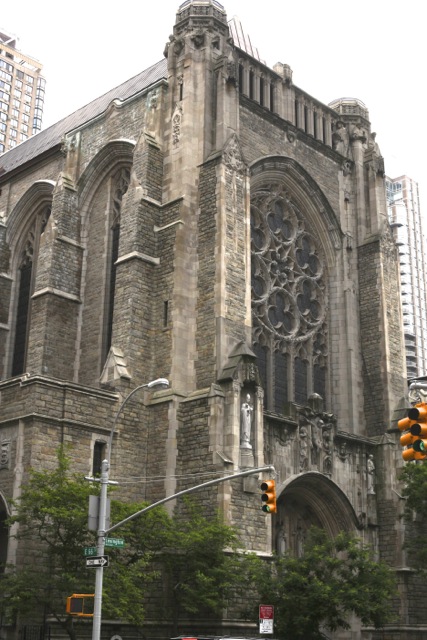
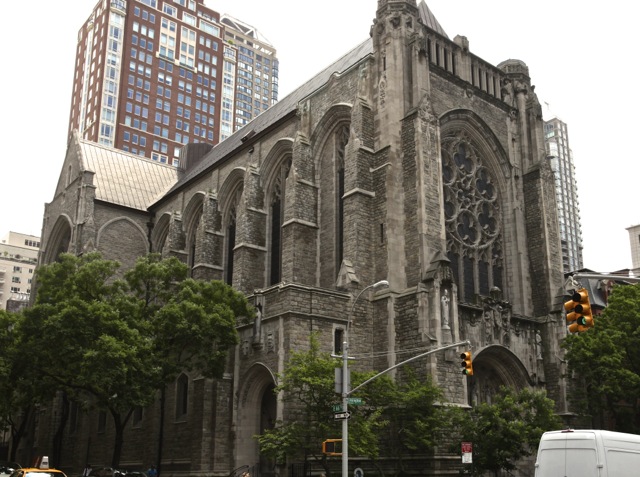
It is no surprise that an architect like Goodhue carefully considered the surroundings in constructing the exterior. The plot has been described as “difficult,” already there was a subway and there were problems in laying the foundations. Yet the bulk of the church would be exposed to view – in contrast to most New York Catholic churches where only a facade emerges from a surrounding streetscape of townhouses. In contrast to these earlier situations, by 1916 Goodhue realized that high-rise apartment buildings would be the neighbors of St. Vincent’s. That meant that traditional towers would not make an impression – consider St John’s near Penn Station! So Goodhue did not provide fro them. Rather, he designed an immensely tall, slender spire at the crossing of the transept. Now this feature seemed to be characteristic of Goodhue – he originally wanted something similar for St Bartholomew’s. It is perhaps fortunate in the case of both churches that the spires were never built if one considers the spire-crowned “Holy Oil Can” in Cleveland that emanated from Goodhue’s studio. 4)
The gray bulk of the exterior is a dominating but not overwhelming presence on Lexington Avenue. It is a source of endless pleasure to the visitor to gaze at various times of the day on the stonework of the walls and the tracery of the stained glass windows. The richness of carving and sculpture is overwhelming – in places there is a vegetative, almost “Hindu temple” quality about it.
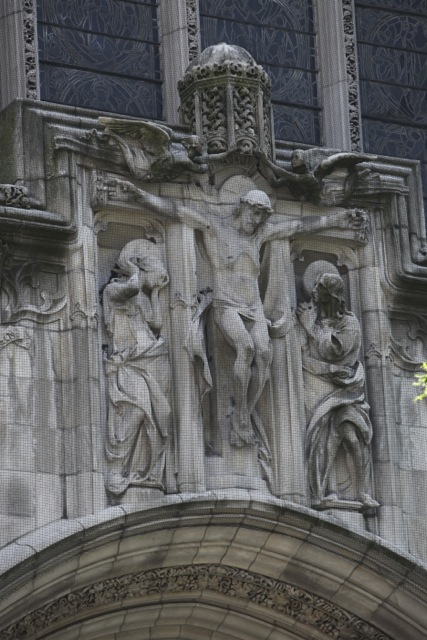
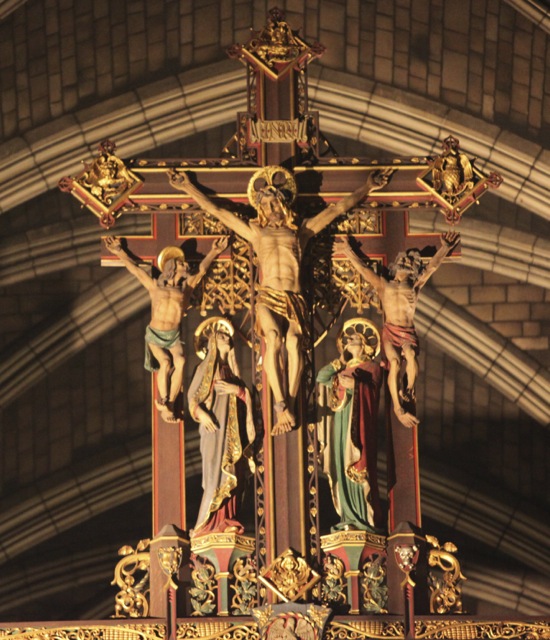
The great crucifixion on the Lexington Avenue facade by Lee Lawrie.
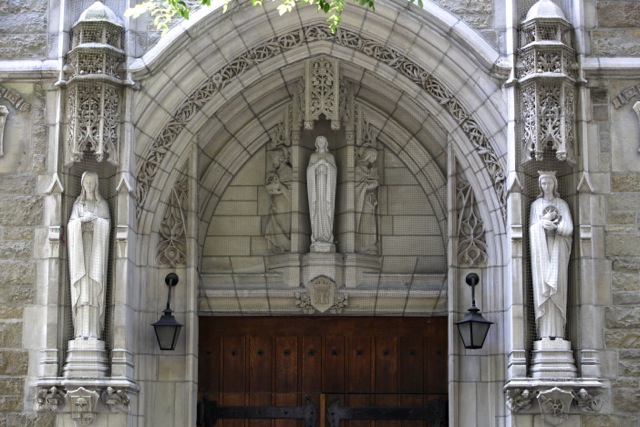
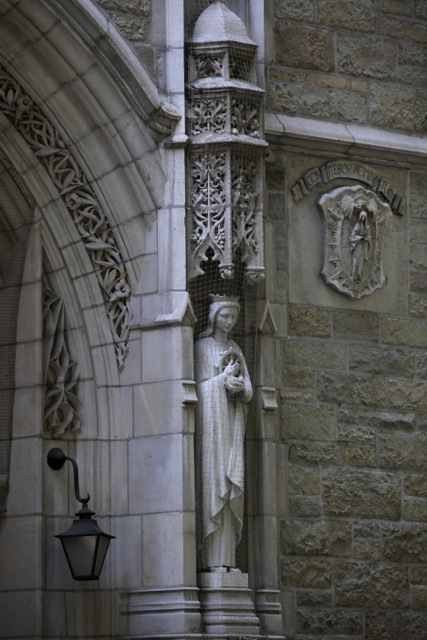
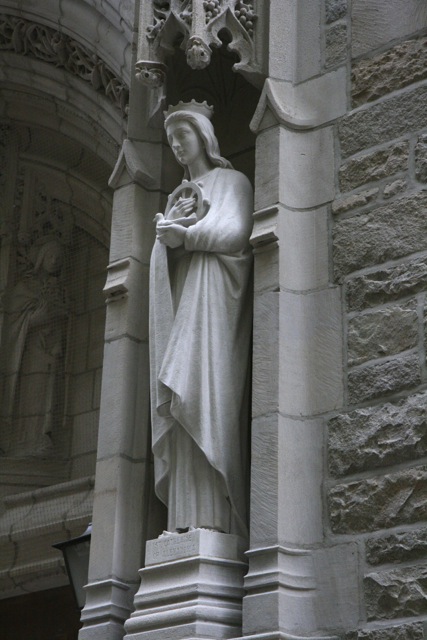
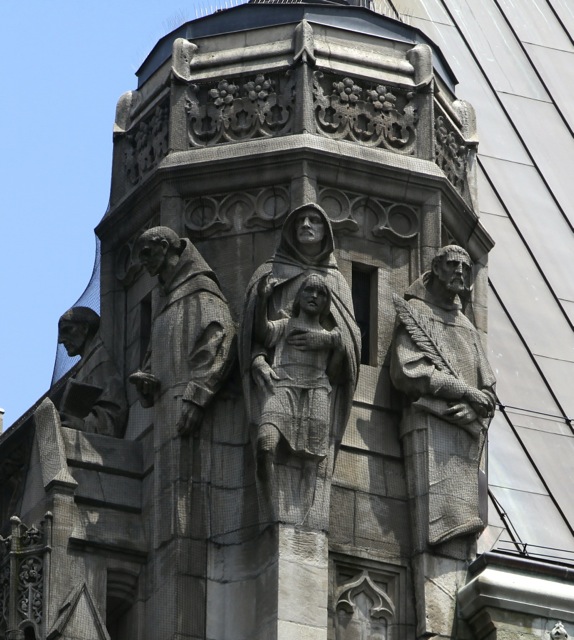
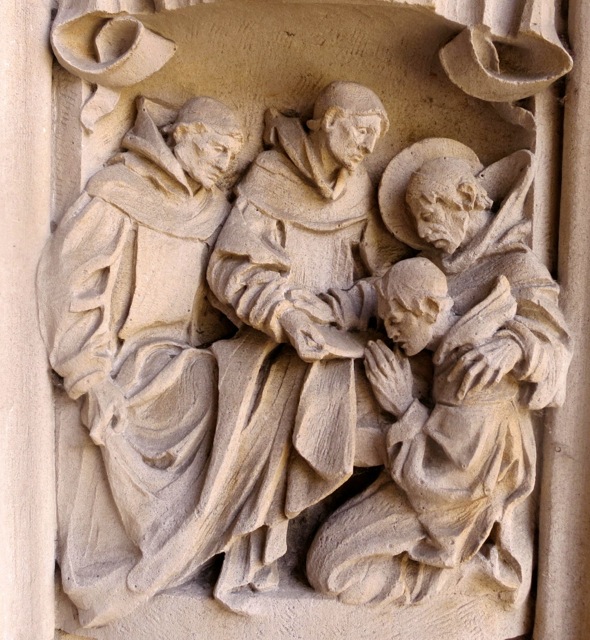
High above the facade are carved famous and saintly Dominicans. The figure holding the man gesturing forward is Diego de Deza, protector of Columbus. As with the patron of this church, de Deza’s career was emphatically not politically correct.
1) Since the knowledge of the correct pronunciation of certain New York churches is fast disappearing, I should mention here that the name of this parish is Vincent FERR -er. Just like St Jean Baptiste is St GENE Baptiste….
2) Dominican Fathers, St. Vincent Ferrer’s Church (1944) (hereinafter the “Guide”). The Guide is itself a unique monument – what other New York Catholic church has a 287-page introduction to its architecture and symbolism? See also the informative website of St. Vincent Ferrer’s.
3) Guide at 18.
4) Guide at 49 -51.
Published in The Churches of New York | no comment
Churches of New York
Holy Roman Empire
Website Highlights
Archives
[powr-hit-counter label="2775648"]