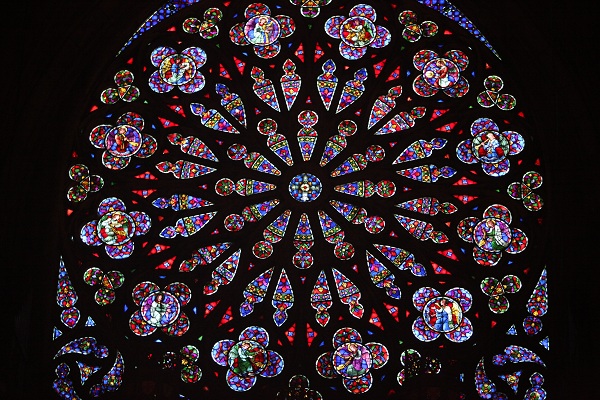
Part of the ambitious program of restoration at St. Gabriel’s, Stamford – a new altar of Our Lady.
Photo Courtesy of Fr. Cyprian LaPastina
18
Jan

Part of the ambitious program of restoration at St. Gabriel’s, Stamford – a new altar of Our Lady.
Photo Courtesy of Fr. Cyprian LaPastina
18
Jan
There will be a Solemn Requiem Mass for the Month’s Mind of Fr. William Shelley at the Church of the Holy Innocents in Manhattan this Monday, January 21st, at 1:00 PM. Fr. Shelley’s funeral was celebrated on December 21st by His Eminence, Timothy Cardinal Dolan at St. Patrick’s Cathedral. Father William Shelley, who served at several parishes in the archdiocese and was a coordinator of the Courage program for Catholics with same-sex attractions, died Dec. 18 at the Mary Manning Walsh Home in Manhattan. He was 87.
He was pastor of St. Thomas the Apostle parish in Harlem, 1978-1979. He served as parochial vicar at St. Malachy’s, The Actors Chapel, 1959-1973; Our Lady Star of the Sea, Staten Island, 1957-1959; St. Martin of Tours, the Bronx, 1952-1957; and Good Shepherd, Rhinebeck, 1950-1952.
He was coordinator of the Courage program in Manhattan, the Bronx and Staten Island. Of his Courage ministry he wrote, “I was active as a priest here in Midtown for 16 years, 1986-1998, almost always helping at (Courage’s) weekly meetings these good people who have dedicated themselves to a wholesome, daily spiritual life.” He was also active in Operation Rescue, and was a frequent presence Saturdays praying at the Eastern Women’s abortion clinic on 30th Street.
15
Jan
On Monday January 21, 2013 Saint Gabriel Church in Stamford will celebrate a Solemn High Mass for the Feast of St. Agnes at 7:30 PM. Mass will be celebrated in the Extraordinary Form of the Roman Rite. Refreshments to follow in the Parish Meeting Room.
14
Jan
“The Holy Mass – our Divine treasure”
Dear brothers and sisters in Christ! In these moments we participate in the most holy, in the most great, in the most wonderful and in the most Divine work in all creation and in all eternity: the Holy Sacrifice of Mass. The Holy Mass as in substance the same as the Holy Sacrifice of Golgotha. We are present to the some work which Christ accomplished on the Cross and we are presented to the work which Christ the Eternal High Priest is now and forever acting in Heaven in the presence of the Holy Trinity: the sacrifice of the eternal and everlasting Covenant, which is the sacrifice of the supreme glorification and adoration of the Triune God and because of this it is the unique effective sacrifice of the redemption of humankind and of sanctification of all creation.
Blessed Cardinal John Henry Newman wrote: “To me nothing is so consoling, so piercing, so thrilling, so overcoming, as the Mass, said as it is among us. I could attend Masses forever, and not be tired. It is not a mere form of words — it is a great action, the greatest action that can be on earth. … Here becomes present on the altar in flesh and blood, before whom angels bow and devils tremble. This is that awful event which is the scope, and the interpretation, of every part of the solemnity” (John Henry Cardinal Newman, Loss and Gain. The story of a convert, London 1906, pp. 327-329, words of Mr. Willis in Cardinal Newman’s first novel).
The example of love, reverence and devotion of Catholics towards Holy Mass during times of persecution is a powerful lesson which may shake up our souls and enkindle in them a new fire of Eucharistic love and reverence. One of the most moving and glorious historical examples is Ireland’s loyalty to the Mass in the time of persecution and the so called ‘Hidden Saints of the Mass’, described in the book of Father Augustine, OMCap., as follows: “After a tour in Ireland, the illustrious Count de Montalembert published in Paris, in the year 1829, some very interesting letters in which he describes what he had seen and felt in this country. ‘I shall never forget,’ he says, ’the first Mass which I heard in a country chapel. I rode to the foot of a hill, the lower part of which was clothed which a thick plantation of oak and fir, and alighted from my horse to ascend it. I had taken only a few steps on my way when my attention was attracted by the appearance of a man who knelt at the foot of the firs. Several others became visible in succession in the same attitude; and the higher I ascended the larger became the numbers of these kneeling peasants, At length, on reaching the top on the hill, I saw a cruciform building badly built of stone, without cement, and covered by thatch. Around it knelt a crowd of robust and vigorous men, all uncovered, though the rain fell in torrents and the mud quivered beneath them. Profound silence reigned everywhere. It was the Catholic chapel of Blarney (at Waterloo) and the priest was saying Mass. I reached the door at the moment of the Elevation, and all this pious assembly had prostrated themselves with their faces on earth. I made an effort to penetrate under the roof of the chapel thus overflowed by worshippers. There were no seats, no decorations, not even a pavement; the floor was of earth, damp and stony, the roof dilapidated, and tallow candles burned on the altar in place of tapers. When the Holy Sacrifice was ended, the priest mounted his horse and rode sway. Then each worshipper rose from his knees and went slowly homeward. Many remained for a much longer time in prayer, kneeling in the mud in that silent enclosure chosen by the poor and faithful people in the time of ancient persecutions’.” (Ireland’s loyalty to the Mass, op. cit., 194-197).
When we recognize and really believe what each Holy Mass is, then every detail of the rite of the Holy Mass, every word, every gesture is important, is deeply meaningful and spiritual. The greatest reality in the Holy Mass is Christ Himself really present in His immolated and glorified Body in the little consecrated host. Each faithful when approaching the Divine Body of Christ in the moment of Holy Communion has to show towards Him not only the interior purity of the soul but also the exterior adoration of the body and greet Him kneeling down and in an attitude of humility and spiritual infancy opening one’s mouth and allow to be fed by Christ through the hand of the priest who in the Holy Mass is acting in persona Christi. The real greatness is manifested then when it bows down. Saint Peter Julian Eymard said: “Has Jesus not a right to still greater honors in His Sacrament since He multiplies His sacrifices therein and abases Himself more? To Him the solemn honors, the magnificence, the richness, the beauty of worship! God regulated Mosaic worship in its minutest details, and it was only a symbol. … The worship and honors paid to Jesus Christ are the measure of the faith of a people. Let honor therefore be given to Jesus Eucharistic. He is worthy of it; He has a right to it” (The Real Presence. Eucharistic Meditations, New York 1938, pp. 144.147). “Catholics have much reason to blush for their lack of respect in our Lord’s presence. Enter a synagogue; if you speak or do not behave properly, you are expelled. Before entering a mosque, you are requested to take off your shoes. All these infidels have nothing real in their temples, but we have everything. In spite of that, their respect far surpasses ours. Why do we do to our Lord what would offend us so much if it were done to us? Why are we less sensitive when our Lord’s honor is at stake than when our own petty dignity is? Let us, therefore, give our Lord this first homage of a sentiment of respect as soon as we come into His presence” (ibd., pp. 161-162).
Dear brothers and sisters, let us receive the Eucharistic Lord with love, with purity of heart, with a gesture of adoration kneeling down, with a gesture of humility and littleness opening our mouth and receiving the Holiest of the Holy, the King of the universe, in the little sacred host. Saint Thomas Aquinas said: O Lord, our Eucharistic Lord, you will visit us with your graces, you will visit your Church in our time, in the measure, we give you Divine honor in the Holy Mass and especially in the moment of Holy Communion (Sic nos Tu visita, sicut Te colimus, hymn Sacris solemniis). O Lord, when we have You in the Eucharist, we have all things and we will miss nothing. Amen.
14
Jan
Holy Communion and the Renewal of the Church
1. The Church in her pilgrimage towards the Heavenly Jerusalem grows and is edified by the work of the Holy Spirit, especially though the fear of God (cf. Act. 9, 31), through the supernatural acts of faith, hope and charity and through concrete acts of adoration towards the Incarnate God in His visible manifestations, especially in His presence under the veils of the Eucharistic sacrament. From the beginning of her historical journey the Church had her most fruitful moments and periods when she paid deep veneration and adoration to the Most Holy Eucharist. Such moments were moments of the authentic effects of the Pentecost.
2. The sacred liturgy of the Church, and particularly the liturgy of the Eucharistic Sacrifice, are the continuation of the prayer, which Christ the High Priest, offered to God on earth, and now continues to offer in Heaven with deep reverence, as He did on earth (cf. Hebr. 5, 7). Those prayers and gestures which are performed with reverence, devotion and the holy fear of God, are truly Pentecostal. Such Pentecostal moments, filled with the Holy Ghost, are especially the main moments during Holy Mass: the moment of Consecration and of Holy Communion. The authentic worship of the Church has to be made according to the model of Christ’s prayer and according to the example of the liturgy of the first Christians. Such a liturgy is pleasing to God, as we are taught by the Letter to Hebrews: “We may adore God acceptably with reverence and fear (cum metu et reverentia), for our God is a consuming fire” (Hebr. 12, 28). This consuming fire is the Holy Spirit. Therefore the more there is reverence and fear of God in the prayers, in the style, in the rites and gestures of the Holy Mass, the more such a liturgy is Pentecostal, the more it is filled with the fruits of the Holy Spirit.
3. The authentic renewal and reform of the life of the Church has to start by the renewal of the liturgy, that is, by deepening the devotion and the fear of God in the liturgical rites. Such a renewal of the holy liturgy is the main expression of the “aggiornamento” which Blessed Pope John XXIII so much desired. Saint JoseMaria Escrivá explained the word “aggiornamento” very correctly in this way: “Aggiornamento means above all fidelity. The delicate, operational and constant fidelity is the best defense against the coldness of the spirit, the aridity of the heart and the mental inflexibility. It would be at least superficial to think the aggiornamento consists primarily in changing” (Conversiones con Mons. Escrivá de Balaguer, ed. José Luis Illanes, Madrid 2012, pp.152-153). Therefore the Second Vatican Council dedicated his first document to the sacred liturgy. The main principles and aims of this document are the following three:
(1) That the rites may express clearer their orientation to God, to Heaven, to contemplation (Sacrosanctum Concilium, 2 and 8).
(2) That the sanctity of the texts and rites may be clearer expressed (Sacrosanctum Concilium, 21).
(3) That there should not be innovations, unless they are organically connected with the existing forms and unless they bring authentic spiritual utility (Sacrosanctum Concilium, 23).
Spiritual utility in liturgy according to the Holy Scripture and the example of the first Christians is given only then, when there is a stronger effect of the presence of the Holy Spirit, Who is God and consuming fire and Who inspires holy love which contains in itself always the fear of God as well (cf. Hebr. 12, 28).
4. When in the most holy and central moments of the Holy Mass there are fewer expressions of reverence and fear of God, then there are doubtless less fruits of the Holy Spirit, then there is less Pentecost, then there is less true “aggiornamento”, then there is less spiritual progress, but on the contrary there is a regress in Christian faith and piety. The manner in which the faithful receive Holy Communion shows if Holy Communion is for them not only the most sacred reality, but the most beloved and the most sacred Person. The reception of the Body of Christ in the little host requires therefore deep faith and purity of heart, and in the same time unequivocal gestures of adoration. This was the constant characteristic of Catholics from all ages, beginning with the first Christians, the Christians in the time of the Church Fathers until the times of our grandparents and parents. Even in the first centuries when in many places the sacred host was deposited by the priest on the palm of the right hand or on a white cloth which covered the right hand of the women, the faithful didn’t touch the consecrated bread with their fingers. The Holy Spirit guided the Church instructing her more deeply about the manner to treat the sacred humanity of Christ during Holy Communion. Already in the 6th century the Roman Church distributed the sacred host directly in the mouth, as it is witnessed by Pope Gregory, the Great (cf. Dial., 3). The next step we observe in the Middle Ages, when the faithful began to receive the Body of Christ kneeling, in an exteriorly more clear expression of adoration (cf. St. Columban, Regula coenobialis, 9). This was another important moment of an “aggiornamento”, a Pentecostal moment.
5. In our times, and there has passed already 40 years, there is a deep wound in the Mystical Body of Christ. This deep wound is the modern practice of Communion in hand, a practice which essentially differs from an analogous rite in the first centuries, as above described. This modern practice is the deepest wound in the Mystical Body of Christ because of the following four deplorable manifestations:
(1) An astonishing minimalism in gestures of adoration and reverence. Generally there is in the modern practice of Communion in hand almost an absence of every sign of adoration.
(2) A gesture as one treats common food, that is: to pick up with one’s own fingers the Sacred Host from the palm of the left hand and put It by oneself in the mouth. A habitual practice of such a gesture causes in a not little number of the faithful, and especially of children and adolescents, the perception that under the Sacred Host there isn’t present the Divine Person of Christ, but rather a religious symbol, for they can treat the Sacred Host exteriorly in a way as they treat common food: touching with his own fingers and putting the food with the fingers in one’s own mouth.
(3) A numerous loss of the fragments of the Sacred Host: the little fragments often fall down in the space between the minister and the communicant because of no use of Communion plate, often the fragments of the Sacred Host stick to the palm and to the both fingers of the person who receives Communion and then fall down. All these numerous fragments are often lying on the floor and crushed under the feet of the people, even so they don’t notice the fragments.
(4) An increasing stealing of the Sacred Hosts, because the manner to receive It directly with one’s own hand effectively greatly facilitates such theft.
There is nothing in the Church and in this earth, which is so sacred, so Divine, so living and so personal as the Holy Communion, because It is the Eucharistic Lord Himself. And such four deplorable things do happen to Him. The modern practice of Communion in hand never existed in such an exterior form. It is incomprehensible that many persons in the Church don’t acknowledge this wound, consider this matter as secondary, and even wonder why one speaks about this theme. And what is even more incomprehensible: many persons in the Church even defend and spread this practice of Communion.
6. Saint John Fisher, cardinal and martyr, stated already in 1526 the following truth: “Indeed, when someone observes with attention the periods of spiritual flourishing of the Church and the times of degeneration as well as the different reforms which often followed one after the other, he must realize this: the cause of the degeneration in the Church is almost always the negligence and the abuse of this most holy Sacrament of the altar. On the opposite side however he will notice this: the times of a genuine reform and of the flourishing of the life of the Church preceded always a tender devotion to this most holy Sacrament” (Holböck, F., Das Allerheiligste und die Heiligen, Stein am Rhein 1986, p. 195). The intention of Blessed John XXIII to celebrate the Second Vatican Council was to foster a genuine reform and a flourishing of the spiritual life of the Church. That means a deepening of the knowledge of the faith, an increased fidelity to the truth of the faith, a more vigilant defense of the deposit of the faith (cf. Allocution on the Inauguration of the Second Vatican Council, October 11th, 1962). A time of new spiritual flourishing of the Church needs necessarily a deeper faith and more rich and faithful expressions of veneration of the Holy Eucharist. When the faith in the Eucharist diminishes and when the Eucharistic rites, especially in the moment of Holy Communion, show less signs of adoration, then surely the life of the Church is not flourishing, and the expectations of Blessed John XXIII are in some way frustrated. In 1961 the same Pope wrote in his spiritual diary the following words: “To promote with care and ardent prayers the Divine worship among the faithful, the exercises of piety and the reception of the sacraments dully administered. This will attract the Divine blessings upon the people. These are my thoughts and my pastoral solicitude, and so it must be today and always.” (John XXIII, Il giornale dell’anima, Cinisello Balsamo, 2000, n. 961).
7. It was the constant belief and practice of the Church that Christ, really present under the species of the bread, has to receive an exclusively Divine adoration, which is realized interiorly as well as exteriorly. Such an act of adoration was called in the Holy Scripture “proskynesis”. Our Lord Jesus Christ rejected the temptations of the devil and proclaimed the first duty of all creatures: “Thou shalt adore God alone” (Math. 4, 10). Jesus used here the word “proskynesis”. In the Bible the act of adoration of God was performed exteriorly in the following manner: kneeling down and bowing the head to the earth or prostration. Such an act of adoration was performed by Jesus Himself, His holy Mother the Blessed Virgin Mary and Saint Joseph when they annually visited the Temple in Jerusalem. In this manner of “proskynesis” the Body of Christ, the Incarnate God, was venerated: firstly by the three wise men (Math. 2, 11); the numerous people, who were healed be Jesus, performed also this exterior act of adoration (cf. Math. 8, 2; 9, 18; 15, 25); the women who saw the risen Lord in the Easter morning fell down in the presence of His glorious Body and adored him (Math. 28, 9); the Apostles as they saw the Body of Christ ascending into Heaven fell down and adored Him (Math. 28, 17; Luc. 24. 52); the Angels and all the redeemed and glorified Saints in the Heavenly Jerusalem are falling down and adoring the glorified humanity of Christ, symbolized in the “Lamb” (Apoc. 4, 10). In the past millennia the Church was growing deeper in the knowledge of the truth about the Eucharistic mystery. Consequently she found ever more perfect expressions of veneration when she was treating the Eucharistic Body of Christ, especially in the moments when the priest or the faithful approach the Eucharistic Body of Christ. In order to express the truth that the Holy Communion in not a common food, but really the Holiest of the Holy, the sacredness in persona, at least from the 8th century in the Occidental as well as in the Oriental churches the priest began to put the sacred host directly in the mouth of the faithful. This gesture symbolizes that it is Christ in the person of the priest who is nourishing the faithful. Furthermore this gesture symbolizes the attitude of humility and the spirit of spiritual infancy, which Jesus Himself requires from all who want to receive the kingdom of God (Math. 18, 3). During the Holy Communion the sacred host is the real heavenly kingdom, because there is Christ Himself, in whose Body all the Divinity dwells (cf. Col. 2, 9). Therefore the most appropriate exterior gesture is to receive the kingdom of God like a child, is to make oneself little, to kneel down and to allow to be fed like a little child, opening the mouth. Consequently the rite of receiving the Divine Body of Christ during Holy Communion kneeling and on the tongue was elaborated during several centuries in the Church by the guidance of the Holy Spirit, the Spirit of sanctity and piety. The abolishing of explicit gestures of adoration during Holy Communion, that is the abolishing of kneeling and the abolishing of the biblically motivated gesture of receiving the Body of Christ like a child in the tongue, will surely not bring a deeper flourishing of the Eucharistic faith and devotion. The following words of the Ecumenical Council of Trent remain always valid and continue to be very up-to-date: “There is, therefore, no room for doubt that all the faithful of Christ may, in accordance with a custom always received in the Catholic Church, give to this most holy sacrament in veneration the worship of latria, which is due to the true God. Neither is it to be less adored for the reason that it was instituted by Christ the Lord in order to be received. For we believe that in it the same God is present of whom the eternal Father, when introducing Him into the world, says: And let all the angels of God adore him (Hebr. 1, 6) (session 13, chapter 5). The Council declares further solemnly: “If anyone says that in the holy sacrament of the Eucharist, Christ, the only begotten Son of God, is not to be adored with the worship of latria, also outwardly manifested, and is consequently neither to be venerated with a special festive solemnity, … let him be anathema” (session 13, canon 6).
8. The Church teaches us, that the more the faithful growth in the faith in the divine reality of the Holy Communion, the more they have to manifest towards the consecrated host reverence and sanctity. Sanctity means the interior sanctity of the soul, to be free from mortal sins or positively spoken to be in the state of sanctifying grace. This is a Divine law, proclaimed already by Our Lord Jesus Christ and underlined by the tradition of the Apostles, especially by the Apostle saint Paul. Our Lord said: “Give not that which is holy unto the dogs, neither cast ye your pearls before swine” (Matt. 7, 6). Saint Paul admonishes: “Whosoever shall eat this bread, and drink this cup of the Lord unworthily, shall be guilty of the body and blood of the Lord. But let a man examine himself, and so let him eat of that bread, and drink of that cup” (1 Cor. 11, 27-28). The Church has always observed this Divine command solicitously and this command shall be observed also in our days with more consciousness. So speaks the same Ecumenical Council of Trent: “If it is unbecoming for anyone to approach any of the sacred functions except in a spirit of piety, assuredly, the more the holiness and divinity of this heavenly sacrament are understood by a Christian, the more diligently ought he to give heed lest he receive it without great reverence and holiness, especially when we read those terrifying words of the Apostle: “He that eateth and drinketh unworthily, eateth and drinketh judgment to himself, not discerning the body of the Lord. Wherefore, he who would communicate, must recall to mind his precept: “Let a man prove himself”. Now, ecclesiastical usage declares that such an examination is necessary in order that no one conscious to himself of mortal sin, however contrite he may feel, ought to receive the Sacred Eucharist without previous sacramental confession. This the holy council has decreed to be invariably observed by all Christians” (session 13, chapter 7). Opening the Second Vatican Council Blessed John XXIII said, that the documents and expressions of the previous Ecumenical Councils, namely of the Council of Trent, have to be considered by all as a sacred treasure (Opening speech, October 11th, 1962).
9. The practice of unworthily received Communions represents in our days the deepest wound in the Mystical Body of Christ. The unworthily received Communions refer in first place to the interior unworthiness: the reception of the Holy Communion in the state of actual mortal sins; in a state of habitual mortal sin; receiving Holy Communion without the full catholic faith in the real presence and in the transubstantiation; in the state of non-repentance about venial sins. The unworthily Communions are determined also by exterior unworthy attitudes: the sacrilegious stealing of the sacred host; receiving the sacred host without any exterior sign of adoration; receiving the sacred host without paying attention to the falling down and to the loss of the little fragments; the distributing the Holy Communion with hurry, which seems like a scene of distributing cakes in a school or in a cafeteria. When there is no belief in the real presence of Christ in the consecrated bread, such as in the case of the Calvinists and similar Protestant communities, an exterior attitude of treating the holy host with minimal sacral gestures or without clear sacral gestures does not astonish so much. When there is still belief in the real presence of Christ at least during the distribution of Holy Communion, such as in the case of Martin Luther and in the case of traditional Lutherans, there must be more explicit gestures of reverence. There exists a moving scene from the life of Martin Luther, which shows his reverence and his devotion towards the Holy Communion. It happened in 1542. We cite from an ancient German historical text: “A woman wanted to receive the Lord’s Supper. As she was to kneel down in front of the chair before the altar and drink, she approached in a brusque manner and hit with her mouth hard the chalice of the Lord and so some drops of the blood of Christ were shed on her cloth and on the backrest of the chair on which she was kneeling. As the Reverend Doctor Luther noticed this, he and the Reverend Doctor Bugenhagen suddenly stood up and ran towards the altar and together with the officiating minister they cleaned the drops from the cloth of the woman and lapped up the drops from the chair as much as they could. Such an irreverence moved so deeply Doctor Martin that he sighed because of what was happened with these words: o God, help us. And his eyes were full with tears” (Stahl, R., Martin Luther für uns heute. Erlangen 2008, p. 28). What a moving example! How many priests and faithful today will clean as much as they can and will sigh and weep, when some fragments of the Sacred Host fall down? During the Synod of Bishops on the Eucharist in 2005 I asked a Norwegian Lutheran bishop, who was there present as an observer, in which manner the Lutherans in Norway do receive Holy Communion. He answered to me: “Until some 10 or 15 years ago people received Communion kneeling and by tongue. But now they receive standing and in the hand”. I ask asked what the reason of this change was. And he answered to me: “We changed because of the influence of our Catholic brothers”. In an interreligious meeting in Kazakhstan, in which I participated, we spoke about the most holy realities of each religion. An Imam said, that for the Muslims the holiest of holy is the book of the Koran in Arabic l and he stressed saying: it would be an act of sacrilege when somebody will dare to touch the Arabic Koran with unwashed hands. Hearing this statement I suddenly was thinking about the scenes of the reception of Holy Communion in hand and without almost any clear sacral sign and surely without immediately preceding washing of the hands, which is the case in the vast majority of the Catholic churches all around the world. I was imagining a following possible scene: when this pious Imam one day will occasionally enter a Catholic Church, where the Holy Communion is distributed directly in the hand and the faithful who are approaching in a quick moving queue, he would ask: “What is this little white bread?” The Catholic would answer him: “It is Christ”. The Muslim will say: “This is surely only a sign or a symbol of Christ”. The Catholic would answer him: “No, it is not a symbol or a sacred object. There is Christ really present”. The Muslim will continue to say: “Christ is there only spiritually or symbolically present”. The Catholic will answer: “No, Christ is really, truly present with the substance of His body, of His blood, of His soul, and with all His Divinity”. Then the Muslim will ask: “Then this little piece of bread must be, according to your faith, your God and the holiest of holy for you”. The Catholic will answer: “Yes, this little bread is really our living God personally in His human Body and Blood, and not an object like your Koran”. Then the Muslim will say: “When you treat your God and the holiest of holy in such a banal manner, then you don’t believe in it. I am unable to agree with you that you really believe in what you affirmed”.
10. The Catholics believe more than Martin Luther and more than traditional Lutherans. They believe not only in the real presence but also in the transubstantiation of bread and wine into the Body and Blood of Christ. The sacred host is for them consequently not a sacred object, even not a most sacred object, but the living Christ Himself with His holy humanity and with His infinite Divine majesty. We must have surely more reverence toward Holy Communion than Martin Luther had. We must have more awe and reverence than the Muslims have towards the Koran. It is of very pastoral urgency that Catholics all over the world start to treat the Eucharistic Body of Christ during Holy Communion in an interior and exterior manner which is unequivocally and explicitly due only to God. A Catholic has to treat the Eucharist, the holiest of the holy, in a manner as It was treated by Our Lady, by the Apostles, by our fathers and grandfathers, by the Christians from all ages according to the axiom: “Dare to give to Christ as much reverence as you can” (in the formulation of saint Thomas Aquinas: quantum potes, tantum aude: sequence Lauda Sion). When we receive the consecrated host in the moment of Holy Communion, then there is required not the minimum, but the maximum of interior and exterior devotion and adoration. The littleness of the sacred host does not justify treating It in the moment of Holy Communion with minimalistic signs of adoration. The most little one, the most fragile one, the most undefended one in the Church in our days is the Eucharistic Lord under the Eucharistic species in the moment of Holy Communion. There could be adduced pastoral reasons in favor of the continuation of the practice of Communion standing and in hand, as for example the rights of the faithful. Such rights, however, violate the right, which Christ the Holiest of the Holy, the King of kings has: His right to receive Divine honors as much as possible also in the little sacred host. In this case this is the right of the most fragile one in the Church. All possible reasons in favor of the continuation of Communion standing and in hand lose their weight in the face of the gravity of the obvious minimalism of reverence and sacredness, in the face of the carelessness with the Eucharistic fragments and of the numerous loss of them and in the face of the increasing theft of the sacred hosts. Possible reasons in favor of the continuation of Communion standing and in hand lose their weight above all in the face of the diminishing, alteration and even disappearance of the full Catholic faith in the dogma of the real presence and of the transubstantiation. This modern practice of Communion in hand, which in this exterior form never existed in the Catholic Church, indisputably weakens step by step the fullness of Catholic Eucharistic faith. Indeed already 1970 the Archdiocese of Vienna in Austria gave the following explanation in favor of the new modern practice of Communion in hand: “The fact that the faithful can take the host with his own hand in the manner as he takes the ordinary bread, will be understood by many people as a simple and natural gesture which corresponds to this sign” (Amtsblatt, April 1970). Such a naturalistic view of the sacred host as a sign, surely increased in the past 40 years, especially among the children and adolescents, who often take the Holiest of the Holy in such a naturalistic manner as they take cakes. To continue with this modern practice of Communion reveals himself ever more as non-pastoral. For when something diminishes the fullness of faith, the reverence, the signs of adoration, when something violates the Divine rights of the Eucharistic Lord, then such a practice is in a high degree non-pastoral.
11. Great periods of the flourishing of the life of the Church were always times of penance and times of an intense veneration of the sacrament of sacraments, the Holy Eucharist. Because of the practice of Communion in hand there is an objective state of Eucharistic minimalistic veneration, and even worse there is a situation of a shockingly widespread loss of Eucharistic fragments which are unperceivably crushed by the feet of the people in our churches, and the astonishing ease of stealing sacred hosts. Such an objective situation demands at least a gradual withdrawal of the practice of Communion in hand. Still more it demands expiation and reparation to the Eucharistic Lord, Who is already too much offended in the sacrament of His love. Such a demand for Eucharistic reparation was pronounced by the Angel who appeared in 1916 to the three little shepherds in Fatima. Sister Lucia reported the following event: “As soon as we arrived there, we began to say the angel’s prayer on our knees, with our faces to the ground. We rose to see what was happening, and we saw the angel bearing a chalice in his left hand. Drops of blood fell into the chalice from a Host suspended over it. Leaving the chalice and the Host suspended in the air, the angel prostrated himself beside us and said the following prayer three times: “Most Holy Trinity, Father, Son, and Holy Ghost…” After this, rising up, he again took the chalice and the Host in his hand; he gave the Host to me and the contents of the chalice to Jacinta and Francisco to drink, saying: ‘Take and drink the Body and Blood of Jesus Christ, who is horribly insulted by ungrateful men. Make reparation for their crimes and console your God. He again prostrated himself on the ground and repeated with us the same prayer three more times” (Andrew Apostoli, Fatima for Today. The Urgent Marian Message of Hope, San Francisco 2010, pp. 34-35).
12. It would be a pastorally urgent and a spiritually fruitful measure if the Church would establish in all dioceses of the world an annual “Day of Reparation for the crimes against the Most Holy Eucharist”. Such a day could be the octave day of the Feast of Corpus Christi. The Holy Spirit will give special graces of renewal to the Church in our days only, when the Eucharistic Body of Christ will be adored with all Divine honors, will be loved, will be carefully treated and defended as really the Holiest of the Holy. Saint Thomas Aquinas says in the hymn Sacris sollemniis: “O Lord, visit us to the extent as we venerate you in this sacrament” (sic nos Tu visita, sicut Te colimus). And we can say without doubt: O Lord, you will visit your Church in our days to the extent as the modern practice of Communion in hand will recede and to the extent as we offer to you acts of reparation and love. The day when in the churches of the Catholic world the faithful will receive the Eucharistic Lord, veiled under the species of the little sacred host, in the gesture of the biblical adoration of “proskynesis”, that is kneeling, and in the attitude of child, opening the mouth and allowing to be fed by Christ Himself in the spirit of humility and in the purity of heart, then undoubtedly will be realized an authentic “aggiornamento”, a genuine renewal of the Church, which so much desired Blessed John XXII and Blessed John Paul II, who left us as his spiritual testament this words from his last Encyclical: “There can be no danger of excess in our care for this mystery, for in this sacrament is recapitulated the whole mystery of our salvation (Saint Thomas Aquinas, Summa Theologiae, III, q. 83, a. 4c.)” (Encyclical Ecclesia de Eucharistia, 61).
Brooklyn, January 5th, 2013
+ Athanasius Schneider,
Auxiliary Bishop of the Archdiocese of Saint Mary in Astana, Kazakhstan
13
Jan
From the Brooklyn Tablet:
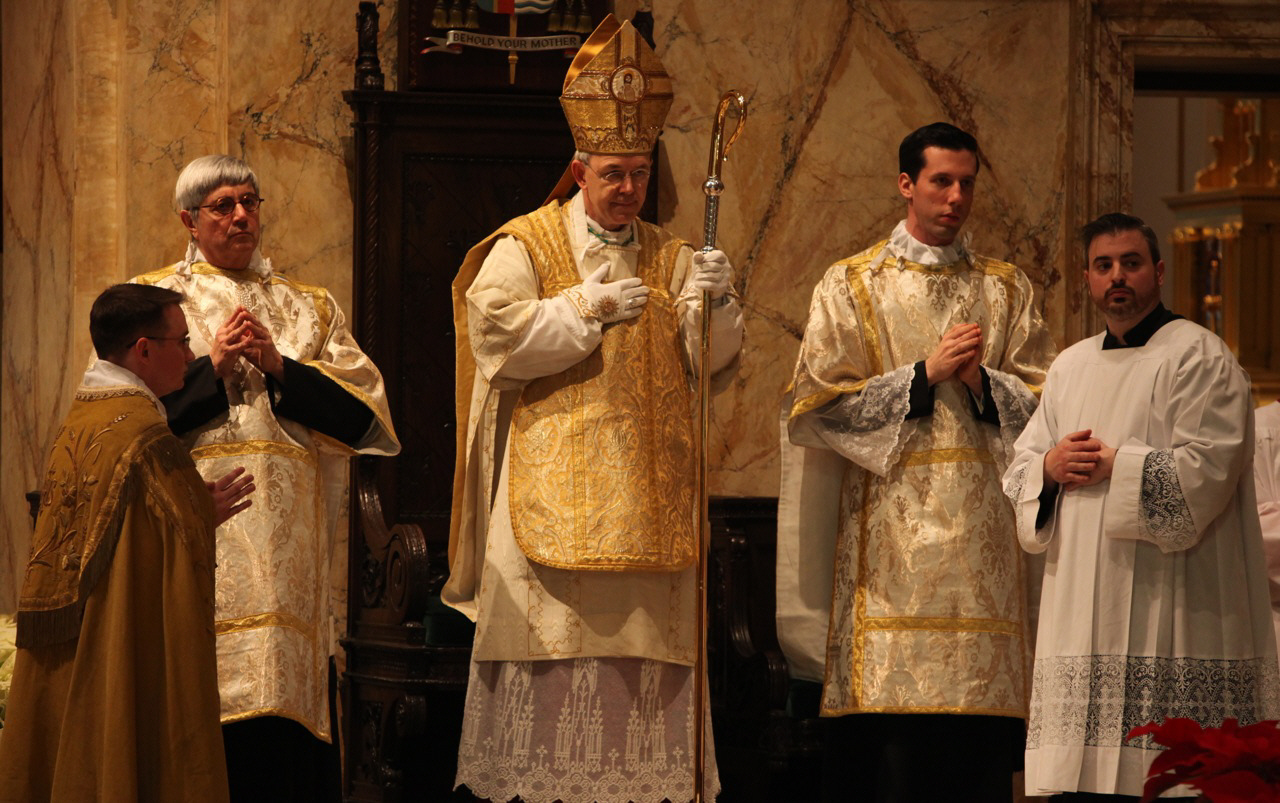
“For the first time since the Second Vatican Council, a Pontifical Solemn Mass in Latin was celebrated by a bishop at St. James Cathedral-Basilica, Downtown Brooklyn (See The Editor’s Space, Page 12).
Bishop Athanasius Schneider, Secretary of the Bishops Conference of Kazakhstan, was the celebrant of the Jan. 5 liturgy sponsored by the Society of St. Hugh of Cluny, which advocates for the return of traditional rites.
Music for the liturgy was provided by Schola Cantorum of St. Mary’s Church, Norwalk, Conn., and members of St. Mary’s Student Schola, directed by David J. Hughes.
About 300 people attended the Mass which lasted two hours and 20 minutes and was carried live on NET television.”
For the source see HERE (with slideshow and video)
And then a personal view from the editor of the Brooklyn Tablet:
by Ed Wilkinson
“If dalmatic, amice and biretta are part of your daily vocabulary, you probably were present at the Pontifical Solemn Mass that was celebrated last weekend in Latin at St. James Cathedral-Basilica in Downtown Brooklyn.
For the first time in 50 years, a bishop celebrated Mass in Latin at the cathedral in accordance with the Tridentine Rite. The liturgy was prepared and conducted by the Society of St. Hugh of Cluny, a lay organization that promotes a return to traditional rites, in accordance with permission granted by the Holy See. The group supplied all the personnel needed for the liturgy, from its own deacons and subdeacons to its own magnificent choir from St. Mary’s Church in Norwalk, Conn.
The almost 300 people who attended were obviously fans of the way the liturgy used to be celebrated in our Church. Prior to the Second Vatican Council, Mass was offered in Latin. The reforms of Vatican II reintroduced the vernacular to the Church’s liturgical life. The priest turned around and now faced the people during the Mass, and he spoke in the language of the community.
This was upsetting to some, although most embraced the changes. Participating in the “old” liturgies is a nostalgic experience for many like myself who grew up learning the Latin responses in order to recite the prayers at the foot of the altar. For those who remembered the Latin Mass, it was an opportunity to experience the Church of a less turbulent era when there was more certainty and we all knew what it meant to be a Catholic.
While acknowledging that the Church is not going back to way it was, there are aspects of the Tridentine Rite that we can learn from. For instance, there certainly was a sense of reverence and awe that is missing from our modern liturgy. Maybe, it’s the ethereal flow of the Gregorian Chant. Or the sense of other-worldliness that emanates from a language that we do not understand.
One observation is that there certainly were more men in the cathedral last Saturday than we find in our Sunday Masses in the parishes.
The Tridentine Mass allowed the cathedral staff to show off some of its treasures. The chalice used by Bishop Athanasius Schneider, the celebrant, was one that belonged to Brooklyn’s third bishop – Thomas J. Molloy. The ornate gold ciborium used at Communion was inscribed to Brooklyn’s second bishop, Charles E. McDonnell, on the day of his consecration as bishop in 1892.
While there is a place for the Tridentine Rite in today’s Church, it certainly could never replace the contemporary Mass. Today’s liturgy is more understandable. It’s simpler. It pays less attention to the frivolous and concentrates on Scripture and communal offering more than we understood in the past. It certainly is more beneficial for the community to listen to a reading in its own language than to have to read along with a missal.
Today’s liturgy is less mechanical and more adaptable to the everyday needs of the community.
Following the Mass at St. James, there was a lecture by the bishop-celebrant, who spoke about his personal preference for distributing Communion on the tongue while the recipient kneels.
Again, there was much reverence for the Eucharist in that practice. During distribution last weekend, communicants kissed the bishop’s ring before receiving the sacred host on the tongue.
Attending the Tridentine Mass at St. James was a beautiful experience but needs to be kept in perspective. For those who wish to celebrate in that way, it’s available. But it does not signal a return to the former liturgical life of the Church.”
That’s a remarkable article by the editor of the Brooklyn Tablet. Perhaps I don’t need to state that I would take issue with almost innumerable statements of fact and opinion set forth in this article – starting with the assertion that Bishop Schneider was voicing a “personal preference” for the traditional method of receiving communion. And one senses the fear that this kind of thing could catch on, could get out of control…But for now I am grateful for the favorable and in some respects perceptive review of this mass.
13
Jan

The visit of Bishop Athanasius Schneider, Auxiliary Bishop of Astana in Kazakhstan, to the New York Metropolitan area, ended on an exalted, even mystical note at Second Vespers for Epiphany at the Redemptorist church of the Most Holy Redeemer on East 3rd Street in Manhattan. It was appropriate that Bishop Schneider, the descendant of German immigrants to Imperial Russia in the 19th century, should conclude his visit at a parish created by 19th century German immigrants to the United States.

The half-Byzantine, half-Baroque church features life-size polychrome statues, rococo altars, wax effigies of saints and splendid stained glass.


Our Lady of Perpetual Help – “Make Her Known!” was the charge to the Redemptorist order.


At the Altar of the Blessed Sacrament.


Bishop Schneider after the Mass at the festive reception.
On Sunday, January 6, Bishop Athanasius Schneider celebrated a Solemn Pontifical Mass for the feast of the Epiphany at St. Mary’s, Norwalk. It is noteworthy that almost all the resources needed for this elaborate liturgy were provided by the parish itself.


Reverent reception of the Eucharist is an apostolate of bishop Schneider.


The blessing of the chalk.


The reception.
12
Jan

The sanctuary of the Cathedral Basilica of St.James prepared for the pontifical mass to be celebrated by Bishop Athanasius Schneider, auxiliary bishop of Astana, Kazakhstan.


The well attended lecture of Bishop Schneider after the Mass.
2
Jan
Vespers for the Feast of the Epiphany of the Lord
Please join us Sung Vespers (Evening Prayer) and Benediction of the Blessed Sacrament
on the Feast of the Epiphany
Sunday, January 6th at 4 PM
Followed by wine and cheese in the Parish Meeting Room
Church of Saint Gabriel
914 Newfield Avenue
Stamford, Connecticut