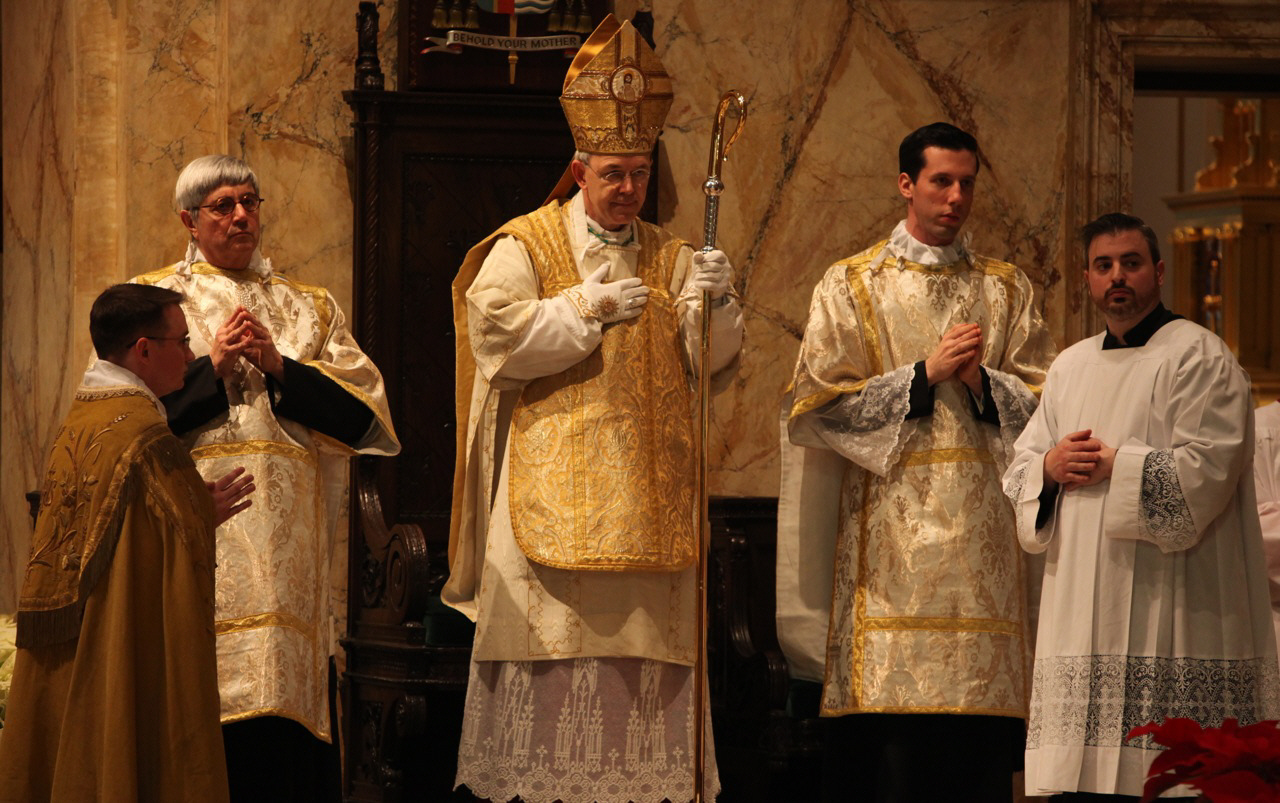
Regina Pacis Academy celebrated a Solemn Mass for the Feast of Candlemas yesterday which included the students, parents and friends of the community.


3
Feb
Regina Pacis Academy celebrated a Solemn Mass for the Feast of Candlemas yesterday which included the students, parents and friends of the community.


30
Jan

This Friday February 2 is the feast of the Purification of the Blessed Mother, or Candlemas. The following churches will offer traditional Masses:
Connecticut
St. Mary Church, Norwalk, 8 am Low Mass; 1 pm Solemn Mass; 7 pm Solemn Mass.
Sacred Heart Oratory, Redding, 6 pm, Solemn Mass with outdoor procession
Sts. Cyril and Methodius, Bridgeport, 7:45 am , 6 pm, blessing of candles, procession and Solemn Mass (bring your candles to the sacristy by 5:30 pm)
St. Patrick Oratory, Waterbury, 6 pm.
New York
Our Lady of Mount Carmel, New York, NY, 7 pm Solemn Mass
Holy Innocents Church, New York, NY, 6 pm
Basilica of St. Patrick’s Old Cathedral, 261 Mott St., New York, NY, Pontifical Seven Cope Vespers according to the 1960 Divine Office for Candlemas, 7 pm, includes works by Antonio Vivaldi.
Our Lady Queen of Peace, Staten Island, Missa Cantata, 7 pm. Bring your own candles for blessing
St. Josaphat, Bayside, Queens, 7pm; Also on Feb. 1: First Vespers of the Purification of the Blessed Virgin, 7 pm
St. Paul the Apostle, Yonkers, 12 noon
Our Holy Redeemer, Freeport (Long Island), blessing of candles, 7 pm; Solemn Mass 7:30 pm.
St. Marys St. Andrews in Ellenville NY , High Mass and procession at 7pm followed by a farewell to Christmas Party in the Parish Hall.
Holy Trinity Church, Poughkeepsie, Missa Cantata 6 pm.
New Jersey
Our Lady of Sorrows, Jersey City, 5 pm
Shrine Chapel of the Blessed Sacrament, Raritan, 7 pm
St.Anthony of Padua Oratory, West Orange, 9 am low Mass; 6:30 pm blessing of candles, procession and high Mass.
Our Lady of Fatima, Pequannock, 7 am, 9 am, 7 pm

29
Jan

On Wednesday, January 31, a Mass will be celebrated on the feast day of Blessed Maria Cristina of Savoy – Queen of the Two Sicilies. The Sacred Military Constantinian Order of St George (of the Kingdom of the Two Sicilies) is of course a sponsor. But Fr. John Hunwicke has pointed out her connections with the house of Stuart and the Jacobite succession. A point of particular interest to me given my name!
From Fr. John Hunwicke’s Mutual Enrichment: Saintly Stuarts, from Blesssed Charles to Blessed Maria Christina
By a chance, January 31 is the memorial, optionally, in Naples, of one of blessed Charles’ descendants who was beatified on January 25 2014 in the Basilica of S Clare in Naples by Crescenzio Sepe, Cardinal Archbishop of Naples. Blessed Queen Maria Christina of Savoy was the daughter of Victor Emmanuel (de jure King of England, Scotland, France, and Ireland, 1819-1824) and sister of Maria Beatrice (de jure Queen Mary III and II of England, Scotland, France, and Ireland, 1824-1840). Blessed Maria Christina was married to Ferdinand II, King of the Two Sicilies, and mother of Francis, last King of the Two Sicilies before the Piedmontese usurpation. Her Eulogy describes her as ‘a prudent counsellor of the King and a true Mother of the poor and needy’. She was also a woman of great modesty, who by her influence prevented the use of the Death Penalty. She died in childbed when she was only twenty four. Here is her Collect, discovered by Fr Andrew Starkie, a learned priest of the Ordinariate.
Deus, qui in figura huius mundi beatam Mariam Christinam prudenti ardentique caritate decorasti et artificem in augmento Regni tui effecisti: tribue nobis, eius exemplo et intercessione; ut de vero amoris tui thesauro benefacientes accipere valeamus. Per.
(O God, which in the figure of this passing world [I Cor 7:31] didst adorn [Isa 61:10] Blessed Maria Christina with a wise and burning charity, and didst make her a worker in the increase of thy Kingdom: grant to us, by her example and intercession; that by doing right [I Pet 2:15] we may be able to receive of the very treasure of thy love. Through. (This rendering takes account of the Italian version, which is not exactly the same as the Latin, and of the Italian Commentary which accompanied the texts.)
The banquet which followed the Beatification, hosted by the de jure King of the Two Sicilies, was, by all accounts, a very ancien regime occasion … Golden Fleeces wall to wall … I bet the Holy Father would have loved to have been invited … I wonder how many of the descendants of blessed King Charles, through his prayers, are within the Church’s catalogus Sanctorum et Beatorum.
28
Jan
Today is the 40th anniversary of Fr. Richard Cipolla’s ordination to the priesthood. Deo gratias agimus! He celebrated Solemn Mass at St. Mary Church, Norwalk.


27
Jan

On Sunday, January 14, I attended what may well be the last traditional mass of the Saint Gregory Society in New Haven. A large congregation was present in the beautiful Saint Stanislaus church. I saw old timers active in traditionalism or music from all over the state and people I had not seen for many years. But I also noticed newcomers, many families with small children and students(presumably from Yale?). The mood, despite the festive liturgy, was of course somber. But the Society said farewell to the city literally on a high note: the music and the ceremony of this mass could rarely be equaled elsewhere. 1)
We are fortunate to have the short history of the St. Gregory Society written by William Riccio, the inimitable master of ceremonies who has been associated with the Society from the beginning. I myself had regularly attended the masses of the Society up to about 1999. I will not try to duplicate Bill Riccio’s work – but to supplement it with my own reminiscences and observations. 2)
Actually, the administration of St. Stanislaus had first announced that January 14th would be the final Latin mass minutes before the Traditional Mass on Sunday, December 31, began. The leaders of the St. Gregory Society state they had no advance notice. 3) Witnesses have reported that on that day there was talk of a “decree“ from the Archbishop Leonard Blair – later, the explanation was given that the “moderator” of the consolidated New Haven parish (“Blessed McGivney Parish”) and the priest in charge of St. Stanislaus had recommended the action themselves and the archbishop had only endorsed it. As far as I can determine, no document has ever been issued nor any official mention even been made of this action (in, for example, the bulletin of the consolidated parish, the websites for Blessed McGivney parish that of “New Haven Catholic” etc.) It seems that, other than their mass disappearing from the schedule, traditionalists are not to be accorded even the courtesy or the dignity of a public statement, let alone a coherent explanation, of the actions taken against them.
The recent history of the Hartford Archdiocese (which includes New Haven) is unfortunate. Since the 1950’s, the old manufacturing economy of the Connecticut mill towns has been in irreversible decline. Yet, on paper, the number of Catholics has not diminished all that much – from 766,000 in 1966 to 734,000 in 2021. I doubt, however, whether even 20% of these nominal Catholics practice their faith. Archbishop John Francis Whealon (1968-1991), a darling of the progressives in his day, left the archdiocese wrecked from end to end. His three successors only succeeded in managing decline. The fall in the number of priests, religious parishes and schools has been disastrous. 4) Vocations verge on the nonexistent: 2021:2; 2022: 0; 2023:2. 5) At no time has the Church analyzed whether the policies and culture established by the Archdiocese may have played a decisive role in these developments. On the contrary, the incoming archbishop, Christopher Coyne, has indicted the laity for the archdiocese’s problems and signaled more down-sizing as the appropriate response to a ( still largely unacknowledged) crisis.
Blessed McGivney parish is the result of a consolidation, decreed in 2021, of the seven remaining parishes in New Haven ( in 1994 there were still 17!). 6) Added to the seven is the chaplaincy of Yale University which, having its own endowment, cannot totally participate in the consolidation. However, the leader of the combined parish is the chaplain of Yale University. The chaplaincy’s website makes clear the ideological direction he (and the new combined parish)favors. 7) There is no friendship for Catholic traditionalists in these quarters.
Indeed, New Haven seems to be a test case of a “Franciscan” model of the Church: monolithic uniformity, bureaucratic leadership, top-down direction, openness to the theological left (America magazine has reported favorably on developments here), and rapidly declining numbers of faithful. The parish reports that in 2022 the average Sunday attendance at all the New Haven Catholic churches was approximately 3100 people – down from 3800 in 2016! 8) The combined parish has been named “Blessed McGivney parish” although there is no devotion or cult of Blessed McGivney. Needless to say, the transparency claimed for this operation has been lacking. The elaborate websites and a consolidated parish bulletin of 20-plus pages do not communicate anything of significance.


The Society of St. Gregory was founded after the first indult in favor of the traditional Mass in 1984. From the beginning it was led by laymen, specifically, musicians. Thus, its governance was unique. The Society was permitted to celebrate the traditional mass in the church of Sacred Heart, a moribund New Haven parish. The time, 2 on Sunday afternoons, was intended to discourage attendance. But the St. Gregory Society was able to turn this disadvantage into a positive factor. The 2 PM mass time allowed many church musicians who had commitments in the morning to participate in the schola.
For the St. Gregory Society from its inception pursued the union of the traditional mass, celebrated in as complete a form as resources permitted, and the music which was created specifically for this mass. In other words, the spiritual and aesthetic forces were united. This contrasted starkly with the performance of polyphony as a concert or as an incongruous insertion in a Novus Ordo liturgy. But it also diverged from the practice of most of the other traditional masses springing up in the 1980s: low masses, sometimes accompanied by an attempted recreation of the dimly remembered musical performance style of 1962. Thus, the St. Gregory’s Society marked the departure of post 1980s traditionalism from pre-conciliar practices– a “return to the sources” of Catholic liturgy and music. The Society’s musical achievements were memorialized in a series of CDs that received critical acclaim.
The Society had to deal with the limitations forced upon it. The mass was usually a missa cantata. It was a challenge to find priests willing to celebrate the traditional mass and to train them to do so. The dilapidated church left much to be desired. – for example, during one mass I attended a stained-glass window collapsed and shattered. A volunteer guard had to be posted outside the church to watch over the parked cars.
Yet in spite of the disadvantageous time and place and the disdain of the official Church many people were willing to make the sacrifice to attend this mass. And the St. Gregory Society quickly attracted national attention. Bill Riccio has chronicled its “outreach” – to use a formerly popular ecclesiastical buzzword – to all kinds of other churches and organizations. Over the years, many bishops participated in the Society’s Masses. The St. Gregory Society became the new gold standard for the celebration of the traditional mass. Many of those involved in the traditional movement today, whether as celebrants, ministers, or musicians, received their training or inspiration at masses of the St. Gregory Society. Such was the Society’s reputation, that, in 1998 when the first traditional mass in decades was celebrated at Saint Patrick’s Cathedral in New York, Michael Davies wrote approvingly of the musical contribution of the Society – although I don’t believe they had much to do with that mass!
Then came the liberating effect of Summorum Pontificum. Perhaps the high point of the Society’s career was a Solemn High Mass celebrated in 2008 in the holy of holies of Catholic New Haven: the Dominican parish of St. Mary’s. 9) In the following year, after Sacred Heart parish was shut down, the Society had the opportunity to move to a much grander and more richly decorated church, the Polish Vincentian parish of Saint Stanislaus. The Society celebrated its new home with a splendid liturgy. 10) Both these festive masses were extremely well attended.


Yet as time went on a certain routine set in. In the wake of Summorum Pontificum other communities and other parishes sponsored liturgies that matched or even exceeded those of the Saint Gregory’s Society in the quality of music, the splendor of the vestments, the completeness of ritual and, above all, in the commitment to the fostering of a growing parish life. The 2 PM mass time had never been ideal for families. Indeed, at least in the now remote past, certain associates of the St. Gregory Society – not the leadership or the clergy! 11) – took a dim view of presence of children. That’s an attitude that contradicted the whole purpose of celebrating the Traditional mass in the first place. I noted, however, at the final mass of January 14 numerous families with young children in attendance.
Nor did the Society establish a firm bond with clerical institutions. For whatever reason, the most obvious next step in the development of New Haven traditionalism, to move the Society’s mass to St. Mary’s at an earlier time, never materialized. Attempts over the years to develop a relationship with the FSSP or the ICRSS eventually went nowhere. Bill Riccio tells us that overtures to the leadership of St. Stanislaus parish were firmly rebuffed. Obviously, the events of this year demonstrate that there was no communication channel with the archdiocese or Blessed McGivney parish.
So, the St. Gregory Society continued on its established course. I hear that the average Sunday attendance, although not insignificant, may not have differed that much from that of the 1990s. In recent years it undoubtedly became even harder to find celebrants.
The representative of the New Haven Catholic Church present on the day that the termination of the traditional mass was announced is reported to have attributed this determination to the difficulty of finding priests and the low attendance. But the same comments could have made in 1998! And, in all candor, would the result this year have been any different if the Society had been able to move their masses to, let’s say, 12 noon at Saint Mary’s and build a young and growing congregation? Has not Cardinal Gregory in Washington recently stated as the justification for terminating the celebration of the traditional mass the success and expansion it was enjoying in the Washington area? And would an association with one of the Ecclesia Dei communities have helped with an archdiocese comfortable with the departure from New Haven of the eminently establishment orders of the Vincentians and Preachers?
Will January 14, 2024, be the end of the traditional mass in New Haven and of the achievements of the St. Gregory Society in establishing an exemplary celebration of the traditional Latin mass and serving as a role model for so many others? The Society’s bulletin recommends writing letters to express dismay at the “withdrawal of this pastoral solicitude to those devoted to the age-old liturgy.” But hasn’t Pope Francis himself clearly indicated that he not does not care about the impact of his decisions on those he has determined to “leave by the wayside?” I also hear that the spiritual leadership in Hartford and New Haven does not welcome dialogue on this subject. Aside from letter writing, an article from a shocked observer has appeared in the secular press and a timid demonstration was being organized. The turnout on January 14 demonstrates that a lay constituency in the Hartford archdiocese exists. I would hope that, after further reflection and with some imagination, more effective responses can be devised to continue a legacy of almost 40 years.


26
Jan
25
Jan
A forceful article by Jim Zebora about the last Latin Mass in New Haven.
The news struck traditional Catholics in south central Connecticut like a dagger to the heart.
The Latin Mass said every Sunday, and many feast days and holidays, by the Saint Gregory Society of New Haven was being shut down. This Mass had been celebrated for 38 years, through the reigns of Pope St. John Paul II and Pope Benedict XVI, who had both encouraged its use where there were Catholics who wanted it as their form of Sunday worship.
I frequently attended this Mass when I lived in Meriden (about 20- 30 minutes driving – SC), seeking what I felt was a more reverent and prayerful observance than the new Mass. The Society’s Masses were indeed beautiful and purposeful, giving honor to God and engaging worshipers in the sacred and soul-comforting rituals that live on in the Traditional Latin Mass. These Masses touched me in a way that the new Mass did not, and I felt spiritually richer for attending and receiving Communion at them. I still attended Mass in the vernacular when that was the only thing available, but the sense of reverence was missing.
You would think a sacred Mass that draws devout worshippers would be encouraged by Catholic leaders, but it is instead being suppressed. The Society’s final approved TLM in New Haven was celebrated Jan. 14 after the priest administrator of St. Stanislaus Church and the pastor of the Blessed Michael McGivney mega-parish petitioned Hartford Archbishop Leonard P. Blair to let them shut it down. No matter how it was positioned as a bottom-up request, the forced cessation of the Latin Mass in New Haven was a direct result of the pope’s hostility.
The last celebration was a Solemn High Mass with three priests (actually two – SC), a full complement of altar servers, and the highly regarded Schola Cantorum offering Gregorian chants.
In 2021, when Pope Francis reversed Pope Benedict’s policy of allowing the Latin Mass whenever and wherever it was requested, eminent Catholic writer and apologist George Weigel called Francis out on marginalizing traditional Catholics and their preferred mode of worship.
Weigel said the pope’s decree suppressing the Latin Mass, ironically named Traditionis Custodes, meaning “guardians of tradition,” “was theologically incoherent, pastorally divisive, unnecessary, cruel.”
Today, the actions of the Archdiocese in suppressing the Latin Mass and Saint Gregory Society are indeed the same.
Zebora, Jim, “End of the Latin Mass in New Haven a Direct Result of the Pope’s Hostility,” Greenwich Time, 1/25/2024
23
Jan
21
Jan