29
Jan
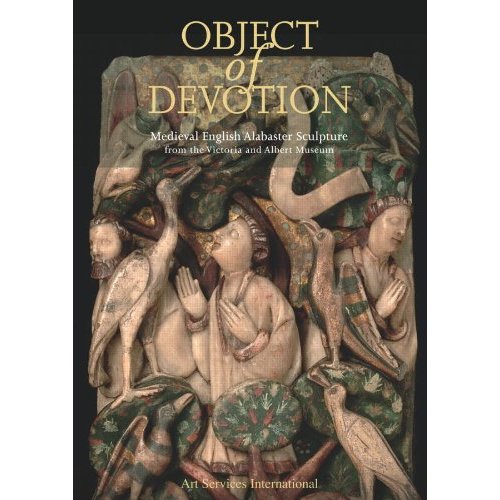
Medieval English Alabaster Sculpture from the Victoria and Albert Museum
Visitors have until February 12 to view an extraordinary exhibit at the Princeton University Art Museum. From around 1350 to 1530 workshops in England produced a vast amount of sculpture in alabaster for both domestic sale and for export all over Europe. It is a remarkable legacy of pre-Reformation English art that has survived the mass destruction of the Catholic images which commenced with the dissolution of the monasteries (and shrines ) in the 1530’s. The pieces in the exhibit are carved stone panels of small to medium size. Some are painted; most have lost any original coloration they once may have had. The pieces range from large sets of images suitable for the altar of a church or chapel to small objects of private household devotion.
It is an extraordinary opportunity to observe this kind of sculpture. For in no way can a photographic image do them justice. The white,soft, semi translucent alabaster – painted or not – positively glows under the astutely disposed and focused lighting of this exhibit. The fine details of the carving and painting are revealed. What would be the appearance of these objects in the “living” light of candles?
The art of the English “alabastermen” may seem strange to us. It is generally expressionistic and remote from the spirit of naturalist observation as found either in the contemporary Renaissance or even in the earlier High Gothic! For example, the risen Christ emerges from the tomb in a veritable explosion with a dramatic outstretched arm and a foot set on a fallen guard. Complex narratives or theological programs are compressed within the boundaries of a single small panel. Scholars at times detect the influence of contemporary passion plays. Certain sculptures, however, show that notions of form derived from Flanders or even the Italian Renaissance were already making their presence felt before production ceased.
The English alabaster workshops did make sophisticated objects for wealthy patrons or for churches. Yet much of their vast output was the production of standardized images for much more modest purchasers. As a founder of the study of these images pointed out, the English alabaster sculptures represent an authentic, popular religious art. In a number of respects this art is the equivalent of that of the icon-painters of the East. If we view it as such, its achievements compare very favorably with the products of that tradition. Moreover, these surviving fragments of a great tradition also give us an idea of the scale of the artistic heritage destroyed in England between 1534 and 1660
There is a fine catalogue obtainable from Amazon(see above). The exhibit itself provides ample commentary – different from that of the catalogue and here and there also more noticeably PC.
Published in Events | no comment
27
Jan

I ask your prayers for Monsignor Ignacio Barreiro who is seriously ill and has had to undergo an operation. I have known Monsignor Barreiro since 1982. He has been for many years a tireless advocate in Rome of both the Traditional liturgy and the pro-life movement. He recently spoke at our conference in Norwalk last September (see above).
Published in Uncategorized | no comment
23
Jan
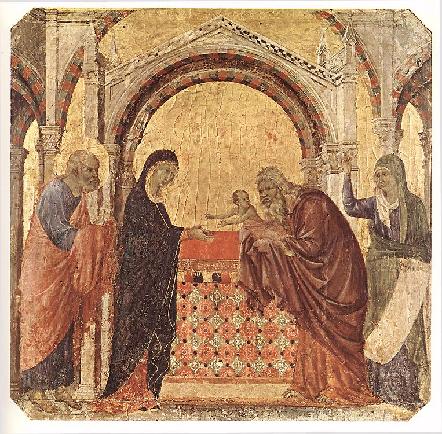
The Feast of the Purification of the Blessed Virgin Mary (Candlemas)
Blessing of Candles, Procession, & Solemn Mass
(Missale Romanum of 1962)
Thursday, 2 February 2012, 7:00 p.m. at St. Mary’s Church, Norwalk CT
Music: Prelude: Plein Jeu (Premième livre d’orgue) (Louis Marchand, 1669-1732)
At the blessing of candles: Lumen ad revelationem gentium (plainsong, mode viii)
At the procession: Adorna thalamum (plainsong, mode vi), etc.
Messe de Nostre Dame (Guillaume de Machaut, c.1300-1377)
Gregorian Mass of Candlemas: Suscepimus, Deus
Hymn at the Offertory: Ave maris stella (plainsong, mode i) [Student Schola]
Motet at the Communion: O quam glorifica (Trent Codex 87)
Postlude: Basse du Trompette (Cinquième livre d’orgue) (Marchand)
Also:
Solemn Mass at 6pm at the Church of the Holy Innocents (West 37th and Broadway, New York).
The Mass will be preceded by the solemn blessing and distribution of candles and the procession inside the church
Published in Masses | no comment
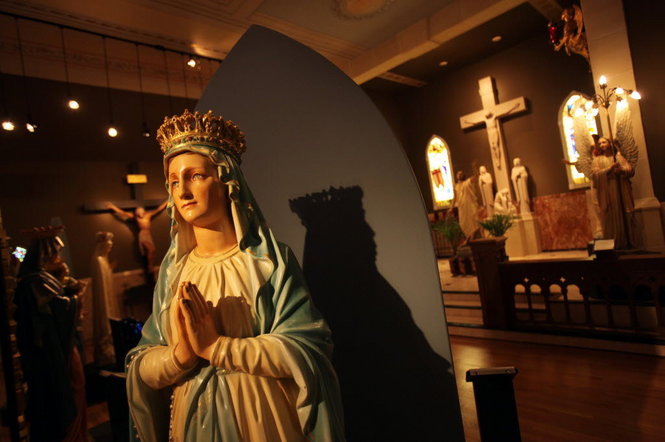
Photo: Gus Chan, Plain Dealer
Truly things in the Church get more and more bizarre! Today Bishop Lennon of Cleveland presented an apologia of the financial results of his closing of 50 parishes in the Cleveland diocese: the disposition of the properties and monies. (http://blog.cleveland.com/metro/2012/01/cleveland_catholic_diocese_sha.html) But it was the location of the bishop’s news conference that was truly startling: a “decommissioned” Catholic parish, St. Hedwig, that now functions as a museum of Catholic art from terminated Cleveland parishes. This is the unique “Museum of Divine Statues.” (http://museumofdivinestatues.com/html/mission.html)
The Museum of Divine Statues was created to restore and care for art from destroyed Catholic churches. The museum’s resident restoration artist, Louis McClung, restores each statue to its former splendor. MCclung’s own position regarding recent aesthetic and liturgical developments in Catholicism is clear:
“Lou McClung can’t forgive the Catholic Church for the 1960s. During those turbulent years the Vatican approved sweeping changes to make Catholicism look modern. “They took away the Communion rails, they painted over the murals on the walls, they threw the statues in the garbage,” said Lou.” (http://www.roadsideamerica.com/story/25798)
When he heard the diocese was closing more than forty churches, McClung sprang into action, obtained the right to one of the closed parishes, scrapped its 1970’s conciliar decor and founded the museum.The saved art is then displayed in a “contemplative atmosphere.” The Museum is intended to honor the contributions of artists and the religious context of their art. And to preserve these works for another generation Truly an admirable mission! But it is a Twilight-zone event that the ordinary of the diocese then holds a news conference in said museum celebrating his dissipation of Cleveland’s treasures. Indeed, many objects of art from closed Cleveland churches are available for purchase from the approved diocesan vendor:http://www.church-inventory.com/index.php
See this amazing gallery, at times depressing, at times outrageous, by Gus Chan of the Plain Dealer: . http://photos.cleveland.com/plain-dealer/2011/11/lou_mcclungs_museum_of_divine_10.html
Published in Essays | 2 comments
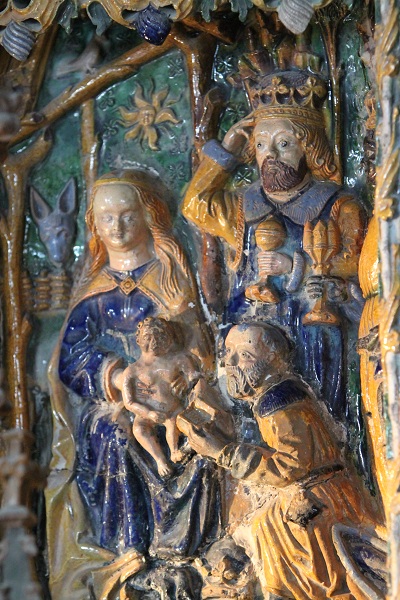
From a ceramic stove in Salzburg Castle.
The following Traditional Masses will be celebrated for the Feast of the Epiphany:
Friday, January 6:
Connecticut
St. Peter’s, 160 Main Street, Hartford, 6:30 PM
St. Mary’s, Norwalk, Solemn High Mass at 7:30 p.m.
Missa Cunctipotens Genitor Deus (Vatican Gradual, Mass IV)
Gregorian Mass of the Epiphany: Ecce advenit
Offertory: Reges Tharsis (plainsong, mode v, with verses)
Hymn at the Communion: Hodie nobis beata illuxit (plainsong, mode i)
Saint Gabriel, Stamford, Solemn High Mass at 7:30 PM.
Mozart’s Missa Brevis in C (“Sparrow Mass”) and the Gregorian Propers. A light reception will follow in the Parish Hall.
New York
Church of the Holy Innocents, Manhattan, Solemn Mass, 6 pm
Sunday January 8:
Saint Gabriel, Stamford, Solemn Vespers and Benediction of the Blessed Sacrament at 4 PM. Followed by wine and cheese in the Parish Hall
.
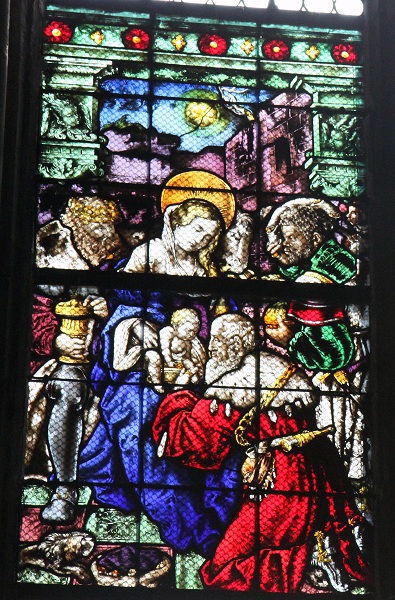
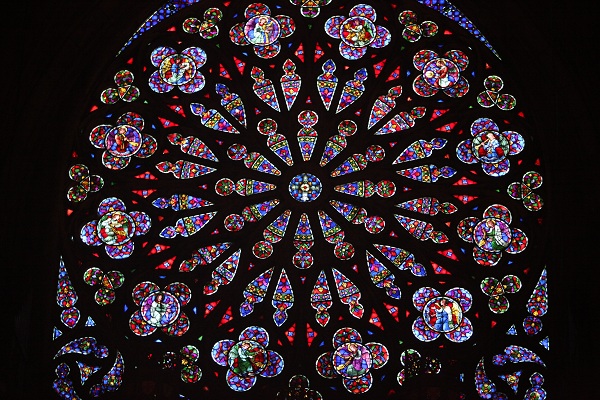
Window in Freiburg Cathedral ( circa 1520)
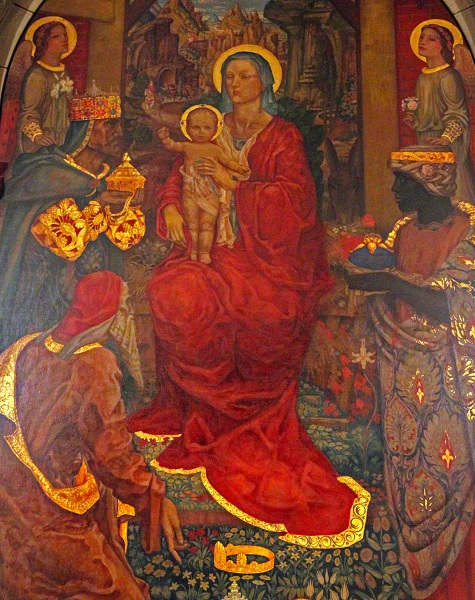
St. Bartholomew, New York.
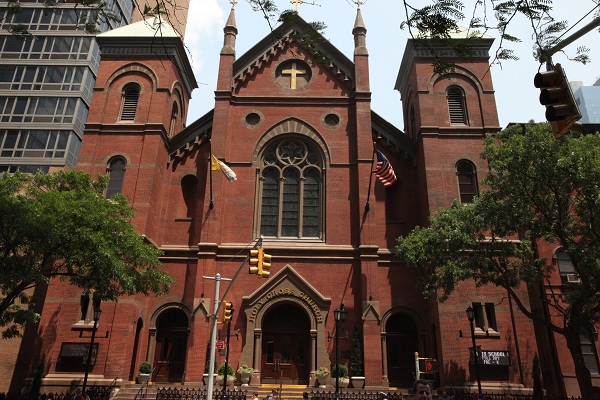
Holy Cross Church
329 West 42nd Street
New York has always been a center of change – “demographic” and otherwise. But few areas of Manhattan have undergone as dramatic a transformation as West 42nd Street. 30 years ago this was a virtual “no-go” zone highlighted by drug dealing, the sex trade (movies, peep shows, prostitution) of 42nd street and the then infamous Port Authority bus terminal. Now luxury apartments continue to rise throughout the area and 42nd Street has otherwise been converted into a kind of family Disneyworld attraction. Through the midst of it all has remained Holy Cross parish, one of the legendary churches of New York City. And of course the parish history stretches back to a much earlier era…
Holy Cross parish was founded in 1852 by Archbishop Hughes in what at the time was on the outskirts of the developed area of New York. It was part of a first dramatic expansion of the number of New York parishes directed by Archbishop Hughes in response to the massive increase in the Catholic population of the city. 1) Considering this parish’s later history, it is amusing that the first pastor seems to have been German, Fr, Joseph Lutz. The original church was largely destroyed by fire after a lightning strike in 1867 – what we see today is the result of a total rebuilding completed in 1870. Some elements of the decoration – such as the main painting of the crucifixion – were carried over from the earlier sanctuary. As always, John Gilmary Shea gives us a full account of the 1870 dedication including the solemn High mass and the music: “a fine rendition of Haydn’s first mass.” 2) In 1885, the church was extended by 25 feet with an apse that contains a circular sanctuary with semi-dome, lighted by nine windows in the upper part. 3)
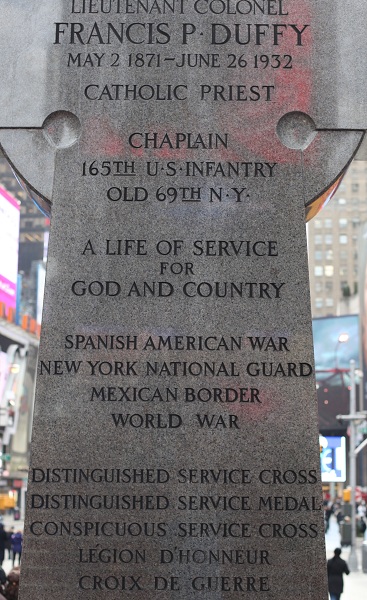
In the second half of the 19th century Holy Cross became one of the archetypal Irish parishes in New York City. As was usual in that day, Holy Cross parish built up a wide variety of other initiatives. But the parish achieved citywide and even national celebrity when Fr. Francis P. Duffy was appointed pastor in 1921. Fr. Duffy was both a scholar (he had attempted to invigorate intellectual life at Dunwoodie seminary) and a dynamic leader. He then became a national figure as a chaplain “over there” in World War I. You may remember: the “Fighting 69th” of New York (the original ‘Fighting Irish”), “Wild Bill” Donovan, Joyce Kilmer, James Cagney, Pat O’Brien (the latter two in the 1940 film). 42nd Street had by then become the center of the New York entertainment world. Fr Duffy forged all kinds of interesting ties with the entertainment and sports worlds. Under Fr. Duffy’s successor, Msgr Joseph A. McCaffrey, the fame of Holy Cross continued to expand beyond the parish boundaries. For example, 22,000 attended Monday night Novena services.
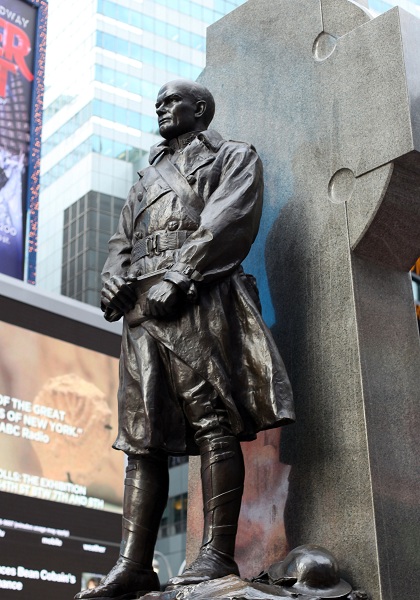
Fr. Duffy: “Lt. Colonel, Catholic Priest.” His successor at Holy Cross, Fr. McCaffrey, organized this monument. Mayor LaGuardia dedicated it and “Duffy Square” at Broadway and West 47th Street in 1937.
From these glory days there followed a dreadful decline. Most of the original parish population fled in the 1960’s and 1970’s. West 42nd Street became a feared center of crime and sleaze. One post -1968 pastor was overwhelmed by the problems confronting this parish and had to be relieved. Another was mugged on the steps of his rectory. The activities of Holy Cross tended to concentrate more and more on poor relief (homeless shelters, food pantries) or care of the elderly ( if we may call bingo such). As we have noted, however, recent years have seen dramatic changes in the neighborhood and the parish. The current pastor, Msgr Colapietro, has navigated this resurrection culminating in multi-million dollar renovation of the interior. We should add the parochial school of Holy Cross – on West 43rd Street – has also remained active since 1852. 4)
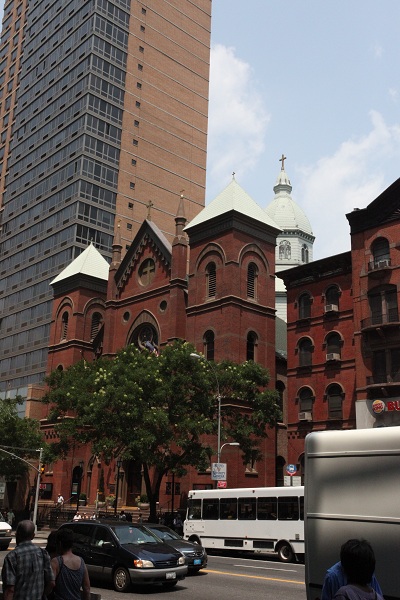
Today Holy Cross presides over a relatively tranquil area of 42nd Street between Eighth and Ninth Avenues, not yet engulfed by the storm of tourism further east. Indeed it is the oldest building on the entire street. The plain but impressive brick façade in an indeterminate style – part Gothic, part Romanesque – does strike a somewhat defiant, belligerent note. Upon entering the visitor encounters a narthex featuring, unusually, stained glass windows. In the rear, on the right as one enters is a magnificent crucifix. A very common feature of older churches, it relates to the previously popular indulgenced prayer. The corpus was swiped but recovered several years ago – despite appearances, this neighborhood is not yet totally “out of the woods”…
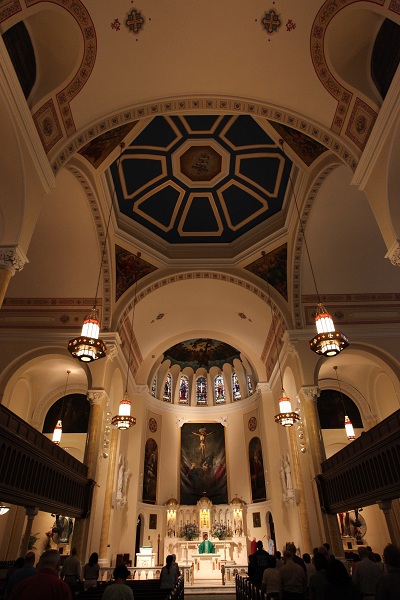
Only gradually does one realize that this church – with its dome and renaissance forms – is intended to be not a standard neo – gothic sanctuary of the era but to evoke baroque Italian churches. The white color scheme of the sanctuary, the dome and the stone altars all serve to focus attention on the altar. All this is very deliberate- one can read in the parish’s website an elaborate description of the interior written at the time of the completion in 1886 of the new extension and sanctuary. It shows the care taken with every detail of decoration, color and architecture – each of which has meaning.5) Despite their often limited financial resources, Victorian era parish churches show a wealth of invention and sophisticated detail that may surprise a visitor used to the tales concerning dark ages of the past. Some elements of the decoration are very fine, like the altars and some of the windows. The mosaics below the dome are ascribed to Louis Comfort Tiffany.6)
The parish’s recent renovation has certainly cleared up the damage that had accumulated over the years. But going beyond removal of damage, an attempt was made to recreate the original Victorian –era decorative scheme. The magnificent new paint job brightens the interior. Some of the worst aspects of the post-conciliar renovations – such as the side tabernacle – have been eliminated. Various statues and shrines such as older New York churches accumulate over the years have been tidied up and side altars restored. So, in most respects a sincere attempt has been made to recreate the original appearance. But as usual in such restorations, there is one glaring difference compared to the past – the “people’s altar” (as it is known in Germany) is now made permanent and also rendered in stone. Holy Cross may never have been one of the most beautiful churches in New York – even Shea uses terms like “massive,” ”imposing” and “spacious” – but it certainly is one of the most impressive.
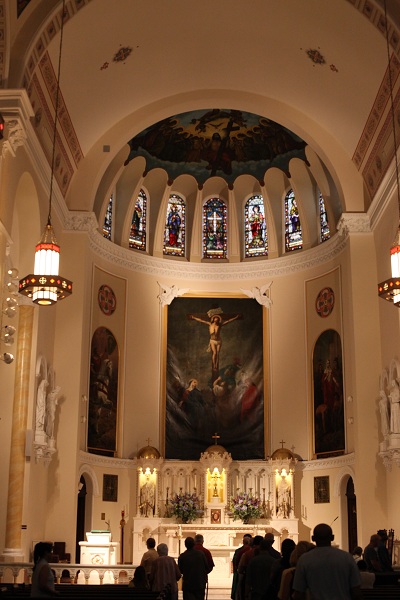
The restored interior.
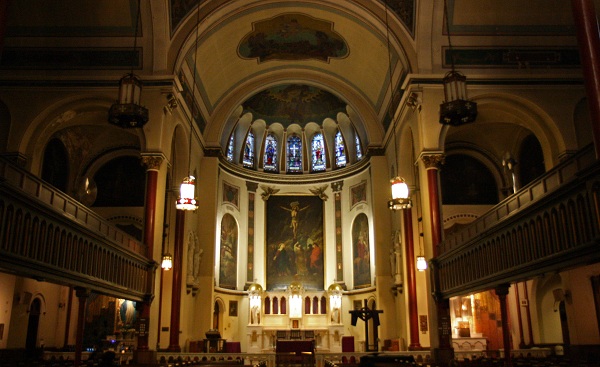
The interior in unrestored condition.

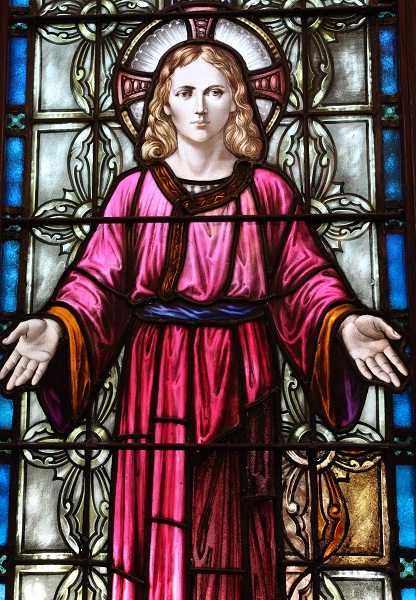
The windows are by Mayer of Munich.

This painting survived the destruction of the first church.
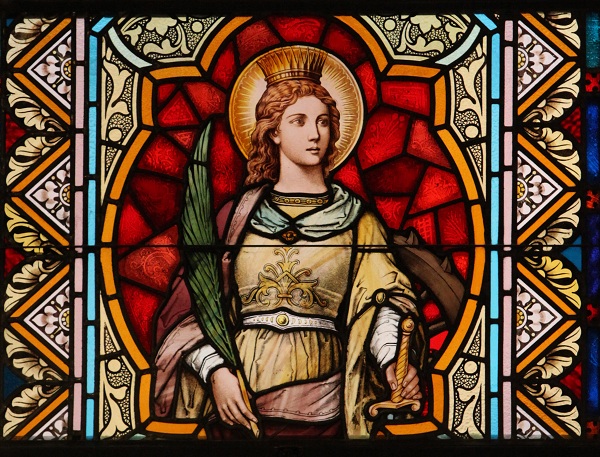
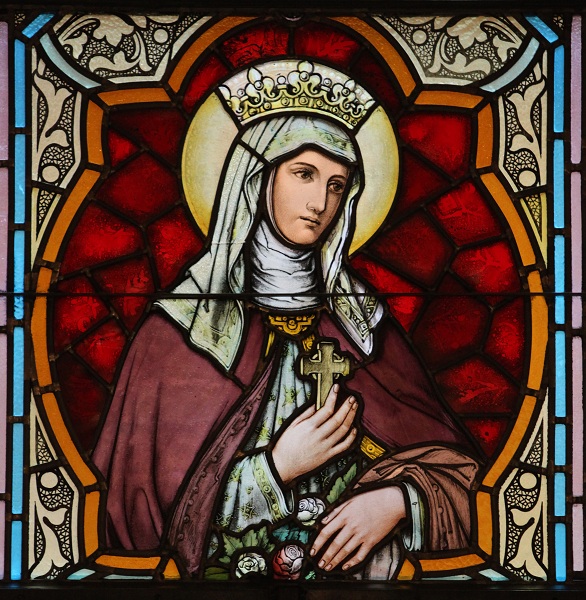
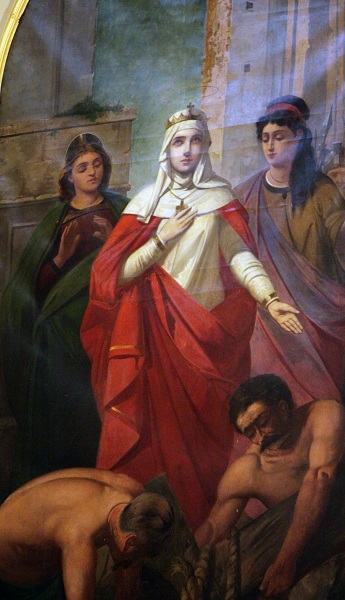
St Helena.

A unique and practical design; as you take holy water a gentle reminder to contribute.

The dome: mosaics by L. C. Tiffany?
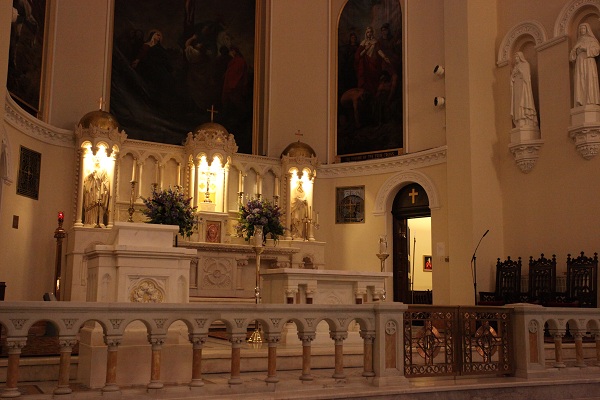
The restored sanctuary.
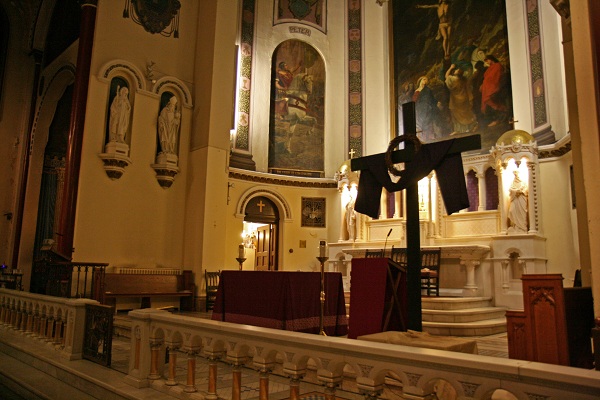
The unrestored sanctuary.
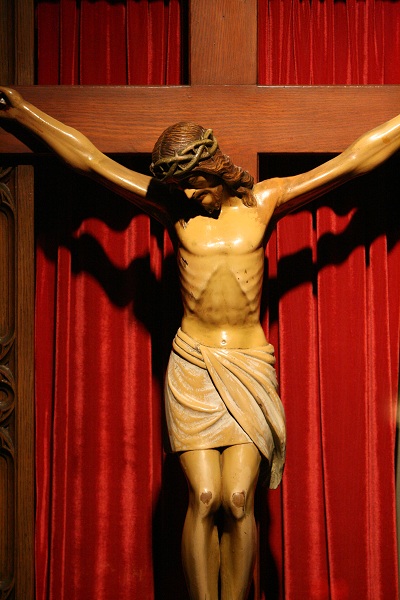
The crucifix, stolen and recovered.
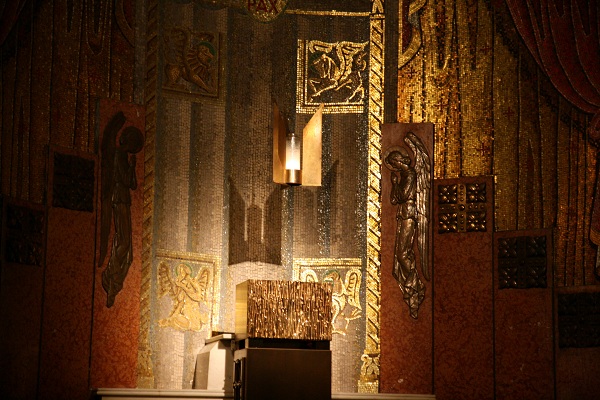
The previous 1960’s style “conciliar” tabernacle.
Perhaps the message of Holy Cross, its long history and restoration is this: The Church is here to stay, through thick and thin. It isn’t like the case of a Protestant meeting house or a synagogue: when their congregations move the buildings that housed them are sold or abandoned. That has never been the case with a Catholic house of God. Holy Cross has continues to exist and has ministered to totally different communities and in the most diverse economic situations imaginable. Some more of that spirit of the “Fighting Irish” exemplified by this parish would do the Church well in this day and age. As the then pastor, Fr. McCarthy preached at the dedication of this church in 1870, speaking of the congregation:
“They had had many trials and many difficulties to surmount but with the blessing of God they surmounted them and the brilliant result was there visible to all.”7)
1) Shea, John Gilmary, The Catholic Churches of New York City 326-327(Lawrence G. Goulding, New York, 1878)
2) Shea, op. cit. at 331.
3) http://www.nycago.org/Organs/NYC/html/HolyCross.html
4) All this and much more can be found in the parish’s very ample and informative website. http://www.holycrossnyc.com/index.cfm?load=page&page=167
5) http://www.holycrossnyc.com/index.cfm?load=page&page=164
6) http://en.wikipedia.org/wiki/Holy_Cross_Church_(New_York_City)
7) Shea, op. cit. at 332.
Published in The Churches of New York | 1 comment
Churches of New York
Holy Roman Empire
Website Highlights
Archives
[powr-hit-counter label="2775648"]