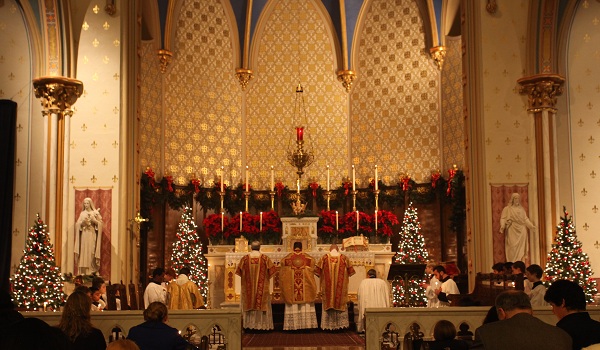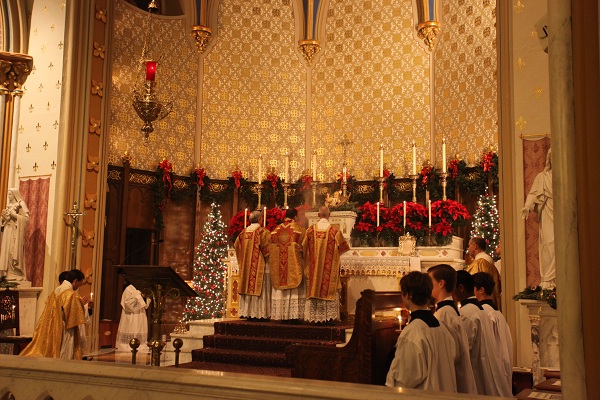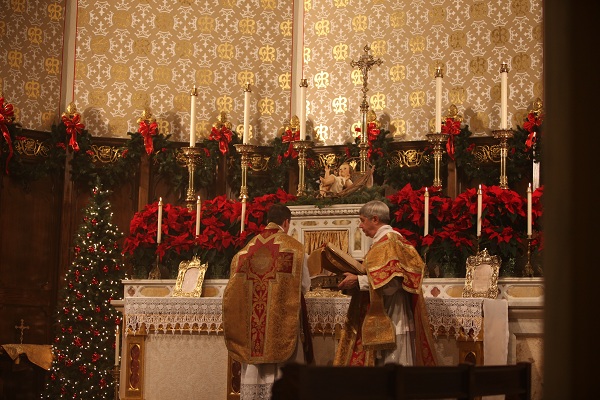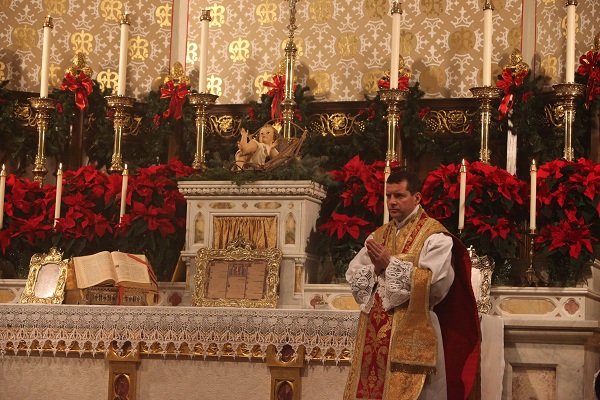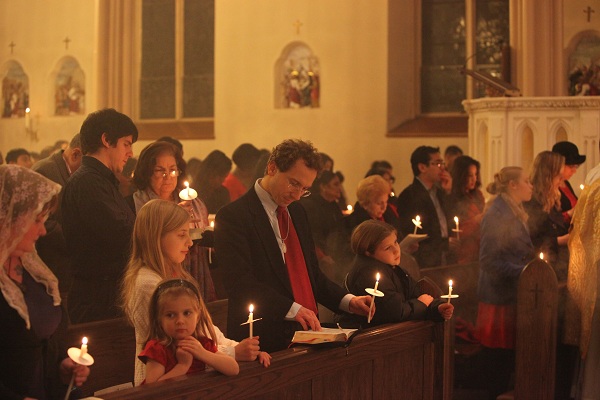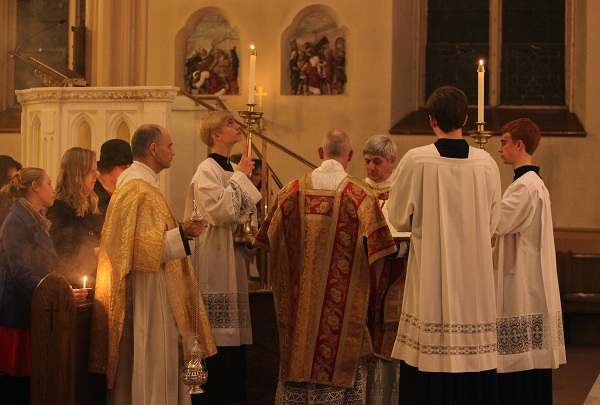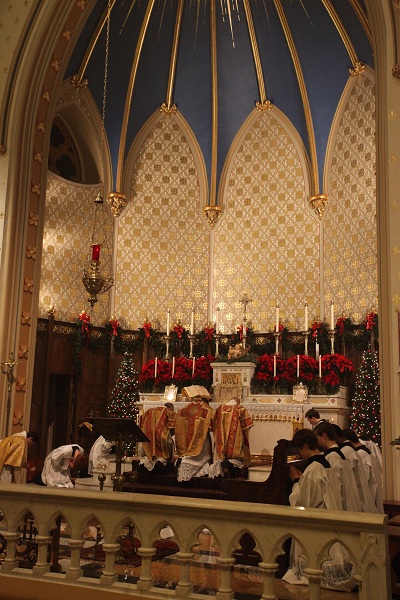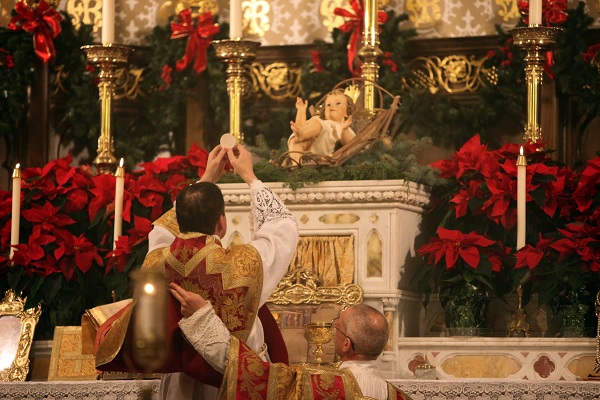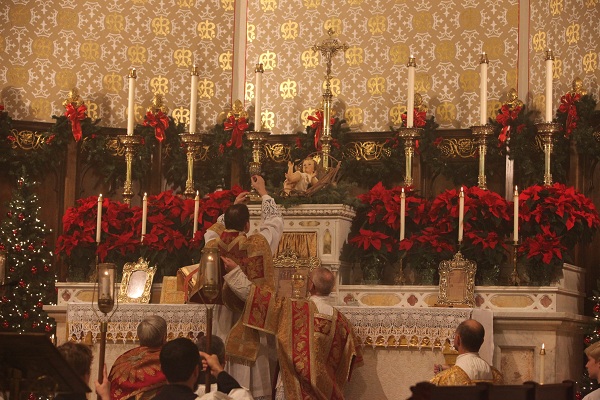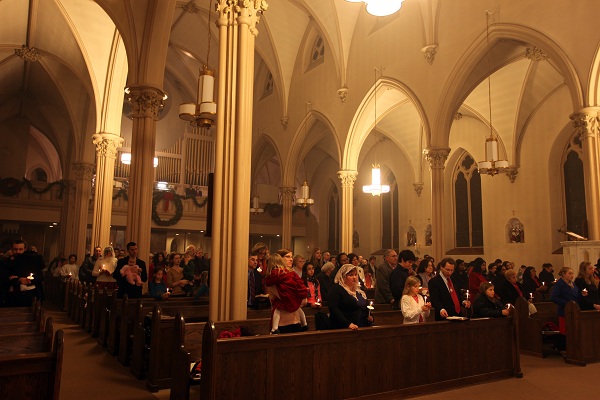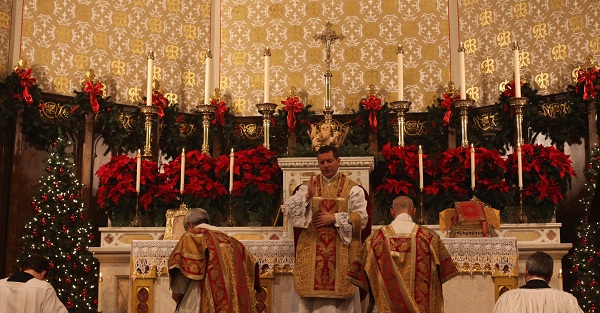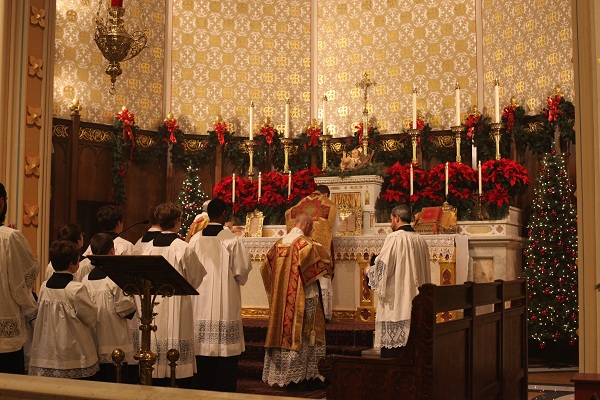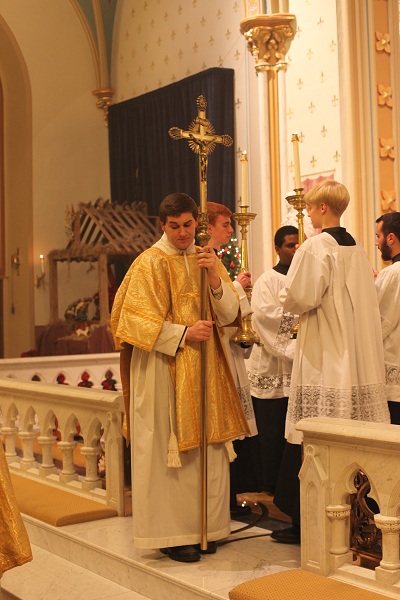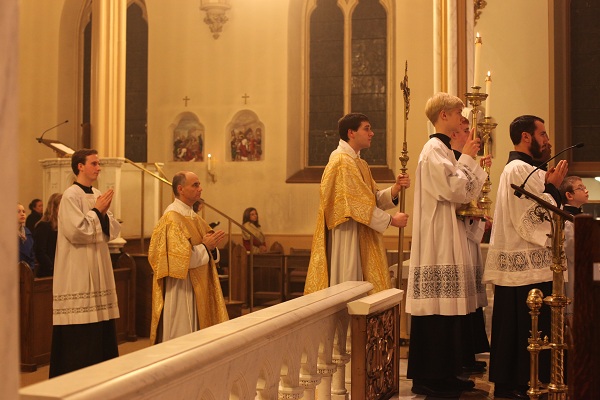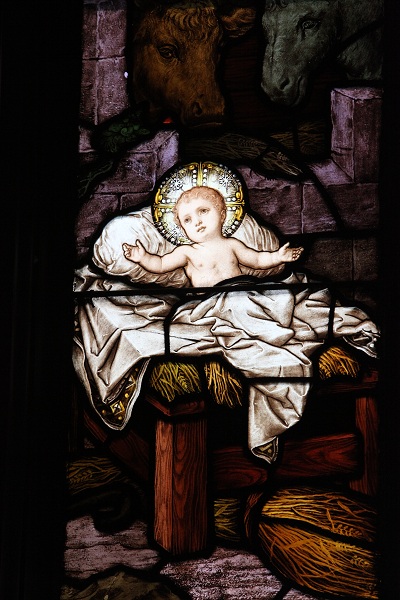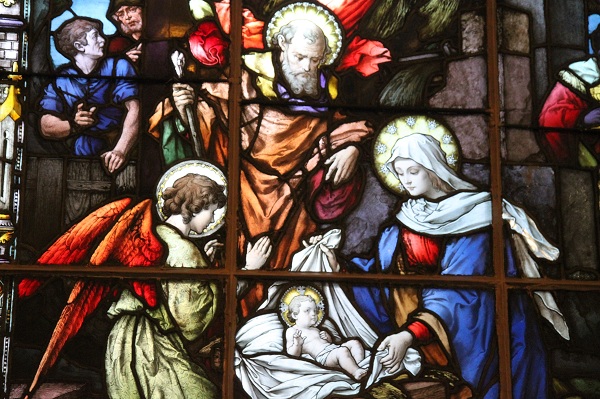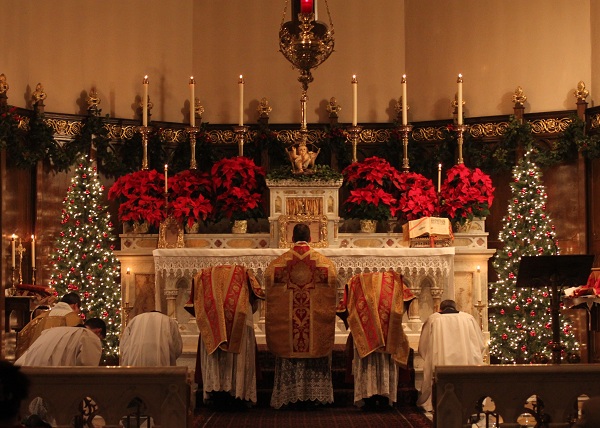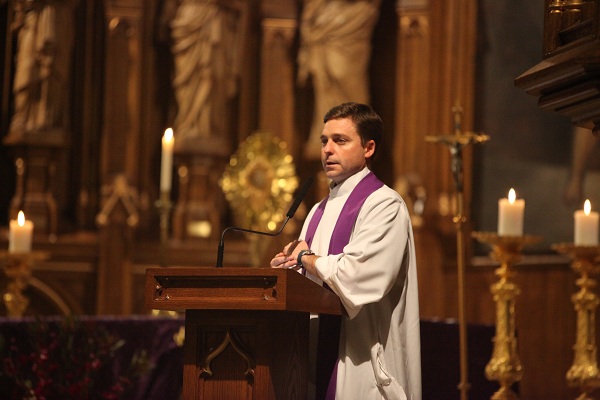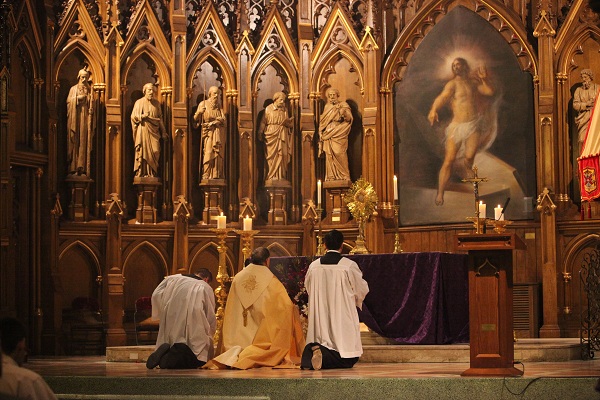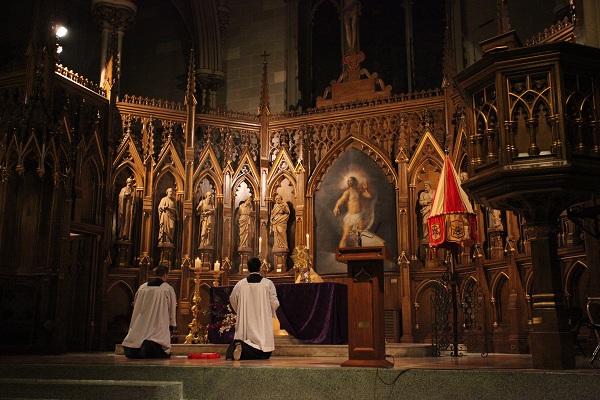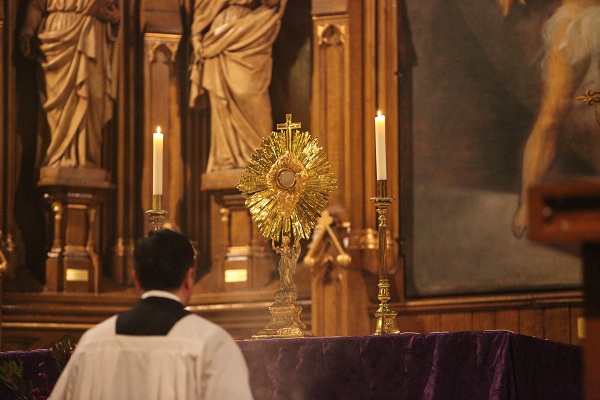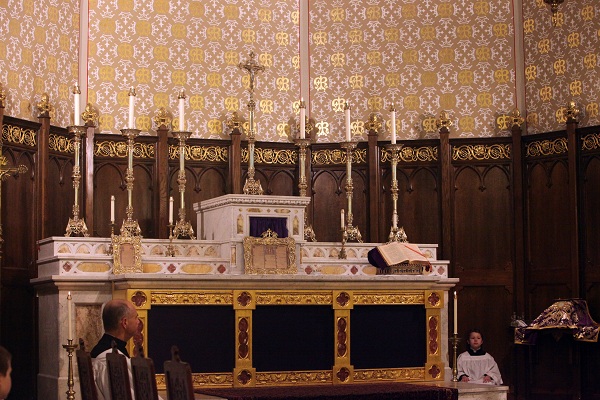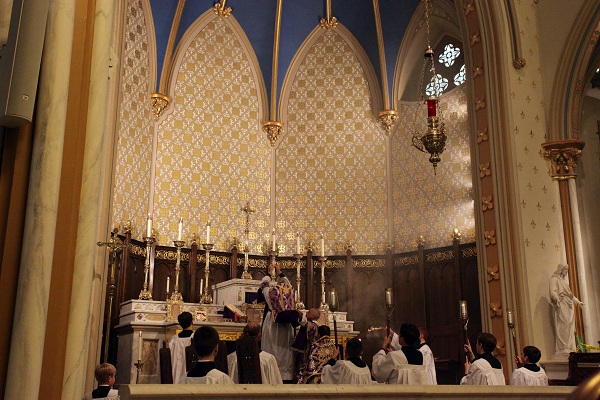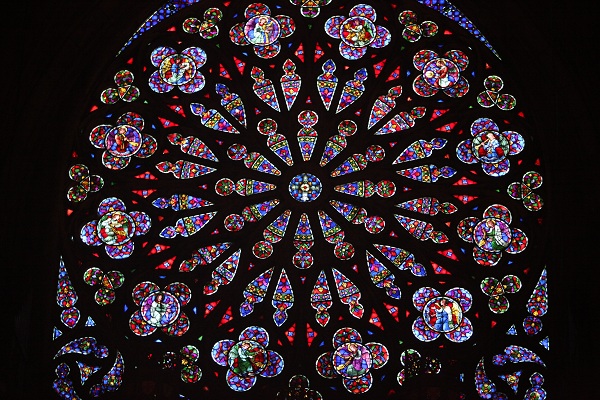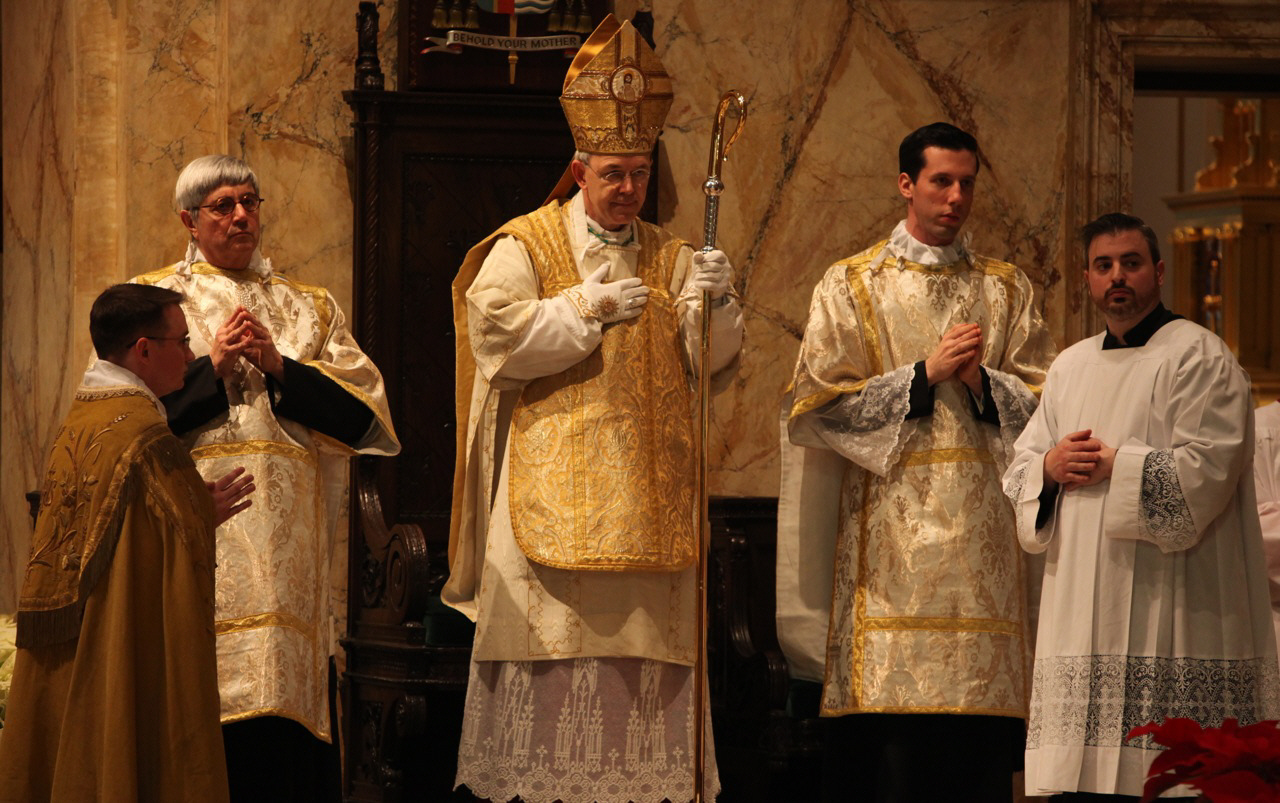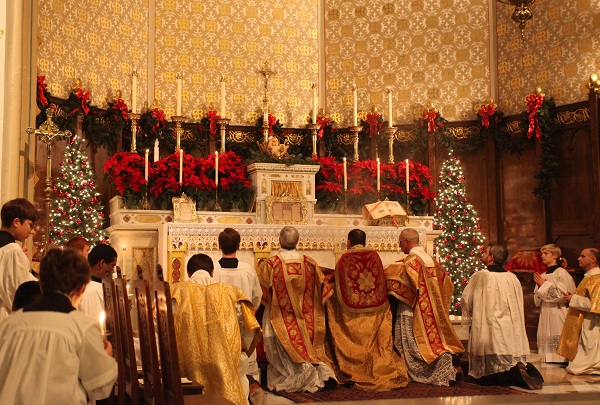
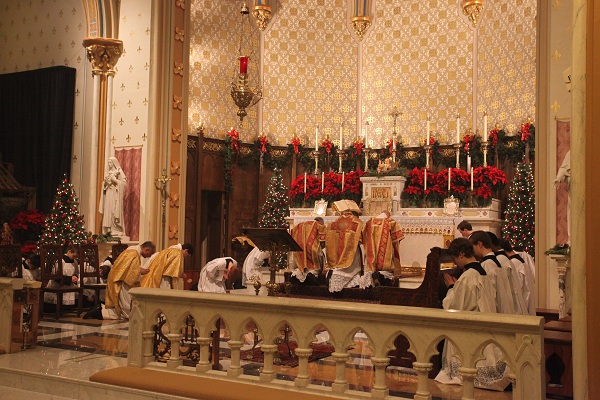
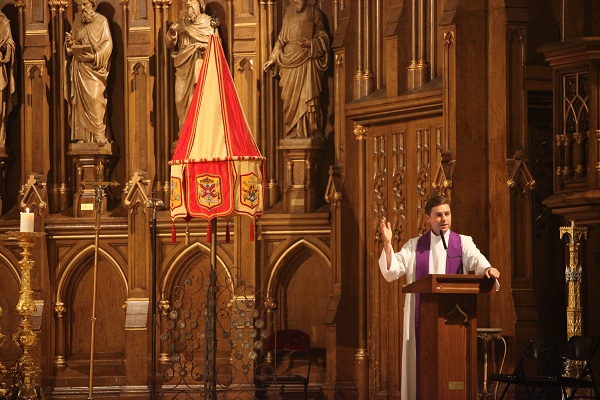
Midnight Mass at St. Mary’s Norwalk – in the newly repainted sanctuary.

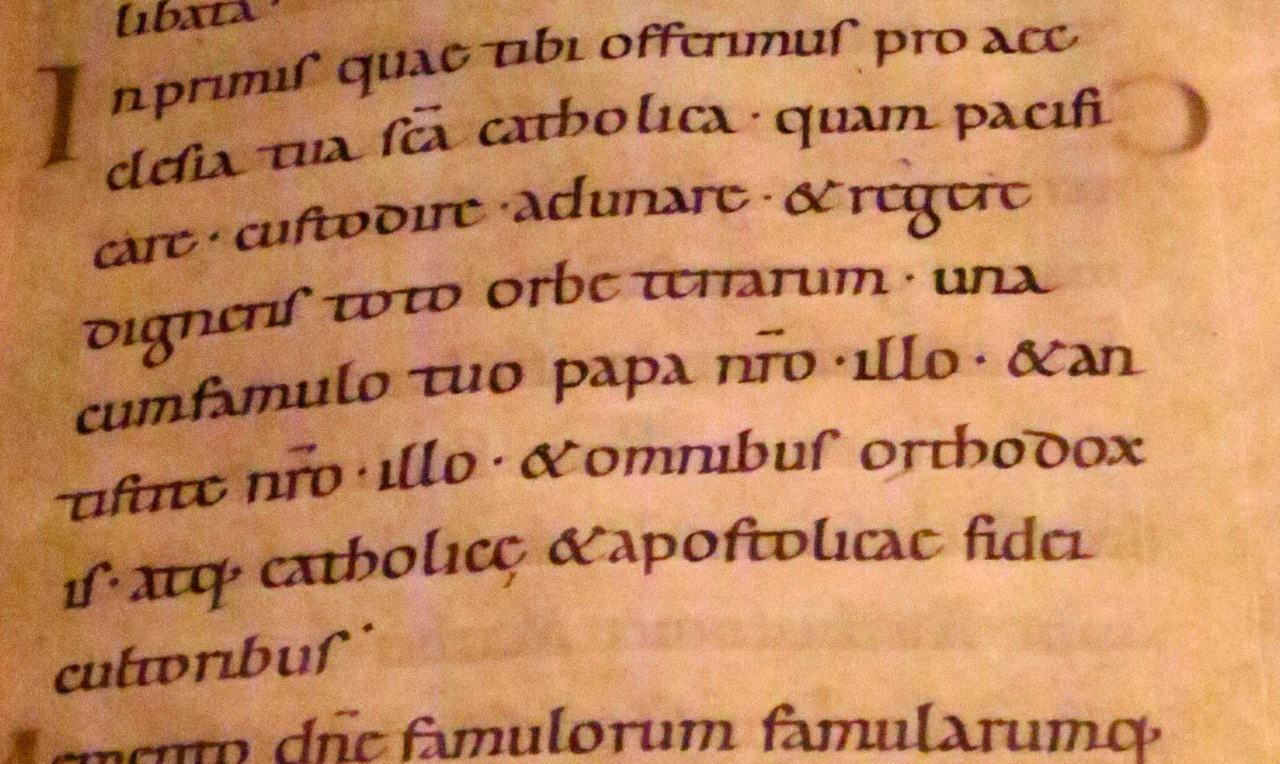
“Anno a creatione mundi…” (Precentor: Bill Riccio)
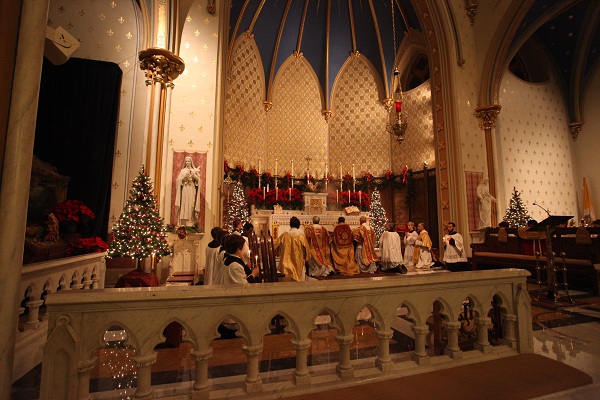
The Gospel.
Homily given in Spanish and English by Fr. Greg Markey, pastor.
23
Dec
Merry Christmas to all our Readers! Our annual schedule of Christmas masses witnesses to the steady progress the Traditional liturgy has made in the “tristate area” in the 4 years since the publication of Summorum Pontificum. in December 2007 9 churches were reported to us as offering the traditional liturgy at Christmas (CT and NY only); in 2010 it was 18 and this year 21 at last count. Moreover, I believe we have not captured every mass in this area. And this number does not tell the whole story. In 2007 we reported no Traditional Midnight Masses; in 2011 there are 5. In 2007 not one solemn high mass was listed; in 2011 four churches are celebrating 5 such liturgies. One church celebrates all three masses for Christmas; another has Christmas vespers. We should be grateful for this renaissance of the Traditional Mass – but we should also recognize that so much more remains to be done. We look forward to the day when every parish celebrates such a mass at this time – and several Traditional parishes are functioning in Manhattan itself!
15
Dec
The following churches will offer the Traditional Mass during the Christmas season. Please notify us if you know of a Mass that is not on our list.
Connecticut
St. Peter’s, Hartford
Christmas Day, 7:30 am, low Mass.
St. Mary Church, Norwalk
Christmas, Midnight Mass, 12 midnight, carols and organ meditations begin at 11:30, Missa Quaeramus cum pastoribus (Morales)
Christmas Day, 9:30 am, Missa dies Sanctificatus (Palestrina)
January 1, 9:30 am, Missa Puer qui natus est nobis (Guerrero)
Basilica of St. John the Evangelist, Stamford
Christmas Day, 8:30 am
SS. Cyril and Methodius, Bridgeport
Christmas Day 10:15
Jan. 1, 10:15
St. Stanislaus, New Haven
Christmas Day, 2 pm, High Mass
January 1, 2 pm, Low Mass
Church of Christ the King, Old Lyme
Christmas Day, 12 noon
St. Margaret’s Church, Willow St, Waterbury
Christmas, Midnight Mass
Christmas Day, 10:30 am
St. Martha Church, Enfield
Christmas Midnight Mass
Christmas Day, 12 pm
New York
Our Lady of Mount Carmel, 627 East 187th Street, Bronx
Christmas Day, 8:30 am
Our Lady of Peace Church, Carroll Street, Brooklyn
Christmas Day, 9:30 am.
Holy Innocents, 128 West 37th Street, Manhattan
Midnight Mass, 12 Midnight, Solemn Mass (followed by reception!)
Christmas Day, 10 am, Missa Cantata; 3 pm, Sung Vespers
Our Saviour Church, Manhattan
Christmas Day,9 am Missa Cantata
St. Agnes Church, Manhattan
Christmas Day,11 am, Solemn High Mass, Missa Ego flos campi (Padilla); motet Hodie Christus natus est (Giovanni Gabrieli)
Our Lady of Mt.Carmel, 456 E. 116th St., Manhattan
Christmas Day, 10 am
Jan. 1, 10 am
Immaculate Conception Church, Sleepy Hollow
Christmas Day, 3 pm, Sung Mass
Directions: www.unavocewestchester.org
St. Eugene, Tuckahoe Rd. and Central Park Avenue, Yonkers
Christmas Day, 10:45 am.
St. Matthew Church, Dix Hills
Christmas Day, 9am
St. Ladislaus, Hempstead, Long Island
Christmas Day, 9am, Missa Cantata
New Jersey
Our Lady of Victories Church, Harrington Park,
Christmas Eve, 9 pm, Missa Cantata
Christmas Day, 8:15 am, Low Mass
Holy Rosary, 344 6th St, Jersey City
Christmas Day, 10am, Missa Cantata
Music by Lotti, Victoria & Saint Saens
January 1, 9:45am (new Sunday time)
Our Lady of Fatima Chapel (F.S.S.P.), 32 West Franklin Avenue, Pequannock
Christmas Eve: 11:00 p.m. to 12:00 a.m. Confessions, 11:00 p.m. Christmas carols
Midnight Mass, 12 midnight
7:00 am, 9:00 am, 11:00 am (High Mass)
Directions: http://www.olfchapel.org/
St. Anthony of Padua Oratory (I.C.R.S.S.), 1360 Pleasant Valley Way, W. Orange
Christmas Eve: 9:30 pm Confessions; 10:30 pm Traditional Christmas Carols
11:00 p.m. Solemn High Mass (First Mass of Christmas)
Christmas Day: 7:30 am Low Mass (Second Mass of Christmas); 9:00 am Low Mass (Second Mass of Christmas); 11:00 am High Mass (Third Mass of Christmas)
Diredtions: http://www.institute-christ-king.org/westorange/
15
Dec
St. Mary’s Church, Norwalk will hold its annual service of Advent Lessons & Carols tomorrow night, Friday, 16 December 2011, 7:00 p.m.
The service will feature The St. Mary’s Choir, El Coro Hispano de Santa María and The St. Mary’s Student Schola.
On the program are traditional carols from England, Spain & Germany; motets of Victoria, Vaughan Williams & Vierne; organ music of Bach, Karg-Elert & Langlais; & Gregorian chants of Advent.
Seven readings from Sacred Scripture & the writings of the saints on the Advent of Our Lord will be interspersed with carols, chants, hymns & organ music of the season, concluding with Benediction of the Most Blessed Sacrament.
A festive reception will follow.
St. Gregory the Great, 138 West 90th Street
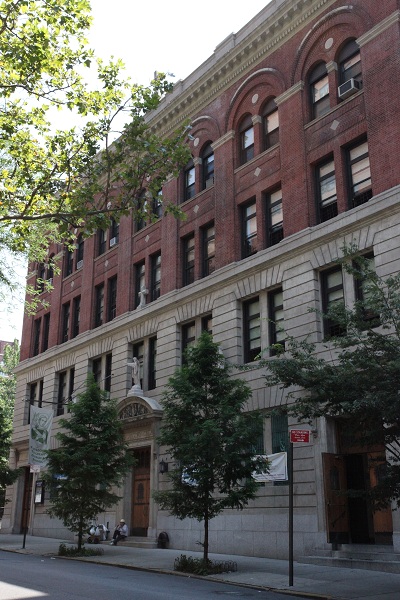
A visitor to the parish of St. Gregory approaches on a pleasant side street of the Upper West Side. Before him stands a typical parochial school like so many others dating from around 1900 to 1939 – four stories, all red brick and white stone facing. It may take a second before he realizes something is missing. There is no church. For where the parish worships is the first floor of the parochial school. The rectory is on the fourth floor.
Now in this day and age this must seem very strange. For nowadays it is the parochial schools that seem the expendable element. Famous parochial schools in Manhattan – like St. Peter’s and St. Ann’s – had been closed as early as 1940 when the surrounding area had become commercial. And capping an unending string of closures of the last few decades was the demise earlier this year of the schools of such ancient parishes as Old St Patrick’s cathedral and St. James. In Brooklyn the recent wave of closures has been even more dramatic.
But in an earlier age (say before 1962) it was often the other way around. For, from the time of Archbishop Hughes, the parochial school was the key means of preserving the faith. It was not at all uncommon for situations like St Gregory’s to exist; first build the school, and then, when resources permitted, a magnificent church. So to mention just one well known example from Brooklyn, the prominent parish of St. Anselm in Bay Ridge opened its school in the 1927 but built its church only in the 1950’s. In such cases mass would be celebrated in the gymnasium or school hall. (In the “good old days,” given the magnitude of the Sunday congregations that had to be accommodated, that practice might continue even after the erection of the parish church!).
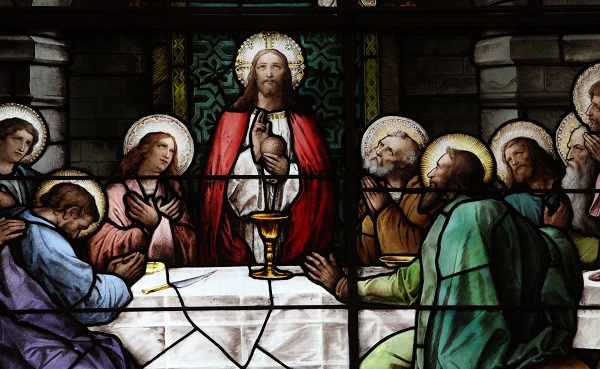
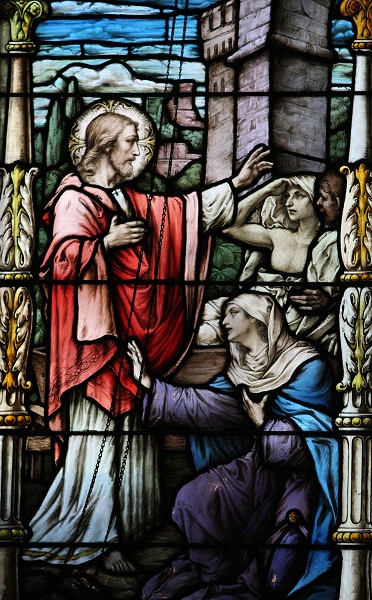
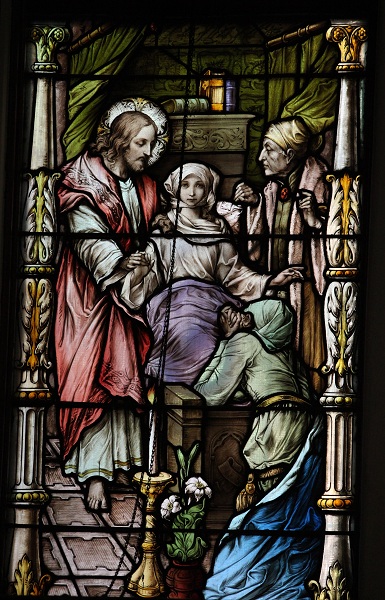
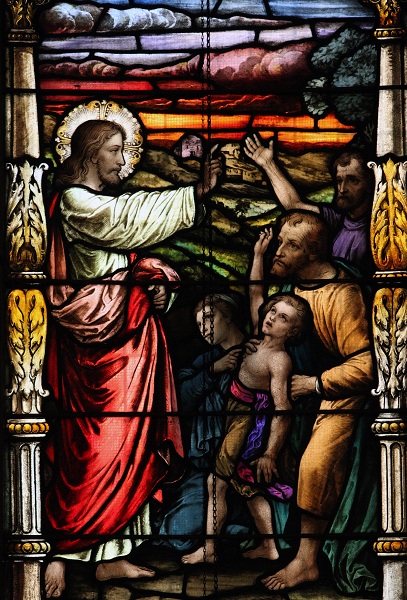
St. Gregory the Great parish was erected in 1907. The parish school, built in 1913, also housed the church (it was thought only temporarily). (1) The church, as a “worship space,” is unique; a long low-ceilinged space encircled a band of stained glass windows and frescos all around the walls. If the proportions of certain furnishings seem a bit odd it may be because some of the decorative elements are alleged to have been salvaged from other demolished sanctuaries. Indeed, some of the glass and paintings are both unusual in subject matter and of a very high quality. Does a beautiful series of windows on the miracles of Christ come from the chapel of a hospital? Traditionalists should also consider paying a visit just to see the frescoes, painted (by a priest of St. Gregory’s) in the 1920’s and 30’s , on the life of St. Gregory the Great – the main codifier of the Traditional liturgy and music. (2)
Now the second pastor, Father William Hughes, was a very interesting character indeed. He installed the rectory on the fourth floor and launched all kinds of renovations. He also lead a very active social and intellectual apostolate, giving the parish much more notoriety in its day than many of it sisters. The very informative parish website recalls some of the colorful events of that era: the procession of the school children over to the statue of Joan of Arc on Riverside Drive in 1920 to celebrate her canonization that year; the semi – secret marriage of Babe Ruth at St. Gregory’s in 1929 (when each altar boy received an autographed baseball). When Fr. Hughes died in 1929 the parish was left encumbered by debt, as was so often the legacy of activist pastors in New York. (3)
In the mid 1980’s I was privileged to visit the rectory erected by Fr. Hughes on the fourth floor of the school. It was furnished with the most wonderful collection of artifacts mostly in the Spanish colonial style. In the course of time, as might be expected, a legend arose – at least among the clergy of St. Gregory’s: that so much money had been spent on furnishing the rectory that the church could not be built. Later in that decade the contents of the rectory were appraised – it turned out that it was mostly junk….

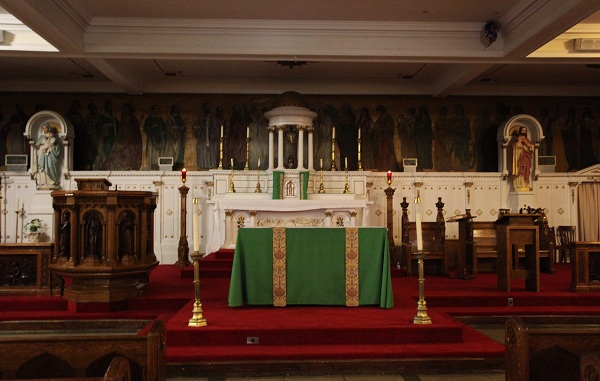
The council and its aftermath have not left St. Gregory’s sanctuary untouched.

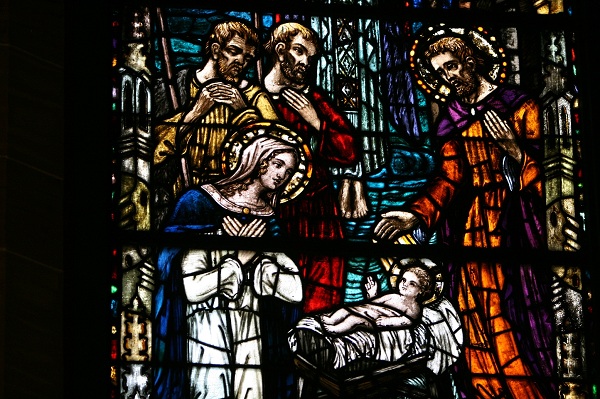
A series of striking windows depicting miracles of Christ.
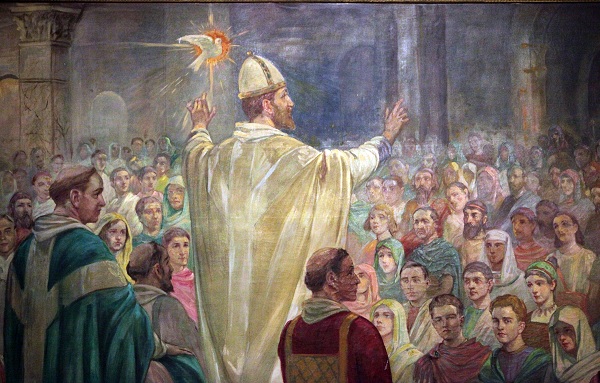
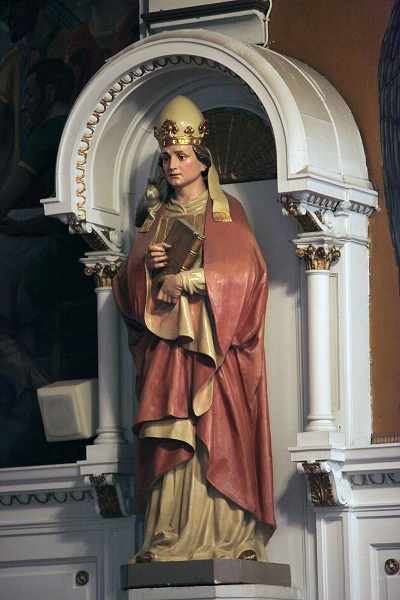
One of the murals of the life of St. Gregory and a statue of the saint.
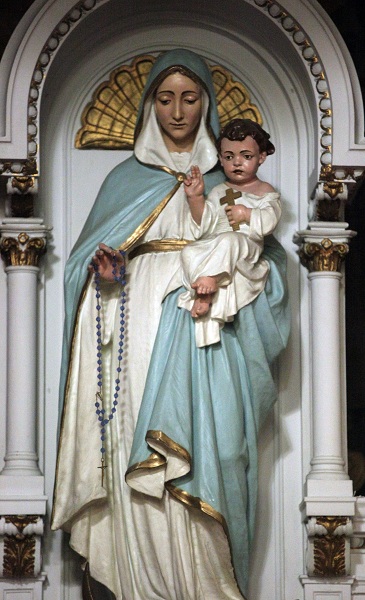
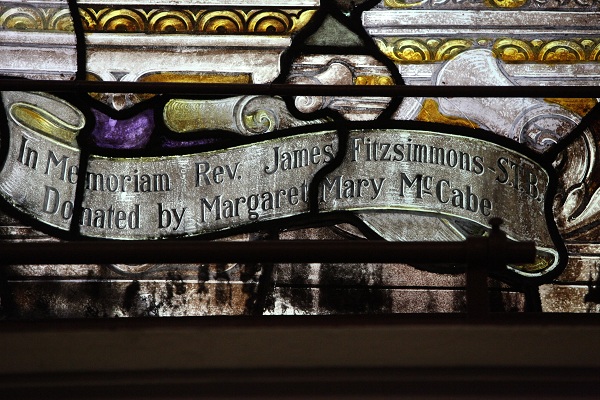
A window dedicated to the first pastor of St. Gregory’s – when the parish was prediominantly Irish.
The failure to build a church was probably due to more obvious “demographic” issues (to quote a mantra of the Archdiocese). In the course of time this part of the Upper West Side first became heavily Jewish and later mostly “Hispanic” and very poor. In recent years it is has been steadily developing as an exclusive residential area. It seems that this parish also shared the same ideological conflicts suffered by many other Catholic institutions in the late 1960’s and 1970’s. Through it all St Gregory’s community by heroic efforts has maintained both the parish and the school.
Yes, it may seem strange to have a school but not a church. But shouldn’t there be a great market for Catholic private education in New York City where the public schools have so manifestly failed for decades? But such is not the case. It seems that neither the well-to-do or, increasingly, even the poor find it advantageous or feasible to patronize the parochial schools of the city. The reasons given are various: the disappearance of the female religious orders and their replacement by much higher cost lay staff, “demographic change” etc. But it for me that the real problem is the obscuring of the original purpose of the parochial school – to preserve the faith. Instead, New York Catholic schools seem to be viewed primarily as a kind of poor relief. Indeed, the current house historian for the Archdiocese seems decidedly ambivalent on the whole topic, hinting that Catholics may have taken a wrong turn – away from public education – under Archbishop Hughes. Thus is failure rationalized away… (4)
We do not know what even the near future may bring for St. Gregory’s. But it does impress that St. Gregory’s parish – and its school as an integral component of itssmission – have negotiated so many vicissitudes to survive to our own day. Who knows – given the reborn affluence of the neighborhood, maybe the church building so long denied this parish will finally be born some day.
1) http://www.stgregorymanhattan.com/History_.html
2) http://www.stgregorymanhattan.com/Art.html
3) http://www.stgregorymanhattan.com/History_.html
4) (Fr.) Thomas J. Shelley, The Bicentennial History of the Archdiocese of New York 1808-2008 at 124-125, 211 (Editions du Signe 2007)
9
Dec
The question of what constitutes a coetus fidelium (“group of the faithful”)
One of the issues that had become contentious after the promulgation of the Motu Proprio was the determination of what constituted a group of the faithful. The instruction establishes that a “group of the faithful” can be said to be existing in a stable manner, according to the sense of art. 5 § 1 of the Motu Proprio Summorum Pontificum, when it is constituted by some people of an individual parish who, even came together after the publication of the Motu Proprio, by reason of their veneration for the Liturgy in the Usus Antiquior, and who ask that it might be celebrated in the parish church or in an oratory or chapel; such a “group” can also be composed of persons coming from different parishes or dioceses, who gather together in a specific parish church or in an oratory or chapel for this purpose.(35) For this group the Instruction does not establish a number of members so it could be very small. The Instruction affirms also that in sanctuaries and places of pilgrimage the possibility to celebrate in the forma extraordinaria is to be offered to groups of pilgrims who request it as mandated in the Motu Proprio Summorum Pontificum, art. 5 § 3, if there is a qualified priest.(36) Common sense indicates that group of pilgrims going to a shrine should be accompanied by a priest capable of offering the extraordinary form.
The acceptance of the Validity and Legitimacy of the ordinary form
The Instructions establishes that “The faithful who ask for the celebration of the forma extraordinaria must not in any way support or belong to groups which show themselves to be against the validity or legitimacy of the Holy Mass or the Sacraments celebrated in the forma ordinaria or against the Roman Pontiff as Supreme Pastor of the Universal Church.” (37) It is evident that attacking the validity of the ordinary form is a very serious problem because it puts into question the dogma of the indefectibility of the Church. With regards to the legitimacy it regards the acceptance of the power of the Holy Father to reform the liturgy and promulgate a new missal. At the same time we should underline that many faithful who certainly accept the validity and the legitimacy of the Mass of Paul VI have been deeply shocked by the abuses of this form of the Mass. Cardinal Ratzinger points out that, “While there are many motives that might have led a great number of people to seek a refuge in the Traditional liturgy, the chief one is that they find the dignity of the sacred preserved there. After the council there were many priests who deliberately raised “desacralization” to the level of a program, on the plea that the New Testament abolished the cult of the Temple: the veil of the Temple which was torn from top to bottom at the moment of Christ’s death on the cross is, according to certain people, the sign of the end of the sacred. The death of Jesus, outside the City walls, that is to say, in the public world, is now the true religion. Religion, if it has any being at all, must have it in the nonsacredness of daily life, in love that is lived. Inspired by such reasoning, they put aside the sacred vestments; they have despoiled the churches as much as they could of that splendor which brings to mind the sacred; and they have reduced the liturgy to the language and the gestures of ordinary life, by means of greetings, common signs of friendship, and such things.” (38)
These words of the future Pontiff show that it does not constitute a form of deligitimization to make observations on the way that the ordinary form of the Mass is celebrated. Neither it is to formulate suggestions to improve the ordinary form. We can mention here several observations made by Nicolas Bux. He points out that the praying of the canon facing the people contributes to confirm the impression that the Mass is a fraternal meal. He criticizes the total substitution of Latin by the vernacular. The transformation of the altar into a table. Pushing to a side of the Church the tabernacle that it is substituted by the seat or throne of the priest. The abolition of the sacred enclosure of the sanctuary and the installation of the baptismal font in the sanctuary. (39) It is also perfectly fitting to promote that for the Liturgy of the Eucharist the whole congregation including the priest be directed towards the Lord and that is expressed by turning toward the altar, as Fr. Uwe Lang strongly suggests. (40)
In the young when they encounter for the first time the traditional liturgy of the Church there is no question of discussing the validity or the legitimacy of the new liturgy, even many of them may not understand the meaning of these words. What they experience is the sense of marvel with a liturgy that brings them closer to the infinite majesty of God which is a longing that the Lord has inscribed in our immortal souls at the movement of their creation. It is a feeling that it is akin to sense of marvel that the Kievan envoys found when they first entered Santa Sophia. It is also the joy of rediscovering a heritage, of finding their roots, in other words of finding a long lost family. A family is formed by brethren, but also parents and ancestors. A family that would give to them a common heritage and what is more important a common and reassuring future that will be built on a well grounded identity. (41)
Who can be considered a qualified priest? (Sacerdos idoneus)
The Instruction starts from the general principle that “Every Catholic priest who is not impeded by Canon Law is to be considered idoneus (“qualified”) for the celebration of the Holy Mass in the forma extraordinaria.” With regards to the use of the Latin language, the instruction takes a very reasonable position and it requires only a basic knowledge that will allow the priest to pronounce the words correctly and understand their meaning. It will be absurd to require this knowledge of Latin from the faithful as a commentator of the Motu proprio indicates.(42) He insists that the faithful have to understand what is being celebrated. At the same time it will be a praiseworthy activity to try teaching some Latin to the faithful. It also takes a benevolent approach on the knowledge a priest might have of how to celebrate the extraordinary form. “Regarding knowledge of the execution of the Rite, priests are presumed to be qualified who present themselves spontaneously to celebrate the forma extraordinaria, and have celebrated it previously.” This provision puts an end to some excessive requests of some dioceses that through severe testing were trying to limit the priests that could be considered qualified.
Formation
With regards to formation the Instruction has two provisions. Priests who desire to celebrate in the extraordinary form should be offered by their bishop the possibility of acquiring the adequate preparation in this form of the Mass. With regards to seminarians the Instruction reiterates the command of the Code of Canon Law that seminarians should be taught Latin well. The question is to what extent this provision is of the Code is observed worldwide? With regards to the formation in the extraordinary form of seminarians the command is placed in rather weak way because it is conditioned by “where pastoral needs suggest it”.(43)
“In Dioceses without qualified priests, Diocesan Bishops can request assistance from priests of the Institutes erected by the Pontifical Commission Ecclesia Dei, either to the celebrate the forma extraordinaria or to teach others how to celebrate it.” (44) If we have the case that a Diocese does not have qualified priests and the Bishop refuses to call priests from the Institutes erected by the Pontifical Commission Ecclesia Dei voiding the right of the faithful to have access to the forma extraordinaria this will be a typical case that could be brought up to the Commission for resolution.
Liturgical and Ecclesiastical Discipline
The celebrants of the extraordinary form must be watchful like many priests in the past to carefully observe the rubrics. In this regard, Universae Ecclesiae is absolutely clear: “The liturgical books of the forma extraordinaria are to be used as they are. All those who wish to celebrate according to the forma extraordinaria of the Roman Rite must know the pertinent rubrics and are obliged to follow them correctly.”(45) Interestingly enough we can see the relation of this article with what it is stated in Sacrosanctum Concilium: “Therefore no other person, even if he be a priest, may add, remove, or change anything in the liturgy on his own authority.”(46) This applies to both the ordinary and the extraordinary form of the Roman Rite. Following carefully the rubrics has to be considered a moral obligation of the priest. More so there is an important aspect of the spirituality of the traditional liturgy that connected with this duty. The priest, like Christ, empties himself and does what the rubrics demand from him and avoids inserting his personality in the Mass. As a matter of fact part of the beauty of the traditional liturgy is grounded on the obligation that it has to be celebrated always in precisely the same manner by all priests in all places.
It is very positive that the Instruction Universae Ecclesiae has clarified many points that have been discussed in the last few years, including the obligation of the faithful to receive communion on the tongue, and the requirement that only male acolytes are permitted. The opinion had been advanced that all the laws of the Church that regulated the use of the Missal and the Sacraments in 1962 had been derogated and the revival of the 1962 Missal does not automatically revive those legal norms. The shocking consequence of this interpretation is that altar girls and the reception of Communion in the hand could have been a be a legal possibility in using this Missal. We should also note that even without the instruction that position is clearly erroneous.(47) In a recent letter of May 19th 2011, the Secretary of the Ecclesiae Dei Commission explained to a faithful in England that in accordance with art. 28 of the Instruction mentioned above, the Circular Letter of the Congregation for Divine Worship and the Discipline of the Sacraments of 1994 permitting female altar servers does not apply to the Extraordinary form. By a similar reasoning communion in the tongue and kneeling is mandated and female readers are not permitted.
The Motu Proprio in its art. 6th had permitted the use of the vernacular for the readings using editions recognized by the Holy See. Art 26 of the Instruction declares that the readings can be proclaimed either solely in the Latin language, or in Latin followed by the vernacular or, only in Low Masses, solely in the vernacular. We should note that the Instruction limits this option of using the vernacular solely to Low Masses.
The Sacrament of Holy Orders
In the regulation that Instruction makes of the disciplines of Holy Orders in the extraordinary form we find two novelties that were not in the Motu Proprio. First, it decides that tonsure, minor orders and the subdiaconate, even if they are maintained, do not have juridical consequences. “As regards tonsure, minor orders and the subdiaconate, the Motu Proprio Summorum Pontificum does not introduce any change in the discipline of the Code of Canon Law of 1983; consequently, in Institutes of Consecrated Life and Societies of Apostolic Life which are under the Pontifical Commission Ecclesia Dei, one who has made solemn profession or who has been definitively incorporated into a clerical institute of apostolic life, becomes incardinated as a cleric in the institute or society upon ordination to the diaconate, in accordance with canon 266 § 2 of the Code of Canon Law.”(49) This norm has been criticized as being opposed to the principle recalled in n. 3 of the instruction concerning adherence to “the usages universally handed down by apostolic and unbroken tradition.” This opens an interesting question because minor orders, even if they are not part of apostolic tradition, can be considered part of tradition. At the same time is positive that they can still be given because the recipients obviously receive a spiritual benefit in their path towards the priesthood.
Second, with regards to the granting of the Sacrament of Holy Orders the Instruction establishes, “Only in Institutes of Consecrated Life and Societies of Apostolic Life which are under the Pontifical Commission Ecclesia Dei, and in those which use the liturgical books of the forma extraordinaria, is the use of the Pontificale Romanum of 1962 for the conferral of minor and major orders permitted.”(50) We can ask ourselves if this norm of the Instruction respects the principle of equivalence between the two forms of the Latin Rite? This norm establishes a limitation that is not contained in the Motu Proprio. At the same time it seems evident that a Bishop wishing to use the Sacrament of Holy Orders could always ask for an indult from the Commission to use it. The above mentioned restrictions would lead to the interpretation that save especial cases like the ordination of a new bishop or an auxiliary bishop of the Personal Apostolic Administration Saint John Marie Vianney this will have to be done in the Ordinary Rite or by seeking permission through an indult.
It should be noted that on October 23, 2011 the Bishop of Frejus-Toulon, Bishop Dominique Rey, ordained a new priest for his diocese using the 1962 Pontifical. The new priest, Fr. Jean Christophe Pelegri, was ordained by Msgr. Rey to the diaconate on May 11 of this year, only two days before the promulgation of Universae Ecclesiae. We might presume that Bishop Rey obtained permission of Ecclesia Dei Commission to do this ordination or that he considers that this norm is not applicable.
The restrictions with regards to minor orders and the granting of the Sacrament of Holy Orders might lead to different traditionalists to petition for the approval of special canonical legislation that should take into account the particular traits of the extraordinary form.
Breviarium Romanum
The Motu Proprio Summorum Pontificum put an end to a long controversy whether it was licit for clerics that have the legal obligation to pray the Holy Office to fulfil this duty by praying the Breviary promulgated by Blessed John XXIII. It established that it could be rightfully used.
The instruction clarifies that the 1962 breviary has to be prayed entirely and in the Latin language. There are two authorized versions of the 1962 breviary: one containing the psalms of the Vulgata and the other containing a translation made by the Professors of Pontifical Biblical Institute and approved by Pius XII in 1945. It is also called the Bea version because at that time the future Cardinal Agustin Bea was the rector of the Pontifical Biblical Institute and had an important influence on Pius XII because he was his confessor. This new translation has some limitations: 1. The classical Latin used in this translation does not match well the late Latin of the Vulgata, of the Fathers, and of the liturgy. 2. The new version could be used only for the full psalms, but not for other parts of the breviary taken from the psalms. As a consequence, the correspondences between the Psalter, the antiphons, the small verses and the responsories became less evident. 3. It is more difficult to sing. For that reasons it is strongly advisable to use the breviary that contains the vulgata psalter.
Laymen should be encouraged to pray the breviary either as a whole or using the key hours like lauds and vespers. Layman also can pray the breviary in the vernacular or use a bilingual edition. They will receive great supernatural benefits and this prayer will lead them to understand better the unity and beauty of the traditional liturgy that forms an integrated whole where the Mass is at the center. At the same time, using the principle of equity, nothing would impede a cleric from using a bilingual edition of the breviary in as much as he uses the vernacular only to improve his understanding of the Latin.
The Sacred Triduum
With regards to the Sacred Triduum the Instruction establishes “If there is a qualified priest, a coetus fidelium (“group of faithful”), which follows the older liturgical tradition, can also celebrate the Sacred Triduum in the forma extraordinaria. When there is no church or oratory designated exclusively for such celebrations, the parish priest or Ordinary, in agreement with the qualified priest, should find some arrangement favourable to the good of souls, not excluding the possibility of a repetition of the celebration of the Sacred Triduum in the same church.”(51) This is an important clarification because some bishops had ruled that the Extraordinary Form was not to be celebrated in any way during the Easter Triduum – from the Evening Mass of the Lord’s Supper on Holy Thursday through to Solemn Vigil of Easter Sunday. This is clearly an erroneous interpretation. Article 2 of the Motu Proprio states precisely that a priest can celebrate Masses without the people on any day with the exception of the Easter Triduum. This clearly should be understood in the context that in neither of the liturgical forms are Masses without the people permitted during the Easter Triduum. The Missal of 1962 is very precise in its rubrics for Holy Thursday, forbidding the celebration of other Masses besides the solemn celebration of the evening Mass in Coena Domini. So there is no basis in law to state that the Easter Triduum cannot be celebrated in accordance with the Missal of 1962 in ceremonies with the presence of the people.
The Rites of Religious Orders
The Instruction in its official English translation establishes “The use of the liturgical books proper to the Religious Orders which were in effect in 1962 is permitted.”(52) A proper translation should state, “Members of religious orders may use their own liturgical books as in force in 1962” This clarification is important because the right of using those books does not belong to the orders, but to the members. So as an example a Dominican priest is free to use either the Roman Missal of 1962 or the Missal of his order that was in effect in 1962.
Conclusions
We are committed to the celebration of a liturgy that gives us a “glimpse of Heaven on earth.” (53) But as true Catholics we do not want to keep this glimpse for ourselves but we want to share it first and foremost with all our fellow Catholics and second with the entire world. The Pope has expressed with dramatic tones the tragedy of the passing away of the faith in many parts of the world. We have to launch again our missionary efforts but we have to be fully aware that without a recovery of our liturgical worship, none of the efforts of New Evangelization will be successful. The Holy Father recently pointed out that to bear witness to our faith; we have to be aware that “it is not by watering the faith down, but by living it today in its fullness that we achieve this.” (53A)
We have to develop the virtue of magnanimity as St. Thomas defines it, “by its very name denotes stretching forth of the mind to great things.” (54) So we have to forgive all the ones that offended and persecuted us in particular within the Church. As Fr. Cipolla suggests in a recent article we have to move out from a bunker mentality and build bridges within the Church. (55)
Cardinal Ratzinger has denounced the “dangerous tendency to minimalise the sacrificial nature of the Mass”(56) One of the causes of this tendency is the passing away of the penitential spirit within many members of the Church. Consequently, the reestablishment of meatless Fridays in England and Wales could help to restore the sense of the sacrificial nature of the Mass.
Much needs to done and still there is long road ahead of us, but we also have to be grateful to the Lord of all that has been achieved in the last twenty seven years since the promulgation of the special indult Quattuor abhinc anno in 1984. The Instruction Universae Ecclesiae is a good step forward that would allow us to move ahead. The name in itself is a valuable program, because it underlines that the immemorial liturgy is a great good not only for the growing minority that benefits from it today, but for the whole Church.
We have to have a profound hope that the liturgy of the Latin Church will be restored. Our confidence comes first and foremost from our certainty that it is the will of the Lord. Second, our confidence also comes from how the process of restoration is moving ahead. We are seeing concrete signs for which we have to be very grateful to the Lord. We have to be grateful to the Lord as Cardinal Domenico Bertolucci pointed out that we are living in the midst of a true and proper reawakening by so many young people, who wish to relive the beauty of the Latin Mass and the greater spiritual fruit derived from it.(57) Third, last but not least, because this restoration is needed to save the souls of the millions and millions that are walking in darkness. We need a great torch to bring them to Christ and in the liturgy we have that light.
1. Instruction Universae Ecclessiae 2.
2. Interview given by Mons. Guido Pozzo, Secretary of the Commission Ecclesiae Dei to Nouvelles de France, June 9th 2011. http://www.santuariodivinamaternita.com/Sito/Documenti/110608_monsPozzo_IntervistaNouvellesFrance.pdf
3. Interview given by Mons. Guido Pozzo, Secretary of the Commission Ecclesiae Dei to Nouvelles de France, June 9th 2011, cit.
4. http://www.paixliturgique.fr/?force=1
5. http://www.paixliturgique.org.uk/?force=1
6. Blessed John Paul II, Apostolic Letter, “Vicesimus quintus annus” On the 25th Anniversary of the Promulgation of the Conciliar Constitution of “Sacrosantum Concilium” on the Sacred Liturgy, 4th December 1988, n. 14.
7. Benedict XVI, Address of His Holiness Benedict XVI to the Roman Curia Offering them his Christmas Greetings, Thursday, December 22nd, 2005.
8. Joseph Cardinal Ratzinger, Feast of Faith, Ignatius Press, San Francisco, 1986, p. 83.
9. Address by Joseph Cardinal Ratzinger, prefect of the Congregation for the Doctrine of the Faith, given July 13, 1988, in Santiago, Chile before that nation’s bishops. The Wanderer June 22, 2000.
http://www.catholicculture.org/culture/library/view.cfm?id=3032&repos=1&subrepos=&searchid=292734
10. Nicola Bux, La crise liturgique, conséquence de la crise ecclésiologique, http://www.clerus.org/clerus/dati/2008-09/09-20/La_crise_liturgique.html
11. Paolo Farinella, Ritorno all’Antica Messa, Gabrielli Editori, 2007, St. Pietro in Cariano (VR).
12. Benedict XVI, Letter to the Bishops of the Catholic Church, Concerning the Remisission of the Excommunication of the Four Bishops Consecrated by Archbishop Lefebvre of March 10th, 2009.
http://rorate-caeli.blogspot.com/, 9-02-2011, http://blog.messainlatino.it/2011/09/discorso-del-card-bartolucci.html 9-03-2011.
13. Instruction Universae Ecclesiae, n. 2.
14. Instruction Universae Ecclesiae, 28
15. Cardinal Joseph Ratzinger, “Ten Years of the Motu Proprio “Eccleia Dei” Sunday October 24th, 1998 Rome. http://web.archive.org/web/20020702085721/http://www.latin-mass.org/ratzinger.html
16. Blessed John Paul II, Apostolic Letter, “Vicesimus quintus annus” n. 16.
17. Blessed John Paul II, Apostolic Letter, “Vicesimus quintus annus” n.9.
18. Blessed John Paul II, Apostolic Letter, “Vicesimus quintus annus”, n. 11
19. “13. Side by side with these benefits of the liturgical reform, one has to acknowledge with regret deviations of greater or lesser seriousness in its application. On occasion there have been noted illicit omissions or additions, rites invented outside the framework of established norms; postures or songs which are not conducive to faith or to a sense of the sacred; abuses in the practice of general absolution; confusion between the ministerial priesthood, linked with Ordination, and the common priesthood of the faithful, which has its foundation in Baptism. It cannot be tolerated that certain priests should take upon themselves the right to compose Eucharistic Prayers or to substitute profane readings for texts from Sacred Scripture. Initiatives of this sort, far from being linked with the liturgical reform as such, or with the books which have issued from it, are in direct contradiction to it, disfigure it and deprive the Christian people of the genuine treasures of the Liturgy of the Church.It is for the bishops to root out such abuses, because the regulation of the Liturgy depends on the bishop within the limits of the law and because “the life in Christ of his faithful people in some sense is derived from and depends on him”.” Blessed John Paul II, Apostolic Letter, “Vicesimus quintus annus”, n. 13.
20. Redemptionis Sacramentum, 4.
21. Ratzinger, Feast of Faith, cit, p. 81
22. Cardinal Dario Castrillón Hoyos, Prefazione, to Introibo ad altare Dei by Elvis Cuneo – Daniele Di Sorco – Raimondo Mameli, Fede & Cultura, Verona, 2008, p. 7.
23. Gabriel Díaz Patri, El Motu Proprio “Summorum Pontificum” y la pacificación de la Iglesia, http://www.clerus.org/clerus/dati/2008-10/16-20/El_MP_y_la_pacificacion_de_la_Iglesia[1].html
L’attività della Santa Sede 2010, Libreria Editrice Vaticana, Città del Vaticano, 2011, p. 939.
24. “Art. 11. The Pontifical Commission “Ecclesia Dei”, erected by John Paul II in 1988 (5), continues to exercise its function. Said Commission will have the form, duties and norms that the Roman Pontiff wishes to assign it. Art. 12. This Commission, apart from the powers it enjoys, will exercise the authority of the Holy See, supervising the observance and application of these dispositions.”
25. Instruction Universae Ecclesiae, 9.
26. Instruction Universae Ecclesiae, 10.1
27. “GUIDELINES REGARDING CELEBRATION OF THE EXTRAORDINARY FORM OF MASS Diocese of Great Falls-Billings
Motu Proprio Summorum Pontificum, (MPSP) article 5.2 notwithstanding, celebrating the Extraordinary Form on Sundays and Holy Days of Obligation in parishes of the Diocese of Great Falls-Billings as a regular Mass of obligation is not allowed at this time. [Parishioners in these instances may be drawn away from celebrating at the regular Mass for Sunday or Holy Day].
Indiscriminate mixing of elements of the Novus Ordo and elements of the Extraordinary Form is not allowed. Norms for each form are to be observed correctly [N.B. Instruction on the Application of the Apostolic Letter Summorum Pontificum, #24].
MPSP, article 5.3 notwithstanding, celebration of ritual Masses (funerals, weddings, etc.) in the Extraordinary Form is not allowed at this time in the Diocese of Great Falls-Billings. A priest must contact the Bishop in advance to ask for any exception to this policy and demonstrate pastoral consideration by not imposing the Extraordinary Form on a parish in these instances.
Altar Servers for the Extraordinary Form must be properly trained.
N.B.: It is important to remember that the Extraordinary Form generally does not enable full, active participation by the assembly which was called for by Vatican II. While the Extraordinary Form holds a definite place in the liturgical tradition of the Church, it does not meet the spiritual needs of the large portion of Church membership today.”
28. Instruction Universae Ecclesiae, 10.2.
29. Instruction Universae Ecclesiae, 11
30. Benedict XVI, Letter to the Bishops on the occasion of the publication of the Apostolic Letter “Motu Proprio Data” on the use of the Roman Liturgy prior to the Reform of 1970.
31. Instruction Universae Ecclesiae, 25
L’attività della Santa Sede 2010, cit, p. 940.
32. Ratzinger, Feast of Faith, cit, pp. 81-82.
33. Instruction Universae Ecclesiae, 12. “Can. 34 §1. Instructions clarify the prescripts of laws and elaborate on and determine the methods to be observed in fulfilling them. They are given for the use of those whose duty it is to see that laws are executed and oblige them in the execution of the laws. Those who possess executive power legitimately issue such instructions within the limits of their competence. §2. The ordinances of instructions do not derogate from laws. If these ordinances cannot be reconciled with the prescripts of laws, they lack all force. §3. Instructions cease to have force not only by explicit or implicit revocation of the competent authority who issued them or of the superior of that authority but also by the cessation of the law for whose clarification or execution they were given.”
34. Instruction Universae Ecclesiae, n 13.
35. Instruction Universae Ecclesiae, n. 15.
36. Instruction Universae Ecclesiae, n. 18.
37. Instruction Universae Ecclesiae, n. 19.
38. Address by Joseph Cardinal Ratzinger, given July 13, 1988, in Santiago, Chile, cit.
39. Nicola Bux, La crise liturgique, conséquence de la crise ecclésiologique, cit.
40. U.M. Lang, Turning towards the Lord – Orientation in Liturgical Prayer, Foreword by Joseph Cardinal Ratzinger, Ignatius Press, San Francisco, 2004, p. 122.
41. Gabriel Díaz Patri, El Motu Proprio “Summorum Pontificum” y la pacificación de la Iglesia, cit.
42. Testo dell’intervista rilasciata a Zenit (20 giugno) dal prof. Manlio Sodi a Antonio Gaspari sul tema: “Ha ancora senso studiare latino e greco?” http://www.oratoriosanfilippo.org/21-06-2011.html
43. Instruction Universae Ecclesiae, n. 21.
44. Instruction Universae Ecclesiae, n. 22.
45. Instruction Universae Ecclesiae, n. 24
46. Sacrosanctum Concilium 22 §3
47. This position even without the Instruction is clearly erroneous for the following reasons:
First, in the Motu Proprio we do not have a revival of a previous rite which had been derogated, but to the contrary, due to the explicit legally binding declaration contained in Article 1 of this law, we have the very strong affirmation that the Missal of 1962 had never been abrogated. As a consequence, all the norms that regulate the way in which it should be used, are now in force. The contrary opinion is not reasonable because it would mean that the Missal would be in existence without the necessary support of all the norms that regulate its use; it is tantamount to affirming that this Missal exists in a legal vacuum. It is abhorrent to any sane legal interpretation of any law to postulate that something should live in a legal vacuum.
Second, we have to consider the basic principle of legal interpretation that states that whoever wishes the principal also desires what is accessory. So if the Supreme Legislator of the Church has decreed that the Missal of 1962 has never been derogated, he is also stating explicitly that all the norms that regulated that Missal were not derogated either. It is evident that the normative corpus that regulates the use of this Missal is an integral accessory to the Missal.
Third, this law like any other law of the Church has to be interpreted in accordance with the hermeneutic of continuity; in accordance with this interpretative criterion, it is evident that the laws that accompanied the Missal of 1962 at its promulgation should guide its way now in the present. To propose that it is legally possible to have female altar servers or to give communion in the hand when using the Missal of 1962 would be a clear case of the hermeneutic of discontinuity which, as I stated earlier, the Holy Father denounced in his address to the Roman Curia.
Fourth, we have to interpret this law like any other law with an spirit of coherence. It is co-natural with the Missal of 1962 that it is highly regulated in such a way that the celebrant of this Mass is always guided by precise and concrete norms and that nothing is left to the spirit of invention of the celebrant. So, it is co-natural with the Motu Proprio that all the legal norms that regulated the 1962 Missal when it was issued, still regulate it now the use of this Missal has been declared to be the right of the faithful.
Fifth, the view that the legal apparatus that supported the 1962 Missal has been derogated is against the spirit of the Motu Proprio, which wishes to preserve the style that governed the celebration of the liturgy in accordance with the Missal of St Pius V and to restore a sense of respectful reverence to divine worship. It is evident that practices such as girl altar servers or communion in the hand are alien to the spirit and style that preside the celebration of the liturgy in accordance with the Missal of St Pius V. Sixth, the erroneous interpretations I have outlined above would be detrimental to one of the purposes of this law, which is to obtain a healing of the divisions that sadly affect the Church in our times. It is evident that such interpretations would not be accepted by different persons or groups (such as the Society of St Pius X) who are currently not in due canonical union with the Church.
48. http://acatholiclife.blogspot.com/2011/06/ecclesia-dei-letter-altar-girls-never.html
49. Instruction Universae Ecclesiae, n. 30.
50. Instruction Universae Ecclesiae, 31 http://rorate-caeli.blogspot.com/
51. Instruction Universae Ecclesiae, n. 33.
52. Instruction Universae Ecclesiae, n. 34.
53. Blessed John Paul II, Apostolic Letter, Spiritus et Sponsa, On the 40th Anniversary of the Constitution of the Sacred Liturgy “Sacrosantum Concilium”, December 4th, 2003, n. 16.
53A. Benedict XVI, Address at the Meeting with Council of the Evangelical Church in Germany, Chapter Hall of the Former Augustinian Convent, Erfurt, Friday, 23 September 2011
54. S.T. II-II, q. 129, a. 1.
55. Rev. Richard Cipolla, Still a Landmark, The Traditionalist, Winter 2011, p. 43.
56. Cardinal Joseph Ratzinger, Ten Years of the Motu Proprio “Eccleia Dei” cit.
57. Cardinal Domenico Bertolucci, the greatest living musician of the Church, at a concert where his compositions were played in the presence of the Holy Father in the Apostolic Palace of Castel Gandolfo on Agust 31st made very explicit declarations on the value of the immemorial liturgy of the Church: “Then, the times unfortunately changed. But today, a true a proper reawakening by so many young people, who wish to relive the beauty of the Latin Mass and the greater spiritual fruit derived from it, can be noticed with great satisfaction; this is great, a very great comfort. And it makes us hope for a liturgical future certainly desired by Your Holiness. We thank the Lord, that he may help all those who are working for seriousness in sacred music. I firmly trust that, we the help of God, a true return to the bimillenary tradition of sacred music will take place.” http://rorate-caeli.blogspot.com/, 9-02-2011, http://blog.messainlatino.it/2011/09/discorso-del-card-bartolucci.html 9-03-2011.
An evening of recollection, with benediction and the opportunity of confession sponsored by the Catholic Artists Society – all in the magnificent surroundings of Old St. Patrick’s Cathedral (now a basilica). It was followed by a most pleasant reception in the rectory of the church – in the very room where Archbishop McCloskey received his cardinal’s hat – he was the first American Cardinal.
An inspiring meditation, specifically addressed to the artistic community, was given by Fr.Jonathan Morris. He referred to Pope Benedict’s comments on the special role of the artist. Through the “production” of art the artist in a sense shares in the ministry of the church; he leads people to the same goal as the clergy seek to do. Second, the artist’s experience of beauty contributes to the spiritual development of the artist himself. His talent is not separate from his spiritual life but is a means by which the Holy Spirit seeks to lead him to salvation. The experience of beauty does not remove us from reality but deepens our encounter with it. This is why the artist often has a higher “velocity” of spiritual life. The temptation to mediocrity, however, is a threat to us all but expecially to the artist. For the devil wants nothing more than that a man should be only a “good guy.”
Many thanks to the pastor of St. Patrick’s, Monsignor Donald Sakano, for hosting this special evening.
4
Dec
A Comment on the Instruction Universae Ecclesiae on the Application of the Apostolic Letter Summorum Pontificum
Msgr. Ignacio Barreiro Carámbula, S.T.D.
Presentation
The Instruction Universae Ecclesiae on the Application of the Apostolic Letter Summorum Pontificum given as Motu Proprio by His Holiness Benedict XVI was signed on April 30th by the President of the Ecclesia Dei Commission Cardinal William Levada and the Secretary Msgr. Guido Pozzo. It had been previously approved by the Holy Father on April 8th. It was made public on May 13th. It is called the Instruction Universae Ecclesiae for the two beginning words in the Latin text. It was issued to strengthen the application of the Motu Proprio that was promulgated to offer to all Catholic faithful the celebration of the Usus antiquior as precious treasure to be preserved. By this Motu Proprio, the Supreme Pontiff promulgated a universal law for the Church, giving a new regulatory framework for the use of the Roman Liturgy that was in effect in 1962.(1) It has the objective of providing guaranties and assure to all the faithful that request it, the use of the Extraordinary Form and as consequence it promotes unity and reconciliation in the Church. (2)
We should receive this Instruction with a very positive spirit. In substance it fortifies and consolidates the doctrine of the Motu Proprio and guaranties the freedom of the traditional Missal so it is clearly a progress. The Instruction constitutes a reaffirmation that we cannot go back to the preexisting situation when the rights of the faithful to benefit from the traditional Mass were not duly protected.
The Instruction was issued also to clarify various questions from around the world that had arisen with regards to the interpretation of the Motu proprio. Some of these questions regrettably have come from an approach that treated to apply the Motu Proprio with a restrictive spirit or worse with an adversary spirit. This well known resistance of some bishops and some members of the clergy was recently pointed out by Msgr. Pozzo Secretary of the Ecclesia Dei Commission.(3) In France one archdiocese and five dioceses so far have not granted the celebration of the traditional Mass. At the same it should be noted that also in France since the publication of the Motu Proprio 103 new locations for the celebration of the Mass have been granted.(4) In Spain before the Motu Proprio for different and complex reasons the traditional Mass had a very limited presence; today it is celebrated in about fifteen dioceses.(5) In Africa also there is a growing interest for the Extraordinary Form; recently Roger McCaffrey shipped to Nigeria fifty copies of the Missal of 1962, which he had reprinted through his publishing company Roman Catholic Books.
A fundamental element of interpretation of the Motu Proprio Summorum Pontificum can be found in many previous statements of the Holy Father on the proper interpretation of the Second Vatican Council. This is very important because many of the persons that have a distorted view of that Council are the ones that have opposed the implementation of the Motu Proprio. These were persons that had interpreted the II Vatican Council as a call for a dynamic of constant change in the Church, as it was denounced by the Blessed John Paul II. (6)
This concern was very well explained by Benedict XVI in his address to the Roman Curia of December 22nd 2005.(7) In this address he contrasted two ways of interpreting the II Vatican Council: a hermeneutic of discontinuity and a hermeneutic of renewal in the continuity. He points out that “The hermeneutic of discontinuity risks ending in a split between the pre-conciliar Church and the post-conciliar Church. It asserts that the texts of the Council as such do not yet express the true spirit of the Council. It claims that they are the result of compromises in which, to reach unanimity, it was found necessary to keep and reconfirm many old things that are now pointless. However, the true spirit of the Council is not to be found in these compromises but instead in the impulses toward the new that are contained in the texts.” But as the Holy Father explains within a hermeneutic of continuity the Church “is a subject which increases in time and develops, yet always remaining the same, the one subject of the journeying People of God.” This address is in total continuity with his previous thinking, some years before in a very important work Cardinal Ratzinger had stated, “The Council has not created any new matter for belief, let alone replaced an old belief with a new one.”(8) Here in a very pithy statement we have the essence of his distinction between Hermeneutic of discontinuity and Hermeneutic of Continuity. Some years later, Cardinal Ratzinger speaking about this Council to the Chilean Bishops in July of 1988 stated, “The Second Vatican Council has not been treated as a part of the entire living Tradition of the Church, but as an end of Tradition, a new start from zero. The truth is that this particular council defined no dogma at all, and deliberately chose to remain on a modest level, as a merely pastoral council; and yet many treat it as though it had made itself into a sort of superdogma which takes away the importance of all the rest.” (9)
This lead us to see how as Nicola Bux points out that the crisis of the liturgy is caused by an ecclesiology of rupture instead of an ecclesiology of continuity.(10) A clear case of these types of mistakes can be found in the work of Fr Paolo Farinella, The Return to the Ancient Mass. (11) He states that the Motu Proprio is not acceptable because it reintroduces in the Church an ecclesiology that was left aside by the new ecclesiology of the Second Vatican Council. He underlines that, each Missal is connected with a different type of ecclesiology. The point that this author or others similar to him, are unable to demonstrate is that the Council introduced a new ecclesiology in the Church.
Important statements of interpretation of the Motu Proprio are contained also in the Letter of Benedict XVI to the Bishops of the Catholic Church, Concerning the Remission of the Excommunication of the Four Bishops Consecrated by Archbishop Lefebvre of March 10th, 2009. He affirms that, “The Church’s teaching authority cannot be frozen in the year 1962 – this must be quite clear to the Society.”(12) (Referring to the Society of Saint Pius X.) This is a self evident statement, we can mention as examples the Encyclical Humanae Vitae of Paul VI or the Apostolic Letter of Blessed John Paul II Ordinatio Sacerdotalis, on Reserving Priestly Ordination to Men Alone,
but is also obvious that II Vatican Council requires a precise interpretation within a proper hermeneutic of continuity.
Speaking about the right interpretation of the Council in the letter to Bishops the Pope stated, “But some of those who put themselves forward as great defenders of the Council also need to be reminded that Vatican II embraces the entire doctrinal history of the Church. Anyone who wishes to be obedient to the Council has to accept the faith professed over the centuries, and cannot sever the roots from which the tree draws its life.” This is stated by the Holy Father because many that opposed the lifting of the excommunications had espoused a hermeneutic of discontinuity with the tradition of the Church. As consequence they were opposing this gesture of reconciliation of the Holy Father because they are against the reaffirmation of the fullness of the doctrinal treasures of the Church and of the restoration of the traditional liturgy which is part of this treasure.
In this letter the Holy Father shows with anguished tones that the biggest external challenge that the Church has is that, “In vast areas of the world the faith is in danger of dying out like a flame which no longer has fuel, the overriding priority is to make God present in this world and to show men and women the way to God.” In this challenge we have also the particular call of the Lord for us in out times. We will be able to be strong missionaries again if we make our own the entire doctrinal and liturgical treasury of the Church and we offer it to the many that today are walking in darkness and in the shadows of death.
Cardinal Domenico Bertolucci, the greatest living musician of the Church at concert where his compositions were played in the presence of the Holy Father in the Apostolic Palace of Castel Gandolfo on Agust 31st made very explicit declarations on the value of the immemorial liturgy of the Church: “Then, the times unfortunately changed. But today, a true a proper reawakening by so many young people, who wish to relive the beauty of the Latin Mass and the greater spiritual fruit derived from it, can be noticed with great satisfaction; this is great, a very great comfort. And it makes us hope for a liturgical future certainly desired by Your Holiness. We thank the Lord, which he may help all those who are working for seriousness in sacred music. I firmly trust that, we the help of God, a true return to the bimillenary tradition of sacred music will take place.” (13)
Introduction
The Instruction in its opening statement affirms the very basic truth that, “The Apostolic Letter Summorum Pontificum of the Sovereign Pontiff Benedict XVI given Motu Proprio on 7 July 2007, which came into effect on 14 September 2007, has made the richness of the Roman Liturgy more accessible to the Universal Church.” Against the negative interpretations mentioned above, that try to ignore this document it is reaffirmed that the Motu Proprio is a universal law of the Church.(14) As such it granted rights and duties to all the faithful of the Latin Church. It is very important to reaffirm this because in some places the right of the faithful to accede to the traditional Mass is still treated like a gracious indult that the local ordinary can grant or deny at will. At the same time it should be noted that under the previous legal system of the indult, an episcopal refusal was in disagreement with the Papal exhortation contained in the Motu Proprio Ecclessia Dei of providing a generous application of the contents of that document. One of the reasons that lead to the promulgation of the Motu Proprio Summorum Pontificum was this lack of generous application of the previous Motu Proprio Ecclesia Dei. The Motu Proprio should be considered also a “special law” that derogates all the liturgical norms that are contrary to the rubrics of the 1962 missal, when this is missal is used today. The Instruction states “Furthermore, by virtue of its character of special law, within its own area, the Motu Proprio Summorum Pontificum derogates from those provisions of law, connected with the sacred Rites, promulgated from 1962 onwards and incompatible with the rubrics of the liturgical books in effect in 1962.” (15)
The traditional principle of the unity of the Liturgy is highlighted in n. 3, “The Holy Father, having recalled the concern of the Sovereign Pontiffs in caring for the Sacred Liturgy and in their recognition of liturgical books, reaffirms the traditional principle, recognized from time immemorial and necessary to be maintained into the future, that “each particular Church must be in accord with the universal Church not only regarding the doctrine of the faith and sacramental signs, but also as to the usages universally handed down by apostolic and unbroken tradition. These are to be maintained not only so that errors may be avoided, but also so that the faith may be passed on in its integrity, since the Church’s rule of prayer (lex orandi) corresponds to her rule of belief (lex credendi).” The Holy Father had reaffirmed this principle in the second paragraph of the introduction of the Motu Proprio. This fundamental principle has been severely challenged by the real way in which the missal of Paul VI has been implemented. Cardinal Ratzinger in 1998 pointed out, “The free space which the new order of Mass gives to creativity it must be admitted, is often excessively enlarged. The difference between the liturgy with the new liturgical books, as it is actually practiced and celebrated in various places is often much greater than the difference between the old and new liturgies when celebrated according to the rubrics of the liturgical books.”(16) I remember well the comment of a faithful that had attended four different masses at an American city some years ago; he told to me that he felt he had attended four different religions. We also have the abuses that are committed in many places giving priority to local costumes under the guise of enculturation and that also have damaged the sense of unity of the liturgy. This was a problem that Blessed John Paul II saw with concern. (17)
Those excesses lead Blessed John Paul II to warn in 1989 “Let nothing in the celebration of the Liturgy disrupt or obscure this unity of the Church!”(18) In the same document he noted that some “have promoted outlandish innovations, departing from the norms issued by the authority of the Apostolic See or the bishops, thus disrupting the unity of the Church and the piety of the faithful and even on occasion contradicting matters of faith.”(19) Blessed John Paul II proceeds afterwards to provide a detailed list of the erroneous applications of the post-conciliar reforms.(20) The condemnation of these abuses was reiterated by the Congregation for Divine Worship and the Discipline of the Sacraments in the Instruction Redemptionis Sacramentum of March 25th 2004. As this instruction points out in some places the perpetration of liturgical abuses have become almost habitual.(21) So taking into account the amount of liturgical abuses that have marred the implementation of the new liturgy, the complaint of the opponents of the Motu Proprio that the re-introduction of the traditional liturgy could damage the liturgical unity of the Church seems to be very inadequate.
Both the Motu Proprio in its first article and the Instruction in art. 6 contain the principle of equivalence between the both forms of the Latin Rite. The Instruction states, “The Roman Missal promulgated by Pope Paul VI and the last edition prepared under Pope John XXIII, are two forms of the Roman Liturgy, defined respectively as ordinaria and extraordinaria: they are two usages of the one Roman Rite, one alongside the other. Both are the expression of the same lex orandi of the Church. On account of its venerable and ancient use, the forma extraordinaria is to be maintained with appropriate honor.” This principle give us a solid legal ground to request that the extraordinary form should be given the same treatment as the ordinary form and should not suffer any type of negative discrimination. At the same time taking into account the history of the liturgy it seems difficult that we could place at the same level a missal that has a long tradition of organic development and the new missal. As Cardinal Ratzinger pointed out, “One of the weaknesses of the postconciliar liturgical reform can doubtless be traced to the armchair strategy of academics, drawing up things on paper which, in fact, would presuppose years of organic growth.”(22) Also we have to consider, as Cardinal Castrillón Hoyos pointed out, that it is possible to sustain that the ancient rite expresses better the sense of the sacrifice of Christ that is represented in every Holy Mass. (23)
The art. 8th of the introduction of the Instruction contains important interpretative elements: First it underlines the magisterial importance of the Motu Proprio Summorum Pontificum declaring that it was issued as part of the competence of the Holy Father to regulate the Liturgy and establishes the aims of this law.
“a. offering to all the faithful the Roman Liturgy in the Usus Antiquior, considered as a precious treasure to be preserved;” So this shows that the effective preservation of the Usus Antiquior is part and parcel the of the Hermeneutic of Continuity of Benedict XVI.
“b. effectively guaranteeing and ensuring the use of the forma extraordinaria for all who ask for it, given that the use of the 1962 Roman Liturgy is a faculty generously granted for the good of the faithful and therefore is to be interpreted in a sense favourable to the faithful who are its principal addressees;” This clause establish the principle that in the case of doubt always it has to be interpreted in a favourable way to the petitioners of the traditional Mass and no obstacles should be placed in its celebration.
“c. promoting reconciliation at the heart of the Church.” It is important to reach reconciliation with groups that are in a more or less in an imperfect canonical situation. It is important also to reach pacification between different groups within the Church that are at odds on liturgical and on theological questions. But more important than all of that, is to build a reconciliation of the members of the Church with their own liturgical tradition, with their common memory and identity so that we can rediscover our permanent liturgical identity in the riches that were built in the past through the constant action of the Holy Spirit and can be carefully and organically developed with a sense of faithful continuity until the Second Coming of the Lord. (24)
There has been some concern on the name used to call the older liturgy. In these documents it is called Extraordinary Form and also “Antiquior Usus” (the “more ancient use”). Some commentators have pointed out that the name “extraordinary” is pejorative. If we read objectively both the Summorum Pontificum and the Instruction there is no way that this concern can be proven. But nevertheless it can be stated that the term “extraordinary” places the traditional rite in a certain condition of inferiority with regards to the ordinary form, because this denomination seems to underlines that the “normal” form is the missal of Paul VI, so it might be prudent to use a different name. This perceived inferiority can injure the legal equivalency as proclaimed in art. 6th of the Instruction. The documents refer also to the traditional rite as the “Antiquior Usus” (the “more ancient use”) so we could use that name more frequently. But even “Antiquior Usus” as a denomination has the limitations that it could be construed as somewhat like an object taken from a museum, so we should explore options to find an appropriate denomination. One possibility is to call it the Latin-Gregorian Liturgy as it has been denominated in the inform of the Ecclesia Dei Commission published in the report “The Activities of the Holy See 2010”. (25)
The Responsibilities of the Ecclesia Dei Commission
The Instruction spells out the powers of the Commission as granted by previous legislation and in particular articles 11 and 12 of the Motu Proprio Summorum Pontificum.(26) The Commission has received ordinary vicarious power for the matters within its competence, to monitor the observance and application of the provisions of the Motu Proprio Summorum Pontificum. (27)
In the instruction it is underlined that the Commission has the power to decide upon recourses legitimately sent to it, as hierarchical Superior, against any possible singular or general administrative provisions of an Ordinary, either bishops or religious superiors, that appear to be contrary to the Motu Proprio.(28) As an example we can mention that the Commission might receive a complain against a diocesan decree that places illegal limits to the access of the faithful to the extraordinary form. We can mention as an example of this type of illegal decree the Guidelines Regarding Celebration the Extraordinary Form of the Mass published by the Diocese of Great Falls-Billings, in the U.S.(29) We should also notice with gratitude that those Guidelines were withdrawn and they were substituted in the diocesan web-site by the publication of the Instruction Universae Ecclesiae, after concerned persons expressed their perplexity to the Diocesan authorities.
Taking into account the vicarious powers that Commission has received it is evident that it can examine administrative decisions of ordinaries with out receiving the legal recourses against them. The decrees by which the Pontifical Commission decides recourses may be challenged before the Supreme Tribunal of the Apostolic Signatura.(30) We sincerely hope that with these new and enhanced powers the Commission will be able to come to the assistance of many faithful that so far are deprived of the traditional Mass.
Liturgical Regulatory Responsibilities of the Commission
The instruction establishes that the Commission, “After having received the approval from the Congregation for Divine Worship and the Discipline of the Sacraments, the Pontifical Commission Ecclesia Dei will have the task of looking after future editions of liturgical texts pertaining to the forma extraordinaria of the Roman Rite.”(31) The Holy Father in his Letter to the Bishops on the occasion of the publication of the Motu Proprio had announced that new saints and some of the new Prefaces would be inserted in the 1962 Missal.(32) To implement this desire of the Holy Father the Instruction gives this responsibility of the Commission.(33) A Vatican publication, “The Activities of the Holy See 2010” has just informed that a joint commission was set up, with experts of the commission “Ecclesia Dei” and of the Congregation for Divine Worship, for the “updating” of the commemorations of the saints and the “possible insertion of new prefaces” into the Missal of 1962.(34) We can clearly see that the inclusion of new saints and prefaces shows that the usus antiquior is not a museum piece but a living and organic reality that will grow and develop.
In the introduction of the news saints a particular respect should be given to popular piety to avoid the mistakes that were made with the new calendar, a point that forcefully made by Cardinal Ratzinger.(35) With regards to the incorporation of the new saints some particularities of the traditional 1962 calendar would need to be taken into account. To give an example, the feast of Saint Maximilian Kolbe is celebrated on August 14th, as an obligatory memorial, which is equivalent to a Third Class feast on 1962 Calendar. On that date on the 1962 calendar we have the Vigil of the Assumption of the Blessed Virgin Mary which is a Second Class Feast, so as a consequence if the feast of St. Maximilian Kolbe were to be introduced on the same date it will be permanently impeded because it will always be superseded by the Vigil. The feast of Padre Pio of Pietralcina is on September 23rd and certainly many faithful in Italy will be very glad if he were incorporated into the 1962 calendar. At the same time I would strongly suggest that it should be done keeping also in that date the feast of the second Pope of the Church, St. Linus whose feast is now celebrated in the 1962 Missal on that same date. Also I am in favor of keeping in that same date the Commemoration of Saint Tecla Virgin and Martyr to whom there is ancient devotion in Italy and in other parts of the world. With regards to the prefaces I have gone through some of the additional prefaces contained in the traditional missal that is used in France and they are very much worthy of being incorporated into the 1962 Missal.
This article of the Instruction has also a very positive implication because it assures that no other changes will be introduced in the 1962 Missal. It assures that the lectionary of this Missal will not be changed save the cases when a new saint is introduced and the new propers for this saint will have their own biblical readings, which in itself is a positive non objectionable development. It should be evident also that in the introduction of propers for new saints the structure and style of the 1962 missal has to be respected.
Specific Norms
This instruction is issued in accordance with Can. 34 of the Code of Canon Law to be a proper interpretation and lead to the correct application of the Motu Proprio Summorum Pontificum.(36)
The competence of the Diocesan Bishops
With regards to the competence of the Diocesan Bishops, the Instruction reaffirms the principle that according to Canon Law, they have to monitor liturgical matters in order to guarantee the common good and to ensure that everything is proceeding in peace and serenity in their Dioceses. It is underlined in this document that this has to be done always in agreement with the mens (mind) of the Holy Father as it was clearly expressed by the Motu Proprio Summorum Pontificum. It reaffirms what we have seen above that “In cases of controversy or well-founded doubt about the celebration in the forma extraordinaria, the Pontifical Commission Ecclesia Dei will adjudicate.” (37)
(To be continued)
4
Dec
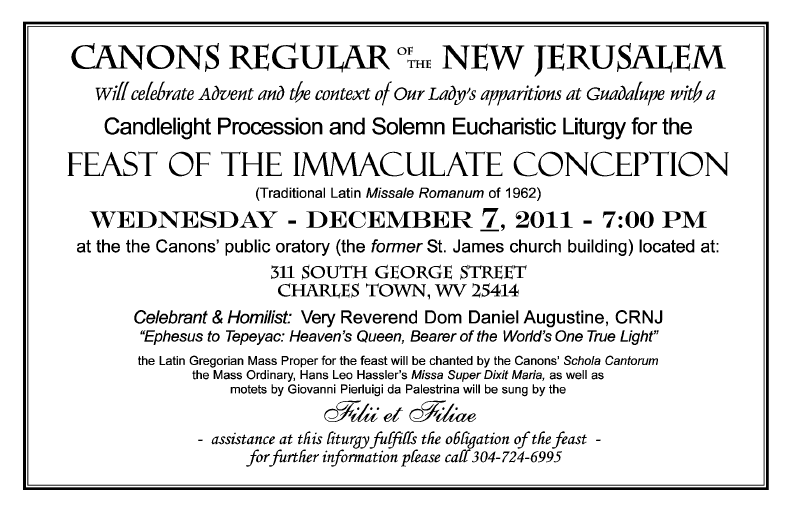
December 7
From our Friends in West Virginia…..
December 8
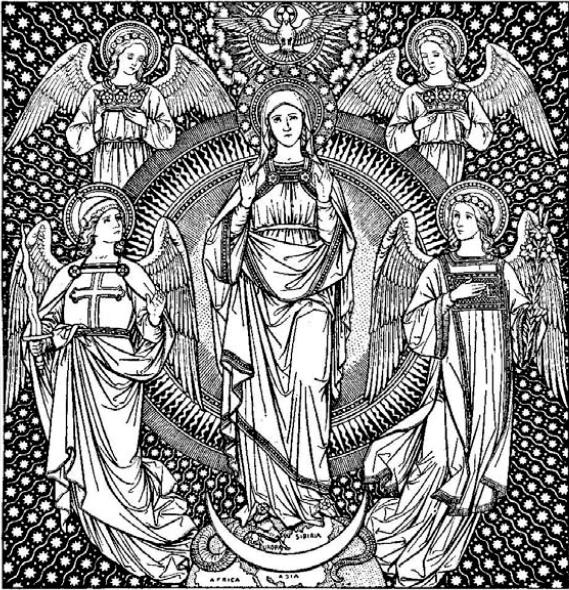
Connecticut:
Hartford: 9 AM, St. Peter Church, 160 Main Street, Hartford.
Norwalk: Solemn Mass, 5:30 PM, St. Mary’s Church, 669 West Avenue, Norwalk
New York:
Sleepy Hollow: Low Mass 5 PM Immaculate Conception of the BVM, Sleepy Hollow
Directions: www.unavocewestchester.org
27
Nov
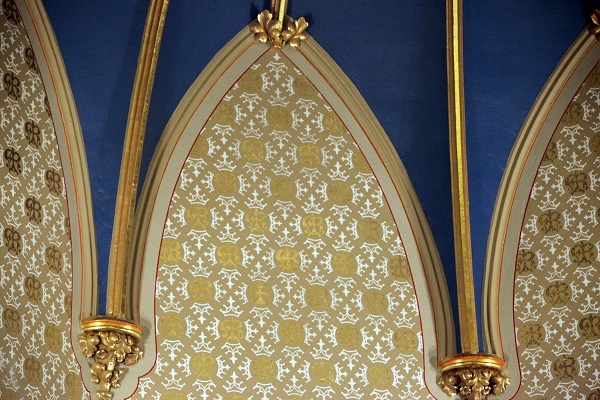
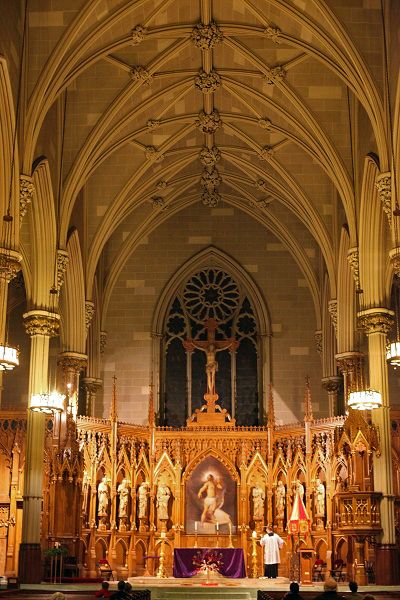
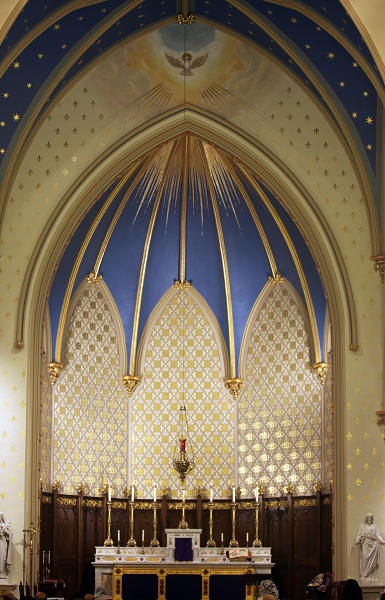
Today the parish of ST. Mary’s moved back upstairs to the main church upon the completion of the painting of the sanctuary. it is part of vast project to restore the splendor of this church. In relation to the restroation of the sanctuary, the pastor, Fr. Markey, explains:
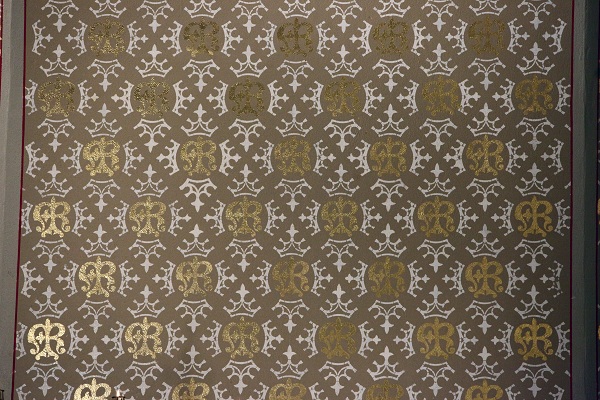
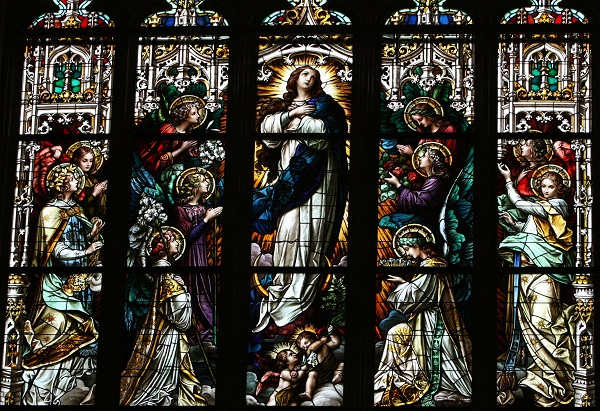
“The French blue with the stars is a clear reminder to all who enter that we are in a church dedicated to Our Lady. The Holy Spirit over the triumphal arch reminds us of the Annunciation, where the Our Lady, the Immaculate Conception, mystically united with the Third Person of the Holy Trinity, to conceive Emmanuel, God among us. The fruits from this union are evident by the gold rays, the stars, and various colors and stencils, all descending down up us. The fleur de lis, a traditional symbol of the purity of Our Lady, envelope the triumphal arch, and fall down like snow flakes on the church below. Over the two front arches we see the first and last words of the Hail Mary written in Latin, Ave Maria and Amen, which will continue around the entire church during the next phase of the church. The double stencil patter in the apse of the church of white crowns surrounding a gold letter M, comes from the nineteenth century English architect, Augustus Pugin, famous for his love for gothic designs.”