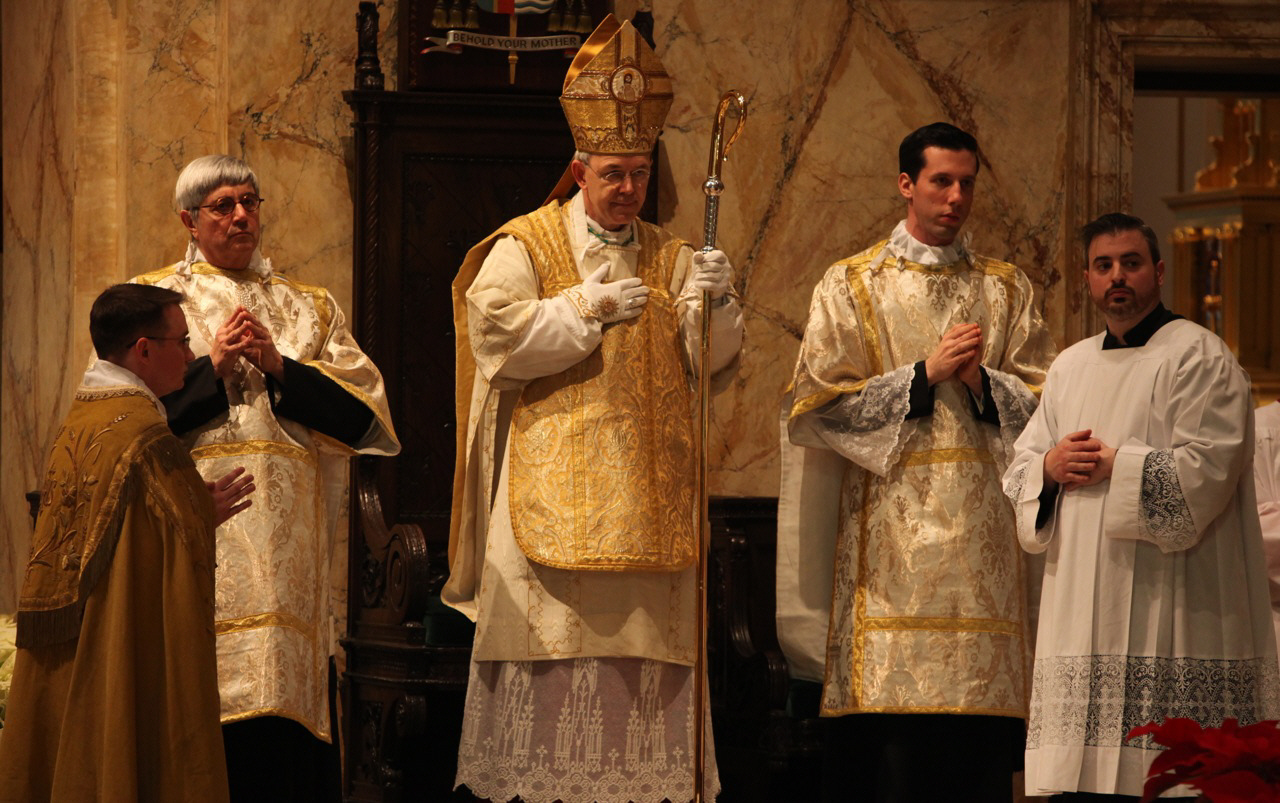
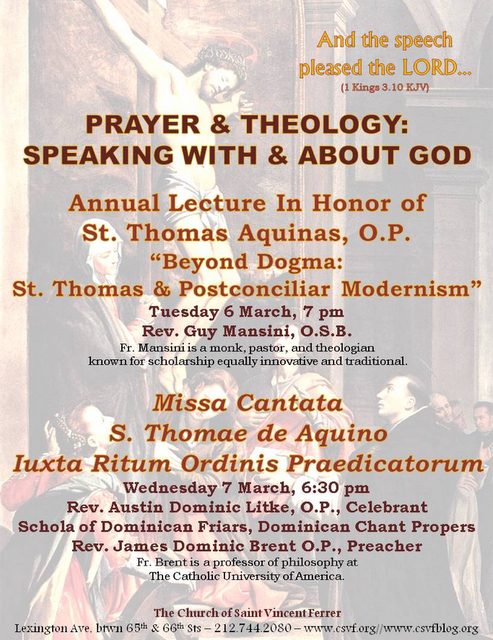
A High Mass (Missa Cantata) for the Feast of Saint Joseph will be celebrated at the Church of Our Lady of Mount Carmel, 259 Oliver Street, Newark, NJ, Monday, March 19 at 7:00 p.m.
The celebrant will be Rev.Msgr. Joseph F. Ambrosio, V.F, pastor.
28
Feb
A High Mass (Missa Cantata) for the Feast of Saint Joseph will be celebrated at the Church of Our Lady of Mount Carmel, 259 Oliver Street, Newark, NJ, Monday, March 19 at 7:00 p.m.
The celebrant will be Rev.Msgr. Joseph F. Ambrosio, V.F, pastor.
21
Feb
Since the promulgation of Summorum Pontificum, the Catholic Traditionalist movement has left the ecclesiastical “skid row” (Prof. Robert Spaemann) and has been gradually entering, tentatively and with setbacks, the Catholic mainstream. Even some of the “crown jewels” of the Church have seen at least one Traditional mass: e.g., St. Mary’s in New Haven, CT , St. Joseph’s in Bronxville, NY, University Church at Fordham, NY, the upper Church of the National Shrine in Washington. And, at least in the greater New York area, solemn high masses are regularly celebrated on major feasts – in one or two locations even every Sunday.
This liturgical renaissance has attracted an ever-growing following of the young and religiously committed and their growing families. At Traditional masses nowadays the average congregation is often substantially younger than that of the “ordinary form” Novus Ordo services! These new adherents to Tradition often wonder: how did this come about? How did the Traditional liturgy disappear, who kept it alive in deed and memory during the intervening years and how was it revived? At a recent conference sponsored by this Society Prof Luc Perrin offered an informative review of French Traditionalism. A reader in the Forum Catholique asked if an equivalent essay existed for the US.
I offer the following sketch as an attempt to give some answers and to point out lines of inquiry for the historians of the future. The reader should take these notes as the personal reflections of an observer. I disclaim any inside knowledge and recognize that this can only be a preliminary undertaking. I have structured the post – Vatican II story of Traditionalism roughly according to decades – although this is no more than a handy convention to impose order on a chaotic flow of events. For example, if I call the period 1975-1985 the era of “Conservative Catholicism,” I am well aware that the first clear manifestations of this school of thought date back to 1968/69 and continue right to the present day.
I ask the reader’s indulgence on an additional matter. In the “era of good feeling” after Summorum Pontificum, we Catholics – Traditionalists , conservatives and the Church establishment – have been enjoined to cultivate mutual respect, which indeed in many cases is happening. Regardless of the current situation, however, one must speak honestly of the past. I cannot avoid setting forth the sins of the Church establishment any I more than I can conceal the limitations of both those who struggled so valiantly in the Traditionalist cause and their “conservative Catholic” contemporaries.
Finally, I limit myself to the broad outlines and the main movements with which I am familiar. Certain “Traditionalist” or quasi-Traditionalist movements and individuals, such as the “sedevacantists,” or the independent priests, are covered briefly or not mentioned at all because (a) they remained tangential to the Traditionalist mainstream and (b) I have very little information to provide on their activities.
The Second Vatican Council and its reforms hit the American church like a tidal wave. Catholics today cannot realize – or have forgotten – how sudden the changes were: the abandonment of Latin, the reorientation of the altars, the intrusion of protestant hymns and alleged folk music. And all this was years before the adoption of the Novus Ordo in 1969. At the same time a chorus of voices within the Church arose that challenged the basics of Christian morality, the rules of the religious orders, and the hierarchy of the Church. These intellectual movements quickly took on physical form: the fasting rules were softened and then virtually abandoned, churches were gutted and renovated across the country; nuns progressively simplified their habits and then ditched them altogether. The first signs of disintegration in the priesthood, religious orders and schools soon followed.
Certainly, among the mass of the laity in this country there was little understanding of these changes. Yet at the same time there was virtually no resistance. The “renewal” had been ordered by authority; that was the end of the story for most American Catholics. There was no American equivalent of the Don Camillo tale in which the congregation – led by the village communist — rises up to block the introduction of a new saint by a visiting priest. Indeed, the really interesting aspect of the American Traditionalist movement of the first years after the Council was that there wasn’t any. The wave of renewal rolled on without confronting organized opposition. Those isolated souls who expressed disagreement with the one or the other change on whatever grounds – or who just sought an explanation of what was going on – were confronted and quickly suppressed. The implementers of Vatican II were not disposed to justify their actions to anyone.
There were exceptions to the general conformity. Scurrilous poems circulated in the pews lampooning the new order. On a more serious note, even while the Council was coming to an end Father Gommar dePauw ( from Belgium himself) announced his opposition to the new order – and maintained his loyalty to the Old Mass and its public practice throughout the years to come. In so doing he founded a chapel and launched an energetic publicity campaign in defense of Tradition. Other independent priests did likewise. But the most significant manifestation of American resistance to the innovations was intellectual, rather than practical.
L. Brent Bozell launched Triumph magazine in 1966. Its origins dated back to a 1962 split of Bozell with William F. Buckley and National Review – thus, even before the Council. Bozell and his allies were concerned at the drift of American conservatism to uncritical support of capitalism and the “American Way”. They revolted against American conservatism’s abandonment of the struggle against the social and intellectual pathologies of modernity in order to form a common front against communism and to support liberal (in the original sense) democracy and economics. Prof. Perrin has pointed out the critical role of existing “networks” in France growing out of pre-conciliar struggles as providing the foundation for Traditionalist resistance. In this one instance, a similar grouping also existed in the US.
To undertake the struggle against modernity, Bozell assembled for Triumph a rare group of writers: Thomas Molnar, Frederick Wilhelmsen, Dietrich von Hildebrand, Warren Carroll, Gary Potter and many others. Triumph embarked upon a searching critique of developments within the Church while always remaining aware of the interweaving of the ecclesiastical with politics, society, culture and the economy. Uncompromisingly (and at that time, thanklessly) orthodox, its very name challenged Catholic progressivism, with its hatred of the “triumphalistic” Church of yore.
The insights this magazine offered were endless. Triumph rightly predicted that the conservatism of National Review would end in a variant of the “liberalism” it had been created to oppose. Triumph was the first – 40 years before Alcuin Read – to expose the doings of the “liturgy club” in demolishing Catholic worship. And years before Roe v. Wade the editors not only wrote against abortion but conducted the first direct actions against the abortion industry. Needless to say, Triumph offered the first detailed critique of the Novus Ordo upon its appearance. Before the terms “neoconservative” and ”paleoconservative” existed Bozell and company dared suggest that the so-called American experiment could be deeply, inherently flawed.
But the most obvious observation we can make regarding the Triumph generation – as basic as it may seem to the readers of this blog – was that they were right. At a time when the entire official Catholic publishing world was either celebrating the achievements of the Council or pushing for further radical change, Triumph revealed the dark aspects, warned of the developing catastrophe. It is the analysis of the contributors to Triumph – not that of the clerical establishment and its in-house press – that has subsequently proven to accord with reality.
Not all of their judgments, however, were equally sound. Triumph celebrated the publication of Humanae Vitae as a glorious turning point for the Church, as the vindication of papal authority after the post- Conciliar chaos. Now, said the editors, it was time to rally around Pope Paul and join the counterattack that he had commenced. In this they were grievously mistaken. They had declared the war over when the struggle had just begun – as the liturgical revolution took off, as the transformation of the “American Catholic Church” from passive conformism to active progressivism gained momentum with the knowledge and at the direction of the Vatican. Triumph’s newfound uncritical enthusiasm for the Vatican stood in all too obvious conflict with the facts recorded in its own pages. I have always believed that this inherent contradiction – just as much as the health problems of its editor-in-chief – led to the publication’s untimely demise in 1974.
So Triumph disappeared. To this day no Traditionalist successor publication has surpassed it in depth, sophistication and intellectual courage. And none has enjoyed the same universal recognition in American Traditionalism Yet, Bozell and his team had not labored in vain. The seeds of an eventual revival were planted in the minds of both the surviving contributors and their current and future readers. And the magazine remained as a fond memory. For example, one afternoon, years later, my studies in the library of a certain secular law school were interrupted by a crash. A distinguished professor of law, getting on in years and at the point of retirement, had fallen at his desk. As I helped him to his feet, I noted that the professor – whom I had not even suspected of being a Catholic at all – had been engaged in carefully cataloguing his precious back issues of Triumph. We looked at each other and smiled….
21
Feb
St. Mary Church, Norwalk, CT will be offering a Solemn Latin Mass on Ash Wednesday, February 22, at 5:30 pm.
The following music will be a part of the Mass:
Missa Inter vestibulum (Francisco Guerrero, 1528-1599)
Antiphon at the blessing of ashes: Exaudi nos, Domine (plainsong, mode vii)
Antiphon at the imposition of ashes: Immutemur (plainsong, mode i), etc.
Gregorian Mass of Ash Wednesday: Misereris omnium
Motet at the Offertory: Immutemur (prima pars) (Cristóbal de Morales, c.1500-1553)
Motet at the Communion: Juxta vestibulum (Immutemur, secunda pars) (Morales)
The Church of the Holy Innocents in Manhattan (West 37th Street) will offer a Missa Cantata at 8:30 am and at 6:00 pm. Ashes will be distributed throughout the day.
Immaculate Conception Church in Sleepy Hollow, New York will offer a low Mass at 5 pm.
9
Feb
The Church of St. Vincent de Paul
123 West 23rd Street
A visit of the bishop of Nancy to New York in 1841 galvanized a French community, present in the city for many decades, to organize its own national parish. The bishop himself provided the seed money. The fruit of these efforts was the church of St. Vincent de Paul, opened the following year on Canal Street. The growing congregation soon decided to move away from that era’s “business district” and, under the dynamic leadership of Fr. Annet Lafont of the Fathers of Mercy, commenced building a new church at the present location on West 23rd Street in 1857. The church was dedicated on May 9, 1868 by Archbishop McCloskey. Like so many other parishes in the second half of the 19th century, St. Vincent de Paul soon became the spiritual and organizational center of innumerable activities serving the needs primarily of the French-speaking population of New York. Between 1857 and 1914 the parish established a parochial school, of course, but also a hospital, what we would call today a “day care center,” a home for immigrant girls, an orphanage, a home for elderly women and even, though it only had a temporary existence, a college! And all this was for one of the smaller national groups making up the New York Archdiocese of the time!
The vital role of this parish in the French community persisted through the first half of the 20th century. In 1939 an elegant new classical facade replaced the unfinished original – it had never received its planned two towers. The parish continued to serve as an initial base for French speaking immigrants – and during and after the Second World War, refugees. A high point – at least in terms of publicity – was the marriage of Edith Piaf in 1952 – with Marlene Dietrich as matron of honor! But this parish suffered, as did most of its sisters, through the dark years of the 1960’s and 70’s. The original parish population dispersed. French nationals in New York now lived primarily in the suburbs (Westchester). I frankly doubt that the more recent arrivals from France – those active in banking, finance, the “culinary arts” and entertainment – are overly interested in maintaining the Catholic faith in Manhattan. Only now and then you can you meet one of the original French community. The church building itself suffered severe neglect. On the bright side, however, was a growing presence of French speakers from Africa or Haiti.
The interior of the church is neoclassical – a barrel-vaulted nave supported by rows of Corinthian columns. It seems distantly inspired by the style of certain parish churches erected in Paris in the 1820’s and 1830’s like Notre Dame de Lorette or Notre Dame de Bonne Nouvelle. This style seems to reappear in French national churches as far distant as St. Louis in Moscow. Does the retention of the classical architectural idiom for St. Vincent de Paul in the 1860’s – long after it had been displaced for ecclesiastical purposes by Gothic elsewhere in the city – reflect the French national commitment of the parish? The original facade, on the other hand, conformed much more closely to the expectations of 1860’s Catholic New York.
The interior is elegant and serene, if perhaps a little dark in natural light. But the warm colors of the sanctuary do contrast nicely with the white columns of the nave. Judging from their style, it appears that the statuary, furnishings, windows and paintings – in most cases of the very highest quality – date from restoration work between 1900 and 1914. In any case, a photograph shows that the interior in 1914 looked very much as it does today. (The Catholic Church in the United States of America, Vol III, 379-380 (Catholic Editing Co. New York 1914)
The gate of the communion rail.

A stand for votive candles- the metalwork throughout the church is of outstanding quality.
There is a shrine and plaques commemorating those who served and died in the two world wars.
There are numerous exhortations and inscriptions in the language of the original parishioners.
(Above) This statue on a side altar is a copy of the famous image in the Paris pilgrimage church of Notre Dame des Victoires.
St. Joan of Arc – and water damage
A special treasure of St. Vincent de Paul are the stained glass windows, created, as a more modest source puts it, “in the Tiffany style.” They follow a unique, unashamedly national program, narrating the history of France and her Faith. The conversion of the Franks, the early bishops, Joan of Arc, Louis XIII, St. Vincent de Paul, Lourdes: it is a magnificent progression of events famous and obscure executed in a harmonious classical style perfectly adapted to this church. The windows celebrate the union of Faith and nation, so abhorrent to liberals and the conciliar Church. For it was this deep rootedness in the nation that enabled an influential minority in France to sustain and preserve Traditional Catholicism after 1962.
St. Bernard of Clairvaux and Crusaders?
The vow of Louis XIII (the dedication of France to the Virgin Mary in 1638 in gratitude for the birth of the future king Louis XIV). The design of this window is borrowed from the famous 1824 painting by Ingres.
Bernadette and the miracle of Lourdes.
St. Joan of Arc. The composition is based on a fresco of around 1890 by Jules Eugene Lenepveu in the Pantheon (hovering over Joan is the Archangel Michael)
It would seem to be lunacy to destroy such a precious inheritance of art and history. Yet the Archdiocese did indeed propose closing this church in 2007 – undoubtedly tempted by the rising real estate values in the ever trendier neighborhood of Chelsea. This, even though attendance had almost doubled in the preceding 8 years. Protests erupted – ignored here but picked up by the mainstream French press. One parishioner, Olga Statz, became a one woman army of resistance. She wrote movingly of her experiences growing up in St. Vincent de Paul and of the role of that church, starting from the days of Fr. Lafont, in the life of French-speaking blacks in New York. She conducted tours pointing out the artistic heritage of the church. She established contacts with French community – including its diplomatic representatives. Even a fashion event was organized! Olga Statz brought her message to quarters usually considered unreceptive to all things Catholic and helped shine the light on this church’s historical heritage, beauty, international connections and importance to the local community – all matters utterly outside the scope of understanding of the Archdiocesan planners.
For whatever reason, in the end this church was spared closure under Cardinal Egan. Yet only five years after the 2007 “realignment,” the Archdiocese is once again working on a massive program of closing churches – especially in the city of New York. Such “downsizing” – as so often in the corporate world – serves only to avoid confronting the real problems – deficiencies in faith and mission. The inability to graduate more than a handful of new priests, the demoralization and indifferent religious practice of the laity, the clergy’s lack of any sense of mission, the widespread conformity, in varying degrees and by nearly everyone, to this world and its immorality -sexual and economic – these are the factors killing the Faith, not demographic change or declining financial resources. We do not know what the future may bring. But we pray that this wonderful church of St Vincent de Paul will survive the renewed wave of “realignment” to serve as a refuge and as a base for the restoration of the sacred in New York City.
St. Vincent de Paul has served as a place of celebration of the Traditional rite of St Gregory the Great. Unfortunately, after a so-called “restoration” carried out at some point in the past, the main altar appears ill- adapted to celebration of the Traditional mass.
The Virgin and the authentic coat of arms of France.
NOTE: The Catholic Artists Society will sponsor an evening of recollection for artists and media professionals on Thursday, March 1st at 7pm at the Church of St. Vincent de Paul, 123 W. 23rd Street. Father Gerald Murray, the pastor of St. Vincent de Paul, will offer a meditation on themes related to the work and spiritual life of the artist. There will be opportunity for confession and silent adoration of the Blessed Sacrament, followed by Solemn Benediction and a reception afterwards.
6
Feb
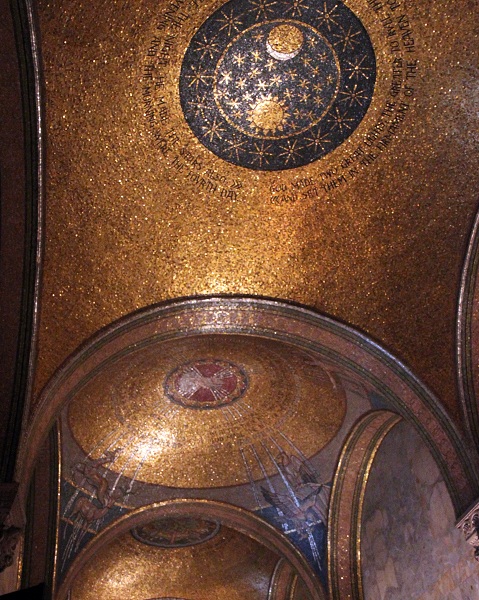
Mosaics in narthex of St. Bartholemew’s, New York, by Hildreth Meiere
Museum of Biblical Art
1865 Broadway
(at 61st Street)
New York, NY 10023
Finally, New York gets a chance to see the first exhibit on the work of an artist whose vast output is ubiquitous in and around this city – yet who has somehow until now not been seen fit for serious study. We have previously covered the Catholic artist Hildreth Meiere, her artistic achievement and the revival of interest in her work. Hers is an oeuvre that tens of thousands see but ignore daily. The concise exhibit at the Museum of Biblical Art offers an introduction to her work. That is difficult indeed in the case of an artist who concentrated on large scale public commissions – mosaics, murals, metalwork, windows – for churches and office buildings. What we see is a selection of sketches and models- including full scale mosaics – and then photographs of the finished works. Quite a few of these are in the city or its surroundings so the visitor can immediately follow up with field work of his own. St. Bart’s, Temple Emmanuel, Fordham University Chapel, St. Patrick’s Cathedral – Hildreth Meiere seems to have received commissions from everyone in the 1920’s – 1940’s. And those are only the religious commissions – the current exhibit does concentrate on this aspect of her work.
The exhibit does take us into some unfamiliar ground. Like the monumental former Passionist monastery of St. Michael which still towers over Union City (it is now in the hands of Korean Protestants). Meiere did a number of frescoes there and then contributed additional work after a disastrous fire in the 1930’s. These works depart from her usual manner of that period and seem inspired by the visionary style of Tiepolo. Then, there is the case made to house a book of remembrance in St Thomas, Fifth Avenue: the two angels adorning it are painted in the most classic Art Deco style but in almost surreal, glowing color. In addition to this case, a few altars are the only complete originals on display. These do include, however, two portable altar triptychs – part of a whole series painted for the US military chaplaincies during the Second World War. It seems that in those unenlightened pre-conciliar days it was felt that even masses in the field should be surrounded by at least some elements of beauty.
Artists will enjoy the detailed presentation of the various media in which the artist worked. Meiere was of course extremely sensitive to the requirements of the different techniques and materials. Consider, for example, her description of the effect of the changing sunlight during the course of the day on the appearance of a golden apse mosaic as being of the essence of this medium. We find that many of the mosaics pre-1939 and after World War II were in fact made to her requirements by a firm in bad old Germany. (The instructions on a diagram for installing the mosaics in the dome of the St. Louis cathedral are partially in German).
After World War II Hildreth Meiere still received commissions from some very prestigious clients: St. Bart’s again, St. Louis Cathedral, the Washington National Cathedral. It seems to me, though, that the élan of the earlier decades was lacking (although the colors of the St. Louis cathedral mosaics are marvelous!). Perhaps that was because in the post-war stampede to modernism her work had fallen out of the favor of the critics. But all who are interested today in the interaction of religion and art – and how these could be mutually enriching even as late as the 1940’s – should make it a point to visit this exhibit. And then get out and take a good look again at the marvelous but forgotten works in situ all about us!
6
Feb
The Vatican Insider (Giacomo Galeazzi) interviews “96 year old Archbishop Loris Francesco Capovilla, the right arm of John XXIII.” The Archbishop, rhapsodizing on John XXIII’s political accomplishments, states:
“If Obama is president today, it is also because in the 60’s Roncalli created the first black cardinal.”
How interesting, in the light of the current dispute over mandatory coverage for contraception! He may be a bit on in years, but the archbishop at least is honest in acknowledging the long term Catholic support, both of clergy and laity, both in and outside of the United States, that has made the Obama regime possible.
5
Feb
The Distribution of the Blest Candles.
Pictures of the Solemn Mass celebrated last Thursday for the feast of Candlemas……
The distribution of the blest candles to the congregation.
The procession.
The schola of St. Mary’s and the childrens’ schola.
Bill Riccio demonstrates a world-class incensation of the congregation.
Sunday, 5 February is Septuagesima Sunday. However, as is
permitted by the rubrics, this Sunday at St. Stanislaus Church
in New Haven, the Feast of the Purification of Our Lady,
or Candlemas, will be observed with a Blessing of Candles,
Procession, and High Mass at 2:00 P.M., to be celebrated
by The Rev. John Ringley, St. Mary, Norwalk.
Music for the service sung by the Chant Schola of the
Saint Gregory Society will include the “Missa Marialis” Ordinary
(Vatican Edition IX/X), the antiphons “Hodie beata Virgo,”
and “Senex puerum,” and the Gregorian chants for the Procession
and Mass of the Day.
1
Feb
31
Jan
The Feast of the Purification of the Blessed Virgin Mary (Candlemas)
Connecticut:
Blessing of Candles, Procession, & Solemn Mass
(Missale Romanum of 1962)
Thursday, 2 February 2012, 7:00 p.m. at St. Mary’s Church, Norwalk
Music: Prelude: Plein Jeu (Premième livre d’orgue) (Louis Marchand, 1669-1732)
At the blessing of candles: Lumen ad revelationem gentium (plainsong, mode viii)
At the procession: Adorna thalamum (plainsong, mode vi), etc.
Messe de Nostre Dame (Guillaume de Machaut, c.1300-1377)
Gregorian Mass of Candlemas: Suscepimus, Deus
Hymn at the Offertory: Ave maris stella (plainsong, mode i) [Student Schola]
Motet at the Communion: O quam glorifica (Trent Codex 87)
Postlude: Basse du Trompette (Cinquième livre d’orgue) (Marchand)
New York:
Solemn Mass at 6pm at the Church of the Holy Innocents (West 37th and Broadway, New York).
The Mass will be preceded by the solemn blessing and distribution of candles and the procession inside the church
New Jersey:
Thursday, February 2nd, at 7:00 PM at St. Anthony of Padua Oratory in West Orange : High Mass preceded by a procession and blessing of candles. Following Mass there will be a convivium downstairs with coffee and special Candlemas treats.
On Friday, February 3rd, at 7:00 p.m. there will be a First Friday Mass – Votive Mass of the Sacred Heart of Jesus with commemoration of the Feast of St. Blaise – followed by the blessing of throats.
St. Anthony of Padua Oratory, 1360 Pleasant Valley Way, West Orange,