There will be a Missa Cantata (Extraordinary Form) for the Feast of Our Lady of the Holy Rosary this Wednesday, October 7th at 6:15 pm at Church of the Holy Innocents, 128 W 37thStreet, New York, NY 10018, Fr. Thomas Kallumady, Pastor.

On Columbus Day, Monday October 12th at 9:30am, there will be a votive Mass in honor of the Blessed Virgin Mary at St. Mary Church, Norwalk. It will be a Solemn Mass in the Extraordinary Form, followed by a procession to the statue of Christopher Columbus in the Thomas C. O’Connor Park on West Avenue. Refreshments will follow in the parish hall afterwards.
In connection with this event, St. Mary’s Church is sponsoring an essay contest open to 7th and 8th graders: “Why Is Christopher Columbus Important For Us As Catholics?” Father Markey, pastor of Saint Mary Church, will give $500 to a student winner towards his or her Catholic School tuition, or religious education tuition. RULES OF COMPETITION:Essay must be HAND-WRITTEN by a 7th or 8th grader. Essay must be 3 or 4 paragraphs, (near 300 words).
Deadline for submission:5:00 PM, Thursday, October 8, 2009. Mail or drop off at St. Mary Parish Rectory 669 West Avenue, Norwalk CT 06850 Tel: (203) 866-5546.
Winner will be asked to read his or her essay on Columbus Day, October 12 at the foot of the Christopher Columbus statue and receive $500 tuition scholarship. (The winner is not required to be present October 12th)
If you have any questions, please call St. Mary’s at (203) 866-5546.
Published in Uncategorized | no comment

Last Saturday, the fourteenth annual Pilgrimage for the Restoration concluded with a Solemn High Mass at the Shrine of the North American Martyrs at Auriesville New York. For many marchers, this day was the culmination of a 65-mile march from Lake George to Auriesville. Others join the march at this time for the final 7 miles from the shrine of Bl. Kateri Tekakwitha at Fonda to Auriesville.
Over the last 14 years, the march has evolved. Whereas ten years ago some 225 Lake George marchers would be met by as many as 800 additional participants for the final day, last Saturday several hundred 65 – mile marchers were joined by only 50-100 additional pilgrims. The Mass, although celebrated with great dignity and care, was less elaborate in some respects ( the sermon, the music) than prior concluding liturgies.
On the other hand, what the march has lost in numbers it has gained in cohesiveness and organization. Participants are now overwhelmingly young people and young families with many children. It is the “long distance” pilgrims – some limping from various sprains and wounds- who now set the tone for the final day. The organization, too, is much more elaborate than in the past and more closely resembles that of the Chartres Pentecost March – the inspiration for the Pilgrimage for the Restoration. The pilgrims are grouped in various “brigades” (like the chapters in France) led by “field marshal.” Water, snacks, security, medical care and sanitary facilities are now provided in a very professional way along the final 7-mile stretch. As is usual for us on this side of the Atlantic, it is hard to resist the temptation to err on the side of over-organization: one could have done with fewer shouted orders and repetitive instructions on the obvious. That is, however, a quibble. Congratulations are due to the National Coalition of Clergy & Laity under the leadership of Mr. Gregory Lloyd for the successful organization of this event.
It is a shame that more Traditionalist Catholics do not join the pilgrimage at least for the last day. Perhaps it is understandable that they nowadays feel less of a need to travel to the wilds of Upstate New York to participate in a Solemn High Mass when such liturgies are now readily available – at the least in the greater New York area. More than ever, however, Traditionalists must seek out every opportunity to demonstrate the growing vitality of the movement. Perhaps if a Pontifical Mass concluded the pilgrimage…..

Early Saturday thick fog blanketed the area – it later lifted so the final stretch of the pilgrimage enjoyed almost perfect weather.

A pilgrim prays in the most mysterious and sacred part of the shrine – the Ravine where St. Isaac Jogues buried the body of his martyred companion, St. Rene Goupil.

The Auriesville shrine is a vast complex of buildings and statues ranging from the horrendous to earlier structures and statues which exist in harmony with the surrounding natural beauty.


The pilgrims – including many of the walking wounded – set out for the final seven miles.


This brigade illustrates the youth of most of the pilgrims and the presence of many religious sisters and priests as well.

Headcoverings for the women are now strongly advised. That and the prohibition of shorts distinguish this pilgrimage from its French model.


Fr. Andreas Hellmann of the Institute of Christ the King, celebrant.

Published in Uncategorized | no comment


The stained glass windows are of extraordinary quality and depict many events and saints rarely encountered in art of the Irish-dominated church in the United States.

I believe – subject to correction by experts- that this window shows St. Hedwig blessing her son Henry before going off to fight the Mongols in Silesia in 1241(he was annihilated). She was actually German (as were half the forces under her son’s command).


King John Sobieski before setting out to defeat the Turks before Vienna – no fashionable post-conciliar pacifism here.

“God save Poland!” – this church is rich in references to the unity of nationality and faith in Poland. It was the key to the survival of both nation and religion through so many vicissitudes of history.

Again, St Hedwig (Jadwiga). But this seems to be the 14th century Queen Jadwiga who was canonized only in 1997 – unless a tradition had already existed venerating her as a saint.
View more pictures of this Mass posted on this blog: link
Published in Uncategorized | 1 comment

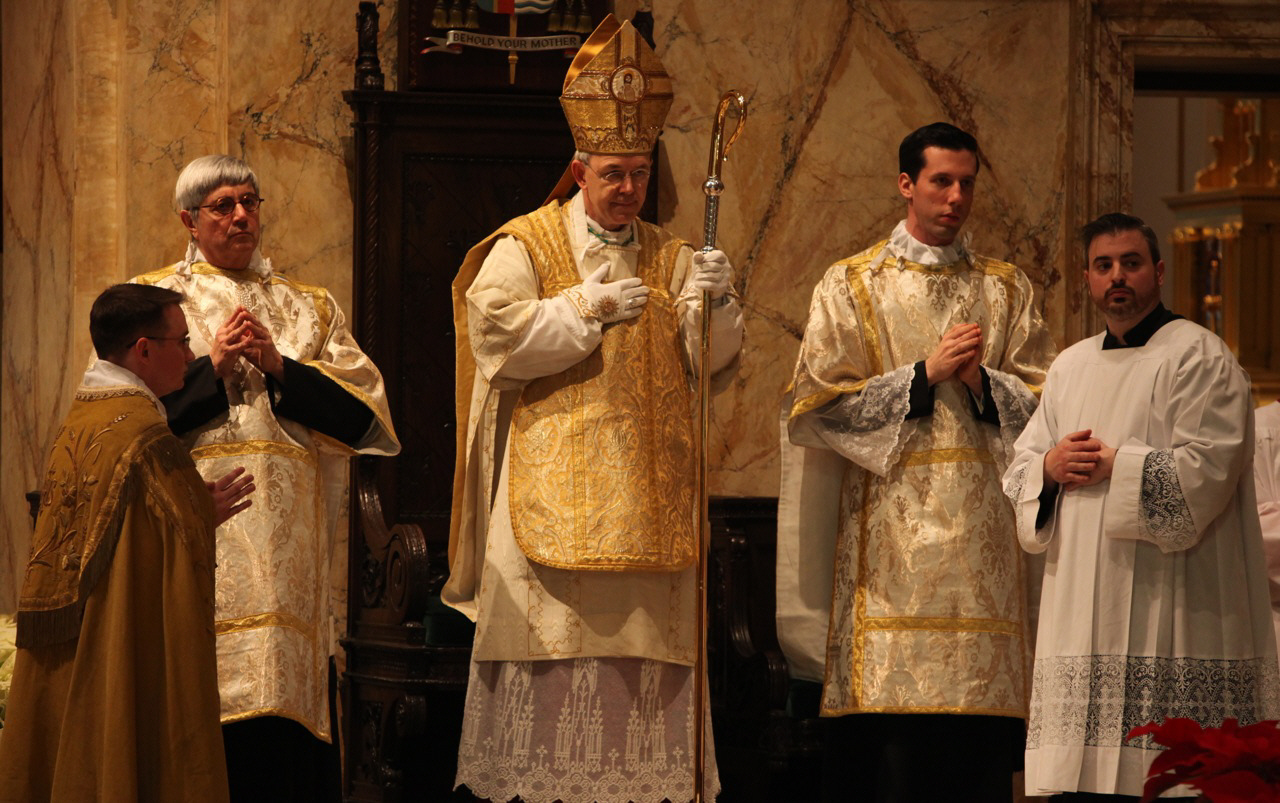
On Friday, September 18, the Society and St. Mary’s parish, Norwalk, CT sponsored a Solemn High Mass at the Church of Our Saviour on Park Avenue. Despite the rather early hour of 5:30 in the evening the liturgy was well attended. Afterwards, St. Mary’s parish held a fundraising reception and dinner in support of the restoration of the sanctuary of the church. It is a most ambitious plan to return the interior of this venerable church to its original splendor.


The ceremony and music of this liturgy were of great beauty – as always David Hughes and his Schola were magnificent. One extraordinary aspect of this Solemn Mass was that it was finished in exactly 47 minutes(dictated by scheduling limitations). I will leave up to the innumerable liturgical commentators of the web whether this constitutes some kind of record.

Afterwards, a reception and dinner were held in the august surroundings of the Union League Club.

Mr. Robert Monahan (right), organizer of this most successful evening, next to the “other” Dr. Robert Moynihan, the guest speaker (center).
Mr. Nicholas Salazar, Ph.D. candidate at Yale, introduced the evening, speaking movingly of his first encounters with the Traditional liturgy.

Robert Moynihan, editor of Inside the Vatican, spoke on the topic of Summorum Pontificum.

Duncan Stroik, architect of the planned renovations, attended.

Father Greg Markey spoke about the plans for the renovation of the Sanctuary of St. Mary’s.
Published in Uncategorized | no comment
by Eamon Duffy (Yale University Press, New Haven and London, 2009)

As he had promised, Prof. Eamon Duffy has addressed the era of the Catholic restoration under Queen Mary in his new book Fires of Faith: Catholic England under Queen Mary Tudor. We can say that all interested in the history of Catholicism in 16th century England have been eagerly awaiting this work. They will not be disappointed. I think, though, that two caveats are appropriate.
First, as Prof. Duffy himself emphasizes, this is not at all a general history of the reign of Queen Mary or even of the Catholic restoration under Queen Mary. Rather, Duffy concentrates on several limited if very important topics: the role of Cardinal Pole, the relation of the Marian restoration to the Catholic Counterreformation, the role of preaching and publicity and of course, the burnings of heretics. One unfortunate side effect of the book’s selective nature is that the length of text devoted to the campaign against heresy subtly undercuts the author’s attempt to prove that Queen Mary’s policy of repression was more than mere reliance on physical force.
Second, although well written and accessible to the non-specialist public, this short work presupposes that the reader possesses a detailed knowledge of English and European history and religion in the period 1530-1570. Given the present state of education, that is certainly a shaky assumption at least on this side of the Atlantic. For example, this book refers in passing several times to the fact that Philip II of Spain was the husband of Queen Mary: that may come as a surprise to the average reader. Duffy also seems to assume the reader has some familiarity with Cardinal Pole’s interaction with the Council of Trent and with several Popes – including “mad, bad” Paul IV.
Within its stated scope, though, Fires of Faith is superb. Perhaps its greatest accomplishment is to bring clarity to the personality and role of Cardinal Pole. He stands out as the guiding figure of the restoration, providing direction Queen Mary at almost every step – including the actions against heretics. Cardinal Pole drew on the early Catholic Counter Reformation for his policies; the measures of Queen Mary in turn served as a model for subsequent actions on the continent.
The religious regime of Queen Mary is shown to have had strong intellectual underpinnings. The queen and her advisors were well aware of the necessity of good preaching and of “publicity.” They took great pains to make sure that clear explanations of the restored faith were disseminated throughout the country.
This regime included the burnings. Prof, Duffy dutifully and on several occasions asserts his own horror at killing others for their faith – so incomprehensible to modern man. I don’t think Prof. Duffy needs to be so defensive before contemporary public opinion. It seems to me that modern man is preeminently qualified to understand drastic actions against a hated and feared enemy. After all, leaving aside the actions of 20th century totalitarian states, which everyone (now) condemns, the bombings of Hiroshima, Tokyo, Hamburg and Dresden are routinely praised and justified to the present day. Moreover, these atrocities involved the burning of tens and hundreds of thousands of people who were almost all “innocent” in contrast to the few hundred punished with death under Mary.
Duffy takes us through the process of the repression of heresy in detail: the search for the heretics, the trials, the unsettling details of the burnings and their accompanying “theater” of denunciation, preaching and crowd participation (either support or condemnation). It is evident from Duffy’s narrative that almost all those condemned were guilty as charged -the judges often bent over backwards to avoid imposing punishment . It is also clear from the location and class of the victims that Protestantism still was the faith of a distinct minority in England of the 1550’s.
What, however, is the significance of the experience of the Marian restoration for the Catholic today? Especially for the Traditionalist Catholic, who, with some justification, views the actions of the present pontificate as the start of a restoration of the integral Catholic faith? The comparison may be disappointing for Traditionalists. Queen Mary, Cardinal Pole and their associates had a comprehensive vision for restoration. In just 5 years, they succeeded at least in initiating the implementation of almost all these measures – and is some cases much more than that. Liturgical, musical and artistic renewal was of course critical. The Marian restoration, however, also entailed the complete rebuilding of the personnel of the two universities. In a process of careful selection, the episcopate and other key ecclesiastical positions were renewed with trained theologians instead of lawyers and politicians. These actions bore fruit in the years of repression that followed under Elizabeth. As noted, great pains were taken to disseminate sermons and other materials with which the clergy could explain the restored religion. As we have see, of course, there also were firm sanctions against open dissenters.
We have seen little of this yet under Pope Benedict. The Pope has undoubtedly imitated a dramatic renewal of the liturgy. He has reemphasized the role of beauty, art and music. In the liturgy, as in other areas, Pope Benedict has emphasized the “hermeneutic of continuity” though his own preaching and writing.
On the other hand, no effort has been made to change the direction or composition of the episcopate or the Vatican. Reform of Catholic universities and religious orders is nonexistent. The message of Pope Benedict is often lost in a mass of confusing and contradictory actions and statements by the hierarchy and the Vatican itself. Finally, I would agree that we are far removed from an era of capital punishment for heresy, but unacceptable statements by scholars, bishops, cardinals, functionaries of the Vatican and even members of the pope’s own personal staff meet hardly ever with verbal reproof – let alone removal from positions of authority.
The Marian restoration did not survive the nearly simultaneous death of Queen Mary and Cardinal Pole. Yet the consequences of their renewal of the hierarchy and the universities laid the foundation for Catholic recusancy under Elizabeth. Their abortive restoration served as the blueprint for the more permanent achievements of other actors in the emerging Catholic restoration. It was in the much-maligned reign of Queen Mary that the Catholic Counter Reformation first acquired definite form.
(Professor Duffy will be speaking at Yale University today on the subject of this book).
Published in Book Reviews | no comment
Churches of New York
Holy Roman Empire
Website Highlights
Archives
[powr-hit-counter label="2775648"]