


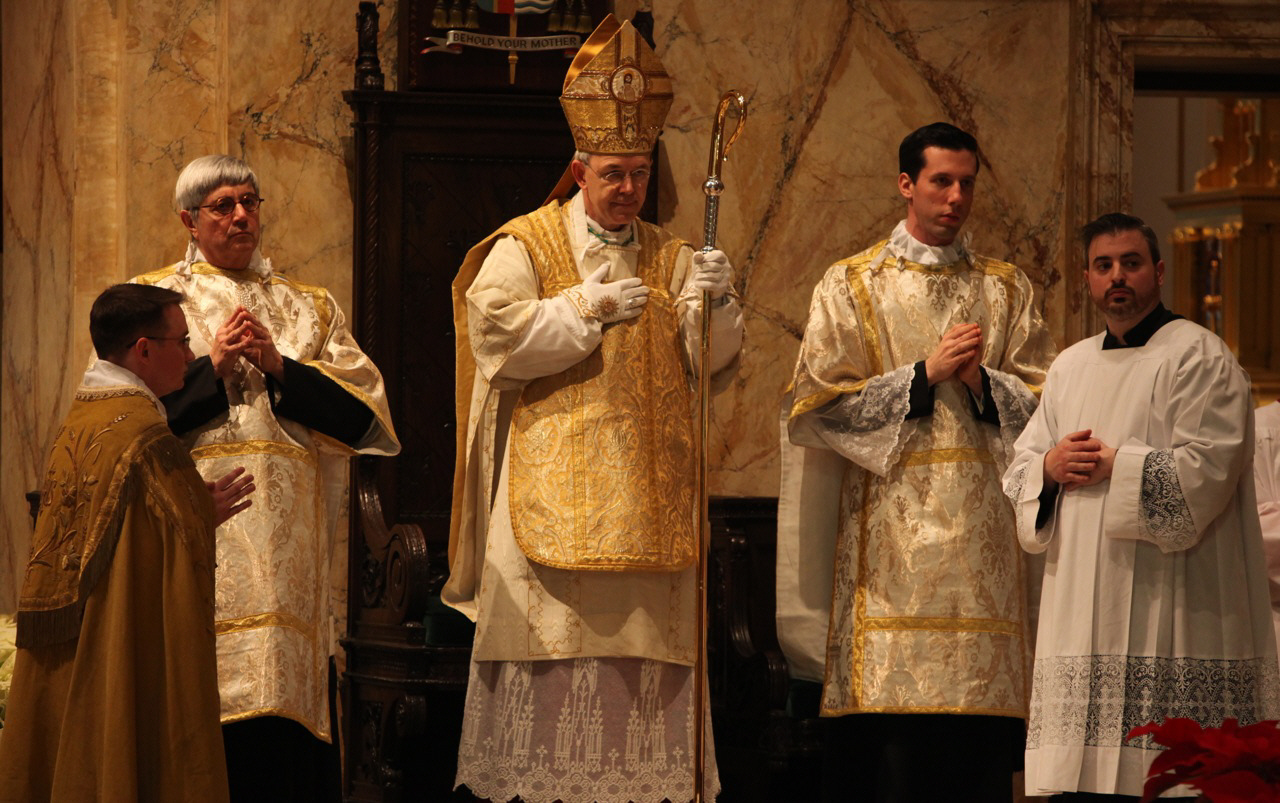
On Monday, July 20, a Solemn Requiem Mass was celebrated at St. Mary’s, Norwalk, on the anniversary of the death of Fr. Keven. P. Fitzpatrick, a devoted friend of the Traditional liturgy.

Augustus Welby Pugin
Designer of the British Houses of Parliament
The Victorian Quest for a Liturgical Architecture
by Christabel Powell
(The Edwin Mellon Press, Lewiston/Queenston/Lampeter 2006)
Rosemary Hill’s elegantly produced and written 2007 biography God’s Architect: Pugin and the Building of Romantic Britain successfully made the case for Pugin as architect, artist and designer. (See my review on this website, link) Yet, her presentation of Pugin left a feeling of incompleteness. She portrays Pugin as eccentric, irrational and belligerent, his work unmotivated. Pugin’s personality, as depicted by Hill, captures our attention – but, like one of the more extreme characters in Dickens’ novels, he and his ideas, although entertaining, seem hardly relevant for any purpose today.
Christabel Powell remedies that deficiency in Augustus Welby Pugin …The Victorian Quest for a Liturgical Architecture. The format of this book is far less polished than that of Hill’s biography – more like that of a private printing. The price demanded is formidable: $129.95. The author’s style tends to the academic. Yet, Powell succeeds in creating a far more credible portrait of Pugin the thinker. She concentrates not so much on the art of Pugin but on his intellectual development as evidenced in his written works and correspondence.
Pugin’s art rested on impressive intellectual foundations – especially on his continued study on the relation among architecture, symbolism and liturgy. His reading was prodigious – almost unimaginable in this age of superficiality: historians of medieval and reformation times, works on architecture from all ages, church fathers and original manuscripts. Indeed, given Pugin’s intense study of original sources, Powell thinks that he can be considered a pioneer of the historical-critical method in England!
Pugin made his views on art, religion and economics known in a series of plainspoken treatises –sometimes combined with very effective illustrations. English Catholics were a small minority in an often extremely hostile environment, yet Pugin did not engage in noncommittal “dialogue” but confronted issues head on. That did not endear him to Protestants or his more timid fellow Catholics. Pugin, however, never aimed to win a popularity contest in the eyes of public opinion.
Pugin came to the understanding that ecclesiastical architecture must reflect the liturgy. He declared contemporary neoclassical architecture to be unsuitable for the Christian religion because the temples it copied had had another cultic purpose, their decoration comprised of symbols vested with non-Christian meanings. The Christian architecture of the Middle ages was similar everywhere because it reflected the same cult. Indeed, Pugin’s ideas ranged beyond his beloved Gothic – he was by no means purely a Gothic revivalist. For Pugin, the true liturgy had brought forth a true architecture in earlier ages as well – and an architecture inspired by the Faith could even make use of modern industrial technology.
This liturgical focus of Pugin is most evident in the famous dispute over rood screens. Pugin’s championing of the screen was neither mere antiquarianism nor eccentricity but the product of deep reflection on the nature of liturgy backed by extensive historical research. As in her treatment of Pugin’s other writings, one of the author’s main achievements is a summary of the sources Pugin drew upon for his magnum opus on this topic. Starting with the Early Christian and Byzantine eras, Pugin argued for the existence from earliest times of a barrier between the “sanctuary” and the rest of the church. He specifically clashed with the “Oratorian” arrangement of a simplified sanctuary designed to make the entire liturgy visible to the faithful.
This, of course, stirred lively controversy at the time. Powell makes the case for Pugin as a “liberal ultramontane” as opposed to the strict Ultramontanes who favored more Italianate architectural approaches. The “Ultramontane” rigorists fought fiercely for a church architecture that was simple, direct and open to the gaze of the faithful. Contrary to claims that the 19th century romantics or liberal Catholics were the forerunners of 20th century Catholic progressivism, it was in fact the Ultramontane wing of the church that started developing ideas leading to the “liturgical movement “ in art and liturgy and, ultimately, to Vatican II.
Newman, of course, was an Oratorian and ended up a definite adversary of Pugin on the issue of “skreens” (as he called them). Moreover, Newman had a distinct liking for the Italianate architecture that Pugin despised. Powell’s book has the merit of analyzing in detail Pugin’s correspondence with Newman and showing how their originally cordial relations deteriorated. The failure of the Tractarian movement’s initial promise of a general return of the Church of England to Catholicism was a great tragedy for Pugin.
Powell’s study clears up other issues and controversies regarding Pugin, his ideas and art – almost all of which had been resolved to Pugin’s detriment in other works.
There are some aspects of this book, however, that would have benefited from further clarification. The title raises expectations of a renewed discussion of Pugin’s role in building the Houses of Parliament that fails to materialize. I would have appreciated more direct illustrations of the influence of Pugin’s ideas on his existing architecture. The author at certain points weaves in and out of the views of Pugin, his sources, subsequent authorities and the modern scholarly consensus in a way I found difficult to follow.
These are, however, quibbles in view of the author’s overall achievement. This work is a major step forward in understanding the objective intellectual and spiritual basis of Pugin’s art. I would commend it to any student of Pugin, liturgical architecture or 19th century English Catholicism.
Published in Book Reviews | 1 comment


This evening a Missa Cantata was celebrated at St. Gabriel’s, Stamford in honor of Our Lady of Mt Carmel. The pastor, Fr. Cyprian LaPastina, was the celebrant and deacon Aaron Huberfeld of the Institute of Christ the King preached. It was instructive to experience how effective the Traditional liturgy can be in the more intimate setting of this church. Those familiar with this church will note that the sanctuary can be adapted for both the Traditional and Novus Ordo masses. Some aspects of this ceremony might raise eyebrows among liturgical purists. For example, to simply read the epistle and gospel in English (on shaky authority)while surrounding them with Latin chant downgrades the liturgical and aesthetic impact of the readings. And it seems questionable to chant a hymn during the reading of the last gospel. Nevertheless, it was an impressive start (or rather restarting) of the celebration of the Traditional Mass at this parish.


The new, classical chapel. Another impressive addition by the pastor to an ungainly building that was a originally a gymnasium.
Published in Uncategorized | 4 comments

Our friends of the St. Gregory Society sent the following announcement:
We are pleased to inform you of wonderful news. Thanks to the good offices of The Most Reverend Henry J. Mansell, Archbishop of Hartford, the Latin Mass will soon have a new home at St. Stanislaus Church in central New Haven.
As many of our members and friends have known for some time, New Haven’s Sacred Heart Church, which has been the home of the traditional Latin Masses celebrated for our Society since its inception in 1985, is scheduled to close in the very near future. We take this opportunity to express our deepest thanks to The Reverend James Richardson and the Parish of Sacred Heart Church for twenty-four years of hospitality and support. We express our special gratitude to Fr. Richardson for his willingness in recent years to celebrate the old Mass, often at but a moment’s notice, to ensure the stability of our schedule. We would be remiss if we did not offer our sincere thanks to Frs. Robert Newman, James Smith and Robert Ladish, who were brave pastors in making Sacred Heart Church available for the celebration of the old liturgy before its recent, more widespread acceptance. Our gratitude to them can never be fully expressed.
Aware that the closure of Sacred Heart Church is imminent, the Officers of the Society wrote to the Most Reverend Henry J. Mansell, Archbishop of Harford, late in the spring expressing the concern that when the church closed, the members and friends of the Society who have faithfully attended the Latin Masses there would be without a home. In his gracious response dated 23 June, Archbishop Mansell explained that he had consulted with clergy in the New Haven Deanery, and that The Reverend Roman Kmiec, C.M., pastor of St. Stanislaus Church in New Haven, had offered his church as a new home for the Latin Mass in our community.
The Co-chairmen and Vice-chairman of the Society met with Fr. Kmiec on 10 July. After a discussion of the history of the Society and an examination of the church with regard to its suitability for the celebration of the old liturgy, Fr. Kmiec extended his generous invitation to the Society to make St. Stanislaus its new home. We accepted without hesitation since the opportunity presents so many benefits to the life of our group.
Located close to the center of New Haven at the intersection of State and Eld Streets, St. Stanislaus is an imposing edifice in the Baroque style, whose construction was begun in 1901 by Polish craftsmen and artisans from the old country. Served by priests of the Congregatio Missionis, founded by St. Vincent de Paul in 1625 (commonly known as the Vincentians), the people of St. Stanislaus are strongly traditional in Catholic faith and practice, a number of them desirous of the return of the older liturgy to their parish. The beautifully decorated church interior remains essentially the same since the day of its consecration and thus ideally suited for the celebration of the traditional rites.
Relocation will require considerable planning and hard work on the part of the Society’s Executive Committee and our members. With Fr. Kmiec we agreed on September 13 as the date on which the first Latin Mass will be celebrated at St. Stanislaus. Falling on the eve of the Feast of the Exaltation of the Holy Cross (September 14th) this date is most appropriate, since it is the second anniversary of the implementation of Our Holy Father Pope Benedict XVI’s Motu proprio Summorum Pontificum. So we are pleased to announce a festive celebration of that feast with Solemn Mass and Benediction on Sunday, 13 September at 2:00 pm. We exhort our members and friends to mark this date on their calendars, to plan to attend the service with family and friends, and to offer prayers of thanksgiving for what promises to be a stimulus for an exhilarating new era in the life of the Saint Gregory Society.
photo courtesy of the St. Gregory Society
Published in Uncategorized | 2 comments

Fr. Greg Markey, pastor of St. Mary Church, Norwalk, is currently on a pilgrimage, walking the famous Camino a Santiago de Compostela. He is on a 40 day sabbatical, granted to him by Bishop Lori, after his first 10 years in the priesthood. He has chosen to spend his sabbatical walking the 500 mile road to Santiago de Compostela, planning to arrive at the famous shrine to St. James on his feast day, July 25. He is keeping his parishioners up-to-date with his progress through weekly reports, which are reproduced on the parish website. We post below an excerpt from his third installation. His account of his journey can be followed on http://www.stmarynorwalk.net/ (go to “From the Pastor”)
July 8, 2009
El Camino De Santiago – Part III
There are so many stories that I would like to tell but I there is not enough time. Furthermore I find that English cannot properly express all of the nuances of the Spanish language. Spanish is a language that is more expressive, speaking more with the heart, but I think you will get the point.
Earlier on the trip I was entering a village after a full day of walking and I began looking for the hostel. None of the them look the same, and some of them are in strange places. Perhaps it was because of the hot sun and the long day, but I wandered into this farmhouse where there were four scruffy men in their 60’s sitting and talking. I asked them if this was the hostel, and they laughed and said no. They saw my flag and asked if I was American doing the Camino. I answered, “Yes, thanks be to God.” One of them answered, “God? Bah! He has nothing to do with it.” It was clear that I was talking to non-believers.
After a few minutes of small talk they asked me if I wanted something to drink and I quickly answered yes. One said, “Do you want water or wine. We know that you priests like wine!”, and they all started to laugh. It was harmless enough and I laughed too. “I will take the water, thank you.”
One of them brought me a tall glass of cold water and I finished it. It tasted great. I said to him, “Surely you will not lose your reward in heaven for the water.” They immediately stopped talking. One of them looked at me intently and said, “What do you mean?” I answered, “Christ says in the Scriptures that anyone who gives even a glass of water to one of His disciples will not lose his reward in heaven.” They then began to argue among themselves, “Why does he get the reward? I help too…” They began to argue among themselves as to who would receive the reward and I just sat back and watched. The face of the man who gave me the water changed. He looked bright and happy, like a child. Finally they were all very helpful in directing me to the local hostel. I think the Lord wanted me to enter that farmhouse.
On day 12 I left Villafranca in Castille and Brother Ass was once again not cooperating. It was about an 8 mile walk to the next town of San Juan de Ortega, and the feet were full of blisters. While most people have 2 or 3 blisters, I had a dozen at this point. I had already switched out of my boots into sandals, but now there were other problems with the sandals. Every step over the rocky terrain was painful and had to be measured carefully. I was considering that perhaps the Camino was coming to a close for me.
I walked most of this journey with some of the very few Americans I have met, two ladies from Ohio. One these is a Spanish teacher, and we discussed Spanish history and language.
When we arrived into this sleepy village, I went into the church and knelt down to pray in this small stark gothic church. “Lord have mercy on me, a sinner.” I prayed my office and laudes, and felt a bit renewed. I returned to the cafe where many of the fellow travelers were for a cafe con leche.
As the day continued I had to climb a mountain peak, Cruciero. It was very rocky and Brother Ass was telling me that he did not think he could do another three weeks of this. I began to have doubts about finishing the Camino again. I had a long heart to heart conversation with the Lord asking the age old question, “Why am I suffering so much?” Every step had terrible pain in it. Why was I doing this Camino anyhow?
I was doing the Camino in honor of my ten years as a priest and I was hoping that it would be an opportunity to explore more closely the rich Catholic history of Spain. I looked forward to being away from the normal responsibilities of parish life, praying in their ancient churches, and peacefully walking through the hills of Spain. I knew that there would be sacrifices and I would offer it up to thank God for the blessings of these years, in reparation for my many failures as a priest, and for the current intentions of my ministry. Yet it had become more than I anticipated. For over a week now the Camino had become more an hourly test of endurance than an inspiration to my life, and I really did not know if I could finish it.
In reflecting deeper I realized that I also wanted to do the Camino to grow in faith. I wanted to purify my faith so that being Catholic would be for me more than a club to which I belonged, or a set of intellectual ideas to which I subscribed.
In his book, Introduction to Christianity, Pope Benedict writes: “Christianity is not a system of knowledge but a way….Christian belief offers truth as a way, and only by becoming a way has it become man’s truth. Truth as mere perception, as mere idea, remains bereft of force; it only becomes man’s truth as a way which makes a claim on him, which he can and must tread.” The Camino is this way.
How does this happen? Because on the Camino there are no more pretenses, and it wears everyone down, even to the point of revealing our hidden faults. For example the Pope writes that the current climate we live in has conditioned many of us to limit our ability to have faith, “…for the most part unconsciously.” How do we break through our strict self-reliance, the illusion that I am actually in control of my life? He answers, “(Man) can only be liberated by allowing himself to be liberated, and by ceasing to try to rely on himself.” If there is a powerful lesson on the Camino, it is that I am no longer in control, and just when I have no more strength, and no more options, He catches me, reminding me that He is ultimately in control.
When I arrived at the mountain peak there was a tall cross about 25 feet tall made out two tree trunks, held up by boulders. I walked a little further, and sat down to do midday prayer. I looked west and could see far off in the distance the historic city of Burgos. To visit the famous Cathedral of Burgos was for me one of the major hopes of this trip. At the end of reciting the psalms I peared out towards Burgos, and I felt an wonderful inspiration: Go to have Mass in Burgos today!
This was no easy suggestion. I had already completed 12 miles today, and the destination village for the day was at the base of the mountain, about 2 miles beyond. I did not know how many miles it was to Burgos, but at least another 8 or 9 miles. Nonetheless I had still not offered Mass, and yesterday I had to offer Mass in the hostel, which is somewhat restrictive. Tonight I would probably have to do the same, which was hard to bear. However, if I went to Burgos, I could have the evening Mass in one the most beautiful Cathedrals in all of Europe! The sun was not too hot, there was a cool breeze, and most importantly, my feet had stopped throbbing.
I then made a deal with Brother Ass: If you get me to Burgos today, I will give you the day off tomorrow. No walking tomorrow. It was a deal. After so many hours of being horribly self consumed, the thought of offering Mass in the Cathedral of Burgos tonight had changed everything. It was the most inspired I had felt on the Camino up to this point. I was joyful with the wind under my wings.
Published in Essays | no comment

Fr. G. Fluet will be offering a low Mass in the Extraordinary Form at Saint Bridget of Kildare in Moodus on the Feast of Our Lady of Mount Carmel July 16 at 7:30 AM (morning).
There will be a Solemn High Mass in the Extraordinary Form for the Feast of Our Lady of Mt. Carmel at St. Gabriel Church in Stamford, CT on Thursday, July 16th at 7:30 pm.
Deacon Aaron Huberfeld of the Institute of Christ the King will preach, and the music will be conducted by Scott Turkington. St. Gabriel Church is located at 914 Newfield Ave.
There will be a Solemn High Mass at Our Lady of Mt. Carmel Church, 259 Oliver St., Newark, NJ, in honor of Our Lady of Mt. Carmel, at 12pm Noon, Thursday, July 16th. Monsignor Joseph Ambrosio will be the celebrant.
A procession will follow with Italian marching band through the streets of the Ironbound district with house visits. The phone number of the church is 973-589-2090.
There will be a celebration of the Extraordinary Rite of Holy Mass on Thursday, July 16th for the Feast of Our Lady of Mt. Carmel at Our Lady of Mt. Carmel Church on 627 East 187th Street, Bronx, New York at 7:30pm. Fr. Nikolin Pergjini will be the celebrant. It will be a sung Mass [Missa Cantata.] For more information please contact the church at (718 ) 295-3770. After Mass celebrate the feast day at the church’s annual outdoor festival with good food and drink!
PLEASE LET US KNOW OF OTHER TRADITIONAL MASSES ON THIS FEAST!
Published in Uncategorized | 1 comment


On Sunday, June 28, Mr.Christopher Check addressed a large audience AT St. Mary’s parish Norwalk on the Knights Templar: their origin, life rule and ultimate demise. Mr. Check is executive vice president of the Rockford institute, the publisher of Chronicles magazine – a publication with which every thinking Catholic should become familiar. His lecture was doubly interesting in that was not an account of stirring battles but rather concentrated the historical and theological basis fro the foundation of the order, its rule and its tragic end. Yet as portrayed by the speaker the story was as engrossing as any tale of action or adventure. Mr. Check was obviously – and quite correctly – an advocate of the rightness of the soldier-monk concept and of Crusading in general. The destruction of the Templars was fro him an act of villainy and cowardice. I am not so sure I can follow the speaker totally here. Nor was there discussion of recent contrary views (such as those of John Paul II) on the subject of taking up arms for Christ. But it was an overwhelmingly impressive presentation of an often misrepresented aspect of the past for which Catholics today should be proud.
Published in Uncategorized | no comment
7
Jul

The blog Vultus Christi on the feast of the holy abbots of Cluny (including St Hugh):
Published in Uncategorized | no comment

From “Athanasius” by Joseph Goerres(G. Joseph Manz, Regensburg 1838) – On the situation of the clergy of the Catholic Church in Germany from around 1780 to 1810:
That so many collaborators (in the work of separating the German Catholic Church from Rome and subjecting her to secular authority – Trans.) were found among the clergy made manifest a deeply rooted and widespread evil. An evil that had been running rampant not just since yesterday and which affords a saddening and depressing phenomenon that Justice will not permit to be passed over in silence. It can neither be hidden nor denied that many members of this clergy even in the immediately preceding times and before the start of this period’s upheavals had surrendered to an ever increasing slackness – both en masse in many of its noblest institutions and individually in many of its representatives. This led even then to the following. Just as the clergy heedlessly went in and out of cathedrals that the zeal of their fathers had built for their faith; just as they considered as only old junk the images with which their fathers’ artistic hand had decorated the interior of those churches, so did they have hardly an inkling any more of the rich treasure which they had been called to guard and hand down. By the side of a dying generation that sought to preserve the last remnants of the old living Tradition with the earlier seriousness and the ancient rigor there arose a new generation that minimized those remnants. They talked themselves into believing that the earnestness previously directed to Tradition was sinister monkery, that strictness was just useless troubling of oneself. Declaring both no longer appropriate for the times, they sought all kind of compromises with the age.
Protestantism stood before them as a shining exemplar: one only had to imitate it in order to rejuvenate antiquated circumstances in a quick transformation. They commenced a work, which in the beginning, regardless of its essence, still had to be carried out within the bounds of propriety and honor. First, they proceeded against dogma. This dealt with so many things the understanding of which had been lost in the increasing shallowness of the age. Now, it was declared incomprehensible and as such expelled from the domain of the only things worth knowing. (…) The ancient doctrine had poured its inner richness into a mass of such formalities, which also formed a barrier against the world. Now, however, as along with the inner nucleus the extremities grew cold, these too were given up, and, when advisable, eliminated as superfluous. Thus, after the tall castle in the center had been evacuated the outer ramparts found themselves abandoned. Doctrine was limited to the middle ground, to the active life and completely secularized by this simplistic limitation.
They proceeded in the same way against discipline. Here too the sense for the importance of asceticism had totally disappeared. The conviction of its unavoidable necessity for the cleric had been completely lost. The ancient rigor thus appeared as only an unforgivable harshness against nature, which like every exaggeration led, instead of to its goal, to the revolt of the one so maltreated. Thus, they were inclined everywhere to liberate oppressed nature; everywhere the tightly drawn bonds of discipline were loosened and in part broken. At the same time even in public services, the old multi-folded toga had to yield to the comfortable chlamys. This spread from the practice of individuals to that of institutions. The rules of the orders and the traditions were relaxed everywhere throughout every rank of the clerical estate. Lax observance was introduced everywhere in place of the strict. Soon the offspring were brought up in it in the seminaries….
(pp. 119-121, my translation)
“Athanasius” was Joseph Goerres’ powerful defense of the archbishop of Cologne, who had been persecuted by the Prussian state for defending Catholic marriage. His description of the German clergy of the enlightenment may strike a familiar note for contemporary readers, especially after some recent events in that country and Austria.
Published in Uncategorized | no comment
Churches of New York
Holy Roman Empire
Website Highlights
Archives
[powr-hit-counter label="2775648"]