27
Oct
27
Oct
27
Oct
From the report of the Polish bishops of their ad limina visit:
On the one hand, the congregation admitted that the matter was resolved too harshly and that instead of serving unity, in individual cases, it could lead to someone leaving the Church because his needs were not met. On the other hand, the will to interpret the motu proprio broadly was expressed – more in spirit than in the letter of the issued law.
Today Pope Francis in no uncertain terms indicates what is the spirit of Traditionis Custodes and, for that matter, that of the current regime in the Roman Catholic Church. What follows are excerpts from his address at the general audience of 10/27/2021 – at which, so the Vatican reports, a significant number of American groups were present.
Saint Paul’s preaching is completely centred on Jesus and his Paschal Mystery. In fact, the Apostle presents himself as a witness of Christ, and Christ crucified (cfr. 1 Cor 2:2). He reminds the Galatians, tempted to base their religiosity on the observance of precepts and traditions, that the centre of salvation and faith is the death and resurrection of the Lord.
Today, there are many who still seek religious security rather than the living and true God, focusing on rituals and precepts instead of embracing God’s love with their whole being. And this is the temptation of the new fundamentalists, isn’t it? Of those who seem to be afraid to make progress, and who regress because they feel more secure: they seek the security of God and not the God of our security…. This is why Paul asks the Galatians to return to what is essential – to return to God, to the essential, not to the securities of God: to the essential – to the God who gives us life in Christ crucified.
And those who seek security, the small group, the things that were clear as they were back then, they live “as it was back then”, they distance themselves from the Spirit, they do not permit the freedom of the Spirit to enter into them.
Sometimes, those who approach the Church get the impression that they are dealing with a dense mass of rules and regulations: but no, this is not the Church! This can be whatever association. But, in reality, the beauty of faith in Jesus Christ cannot be grasped on the basis of so many commandments or of a moral vision developed in many layers which can make us forget the original fruitfulness of love nourished by prayer from which peace and joyful witness flow.
General Audience of 10/27/2021.
I could write at length about these calumnies – since when in the post-Vatican II world has choosing to follow the traditional rites achieved “security” under any definition for any Catholic? Certainly not institutional security: traditionalists have neither job prospects in the bureaucracy of the Church nor any assurance that any of their congregations has permanent status! But more importantly, I believe the Pope is clearly asserting that “fundamentalists” (a code word, like, in the past, “integralist,” often used by the Vatican and the European Catholic churches for traditionalists) are not even Christians. 1) It establishes a fearful hermeneutic for Traditionis Custodes.
26
Oct
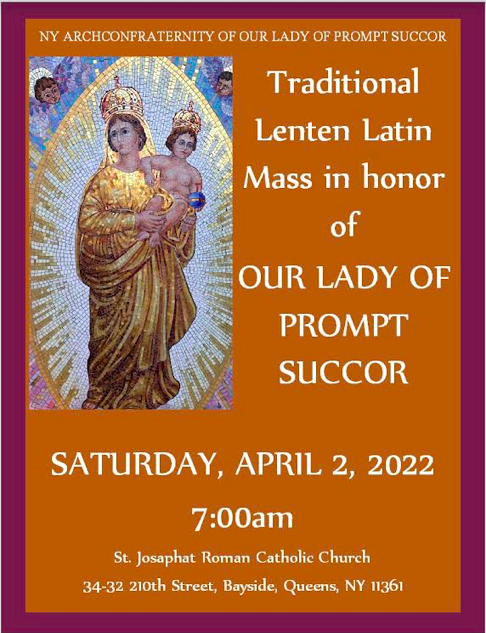
These Masses will be offered at St. Rocco’s Church in Glen Cove, Long Island.
Sunday, Oct 31 Feast of the Kingship of Our Lord Jesus Christ at 11:30am (as usual)
Monday, Nov 1 Solemnity of All Saints Mass at 7 pm
Tuesday, Nov 2 All Souls (Requiem) Mass at 7 pm
25
Oct

A nationality that once was extraordinarily prominent in the United States but has largely disappeared from view are the Germans. We recently had the opportunity to visit Cincinnati, one of the centers of German and specifically German Catholic immigration in the 19th century. These Catholics left their mark in a series of impressive churches. Two of these, Sacred Heart and Old St. Mary’s, are served by the Oratory of St. Philip Neri. We’ve recently read of drastic parish reductions to be imposed in the Cincinnati Archdiocese – we will say more about this later. Unless I am misreading the map of the proposed changes, however, these two churches will remain unaffected.

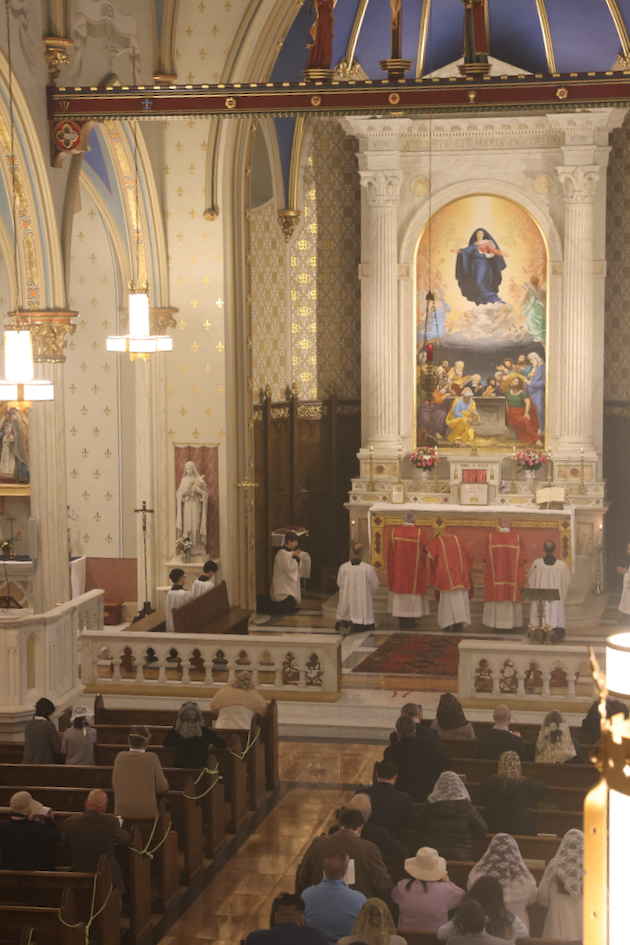
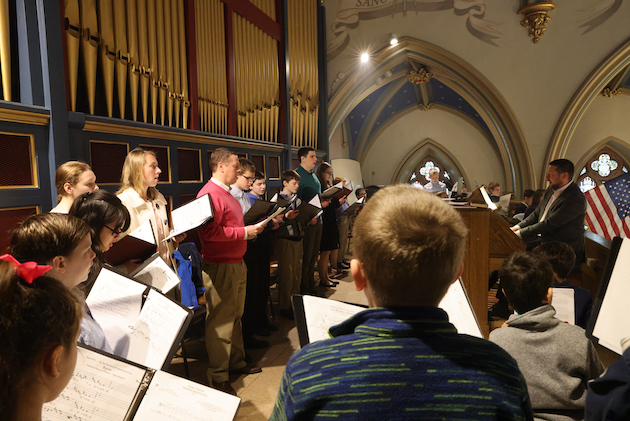
We attended Traditional Sung Mass at Sacred Heart Church. The church was completely full and the music was impressive.


Sacred Heart is well preserved – but the above photo shows the decoration was once much more elaborate. The parish has an ongoing project to restore the interior decoration. See CHURCH HISTORY for photos.

Old St. Mary’s church, ot the Marienkirche, is the oldest house of worship still standing in Cincinnati. It was founded by the German immigrants in 1841 – the cornerstone was laid on March 25, 1841 (the Feast of the Annunciation) and it was consecrated in 1842. It also is in the care of the Oratorian Fathers. The Traditional Mass is also offered here.


Across the river, Covington, Kentucky was also a center of German Catholicism. Their main legacy is the Mother of God parish church (Mutter Gottes Kirche) whose twin towers preside over an old neighborhood called the Mutter Gottes historic district. The interior is magnificently decorated – unfortunately the church was closed at the time of our visit.


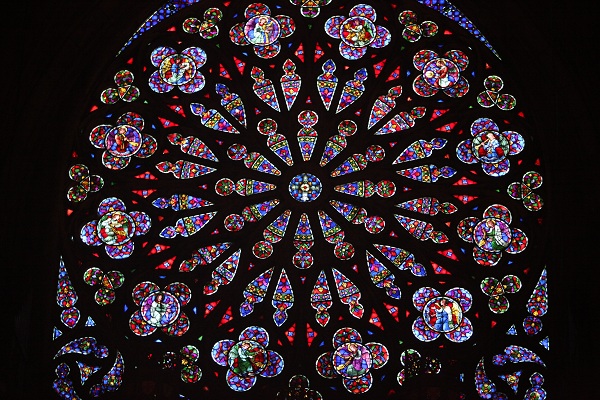
A final monument to German Catholicism is Covington Cathedral( St. Mary’s Cathedral Basilica of the Assumption). This church, as we see it today, was finished by 1915. Now the bishop who built it, Paul Maes, was a native of Belgium, and the exterior (below) is a strange copy of Notre Dame of Paris. But the interior is dominated by one of the most complete sets of stained glass by Mayer studios of Munich to be found in the United States. Perhaps only Sacred Heart Cathedral in Newark has more such windows – but, installed after 1945, these are in a style which, if still beautiful, is no longer the classic Mayer pattern.
The Covington cathedral windows are impressive not just for their number but also for their size, culminating in three unusual depictions of the council of Ephesus and two Papal decrees. The window of the Council of Ephesus and of the Coronation of the Virgin is reputedly the largest handmade stained glass window in the United States.


25
Oct
25
Oct
A report from the ad limina visit of the Polish bishops. In discussions with the “Congregation for the Liturgy” (presumably the Congegation for Divine Worship), it was conceded that “the affair (of Traditionis Custodes) had been handled too harshly” and could lead to individuals exiting the Church. They were told to interpret TC “generously” (or “loosely”) and “more according to the spirit than to the letter.” According to this report, the pope has not said no categorically to the “Tridentine liturgy “ as such.
SOURCE (from the website of the German Catholic Church)
UPDATE:
Below is a translation of the original Polish report (Thanks to Christine Watkins)
Tridentine liturgy
The Tridentine liturgy was discussed in the Congregation for Divine Worship and the Discipline of the Sacraments. The bishops asked questions, especially related to parish churches, in which the liturgy could possibly be continued, as well as extending the possibility of celebrating it, in accordance with the motu proprio “Traditionis custodes”, should such a need arise in Poland in the future. On the one hand, the congregation admitted that the matter was resolved too harshly and that instead of serving unity, in individual cases, it could lead to someone leaving the Church because his needs were not met. On the other hand, the will to interpret the motu proprio broadly was expressed – more in spirit than in the letter of the issued law.
“The general rule is that priests who under Benedict XVI had permits to celebrate the Tridentine liturgy should have them. On the other hand, new, young priests who would like to celebrate this liturgy must apply to the Holy See with a written request for permission to be biritual [celebrating the liturgy in two rites – KAI]. The Holy See wants this matter under control. He does not say ‘no’ to the Tridentine liturgy as such, but is cautious due to the fact that in some countries of the world it is associated with an anti-Vatican II ideology that rejects the Second Vatican Council, ‘said Cardinal Nycz.
24
Oct
24
Oct
1 November 2021
Solemnity of All Saints
Dear Brothers and Sisters in Christ,
In these troubled times of recovery from two severe hurricanes, a three-day ice storm in January, and a natural disaster of flooding in May, all in the space of nine months, I am writing to address the implementation of Traditionis custodes.
Thousands in our diocese remain displaced, living in temporary housing. The Federal Government has not been forthcoming with assistance, as in the past. To further compound our difficulties, we are dealing with the pandemic, burying our deceased, and addressing the controversies over vaccinations, quarantines, and masking. Given these burdens and the emphasis on mercy exhibited by our Holy Father, I am prompted to address this implementation, where appropriate, in a spirit of epikeia and with the application of Canon 87.
I am issuing this Decree for the implementation of Traditionis custodes in compliance with its prescriptions. As a pastor and a bishop, I am aware of the needs of the flock and address them. We do so liturgically for numerous groups that require special attention, such as our University students, the Hispanic community, and the hearing impaired. Our pastoral concern extends as well to those who worship in the usus antiquior, that is with the Roman Missal of 1962, and who have done so since the establishment of the Diocese. I am unaware of anyone in this community who has expressed opposition to the Second Vatican Council, much less denied its legitimacy. As well, those who have chosen to discuss with me their devotion to the usus antiquior have insisted upon the validity of the reformed liturgy. With this in mind, I would be grossly negligent, if not callous, to implement any restrictive law while at the same time ignoring these realities.
In my many years of having the privilege of celebrating the Sacraments in the Diocese of Lake Charles, I have been continually struck by the tender devotion of the faithful. I am also aware, as well as can be, of the needs of the people as they have expressed them to me. Whether at Masses in newer or older rites, I know the people with their concerns. There are those with terminal illnesses, genetic diseases, and psychological problems that make all else pale by comparison. There are many burdened by financial difficulties, unemployment, and estrangement in marriage. They have lost loved ones to a virus whose origins and nature they do not understand. They strive amidst great trials to protect and provide for their spouses and children. They suffer quietly, not advertising their problems, seeking some solace in the rites of the Church, whether in the vernacular or in Latin. If we, as pastors, do not acknowledge these realities and instead continue to engage in arguments that the faithful find incomprehensible, then we truly risk becoming a “resounding gong and clashing cymbal” ( cf. I Corinthians 13: 1) and just as irrelevant.
In offering this preface to my Decree, I ask your prayers for the Church. As She journeys cautiously over these troubled waters, pray that God will guide Her as He promised and that the gates of Hell shall not prevail ( cf. Matthew 16: 18).
As I remain with prayers for you and your families, be assured of my blessings for all in need.
Sincerely yours in our Lord,
Glen John Provost
Bishop of Lake Charles


A much more generous application of TC than elsewhere! And some complimentary and encouraging language for traditionalists. Perhaps the Bishop’s experience with the Oratory of St Francis de Sales, led by a priest well-known to us in the New York area, had something to do with it: