21
Nov

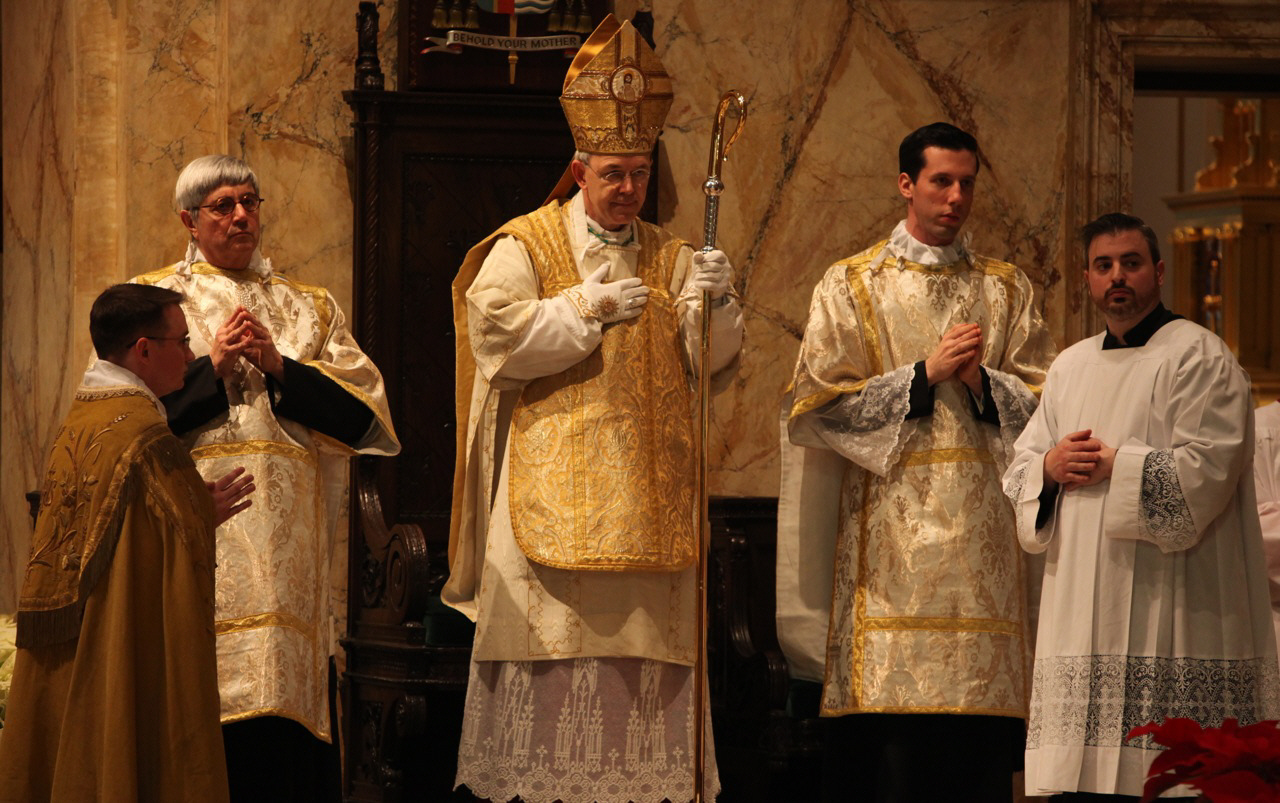
Solemn Mass for the Feast of St. Cecilia, glorious virgin and martyr, patroness of Music.
Monday, November 22 at 7:00 p.m., St. Mary Church, Norwalk, CT
Sung by St. Mary’s Schola Cantorum and offered for the benefactors of the St. Cecilia Society.
The St. Cecilia Society is profoundly grateful for the support that allows our extraordinary music program to continue.
18
Nov

And of the Catholic (and religious?) use of one of the most architecturally significant Catholic church buildings in Manhattan (see our description: “Harlem’s Cathedral”). It is the second magnificent Catholic church in Harlem – after St. Thomas (the latter’s story here) – that has been reduced to profane use by the Archdiocesan planning under Cardinals Egan and Dolan. The speed of the Catholic decline in New York City amazing: All Saints school was closed as recently as 2011, the parish followed in 2015 and the property “relegated to secular use” (deconsecrated) in 2017.
What will be the new owner?
Sean “Diddy” Combs has found a storied new home for his Capital Prep Harlem school.
The school is relocating to the former Church of All Saints at East 129th St. and Madison Ave. The site was built in the 1880s and designed by James Renwick Jr., the architect behind St. Patrick’s Cathedral.
The move will allow Diddy’s Harlem academy to increase its capacity from 500 to 700 students in grades six through 12 beginning next school year.
The new campus will house 40 classrooms and offices, science labs, a cafeteria, an outdoor communal courtyard and a “Great Hall” (the former church? – SC) for assemblies and performances.
Mohr, Ian “Sean ‘Diddy’ Combs finds historic home for his Harlem charter school” The New York Post (11/12/2021)
See also: Angermiller, Michele Amabile, “Sean ‘Diddy’ Combs’ Charter School Relocates to Landmark Harlem Church, Increases Student Capacity” Variety (11/11/2021)
17
Nov
17
Nov
17
Nov
16
Nov
14
Nov
See earlier posts of the Summorum Pontificum Pilgrimage

We returned to Most Holy Trinity of the Pilgrims for All Souls Day on Tuesday evening (on All Saints Day we had attended Mass at Sts. Celsus and Julianus (ICRSS)). It was an appropriately somber and reflective conclusion to the liturgical events surrounding the pilgrimage. The celebrant was once familiar to Traditionalists: Archbishop Guido Pozzo, former secretary of the now-suppressed Ecclesia Dei Commission.


(Below) Absolution at the catafalque.


See earlier posts of the Summorum Pontificum Pilgrimage

The 2021 pilgrimage of the people of Summorum Pontificum ended on Sunday, October 31, the eve of All Saints, with Solemn High Mass at the church of the Most Holy Trinity of the pilgrims (Santissima Trinità dei Pellegrini) – the home of the FSSP in Rome. This church, with its grand late Rennaissance/early Baroque interior, was nevertheless barely adequate to contain the congregation.


While the people were assembling for the grand Mass, a low Mass was being celebrated at a side altar. The priest was attended by one server – and those in the pews or standing in the immediate vicinity of this liturgy. It reminded me of a story I had read in a parochial school reader years ago, of a boy who had lived through the siege of Vienna in 1683. The day after the siege was lifted, a grand mass of thanksgiving was celebrated at the Cathedral of St. Stephens. But, this boy did not see that magnificent ceremony, for he was serving as the sole acolyte at the requiem Mass for his parish priest who had died the day of the victory.
The unique dignity and beauty of the traditional Mass never fails to amaze me – regardless of the number of clegry and ministers, the size of the congregation, the quality of the music, the splendor of the vestments, the architecture of the church etc. And it was heartening to see the side altars being used for their intended purpose.


The rousing homily formed a fitting conclusion to the pilgrimage. It was a celebration of the traditional liturgy and the role it must play it in the “apocalyptic” situation we live in today. It is a Mass that indeed represents the grandeur of the Christian ages, when Christ’s kingship was most widely acknowledged by men. Yet it also best expresses the deepest needs of the soul in the midst of the complete denial of that kingship by the present “apostate” age. It is our “imperative obligation to ensure the transmission of what we have received to the generation to come.”
…It is important to remember that this Mass was formed at the same time the West was constituting itself as Christian….The Roman Mass was fully constituted when the ideal of Christendom received its maturity. It is the Mass of Christendom.
Of course it is not enough to celebrate Mass as if we wish to lay a stone enabling the reconstruction of Christendom. Other struggles are necessary. But the anti-modern character of our liturgy, in contrast to a liturgy thst imitates profane fashions and language, helps us powerfully to put the priestly and royal mark of Christ on the whole of our personal, family and public life.
“Jesus,” said the good thief, “remember Me when you come into your Kingdom.” In other words, while Peter had denied Him and all the apostles except for Saint John had gone into hiding, it is this dying man who makes the most formidable confession of Christ’s kingship, thus becoming the first Christian saint. “This very night you will be with me in paradise.” Let this confession be ours. “The Lamb ,who was slain, is worthy ,” says the Apocalypse in the passage that serves as an introduction to this Mass, “to receive power and divinity and wisdom and strength and honor; to Him be glory and power forever and ever.”
( Excerpts from the homily of Fr. Claude Barthe – I have slightly amended the English translation.)
Continue to Part VI: All Souls Day
13
Nov
See earlier posts of the Summorum Pontificum Pilgrimage

Separate from the pilgrimage was the fascinating and unusual ceremony of the Blessing of a Bell. It took place on late Saturday afternoon in the church of the Most Holy Trinity of the Pilgrims (Santissima Trinità dei Pellegrini ) This parish is in the care of the Fraternity of St. Peter (FSSP).
This ceremony is a perfect example of the power of Catholic tradition. It communicates the significance of the church bell and of its consecration to God through a series of gestures and actions. These are not “didactic” but, nevertheless, by symbol and analogy, convey meaning more profoundly taan any pedagogical lecture could accomplish. Consider how these ceremonies in several respects parallel the baptismal rite.
In the course of the ceremony of blessing the bishop recites a series of magnificent exorcisms, prayers and blessings. One example:
Bless O Lord, this water with a heavenly benediction, and may the power of the Holy Ghost come upon it, so that when this vessel, prepared to call together the children of Holy Church, has been washed with it, there may be kept far away from wheresoever this bell may sound, the power of those lying in wait, the shadow of spectres, the ravages of whirlwinds, the stroke of lightning, the damage of thunder, the disaster of tempests, and every breath of storm; and when the sons of Christians hear its ringing, may their devotion increase so that, hastening to the bosom of their mother the Church, they may sing to Thee in the Church of the Saints a new canticle….