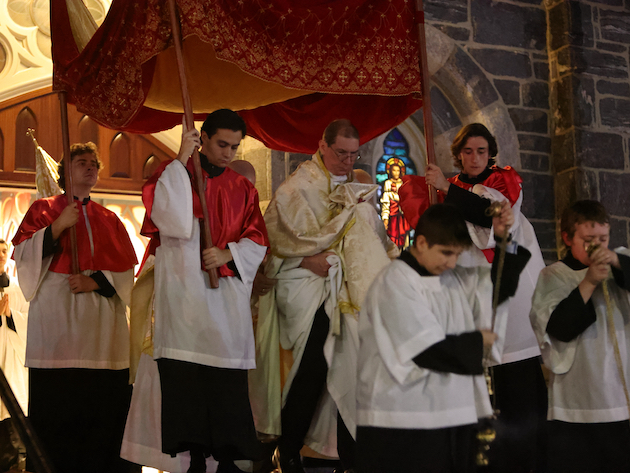
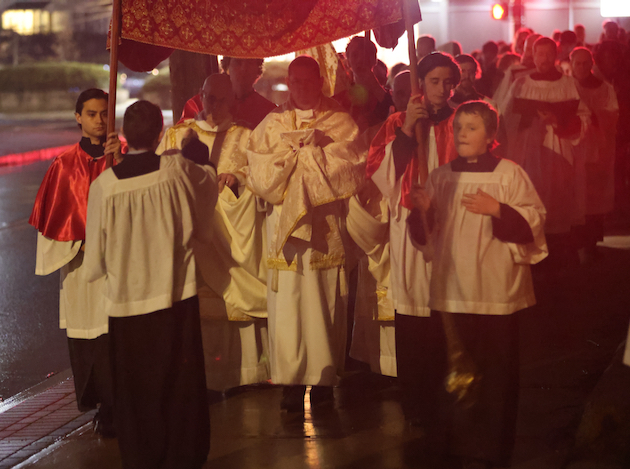
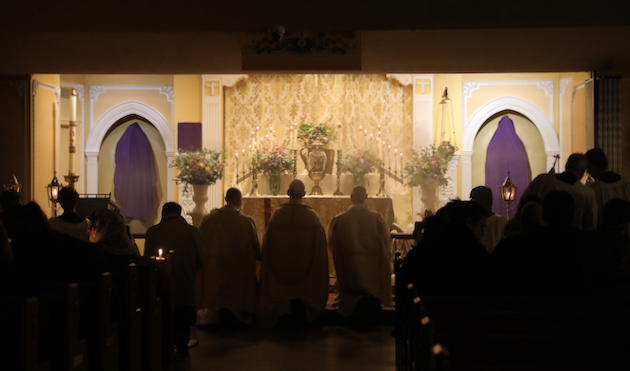
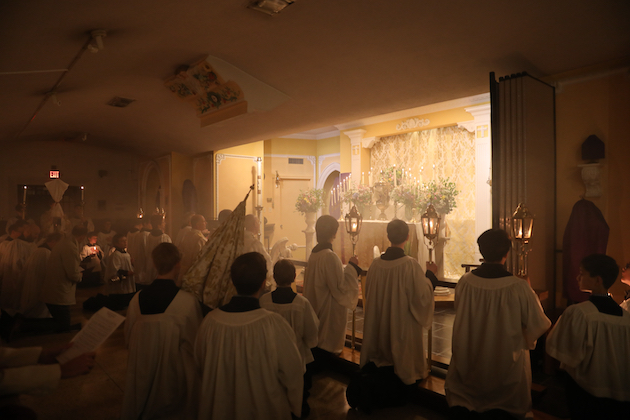
24 Mar
2024


17 Mar
2024

We received word that David Hughes will be moving out of Connecticut to the Denver area soon.

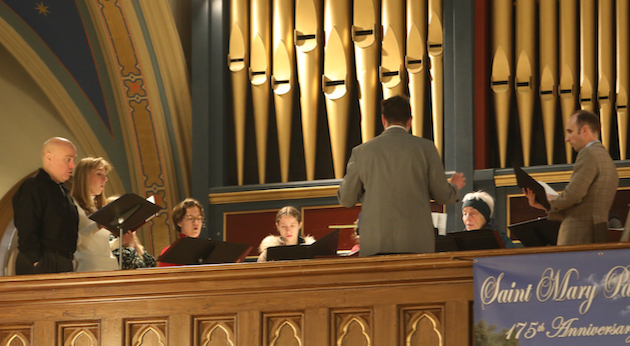
It is a tragic loss for the Catholic Church in this region. David Hughes was instrumental in creating a culture of musical excellence, especially for the celebration of the Traditional Mass, in Fairfield County and surrounding areas. He was an early, passionate advocate of the Traditional Latin Mass and of the music written for it. For many years he directed the music of St. Mary’s Norwalk, where he led a professional schola, the parish choir, a men’s schola, children’s choirs–I think at one time there were 5 or 6 groups simultaneously under his direction. He travelled around to other churches, helping to establish in the Catholic Church a new level of outstanding musical performance. He provided the music at many masses and events this society sponsored (you can find the exhaustive photographic record posted on this site). David also has had national and international success – for example, he led a large schola of children to sing at World Youth Day. More recently, he formed and directed the Viri Galilei, a group of men who sing chant all over the region.
Since 2019 our contacts with David have diminished. A whole new set of great musicians has appeared at local Catholic churches. Yet David was the first – and he demonstrated the greatest flexibility of all in leading every kind of musical group. We will miss him here – but we wish him luck and hope to welcome him back often!


2 Mar
2024

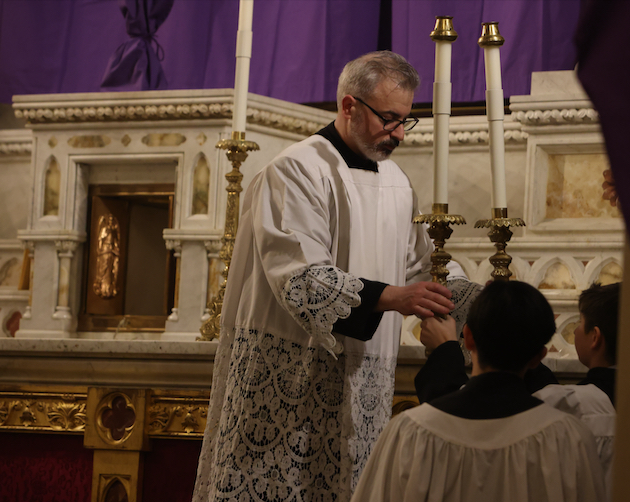
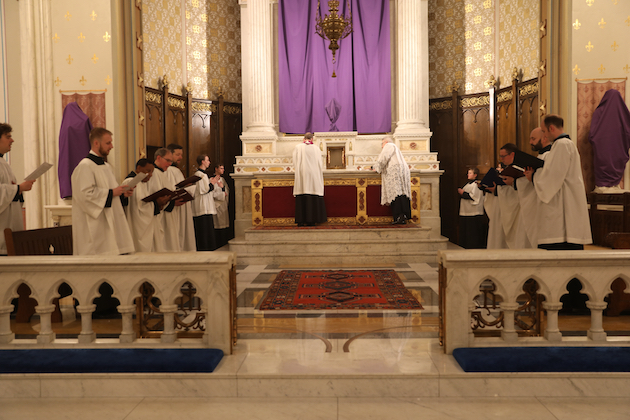
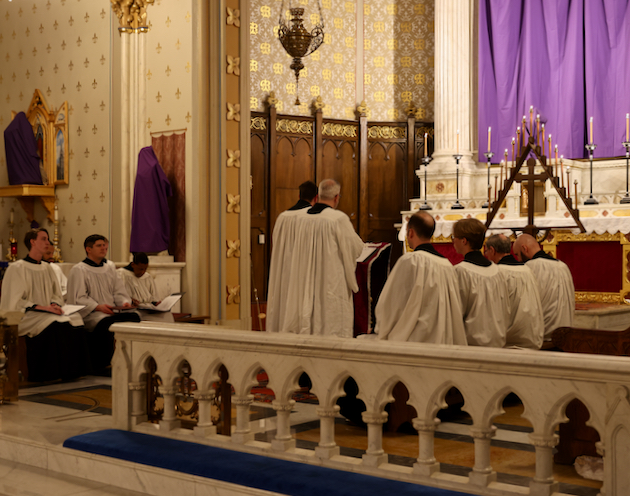
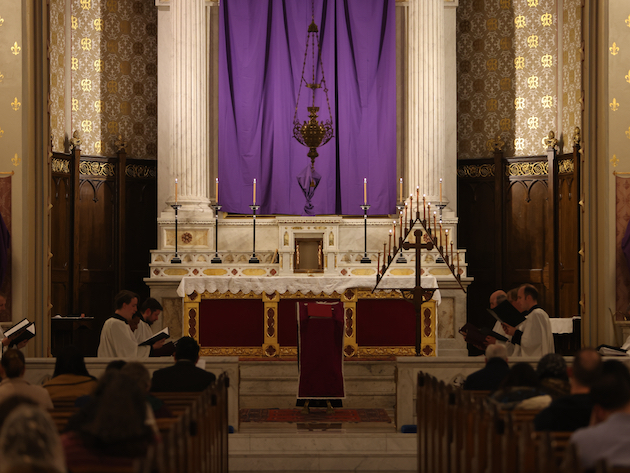
Friday was a very special evening at the Princeton University Chapel: First Vespers of St. Chad of Mercia, bishop, according to the use of the Church of Salisbury (the “Sarum Use”). The Use of Sarum was the main form of the Roman liturgy in Pre-Reformation England. It was celebrated now and then by Catholics as late as the 19th century, but was regrettably entirely superseded by the “Tridentine” liturgy. Perhaps that was because the Use of Sarum obviously makes considerable demands upon a church’s staff resources and available time….. First Vespers refers to the fact that St. Chad (whose feast is on the following day, March 2) was commemorated. 1)
Music and ceremonial were of outstanding quality. A congregation of around 1,000 was in attendance. The demeanor of all was reverent. An introduction preceding the Vespers and the informative program emphasized the spiritual nature of what was happening. In no way was this liturgy presented as a secular concert.
I must admire the creativity (in an appropriate sense) of the organizers. If the basic elements of ritual and music were supplied by authentic texts of the period, features of other traditions were freely drawn upon to complete the liturgy. So, German and English organ music of the 20th Century preceded and followed Vespers. A Byzantine icon was displayed. Benediction of the Blessed Sacrament ( a ritual not a part of the Use of Sarum) concluded the evening. It was a rare instance of how the various strands of Tradition can mutually complement each other without falling into arbitrary eclecticism.
Achieving all this was a truly a remarkable effort. 2) It illustrates that if such an effort is made, while preserving the spiritual basis of art, music and ceremonial, people will come. We were proud that the Society of St. Hugh of Cluny could be counted as one of the sponsors.


24 Feb
2024

Today at noon, hundreds of Catholics came together to pray the Rosary in reparation for the sacrilegious funeral that took place last week in the cathedral. Fifth Avenue was bustling with tourists, shoppers and residents, some of whom joined the rally or stopped to take pictures. From our perspective, the event proceeded peacefully, with no sign of counter protesters.
There are also Rosary rallies scheduled for noon tomorrow and Monday.

23 Feb
2024

Sacred Heart Cultural Center in Augusta, Georgia, was the Jesuit church of the Sacred Heart, built between 1898 and !900. It formerly was a center of Catholic faith, life and education in what was once a not-very-Catholic part of the United States. The church was closed and abandoned in 1971. For years the buildings lay vacant and were repeatedly vandalized. In 1987 the buildings were purchased and reopened as the Sacred Heart Cultural Center. Over the years, great efforts have been made to restore the bulding and windows. It now functions as a cultural center and as an “event venue,” especially for weddings.

(Above and Below) Sacred Heart. The very elaborate exterior brickwork reminds me of a somewhat earlier (1880’s) church in New York City, Sacred Heart of Jesus, in Hell’s Kitchen.


The church – now the “Great Hall” – is grandly dimensioned. It has been nicely restored and painted , except for the communion rail, visible in old photographs – but that may have already disappeared before 1971.


The pulpit with its sounding board or tester. The original pulpit in St. Patrick’s Cathedral, New York, had a similar feature.
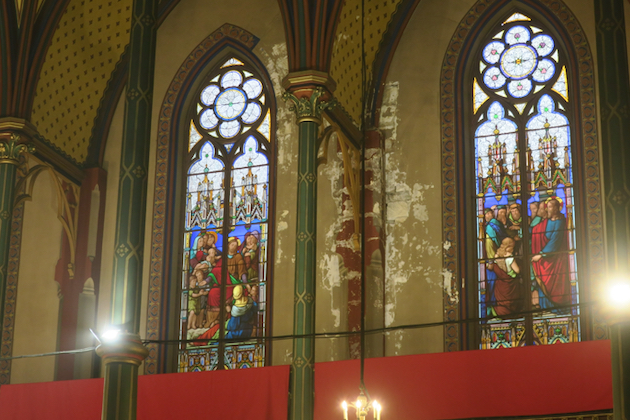
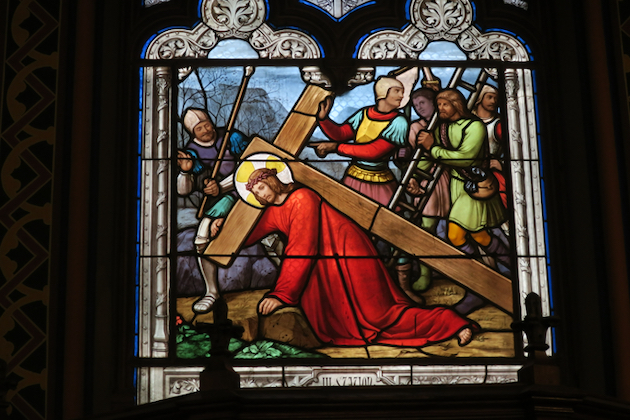
The Center is particularly proud of the stained glass windows, most of which were creations of the firm of Mayer, Munich. The windows were installed at the time of the building of the church or shortly thereafter. Mayer provided windows to inumerable Catholic churches in the United States especially from the 1890’s to World War I. Indeed, Mosy Holy Trinity, the (still functioning) Catholic parish in downtown Augusta, also has a set of Mayer windows which it is currently restoring. The design of the windows of Sacred Heart closely resembles that of certain windows that can be found in, for example, Holy Innocents parish (installed twenty-five years or more after completion of the church), or Holy Name of Jesus parish (both New York City). The artists of the Mayer windows, however, while often relying on a common repertoire of designs or patterns, seem to have taken care to vary the details for each commission.
When the Jesuits left Sacred Heart in 1971 all this was left behind – good riddance, they undoubtedly thought. Nowadays, as church after church is closed in New York City and elsewhere, the windows, altars, stations of the cross, etc. are usually salvaged for disposition to other churches seeking to upgrade their modernistic buildings. The parish of St. Theresa, not too far from Augusta, is a very good example of this recycling.


In the former baptistery a small museum of Catholicism has been set up. It explains to visitors what once was done within these walls. Similar Catholic museums exist in Victoria, British Columbia and in Zurich. The materials published by the Sacred Heart Center that I have seen do treat the practices of those who used to worship here with respect.


(Above) This is a sanctuary lamp. (Below) The final sign for Sacred Heart Church. Note it is “post-conciliar” ( A Vigil Mass on Saturday is scheduled).

We applaud the Sacred Heart Center for the care and respect they have shown to this church, abandoned by its original spiritual leaders and congregation. It’s impressive to encounter this degree of appreciation for these old Catholic churches, which are still scorned by the clergy, at least in the Northeast. Yet we weep to see the art of the Catholic faith turned from its purpose and treated as a relic of some distant past. In this respect, the secular management of this Center is completely aligned with, for example, the New York Archdiocese, which has often described its architectural heritage as “museums.” Finally, we firmly hope that a recovering Traditionalism, made stronger through persecution, will continue as part of its mission the revitalizaion of the splended Catholic churches of the past. For after all, as Proust wrote of the French cathedrals, these grand old buildings were created for one purpose: the celebration of the Traditional Mass.
14 Jan
2024
Just one week after its 38th anniversary, the St. Gregory Society offered its last Traditional Mass in New Haven today, permission having been withdrawn abruptly by the Archibishop of Hartford. The Solemn Votive Mass of St. Gregory the Great, patron of the Society, was assisted by a large choir which included the St. Gregory Society choir and the choirs of the Oratories of St. Patrick and Sts. Cyril and Methodius. The church was filled with friends and well-wishers. In his sermon, whose tone combined sadness with muted optimism, Fr. Cipolla expressed confidence that this last Mass only represented a hiatus.
“So now after this barrage of words that always fade into nothing, we proceed to the heart of the matter, where words do not merely change water into wine, but words effect an infinitely greater miracle, but not merely words or mere words or random words but the words of Him through whom the universe was created: Hoc est corpus meum.And there is nothing else to say. But much more to sing. And we will sing again.”
Father Cipolla’s full sermon here.


16 Dec
2023
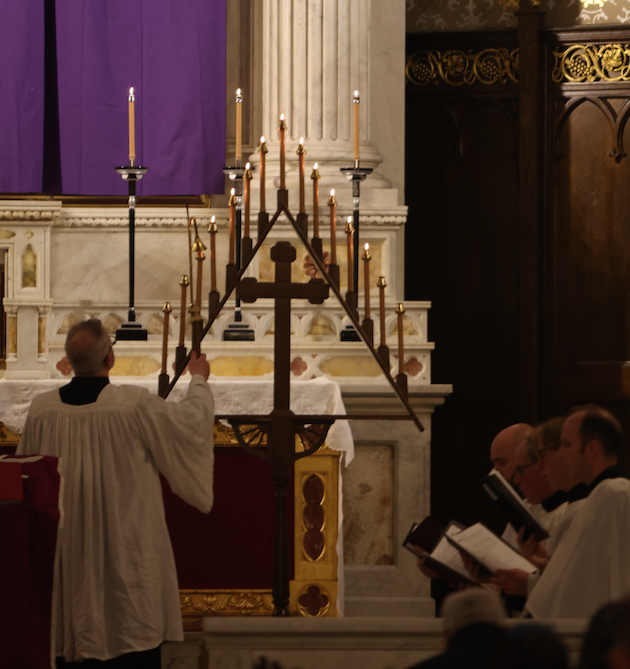
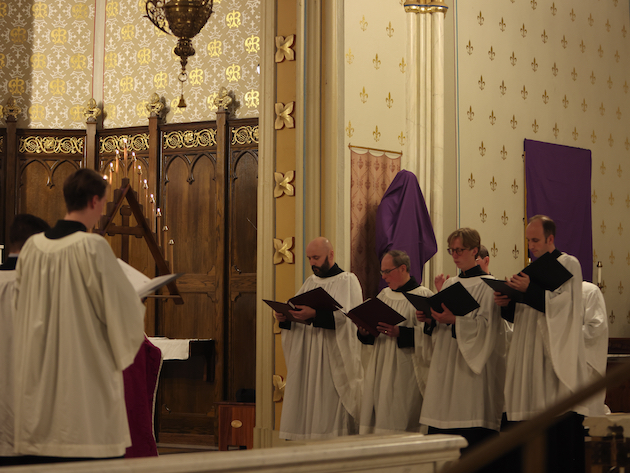
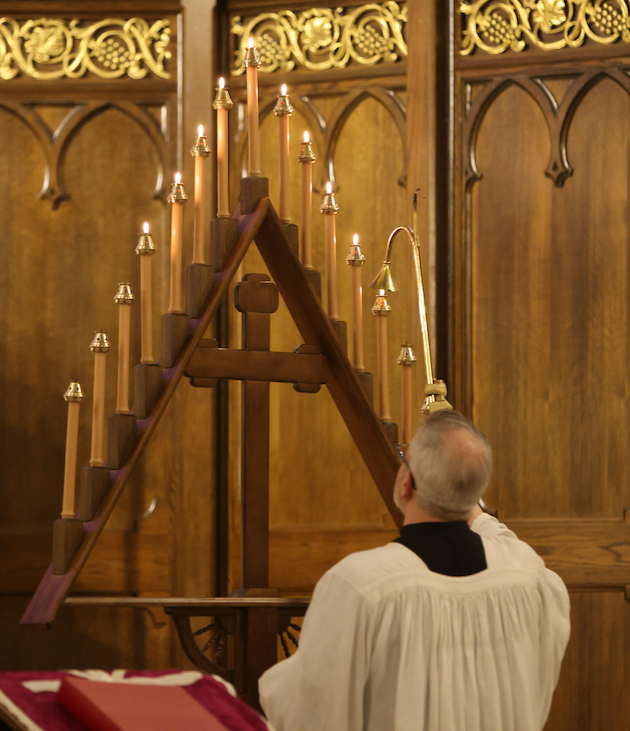
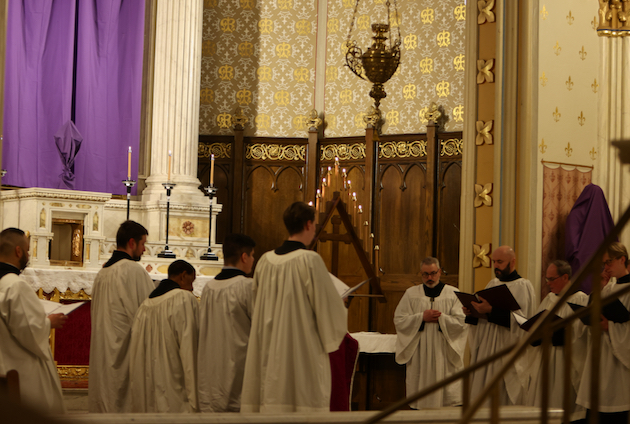
Father Richard Cipolla celebrated a Rorate Mass at 6 am this morning at St. Pius X Church in Fairfield, CT.


2 Nov
2023

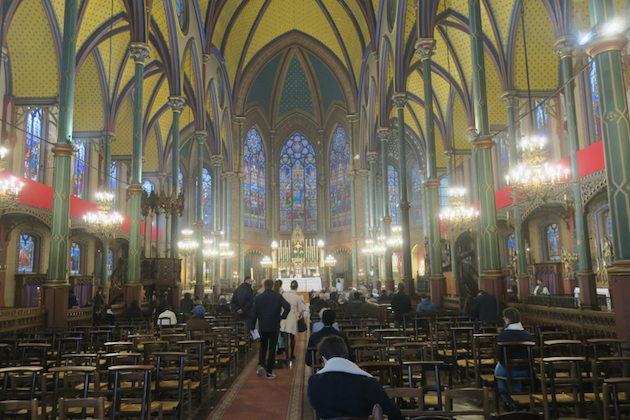
The church of Sacro Cuore del Suffragio ( or Sacro Cuore di Gesù in Prati ) as seen on a sombre evening in Rome last week. Completed in 1917, its extravagent neo-gothic style is unlike any other in the center of Rome. The church overlooks the Tiber and is situated next to the truly monstrous court building ( a structure which, like the “Altar of the Fatherland,” is a legacy of the post-1870 regime in Rome).


Inside is a vast Gothic hall adorned with art in an extraordinary syle showing neo-Gothic, Pre-Raphaelite and Art Nouveau influences. A unified ensemble very much a part of its time: the 1890’s to the 1910’s. An underlying theme of the entire Gesamtkunstwerk is remembrance of the dead and prayer for the poor souls in purgatory.


But this church is most famous for the Museum of the Souls in Purgatory. It displays objects showing tangible evidence of visitations to the living of souls in purgatory. The exhibits typically are prayer books or articles of clothing that feature burn marks of hands or fingers left by the deceased. These testimonies have a common theme we should all remember: keep praying and offering masses for the souls in purgatory.

For a description of the church, see:
https://en.wikipedia.org/wiki/Sacro_Cuore_del_Suffragio#Façade
For an appreciation (in Italian)by famous traditionalist Cristina Campo, see:
https://it.wikiquote.org/wiki/Chiesa_del_Sacro_Cuore_del_Suffragio
17 Sep
2023

Last night a concert of the music of William Byrd took place in the splendid, resonant and historic setting of Most Holy Redeemer Church, East 3rd Street, New York. A good-sized audience heard a superb performance of Bryd’s music, both sacred and secular. The church was an ideal acoustical environment for this kind of smaller scale, somewhat melancholy music. The warmly applauded performers were Charles Weaver, Elizabeth Weaver, Terence B. Fay and Grant Herreid.

Do I need to point out that Charles Weaver is the Music Director at St. Mary’s, Norwalk, where Elizabeth Weaver and Terence Fay sing with him each Sunday at the Solemn Traditional liturgy? Throughout the evening Charles Weaver interspersed historic commentary which highlighted Byrd’s deep ties with the Catholic recusants (Byrd was one of their number). Indeed, he had a specfic connection with the manor of the Paston Family in Norfolk where some of the music heard last night would have been performed. Edward Paston was, moreover, not just a patron but an artistic collaborator of Byrd; a poem written by Paston in honor of the Catholic Queen Mary and set by Byrd was performed last night. For it is an amazing fact that in their clandestine celebration of the prohibited Mass the Catholic recusants of Elizabethen England often created magnificent music and art. As Julian Kwasniewski points out in an essay distributed last night with the program:
Although I have spoken primarily of his life as a musician, Byrd’s life as a recusant Catholic should serve as inspiration for Catholics today, who face varying degrees of persecution not only from secular governments, but from within the Church’s hierarchy itself. Figures like Byrd remind us that the creation of great art is possible even in times of adversity. 1)

Since 2011 we at St. Hugh of Cluny have often covered events at the grand Church of Most Holy Redeemer, formerly Redemptorist, formerly German. Indeed, this Society has sponsored some of them. Today a young priest of the archdiocese leads this parish in the midst of what some might consider one of the city’s more inhospitable surroundings – half party land, half “underprivileged” neighborhood. Yet, under Fr. Sean Connolly, the church looks better than ever before and the parish is sponsoring an ambitious program of musical performances. 2)

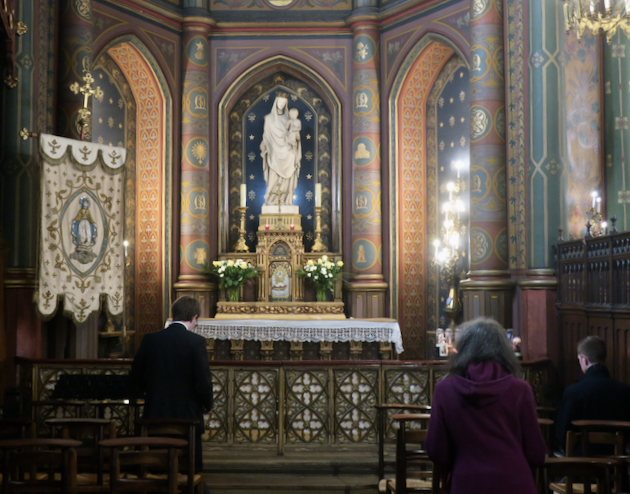
(Above and Below) Most Holy Redeemer is an endless source of insights into the Catholic devotional life of the past ( and, as is the intention of this parish’s current management, of the future as well). Since 1914 the lavishly decorated shrine of Our Lady of Perpetual Help is supposed to be the center of this devotion in New York City. 3)


(Above and below) The chapel-shrine of the relics includes those of St. Datian, a romam Martyr, enclosed in a wax image. His relics were brought to New York in the 1890’s amid great rejoicing.


(Above) Catholic devotions of an “earlier age” – that of the poor souls in purgatory. (Below) This modern, somewhat expressionless statue used to adorn (protected by a cage) the facade of the nearby Nativity parish, victim of a recent Archdiocesan downsizing. Most Holy Redeemer parish is now “Most Holy Redeemer-Nativity.” 4)