28 Jul
2017
28 Jul
2017
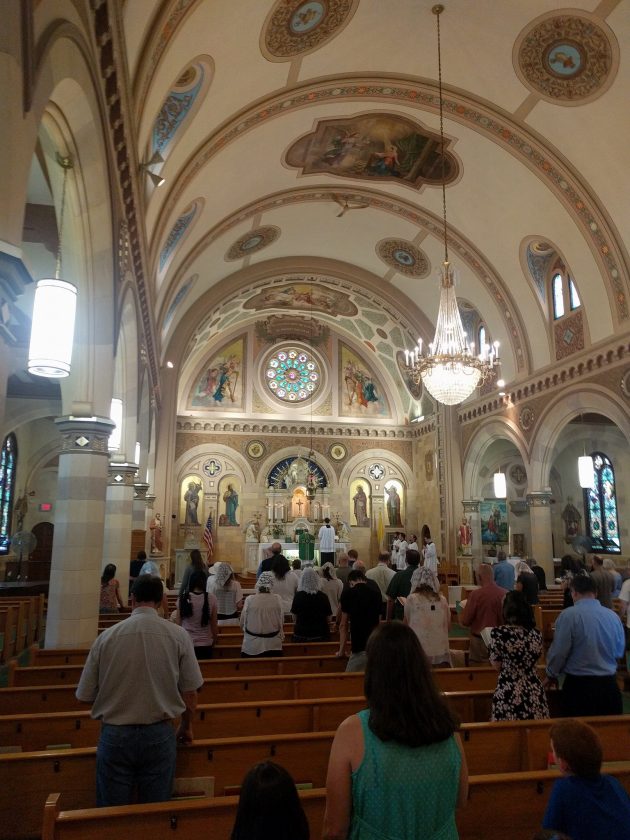
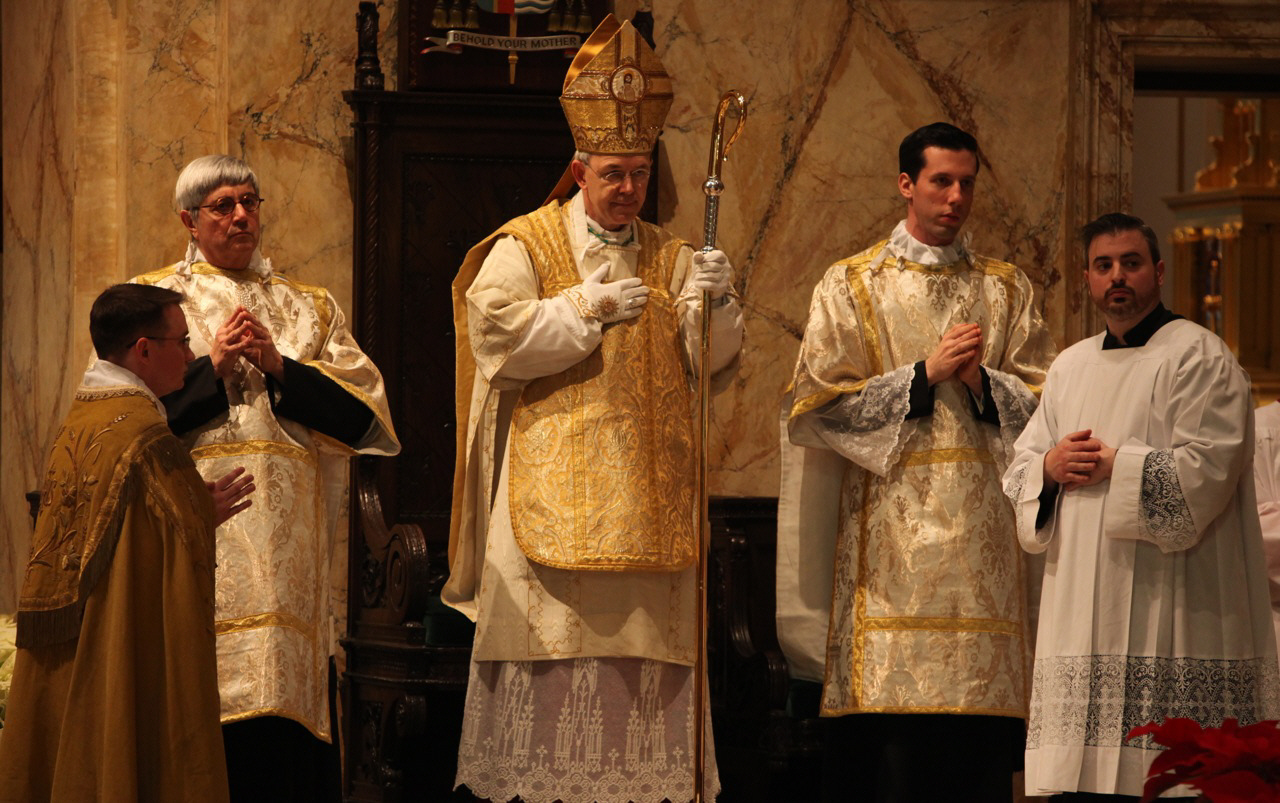
Saturday, July 22, 2017 was the 6th Annual Traditional Mass Pilgrimage at Mt. Carmel, NYC. A few photos:
Fr. Matthew McNeely, FSSP, was the Celebrant. Fr. Karl Marsolle, FSSP, served as Deacon. Fr. McNeely and Fr. Marsolle belong to the Priestly Fraternity of Saint Peter and are from Our Lady of Fatima Chapel in Pequannock, NJ.
Before the Solemn High Mass, there was Confession and a talk on the Blessed Virgin Mary by Fr. Christopher Salvatori, SAC. After Benediction, there was veneration of the relics of St. Vincent Pallotti and St. Helen of Laurino. There was also investiture in the Brown Scapular by the Pallottine Fathers of Mt. Carmel.
(thanks to Diana Yuan for the photos and report)
25 Jul
2017
Last year we posted an extensive table of data about the New York Archdiocese compiled by a friend of the blog, from whom we have recently received an updated spreadsheet with the 2016 figures. We distill a few of the trends in this chart:
22 Jul
2017
10 Jul
2017
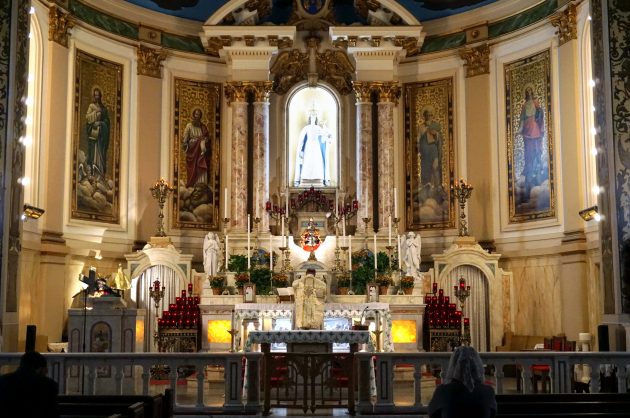
Our Lady of Mount Carmel over the main altar in Our Lady of Mount Carmel Pontifical Shrine, New York
Our Lady of Mount Carmel in Newark
Our Lady of Mount Carmel Church, 259 Oliver Street, Newark:
There will be a Solemn High Latin Mass on Saturday July 15th at 5pm followed by a Procession through the Streets of the Ironbound on the occasion of the 127th Annual Feast of Our Lady of Mount CarmelRev. Msgr. Joseph F. Ambrosio will be the Celebrant and Homilist
Rev. Mr. Trevor Fernandes from the Diocese of Toldeo, Ohio will be the Deacon
Mr. Damian Zablocki, a seminarian from the Archdiocese of New Orleans will be the Subdeacon.
Andres Giraldo will be the Master of Ceremonies.
The street festival opens Wednesday July 12th and closes Sunday July 16th from 6:00pm-11pm.
Pontifical Shrine of Our Lady of Our Lady of Mount Carmel, 116 E. 116th Street, New York
Saturday, July 15: Traditional Latin Vespers of the Little Office of Our Lady, 7:30 pm; Candle Light Procession, 9 pm; Rosary and Litany, 11 pm;
Sunday July 16: Solemn Midnight Mass in Extraordinary Form.
6 AM – Low Mass; 7 AM – Low Mass
Grand Procession, 11:15 am
7 PM – Low Mass
International Food Festival, 8 am -8 pm
Saturday July 22, Traditional Latin Mass Pilgrimage, 11 am
10 Jul
2017
For those travelling in Massachusetts, Mary Immaculate of Lourdes is a good church to know about. We visited this church yesterday for the 10:30 am Sunday Traditional Mass. Well-attended, with an altar boy count to rival St. Mary’s Norwalk, and a choir that skillfully performed all of the ordinaries of the Palestrina Missa Sine Nomine (including the Credo). Close to the Massachusetts Pike and I-95—we’ll remember this church for our next trip.
The bulletin says this about the parish: “A canonically open parish of the Archdiocese of Boston, which has a Traditional Latin Masss apostolate. Both the ordinary form of the Roman Rite and the extraordinary form are celebrated here with the blessing of His Eminence Sean Cardinal O’Malley.” The church also offers daily Traditional Masses.
It’s a beautiful Roman-style church with exquisite stained glass windows.
Many windows are copies of familiar paintings—here is Raphael’s Sistine Madonna
.

St. Elizabeth of Hungary with the church itself in the background.
St. Agnes
The maker of the windows, from Munich
7 Jul
2017
(Continued from Part 1)
To be sure, the last ten years have not been only a tale of a triumphant progress. For in practice, in many ways, the indult regime has continued. Traditional Catholicism remains extraneous to the mission and self-understanding of the “establishment” Catholic church. Regardless of what SP says, the Traditional Mass is usually viewed as a favor bestowed on a minority group.The continuance of the celebration of the Traditional Mass still largely depends on the arbitrary decision of the pastor of a given parish – and often on the arbitrary decision of the bishop to continue the existence of the parish itself. Priests – especially those of certain well-known orders -very often remain in fear of the reaction of the diocese if their involvement in a traditional liturgy became known. And the “traditional” defects of the Traditionalists themselves are very much alive today – eccentricity, factionalism, the inability to cooperate with others, a reluctance to devote the time and the money necessary to really consolidate the gains that have been made.
And hovering above the scene is the threat posed by the Vatican’s radical turn to the left under Pope Francis. The Pope has repeatedly and forcefully expressed his disdain for the Traditionalists – especially the young ones . Yet the new regime has not hindered the progress of SP – indeed, it may even be fostering its spread. But, as I wrote in 2013, I would not be at all surprised if crises on other fronts motivated Francis to take drastic steps against the Traditional Mass – actions that undoubtedly would be met by the indifference, or even the enthusiastic approval of the hierarchy. To paraphrase “Stonewall” Jackson, however, let us not take counsel of our fears. The Traditional Mass has survived and indeed is flourishing today despite all obstacles. And, fortunately, we know that there is always one very important additional Player in the course of supposedly “human events.” We at St Hugh of Cluny hope and expect to support and to report on many new developments of the most important movement of Catholic renewal today for many years to come.
Here are some highlights of the last ten years (continued from an earlier post). This is by no means comprehensive. In going through the archives of the past 10 years, it was hard to narrow down what would be featured here.
Feb. 1, 2009: Father Richard Cipolla celebrates the 25th year of his ordination at St. Mary’s Church, Norwalk, with a Solemn Mass for the Feast of the Presentation.
May 2009: Ascension Thursday at the Church of the Holy Innocents, Manhattan. Holy Innocents had recently begun offering the Traditional Mass. Today the Traditional Mass community there is thriving, with the Traditional Mass offered daily.
(Above) June 2009: Bishop Fernando Areas Rifan, the Apostolic Administrator of the Personal Apostolic Administration of St. John Mary Vianney in Campos, Brazil, celebrates a Pontifical Mass at St. Jean Baptiste Church in Manhattan.
(Below) Bishop Rifan celebrates Solemn Pontifical Vespers at St. Mary Church, Norwalk.
Nov. 2, 2009: Bishop James C. Timlin, Bishop Emeritus of Scranton, celebrated a Pontifical Requiem Mass at the Church of the Holy Innocents.
Apr. 2011: Good Friday Traditional Liturgy returns to St. Mary Church, Norwalk. The following year, the entire Easter Triduum would be celebrated there in the Traditional rite.
(Above) January 5, 2013: Bishop Athanasius Schneider, auxiliary bishop of Astana, Kazakhstan, celebrates a Solemn Pontifical Mass at the Cathedral Basilica of St. James, Brooklyn
(Below) January 6: Bishop Schneider celebrates a Solemn Pontifical Mass for the Feast of Epiphany at St. Mary Church, Norwalk.
Apr. 2013: A Solemn Nuptial Mass at the Basilica of the Immaculate Conception in Waterbury. A welcome option under Summorum Pontificum
July 16, 2013: Bishop Arthur Seratelli of Paterson, celebrates a Pontifical Mass for the Feast of Our Lady of Mount Carmel at Our Lady of Mount Carmel Church in Newark. Traditional Masses for this feast have become popular at this church.
Nov. 6, 2013: Standing room only at the Church of St. Agnes, New York, for a Solemn Requiem Mass featuring Mozart’s Requiem. Fr. Lenard Villa was celebrant. The music was sponsored by the Catholic Artists Society, the New York Purgatorial Society – and our own Society. This yearly event—a Solemn Requiem Mass, has proved popular. In addition, the New York Purgatorial Society organizes a monthly Traditional Requiem Mass.
Nov. 2013: Our Society organized yearly pilgrimages to Our Lady of Esperanza in New York. Here Fr. Greg Markey celebrates Solemn Mass.
May 2014: The annual Mass of the Catholic Artists Society at Old St. Patrick’s Basilica—a Solemn Mass with Fr. Brian Taylor as celebrant.
May 2014: Another welcome development is Sunday Traditional Mass at St. Anthony of Padua in Jersey City. In this Solemn Mass for the Vigil of Pentecost, Fr. John Perricone was celebrant.
June 2015: Sacra Liturgia Conference in New York, featured a 3-day conference and beautiful Traditional Masses at St. Catherine of Sienna Church, culminating in a Corpus Christi procession from St. Catherine’s to St. Vincent Ferrer Church.
April 23, 2016: A Solemn Mass at the Cathedral Basilica of the Sacred Heart in Newark, Canon Jean Marie Moreau, celebrant, organized by St. Anthony of Padua Oratory.
May 27, 2016: Solemn Mass in the Dominican Rite at the Church of St. Vincent Ferrer, New York, now a not uncommon occurrence there. This Mass, which featured the music of Byrd and Tallis, Elizabethan recusants, was sponsored by our Society.
Sept 24, 2016: A Solemn Mass for the Feast of San Gennaro celebrated by Fr. Cipolla (during the San Gennaro Festival) in Church of the Most Precious Blood, Little Italy, sponsored by our Society. The first Solemn Traditional Mass in ages in this church – but just the start.
Nov. 2016: A Missa Cantata at St. Patrick’s Catheral, Fr. Leonard Villa, celebrant.
March 25, 2017: Raymond Cardinal Burke celebrates a Solemn Pontifical Mass at St. Mary, Greenwich, CT, for the Feast of the Annunciation before a packed church.
6 Jul
2017
Tomorrow will be the 10th anniversary of the promulgation of Summorum Pontificum. This Society was organized shortly thereafter; in September of 2007 we sponsored the first Mass pursuant to SP in the Archdiocese of New York.
How many things have changed since then! We have since sponsored so many masses in New York, Connecticut, Brooklyn and New Jersey. We have welcomed so many great speakers and priests to this area – amazingly, some for the first time.
And it is not just what we ourselves have done, but what the movement of which we have been a part has accomplished. For in the indult days the traditional mass, aside from the Ecclesia Dei communities, had remained largely an affair of low masses celebrated in inconvenient locations at odd hours and often on a semi-clandestine basis. Traditionalists remained a community under official suspicion. Today, just in this region, there are diocesan parishes that regularly celebrate the Traditional Mass, in one case daily (Holy Innocents), in another as a Solemn Mass every Sunday (St. Mary’s Norwalk). Several more are proceeding in this direction – and individual celebrations of the Traditional Mass are proliferating as well. We have been blessed to witness the celebration of the Traditional Mass in the cathedrals of New York, Brooklyn and Newark – as well as in so many other churches where the Traditional liturgy would have been inconceivable prior to SP.
We have been heartened to see how new societies and initiatives have arisen to further advance the cause of liturgical (and artistic and musical) excellence. Even more important, an entire new generation of priests and laity has arisen to carry Traditionalism on into the future. I don’t mean to cast aspersions on those who fought the good fight through the long bleak years preceding SP, when I share my conviction that this younger group often displays a level of knowledge, self-confidence, maturity and courage rarely encountered in the past. They combine these qualities with the ability to work together with other “factions” within Catholicism and with the establishment itself.
It has been a great pleasure to chronicle these developments over the last ten years. If you search this blog’s archive you can see for yourself the dramatic increase in activity that’s also reflected in the traffic volume, which is four or five times the number of hits even five years ago.
In this post, we present photos from our archives of the first year of Summorum Pontificum—it was already an event-filled year. Tomorrow we will post highlights from the subsequent years.
Sept. 9, 2007: Our Society sponsored the first Traditional Mass under Summorum Pontificum in New York City—a Solemn Mass at the Church of Our Savior. Father Uwe Michael Lang was the celebrant and Fr. Richard Cipolla, the Society’s chaplain, was the deacon. David Hughes organized a schola. After the Mass, the Society sponsored a presentation downstairs by Fr. Lang and Martin Mosebach (his first speaking engagement in the New York).
Above: Martin Mosebach autographs a copy of his book Heresy of Formlessness.
Sept. 14, 2007: Father Robert Boyd celebrates one of the first Traditional Masses under Summorum Pontificum in Connecticut for the Feast of the Exaltation of the Holy Cross, in St. Mary Church, Greenwich (downstairs chapel). Fr. Boyd had contacted us to ask for assistance. We provided altar cards and other items plus several altar servers, including the MC.
Nov. 2, 2007: At St. Vincent de Paul Church, New York, a priest of the Institute of Christ the King celebrates a Missa Cantata for All Souls Day.
Nov. 18, 2008: Our Society provided support for the first Traditional Mass at Immaculate Conception, Waterbury, CT. Fr. Cipolla was celebrant; Society member Michael Boyd was MC. Seminarians from Holy Apostles Seminary in Cromwell provided the chant. The pastor announced the start of a weekly Sunday Traditional Mass at the church at 6 pm, which remains on the schedule to this day.
Dec. 2, 2007, Fr. Greg Markey institutes weekly Sunday Traditional Masses at 9:30 am at St. Mary’s Norwalk, CT. The Traditional Mass had to be celebrated in the downstairs chapel, because under Bishop Lori’s rule, a Traditional Mass could not replace a Novus Ordo Mass in a church’s schedule. For about a year, at St. Mary’s, a Novus Ordo Mass (upstairs) and a Traditional Mass (downstairs) were celebrated simultaneously at 9:30 am.
Father George Rutler celebrates a Missa Cantata for the Feast of Immaculate Conception at the Church of Our Saviour in New York. Our Society provided support for the Mass. Fr. Rutler would soon schedule weekly Sunday Traditional Masses at Our Saviour.
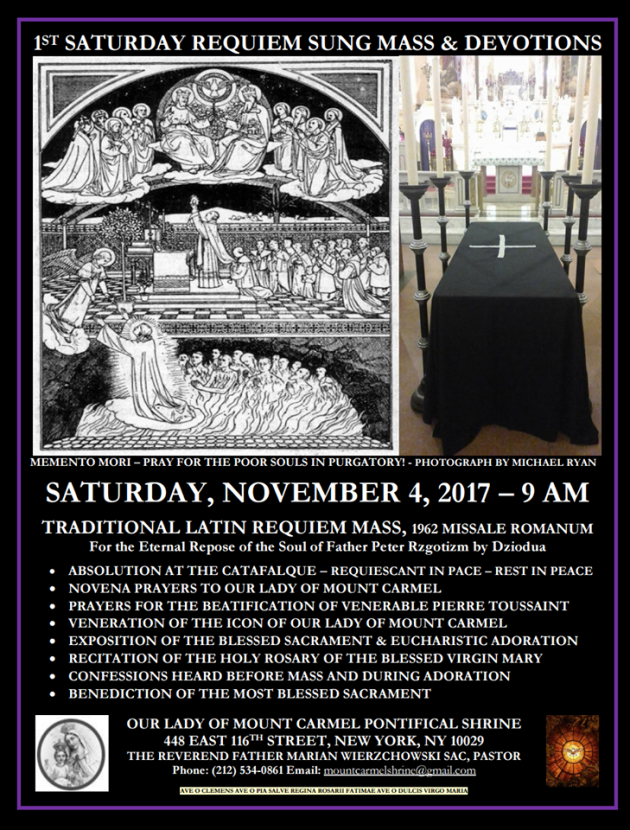
Feb. 24, 2008. Our Society provided support for a Missa Cantata at Our Lady of Mount Carmel, New York. Traditional Mass had been celebrated here every Sunday since the promulgation of Ecclesia Dei in 1988. The church was now scheduling a Missa Cantata on the last Sunday of every month.
May 2008: The Corpus Christi procession at St. Mary’s Norwalk, CT through the neighborhood, became a yearly event.
June 2008: Solemn Mass at the Church of the Guardian Angels, New York. Msgr. Gilles Wach of the Institute of Christ the King was the celebrant.
Aug. 2, 2008: A Solemn Requiem Mass for Gerald Luff at St. Mary’s Norwalk—the first of its kind under Summorum Pontificum. A Traditional Requiem Mass has remained an option at St. Mary’s, as has a Traditional Nuptial Mass.
Sept. 9, 2008: Sunday Traditional Mass moves upstairs at St. Mary’s Norwalk.
4 Jul
2017
In case you hadn’t noticed, today the “Convocation of Catholic Leaders” ends in Orlando, Florida. At a cost of hundreds of thousands of dollars, some 3,000 or more “leaders” were transported to Orlando for the four-day conference. The Church bureaucracy and affiliated organizations bore the cost of this; judging by the hierarchy of the sponsors’ logos, the Knights of Columbus played a primary role.
See “Convocation Guidebook and Journal.”
It’s invitation only. The leaders – episcopal, clerical religious and lay – are selected by the hierarchy and the church bureaucracy. At Orlando they could listen addresses by other dynamic Catholic leaders like Cardinal Timothy Dolan and Archbishop William Lori. In some respects the “convocation” seems an Americanized version of the German Church’s Katholikentag which has existed for many years – without the still-prounounced anti-Roman orientation of the latter but adding a distinctly American secular corporate flavor.
Do we need to point out that the entire concept of developing “leaders” is un-Catholic and un-Christian, derived as it is from the realms of corporate development and, to a lesser extent, of secular political organization? Indeed, the official Guidebook of the Convocation reads like the handout for a corporate executive “leadership development” conference so many of which I have had the pleasure to attend. For in dead corporate bureaucracies the question of how to reawaken any leadership or initiative is a perennial challenge – when the entire organization seems to militate against these qualities.
Now the conference is entirely organized around the works of Pope Francis: above all Evangelii Gaudium. Amoris Laetitia, Laudato Si and his other addresses are also proposed for reading and reflection. It seems that in this stage of the life of the conciliar Church the thoughts of Bergoglio have largely displaced the previous endless citations of Vatican II. Talk about a “hermeneutic of rupture”: the Church seems to have just begun in 2013!
The Guidebook offers pages upon pages of nebulous jargon and platitudes. True, some disturbing statistics on mass attendance are quoted; other than that, very little that is specific and concrete appears. The spiritual and societal concerns we encounter in current discussions and in works such as The Benedict Option seem absent here. The ongoing monumental issues which Bergoglio’s initiatives in moral theology raise for every Catholic appear not to be directly addressed. Nor is his emphatic rejection of “proselytism” considered in relation to “evangelization.” Do we need even to mention that issues dear to Traditionalists such as restoring the liturgy, traditional spirituality and ecclesiastical art receive no attention at the Convocation? It seems that the Catholic leader of today only needs to study the works of Bergoglio, a few short bursts of individually structured prayer, and some “team-building” before sallying forth to evangelize the world.
Like corporate conferences this time of year, “attire for the Convocation is business casual.” The Guidebook feels the need to provide elaborate instructions to the participants – the following selection combines sanctimonious piety with a helpful if ludicrous boost for Orlando tourism:
The Orlando Area
Our Lord said to the disciples, “Come to me, all you who labor and are burdened, and I will give you rest” (Mt 11:28) and to the seventy-two missionaries, “Stay in the same house and eat and drink what is o ered to you, for the laborer deserves his pay- ment” (Lk 10:7). One of the reasons the Convocation is being held in Florida is to offer Catholic leaders a place of beauty and rest. While the weather may be hot and humid, the Orlando area offers many options for relief from the heat and chances to gather with friends, colleagues, or family at the region’s many attractions before or after the Convocation. If time and budget considerations allow, try to spend a few extra days in the area prior to or following the Convocation. Enjoy Orlando as you wish: the theme parks, the pools, the restaurants and entertainment options, or the many amenities of your resort or hotel.
29 Jun
2017
We recently posted that there is daily Traditional Mass (every day except Tuesday and Friday) at St. Paul’s Church in Yonkers at 12 noon.
We’ve now discovered that the Basilica of St. John the Evangelist in Stamford offers a Traditional Low Mass every Friday at 2 pm.
These Masses are not on the posted Mass schedule—you have to know about them. It’s the value of reading this blog.