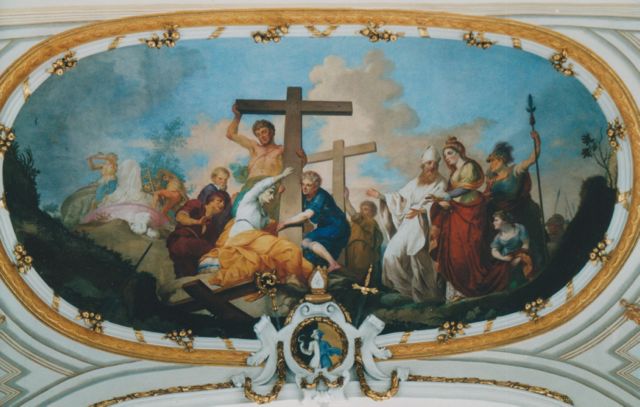
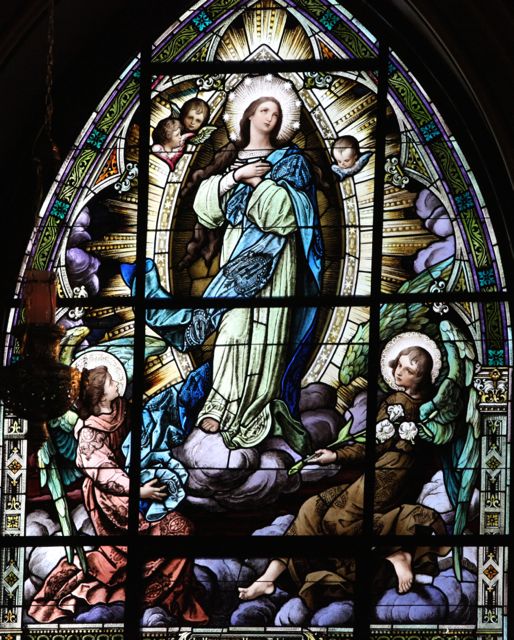
Wishing you a blessed Feastday of St. Ann. St. Ann pray for us!
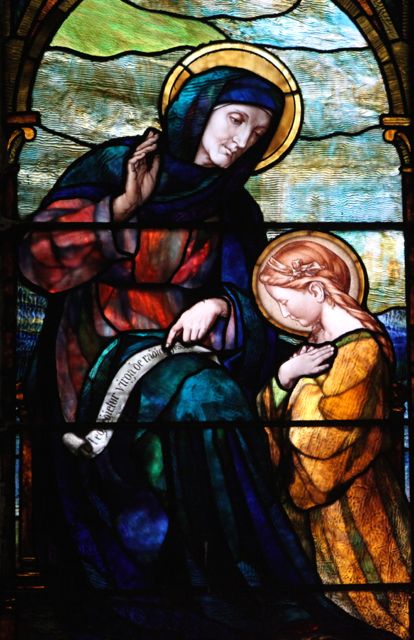
This stained glass window is in the Church of All Saints, 47 E 129th St, New York. n.b. The church is slated to close next month.
26 Jul
2015
Wishing you a blessed Feastday of St. Ann. St. Ann pray for us!
This stained glass window is in the Church of All Saints, 47 E 129th St, New York. n.b. The church is slated to close next month.
26 Jul
2015
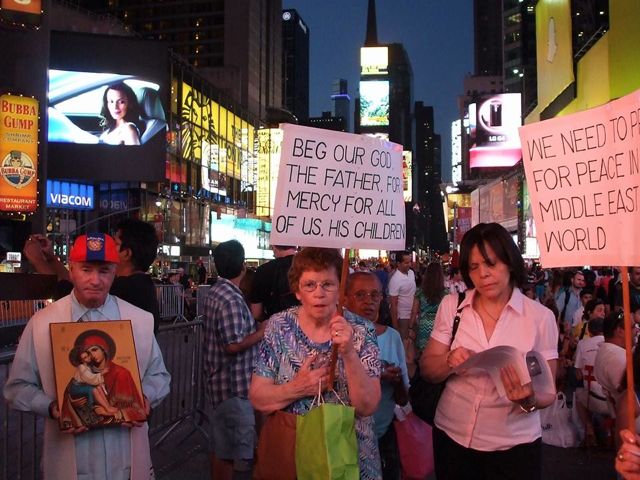
This past Friday, July 24,a prayer rally was organized from Herald Square to Times Square in support of persecuted Christians in the Middle East. Photo courtesy of Fr. Christopher Salvatori
22 Jul
2015
Finally , after one year, the pastor of Our Saviour has published an explanation of what is going on in the parish Facebook page. Robbins, who refers to himself in the third person, does not invite discussion or commentary:
“Church of Our Saviour, New York City
This original watercolor/gouache interior sketch of the proposed interior of the Church of Our Saviour was created by Mr. Richard Zimmerman of the Rambusch company under the artistic direction of Harold Rambusch and architect Paul C. Reilly before the church was built. This was the vision that the pastor and archbishop approved prior to beginning the construction of the building. Note that most of the colors in the sketch, such as the walls, ceiling and side altars are as the church appears today. It is also evident from this sketch that the baldacchino and sanctuary screen were always intended to be part of the sanctuary design even though early 1960’s photos show the sanctuary without them.
Since his appointment as pastor on August 1, 2013, Father Robert J. Robbins has worked to restore the church to its original vision and updating necessary systems. The church hired the firm Renovata Studios to begin a professional restoration process that was sensitive to the history of the church, while adapting the church to new technologies for the future. The original church lighting installed by Rambusch in 1959 was completely re-lamped with LED lighting fixtures which provide more light at a fraction of the cost in electricity. The bronze and glass chandeliers were restored and re-lamped with LED bulbs. This new LED lighting system is controlled by a new state-of-the-art computerized dimming system that allows complete control of the light output and can be individually programmed for the various religious services. The 12 icons on either side of the altar were removed to restore the original vision of the central altar and its relationship to the two side altars of Joseph and Mary. The fourteenth station of the cross was found in storage and returned to its original location. The original cast bronze reading desk was of inadequate size for the Book of the Gospels, so a larger identically styled reading desk was cast in bronze and installed on the ambo. The decorative coffered ceiling was cracked and damaged in many places and this was painstakingly restored to original condition. The sound system was also upgraded with new digital technology.
The original Rambusch 500 watt downlights were replaced with Rambusch replacement LED units that draw only 85 watts while providing much more light. All original fixture locations and ceiling trim hardware was re-used in the original locations. There is significantly more light in the pews to help the congregation with reading and also much more light on the side walls of the church to make the church brighter. All of this new LED lighting is appropriately colored to 2700k for proper “warmth” of light and is completely controllable and dimmable with a new Strand 15 zone dimming system.
The original bronze chandeliers were restored and re-lamped with new LED technology. Previously, the chandeliers had spray painted gold paint over some of the translucent glass in the fixtures and the restoration/cleaning of this glass allows more light in the church. Uplighting was added to the chandeliers so the congregation can better see the beautifully restored coffered, decorative ceiling. New accent lighting was also incorporated into the chandeliers to add needed lighting to the side shrine areas, rear organ pipes and the side altars of Joseph and Mary.
New LED architectural uplightng was also incorporated into the window wells of each stained glass window to accent the beautiful architectural columns and mouldings in the nave and choir loft. Every component of this new lighting system is separately controlled by the new dimming system so that different settings can be created for the various liturgies. These 8 different settings are controlled by a central keypad that is simple to use and allows foolproof operation of the lighting in the church.
To date, twelve large and twelve smaller icons have been removed from the four columns that flank the altar. According to archival photos, these columns did not originally have decoration of any kind. All icons were carefully and sensitively removed by the same restoration craftsmen that restored the beautiful decorative ceiling of the church. The icon panels have all been wrapped individually in plastic and carefully stored in the undercroft of the church to await re-installation in other parish buildings or perhaps another church. The painted panels were installed on the two columns of the proscenium arch between the main altar and the two side altars.
Rev. Robert J. Robbins
Pastor
Lawrence Hoy
Renovata Studios”
Taking all this at face value, I would respond as follows:
Robbins does seem to have an obsession with lighting. Some of this reads like a satire:
“Every component of this new lighting system is separately controlled by the new dimming system so that different settings can be created for the various liturgies.”
I can’t comment on the power savings of the LED approach; many other parishes have done the same recently without a drastic renovation. In a recent visit I couldn’t detect any notable difference in illumination offered by the new system. This church already seemed to have a perfectly adequate level of illumination. But taking the description at face value, by aiming to illuminate every nook and cranny of the decor and architectural detail, the new system may create the same problems as found in St. Patrick’s cathedral today: the imposition of a new, brilliant lighting system that contradicts the original lighting assumptions of the architecture. Indeed, given the questionable quality of much of the decor I always thought this church looked best when the lights were out (see below).
Then we come to the removal of the icons. This is done in the name of restoration (and authority):
“This original watercolor/gouache interior sketch of the proposed interior of the Church of Our Saviour was created by Mr. Richard Zimmerman of the Rambusch company under the artistic direction of Harold Rambusch and architect Paul C. Reilly before the church was built. This was the vision that the pastor and archbishop approved prior to beginning the construction of the building”
“According to archival photos, these columns did not originally have decoration of any kind.”
This statement only reveals the writer’s lack of historical and artistic judgment. We are challenged to restore the “vision” of a circa-1960 commercial contractor of church interiors, as if it were the creation of a major artistic mind! Robbins also seems to think, since the archdiocese approved it in 1960, no changes can ever be made to the “vision.” Fifty gutted or rebuilt sanctuaries just in the city alone disprove the latter point.
As a rule Catholic churches were not built as part of one encompassing unity of architecture and decor. As time went on changes and improvements would be made as more funds became available and better aesthetic insights emerged. Consider in St. Patrick’s cathedral: the bulk of the sculptural art that was set up after the completion of the cathedral, the erection of the Lady Chapel, Cardinal Spellman’s baldachino, doors and windows…. Only certain churches built largely between 1900 and 1920 – like St Vincent Ferrer – actually attempted a real artistic integration of all elements of architecture and decor. Naturally, notions of stylistic purity didn’t prevent drastic changes being made to St Vincent’s sanctuary, among other places, in recent years.
Now in the case of Our Saviour, there was a contrast from the beginning between the quality of some of the stonework and architectural details (like the ceiling and floor) and the mediocre decor (like the stained glass and the stations of the cross), the latter so similar to that found in every new suburban church of that era. Undoubtedly this was part of the reason Our Saviour’s was viewed as a failure in its time. To attempt to restore the appearance of the “original vision” – the feeble decor of the last years of Spellman’s reign – is preposterous: it only recreates the weakest features of the original interior. The prior pastor instead made an effort, internationally recognized, to creatively address this original deficiency in decoration and furnishings (as well as to remedy years of neglect) by introducing new works of art that complemented, rather than contradicted, the surrounding architecture.
Need I add that Robbins doesn’t mention the most glaring departure from the “original vision”: the sawing off of the altar to create a freestanding “Novus Ordo” altar? He doesn’t propose changing that back!
And what is the fate of the icons?
“The icon panels have all been wrapped individually in plastic and carefully stored in the undercroft of the church to await re-installation in other parish buildings or perhaps another church.”
It is an indictment of the organization and management of the Roman Catholic Church that entirely optional and decorative projects like this are cleared based exclusively on the decision of the pastor. This, at a time when so many Catholics are losing their own parishes allegedly because of financial difficulties of the Archdiocese. And also at a time where Our Saviour’s parish has been experiencing its own financial issues (since Fr. Robbins assumed the pastorate there). We know of other, very recent abuses of clerical power in this region. With such clericalism the Catholic Church is only continuing the long-term process of digging its own grave.
21 Jul
2015

(above) A picture of the sanctuary taken on August 24, 2014.
Just within the last couple of weeks, Fr. Robert Robbins – the newly confirmed pastor – has resumed his “restoration” of the church of Saviour. It has been reported that the objective is to entirely purge the art of Ken Woo (and others) from the sanctuary. Today I could confirm that another column has been stripped of Woo’s icons:

(Above) A picture taken today. Notice the column to the center rear. My apologies for the picture quality
As was the case last year, Fr. Robbins has not published or announced any explanation for what is going on – at least as far as I am aware. The goals and objectives of the “restoration” are known only to him and his initiates. In the rear of the church, however, there is now a set of mysterious photographs of the sanctuary pre-Rutler and pre-Woo. (These cases in the rear used to be full of information, books and helpful materials under the prior administration of this parish; they are now almost totally empty.) These photographs undoubtedly show what Fr. Robbins has in mind:
(Above) Pictures of the unrestored sanctuary (Below) The Transfiguration – perhaps a photo dating back to the opening of the church.
Our hunch is reinforced by the emphasis Fr. Robbins gives this feast in the current parish bulletin. Now looking at the above pictures, one would have to conclude that the apparent attempt to restore early 1960’s church art has to be – aesthetically speaking – bizarre beyond belief. Those years were the absolute nadir of ecclesiastical art. But Fr. Robbins was pastor for many years of the pseudo-modern Holy Family parish, which dates to a few years after Our Saviour and is one of the ugliest churches in Manhattan. Perhaps Fr. Robbin’s taste in art was formed there. Moreover, it also seems entirely unclear, based on these photos, how much of this painting had actually survived into the 1990’s.
It is distressing that a church that very recently has been restored at such great effort should now be subject to an iconoclastic house-cleaning only 10-15 years later. One has to question the judgment of those who authorize unnecessary projects of this kind – one could also mention former Monsignor Hull’s Sheen Center. These expensive projects proceed at a time when so many Catholics are being thrown our of their parishes which will in due course be offered to developers – because, supposedly, the Archdiocese is strapped for funds.
We look forward to an explanation from the pastor or the Archdiocese as to what is going on. I also hope this latest move of Fr. Robbins receives the press attention that it deserves.1)
1) Especially from one particular neocon high priest who effusively praised this very church and its new paintings in 2005 – we hope to hear from him soon.
For a view of the church with Woo’s artwork complete see HERE and HERE.
20 Jul
2015
On Monday, July 27th, St. Mary Church, Greenwich, Ct, will offer a Votive Mass of the Precious Blood (Solemn Mass) at 7:30 in the evening.
12 Jul
2015
St. Mary Church, Norwalk, Thursday, July 16th, 6 pm, Solemn Mass
The Church of St. James the Apostle, 14 Gleneida Ave., Carmel, NY, Wednesday, July 15th, 7:30 PM, Solemn Mass, More information
Shrine of Our Lady of Mount Carmel, 448 E. 116th St., New York
Byzantine Eastern Rite Liturgy w/Blessing of Sick July 12 at 5PM
Vigil Mass (Novus Ordo) July 15 at 6PM
Traditional Latin Vespers July 15 at 7:30PM
Candlelight Procession July 15 at 9PM
Rosary and Litany July 15 at 11:00PM
Solemn Extraordinary Rite, Midnight between July 15 and 16, Midnight Mass of Our Lady
Extraordinary Form Mass July 16 at 6, 7AM
Feast Mass (novus ordo) and Grand Procession July 16 at 10 AM
Multi-Language Masses July 16 From 6AM – 8PM
Traditional Latin Pilgrimage July 18 at 11:00 AM
Our Lady of Mount Carmel Church, 259 Oliver Street, Newark NJ, Solemn Mass, July 16 at noon
Our Lady of Fatima, Pequannock, NJ, 8 am, 7 pm. (At 6 pm there will be a vesting and receiving the professions of Third Order Carmelites. The Sung Mass will follow at 7:00 and a reception.)
7 Jul
2015
Here are photos from our archives of Traditional Masses celebrated in the first months following Pope Benedict XVI’s promulgation of Summorum Pontificum, July 7, 2007.
Church of Our Saviour, New York, Sept. 9, 2007, Solemn Mass, Father Uwe Lang, celebrant
St. Mary Church, Greenwich, CT, downstairs chapel, September 14, 2007, Fr. Robert Boyd, celebrant
Church of St. Vincent de Paul, New York, All Souls Day 2007
\
Immaculate Conception Church, Waterbury, CT, November 18, 2007, Fr. Richard Cipolla, celebrant
St. Mary Church, Norwalk, CT, December 2, 2007, celebration of the 9:30 am Sunday traditional Mass begins, downstairs in the St. Patrick chapel, Fr. Greg Markey, celebrant. Regular celebration of the traditional Mass would not move upstairs to the main sanctuary until the following September.
Church of Our Saviour, New York, December 7, 2007, Father George Rutler, celebrant
29 Jun
2015
SHRINE OF OUR LADY OF MOUNT CARMEL
448 EAST 116 STREET
NEW YORK, N.Y. 10029
SOCIETY OF THE CATHOLIC APOSTOLATE (Pallottines)
Rev. Marian Wierzchowski SAC. Pastor
THROUGH 131 YEARS HARLEM HONORS ITS BLESSED MOTHER
Processions, Novenas, and Prayers to Honor Our Lady of Mount Carmel
The Pontifical Shrine Church of Our Lady Of Mount Carmel, located at 448 East 116th street in Manhattan has announced plans for its 131th annual Feast in honor of its patron Madonna. Long the largest singularly sponsored religious procession in New York City, plans call for this year’s religious feast to run from July 6 through July 18.
Drawing thousands of pilgrims to the feet of the Blessed Mother, the feast, originally created by Italian immigrants, now unites Catholics of all racial, economic and social classes in their love and devotion to Mary. Indeed Marian hymns and prayers are chanted in various tongues: it is not unusual to hear French, Latin, Spanish and English as one walks a scant few feet among the thousands in the procession. The Feast is that universally appealing and multi- cultural.
Perhaps it is minor miracle in itself that the various ethnics get along, marching together in honor of Mary. Perhaps another miracle is that religious people make pilgrimages to Harlem, by the thousands yearly, or even that local residents still decorate their houses to honor the procession’s passing. The faithful pack the church, those unable to enter line the steps and street by the door. Each has his own special prayer. Some ask for help or a healing; some on their knees make their way up the center aisle in fulfillment of vow for a granted favor. All agree there is something spiritual, powerful here, and wish to be a part of it.
The Vatican itself has specially recognized the Mt. Carmel Shrine. In 1904, Pope St. Pius X, following the approval of Pope Leo XIII who had just passed on, ordered that the image of the Madonna be given the right to wear a golden crown. This was done in recognition of the graces received, and prayers answered at the Shrine. This privilege, known as “incoronation”, is an extremely rare one in Catholicism, and has been granted to only five Marian images outside of Europe. Indulgences were also attached for visits to the Shrine during the Feast.
Retired Auxiliary Bishop Sansiriq will officiate at the French/Creole Mass for the Haitian community.
Events of the 2015 Feast
Morning Novenas after the 9AM Mass
(excluding Sundays)
In Italian July 10, 11, 13
French/Latin followed by July 11 , 9AM
1000 Hail Marys
Evening Novenas Each night at 7:30 PM
In Haitian-French/Creole July 6,7, 8
In Spanish July 9.10. 11
In English July 12, 13, 14
Byzantine Eastern Rite
Liturgy w/Blessing of Sick July 12 at 5PM
Vigil Mass July 15 at 6PM
Traditional Latin Vespers July 15 at 7:30PM
Candlelight Procession July 15 at 9PM
Rosary and Litany July 15 at 11:00PM
Solemn Extraordinary Rite Midnight between July 15 and 16
Midnight Mass of
Our Lady
Latin (Tridentine) Mass July 16 at 6, 7AM
Feast Mass and
Grand Procession July 16 at 10 AM
Multi-Language Masses July 16 From 6AM – 8PM
Traditional Latin Pilgrimage July 18 at 11:00 AM
28 Jun
2015
2ND ANNUAL ALL NIGHT VIGIL
IN HONOR OF THE MOST PRECIOUS BLOOD
THURSDAY, JULY 16 AND FRIDAY, JULY 17, 2015
The Church of Saint John the Baptist
210 West 31st Street (near 7th Avenue)
9 PM – Sung Mass in the Extraordinary Form – 1962 Latin – Rev. James Miara, Celebrant and Homilist
10 PM – First Break
11 PM – Exposition of the Blessed Sacrament
Commemoration of the Hours Our Lord suffered
in Agony in the garden of Gethsemane
2 AM: Moloben to the Mother of God and Veneration of the Miraculous Icons of Our Lady of Zhyrovitzi, Ukraine and the Miraculous Sorrowful Russian Myrrh Tearing Icon of The Theotokos
2:30 A.M.: Stations of the Cross, Efficacious Reparation Prayer to The Eternal Father
3 AM: Chaplet of the Divine Mercy
3:15 AM – Second Break
4 AM: Eucharistic Healing Procession, Benediction of the Most Blessed Sacrament and Blessing of Religious Articles
5 AM: Sung Mass in the Extraordinary Form – 1962 MR of Pope St. John XXIII Latin
Rev. James Miara, Celebrant and Homilist
Father James Miara was ordained for the Archdiocese of New York in 2001 by the late Edward Cardinal Egan. He currently serves as Administrator of St. Anthony’s Church, Commonwealth Avenue in the Bronx. Father James L.P. Miara is also part of the Marian Movement of Priests, In addition to his pastoral duties, Father Miara is the spiritual director of the New York archdiocesan division of the World Apostolate of Fatima, also known as The Blue Army. He regularly gives retreats and conferences and is involved in many groups that spread a devotion to Mary.
You are most welcome to bring Potluck dishes to be shared during the breaks at the All Night Vigil. Confessions will be heard during the all-night vigil.
Sponsored by the Third Friday Reparation Devotional Prayer Group
and The Outreach Program (347) – 277 – 3487
(The image at top appears in St. Elizabeth of Hungary Church, Manhattan)
9 Jun
2015
Photos from the Corpus Christi celebration at Immaculate Conception Church in Sleepy Hollow, NY this past Sunday. Photos courtesy of Ann Whelan