19
Feb
13
Feb
“Brief über die KIrche”
Die Kontroverse um Ida Friederike Görres’ Aufsatz – ein Dokumentationsband
A Letter on the Church
The Controversy surrounding the Essay by Ida Friederike Görres – a Documentary Collection.
Paraiso, Jean-Yves (Editor)
(2005 Böhlau Verlag, Cologne, Weimar, Vienna)
Last year I wrote a review of the 1951 book The Church in the Flesh of Ida Friederike Görres. Now that book prominently refers to a prior essay of hers, A Letter on the Church, (the “Letter”) from 1946, which at the time had created an uproar in the German Church.1) I felt it was incumbent upon me to examine the Letter and assess its significance. Fortunately, in 2005 Jean-Yves Paraiso – who seems to have impeccable progressive credentials – had published the Letter along with other source documents relating to it. He also provided notes and an introduction.
I do have to confess that I find Görres’s prose to be somewhat tiresome. Her style is now enthusiastic and emotional, now dogmatic and pontificating. It reminds me of what someone once wrote about the writings of Eric Gill (who, among other things, was a Catholic publicist): it’s like being harangued in a pub by someone who’s speaking too long and too loudly. It is somewhat unfortunate, however, to judge Görres by these post-World War II writings. They leave the impression that she is first and foremost a commentator and polemicist on ecclesiastical issues. Her most famous works, however, published during and before World War II, dealt with spirituality and hagiography, such as her lives of Mary Ward and St. Theresa of Lisieux.
The Letter takes the form of a dialogue between a ”Protestant” and the author. The Protestant speaks of his admiration for the Catholic Church: its liturgy, splendid and understandable for the common people; the beauty of Corpus Christi processions; the high educational level and exemplary conduct of the clergy; the sacrificial service of the nursing sisters. Görres, however, feels compelled to point out that his “outsider’s” understanding may be superficial. She then launches into a catalog of the woes afflicting the Catholic Church at that time.
Perhaps the most surprising aspect of the Letter is its focus upon the deficiencies of the Catholic clergy, particularly the diocesan clergy. In the post-1870 Church such public attacks on the clergy by Catholics of course had been few and far between. According to Görres, the conduct of the German clergy may indeed be “correct,” but that is inadequate. Görres provides a long list of clerical deficiencies: their education, their personalities, their worldliness and the leadership of their parishes. Why are there are so few pious priests? The priests often rattle off the Mass without any thought. To hear a decent sermon is an exception. “Celibacy, instead of freeing up the priest for fraternal encounters, locks the individual rigidly and icily in his unmastered self.” Clerical authoritarianism can reach an extreme that Görres qualifies as “clericofascism!“ These problems – and worse – are even more rampant in her homeland of German Bohemia (the Sudetenland).(By 1946 the German population there was either dead or in exile).
Certainly, the diatribe against the German clergy in the Letter attracted the most attention at the time, but other aspects of the Church are not spared. The German monastic orders are impressive in choir, but such monks, according to Görres, should be “angels.” Catholic charitable organizations can be cruel and disrespectful to those in need. The laity, at least in certain 100% Catholic rural districts, are narrow-minded and anything but Christian – after all, are they not the source of the clergy? Catholic schools are all too often characterized by a “narrowness bordering on fanaticism, perpetuation of the inadequate and substituting competence with zeal.” Moreover, Görres suspects these issues of the German-speaking countries may also be prevalent elsewhere in the Catholic world.
Görres’s imaginary dialogue partner, after hearing all this, inquires why she remains a member of the Catholic Church. She answers, not inappropriately, because the Church is the bearer of the Truth. Therefore, she loves the Church. In fact, she says all these things against the Church because she loves it so much. This love enables her to see everything clearly without any cover up. Her anger and sorrow are prompted by her conviction of how great a presence the Church should be. For the Church is the Church of Christ. These sentiments are set forth in a lengthy, emotional peroration.
Now, surprisingly enough, you do not find in the Letter certain things that you might have expected based on the polemics of subsequent decades. There are only tangential references to the war or the Third Reich, and the role of the Church in that time. There’s no real analysis of how the desolate situation of the Church came about and no examination of the role of the (current) hierarchy or the papacy, nor are any solutions offered. Curiously, she cites as a major issue that the Holy Saturday services take place in the morning of that day, which represents to her a logical absurdity. I don’t know if raising this point would make much sense in a dialogue with a real, as opposed to an imaginary, Protestant, but it does reveal the influence of Liturgical Movement agitation. Otherwise, as elsewhere in her writings, Görres devotes surprisingly little attention to the liturgy. At times Görres’s recitation of ecclesiastical ills declines into nonsense, such as when she cites real or imagined anecdotes from the life of aristocratic priests in the 18th century.
The Letter demonstrates that in that “pre-conciliar” era the blunt critical speech of Catholics could match anything found online today. And Görres’s Letter provoked a response no less vehement. Indeed, the editor of this collection claims a statement of Pope Pius XII was specifically directed at Görres’s remarks (without expressly naming Görres).
Of the critical responses quoted in this volume, I find most persuasive that of the Catholic archbishop of Freiburg, who pointed out how utterly inappropriate it was for Görres to publish the Letter at that time. For Germany in 1946 was not like the United States in 1965. Many German Catholics and their pastors were living in bombed-out cities or refugee camps, many families were still hoping for the return of their loved ones who were prisoners of war. The economic and political situation remained chaotic. Moreover, in the total German collapse of 1945, the hierarchy and clergy of the Catholic Church had played a great role in stabilizing society to the best of their ability – just as the bishops of Gaul did during the barbarian invasions in the 5th century. And what of the witness of a not insignificant number of clerics during the Third Reich – many of whom paid with their lives?
I of course do not have direct experience of what the German Church was like at the parish level in 1946, but I think there are independent witnesses of that age that offer a stark contrast to Görres’s depiction. Such as Peter Seewald’s Benedikt XVI: Ein Leben, which describes the youth of Joseph Ratzinger in the 1920s and 30s. For Poland, George Weigel’s Witness to Hope tells a similar tale about Karol Wojtyla’s younger days. Do we need to mention the situation of the Church in the United States in those immediate postwar years, which Catholics at the time thought was a “golden age?” This evidence at a minimum demonstrates the “black legend” given us by Görres is a one-sided caricature.
This is unfortunate because there were there were significant issues with the Catholic Church in 1946. Görres hints at some of these when she writes about priest-bureaucrats. Or when she comments on the worldliness of some priests, their desire to fit in with the laity and ingratiate themselves with the world. These were harbingers of what was to come. Now, of course, in prior ages saints like Benedict and Bernard, Dominic and Francis rose up to reform the Church even when everything seemed to be in flourishing condition. For in earlier eras, the response to mediocrity or worse in the Church was not just to denounce, but to reform one’s own life, and then attract others to the same cause – in other words, to found monasteries and orders.
But I do not think the Letter‘s dark image of the Church necessarily has anything to do with historical truth. It is the start of a myth – like the myths of the decadence of the Church before 1517 and the Reformation, or of the French state and society prior to 1789 and the French Revolution. Such myths serve to delegitimize the establishment, in Church and state, to call its rule into question. They also justify political action against the establishment
Am I mistaken in seeing the vehemence of the Letter the consequence of the exalted notions of the author regarding the clergy and the institutional Church? Ideals that were derived from the excessive glorification of the institution that the Church inculcated after 1870. It seems Görres expected the clergy could be “angels.” Such an image inevitably would lead to disappointment when it collided against the actual condition of the Church in the world (no matter what that might be). In Görres’s case, the reaction was rage – and eventually, the dream of a future total transformation.
Now, in a way her subsequent book, The Church in the Flesh, 2) can be seen as atonement (Sühne) for the Letter. For The Church in the Flesh has as its stated purpose the defense of the Church as it concretely exists, as opposed to some disincarnate spiritual entity. However, she did not at all renounce the Letter. Indeed, The Church in the Flesh leads off with a dialogue that is clearly modeled on the Letter. This time the “Protestant” is replaced by a “convert” and the author is replaced by a “bold” representative of the worker priest movement in France. (pp. 3-4) The emotional indictment of the clergy and the Church is absent or subdued in The Church in the Flesh. Yet Görres states:
“(In the Church today- SC) [t]here is also ‘the dying of the Church in souls’ ….the slow , creeping imperceptible dying from catching a cold and from impoverishment, from spiritual malnutrition and hardening.” (p. vii)
And she hopes for a new age of the Church:
Do you not feel how much has begun to flow that still seemed to our parents petrified in unchangeability? …It is a pleasure to be a part of this unique adventure of becoming new! … So often it seems to be as if the Church is once again in early spring, in the very early part when nothing could be seen but snow, ice, mud and floods. (p.48)
Görres in 1960 published Zwischen den Zeiten ( Between the Eras or Ages, titled Broken Lights in the English translation).3) On the one hand, she returned to blanket denunciations of the Catholic Church of her day and restated her faith in a ‘Church to come”:
Nothing saddens me more at the moment than the pitiable mediocrity and flatness of Catholic Christendom – I can hardly find one redeeming feature anymore.
The Church of Today, which is as much my concern as the Church of Tomorrow is that of the reformers. In me the present Church in changing if only in one tiny fragment, into the Church to come – that is the nucleus and meaning of my destiny.
On the other hand, in this book she already was distancing herself from the concrete positions that were dominating Catholic progressive circles, like revolutionary criticism of the liturgy and unbounded admiration for the United States.
During and after Vatican II, Görres took up these themes once more in private letters. 4) She acknowledged the frankly mythical character of these dreams of destruction and renewal by invoking an image of the Church as the phoenix, arising from the ashes of the existing Church, thanks to the creative destruction of the Council. Yet early on she challenged this image and then expressly repudiated the entire idea of a total rejection of the Church’s past:
I know, the Church is a phoenix. She has already died many deaths. But by suicide? Is there resurrection after that? If that’s so, then I wouldn’t really want to live any more. I can’t in such a wicked way separate myself from the whole past, to throw it overboard as a tissue of mistaken developments, of disappointments and wrong interpretations of the Gospel…. I simply can’t believe that the Lord incarnated in such a wrong way….( Letter of February 23, 1965. p. 89)
Yet the myth lived on. Have not we not heard the stories about the bad old days of the pre-conciliar Church? In the 1960s the specific target of progressive condemnation shifted from the clergy, who after all were the agents of the Conciliar revolution, to the laity. The Catholic laity does remain a target of progressive abuse even today. But Pope Francis, in his repeated attacks on “clericalism,” has redirected the criticism back to the clergy. And the progressive forces advocating women priests and the abolition of clerical celibacy have no hesitation in excoriating the current clergy, 60 years after the Council, using terms not unlike those of Görres!
But is there not an element of truth here ? Did not the revolution of the 1960s indeed create a clergy with problems very much like those Görres describes – and far worse? She did, after all, concede to the German clergy of 1946 “correct” behavior. Since 1965, that has clearly no longer been the case. Not with $5 billion having been paid by the Church to victims of sex abuse since 2004 in the United States alone. Frankly, the clergy today, aside from a dedicated minority, is totally inadequate to the monumental evangelical task facing the Church. Indeed, in the advanced West, it is increasingly difficult to find any candidates at all for holy orders and a large percentage of clerics must be imported from Latin America, Africa, Asia and Poland.
As Paraiso concedes, Ida Görres was no ”left-wing” Catholic. As she herself wrote, she indeed stood between the eras. But by that she first had meant her position between the existing Church and the Church to come. Later, the expression took on a different meaning. Görres had shared in the prerevolutionary ferment of the progressives. Eventually, however, she could no longer follow either their concrete recommendations or their myths of destruction and renewal. The result was, at the end of her life, a public confrontation. But by that time a general revolution was shaking the Church to her foundations!

I have been meaning for a long time (two years to be precise!) to provide an updated report on where we think the Church stands and what the Society of St. Hugh of Cluny intends to do in the upcoming year. That task kept being deferred. But I think I now owe you are an accounting of where we are today. I am especially thinking of our loyal supporters and contributors.
By now traditionalist Catholics have suffered over 3 1/2 years of persecution. They have been segregated from the rest of Catholics, regulated and restricted. Their Masses are arbitrarily suppressed. They are routinely denounced by various spokesman of the official Church – including of course Pope Francis himself, who not only calls them enemies of the Holy Spirit but also mentally ill. In individual dioceses, orders and parishes the Church establishment continues its attack – sometimes coordinated by the papal nuncios. Throughout this campaign of annihilation, the hierarchy, the Catholic religious orders and the Catholic educational institutions have absolutely refused any “dialogue” with traditionalists. Often the Church does not deign even to publish the actions it takes against the traditionalists. It is entirely an exercise in brute force. The war against Traditionalism has become a core initiative of the papacy of Pope Francis.
If we consider only the clergy, the persecution to a significant extent has been effective. Priests have abandoned the celebration of the traditional mass; traditional parishes or masses of long standing have been abolished or displaced without resistance. Yet many traditional masses continue to be celebrated openly. And many others have “gone underground” or at least do not call attention to themselves. These traditionalist activities have attracted favorable media attention – even, here and there, (by mistake?) in the diocesan press.
Now of course we were aware of the reports last year concerning a more definitive prohibition of the traditional mass being prepared by Pope Francis. We did not engage in that discussion, above all because we have no special knowledge of the facts in Rome. Based on prior disclosures, we believe that ideas or drafts for such a prohibition have existed and have been circulated at the Vatican for months and even years now. Whether such a measure will be adopted will depend on the sudden and arbitrary decision of the Pope. He has decided up till now not to proceed further down the path of persecution, but that is no guarantee he will not reverse himself tomorrow. Given how the Church is governed, there is little point in speculating on this subject.
Furthermore, I think such speculations highlight one of the worst aspects of the Roman Catholic Church today: the exclusive focus on the Pope and his entourage. On blogs and online media, we read more about opaque personnel moves in the Vatican, the opinions of Francis’s favorites and the day-to-day utterances of Pope Francis than we do about the faith, canon law or the principles of morality. I see no reason to contribute to such abuses.
The Twilight of the Conciliar Church.
We find ourselves in a late stage of the regime of the Catholic Church that was established starting with the Second Vatican Council in 1962. We’ve already discussed in the past the most fundamental principles of this system. First, ultramontanism: the concentration of all governance and spiritual authority in the papacy, combined with an understanding of the rest of the Church as a ministerial bureaucracy under Vatican control. Second, Vatican II: not any specific text of the Council, but the general principle of openness to the world (that is, the political, social and cultural regime dominating the western world by the 1960s). This was associated with a revolutionary rejection of the Catholic liturgy, morality and culture as they existed prior to1962.
Under Pope Francis these two cornerstones of the post-Conciliar Catholic culture have fused and have been pushed to a new extreme. At least within the Church bureaucracy, the only rule of law, morality and liturgy is the arbitrary will of Francis as expressed at any one time. The Pope contradicts not only the decisions of his predecessors but even his own rulings of the immediate past. The Pope removes or protects prelates or clerics without any explanation or accountability. He and his Vatican directly manage the affairs of individual priests and parishes.
As to the Council, the decisions and utterances of Francis, the synodal path of Germany and the “Synod on Synodality” embracing the whole Church have reaffirmed the Church’s commitment to an ongoing, open-ended series of changes in doctrine, liturgy and morality. The substance of the Church’s message at least at the highest levels has been reduced to a copy of the secular agenda of the quasi-totalitarian culture of the liberal West. (At least as it existed prior to Trump’s election!)
But the roots of the present situation predate Francis. In 1962 a new culture of conflict was introduced into the Catholic Church. In the movement for updating (aggiornamento), a party was established in the Church that demanded immediate and complete accommodation to the world of today and its morality. It was opposed to a second tendency or faction which wanted to restrict the Conciliar innovations to certain discrete areas while leaving basic Christian moral rules and the basics of Catholic theology intact. ( A third group, that dissented from the decisions of the Council, was excluded from the conversation.)
Thus, with the Council, a struggle broke out within the governing and teaching institutions of the Church itself. Progressives were pitted against those who wanted to “conserve” earlier rules and structures of authority (or at least go slow on innovations). By its very nature, no resolution of this conflict was possible. For given the hostility of the modern world to the Catholic faith – an animosity that only continued to grow – achieving the progressive ideal could only mean the liquidation of the Catholic Church. A substantial part of the establishment was unwilling to do exactly that. The result of this conflict, drawn out decade after decade, has been chaos and lawlessness within the Church
Pope Francis has embraced this conflict and has aggressively confronted, in word and deed, the entire spectrum of enemies of Catholic progressivism – Conservative, traditionalist and middle-of-the-road. They range from individuals posting on social media, alternative Catholic news sites, individual bishops and even cardinals. And, after Fiducia Supplicans, even an entire continent joined. We cannot say that the Pope has succeeded in eliminating them.
For the reach of the Pope’s authority and the progressive cause to which it is wed today have definite limits. First, the very nature of the regime of Francis entails a high degree of confusion and incompetence. No effective leadership structures have been established, rather, doctrinal concessions to progressive demands have been made and individual adversaries have been targeted, demoted or destroyed. But the chaos which Francis seeks to create functions as a barrier to any consolidation of his regime.
Second, Francis depends on the goodwill of the secular media and of the Catholic progressives. It is they that create a favorable or at least neutral public image for Francis throughout the world. It is they that make sure the glaring faults of his regime are buried or at least minimized. For these services a price must be paid: continued progress on the accommodation of the Church with the secular world of today. Given this dependence on external and internal allies, the regime of Francis is only a limited totalitarianism.
Third, the Church is dependent on the laity to provide both funding and congregations. In today’s society, the Catholic Church is unable to compel anyone by penal sanctions to either participate in or contribute to the Church. Even in Germany lay participation is ultimately voluntary. Here too the Francis regime feeds on itself – under any empirically quantifiable measure the Catholic Church is in drastic decline: the level of religious participation and understanding of Catholic doctrine among the laity, the number of priests and religious, the number of parishes etc. And this is especially so in the “advanced” nations of the West which have long served as the model for the Conciliar Church. These trends have already required drastic reductions of parishes, schools and religious foundations in places like Germany, the United States and the Netherlands. Even the merging of dioceses has commenced. More losses will inevitably follow.
Regardless of what is officially claimed, the rites of the Conciliar Church, as they are celebrated in the vast majority of locations, have been ineffective in retaining people in the Church, let alone finding new members. The mind-numbing banality and uniformity of the Novus Ordo and its music are in no way an attraction but a deterrent.
How is the Church establishment addressing these crises?
Pope Benedict’s response was increased tolerance of the Traditional Mass and encouragement of traditional elements in the Novus Ordo. Both initiatives have been expressly rejected by Francis. More recently the Church has deployed, often outside of the liturgy, selected practices and forms of a prior era. Relics of saints brought from Europe are being paraded around dioceses in the United States. A new jubilee year in Rome with the appropriate indulgences has been proclaimed. And, of course, there is the “eucharistic revival” – the attempt to revitalize eucharistic piety or just the awareness of what the Eucharist represents. Tabernacles are being returned to the center of churches. Monstrances are prominently displayed as a new kind of Catholic “icon.” Eucharistic processions – in the United States until very recently exclusively the province of conservative and traditionalist Catholics – are now conducted with great fanfare. And, last year, a grand (and expensive) eucharistic conference was held in Indianapolis.
A second official response to religious collapse is to foster the charismatic movement. So, last year’s eucharistic conference was also accompanied by charismatic services and performances. Charismatic meetings and encounters are held regularly.
But how effective will be these initiatives? The establishment may be fostering eucharistic processions and rites – but at the same time Cardinal Cupich, who is held out to be great friend of the Pope, continues to call into question all these practices. Thus, the underlying conflicts within the Church, such as those on the nature of the Eucharist, remain unresolved – the “new conservatism” is more a matter of appearance.
As for the charismatic renewal, its presence remains limited. Its close connection with evangelical Protestantism is problematic in a country, like the United States, where in many places the evangelicals a strong force (and competitor). For example, I would see the development of charismatic ministries as prompting the departure of as many Hispanic Catholics as it wins or retains. The charismatics’ encouragement of unrestrained emotionalism is hardly propitious, in the context of the numerous occasions of Catholic faith leaders abusing their spiritual authority over gullible followers.
Thus, the culture of the Conciliar Church will continue. Conflict, lawlessness and pervasive dishonesty are its hallmarks. It is any wonder that we increasingly read of apocalyptic expectations? That the question of whether and to what extent Francis is pope no longer is reserved to an eccentric fringe but is ever more widely discussed. That more and more appeals to divine intervention are being made?
Misunderstandings and Weaknesses of the Traditionalists.
Obviously, these times have been traumatic for traditionalists. Based on a total misinterpretation of what had happened within the Church after Vatican II, most of them previously viewed themselves as defenders of the papacy – at least as it was defined in 1870. To have such an exalted notion of the Pope and then to be denounced and persecuted by him “with magisterial authority” is obviously a severe blow. Many bishops and priests who had been favorable to the traditionalist movement, quickly became indifferent or even turned into persecutors after Traditionis Custodes.
Traditionalists had very much underestimated the continuing commitment to Vatican II and its implementing decrees among the clergy, the religious and their lay acolytes. 1962-65 indeed had unleashed an authentically revolutionary movement. Admittedly, that elan largely had dissipated by the time of Francis. Many of the first wave of participants had died or left the Church. Yet in the institutional Church the dream remained of a grand opening to a superior modern world, and concurrently, of the need for a violent rejection of traditional Catholic culture in all its aspects. This was no mere intellectual exercise – adhering vocally to “the Council” offered career opportunities in Catholic education, media and administration.
During the era of Summorum Pontificum I can testify to numerous encounters with the clergy and Catholic religious who showed a continuing violent hostility to the traditional mass and the culture associated with it. This hostility was also shared by that minority of the laity that had associated themselves with these priests and religious. For, given the dearth of vocations to the religious life and to the priesthood, many of the Catholic institutions – parishes, schools, colleges and dioceses – are in fact run today by lay bureaucrats who have been nurtured in the attitudes of the makers of the 1960’s revolution.
To expect that this culture would change because of Pope Benedict’s motu proprio was extremely naive. The implementation of Summorum Pontificum was very uneven: in some parishes and dioceses near miraculous results were achieved. In others there was no real change from the situation after 1988 in which the Traditional Mass was permitted as a matter of episcopal grace under severe restrictions.
The Traditionalists’ dilemma also reflected a continued misunderstanding of the constitution of the Church – in particular its de facto organizational form as a modern bureaucracy, imposing rules from the top and demanding obedience. Traditionalists underestimated the continuing effectiveness of papal power within such a bureaucracy. They had been misled by the ineffectual attempts of Popes Paul VI, John Paul, and Benedict to restrain the progressive Catholics. They didn’t consider that those progressive forces occupied key positions of power in the Catholic Church and had important relationships with the secular forces, above all the media. They also didn’t fully appreciate that the three popes above mentioned agreed in varying degrees with aspects of the progressive ideology.
Traditionalists, on the other hand, had no such allies. They have virtually no representation in the mainstream Catholic religious orders and educational institutions. The secular political world and its media often view them as reactionary political adversaries. So, when Pope Francis launched his persecution, there was limited public resistance. Regardless of what his liturgical, moral, and theological convictions might be, it is very difficult for a Catholic priest or bishop to publicly stand up to the policies of Francis.
The Traditionalist Movement Continues
Yet, the traditionalists have carried on. The Ecclesia Dei congregations are still functioning and still training and ordaining seminarians. The traditionalist masses continue, sometimes, as in a dimly remembered past, on a clandestine or unannounced basis. Alternative forms of Catholic liturgy such as vesper services have been proliferating. And should we fail to mention the courageous support given to the traditionalist cause by individual bishops and cardinals throughout the world? This support is not just in words but by direct participation in traditional liturgies.
Among the laity, the current generation of traditionalists has come to its convictions as a product of personal spiritual development, through the conscious participation in the traditional liturgy. Their faith is the product of conscious choice not conformity to some outside culture.
In finding and developing their faith they enjoy a whole range of supports that did not exist in the 60’s and 70’s. A host of Catholic sites, blogs and podcasts provide contemporaneous coverage of news in the Church. These sources also provide access to orthodox Catholic spirituality. It is true that, especially for the more narrowly defined traditionalist world, many of the best sources are still not to be found in English but in the French, Italian, German and Spanish languages. To become an informed traditionalist, it’s a great advantage to be a polyglot too!
Accompanying this this is a veritable avalanche of new books – now available in English – on Traditionalism and related movements. They include detailed analyses of the Mass, music and rites of the Church. Noted scholars have given personal witness of their commitment to Catholic Tradition. Even the history of Catholic traditionalism has by now acquired its own literature. Most of these works have appeared since 2020. The contrast with the meager intellectual support the establishment has been able to drum up in favor of Traditionis Custodes is remarkable.
A whole spectrum of special events now exists in which the traditionalist can participate: pilgrimages, retreats and conferences of every kind. Recall how the overflowing 2024 pilgrimage to Chartres made such a strong impression on the secular world and stunned the Church. Instead of rejoicing in the success, the immediate reaction of the ecclesiastical authorities was to discuss banning the pilgrimage from the cathedrals in Paris and Chartres! But that is a restriction the pilgrimage has lived with before. In the United States, similar if smaller pilgrimages are scheduled this year for Auriesville, New York and Clear Creek, Oklahoma.
Thus, the era of Traditionis Custodes, if a time of sorrow and tragedy for so many, is at the same time an era of growing understanding of the cause for which traditionalists fight. Resources unknown to their forbears are available to them. These aids, in addition to the goad of persecution, permit a far clearer understanding of what it means to be a traditionalist. The position of traditionalists today is thus very different from that which prevailed between 1965 and 1978 – the previous highwater mark of the ecclesiastical assault on the traditions of the Church.
What is Catholic Traditionalism?
Traditionalism is not primarily an esthetic movement. For decades traditionalists celebrated the mass of their forefathers without the aid of beautiful music, splendid vestments or churches. Traditionalists have developed important and growing links with “right-wing” political movements – yet political engagement has played a subordinate role in traditionalist life. In this regard, the contrast is remarkable with the “Conservative Catholics” of the United States and even more so with the relentlessly secular political orientation of the progressive Catholics (and Pope Francis). Similarly, traditionalism by now has no connection with nostalgia – if it ever had any! Traditionalism is not attached to any one period or era of the past – neither the age of Pius XII nor the Middle Ages – in contrast to the exclusive focus of the Conciliar Church on the modern world of Western Europe and the United States.
Rather, traditionalism is a movement for the recovery of the Catholic faith lived through the ages and concretely experienced in liturgy, in morality and in theology. It is a vision that sees the faith as encompassing and transforming all aspects of human life – yet it does not proceed from politics or “Catholic social doctrine” nor does it primarily rely on the techniques of publicity, agitation or argumentation. Rather, it grows through offering the experience of the dignified and complete celebration of the Traditional Mass and other liturgical functions. This is not an individual quest, but takes place in congregations, orders, parishes and communities. In the so-called ”secular age,” traditionalism retains a holy hope for the recovery of the Church and of the sacred. Traditionalists understand that now they can only be a minority movement, but their ambition is to transform the entire Church.
The Role of the Society of Saint Hugh of Cluny
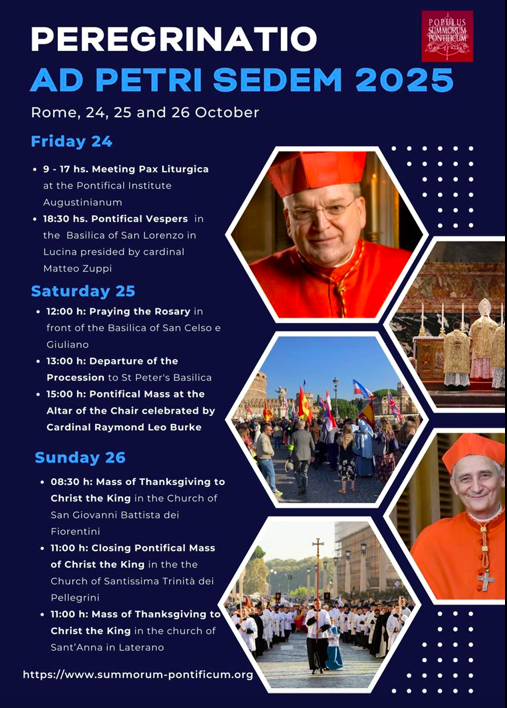
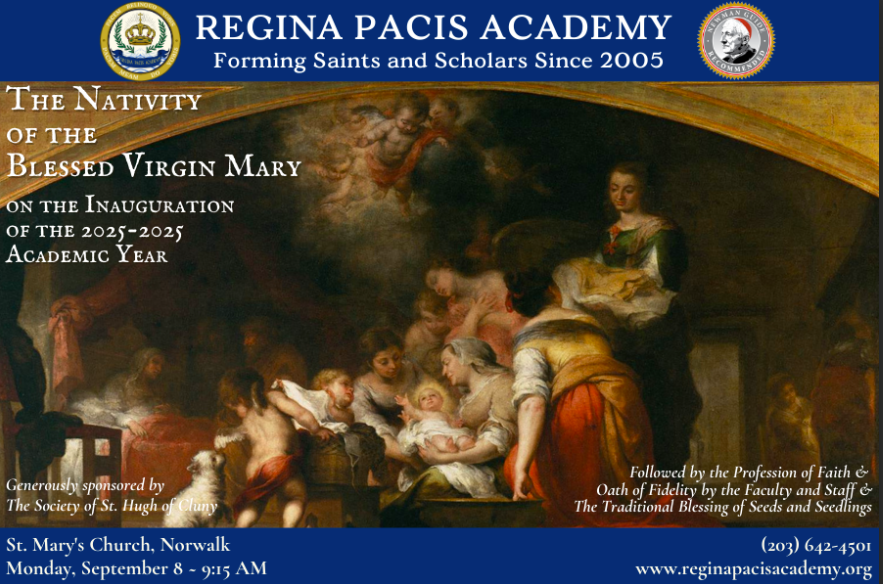
What is the role of this Society in the present day? Let me first summarize our activities in 2023 and 2024. As you can see, the Society sponsors a blog which seems to be widely read. We have sponsored a whole series of solemn masses, usually in connection with a classical Catholic school in Connecticut. We have acquired and made available additional vestments for the dignified celebration of the Traditional Mass at local parishes. We have helped to sponsor in New York and Princeton solemn vespers with outstanding music and magnificent ceremonial. We have sponsored very well received lectures by John Lamont and Marie Meaney. The Society has joined the CISP (the “International Coetus Summorum Pontificum”), and since 2021 the Society has been represented each year at the Summorum Pontificum pilgrimage in Rome (not at the expense of the Society!)
We thank all those who contribute to support these efforts. Much more could be done and perhaps we should more actively seek out donors. The main constraint on the Society’s mission, however, have always been not the lack of funding but the lack of personnel. In 2023, for example, we tried to organize a large-scale conference in Connecticut. In the world of Traditionis Custodes, finding a venue is challenging. And bringing off our usual format of combining lectures with the celebration of a traditional liturgy is even more so. Several key speakers could not in the end attend. With all these complexities, by the time a suitable venue was found it was too late to proceed with the conference. I suspect with more (human) resources devoted to the project some kind of resolution could have been achieved.
Going forward, we envisage continuing the path set forth above. The Society will sponsor more conferences and liturgies. Our primary area of activity will remain in and around the greater New York area. We of course welcome suggestions from readers as to projects and events the Society should support. With this in mind, we look forward to continuing our successful activity in the course of 2025.
7
Feb
27
Jan

Living in Wonder: Finding Mystery and Meaning in a Secular Age
by Rod Dreher
Zondervan Books, Grand Rapids, 2024
Rod Dreher, the conservative political analyst and cultural critic, now lives in Hungary – one center of the struggle against globalism. Dreher published last year Living in Wonder, the third in a series of commentaries on the social and religious life of our age. In The Benedict Option he championed the establishment of small communities as a refuge from the surrounding world. In Live not by Lies Dreher wrote in a darker vein. He no longer saw self-sufficient communities as successfully existing within today’s society but anticipated conflict and persecution exemplified by the life and experiences of Alexander Solzhenitsyn. Now, in Living in Wonder, Dreher writes both of his own spiritual quest and even of the restoration of the sacred in this “secular age.”
I doubt that this work will attain the celebrity of The Benedict Option. Living in Wonder covers too broad a range of topics: history, spirituality, philosophy, religious practice and personal faith experiences. The book’s starting point is the classic topic of disenchantment: the loss in the modern world of any sense the divine as present in the universe. This of course has been an ongoing issue since the romantic movement. Much more recently, Catholic authors have taken up the theme. Cristina Campo, whose works we have reviewed here, wrote eloquently of the loss in the modern world of symbols and of man’s sense of destiny. Czesław Miłosz did the same in The Land of Ulro. How is Man to live in such a world or even rediscover a sense of this world’s “enchantment”? These are the questions Dreher addresses.
He writes of the importance of prayer, liturgy and of the beautiful as portals to the sacred. Here and there throughout this book Dreher speaks warmly of his(relatively) new faith, Eastern Orthodoxy. His advocacy, however, is never overbearing or exclusive and it’s refreshingly different from the tirades of others who have moved to the East. Dreher doesn’t rant about filioque, the Byzantine empire, 1204 and the allegedly unbridgeable gap between West and East. Indeed, it would be hard for him to do so, since, like his earlier works in this series, Living in Wonder aims at a broad readership in various religious traditions. Speaking of his Orthodox faith, Dreher appropriately emphasizes those aspects attractive to outsiders: the beautiful liturgy, the continuing centrality of the mystic tradition, the cult of icons. Dreher makes the case that Orthodoxy has thereby preserved a greater sense of the sacred as present in this world.
Dreher however, ranges far beyond this. He particularly dwells on tangible experiences of the sacred in this world: wonders and miracles, coincidences and healings are discussed at length. The author not only presents experiences of a benign “spiritual presence” but also the dangers of encountering evil forces actively working harm. In so doing, Dreher delves into realms such as exorcism, demonic forces potentially present in AI, and even UFOs.
I think that these matters weaken the argument of the book. I myself have met people who have had such experiences – so I do not at all dismiss this aspect of reality. But the counsel of all the spiritual writers I know is to eschew pursuing such things. Dreher, however, seems to think the opposite: someone wishing to rediscover the sacred should be expecting and seeking out these phenomena. Is this the residual influence of the world of evangelical Protestantism which the author claims to have abandoned? The bizarre nature of some of the events for which the author vouches will unfortunately lead many readers not to take his latest work seriously.
Rod Dreher brings his own experiences into the narrative of encounters with the world beyond the world. Some of these events involve personal tragedies in the author’s life. This lends a poignant and serious note to the author’s reflections. As in his other books, Dreher also relentlessly quotes witnesses to support the argument of his book. They are predominantly, but not exclusively, Western converts to Orthodoxy. The overall effect of these “voices,” however, is to create a feeling of disorganization: the reader feels that he is hopping from issue to issue, from topic to topic, from country to country. And all in a rather short book. Dreher’s language also detracts from his exalted spiritual aims. It all too often is excessively colloquial; on other pages Dreher offers undigested terms derived from Orthodoxy: nous, perichoresis, theosis etc.
Dreher has moved in this book beyond the facile optimism of The Benedict Option and the focus on cultural and political catastrophe of Live Not by Lies. He correctly sees that what is needed is the recovery of faith and of spirituality. Disenchantment is a defining feature of contemporary Western culture. A culture, however, cannot be changed by the exercise of the willpower of individuals or communities however well intentioned. And certainly not by the idiosyncratic spiritual quests of some of the characters quoted in this book. Only generations and even centuries of men living an ordered, sacramental faith can effect a reversal of the present malaise. This world does need to be reenchanted – but that is not something that we should consciously set out to achieve. If and when the perception of enchantment revives it will be the result of the practice of a rediscovered faith.
27
Jan
27
Jan
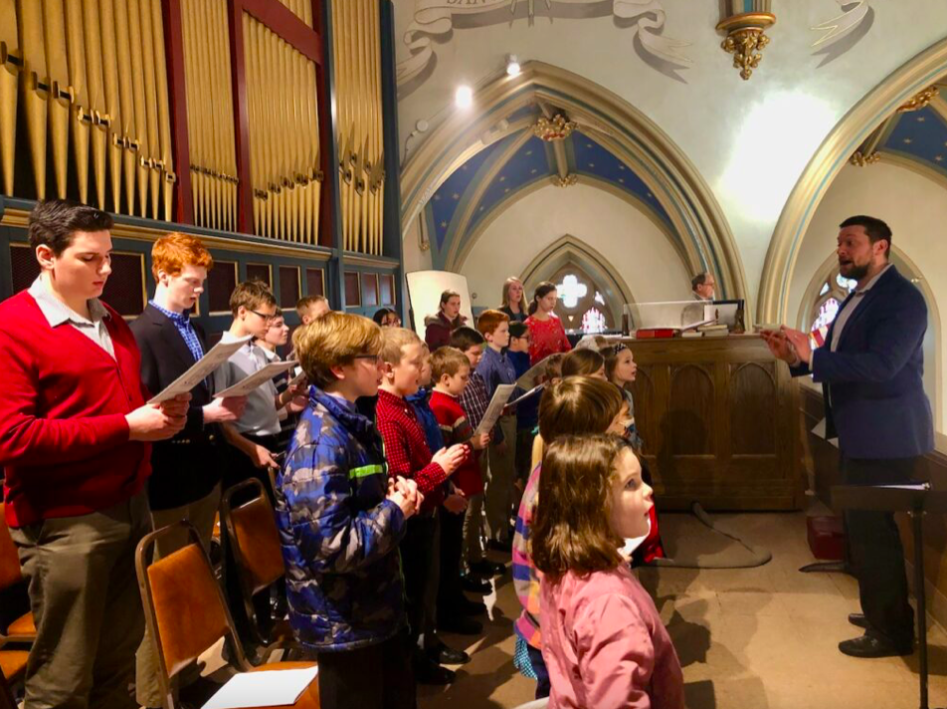
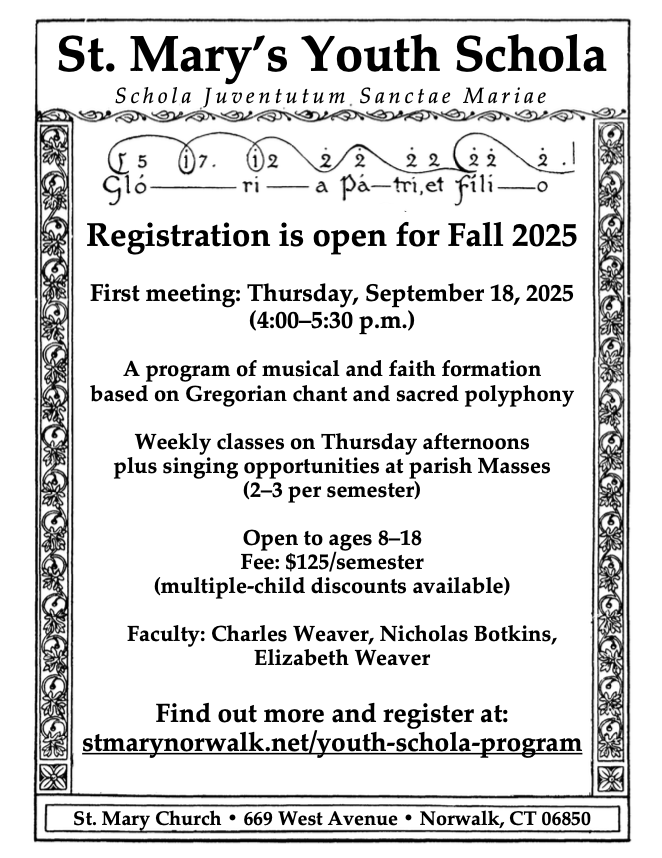
St. Mary’s Youth Schola Registration is open for Spring 2025
First meeting: Thursday, February 6, 2025 (4:00–5:30 p.m.)
A program of musical and faith formation based on Gregorian chant and sacred polyphony, with weekly classes on Thursday afternoons from 4:00–5:30 p.m., plus singing opportunities at parish Masses (2–4 per semester). Open to ages 8–18; young men with changed or changing voices are welcome!
Fee: $125/semester (multiple-child discounts available)
Faculty: Charles Weaver, Nicholas Botkins, Elizabeth Weaver
Find out more and register at: stmarynorwalk.net/youth-schola-program
11
Jan

By Marie Cabaud Meaney
(Marie Meaney has summarized for us the presentation she gave on November 9, 2024 for the St. Hugh of Cluny Society. SC)
Biographical Introduction
Simone Weil is not someone one might expect to hear about at a society centering on the liturgy. For this French philosopher was not a Catholic; she came from an agnostic, Jewish French family. Only in the aftermath of several mystical experiences did she come close to the Catholic Church (though she had already felt attracted to the liturgy earlier on). But she had
always had a great sense for beauty and its significance; and after encountering Christ, the supernatural became the focus of her thought. Hence, I believe she can teach us something about these matters.
In hindsight, she thought that she had always been Catholic de facto, if not de iure. For she shared the Catholic worldview, always sought the truth and the good, lived charity to a heroic degree, chose poverty, and embraced chastity. As she would come to see later on, she had loved God implicitly and obeyed His commands without knowing Him – thus proving Christ’s prediction that at the Last Judgment some who did not know Him will be surprised to sit at His right hand for having served Him.
For a long time, she had embraced agnosticism, believing that the human mind could not reach God. That God would descend to man came as a complete surprise to her in November 1938. It was when she was reciting George Herbert’s poem “Love” that “Christ came down and took her,” as she writes in her famous autobiographical 4th letter to Father Perrin (to be found in Waiting for God).
Though astonishing, this mystical encounter had been prepared in various ways. There were three “contacts” with Catholicism that truly mattered. During the academic year of 1934-5, she had taken time off from teaching to be employed among factory-assembly line workers to understand from the inside their working conditions. Attracted to Communism, she hadn’t kept
her concern for the oppressed on a purely theoretical plane but wanted to gain insights based on experience in order to find workable solutions (she would later criticize Communism scathingly). Given her bad health and natural clumsiness, the work on the assembly line was particularly
grueling for her. She came out of this experience, broken in body and soul. As she writes: “There I received forever the mark of a slave, like the branding of the red-hot iron the Romans put on the foreheads of their most despised slaves.” To recover, she went with her parents on a holiday
to Portugal in September 1935 where she witnessed a religious procession in a poor fishing-village, perhaps on the feast-day of Our Lady of Sorrows. The people were singing hymns of such “heart-rending sadness” that “there the conviction was suddenly borne in upon me that Christianity is pre-eminently the religion of slaves, that slaves cannot help belonging to it, and I among others,” as she explains. This was not a Nietzschean position about the weak resenting the strong and trying to control them through a restrictive morality, but rather the realization that Christianity recognizes suffering by showing affliction’s true face as Christ’s Passion.
In the Spring of 1937, she travelled to Italy, where, in Assisi, “alone in the little twelfth-century Romanesque chapel of Santa Maria degli Angeli, an incomparable marvel of beauty where Saint Francis often used to pray, something stronger than [her]self compelled [her] for the first time in [her] life to go down on [her] knees.” Though her kneeling-down was not yet prayer, it was a definite step in that direction, i.e. the implicit acknowledgement of someone infinitely holy and good calling for this posture of reverence.
A year later, in 1938, she spent Holy Week at the Benedictine Abbey of Solesmes, which is famous for its wonderful liturgy and Gregorian chant. Non-believers were known to go there for the beauty of the liturgy. She writes: “I was suffering from splitting headaches; each sound hurt me like a blow; by an extreme effort of concentration, I was able to rise above this
wretched flesh, to leave it to suffer by itself, heaped up in a corner, and to find a pure and perfect joy in the unimaginable beauty of the chanting and the words. This experience enabled me by analogy to get a better understanding of the possibility of loving divine love in the midst of
affliction. It goes without saying that in the course of these services the thought of the Passion of Christ entered into my being once and for all.” That Christ’s Passion left its mark on her came through the liturgy and implies already a kind of union with Christ through the Cross.
There too, she was introduced to the Metaphysical Poets, and in particular to George Herbert’s poem “Love III” depicting a dialogue between the soul and God, ending on a Eucharistic note. She would recite it during her violent headaches, thinking it was merely a beautiful poem without realizing that it “had the virtue of a prayer.” As she succinctly states: “It
was during one of these recitations that… Christ himself came down and took possession of me.”
After this, everything changed and nothing changed. Everything changed in that she now knew that God existed; hence, the supernatural was going to become the main focus of her philosophy. Nothing changed in that she’d already led a highly moral life – so there was no moral turnaround. Nothing changed in that it didn’t lead her to engage in any steps towards the Catholic Church, nor did she start to pray. A mystic who doesn’t pray is a surprising combination, nay even seems like a contradiction in terms. But she was fearful of auto-suggestion and therefore resisted giving her intellectual assent to her experience for the sake of the truth, knowing that “if one turns away from him [Christ] in order to go towards the truth, it will not be long before one falls into his arms.”
But this changed, when she decided with Gustave Thibon in September 1941 to learn the “Our Father” by heart in Greek. Thibon was a thinker and gentleman farmer whom she met during her exile in the South of France, where she had fled from the Nazis with her parents to the unoccupied zone. Remembering her promise a few weeks later, she did so, reciting the prayer
from then on with the utmost attention at least once a day. Each time, she would have another mystical experience, where her spirit was transported beyond time and space, where she experienced a silence “which is more real than a sound,” and where “Christ is sometimes present in person.” And after having met the Dominican priest Joseph Marie Perrin in June 1941, who raised the question of baptism with her, she went to mass every Sunday, and often daily. Weil also frequently spent hours in Eucharistic Adoration.
The question of baptism haunted her for the rest of her short life. She left France with her parents for the US in May 1942, though she would have preferred to stay in France, to continue helping in the Resistance and suffering with the oppressed and persecuted. She applied for and
obtained a position in the Free French Government of General de Gaulle in London. She arrived in the UK at the end of 1942, but died on August 24th, 1943 from tuberculosis, overwork, exhaustion, and malnutrition. 1)
I will now turn to Weil’s reflections on beauty that are significant in and of themselves, but also in terms of their importance in the liturgy, even if she didn’t reflect much on the latter.
Beauty
Every time we experience authentic beauty, “there is a real presence of God,” Weil writes in her notebooks, for “it is like a kind of incarnation of God in the world of which beauty is the mark.” “Beauty is therefore nothing else but God who comes to seek man,” as she states in “God in Plato.” More precisely, the beauty of the world is that of God Himself, rendered graspable to the senses, while all other beauties are reflections.
When you ask people to define beauty, they have a very hard time doing so and will often say that it’s in the eye of the beholder and therefore purely subjective. Or they will state that the experience of beauty is due to a chemical reaction, such as hormones set in motion. But even
without a reductionist approach, one can find it difficult to capture it in words. It is not surprising therefore that “when one reflects on the beautiful, one is stopped as by a wall.” Weil therefore sternly states in her notebooks that “Everything that has been written on this is miserably and obviously insufficient, for this study needs to start with God,” for the simple reason that beauty is God. By taking Him out of the equation, one ends up doing injustice to it.
Beauty is “a reflection of the supernatural in the natural,” which doesn’t mean it exists disassociated from us (Prechristian Intuitions). For it occurs as a relationship between our senses and this world. It is meant to be enjoyed by human beings and even by all rational beings in the universe to whose sensory perception it is geared, is Weil’s claim. But beauty is real and of its own kind (sui generis). It cannot be explained by anything else but itself and is its own criterion.
Beauty as Sacrament
Yet beauty has an incomparable role to play. Weil even compares it to a sacrament, since it unites God and human beings. Without beauty, therefore, human beings would be lost. Those who have never experienced beauty “could perhaps reach God by no other means.”
Though there are a number of openings to the supernatural, “the beauty of the world is almost the only way through which one can let God penetrate” people’s lives in the West, as she writes in “Implicit Forms of the Love of God.” Yet, “the white race has almost lost its sensitivity towards the beauty of the world.” If it was bad in Weil’s day, one wonders what she would say
today.
But this sense of beauty, “even if mutilated, deformed, and sullied, remains indestructibly in the heart of man as a powerful motive.” If rendered “authentic and pure, it would transport in one fell swoop secular life at the feet of God” and make a “complete incarnation of faith” possible.
However, this isn’t easy, for it means abstaining from using beauty for one’s own gratification. Therefore, “only those can be saved,” she states in her notebooks, “that something compels to stop when they would like to approach that which they love, those in whom the sense of beauty has put contemplation.” This detachment is motivated by beauty itself, by the
realization that beauty is fragile, at least in this world, and can be destroyed and debauched. It implies a renunciation of one’s selfishness or a “decreation,” as Weil calls it, that comes down to a painful death to self.
Beauty and the Liturgy as Metaxu
Beauty is one of the metaxu, the bridges or “holes” in the fabric of our artificially secularized world, that lead to the supernatural. The supernatural is obviously not the demonic, but is “that other reality,” namely the absolute good which turns out to be the triune God, Love
itself.
It has its own laws that can be drawn up and are just as certain, if not more, than scientific laws. If someone directs all his attention and love towards the absolute good, then he will eventually perceive it; it will “descend upon him” and shine “through him upon all that surrounds him.” However, this will not happen primarily through perception or reason (though these can confirm it) but through the heart, of which Pascal already said that it “has its reasons which reason does not know.”
Another manner to get to “touch the supernatural,” another metaxu, is through the liturgy. In a time where people have lost their roots, the liturgy is key to give them back these roots, as Weil states in “Le christianisme et la vie des champs.” In “Human Personality,” she compares the human person to a tree that has roots both in the sky (the supernatural) and in the earth (their culture, traditions, and history) that have so often been lost through industrialization and secularization. The supernatural is often accessed through those cultural roots: through customs, art, literature, architecture. But when these have disappeared, been disfigured, or remain
inaccessible, then the supernatural in the form of the liturgy becomes even more essential in helping people grow these roots again (though Weil mainly thinks of farmers in “Le christianisme,” it is applicable to all).
Conclusion
The cult of ugliness seems to reign everywhere. Unfortunately, beauty has often even been removed from our churches and our liturgy. But the beauty in the liturgy is essential, as Weil is implicitly saying, in drawing people back from the secularized and uglified universe they live in, giving them roots to grow and the capacity to understand what life is truly about – not a comfort-zone that tends to our desires and need for distraction, but a heroic choice between good and evil, for God or against Him.
© Marie Cabaud Meaney
For more elements regarding Simone Weil’s thoughts on the supernatural, see my analysis in: https://ojs.unito.it/index.php/spaziofilosofico/article/view/9964
For Weil’s thoughts on beauty, see my chapter in the forthcoming volume: Amazon.com: The Bloomsbury Handbook of Simone Weil (Bloomsbury Handbooks): 9781350341623: McCullough, Lissa (Editor)

10
Jan

We read that the New York Archdiocese (in a message from the vicar general, Msgr. Joseph P. LaMorte) )has advised that “there is no need for” altar rails when “restoring places of worship.”.
Archdiocese of New York dismisses increased requests for altar rails, claims ‘no need’ for them.LifeSiteNews (1/7/2025)
Some pastors have been inquiring about reinstalling an altar rail. According to current directives there is no need for it. The General Instruction for the Roman Missal (GIRM) specifies that the normal posture for the reception of communion is standing. To install an altar rail would be to suggest a posture other than the GIRM’s stated norm. 1)
Now only last month Cardinal Cupich of Chicago had stated his displeasure at the faithful kneeling when receiving communion. His argumentation, insofar as he relies on authority at all, resembles that of Msgr. LaMorte. I would be surprised if these developments are unrelated.
Lex Orandi, Lex Credenda, The Society of St. Hugh of Cluny (12/13/2024)
What Cardinal Cupich and Msgr. LaMorte don’t bother to mention is that the GIRM specifically provides for kneeling at Communion. Furthermore, in the United States, the bishops had tried to make standing mandatory – this was changed at Vatican insistence in 2004 (Redemptionis Sacramentum). A position paper of the New York Archdiocese (On Receiving Holy Communion), upon which Msgr. LaMorte relies for authority does mention the relevant provision of Redemptionis Sacramentum but gives a distorted presentation of the history and current legal status of the issue which exclusively favors standing. (Moreover, it also denies to kneeling and reception of communion on the tongue any special Eucharistic reverence). 2)
Of course, the original (and current) purpose of the altar rail is to mark off the sanctuary or chancel from the nave. It is the descendant of the medieval rood screen or the Eastern iconostasis. It does not primarily derive from the mode of receiving communion. The topic of the altar rail, involving separate ideological issues and ignorance as to what the Vatican Council and the Church actually decreed, is a separate subject altogether.
In the Archdiocese of New York itself, as recently as 1998, a new church (St. Agnes) was built featuring an altar rail. However, as I wrote in 2011:
(C)an the “language” of Catholic traditional art indeed express the modernistic, non-traditional and ever-changing nature of the new liturgy? To point out just one example, by setting up a communion rail, the builders of the new St. Agnes intended to memorialize the return of the traditional mode of receiving communion – kneeling and on the tongue – to the Novus Ordo liturgy. Yet not too many years after the completion of this church, the US bishops tried to mandate receiving communion standing as obligatory in the Novus Ordo. 3)
If I were in a Novus Ordo parish yet desperately seeking to preserve traditional practices of piety, I would be worried. For it seems that some hierarchs would welcome revisiting and overturning the compromise regarding the posture when receiving communion established in 2004. Cardinal Cupich, after all, has also effectively banned celebrations ad orientem in the novus ordo, which seems to contradict the liturgical books (if not the liturgical practice).4) And this time there would be no resistance from the Vatican, for Cardinal Cupich enjoys the best of relations with the bishop of Rome. The war of Pope Francis and the progressive establishment against Catholic Tradition is by no means limited to the Traditional Mass!
Yet nevertheless the struggle goes on. As Msgr. LaMorte notes:
No one is sure where the impetus for this (altar rails– SC) is originating, but it seems to be picking up a bit of steam. 5)
Could it be originating from man’s innate sense for beauty, truth and reverence? A sense that keeps breaking through and making itself felt despite all the official ideologies and attempts at manipulation. Just last year at the church of Corpus Christi in Manhattan, the tabernacle was restored to its old place of honor in the center of the sanctuary – supposedly at the express direction of Cardinal Dolan. Yet the bulletin of this same parish had published earlier a statement – again by Cardinal Cupich – summarizing ideological reasons why the tabernacle shouldn’t be placed in a central position in a church! 6) The endless ideological conflict that defines the post-Conciliar church continues. Catholic Traditionalists, however, long ago concluded there is a better way….

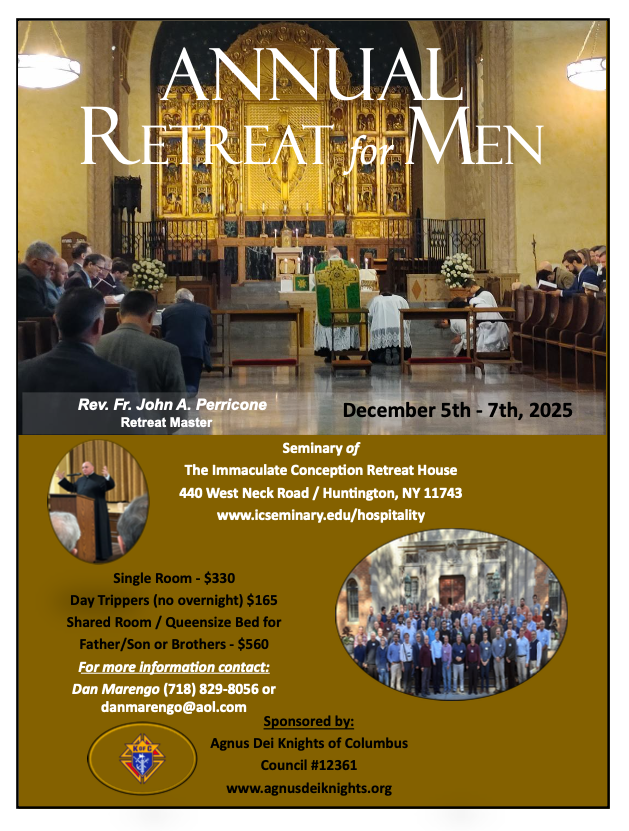
Registration for the annual Women’s Retreat, which is scheduled for March 21-23, 2025 at the Seminary of the Immaculate Conception in Huntington, L.I., is now open. The Retreat Master is Fr. John Perricone and is sponsored by Agnus Dei Knights of Columbus Council. 130 women were in attendance last year. If you intend on coming, it is recommended that you reserve a spot sooner rather than later. Please contact Dan Marengo for more information and instructions on how to register. danmarengo@aol.com. Register by March 3.