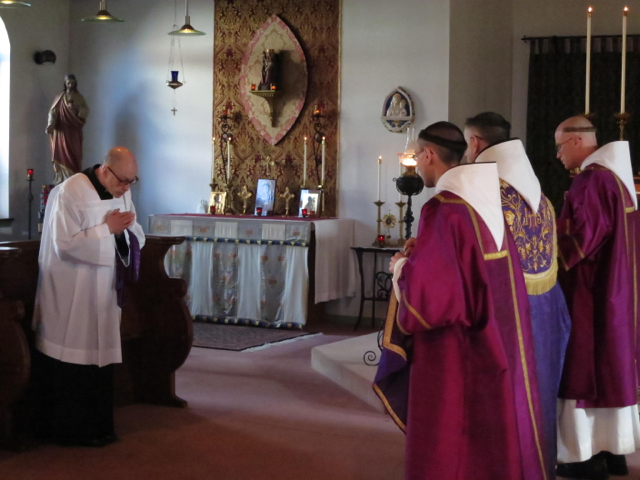
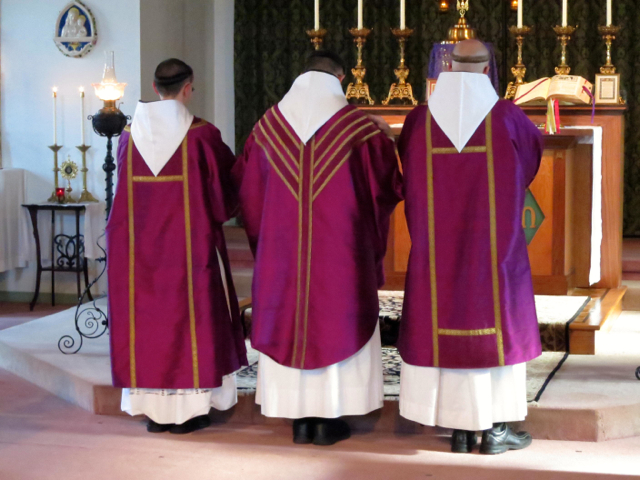
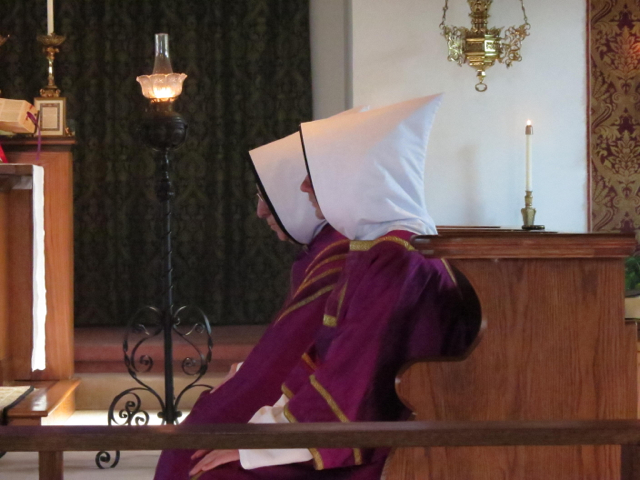
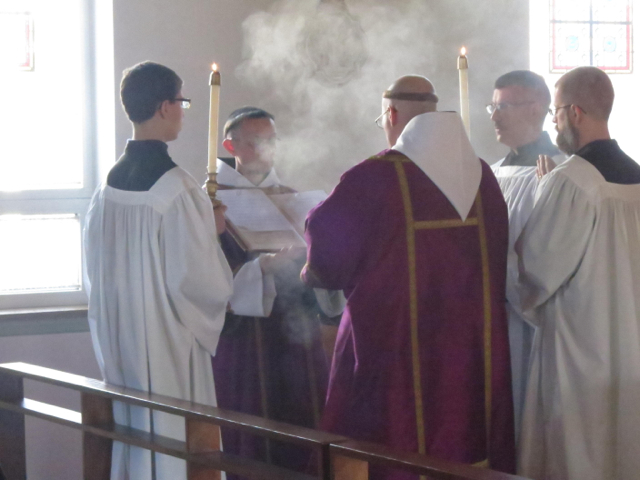
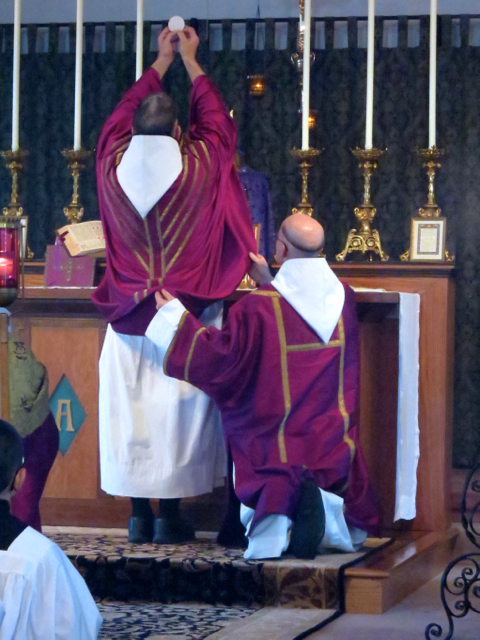
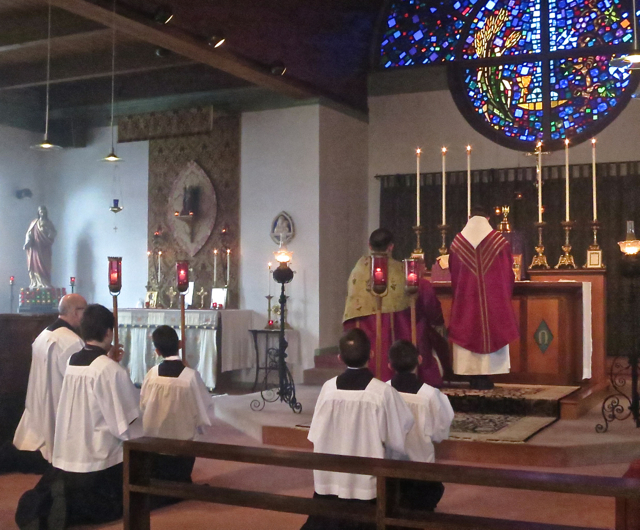
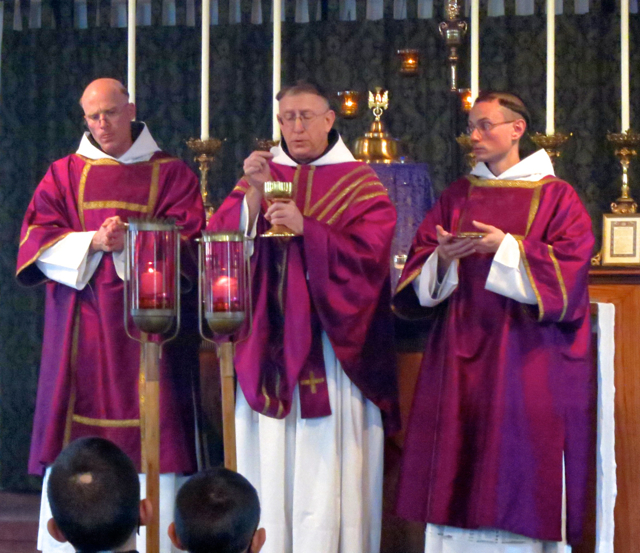
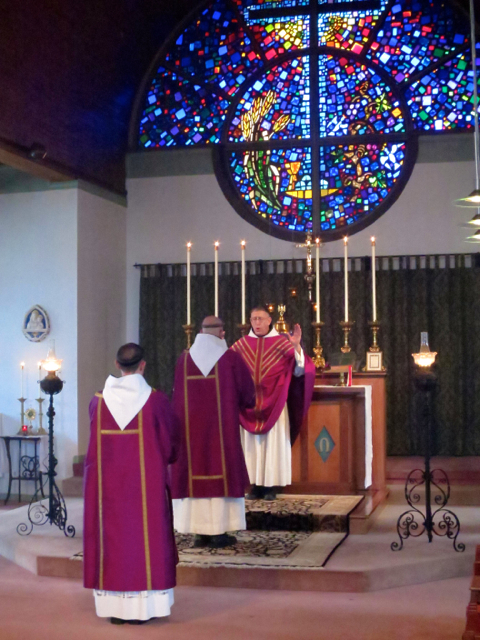
Sung Mass for the Dead on Tuesday, November 18th at 7:30 in the evening
Saint Mary Church
Greenwich Avenue
Greenwich, Connecticut
23
Oct
Sung Mass for the Dead on Tuesday, November 18th at 7:30 in the evening
Saint Mary Church
Greenwich Avenue
Greenwich, Connecticut
14
Oct
Readers of this site will be familiar with the beloved statue of Our Lady of Mount Carmel in Harlem. The Holy Name Society of Our Lady of Mount Carmel Pontifical Shrine is mounting a fund raiser to restore the statue. The statue of the Virgin was crowned with Vatican authorization in 1903 – one of only a handful of Crowned Virgins in North America. Pope Pius X contributed an emerald but the rest of the gold and jewels for the crowns of Our Lady and the Christ Child came from the wedding rings and other jewelry contributed by the Italian ladies of the parish. The feast and procession of Our Lady of Mount Carmel draws a huge crowd in the summer.

The interior of Our Lady of Mt. Carmel Pontifical Shrine, where the historic statue stands over the main altar
13
Oct
Mass Mobs: From the New York Times
“Elizabeth Davis, 47, of Harmony, Pa., decided to start a Mass mob in Pittsburgh after hearing about the group in Buffalo. Her first effort, organized via Meetup.com, drew 25 people and the second about 50. Now, by reaching out through a Catholic women’s organization and youth programs, as well as to members of a historic preservation group, she hopes to hit 150 later this month.
“These beautiful old churches were built by our grandfathers and great-grandfathers, and to see them close is really sad,” said Ms. Davis, who is also raising six children and finishing a college degree. “We have 2,000 years of tradition, and it’s time we get excited about it.”
(As the article notes, there is a “Mass mob” movement in Fairfield County!)
Paulson, Michael, “At Forlorn Urban Churches, Mass gets crowded in a Flash” (The New York Times, 10/11/14)
13
Oct
13
Oct
12
Oct
New Lamps for Old
The most tragic loss of a church in recent years was that of St. Ann’s church of East 12th Street. 1) What had made this parish so special? The writer of the parish history identified this parish’s defining characteristic: St. Ann’s had always had a reach that extended beyond its parish boundaries. Under Fr. Thomas Preston, rector 1862-1891 (and Chancellor of the Archdiocese), this parish took a leading role in the city – and not just among Catholics. Fr. Preston’s preaching drew large crowds – supposedly including representatives of elegant society from all over the city. In architecture, Napoleon Lebrun (a parishioner) crafted one of his most perfect Gothic interiors. In music, this parish sponsored the first performance of Verdi’s Requiem in the United States in 1874. To care for the poor the parish, Fr. Preston helped to found in a new congregation: the Sisters of the Divine Compassion. That order later spread far from this parish. Indeed, Fr. Preston’s body resides in a mausoleum at the chapel of the motherhouse in White Plains – which is currently up for sale….
After Fr. Preston’s death, St. Ann’s, even by 1900, had to face the fact that the population of Catholics within the bounds of the parish – although impressive by today’s standards – was inadequate to support such a splendid church. So the parish turned itself into a shrine of St. Ann, in cooperation and competition with St. Jean Baptiste far to the north in Yorkville. The crowds returned to St. Ann’s for prayers and novenas – the parish was thereby able to afford a lavish project of redecoration executed through the 1920’s. Governor Al Smith was one of the parish trustees when St. Ann’s was designated as the “National Shrine of the Motherhood of St. Ann” in 1929. 2)
By the 1950’s the parish was trying to reposition itself as a commuter church for the many shoppers frequenting what had become the bargain shopping area of the City. As time went on even these stores vanished. St. Ann’s had to reinvent itself once again – this time as a cathedral for the Armenian Catholics, as a national church for New York Ecuadorians and, after 2004, as one of the original two homes for the revived Traditional Latin Mass on the island of Manhattan. Once again St. Ann’s parish had reached out beyond the limitations of its neighborhood to find new congregations. It was an amazing place to experience the diversity (in a real sense) of the Catholic Church.
All that is gone – replaced by a dormitory of NYU. Only the tower of the very first (Protestant) church that predates the total rebuilding of St. Ann’s as a Catholic parish remains…
You can therefore imagine my interest when I heard that stained glass – and some other items – from St. Ann’s had been installed in a new church in Somers, in northernmost Westchester County. 3) The Archdiocese has claimed that it intends to save and recycle for ecclesiastical use all “artwork” from closed churches (as if architecture is not art). It had been reported, however, that stained glass from St. Ann’s was in the possession of private parties. 4) So I was curious to see how the recycling of art of St. Ann’s windows had worked out.
St. Joseph’s and St. Ann’s form a contrasting pair. To compare them is perhaps invidious; the construction of a new church in upper Westchester county should have nothing to do with the demise ten years earlier of an ancient parish in the City. But the archdiocese itself forces the comparison upon us by holding forth St. Joseph’s as a success story of “reconfiguration.” The new church replaces three older churches and missions, which are being sold – the former parochial school of St. Josephs has also been closed (but is still in the parish’s hands).
St. Ann’s was the creation of one of the leading architects of the day; St. Joseph’s is a pleasant structure in a highly stylized “Gothic” style. The layout is a cross between that of a traditional “basilica” and a centralized space so beloved by the liturgical renewal. The 1961 church of St. Theresa in Trumbull CT has vaguely similar ideas (especially in the interior) carried out much more impressively. St. Joseph’s does represent a return to a ”modern” style that nevertheless retains the appearance of a church – unlike the lecture halls and hotel lobbies that have characterized the limited products of (Roman) Catholic Church architecture on the island of Manhattan in the last 45 years. We should be grateful for such favors!
On a first visit St. Joseph’s is difficult to find; later one realizes that the road connections are very good. Indeed, facilitating car transport appears to be a major concern here; the church is separated from the surrounding nature by vast parking lots on every side. Another planning objective was to reduce the number of masses that had to offer on the weekend by uniting the congregations of several smaller churches in one large structure. The complex of St. Joseph’s provides a number of different spaces for the use of the parish as well.

(Above) The surrounding parking lots.

(Above) The altar and pulpit are also formed from marble taken from St. Ann’s.
Inside, like most “conciliar” churches, all is brilliantly lit. There is, however, much natural wood and natural light. Architecturally there is a large separate chapel and what appears to be a world-class cry-room. Elements of Catholic devotion like statues are limited in number. Banks of unlit votive candles stand before them – perhaps it is a little early in the history of this new building for such devotion to take root.
In summary, while old St. Ann’s was a highly visible building for a parish that exercised a citywide influence, St. Joseph’s is very much the secluded, private “chapel” of a religious minority, known only to initiates. It very faithfully illustrates the direction the Catholic Church – and the faithful of the Catholic church – have taken in this region over the last 50 years.

Compare the style of the above window with the others.

(Above) One of the windows with unusual Old Testament themes.

(above) Note the dedication from Cardinal Hayes.
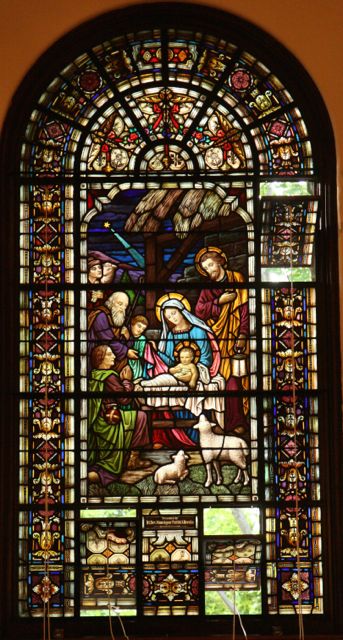
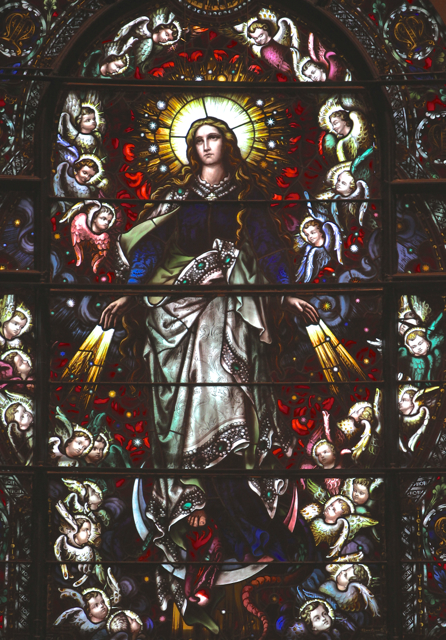
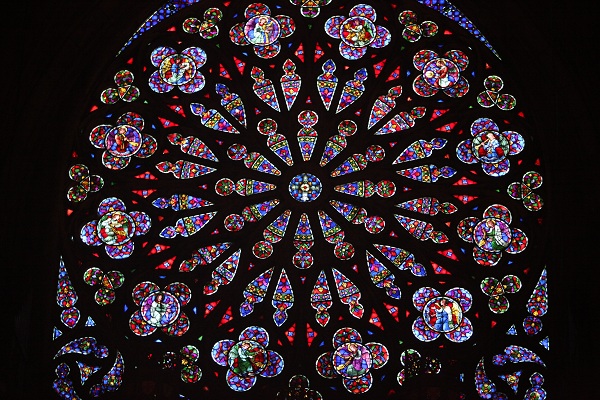
And what of the windows of St. Ann’s – the initial reason for our visit? To our disappointment we now realize that they date from the 1920’s and are not products of the absolutely best studios (one source says they are from France). In addition, a number of much cruder windows are found – are they earlier, from another inferior workshop or did the come from the predecessor of the current church? (The windows of the chapel came not from St. Ann’s but from the old St. Joseph’s church) Moreover, instead of the darkness of the interior of St. Ann’s, we have bright light everywhere, robbing the stained glass of much of its effectiveness. I believe not all the St. Ann’s windows could be accommodated at St. Joseph’s – I saw only three examples of the curious and unique Old Testament series. Thus, the sense of the complete program is lost. Nevertheless, the St. Ann’s windows are a colorful and comprehensive set of images, some highly unusual; I am glad that many of them have been saved here.
1) See, for example, “The Travesty of St. Ann’s Church 120 East 12th Street,” http://daytoninmanhattan.blogspot.com/2011/08/travesty-of-st-anns-church-120-east.html
2)Browne, Henry J. St. Ann’s on East 12th Street in New York City 1852-1952 (The Roman Catholic Church of St. Ann, New York, 1952)
3) Poust, Mary Ann, “St Joseph’s Breaks Ground on New Church in Somers,” Catholic New York (6/15/11) at http://cny.org/stories/St-Josephs-Breaks-Ground-on-New-Church-in-Somers-,5679; Chicoine, Christie L., “All can Come Home to New Church at St. Joseph’s, Somers” Catholic New York, (7/9/14) at http://cny.creativecirclemedia.com/stories/All-Can-Come-Home-to-New-Church-at-St-Josephs-Somers,11271
4) White, Meghan, “Shedding Light on a Church that was Razed by NYU,” at
12
Oct
More inspiring news from Brooklyn at the newly renovated Holy Name of Jesus church.
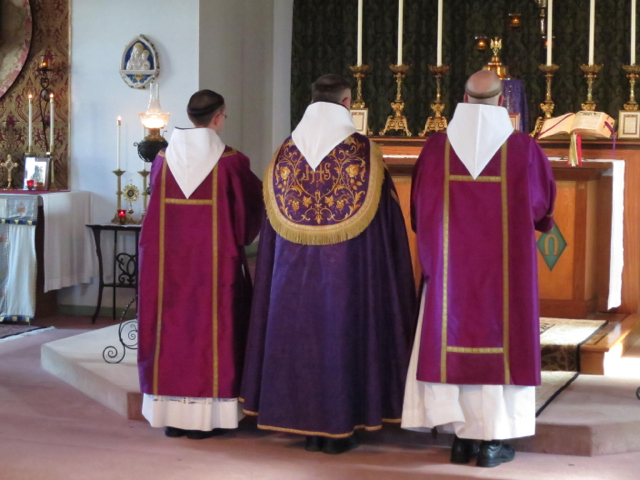
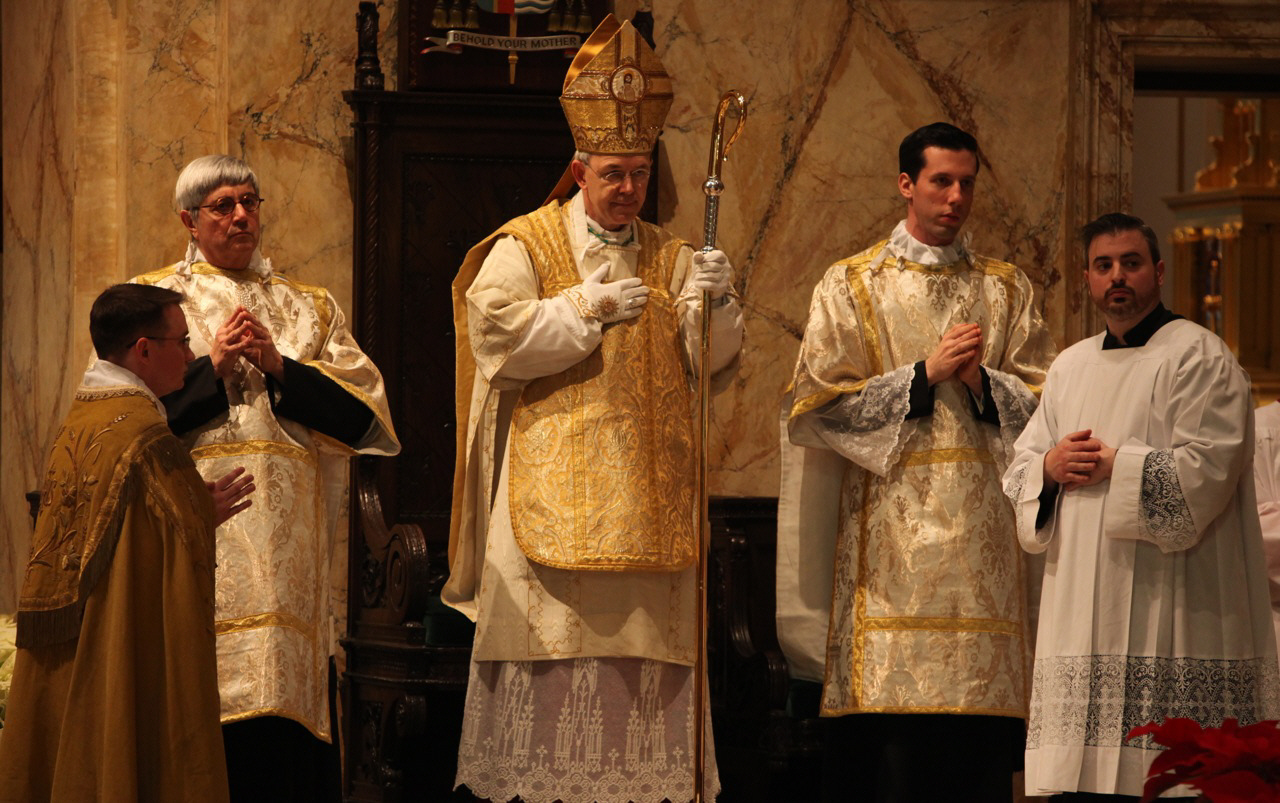
On October 11, 2014, Rev. Fr. Brandon P. O’Brien (Diocese of Rockville Centre) celebrated a Solemn High Mass at Holy Name of Jesus Church located in the Diocese of Brooklyn, NY. Mr. Jon Tveit was the Sub-Deacon and Mr. Eddy Toribio was the Master of Ceremonies. Among the clergy assisting in choir was the pastor, Rev. Fr. James K. Cunningham.
(Notice and photos courtesy of Mr. Arrys Ortanez)
11
Oct
At St. Mary Church in Greenwich, CT, on Friday, October 17th at 7:30 in the evening there will be a Solemn High Mass Votive Mass in honor of Pope St. Pius X commemorating the centenary his death.
11
Oct
THURSDAY, NOVEMBER 6, 2014 I 6:30 PM
TWELFTH ANNUAL SOLEMN
REQUIEM MASS
Missa pro defunctis (Requiem á 8) Duarte Lôbo (c. 1565-1646)
sung by the Schola Cantorum of Saint Agnes
James D. Wetzel, Organist and Choirmaster
The Church of Saint Agnes
143 East 43rd Street (between Lexington & Third Avenues) New York City
sponsored by the CATHOLIC ARTISTS SOCIETY, NEW YORK PURGATORIAL SOCIETY and the
SOCIETY OF SAINT HUGH OF CLUNY (stagneschurchnyc.org catholicartistssociety.org nypurgatorial.com sthughofcluny.org)
REMEMBER THE SOULS IN PURGATORY DURING NOVEMBER!

9
Oct
Columbus Day Concert for Neumann Classical School: The Voice of Joy
Friar Alessandro of the Franciscan Friars Minor of Assisi will perform in a special concert benefiting the Neumann Classical School.
This Monday: October 13 at 4 pm
Church of Saint Casimir
239 Nepperhan Avenue, Yonkers NY 10701
International singing sensation Friar Alessandro of the Franciscan Friars Minor of Assisi is a celebrated tenor who has released two albums with Decca Records. His debut album Voice of Assisi was produced by the legendary Mike Hedges (U2, The Cure, The Manic Street Preachers) at Abbey Road Studios in London. Friar Alessandro is the first member of the Friars Minor to have received a global record deal from a major international label.
This concert, Friar Alessandro’s only performance in the NY area, will benefit the Neumann Classical School, the only classical-curriculum Catholic primary school in the New York Archdiocese.
Tickets can be purchased at the doors: $30 adults; $20 students and seniors. Children under 12 admitted free with an adult.
For more information contact lopes@neumannschool.org.