From the Catholic History Nerd.
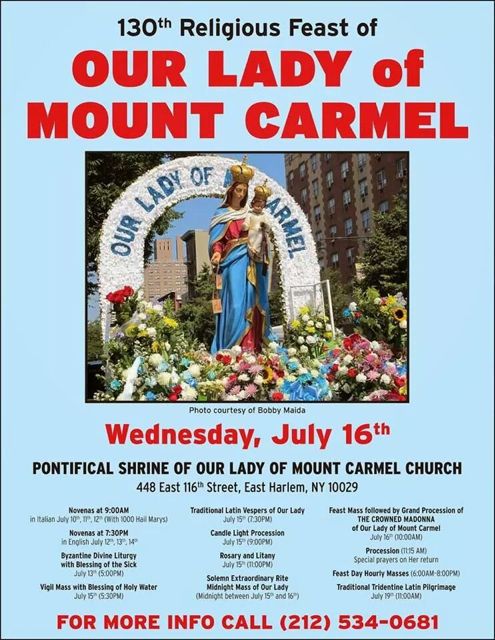
SOLEMN HIGH MASS
FOR THE FEAST OF CORPUS CHRISTI
Thursday June 19th at 7:30 in the evening
Celebrated in Latin according to the
Extraordinary Form of the Roman Rite.
Outdoor Eucharistic Procession and Benediction after Mass.
Light refreshments to follow in
Parish Meeting Room
Church of Saint Gabriel
914 Newfield Avenue, Stamford, Connecticut
10
Jun
Fr. Justin Wylie is a priest of the Archdiocese of Johannesburg, South Africa, who, until very recently, had been on assignment in New York City as attaché to the Holy See’s Permanent Observer Mission to the United Nations. He has become an extremely popular preacher in New York and was a frequent celebrant of the Mass in the Extraordinary Form at both the Church of St. Agnes (three times a month) and the Church of the Holy Innocents (one time a month) in Manhattan. (Fr. Wylie was the celebrant at Holy Innocents on several of our visits to the church, including this one). As first reported here in Rorate, the Church of the Holy Innocents has now been placed on a preliminary list of churches in Manhattan targeted for closing by the Archdiocese.
On Sunday, May 18, 2014, Fr. Wylie preached a sermon at Holy Innocents on charity and, in particular, on the urgent need for the Archdiocese to send true and sympathic shepherds to serve (and guide) those who attend the Extraordinary From of the Mass in the Archdiocese. Shortly thereafter copies of the text of Fr. Wylie’s sermon began to appear all over the internet – not in Rorate.
It would appear that Fr. Wylie has not survived the publication of the text of his sermon unscathed. The following does not seem to be in dispute: just days after his sermon was widely publicized on the internet, Fr. Wylie was obliged to withdraw from all of his commitments to celebrate Mass in the Extraordinary Form in the Archdiocese (and, apparently, from all public ministry in the Archdiocese of New York). It seems also that both the Holy See’s UN Permanent Observer Mission and the Archdiocese of Johannesburg received letters about the sermon from the Archdiocese of New York; Fr. Wylie no longer works for the Holy See UN Mission and he will soon be returning to South Africa.
10
Jun
There will be a Gregorian chant tutorial learning the basics of the Church’s chant in Branford, CT on Wednesday June 18 at 7 pm. This event is sponsored by the St. Gregory Society. The tutorial will take place at the Monastery of the Glorious Cross, 61 Burban Drive, Branford (next to St Elizabeth Church). There is a small fee of $20 (scholarship available). The text will be the Parish Book of Chant (CMAA, 2nd); if you have the Liber Cantualis, please bring that text, too.
An RSVP is required by June 14. Space is limited. Please send your RSVP and direct all questions to the St. Gregory Society: saintgregorysociety@gmail.com.
9
Jun
Some photos of the Missa Cantata for Pentecost at Immaculate Conception in Sleepy Hollow, New York. The Mass was offered by Fr. Richard Munkelt. The MC was Dominic Morlino. There was a reception after Mass to thank the schola for 10 years of service to Our Lord. The schola livened up the reception by taking to the stage to entertain with various musical pieces. Our thanks go to Dennis DeVito for sending this report and the photos.

8
Jun
St. Peter
22 Barclay Street
We first encountered this church many years ago – was it in the late 1970’s? In those years the gray mass of St. Peter’s seemed to squat, forlorn and dingy, in the shadow of the surrounding giants: the Woolworth building, the twin towers of the World Trade Center. A parish known only to those working in nearby office buildings who patronized it as a commuter church. So short a memory do Catholics have – how little awareness of their history! For St. Peter’s is the oldest church in New York and in the Archdiocese – indeed, it predates the formation of the diocese of New York by some 20 or more years.
St. Pater’s has a long and colorful history – identical to that of the diocese itself for many years. It was organized in 1784 – the consul general of France was one of the trustees. In 1785, with the decisive organizational and financial support of the minister of the kingdom of Spain, Don Diego de Gardoqui, and of the king of Spain himself, various Catholic gentlemen were able to acquire land and build a church, finished the following year.
“It was the first Catholic church erected and opened after the United States achieved their independence.” 1) There were some 400 in the congregation. The priests of St Peter’s were of all kinds of nationalities and religious orders and included some extraordinary characters. Fr. Malon, SJ, for example, had been a Belgian general (he was buried at St. Peter’s). Sermons were given in three languages: English, French and German.
New York was then the capitol of the United States. In 1789 the first congress held its sessions in New York. In the congregation of St. Peter’s were the Spanish and French minsters (ambassadors) and consuls, as well as Charles Carroll and other Catholic Senators and congressmen.
In 1788 the pastor made a fund raising tour to the then much more magnificent cities of the Spanish empire in America. From Mexico City he brought back five thousand nine hundred and twenty dollars – and a painting of the crucifixion, which he installed as the altarpiece. It was before this image that Elizabeth Ann Seton prayed. It was at St. Peter’s that she as received into the Catholic church in 1805. 2) In 1800 the parish established “St Peter’s free school” – the first parochial school in New York City and one that antedated any public school in the city.
Despite all this seeming success and activity the history of St. Peter’s was from the beginning a stormy one. There were recurring conflicts among the clergy. The yellow fever repeatedly ravaged the neighborhood. In 1806 an anti-Catholic mob threatened – the first instance of what would later be a regular occurrence. In 1813 a priest attached to St Peter’s vindicated the seal of the confessional in court. 3)
The relentless increase in the Catholic population soon made the original structure of St. Peter’s inadequate. The venerable brick church was demolished in 1836 and a new neoclassical structure erected. Finished in 1838, it was at the time one of the grandest churches of any denomination in New York.
Yet one senses some disappointment. Catholic New Yorkers never really warmed up to their grand new house of worship. St. Peter’s was one of the last of the neoclassical temples – and an especially austere example at that!
“The Church was of Grecian architecture, a style which has never since been adopted in our city Catholic churches. It excited no little comment at the time, and the marble tabernacle, a representation of the church itself, and the movable pulpit, appeared to many strange.” 4)
And in a few years Upjohn’s Holy Trinity and Renwick’s Grace church had inaugurated the neo-gothic wave in the city. It was this “Christian style” that became the preferred expression of church architecture in New York. The estrangement from the appearance of St. Peter’s only grew as the 19th century progressed when the temples in this style of architecture became associated with banks.

To say the location is busy is an understatement.
(Above) The wall facing the alley is without a stone facing; (below) the exposed western wall is clad in smooth granite.

In the perpetual shadow of the giants.
Regrettably the old troubles of St. Peter’s quickly returned. The expense of the new building and the unresolved issues of governance under the old trustee regime led to a new crisis in the 1840’s. St. Peter’s faced bankruptcy and was put up for foreclosure. Bishop Hughes’s forceful intervention saved St. Peter’s from this ignominious situation. But it was 1852 before the legal mess could be strengthened out.
After this year, peace finally settled upon this church. St Peter’s became just one of the many flourishing, huge Catholic parishes in the New York of the second half of the 19th century. Yet we must mention one further event:
“In July 1853, St. Peter’s was filled with Catholics and Protestants to attend a solemn requiem for an aged man whose coffined corpse lay before the altar…And never perhaps has the Catholic Church stood forth more grandly in New York than on that day. …(From the eulogy)’There are few left among the clergy superior to him in devotion and zeal for the Church, and for the glory of God; among laymen, none.’ And the man whom the Catholic Church thus honored was a black man, of humble calling, Pierre Tousssaint.” 5)
Yet as early as the 1880’s St Peter’s was among the first parishes to be confronted by a new phenomenon: the rise of purely commercial areas in New York and the resultant disappearance of the local parish population. St Peter’s congregation declined from 20,000 in the 1860’s to fewer than 5,000 in 1914. The parish ceased to be predominantly Irish and embraced a whole number of nationalities. By 1913 the most numerous in fact were the “Polish Ruthenians”; Arab Melkites held their services in that rite in the lower church from 1899 to 1916. 6)
Would the parish itself close? Archdiocesan spokesmen today make much of the fact that some voices in the 1890’s recommended closing some of the downtown parishes. Yet the fact is these parishes were not closed. In the case of St. Peter’s, the question was raised – and answered – as early as 1885:
“One of St. Peter’s most solemn moments occurred in 1885, a hundred years after the founding of the parish, when the second church became eligible for consecration because all debt had been paid. Some parishioners thought the neighborhood was changing from a residential to a business district and that it would eventually be more profitable to sell St. Peter’s and build a church elsewhere in the city. John Cardinal McCloskey declared that St. Peter’s would “never be alienated,” and instructed the pastor to proceed with his plans for consecration. The solemn ceremony took place on November 22, 1885.” 7)

Probably the original tabernacle that aroused such wonderment in 1838.
So St Peter’s soldiered on as one of the first “commuter churches’” a spiritual oasis in the midst of the increasingly monstrous structures of a monotonous commercial landscape. The school – the first Catholic school in the city – had to close in 1940. By the 1940’s St. Peter’s seemed definitively to have found its final niche: as a chapel for the thousands commuting to and from downtown New York each day. 7)
Yet “the course of human events” changed once again. History returned to St Peter’s. Downtown New York started developing once again as a residential area. St. Peter’s acquired its own residential congregation for the first time in many decades. 8) Recently the entire church interior was completely restored.
And on September 11, 2001 the twin towers of the World Trade Center were destroyed – St. Peter’s was the closest Catholic church to the catastrophe and indeed was nearly buried by it. Wreckage descended upon the roof of St Peter’s which served as staging area for the rescue operations. It was an unimaginable climax to this parish’s history.
Today a visitor encounters a rejuvenated, polished St Peter’s. Some new construction has momentarily freed up some surrounding space, giving the visitor an unimpeded view of the façade of the church for the first time in decades. Contemplating the unadorned, flat, polished surfaces of this church’s exterior, we can readily see how the neoclassical idiom was the first “non-organic” modern style of the West, how St. Peter’s seems to blend in with harsh geometrical shapes of the skyscrapers around it.
Inside, St. Peter’s has a cream color scheme that nicely completes and enriches the monochromatic gray of the exterior. But in 1905 a magnificent set of beaux-art altars was installed. These altars give the interior a much-needed festive touch compared to the somber exterior. Yet above the main altar still presides the altarpiece of the 1789; the same image of the crucifixion before which St. Elizabeth Seton prayed in the infancy of New York Catholicism so many generations ago.
(Above) and (below) Altars of the 1905 restoration – all thanks to a single donor.

The original painting of the Crucifixion.
(St. Peter’s has a fine parish website at: http://www.spcnyc.org)
1) Shea, John Gilmary, The Catholic Churches of New York City at 587-590 ( Lawrence G. Goulding &Co., New York 1878)
2) Shea, op.cit. at 592-593.
3) Shea, op.cit at 595-598, 600-602
4) Shea, op. cit at 610.
5) Shea. op.cit at 614.
6) The Catholic Church in the United States of America, Vol. 3 at 368 (Catholic Editing Company, New York 191
7) http://www.spcnyc.org/index.cfm?load=page&page=172
8) http://www.spcnyc.org/index.cfm?load=page&page=172
The Pentecost Sunday 3 pm Sung Mass at Immaculate Conception Church in Sleepy Hollow, NY will be followed a special convivium to honor the Sleepy Hollow Schola Cantorum.
Since 2004, Masses have been sung by a devoted group of all ages and from all corners of the tri-state area. Celebrate ten years of beautiful worship with Mass and conviviality!
Please invite your family and friends.
2
Jun

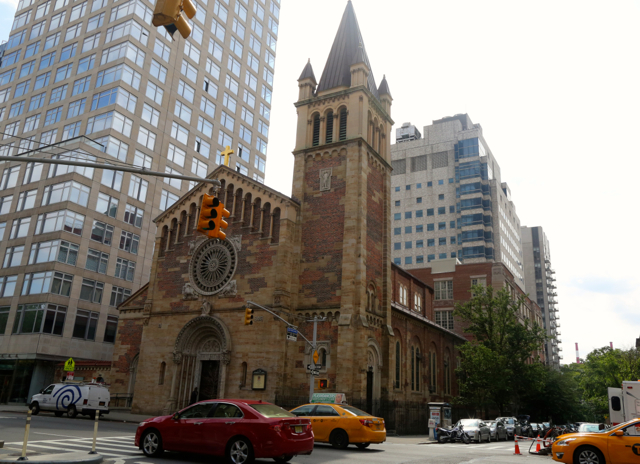
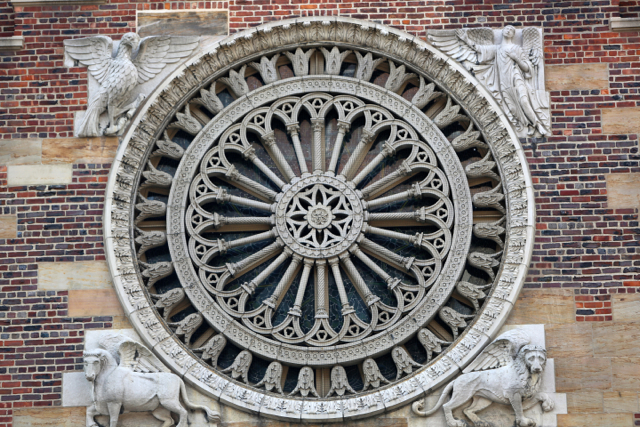
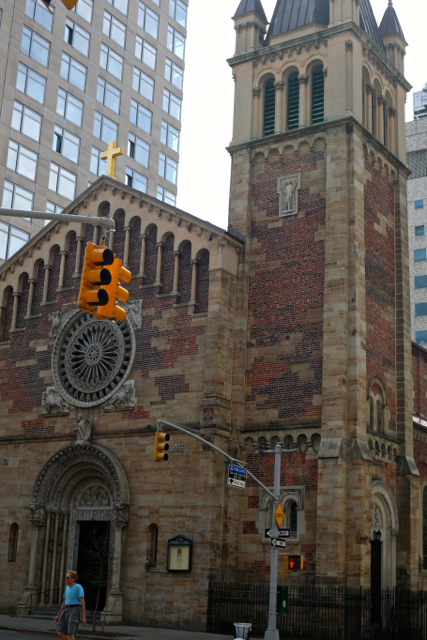
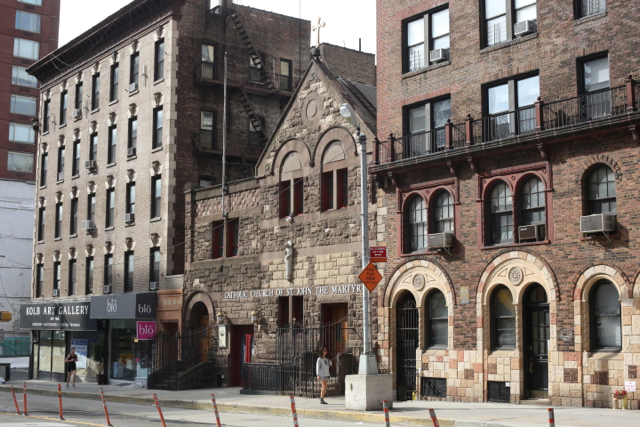
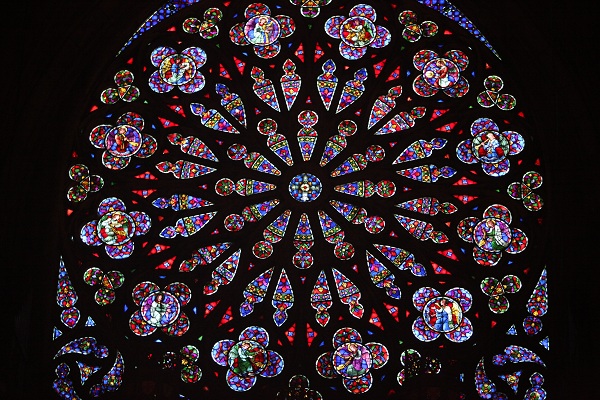
The rose window of Holy Innocents is very likely the original from 1870 mentioned by John Gilmary Shea.
Yes, there is a unique quality, difficult to capture, that the sensitive visitor experiences in the silent old churches of New York or Brooklyn. A feeling of remoteness from the surrounding city, a somewhat musty atmosphere of a past that here somehow has not disappeared and a mysterious sense of solidarity with the tens, even hundreds, of thousands who have passed through these doors. This is especially so in the old Victorian churches of New York. The few neoclassical buildings, like St. Peter’s, are stark witnesses to us of an earlier age that has vanished. The later magnificent structures of the golden age of the Archdiocese, like Blessed Sacrament or St. Vincent Ferrer, are too artistically complete, too carefully thought out. I find myself constantly returning the structures of the earlier High Victorian age – St Stephen’s especially, but also Holy Innocents, Most Holy Redeemer or the former St. Ann’s. These churches, once grand centers of Catholicism and even of the city itself, now lie off the beaten track, sustained by small devoted congregations. They show all too clearly the ravages of time: water damage, indifferent paint and plaster work, shrines and altars that have been abandoned. Their decor ranges from magnificent windows and altars to kitschy devotions – with every age feeling entitled to add its own new devotion or shrine. Some, like St. Stephen’s are splendid architectural achievements, other like Holy Innocents represent the average parish church of the time. Best of all, by reason of their poverty, they mostly – not entirely – escaped the full ravages of the liturgical renewal.
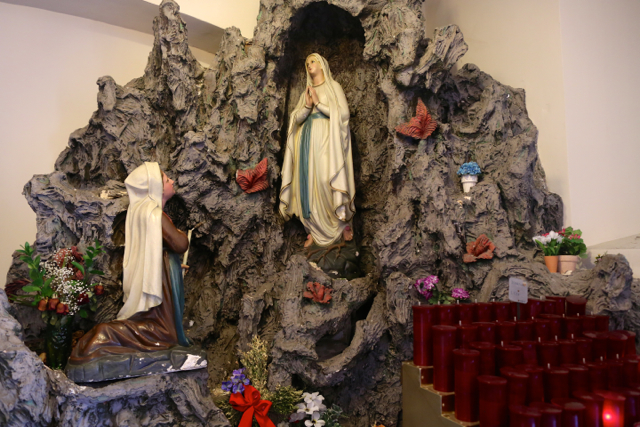
(Above) Candles (real) are always burning at Holy Innocents, here before an image of Our Lady of Perpetual Help. (Below) A Lourdes grotto is furnished with a fountain that has gone dry long ago.
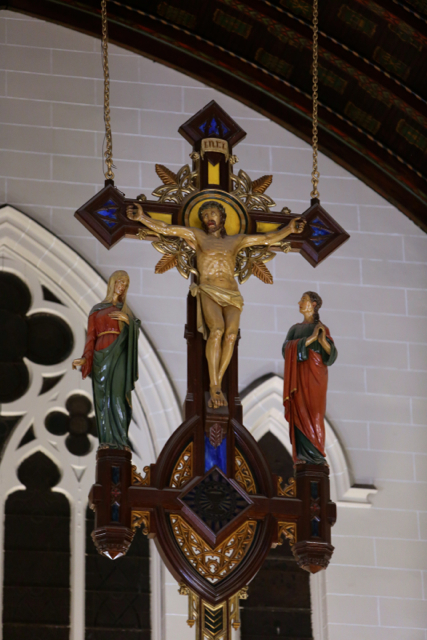
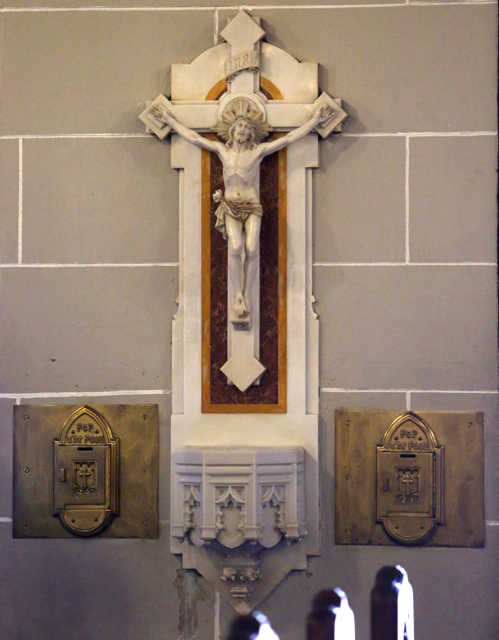
(Above) St. Lucy is of course among the seemingly innumerable statues of Holy Innocents. (Below) Joyce Kilmer also stood before this crucifix many times before his conversion.
What does the threatened loss of a church like Holy Innocents mean to us? First,of course, the loss of a place of secluded refuge, of prayerful spirituality and even, here and there, of real beauty – all set in the midst of one of the most arid wastelands created by a barbarous capitalism.

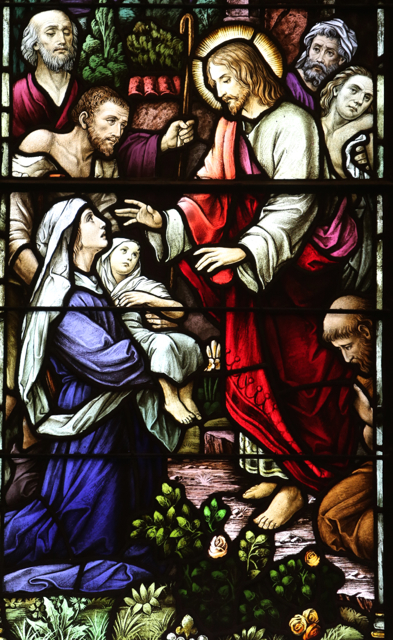
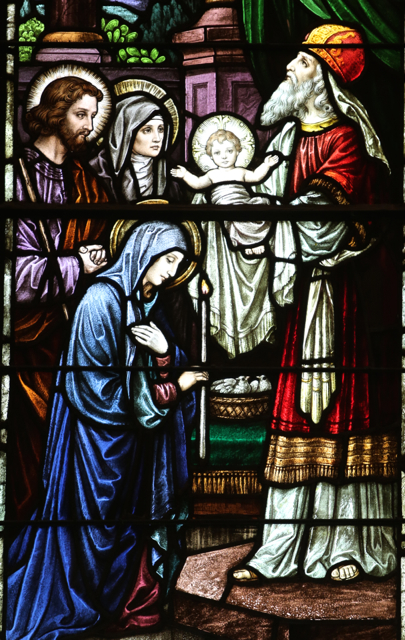
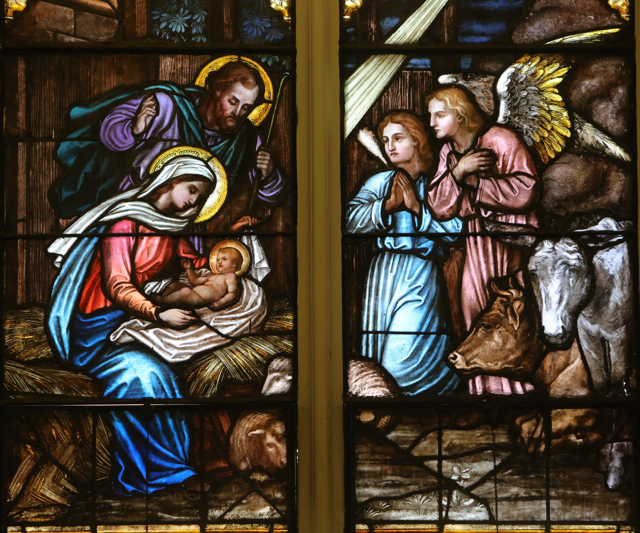
This window is one of set of 20 from Munich installed as part of a grand refurbishing of the church starting in 1894 which included the new high altar. Other elements of that once magnificent decoration, like the side altars and communion rail, have disappeared.
Then, there is the loss of the devotions that made up so much of the life of old Catholic piety. Our Lady, the Infant of Prague, Christ the King, the great crucifix for an indulgenced prayer before leaving the church – all these and many others are found here. In recent years Holy Innocents also acquired a special new devotional role: as a shrine to its own patron saints in the face of a new massacre – that of abortion. Presumably this devotion is no longer seen as necessary or urgent.
There is also the loss of solidarity with the many who come here daily to pray, to light candles, to attend the masses and devotions. They are generally workers, the poor, even the eccentric and annoying. Those who frequent parishes in the suburbs or off Park Avenue do not come here. It is these ones with little means who are most adversely impacted by the looming changes. But so are they who are deprived of their example of sacrifice.
Above all, of course, Holy Innocents has served since 2007 as a center of the daily celebration of the Traditional mass. How many magnicent liturgies have taken place here in recent years! Moreover, this mass has added significance now that that the Traditional mass at Our Saviour’s across town has been suppressed. All this liturgical progress is the result of grass root initiatives – just like the hundreds of thousands of dollars this parish recently raised to refurbish the grand Brumidi fresco. I would have thought that the Church would want to encourage such initiatives from below. That is, if I didn’t know already through long experience how unlikely that would be! But the cessation of the celebration of the Traditional Mass would be the gravest loss of all. Let us pray – through the intercession of the Holy Innocents – that this fate can somehow be averted.
(Above and below) Mass for Ascension Thursday celebrated by Fr. George Rutler.
1
Jun
A Solemn High Mass in honor of the Queenship of Mary was celebrated yesterday as part of the events marking the completion of the restoration of this church. The weather was glorious. The neighborhood with its townhouses, many trees, and strolling families seems lively but peaceful, pleasant and quaint – the epitome of old Brooklyn, “the borough of churches.” Especially if you choose to disregard the subway station right next to the old parochial school or the horrendous traffic getting to and from this vicinity even on a Saturday!
Holy Name of Jesus is just a few short blocks from the chancery of the Brooklyn diocese. The red brick facade is austere and largely undecorated. The dimensions of the church are also modest. But the church building doesn’t tell the parish’s whole story at all – like many others of that era, Holy Name of Jesus obviously invested its resources in its school. A whole series of buildings occupies the block where Holy Name stands: a rectory, (former ) convent and finally an enormous parochial school. The latter today houses a private Catholic academy.
After the Council, the church of Holy Name of Jesus underwent one of the most destructive “updatings” in New York.
(Above) The appearance of the church circa 1950. (Below) The appearance prior to the just completed restoration.
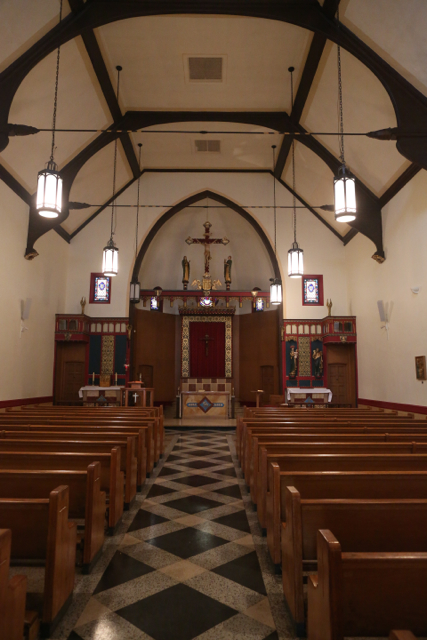
The current restoration attempts to restore a truly Catholic “worship space.” For the renovation here – in contrast to, let us say, that of St. John’s in Stamford, CT – incorporates elements of the past in what remains a Novus Ordo setting (a least as the requirements of the Novus Ordo are commonly interpreted). A communion rail is lacking, a fixed altar stands in front of the newly installed grand high altar, a “baptismal pool”(?) sits on the floor in front of a side altar (whose tabernacle has been adapted as a receptacle for holy oils) and a “gathering space” doubles as a world class cry-room. The church is also “user-friendly” regarding wheelchair access and restrooms. And all is brilliantly finished and in perfect condition!
This church is truly up to date – he’s already there!
Take a guess as to whose coat of arms this is.

In addition to a large collection of images of the saints, there is this “Virgin’s corner” in the rear.
This parish was able to sponsor a Solemn Requiem Mass conducted with a perfection of ceremony and music encountered almost nowhere – including the immediate “pre-conciliar” time – prior to Summorum Pontificum. The celebrant was Fr. Brandon O’Brien. The deacon, Fr. Joseph Zwosta; the subdecaon, Fr. Stephen Saffron. The master of ceremonies was Eddy Toribio ( you have encountered him many times on the photographs found on this blog). The music includesd the Missa de Beata a 5 by Victoria, motets by Palestrina and by the music director of the mass himself: director of music and organist was Mr. David Adam Smith.

Uniquely garbed ushering staff at Holy Name of Jesus.
A large congregation of all ages, nationalities and races filled the church. Old-timers of the parish spoke of their joy in seeing the resurrection of the church. Truly the restored interior is magnificent sight – testifying to the sacrifices and commitment of the parishioners of Holy Name of Jesus. Yet the experience of ceremony in a such a splendid setting leaves the visitor pensive. A beautiful church has been recreated – yet across the East River many intact churches with even more magnificent interiors face the wrecking ball. Indeed, the new high altar of the church came from a razed church in Williamsburg:
“The centerpiece of the renovations is the 19th-century altar by renown architect James Renwick Jr., who coincidently is buried only a stone’s throw away in Green-Wood Cemetery. Originally designed as a side altar for St. Patrick’s Cathedral in Manhattan, the piece proved to be too big and was relocated to St. Vincent de Paul Church in Williamsburg in 1881. It remained there for more than 100 years until the church was sold about five years ago.” 1)
So here in this corner in Brooklyn, a church was built starting in 1878. It was decorated and furnished over the years as well as available financial resources and other parish commitments permitted. After serving for generations, this same church was then repudiated as retrograde and its interior gutted. Now, at least the broad elements of that prior church have been splendidly recreated. Yet what do these these radical reversals of direction tell us about an institution – the universal Church, the diocese, even the very parish – which after all remained, at least as an external organization, the same throughout all this entire time? There is much to reflect on here – in the meantime let us congratulate Holy Name of Jesus parish on its accomplishment.
1) http://thetablet.org/parishioners-are-proud-of-new-holy-name/
(Below) One of the two side altars (also from St. Vincent de Paul in Williamsburg?)